The Best Way to Advertise Golf Club Membership in 2026

Most advice on the best way to advertise golf club membership starts in the wrong place. It starts with channels, creative, and spend. That matters, but it ignores the reason many clubs fail to turn interest into joiners. The issue usually isn't a lack of enquiries. It's what happens next.
A prospect clicks an ad, fills in a form, asks about a trial round, then waits. Nobody sees the enquiry quickly enough. The follow-up sits in an inbox. Notes are kept in different places. One person thinks another person has replied. By the time the club responds, the golfer has already moved on.
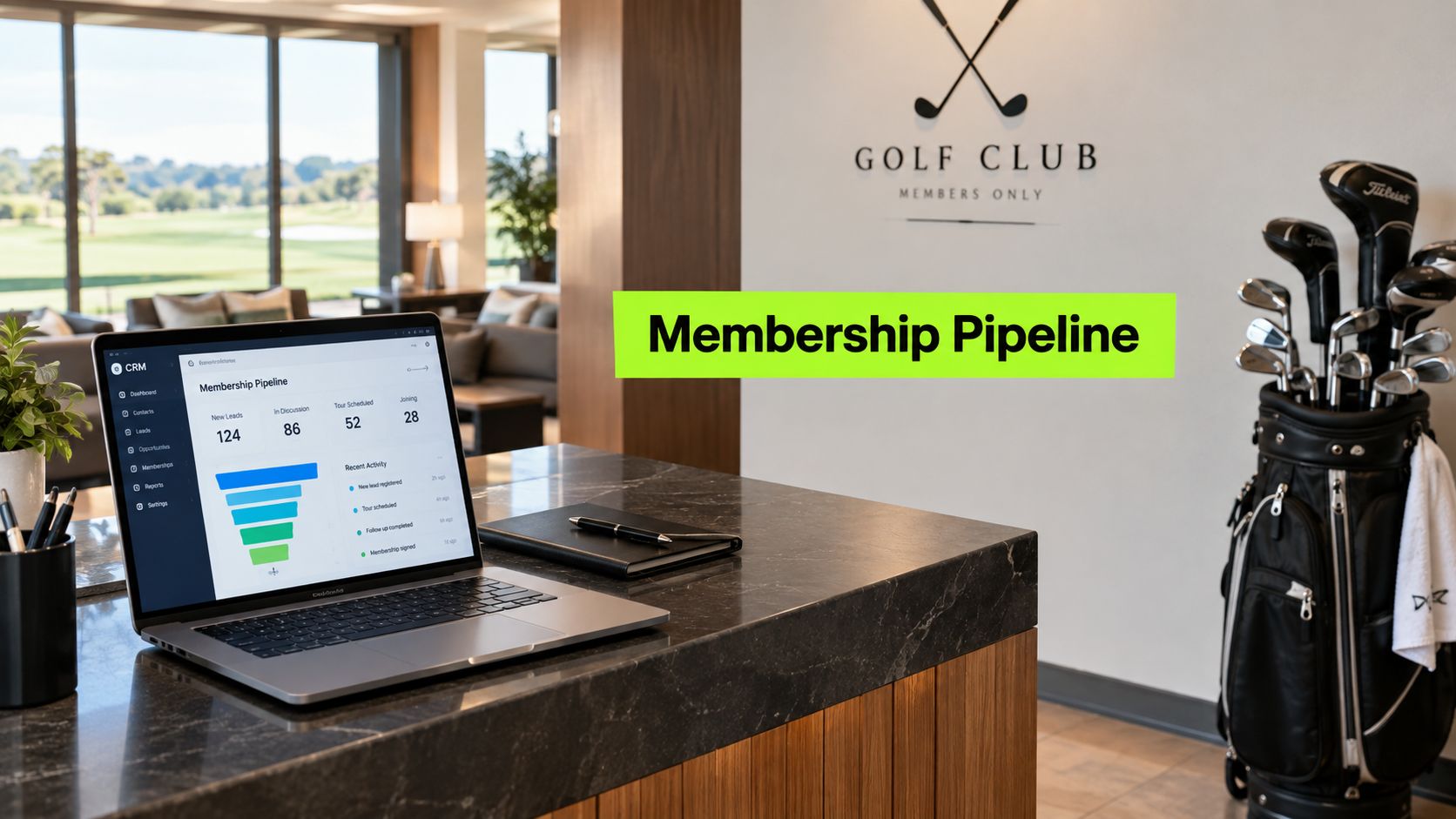
That's why the best way to advertise golf club membership isn't just about getting attention. It's about building a system that captures demand, responds fast, tracks every enquiry, and keeps the conversation moving until a decision is made. Advertising without that system turns spend into waste.
At GolfRep, that's the practical difference we see again and again. Clubs often assume they need more leads. In reality, many need better visibility, better follow-up, and a process that doesn't rely on memory or manual admin. Good advertising can fill the top of the pipeline. Only good systems convert it.
The tactics below work. But they work best when they're connected to structured response, nurture, and conversion tracking, not treated as isolated marketing activities.
1. Data-Led Targeted Digital Advertising

If you want a direct answer to the best way to advertise golf club membership, start with tightly targeted digital advertising on Google and Meta. Not broad awareness. Not generic “join now” campaigns shown to everyone within a county. Precision matters.
A strong UK benchmark comes from a Pyrford Lakes golf membership campaign, where Google and Meta ads together generated £67,840 in new membership leads and achieved a total ROAS of 2,148%, while the Google ad alone delivered 3000%+ ROAS. The lesson isn't that every club will produce the same result. It's that local targeting, cross-channel remarketing, and proper conversion tracking can turn advertising into a revenue system rather than a publicity exercise.
What good targeting looks like
The clubs that waste budget usually target too widely. They push ads to anyone interested in golf, sport, or leisure, then wonder why lead quality is mixed. Most private clubs don't need reach for its own sake. They need relevant local demand.
A better setup usually includes:
- Local catchment targeting: Build campaigns around realistic drive-time geography, not vanity reach.
- Intent-based search ads: Show up when golfers actively compare clubs, membership categories, and trial options.
- Retargeting layers: Use Meta and Google together so one platform creates familiarity and the other captures action.
- Dedicated landing pages: Send traffic to a membership-specific page with one clear next step.
For clubs exploring paid social in particular, GolfRep's guide to why Meta ads work so well for golf club membership campaigns breaks down where they fit.
Practical rule: Don't judge paid media by clicks. Judge it by booked visits, qualified conversations, and signed memberships.
There's also a creative trade-off worth noting. Course imagery looks attractive, but it doesn't always sell membership on its own. Lifestyle messaging often works better. Family use, club atmosphere, competitions, community, and flexibility give prospects a reason to imagine themselves joining. If you want a broader platform guide, this piece on how to advertise on Facebook and Instagram is useful background.
The biggest mistake isn't poor ad design. It's sending good traffic into a weak follow-up process.
2. AI-Driven Lead Qualification and 24/7 Chatbot Automation
Most clubs lose enquiries outside office hours, during busy periods, or because nobody owns the next step. That's where automation earns its place. Not as a gimmick. As protection against delay.
When someone asks about joining, they usually want quick answers to practical questions. Membership types, trial rounds, social options, waiting lists, dress code, lessons, and cost structure. If the club can answer instantly, interest stays warm. If it can't, momentum drops.
Speed matters more than most clubs think
In the UK, 85% of adults were internet users in 2024, which makes digital discovery and retargeting a practical primary channel rather than a niche add-on. That has a direct implication for membership sales. Golfers are already researching clubs online, often outside normal working hours, and they expect a relevant response without friction.
An AI chatbot or automated qualification flow helps in three ways:
- Immediate response: The enquiry is acknowledged and progressed straight away.
- Basic qualification: The club learns whether the prospect is local, what category they want, and how ready they are.
- Clean handoff: Staff receive a structured lead, not a vague form submission.
That last part matters. A chatbot isn't there to replace human conversation. It should remove admin and surface intent so your team can step in at the right moment.
Fast response wins attention. Structured qualification keeps your team focused on the prospects most likely to convert.
For clubs considering this route, GolfRep's overview of AI lead qualification for golf clubs shows how automated screening can fit into a membership pipeline without making the experience feel robotic.
The trade-off is straightforward. Poorly configured automation frustrates people. Good automation shortens time to conversation. If the bot can't answer a nuanced question, it should escalate quickly to a person. That's the standard.
3. Email and SMS Nurture Funnels with Segmentation
Most membership enquiries don't convert on the first interaction. That's normal. People compare options, discuss cost, think about time, and decide whether the club feels right. If your only follow-up is one email and a missed phone call, many of those leads disappear.
Nurture matters. Not endless messages. Relevant, timed communication that answers the questions each prospect has.
Different prospects need different messages
England Golf reported that in 2024 there were more than 1.2 million people playing golf in England, including more than 740,000 males and just over 469,000 females. It also reported more than 250,000 junior golfers and more than 220,000 club golfers under 50 in England, which shows a substantial but segmented market for membership recruitment, as cited by Capstone Hospitality's summary of the England Golf data.
That's why generic nurture underperforms. A family considering junior pathways doesn't need the same sequence as a golfer comparing weekday flexibility, or someone looking for a stronger social scene. Segmentation is not a luxury. It's basic relevance.
A practical setup often separates:
- New website enquiries: Introductory content, club atmosphere, membership pathways
- Trial-round prospects: Booking reminders, what to expect, who they'll meet
- Lapsed or dormant leads: Light re-engagement, updated offers, event invitations
- Category-specific prospects: Junior, women's, flexible, full, social, or corporate interest
GolfRep's guide to golf club email marketing covers how clubs can structure these sequences without making them feel over-automated.
Useful test: Read each nurture email and ask, “Would this still make sense if the recipient were interested in a different membership type?” If yes, it's probably too generic.
SMS works well as a support channel, not a replacement for email. It's especially useful for confirmations, reminders, and low-friction prompts to reply. Used properly, it keeps prospects moving. Used too often, it feels pushy.
The common failure here is not the content. It's the lack of a system for knowing who received what, who clicked, and who needs a personal follow-up now.
4. Strategic Event Marketing and Trial Round Experiences
Advertising gets attention. The visit closes the gap between interest and trust.
For many clubs, trial rounds, open days, and member introduction events still do some of the strongest conversion work because they let prospects feel the club for themselves. That matters because golf membership is rarely a purely rational purchase. People join for the course, yes, but also for atmosphere, welcome, pace of play, facilities, and whether they can picture themselves belonging.
Don't treat the event as the conversion
A lot of clubs run decent events and then lose the momentum afterwards. Attendees enjoy the day, speak to a member of staff, say they'll think about it, and then hear very little beyond a generic follow-up email.
That's why event marketing only works when it feeds a structured pipeline. The event should not sit outside your system. It should trigger it.
A better approach is to:
- Pre-qualify attendees: Ask why they're considering membership and what type interests them.
- Assign ownership: One named person should follow each attendee through the process.
- Capture context: Record what they liked, what they asked, and what may block the decision.
- Follow up quickly: Reference the specific day they attended, not a generic template.
For clubs planning seasonal activity, broader event inspiration can help shape the format. This roundup on summer event ideas for 2026 is one example.
The trade-off with trial rounds is simple. The more open you make them, the more volume you may attract, but the lower the average fit can become. The tighter you qualify, the better the conversion potential, but the lower the raw attendance. The right balance depends on course availability, staff capacity, and how clear your membership positioning is.
Done well, events reduce perceived risk. Done badly, they create a list of attendees nobody meaningfully follows up.
5. Strategic Content Marketing and SEO
If paid media captures demand today, content and SEO help your club get found tomorrow. This is the slower play, but it matters because many golfers research clubs before they ever enquire. They search for local options, compare membership pages, check reviews, and try to work out which club fits their stage of life and playing habits.
That means the best way to advertise golf club membership isn't always an advert in the narrow sense. Sometimes it's the membership page, the local guide, the women's golf page, the trial-round article, or the facilities video that answers a prospect's question before they contact you.
Organic visibility supports trust before first contact
A strong organic presence usually includes a clean Google Business Profile, clear local landing pages, practical membership content, and search-friendly site structure. Clubs often overcomplicate this. You don't need a publishing machine. You need useful pages that match real search intent.
Content worth producing includes:
- Local comparison pages: Help golfers understand what makes your club distinct
- Membership category pages: Explain options clearly instead of bundling everything together
- Beginner and returner content: Address confidence barriers for newer players
- Lifestyle content: Show the club experience beyond the course itself
This channel has one major trade-off. It rarely fixes a short-term membership target on its own. SEO compounds over time. If a club needs enquiries this month, paid search and paid social usually move faster. But if the website remains thin, outdated, or vague, every paid click has to work harder.
Organic content also improves follow-up. When a prospect is in nurture, your team can send specific pages that answer specific objections. That's much more effective than repeatedly asking if they'd like to join.
6. Referral and Affiliate Marketing
The easiest enquiry to convert is often the one that arrives with trust already attached. That's why referrals matter so much in golf club growth. A recommendation from an existing member carries more weight than almost any ad.
Yet many clubs treat referrals casually. They assume members will naturally bring friends along. Some do. Most need prompting, structure, and a simple process.
Word of mouth needs a system too
A strong referral approach doesn't need to be complicated, but it does need to be visible. Members should know who the club is trying to attract, how to introduce them, and what happens next. If the process feels vague, referrals stay informal and untracked.
Useful referral mechanics include:
- Simple introduction routes: A dedicated form, landing page, or named contact
- Clear member prompts: Ask at the right moments, especially after positive club experiences
- Referral tracking: Record where leads came from and who referred them
- Consistent follow-up: Protect the referrer's reputation by responding properly
External partnerships can support this too. Local coaches, nearby hospitality venues, driving ranges, and corporate networks can all surface relevant prospects if the proposition is right. If you're building a more formal programme, this guide to building a white-label referral programme gives a useful operational view.
The mistake here is overengineering rewards while underinvesting in response. If a member refers someone and the club replies slowly, the programme loses credibility quickly. Referral growth depends less on incentives than many clubs think. It depends more on making introductions easy and handling them well.
7. Retargeting and Pixel-Based Audience Building
Very few prospects join on the first visit to your website. They browse the membership page, look at the course, maybe read about trial rounds, then leave. If you don't retarget them, you're paying for attention and letting it vanish.
Retargeting fixes that by keeping your club visible after the first interaction. It's one of the most practical ways to improve efficiency because you're speaking to people who already showed interest.
Warm traffic deserves different treatment
Clubs often miss an obvious opportunity. They run one campaign to everyone, with the same message, whether the person has never heard of the club or has already visited the pricing page twice.
Retargeting lets you tailor the next message. Someone who viewed membership categories may need reassurance on value or flexibility. Someone who started an enquiry may need a softer prompt to book a visit. Someone who watched a club video may respond better to member stories or an event invitation.
A useful retargeting structure usually includes:
- Website visitor audiences: General reminders and club positioning
- High-intent page viewers: More direct calls to action around visits or conversations
- Lead-form non-submitters: Reduced-friction prompts to restart the process
- Existing lead exclusions: Prevent wasted budget and awkward duplicate messaging
Retargeting works best when paired with CRM data. Otherwise, your ads may keep chasing people your team has already spoken to, or worse, people who have already joined. The technology is easy to install. The discipline lies in keeping audience rules, exclusions, and messaging clean.
This is one of the clearest examples of why systems beat standalone tactics. Retargeting on its own is useful. Retargeting connected to lead status is much better.
8. Social Proof and Review Management
A golfer considering membership wants reassurance from people like them. Not just from the club. That's why testimonials, reviews, and member stories play such an important role in conversion.
Most clubs already have social proof. They just haven't organised it. Happy members mention the welcome they received, the people they've met, the condition of the course, or how easy it was to settle in. If those stories stay offline, prospects never see them.
Trust rises when proof feels specific
The most useful testimonials aren't polished slogans. They answer real objections. Why someone chose the club over another local option. What they worried about before joining. How the club fits work, family, or playing frequency. Those details help prospects recognise themselves in the story.
Strong social proof usually includes:
- Diverse member stories: Different ages, genders, and membership types
- Review generation after positive moments: Not random requests at random times
- On-site placement: Reviews and testimonials near enquiry forms and membership pages
- Staff responses to feedback: Especially where concerns need context
Prospects don't need endless praise. They need enough believable evidence to feel safe taking the next step.
There's a discipline to this. Don't wait until you “need more reviews.” Build review capture into onboarding, event follow-up, and positive member milestones. Then use those signals across ads, nurture emails, and landing pages. Social proof is not a finishing touch. It's a conversion tool.
Clubs that manage this well make it easier for prospects to trust what they're seeing before they ever speak to anyone. That shortens the sales cycle and improves the quality of the conversation when it happens.
8-Point Comparison: Golf Club Membership Advertising
| Strategy | Implementation complexity | Resource requirements | Expected outcomes | Ideal use cases | Key advantages |
|---|---|---|---|---|---|
| Data-Led Targeted Digital Advertising (Google & Meta) | Medium–High, setup, tracking and ongoing optimisation required | Paid ad budget, campaign manager/agency, creative assets, analytics/UTM tracking | Rapid, measurable lead generation and scalable membership conversions | Fast growth, seasonal pushes, targeting affluent local prospects | High-intent reach, clear attribution, rapid scaling once optimised |
| AI-Driven Lead Qualification & 24/7 Chatbot Automation | Medium, training, integrations and escalation rules needed | Chatbot/AI platform, training data, CRM & calendar integration, initial configuration | Immediate responses, higher qualified lead capture, reduced labour for initial enquiries | High enquiry volumes, after ad traffic, clubs needing 24/7 coverage | Instant qualification, consistent messaging, 24/7 availability |
| Email & SMS Nurture Funnels with Segmentation | Medium, build flows, segments and testing cadence | Marketing automation platform, CRM, copy/assets, SMS credits | Gradual lift in conversion from warm leads; cost-effective retention | Nurturing cold/warm leads, trial attendees, lapsed members | Automated personalised journeys, high ROI per contact |
| Strategic Event Marketing & Trial Round Experiences | High, logistics, staffing and in-person coordination | Staff time, course availability, event budget, on‑site ambassadors, follow-up automation | High conversion rates from attendees and strong member affinity | Local recruitment, premium positioning, corporate and demographic drives | Experience-driven conversions, strong referrals and testimonials |
| Strategic Content Marketing & SEO (Organic Visibility) | Medium–High, ongoing content creation and technical SEO work | Content creators, SEO tools, site optimisation, time investment or agency | Long-term organic traffic growth and authority; lower paid reliance over time | Clubs with limited ad budgets or long-term visibility goals | Compounding traffic, credibility, lower cost per lead over time |
| Referral & Affiliate Marketing (Member-to-Member Growth) | Medium, programme design, tracking and partner management | CRM integration, incentive budget, partner outreach, automation for rewards | High-quality, low-cost leads and increased member engagement | Clubs with engaged memberships and referral potential | Highest conversion rates, low CAC, scalable via members |
| Retargeting & Pixel-Based Audience Building | Medium, pixel implementation and audience strategy | Tracking pixels, creative assets, ad budget, analytics | Improved conversion from past visitors and efficient ad spend | Complementing paid/content channels, re-engaging abandoned visitors | Efficient re‑engagement, lookalike expansion, multi-platform reach |
| Social Proof & Review Management (Testimonials, Case Studies, UGC) | Low–Medium, processes for collection and moderation | Review tools/widgets, content production, staff time to solicit/respond | Higher trust, improved conversion rates and local search performance | All clubs, especially during membership drives or reputation building | Trust-building, low-cost authentic content, boosts SEO and conversion |
Building Your Growth Engine Systems Over Silos
The best way to advertise golf club membership isn't to choose one tactic from the list above and hope it carries the whole target. That's how most clubs end up disappointed. They try Google Ads without proper follow-up, run an open day without a nurture sequence, or collect enquiries without any clear ownership once those leads arrive.
The better approach is to build a joined-up system.
Paid media brings in demand. Retargeting keeps warm prospects engaged. Email and SMS nurture maintain momentum. Events and trial rounds create real-world trust. Referrals bring in high-quality introductions. Reviews reduce hesitation. CRM tracking ties all of it together so the club knows what is working, who needs follow-up, and where prospects are dropping out.
That's the fundamental shift many clubs need to make. Stop thinking in campaigns. Start thinking in pipeline stages.
A club doesn't grow predictably because it generated a burst of leads this month. It grows predictably because every enquiry enters a process that is visible, assigned, tracked, and followed through. Someone responds quickly. Someone records the context. Someone knows whether the prospect booked a visit, opened the follow-up, asked a pricing question, or went quiet. Without that visibility, marketing becomes guesswork and conversion depends too heavily on whoever happens to be free that day.
This is also why the usual conversation about lead generation is often too narrow. More leads won't solve a broken response process. In fact, they can make it worse by creating more admin, more missed follow-up, and less accountability. For many clubs, the most valuable improvement isn't doubling top-of-funnel activity. It's making sure existing demand is handled properly.
At GolfRep, that's the lens we bring to membership growth. Not just how to drive enquiries, but how to build a predictable system around them using data-led advertising, automation, CRM visibility, and structured follow-up. That approach suits clubs that want more than sporadic campaign spikes. It suits clubs that want a repeatable way to turn local interest into long-term members.
Advertising still matters. Creative still matters. Channel choice still matters. But none of it delivers its full value without systems behind it.
If you want membership growth that lasts, build the engine first. Then every advertising pound has a better chance of becoming revenue.
If your club wants a clearer membership pipeline, GolfRep helps golf clubs combine advertising, automation, and CRM follow-up into one structured growth system, so enquiries don't just come in, they get seen, handled, and converted.
Ready to tap into our proven growth system?