8 Golf Club Membership Ideas That Convert

Most advice on golf club membership ideas starts in the wrong place. It assumes the club's main problem is a lack of interest, so the answer must be a new package, a sharper headline, or another campaign. In practice, many clubs already generate enough enquiries to grow. The bottleneck is what happens next.
An attractive offer only works when someone responds quickly, records the lead properly, books the next step, and keeps the conversation moving. If an enquiry sits in a shared inbox, if nobody knows whether the prospect visited, or if follow-up depends on one busy staff member remembering to call back, even a strong membership proposition loses momentum. A UK lead-response study found businesses were 21 times more likely to qualify a lead when they made contact within five minutes than when they waited 30 minutes. For golf clubs, that matters as much as the offer itself.
At GolfRep, we look at membership growth as a pipeline problem before we look at it as a promotion problem. We're a UK-based growth partner for golf clubs, and the clubs that grow most reliably tend to combine lead generation with CRM-enabled follow-up, automation, and clear conversion stages. That means every enquiry is visible, every next action is assigned, and every offer can be measured.
The eight ideas below work best when they're treated that way. They aren't just membership packages. They're acquisition and conversion systems.
1. Tiered Membership Structures with Clear Value Progression
A single all-in membership price often creates avoidable friction. Prospects who like the club may still hesitate because full membership feels like too much, too soon. Tiered structures solve that by giving people a credible way in.
Addington Palace Golf Club is a useful real-world example of the model. Clubs using bronze, silver, and full membership options can capture younger golfers, career-movers, and returning players who want commitment to feel proportionate to their current playing habits. That's more effective than forcing every prospect into one decision.
Here's the visual comparison many committees find useful before reshaping their packages:
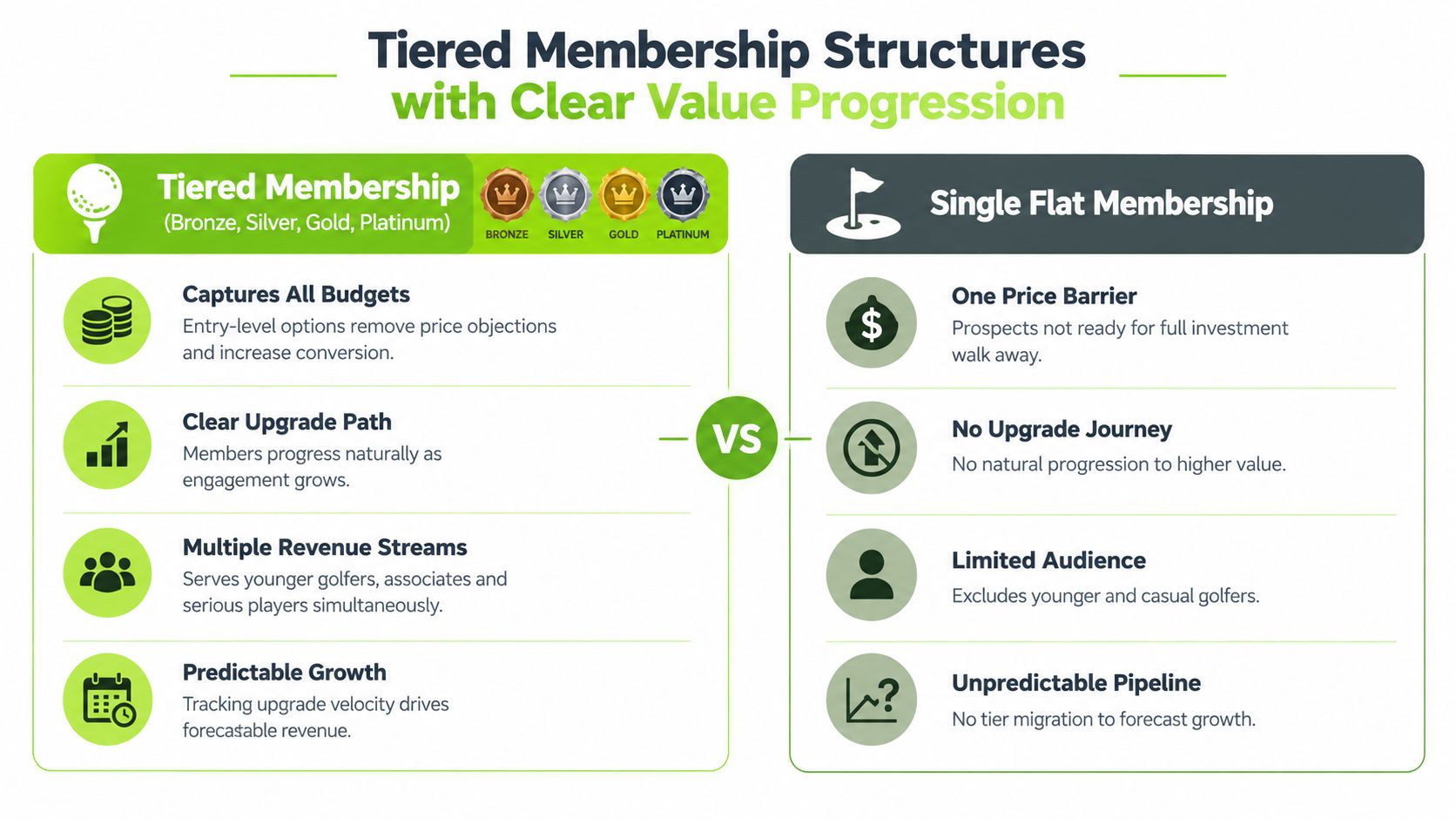
What makes tiers convert
The best tiered offers don't rely on cosmetic differences. They give the prospect enough access to experience the club properly, then make the next tier visibly better.
- Start with real usage value: Entry-level members need enough access to build habit. If the lower tier feels tokenistic, it won't convert or retain.
- Make upgrades tangible: Better booking access, broader playing rights, guest privileges, or competition eligibility are clearer than vague “enhanced benefits”.
- Show the pathway in every enquiry response: If someone isn't ready for full membership, staff should present the lower tier as a step in a clear progression, not as a consolation.
Practical rule: A tier only works if staff can explain who it's for in one sentence.
The operational piece matters more than most clubs expect. Your CRM should record which tier each prospect enquired about, which tier they joined, and whether they later upgraded. Without that, clubs can't tell whether the entry product is feeding full membership or creating a cheaper endpoint.
Practical positioning helps. If your club also sells lifestyle merchandise or partner items, even details like member welcome packs can reinforce differentiation between tiers, whether that's a starter cap or something more premium such as a FLYP LTD custom golf cap. The package still has to stand on access and experience first.
2. Corporate and Group Membership Packages
Corporate membership succeeds or fails after the first enquiry.
A strong package can still underperform if the club treats the lead like a standard membership form. Business buyers usually ask practical questions first. Who can use it, how bookings work, what guest access looks like, who manages changes, and how quickly the club replies when plans shift. If those answers sit across emails, diary notes, and the pro shop inbox, the offer feels harder to buy than it should.

The clubs that convert these enquiries well usually run them like managed accounts. One person owns the relationship, every contact is logged, and the prospect moves through visible stages such as initial enquiry, proposal sent, terms discussed, site visit booked, and decision due. That matters because corporate sales often slow down for ordinary reasons. Internal approval, named user questions, finance sign-off, or uncertainty about expected usage. Without stage tracking, clubs tend to assume the lead went cold when it really needed a specific follow-up.
The offer itself should be easy to operate, not just easy to advertise. Shared fourball allocations, named-player access, guest credits, meeting room use, and hosting discounts can all work. The trade-off is admin. More flexibility can help close the sale, but it also creates pressure on tee sheet control and reception teams if the rules are vague.
A good test is simple. Can staff explain the package in under a minute, then log exactly which version the company asked about?
Three operational points usually separate the packages that renew from the ones that create friction:
- Assign clear ownership: One contact at the club should handle the enquiry, proposal, usage questions, and renewal conversation.
- Record usage at company and individual level: That shows which accounts are active, which named users may suit individual membership later, and which businesses need attention before renewal.
- Set follow-up dates early: If a proposal goes out on Friday, the next call or email should already be scheduled in the CRM.
GolfRep has covered the sales side of this in more detail in its guide to golf club corporate membership marketing. The practical point is that more corporate leads do not fix a weak handover. Fast response, visible pipeline stages, and consistent follow-up do.
Corporate packages also perform better when the hosting experience matches the promise. Food, service, changing facilities, and small client touches all influence renewal, especially for companies using the club for relationship building rather than pure playing access. That can extend to considered gifting as well, including ideas such as whiskey stones for business gifts, but the core sale still rests on dependable access and easy account management.
3. Guest Pass and Trial Membership Systems
Guest passes and trial memberships do not fail because the offer is weak. They fail because the club treats the enquiry like a booking rather than the start of a sales process.
A free round or 30-day trial can create interest, but interest only becomes membership if staff can see who enquired, who turned up, what they used, and what should happen next. Without that visibility, clubs end up measuring redemptions instead of conversions.

The strongest trial systems are built around milestones, not just access. Day one should confirm the booking and explain the trial rules. Mid-trial contact should check usage and prompt the next visit. Before expiry, the prospect should receive a clear membership recommendation based on what they did at the club.
That structure matters because trial users are rarely equal in value. One prospect may play once and disappear. Another may book twice, bring a guest, spend in the bar, and ask about competition access. Those are different buying signals, and they need different follow-up, not the same generic expiry email.
A practical setup usually includes three parts:
- Clean capture at sign-up: Trial forms should push straight into the CRM with source, package type, and preferred membership interest.
- Visible activity tracking: Staff should be able to see rounds played, visit dates, and any non-golf usage before making the next call.
- A defined conversion point: Every trial needs an end-date, an owner, and a recorded outcome such as joined, extended, not ready, or lost.
GolfRep's advice on how to let prospects book a club visit online fits naturally here. If booking a tour, trial round, or membership meeting takes too many steps, the club loses momentum before follow-up even starts.
The commercial trade-off is straightforward. A looser trial gets more takers, but it also creates more admin, weaker intent signals, and more names that sit in limbo. A tighter trial with clear rules usually produces fewer participants, but staff can manage it properly and conversion rates are easier to measure.
That is usually the better model.
Clubs do not need more trial leads if the current ones go cold after the first visit. They need response speed, a visible pipeline, and staff ownership from enquiry to decision. Trial access should help the club qualify demand, guide the prospect, and record why people join or drop out. That is what turns a guest pass into a membership system rather than discounted golf.
4. Seasonal and Flex Memberships
Full seven-day membership is not the answer to every enquiry. Plenty of prospects like the club, can afford to join, and still hesitate because they know they will not use unrestricted access every month. If the club has no middle ground, those enquiries often stall, not because demand is weak, but because the buying step feels too large.
Seasonal and flex memberships solve that problem only if the club can manage them cleanly after the first conversation. A winter package, points model, or weekday plan creates more decision points than a standard membership. Staff need to see what the prospect asked for, what they bought, how often they have played, and when the next conversation should happen. Without that visibility, flexible products create admin and missed upgrades rather than growth.
A good flex offer should answer four practical questions straight away:
- What access is included
- When that access can be used
- What happens when credits or the season run out
- How the member can move into a higher package
That sounds basic because it is. Clarity sells.
The bigger mistake is treating flex membership as a pricing tactic instead of a conversion path. A golfer who buys a summer pass or a 20-round bundle is giving the club a useful signal. They want commitment with lower risk. If they use the course heavily, visit the clubhouse, bring guests, or ask about competitions, the club should not wait until expiry and send a generic renewal message. Someone needs to see that behaviour early and act on it.
One club may choose a simple seasonal product with fixed dates and a manual review at the end. Another may run a credit-based model with automated alerts when usage crosses a threshold. Both can work. The trade-off is operational. More flexibility can widen appeal, but every extra rule, credit balance, and exception increases the need for accurate tracking and staff discipline.
England Golf's recent membership growth, reported at 750,071 club members with rising demand for more flexible membership structures, supports the case for these models. Clubs do not need to discount core membership to respond. They need flex products that are easy to explain, easy to administer, and tied to clear follow-up stages so the club can measure who renews, who upgrades, and where prospects drop out.
5. Family and Junior Development Memberships
A junior offer does not fail because the price is wrong. It fails because the family enquires, hears something vague, and never sees a clear next step.
Family membership is a follow-up model as much as a pricing model. Parents usually want three things before they commit. They want to know who is coaching their child, how safe and organised the programme is, and what progression looks like after the first few weeks. If the club cannot answer those points quickly and consistently, more junior leads will not solve much.

Clubs get better results when the offer is built around a development journey. A six-year-old beginner, a twelve-year-old in group coaching, and a teenager moving toward adult competitions should not receive the same message, the same access, or the same renewal conversation. The structure needs to reflect real use.
A practical setup usually includes:
- clear age bands with different benefits and expectations
- named coaching support, often tied to a PGA professional or qualified junior lead
- simple information for parents on safeguarding, booking, dress code, and who to contact
- a visible route from junior activity into family participation or later adult membership
The coaching side matters, but the handover matters just as much. GolfRep's article on choosing a junior golf coach covers part of that picture. The commercial point is that coaching interest should flow into a recorded membership process, not sit in inboxes or on handwritten lists.
Parents often join before the child is fully committed. Treat that as a linked decision inside the CRM.
That means recording family relationships, enquiry dates, trial attendance, coaching milestones, birthdays, and age-band changes. Without that visibility, clubs miss obvious moments to invite a parent into a family category, move a junior into the next stage, or recover an enquiry that stalled after the first conversation. The offer may be strong, but the system behind it still decides how much of that demand converts.
6. Pay-Per-Play and Green Fee Conversion Systems
A busy visitor sheet can hide a membership problem.
Clubs often look at green fee volume and assume demand is healthy. Revenue may be healthy. Conversion often is not. If repeat visitors are booking, playing, and leaving without any recorded follow-up, the club is relying on footfall instead of building a membership pipeline.
The practical opportunity sits after the round, not just at the point of sale.
A golfer who has played three, five, or eight times in a short period has already done part of the buying work. They know the course suits them. They know the journey is manageable. They have accepted the day-rate more than once. That does not mean they want a membership call tomorrow, but it does mean the club should see them, segment them, and decide what happens next.
The weak version of this process lives in reception memory. The stronger version lives in the booking system and CRM.
Build the trigger before writing the offer
Many clubs start with the message. The better starting point is the rule. Decide what pattern should trigger review, then make sure staff can see it without manual checking. That might be repeat rounds within a defined period, a visitor who also enters open events, or a pay-and-play golfer who books popular times consistently.
Once that trigger exists, the follow-up can match actual behaviour:
- repeat social play may suit a flexible or points-based membership conversation
- regular weekend booking may point to priority access and better value over time
- event or competition participation may justify a message about member playing rights and club integration
Offer design and operations meet here. A good membership option still underperforms if nobody owns the next step, nobody can see contact history, and nobody records whether the player declined, delayed, or asked to revisit later.
England's affiliated base reached 1,735 clubs and more than 730,000 members, while average member age fell from 56.18 to 54.99. In a local market with plenty of choice, repeat course usage is one of the clearest buying signals a club can track.
The clubs that convert this well usually keep the process simple. Booking data feeds into a visible list. Staff know the threshold for contact. Each conversation is logged against a clear stage, such as identified, invited, interested, trial discussion, or membership decision. That visibility matters more than writing a clever email.
Pay-per-play conversion works best as a controlled system, not a reception hunch.
7. Referral and Member Advocacy Programmes
Referral schemes underperform for a simple reason. Clubs often treat the introduction as the win, when the commercial value sits in what happens over the next few days.
A member brings in a friend after a Saturday fourball, or introduces a colleague who has asked about joining. If that contact lands in a shared inbox, sits unassigned, or gets logged without the member connection, the club loses the main advantage of a referral. Speed, context, and trust.
The better approach is operational. Give members one clear way to refer. Record the introducer at the point of enquiry. Set a response standard. Then track the prospect through named stages so staff can see whether the lead was contacted, booked for a visit, discussed against the right membership option, or went quiet after initial interest.
That structure also protects the member relationship. Referrers notice when their introduction disappears into the system. They also notice when the club responds well. A quick acknowledgement to both parties, followed by visible ownership inside the team, does more for future advocacy than a generous referral prize that nobody can properly attribute.
Three details usually decide whether a referral programme produces members or just anecdotes:
- Capture the source cleanly: use a form field, referral code, or recorded member-introducer field that staff complete
- Keep the follow-up visible: the referral should sit in the same pipeline as other membership enquiries, with clear status updates and ownership
- Review conversion by referrer: some members bring high-fit prospects who join and stay, while others generate interest that rarely progresses
Referral quality matters more than referral volume. A smaller number of well-matched introductions, handled properly, will usually outperform a loosely promoted campaign that creates extra admin and little visibility.
The operating context supports that. The 2024/25 Hillier Hopkins benchmarking report noted that 59% of members' clubs and 55% of proprietary clubs reported over 600 playing members, while earlier survey waves showed only 24% of clubs had more leavers than joiners and average annual new-member intake at 94 per club. Referral programmes can help, but only if the club can see which introductions convert, which stall after first contact, and which members consistently bring in the right type of prospect.
8. Corporate Entertainment and Day-Access Memberships
Occasional premium access is a different product from contracted corporate membership. The buyer is not looking for a block of annual rights for a team. They are buying a well-run hosting option for selected dates, with enough service around it to justify the price.
That distinction matters operationally. If a club prices this like dressed-up visitor golf, enquiries often come from buyers who want flexibility without margin, and staff end up handling bespoke requests that are hard to track and harder to renew profitably.
The offer works best for clubs with attractive weekday inventory, a premium setting, and the ability to package golf with food, meeting space, or light-touch concierge support. Affluent local golfers can fit too, but only if the terms stay clear. This is occasional access with priority treatment, not a back-door route into full membership benefits.
What tends to separate the clubs that make this work is not the brochure. It is what happens after the enquiry.
A day-access lead should move through a defined pipeline: first enquiry, date or usage discussion, proposal issued, booking confirmed, event completed, renewal or upgrade review. Without that visibility, good prospects disappear into inboxes, repeat users get treated like first-time bookers, and the club cannot tell whether the product is producing profitable hosting revenue or just extra admin.
A few design choices usually decide whether this model stays commercially clean:
- Package the experience, not just tee times: include the booking window, hospitality options, guest allowances, and any room use in plain terms
- Protect the line between occasional access and membership: avoid adding so many member-style privileges that the product starts to undercut full joining
- Track usage and post-visit outcomes: record who hosted, what they bought, whether they rebooked, and whether the contact later became a fuller corporate or individual membership opportunity
Used properly, this can become a feeder product as well as a revenue line. Some buyers will stay occasional. Others will reveal a pattern of repeat entertaining that justifies a contracted package later. The club only sees that if follow-up is structured and conversion stages are measured, rather than treating each booking as a one-off transaction.
8 Golf Club Membership Models: Side-by-Side Comparison
| Strategy | Implementation complexity | Resource requirements | Expected outcomes | Ideal use cases | Key advantages |
|---|---|---|---|---|---|
| Tiered Membership Structures with Clear Value Progression | Medium, design tiers + automation for upgrades | CRM automation, tiered pricing, marketing & staff training | Higher conversion at entry; predictable upgrade revenue | Clubs wanting to capture multiple budgets and lifecycle stages | Removes entry barrier; multiple revenue streams; natural upgrade path |
| Corporate and Group Membership Packages | High, B2B sales processes & account management | Dedicated sales/account manager, contract admin, CRM | Large, predictable contracts; increased weekday use | Targeting local businesses, hotels, resorts or large clients | Bulk revenue; weekday fill; client entertainment opportunities |
| Guest Pass and Trial Membership Systems | Medium, trial flows + disciplined follow-up | CRM automation, onboarding staff, tracking systems | Improved trial-to-member conversion when followed up | Prospects reluctant to commit; conversion marketing campaigns | Lowers commitment risk; demonstrates club culture; captures engagement data |
| Seasonal and Flex Memberships | Medium–High, credit tracking and expiry management | Member portal, payment & CRM integration, credit tracking | Attracts irregular players; variable but acquisitive revenue | Seasonal tourists, second-home owners, busy professionals | Flexible access; captures seasonal demand; conversion signals for upgrades |
| Family and Junior Development Memberships | High, coaching programs and safeguarding obligations | PGA-qualified coaches, junior programming, safeguarding systems | Higher lifetime value; lower churn; pipeline of future members | Family-oriented communities and long-term growth strategies | Generational retention; coaching revenue; strong community positioning |
| Pay-Per-Play and Green Fee Conversion Systems | Medium, booking → CRM integration & segmentation | Booking system integration, CRM tagging, targeted outreach | Converts warm prospects; lower acquisition cost per member | Pay-and-play courses with frequent visitors | Targets high-probability prospects; predictable pipeline; efficient acquisition |
| Referral and Member Advocacy Programmes | Low–Medium, set up tracking and incentive flows | CRM referral tracking, rewards budget, communication assets | Very high conversion and retention; low acquisition cost | Clubs with engaged membership base seeking organic growth | High conversion rates; cost-effective; strengthens community |
| Corporate Entertainment and Day-Access Memberships | High, premium service delivery & relationship mgmt | Dedicated concierge/account contact, catering/event support | Premium revenue; ancillary spend; corporate relationships | Executives, affluent businesses, hotel/resort guests | Premium pricing; predictable contracts; high ancillary income |
Turn Good Offers Into a Predictable Membership Pipeline
The right golf club membership ideas aren't the ones that sound most creative in a committee meeting. They're the ones your club can sell, deliver, and track consistently.
That usually means starting narrower than clubs expect. Pick one offer that matches a clear segment and fits your operational capacity. If your club already sees strong green fee traffic, start there. If families are a realistic growth area, build the junior and household journey properly. If weekday hosting is underused, shape a corporate or day-access proposition around service and account management. A focused offer with disciplined follow-up will outperform a crowded membership page full of options nobody owns internally.
Before promoting anything, map the journey from enquiry to membership. Who receives the lead first. How quickly do they respond. What is the next step. Is that next step a call, a visit, a trial, or a meeting with a membership contact. Where is the prospect recorded. How will the club know if they went cold, visited, joined, upgraded, or renewed. Those questions matter more than another round of brochure edits.
The measurement side should stay practical. Track response time, contact rate, booked visits, visit or trial engagement, conversion rate, source, upgrade activity, and retention. If a club can't see those stages, it can't improve them. It also can't judge which membership idea is working and which one only sounds promising.
That's particularly important in a market where membership remains strong but expectations are changing. The latest Hillier Hopkins survey noted that 46% of clubs still had waiting lists, with an average of 51 people on those lists, and the 2024/25 survey showed 59% of members' clubs had more than 600 playing members, up from 56% in 2023. Opportunity clearly exists. The clubs that benefit most won't necessarily be the ones with the loudest offer. They'll be the ones with the clearest systems.
GolfRep's perspective is simple. Lead generation matters, but it isn't enough on its own. Clubs need a predictable pipeline that connects campaigns, enquiry handling, CRM visibility, nurture, and conversion tracking. That doesn't guarantee instant results, and it doesn't remove the need for good operations on site. It does give clubs a better chance of turning interest into booked visits and booked visits into long-term members.
If a membership offer is worth promoting, it's worth building a system around.
GolfRep helps golf clubs build that system. We combine membership lead generation with structured follow-up, CRM visibility, and automation so enquiries don't disappear between inboxes, spreadsheets, and busy front-of-house teams. If you want to turn these golf club membership ideas into a measurable pipeline, visit GolfRep.
Ready to tap into our proven growth system?