Mastering Golf Club Corporate Membership Marketing

Most advice on golf club corporate membership marketing starts in the wrong place. It tells clubs to run more campaigns, host more open days, and post more often on social media.
That sounds sensible, but it misses the operational problem that holds most clubs back. Corporate membership growth rarely stalls because nobody is interested. It stalls because enquiries sit in inboxes, follow-up depends on memory, proposals vary by staff member, and nobody can see where a lead has gone cold.
At GolfRep, we see the same pattern repeatedly. Clubs ask for more leads when what they really need is a more reliable conversion system. If your offer is unclear, your outreach is inconsistent, and your sales handling is manual, more enquiries create more waste.
Corporate buyers are not browsing for a pastime. They are comparing options, justifying spend internally, and looking for a partner that feels organised from the first interaction. If your process feels improvised, the sale gets harder before the conversation has properly begun.
Redefining the Corporate Membership Challenge
The old assumption is that golf club corporate membership marketing is a visibility problem. It isn't, at least not in most clubs.
The market is there. The UK and Ireland golf market remained at 5.2 million participants in 2023, and 48% of all golfers were aged 18 to 44, according to the R&A participation data cited by Private Club Marketing. That matters because this audience is used to digital-first buying behaviour. They expect fast acknowledgement, clear next steps, and follow-up that doesn't depend on someone remembering to send an email after a busy committee meeting.
A club can spend heavily promoting corporate packages and still underperform if nobody owns the lead journey after the form submission. That's the critical break point.
More enquiries don't fix a weak process
If an enquiry arrives on Friday afternoon and nobody replies until Monday, the problem isn't lead generation. If one prospect gets a polished proposal and another gets a vague PDF with no follow-up plan, the problem isn't lead generation. If a general manager can't say how many corporate leads are active, qualified, or stalled, the problem isn't lead generation.
Those are systems failures.
Practical rule: A lead that isn't visible, assigned, and followed up by process is not an asset. It's an accident waiting to be forgotten.
Club management often overestimates the value of marketing activity and underestimates the value of sales discipline. Brochures, events, and paid campaigns can create interest. They can't rescue poor response handling.
Corporate buyers judge your club by your process
Businesses buy confidence as much as access. They want to know the club can host clients properly, support staff use, and communicate clearly. Your handling of the first enquiry becomes evidence.
That is why a joined-up sales process matters more than isolated tactics. The practical lesson in Salesmotion alignment best practices applies strongly here: marketing and sales can't operate as separate functions with different definitions of success. In a golf club, that means the person generating enquiries, the person answering them, and the person presenting the package must all work from the same system and the same standards.
The hidden cost of manual follow-up
Manual processes feel manageable until volume rises. Then things start slipping:
- Inbox dependence: Enquiries stay in personal email rather than a shared pipeline.
- Uneven response quality: One staff member asks good questions. Another sends pricing too early.
- No lead visibility: Committee members ask what's happening, and nobody can answer confidently.
- Weak accountability: Missed follow-up looks like bad luck instead of a broken process.
Clubs don't need more noise at the top of the funnel. They need a dependable mechanism that turns interest into booked calls, tours, and signed agreements.
Designing Your Corporate Membership Proposition
A corporate package that says little more than "fourballs and bar discount" won't carry much weight with a serious buyer. Businesses don't buy a membership because the club wants recurring revenue. They buy because the package solves a business need clearly enough to justify the spend.
That means your proposition needs structure before it needs promotion.
Start with the business use case
Most clubs try to create one package for everyone. That usually leads to a muddled offer. A stronger approach is to segment by business purpose first, then build the package around how the membership will be used.
A useful starting point is defining your target B2B client, because it forces you to think beyond company size and into buying triggers, internal decision-makers, and expected outcomes.
In practice, most corporate prospects fall into a few broad groups:
- Client entertainment buyers: They need a polished setting, easy booking, and hospitality support.
- Employee wellbeing buyers: They care about access, convenience, onboarding, and usage across several named users.
- Networking-led buyers: They want introductions, events, and a credible local business environment.
- Leadership and executive buyers: They value privacy, time efficiency, meeting space, and premium service.
These are not small differences. They affect what you include, how you price it, and how you present value.
Build tiers that make commercial sense
A tiered structure works best when each level reflects a different level of business need, not just more of the same things. If Gold merely means "more rounds", the package is weak. If Gold means broader commercial utility, it becomes easier to justify.
Here is a simple structure clubs can adapt.
| Feature | Bronze Package (e.g. Local Business) | Silver Package (e.g. SME) | Gold Package (e.g. Corporate Partner) |
|---|---|---|---|
| Named users | Limited named users | Broader user allocation | Multi-user access with guest flexibility |
| Golf access | Core playing access | Expanded access windows | Priority access and premium booking support |
| Guest hosting | Basic guest entitlement | Larger guest allowance | Hospitality-focused guest hosting support |
| Meeting space | Pay-as-you-use access | Included room allocation | Priority meeting and event access |
| Food and beverage | Small credit or member rate | Larger credit or event support | Hospitality credit and tailored packages |
| Coaching and clinics | Optional add-on | Included group session | Executive or team clinic inclusion |
| Brand visibility | None or occasional | Event sponsorship options | Ongoing visibility within club activity |
| Account support | General club contact | Named relationship contact | Dedicated commercial contact and review cycle |
The point is not to copy this line by line. The point is to stop selling tee times and start packaging outcomes.
What to include beyond golf
The strongest offers usually combine golf with business utility. That could mean:
- Meeting room access: Useful for pre-round meetings, board sessions, or informal client discussions.
- Hospitality credits: Easier for finance teams to understand than vague member privileges.
- Coaching clinics: Strong for staff engagement and client experiences.
- Event priority: Helpful for businesses that want reliable access to golf days or hosted occasions.
- Guest management support: Important when the buyer is entertaining clients, not just using the membership personally.
A lot of clubs already have these assets. They have not packaged them effectively.
Corporate buyers rarely ask, "How many rounds do I get?" first. They ask, "How will this help us use the club well?"
Make pricing easier to defend
Clubs often undermine themselves by discounting too early. That creates two problems. First, it weakens the perceived quality of the membership. Second, it trains the buyer to negotiate before they understand the value.
A better route is to explain the package in commercial terms:
- Who is it for
- How it will be used
- What is included operationally
- What support the club provides
- What the business gains from choosing membership over one-off spend
That last point matters. Businesses compare corporate membership against hospitality budgets, event spend, and ad hoc entertaining. Your package needs to stand up in that comparison.
For clubs shaping a business-focused proposition, our guide to golf for business is useful because it frames the club as a commercial environment, not just a sporting one.
Keep the offer easy to buy
Complexity kills momentum. If your package needs a long verbal explanation every time, it isn't ready.
A strong proposition should pass three tests:
- A buyer can understand it quickly
- A staff member can explain it consistently
- A proposal can be generated without rewriting everything from scratch
That is where proposition design links directly to conversion. If the package is unclear, your sales process becomes slow and fragile. If the package is clear, your CRM, proposal templates, and follow-up can do their job.
Building a Predictable B2B Outreach Pipeline
Corporate membership sales become erratic when clubs rely on whatever happens to come in. A member mentions the club to a local business owner. Someone attends a networking breakfast. An enquiry appears after a golf day. Then nothing for weeks.
That isn't a pipeline. It's chance.
The fix is to build one commercial system that feeds from several channels, with every response captured in the same place and handled the same way.

Stop treating outreach channels as separate projects
The UK and Ireland saw 5.2 million golf participants in 2023, including 1.2 million on-course beginners, and 27% of golfers were female, according to R&A data cited by Capstone Hospitality. That should change how clubs think about prospecting. The corporate audience isn't limited to longstanding male members with established club habits. It includes newer and broader segments who may discover your offer digitally, through events, or through business communities rather than through legacy club networks.
That means outreach has to be broader and more intentional.
A practical pipeline usually combines these sources:
- Targeted digital campaigns: LinkedIn for business decision-makers, and search-led channels for active demand.
- Partnership routes: Chambers of commerce, local employer groups, and regional business networks.
- Club-led events: Corporate breakfast briefings, hosted taster sessions, and business golf showcases.
- Direct outreach: Personal contact to selected firms that fit your package well.
- Member-led introductions: Still useful, but no longer enough on their own.
The mistake is running each route independently. Every one of them should feed the same CRM with the same source tracking, qualification process, and follow-up standards.
What a workable outreach model looks like
A predictable pipeline has five moving parts.
Target list
Start with sectors and company profiles that fit the package. Professional services, property, financial advice, recruitment, and regional employers often behave differently. Don't lump them together.
Offer matching
Send the right package to the right prospect. A local SME does not need the same proposition as a larger corporate hospitality buyer.
Multi-channel contact
Use a sequence, not a one-off message. That may include email, phone, LinkedIn, event invitation, and follow-up after attendance.
Qualification
Ask who will use it, why now, what budget shape they expect, and what alternatives they are considering.
Sales hand-off
Once interest is real, move quickly into a call, visit, or proposal stage.
If a lead enters from an ad, a referral, or a breakfast event but lands in different spreadsheets and inboxes, the club hasn't built a pipeline. It has built three separate blind spots.
Outreach needs context, not volume
Many clubs get B2B outreach wrong. They send generic messages that sound like a brochure in email form. Corporate buyers don't respond because the club has a lovely course. They respond when the message connects the membership to a business problem they already recognise.
Examples include:
- client hosting without repeated one-off event admin
- staff engagement with a premium local benefit
- executive networking in a credible setting
- year-round access to a venue for meetings and relationship building
Those themes should also shape your event strategy. If you're promoting hosted business days, this guide to corporate golf day marketing helps clubs connect event demand with longer-term commercial sales rather than treating each event in isolation.
Pipeline discipline beats sporadic effort
Outreach should not depend on whether the manager has a quiet afternoon. It needs cadence, ownership, and tracking. The club should know:
- which companies are being targeted
- which contacts have engaged
- which offers have been sent
- which leads are qualified
- which opportunities are moving toward a meeting or decision
Without that visibility, clubs confuse activity with progress. A proper pipeline removes that guesswork.
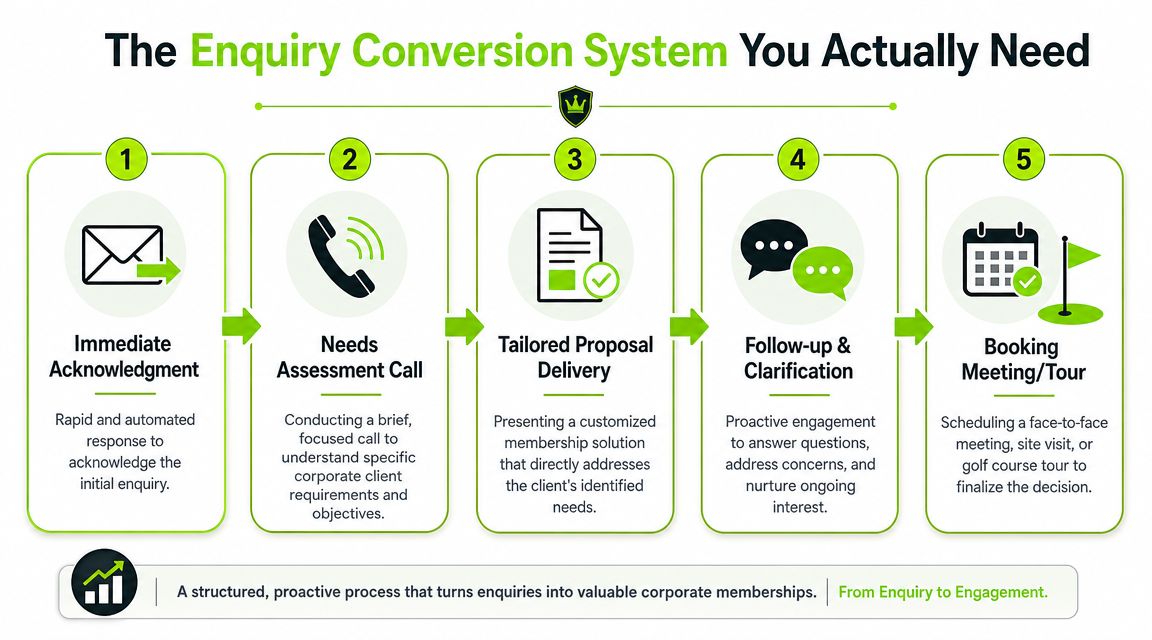
The Enquiry Conversion System You Actually Need
Most clubs don't lose corporate opportunities because the prospect wasn't suitable. They lose them in the gap between interest and action.
A prospect fills in a form. Someone reads it later. A reply goes back without a clear next step. A proposal is promised, then delayed. Follow-up becomes awkward because there is no system to tell staff what has happened already.
That is why the conversion layer matters more than the campaign itself.
Passive selling is failing clubs
Industry data reported by NGCOA shows that member referrals fell 50% between 2021 and 2023, while the average time in deal stages increased to 14.7 days in 2023. For clubs, that means two things. Traditional passive growth is weaker, and sales cycles are taking longer. Both increase the cost of poor follow-up.
You can't assume a prospect will chase the club. You can't assume a referral will do the selling for you. And you can't rely on one email and a vague promise to "come back next week".
A CRM is not a database
A lot of clubs say they have a CRM when what they really have is a contact list. That isn't enough.
A functioning CRM should do four jobs at once:
- Capture enquiries automatically
- Assign ownership immediately
- Trigger the right response sequence
- Show the live status of every opportunity
If it doesn't do those things, staff are still working from memory and inboxes.
At this point, clubs usually need a combination of tools rather than one magic platform. Some use HubSpot. Some use Pipedrive or another sales CRM. Some use a golf-specific system with external automation layered on top. GolfRep is one example of a golf-focused setup that combines lead generation with CRM-led follow-up and visibility, but the principle matters more than the brand. The club needs one reliable operating system for enquiry handling.
The non-negotiable first response
The first reply should happen automatically, even outside office hours. Not a generic "thanks for your message" if you can avoid it. A proper acknowledgement should confirm receipt, set expectations, and point the prospect to the next step.
A useful first response includes:
- Confirmation: The enquiry has been received.
- Human ownership: Name the person or team responsible for the next step.
- Time expectation: Say when the prospect will hear back.
- Simple progression: Offer a call, meeting, or brief needs discussion.
That one step protects the enquiry from silence. It also signals that the club is organised.
Operational truth: Speed matters, but clarity matters just as much. A fast reply with no next step still leaves the lead floating.
Use a staged conversion sequence
Corporate prospects need a structured journey. Not every touch should be manual, and not every touch should be automated.
A practical sequence often looks like this:
Immediate acknowledgement
Sent automatically. Confirms receipt and next steps.
Needs assessment contact
A short phone call or personalised email to understand purpose, likely users, and timing.
Custom proposal
Drawn from a standard package framework, then adjusted to the prospect's business case.
Scheduled follow-up
Not an open-ended "let me know". A defined check-in with a date and task inside the CRM.
Meeting or club visit
The prospect sees the environment, asks commercial questions, and moves toward a decision.
It is common for many clubs to become inconsistent. One prospect gets step five quickly. Another sits at step two because no one has been prompted to act.
Standardise what should never be improvised
The best conversion systems remove avoidable variation. Not every conversation should sound scripted, but the process should still be standard.
Create standard assets for:
- Enquiry acknowledgement emails
- Needs assessment question sets
- Proposal templates
- Follow-up task timing
- Meeting and tour booking workflows
That protects the club from staff changes, annual leave, and committee bottlenecks.
Track movement, not just volume
The useful question isn't "How many enquiries did we get?" The useful question is "What happened to them?"
Every corporate lead should sit visibly in a stage such as:
| Lead stage | What it means |
|---|---|
| New enquiry | Captured but not yet qualified |
| Contact attempted | First response sent and owner assigned |
| Qualified | Need, fit, and likely intent confirmed |
| Proposal sent | Commercial offer delivered |
| Follow-up due | Awaiting response with scheduled next action |
| Meeting booked | Visit or call arranged |
| Won or lost | Final outcome recorded with reason |
That level of visibility changes management behaviour. Instead of asking staff to "keep on top of it", the club can see where leads slow down and fix the exact point of failure.
Automation should support judgement, not replace it
Automation is there to prevent drift. It should handle acknowledgement, reminders, task creation, and nurture emails. Staff should handle diagnosis, relationship-building, and commercial judgement.
When clubs get this balance right, the process feels professional rather than robotic. The prospect gets timely communication, while the sales conversation still feels personal and relevant.
Without that balance, one of two things happens. Either the club over-automates and sounds generic, or it under-automates and drops leads whenever staff get busy.
Activating and Retaining Corporate Members
Signing the agreement is not the finish line. If the business never uses the package properly, renewal becomes difficult and the original sale starts to look fragile.
Retention depends on activation. A corporate member who understands the benefits, knows how to book, and sees regular value is far more likely to stay than one who receives an invoice and a bag tag.

Onboarding needs ownership
Many clubs handle onboarding too casually. They assume the buyer will tell colleagues how everything works. That creates confusion immediately.
A better process includes:
- Welcome pack: Clear guidance on named users, booking rules, guest access, and key contacts.
- Primary contact introduction: One person at the club who owns the relationship.
- Usage setup: Help the business activate users, not just purchase access.
- Early touchpoint: A check-in shortly after launch to remove friction.
The first few weeks shape the entire membership relationship. If usage stalls early, recovery gets harder.
Communication should run through the year
Expert guidance on club promotions recommends a staged cadence, with major campaigns starting 1 to 3 months ahead, using one email every two weeks initially and increasing frequency in the final week, while smaller activations should begin 4 to 6 weeks ahead, as explained in this golf club promotion guidance on YouTube. That same principle works well for corporate member retention. Don't wait until renewal to communicate value. Use segmented, timed communication throughout the year.
That might include invitations to business events, reminders about underused benefits, guest hosting ideas during peak entertaining periods, or updates relevant to the specific type of corporate member.
A corporate account shouldn't hear from the club only when payment is due. It should hear from the club whenever there is a useful reason to engage.
Retention comes from relevance
Not every corporate member wants the same things after joining. Some care about hospitality dates. Others care about staff activation. Some need help using meeting space. A CRM should segment those patterns and prompt the right communication.
Useful retention habits include:
- Quarterly account reviews: Discuss usage, upcoming needs, and any friction.
- Underuse alerts: Identify accounts that are not activating enough users.
- Event-based communication: Invite the right businesses to the right experiences.
- Member feedback capture: Record issues before they become renewal objections.
Renewals are earned operationally
Most clubs talk about renewal as if it is a pricing conversation. Usually it is a value-delivery conversation first.
If the buyer can see usage, engagement, and consistent support, price becomes easier to defend. If the account feels neglected, even a discounted renewal can become uncertain.
Retention is where corporate membership turns from a sale into recurring revenue. Clubs that manage this well don't rely on charm at renewal time. They build a year of evidence.
Measuring Success and Proving ROI
Committee reports often focus on the wrong numbers. They mention campaign reach, event attendance, or general awareness, then struggle to explain whether the corporate programme is commercially healthy.
Corporate membership needs a tighter reporting model. If you can't show what happened from first enquiry to retained account, you can't defend budget or improve performance.

Track the numbers that expose bottlenecks
A major challenge for clubs is proving premium pricing when buyers want a clear return. As noted in NCGA guidance on boosting club membership, clubs need to sell value rather than simple access, and CRM tracking of lead conversion and member usage helps build that business case.
That starts with operational metrics, not vanity metrics.
The most useful measures are usually:
- Lead response time: How quickly the club acknowledges and handles new enquiries.
- Stage conversion: How many enquiries become qualified opportunities, meetings, proposals, and signed members.
- Sales cycle visibility: Where deals slow down or get stuck.
- Member usage patterns: Whether the corporate account is activating the benefits purchased.
- Renewal outcomes: Which accounts renew, pause, downgrade, or leave.
These metrics matter because they point to action. If response handling is weak, fix process. If proposals are sent but meetings are not booked, fix sales follow-up. If members renew poorly despite healthy acquisition, fix activation and account management.
ROI needs a club-specific model
A simple B2B ROI framework is useful here. If you want a clean explanation of how to structure that thinking, Fame on B2B marketing ROI is a helpful reference for separating input, output, and commercial return.
For a golf club, the practical version is straightforward:
| Reporting area | Question to answer |
|---|---|
| Enquiry generation | Which channel produced the lead? |
| Conversion handling | How fast and how well did the club respond? |
| Sales progress | Did the lead become a meeting, proposal, and decision? |
| Revenue quality | What package was sold and at what margin? |
| Retention value | Is the account using enough value to support renewal? |
This is the level of reporting that helps a manager or committee make good decisions. It moves discussion away from opinion and toward process.
Pricing confidence comes from evidence
When a buyer challenges your fee, generic claims about prestige won't help much. Specific usage evidence will. If the club can show how the package is used, which benefits are most valued, and where enquiries convert best, pricing becomes more defensible.
That is also why clubs should review marketing and sales data together, not separately. Acquisition, conversion, and retention are one commercial system.
For clubs building that reporting discipline, our guide to golf club ROI marketing looks at how to connect campaign spend to actual revenue outcomes rather than surface-level activity.
Conclusion From Manual Effort to Sustainable Growth
Corporate membership growth isn't created by louder marketing. It comes from a better operating model.
Clubs that perform well in golf club corporate membership marketing usually do four things consistently. They build a proposition that businesses can understand. They run outreach as a system rather than a series of one-off efforts. They manage enquiries through a visible conversion process. And they treat onboarding, retention, and reporting as part of the same commercial engine.
That requires a mindset change. Manual effort feels personal, but it doesn't scale and it doesn't give management clarity. Structured systems do. They protect leads, improve follow-up, and make revenue more predictable.
The clubs that win in this space aren't always the clubs with the biggest marketing budget. They are often the clubs that respond faster, package value more clearly, and manage every stage with discipline.
If your club wants a clearer, more predictable way to generate and convert corporate membership demand, GolfRep helps golf clubs build the systems behind the sales. That includes lead generation, CRM-led follow-up, conversion tracking, and the operational visibility clubs need to grow without relying on manual chasing or guesswork.
Ready to tap into our proven growth system?