Golf Club Membership Growth: Our 2026 Playbook
Most advice about golf club membership growth starts in the wrong place. It tells clubs to spend more on ads, post more on social media, and push harder for enquiries.
That misses the primary constraint.
Demand for golf is already strong. The clubs that struggle to grow usually don't have a visibility problem first. They have a handling problem. Enquiries arrive, then sit in inboxes. Calls get passed around. Follow-up depends on who's on shift. No one can see which prospects booked a visit, who went quiet, or which source produced members.
At GolfRep, we see the same pattern repeatedly. Clubs ask for more leads when the faster win is often fixing response time, follow-up discipline, and lead visibility. If you want predictable golf club membership growth in 2026, build a system that turns interest into visits and visits into members.
The Real Problem with Golf Membership Growth
The popular view is simple. More marketing equals more members.
In practice, that's often wrong.
According to England Golf's membership update, golf club membership in the UK rose by 90,000 members in a single recent period, marking a significant reversal of a long-term decline. The same update says this surge increased overall membership by nearly 10 percentage points compared to the previous year.
That matters because it changes the question club managers should ask. If demand has already returned, why are some clubs still missing their membership targets?
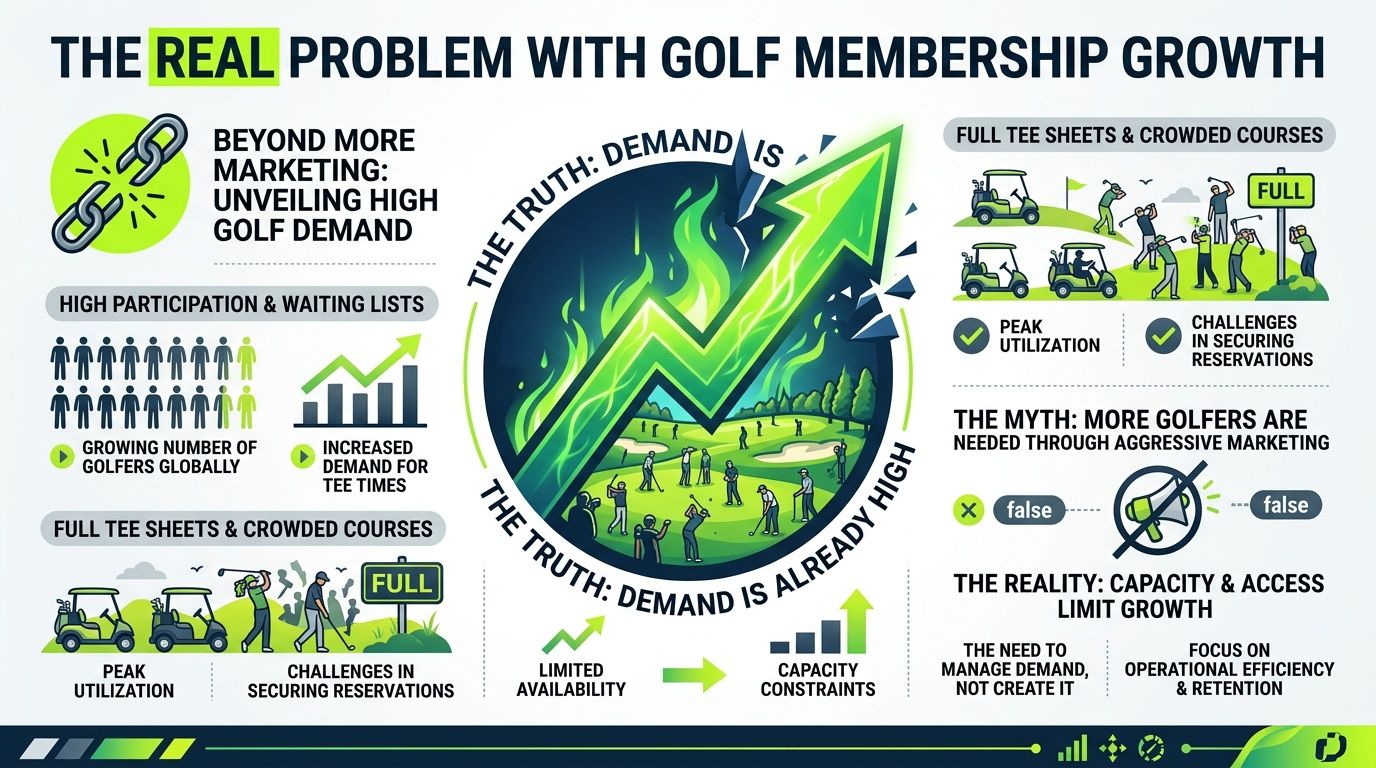
Demand exists but process often breaks
A prospect sees your club online, fills in a form, and waits. Sometimes they get a reply the same day. Sometimes they hear nothing until the next afternoon. Sometimes they receive a forwarded email with little context and no clear next step.
That's not a marketing issue. It's an operating issue.
Clubs rarely lose the enquiry at the ad stage. They lose it in the hours and days after the enquiry arrives.
Membership growth becomes inconsistent when clubs rely on memory, inboxes, handwritten notes, and good intentions. Those methods can work when enquiry volume is low. They fail when demand rises, staff are busy, and multiple people are involved in the process.
More leads can make the problem worse
If your current pipeline is loose, adding more enquiries doesn't solve the problem. It increases the backlog.
That's why some clubs feel busy but don't feel organised. The office handles plenty of interest, yet no one can answer basic questions with confidence:
- Response discipline: How quickly does the club reply to a new membership enquiry?
- Lead ownership: Who is responsible for first contact, tour booking, and follow-up?
- Pipeline visibility: Can anyone see which prospects are warm, cold, booked, or closed?
- Conversion tracking: Which channels produce actual members rather than just form fills?
What clubs should focus on instead
The first move isn't always more promotion. It's building a process that can absorb interest without dropping it.
A club with average advertising and excellent follow-up will usually outperform a club with strong advertising and weak follow-up. That's because membership decisions are rarely made in one click. Prospects compare clubs, discuss cost at home, check location, ask about flexibility, and often need a nudge to book a visit.
If your system can't support that journey, demand leaks out of the pipeline.
Audit Your Current Membership Pipeline
Most clubs don't need a complicated review. They need an honest one.
Across more than 50 UK golf clubs, the average response time to a membership enquiry was 30 hours in 2025, and faster response times consistently correlated with significantly higher conversion rates, according to The Revenue Club's 2025 review. If your club is slower than that, you're already operating behind the benchmark. If you don't know your response time, that's the first warning sign.
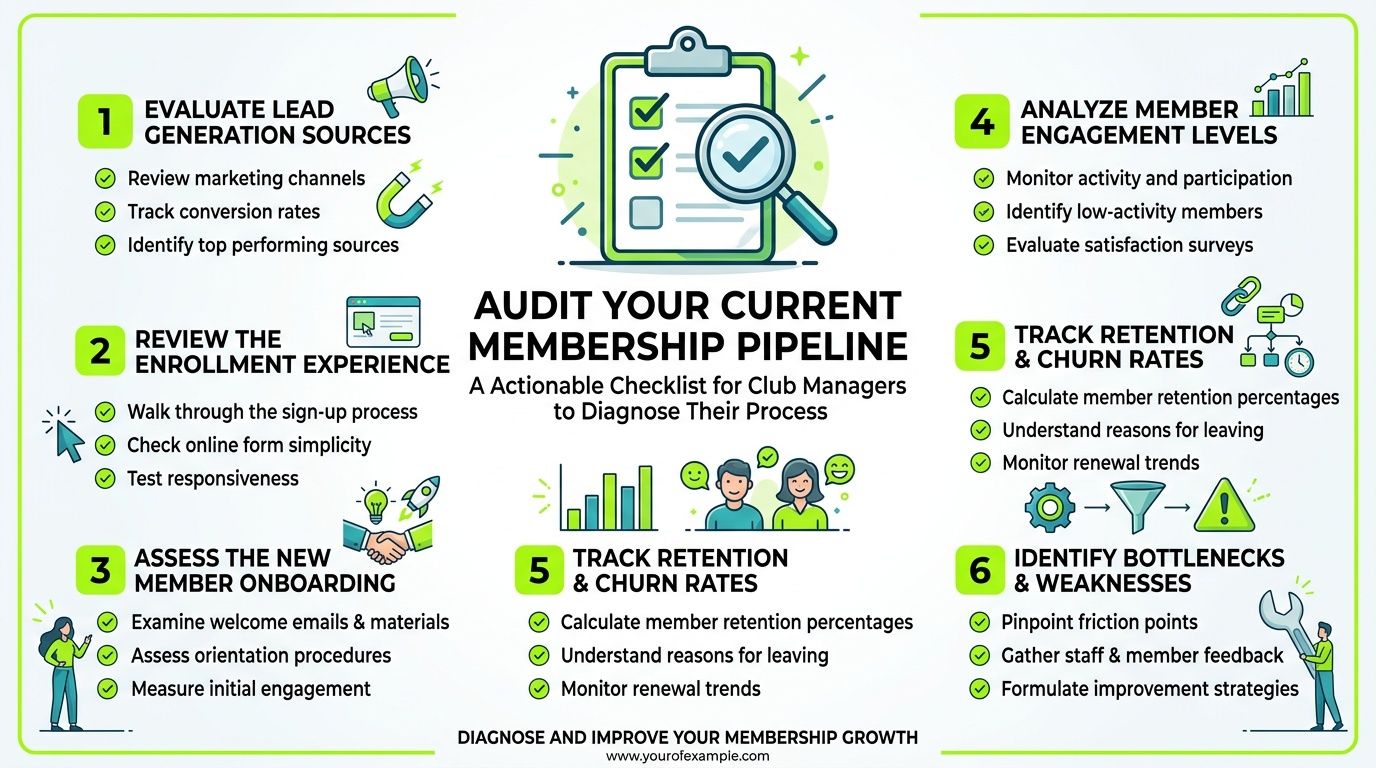
Start with the journey, not the software
Before you think about tools, map what happens after an enquiry comes in.
Write it down from the prospect's point of view. They submit a form, call reception, email the secretary, or send a social message. Then ask what happens next, in order, without assuming the ideal version is the actual version.
A proper review should cover:
Entry points
List every place an enquiry can arrive from. Website forms, phone calls, Facebook messages, email, referral introductions, and visitor bookings all matter if they lead to membership conversations.First response
Check how long it takes to acknowledge interest. Not when someone intends to reply. When the prospect has received a reply.Next step offered
Decide whether prospects are being guided to a visit, a call, a trial round, or a membership pack. If the next step changes depending on who replies, the process is too loose.Follow-up cadence
Review what happens when a prospect doesn't respond. Many clubs have no real follow-up sequence at all. One email goes out, then the lead disappears into the office inbox.Ownership
Name the person responsible at each stage. Shared responsibility usually means no responsibility.Reporting
Confirm whether the club can track source, status, and outcome. If you can't see those clearly, you can't improve them.
Look for operational friction
The biggest leaks are often ordinary ones. An office manager is on leave. A committee member has access to some leads but not all. A form sends to a single email address. A prospect asks for prices and gets a PDF but no invitation to visit.
Practical rule: if a membership enquiry can only be handled properly by one specific person, the process is fragile.
A structured review proves helpful. A useful primer on the benefits of a CRM audit explains why clubs and other businesses often discover hidden gaps only when they map data flow, ownership, and process consistency properly.
Audit for visibility, not blame
Staff usually know the process isn't perfect. The issue isn't effort. It's visibility.
If you want a practical way to assess where leads are getting lost, GolfRep has written about golf club enquiry tracking in a way that's useful for managers who need clarity without technical jargon.
Use your audit to answer a short set of uncomfortable questions:
| Audit question | What a healthy answer sounds like |
|---|---|
| Do we know our average first response time? | Yes, and we review it regularly |
| Can we see every live membership enquiry in one place? | Yes, by source and stage |
| Is there a standard follow-up sequence? | Yes, and staff follow it |
| Do we know who owns each lead today? | Yes, it's assigned clearly |
If you can't answer those confidently, your club doesn't have a lead problem yet. It has a pipeline problem.
Build a Growth Engine with CRM and Automation
Most golf clubs don't need more admin. They need fewer manual steps.
A CRM should be treated as the club's membership control centre. It stores the enquiry, records the source, assigns responsibility, tracks contact history, and shows the next action. Automation does the repetitive work around it. Together, they create consistency that manual handling can't maintain.
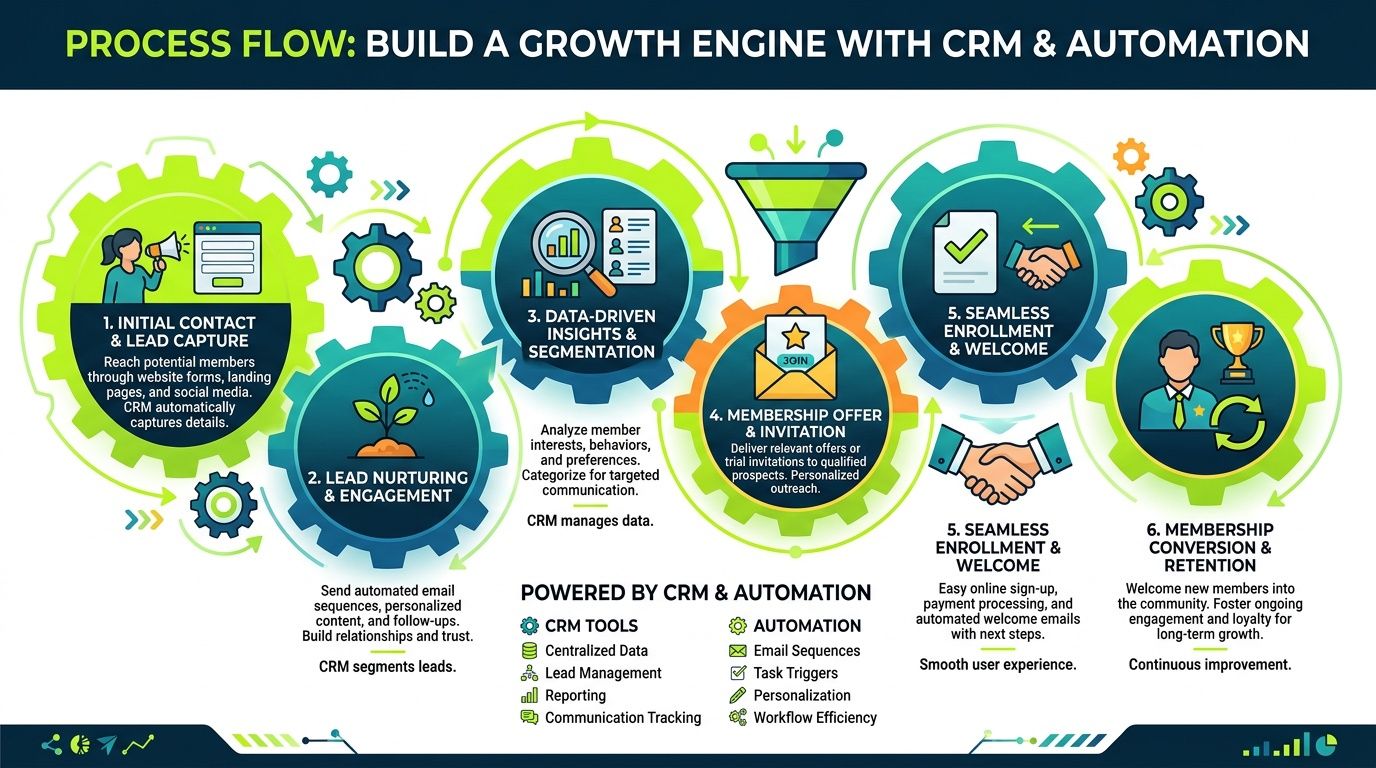
What the manual version looks like
A prospect submits a website form on Tuesday evening.
The email lands in a shared inbox. Someone sees it on Wednesday morning, forwards it to the membership contact, and adds a note asking them to call. The membership contact is coaching that day. By Thursday, the prospect has already enquired with another club.
Nothing about that sequence is unusual. That's why it's dangerous.
The problem isn't that staff don't care. The problem is that the process depends on memory, availability, and inbox behaviour.
What the structured version looks like
Now take the same enquiry in a CRM-led workflow.
The form submission creates a contact record instantly. The prospect receives an immediate acknowledgement by email. If the club uses text messaging, they can also receive a short confirmation with a clear next step. A task is assigned automatically to the right team member. The lead is placed into the correct stage, such as new enquiry or awaiting contact. If no one responds within the club's target window, the system flags it.
That single change does three things:
- It reduces delay because the first acknowledgement doesn't wait for office hours.
- It protects lead visibility because the enquiry is stored in one place rather than buried in email.
- It enforces follow-up because tasks and reminders don't rely on someone remembering.
Keep the workflow simple
Clubs often overcomplicate this stage. They try to build a perfect system before they've built a usable one.
A practical membership pipeline usually needs only a few clear stages:
| Stage | What should happen |
|---|---|
| New enquiry | Acknowledged quickly and assigned |
| Contact made | Prospect has had a human reply |
| Visit or call booked | A date is set |
| Considering options | Questions handled, follow-up active |
| Joined or closed | Outcome recorded clearly |
That's enough to create control.
A CRM isn't valuable because it stores contacts. It's valuable because it shows what needs to happen next.
Use automation where staff repeat the same task
Automation should remove routine friction, not replace real conversations.
Good uses inside a golf club include sending first-response emails, booking confirmations, reminder messages before a tour, internal task creation, and follow-up prompts after a visit. Those are the jobs staff repeat every week. Let the system handle the trigger so your team can focus on personal contact where it counts.
For clubs exploring broader operational use, this guide on how to leverage AI for CRM gains is a useful read because it frames automation as a practical support layer rather than a gimmick.
The right tool is the one the team will use
Don't buy software because it looks powerful in a demo. Buy software your team can operate on a busy day.
The best setup is usually the one that makes it obvious when a lead is waiting, when a follow-up is overdue, and which sources are producing members. That applies whether a club uses HubSpot, another CRM, or a specialist workflow built for membership sales. GolfRep's golf club CRM software article covers the practical criteria clubs should look at before choosing.
GolfRep approaches this as a pipeline problem, not a campaign problem. That means combining advertising, CRM structure, and automated nurture so the club can track the path from enquiry to membership without relying on spreadsheets and inbox memory.
A good system should answer these questions instantly
Ask your team whether they can answer the following without digging through emails:
- Which enquiries came in this week?
- Which prospects have booked a visit?
- Who needs a follow-up today?
- Which source brought in the most serious prospects?
- Which leads went cold after first contact?
If the answer is no, the growth engine isn't built yet.
Attract High-Value Prospects with Targeted Advertising
Once the handling process is organised, paid advertising becomes much more useful. Not because it creates magic, but because the club can finally do something valuable with the interest it generates.
Broad awareness campaigns often waste budget for private member clubs. They may create traffic, likes, and low-intent enquiries, but they don't always produce the right prospects. Better advertising starts by deciding who the club wants more of.
According to Golfshake's 2025 membership overview, overall UK golf club membership growth increased by nearly 10 percentage points year-on-year, with junior participation up by 10.5 percentage points and female membership rising steadily. That should change how clubs think about audience targeting.
Target the segments already moving
If junior participation is rising and female membership is growing, generic messaging aimed at “all golfers” is too blunt.
A club should build campaigns around distinct prospect groups with distinct reasons to join:
- Young families often care about coaching access, beginner friendliness, and whether golf fits around family life.
- Women returning to or trying golf usually want reassurance about club culture, welcome, and realistic routes into membership.
- Working-age local golfers often respond to convenience, flexibility, and whether they can use the club regularly.
- Lapsed golfers may need a lower-friction route back in rather than a full traditional commitment upfront.
These groups don't need different branding. They need different messages and offers.
Match the advert to the next step
Many clubs run ads that ask for a big decision too early. “Join now” is often the wrong call if the prospect doesn't yet know the course, the atmosphere, or the options.
A more effective route is usually to promote a smaller next step. Book a tour. Request membership options. Speak to the club about flexible pathways. Attend an open day. The advert should lead into the pipeline you've already organised.
The job of advertising isn't to close the membership sale. It's to start the right conversation with the right golfer.
Quality beats volume
A campaign that produces fewer but better-fit enquiries can outperform a bigger campaign that floods reception with poor-fit leads.
That's why creative, copy, and audience selection matter more than vanity metrics. Tight geography, relevant imagery, a clear offer, and a strong follow-up path will usually do more for golf club membership growth than broad, generic promotion.
For clubs testing creative angles and message ideas, these AdCrafty AI insights for marketers are helpful because they focus on refining ad messaging rather than just increasing spend. If you want a golf-specific view of campaign setup and targeting, GolfRep's article on golf club paid advertising covers the practical side.
The key principle is simple. Don't advertise for attention. Advertise for fit.
Rethink Pricing and Packaging for Sustainable Growth
Many clubs are trying to grow with a pricing model built for a different market.
The traditional approach assumes the full annual membership is the obvious goal and that most serious golfers will adapt to it. Some will. Many won't. That's especially true when clubs raise visitor revenue aggressively while leaving the membership proposition unclear or rigid.
At 26 UK clubs, member subscriptions rose by an average of 4.8% in 2025, while visitor fees at the same clubs increased by 11.8%, according to UK Golf Guy's green fee analysis. That gap matters because it changes how golfers judge value.

When pricing sends the wrong message
If visitor prices keep climbing and membership options stay rigid, the club can create two problems at once.
First, prospects start to feel that joining requires too much commitment. Second, existing members start comparing what they pay against what they receive, particularly if access, tee availability, or service don't feel aligned with the price.
Committees often make a mistake. They focus only on the annual subscription figure and not on the structure around it.
Packaging matters as much as price
You don't always need cheaper membership. You often need clearer and more flexible packaging.
Consider the difference between these two approaches:
| Traditional model | Sustainable model |
|---|---|
| One main annual package | Multiple routes based on playing habits |
| Heavy upfront commitment | Lower-friction entry points |
| Limited explanation of fit | Clear guidance on who each option suits |
| Manual handling of upgrades | Planned movement between packages |
A modern club can still protect full membership value while creating sensible pathways for different golfer types.
Practical options clubs should consider
This isn't about discounting for the sake of it. It's about reducing mismatch.
Flexible credit-based access
Useful for golfers who play irregularly and resist a full annual commitment. It gives the club a structured entry product without forcing a hard yes or no decision.Seasonal or transitional packages
Helpful for beginners, returning golfers, or people relocating into the area who want to test the club properly before taking a full subscription.Defined upgrade paths
A prospect who starts on a lighter option should know exactly how they move into fuller membership. If the club treats entry products as dead ends, it limits long-term value.Household and family framing
Where junior participation and female membership are rising, clubs should present membership in a way that reflects shared use, progression, and accessibility rather than a single traditional buyer.
Commercial reality: a rigid membership model can repel golfers who would happily join if the route in felt sensible.
Protect long-term retention, not just short-term yield
Some clubs lean too hard into visitor income because it's immediate and easy to see. That's understandable. It can also become a trap.
Visitor revenue is transactional. Membership revenue is relational. Members bring recurring income, secondary spend, referrals, atmosphere, and stability. If your pricing and packaging push golfers towards occasional play instead of structured commitment, you may improve short-term cash flow while weakening future retention.
The modern task isn't choosing between visitor income and membership. It's designing packages that make membership feel relevant, usable, and worth committing to.
That's what sustainable golf club membership growth looks like.
Measure What Matters and Build a Predictable Pipeline
A club can't manage growth from intuition alone. It needs a small set of numbers that reflect the actual member journey.
The UK Golf Courses industry has a projected market size of £2.8 billion in 2026 and grew at a 2.2% CAGR between 2020 and 2025, according to Credence Research's UK golf club market report. There is real commercial upside in getting this right. But clubs only benefit if they track the stages that turn demand into revenue.
The KPIs worth tracking
Most vanity metrics distract. Website traffic, post reach, and social engagement may tell you something, but they don't tell you enough about sales performance.
Track the numbers that sit closest to membership decisions.
| KPI | What it Measures | Why it Matters |
|---|---|---|
| Lead-to-response time | How quickly the club replies to a new enquiry | Slow replies weaken first impressions and reduce the chance of a visit |
| Lead-to-visit rate | The share of enquiries that become tours, calls, or trial experiences | Shows whether your first contact and offer are strong enough |
| Visit-to-member conversion rate | The share of visits that turn into memberships | Reveals the quality of your sales conversation and package fit |
| Follow-up completion rate | Whether the team is actually completing planned follow-ups | Stops warm leads from going cold through inaction |
| Source-to-member yield | Which channels produce actual members | Helps budget and staff time go to the right places |
| Member retention by package | Which membership options hold people best over time | Shows whether your pricing structure supports sustainable growth |
Predictability comes from visibility
When a club knows how many enquiries came in, how fast they were handled, how many visits were booked, and how many of those visits converted, planning becomes simpler.
You can spot weak points early. You can compare performance by source. You can coach staff on the stages that need work. Above all, you stop treating membership growth as something that happens in bursts and start treating it as a managed pipeline.
Good clubs don't rely on memory for growth. They rely on visible numbers and repeatable actions.
If your current process still runs through inboxes, spreadsheets, and staff memory, fix that first. Once the system is visible, growth becomes far easier to control.
GolfRep is a UK-based growth partner for golf clubs focused on building predictable membership pipelines through advertising, CRM structure, and follow-up systems. If your club is getting interest but not converting enough of it, that's usually a process issue before it's a lead volume issue.
Ready to tap into our proven growth system?