Golf Club Member Acquisition: Build a Predictable Pipeline

Most advice on golf club member acquisition starts in the wrong place. It starts with traffic, reach, and lead volume, as if the club with the biggest advertising budget automatically wins.
That isn't what we see in practice at GolfRep. Clubs rarely struggle because nobody is interested in joining. They struggle because enquiries sit in inboxes, follow-up depends on who is on shift, and nobody can clearly see which prospects are active, qualified, or close to booking a visit.
That distinction matters. Overall UK golf club membership growth increased by nearly 10 percentage points year-on-year in 2025, with 77% of golfers planning to renew their membership and female membership continuing its steady rise, which points to real demand rather than a demand collapse, according to Golfshake's review of golf club membership in 2025. If your club still feels stuck, the issue usually isn't awareness alone. It's what happens after someone raises their hand.
For clubs reviewing their acquisition process, it's worth looking outside golf as well. A strong comprehensive Google Ads review for agencies can be useful because it sharpens the same commercial question clubs need to answer: are you buying the right attention, and can you prove what happens after the click?
The Real Bottleneck in Membership Growth
A membership enquiry is not a sale. It's the start of a race.
Many clubs still operate as if prospects will wait. They won't. People compare options quickly, ask similar questions at multiple venues, and make decisions based on convenience, clarity, and speed as much as course quality. A club can have a strong brand, a good location, and healthy local interest, then still lose opportunities because the response process is slow or inconsistent.
Enquiries are being wasted, not just under-generated
The common boardroom conversation is familiar. "We need more leads." Sometimes that's true, but often it's only half true. If the club can't reply promptly, qualify properly, and move the prospect towards a visit, more leads create more missed opportunities.
That is why golf club member acquisition should be treated as an operational system, not a campaign. Marketing creates the opportunity. Process decides whether the opportunity becomes revenue.
Practical rule: If a club can't see every enquiry, every follow-up, and every next step in one place, it doesn't have a pipeline. It has a collection of disconnected tasks.
Manual handling breaks under normal conditions
Most private member clubs aren't failing because staff don't care. They're failing because the process relies on memory and goodwill.
A typical setup looks like this:
- Website forms go to a shared inbox: Someone intends to call back later, but later becomes tomorrow.
- Phone enquiries depend on availability: If the right person is busy, off-site, or off-duty, the momentum is gone.
- Follow-up varies by staff member: One prospect receives a polished response. Another gets a short email with a PDF attached.
- No central tracking exists: Management can't tell which channels create qualified interest or where prospects drop away.
When clubs rely on manual responses alone, growth becomes unpredictable. The problem isn't effort. It's system design.
The clubs that grow predictably fix the middle of the funnel
The clubs that improve acquisition most consistently do something simple but often overlooked. They tighten the gap between enquiry and human conversation. They make response immediate, they qualify interest early, and they give staff a clear next action.
That is the bottleneck in membership growth. Not just how many people enquire, but how many are seen, answered, guided, and converted.
Auditing Your Market and Profiling Your Ideal Member
Before spending more on promotion, a club needs a sharper view of who it's trying to attract. Many membership campaigns fail long before the first ad goes live because the offer is aimed at a vague audience. "Local golfers" is not a target market. It's a geography.

Start with the local reality
A proper market audit doesn't need a large research project. It needs discipline. Look at the clubs within your catchment, the types of memberships they push, the language they use, and how easy they make first contact. Then compare that with your own presentation.
Pay attention to practical questions:
| Question | Why it matters |
|---|---|
| What type of golfer lives or works nearby? | It tells you whether you should speak to families, flexible workers, younger players, competitive golfers, or lifestyle-led members. |
| What barriers appear early? | High formality, unclear pricing, and rigid joining journeys often put people off before they ever enquire. |
| What are competing clubs really selling? | Some sell prestige. Others sell flexibility, community, or convenience. |
| What does your club make easy? | If the answer isn't obvious online, prospects won't work it out for themselves. |
Stop describing the club only in traditional terms
England Golf data points to a large missed opportunity. Many golfers, even those playing for several years, remain unjoined club members, which suggests that current messaging often leans too heavily on tradition and not enough on accessibility and value, as noted in this England Golf LinkedIn post.
That should change how clubs build their ideal member profile. The target isn't only the golfer who already behaves like a long-standing member. The target may be the active local player who likes the game, spends on it, plays regularly, but still hasn't seen a club offer that feels relevant.
Clubs often don't have a market size problem. They have a positioning problem.
Build an ideal member profile that reflects behaviour
Demographics still matter, but behaviour matters more. A useful ideal member profile should include:
Playing pattern
Do they play weekly, socially, after work, or in weekend groups?Joining trigger
Are they looking for convenience, competition, community, better value from current spend, or family use?Objection risk
Do they assume the club is too formal, too expensive, too time-consuming, or not suited to their lifestyle?Decision style
Some prospects want a quick conversation and a visit. Others need more education before they commit.
This is also where segmentation becomes valuable. Clubs that want a more practical framework can use this guide on market segmentation for golf clubs to organise audiences around real intent rather than broad assumptions.
Audit what your current marketing attracts
Many clubs never ask a critical question. Are we attracting the kind of member we want to retain?
Review your current enquiry sources and ask:
- Which channels bring serious prospects
- Which messages create curiosity but not commitment
- Which audience groups book visits
- Which ones disappear after the first contact
A market audit should narrow the field, not widen it. Better targeting doesn't reduce opportunity. It improves fit.
Designing a High-Value Attraction Strategy
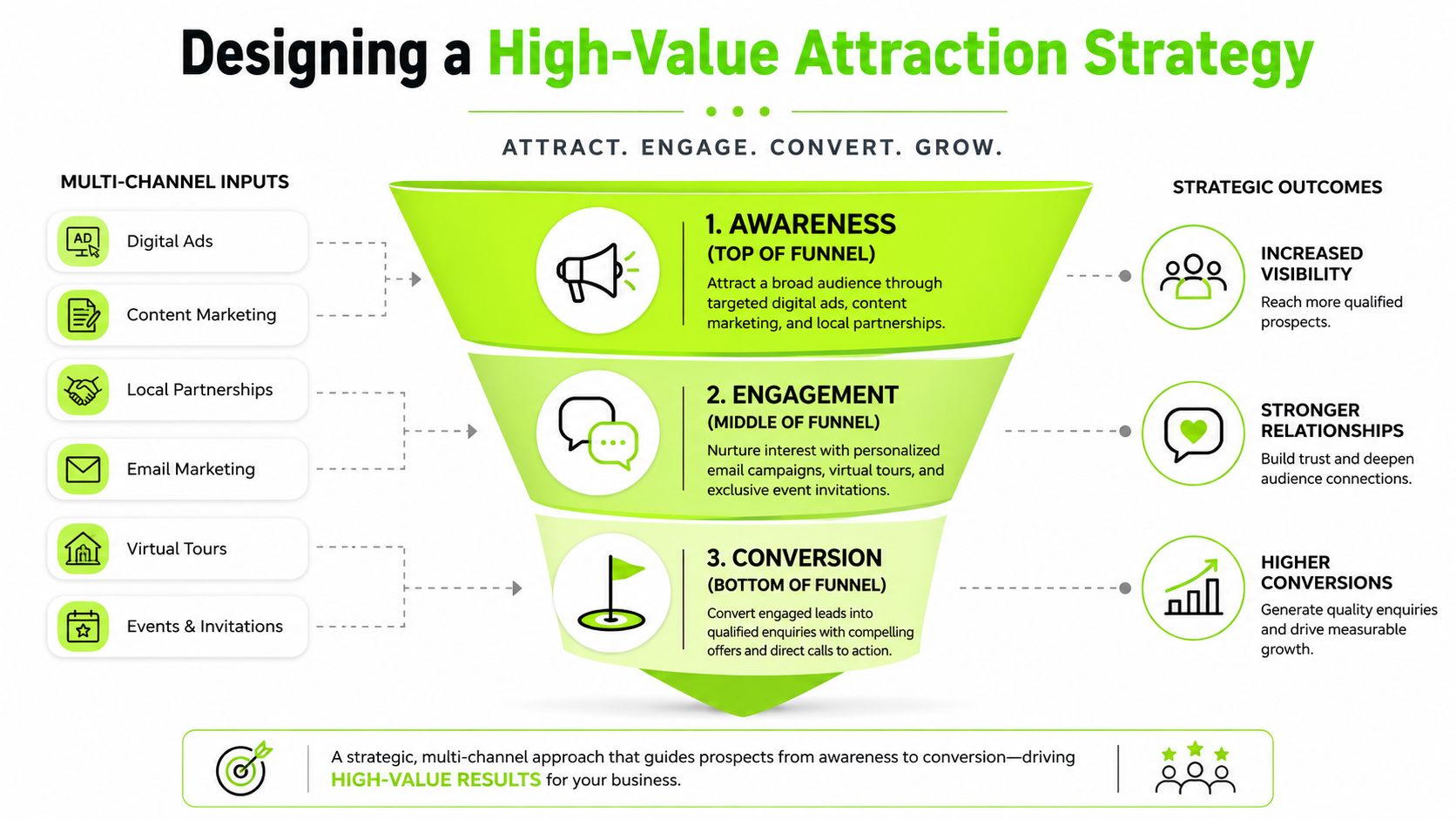
Once the club knows who it wants, the next job is to attract that person deliberately. That sounds obvious, but many clubs still spread effort too thinly across random channels and generic messages. The result is activity without control.
A high-value attraction strategy isn't about being everywhere. It's about creating a joined-up route from attention to enquiry.
Paid, organic, and local channels should support each other
The strongest acquisition systems don't rely on a single tactic. They combine targeted paid traffic, useful organic content, and local credibility.
Paid channels such as Google Ads and paid social can capture active demand and create awareness quickly. Organic content helps the club show relevance, answer objections, and build trust before the prospect speaks to anyone. Local partnerships, including employers, golf retailers, coaching setups, and community events, can introduce the club to people who are already engaged with the game but haven't considered membership seriously.
What matters is alignment. If the ad speaks to flexibility, the landing page must reinforce flexibility. If the content promises a modern, welcoming club, the enquiry process must feel modern and welcoming too.
The website must act like a conversion tool
Many golf club websites still behave like digital brochures. They look fine, but they don't guide action well enough.
Website analytics can be a powerful source of insight for private golf clubs because tracking conversion rates on different calls-to-action helps identify what motivates prospects and measures ROI more clearly, as explained in this website analytics article for private club membership growth.
That means clubs should stop judging website performance by appearance alone and start measuring behaviour.
Focus on these areas:
- Membership landing pages: Build pages for specific audiences or offers instead of sending every visitor to a general membership page.
- Clear calls-to-action: "Book a visit" and "Speak to membership" usually outperform vague prompts.
- Short forms: Ask for enough detail to start a useful conversation, not everything the club might want eventually.
- Message match: The promise in the advert should continue on the page without friction.
A click is not proof of interest. A completed form from the right prospect is.
Attraction quality matters more than reach
A broad campaign can produce plenty of traffic and still underperform commercially. High-value attraction means selecting channels based on intent and fit, then reviewing them against conversion quality rather than vanity metrics.
A simple planning resource like this practical guide to marketing strategy can be helpful because it reinforces a point many clubs miss: strategy is not channel selection alone. It's deciding what audience, message, and action need to line up.
Build for consistency, not bursts
Too many clubs market in short bursts. They launch when membership dips, pause when things improve, then restart when pressure returns. That pattern makes forecasting difficult and weakens learning because campaigns never run long enough to show what works.
At GolfRep, the more reliable model is a structured pipeline that combines high-value traffic generation with conversion-focused pages and planned follow-up. The attraction piece matters, but only when it feeds a system that can handle interest properly.
For practical planning, the club should be able to answer four questions at any time:
| Area | Key question |
|---|---|
| Audience | Who exactly are we trying to attract this month? |
| Offer | What reason are we giving them to enquire now? |
| Destination | Where does each campaign send them? |
| Measurement | How will we know if the traffic is producing qualified opportunities? |
If those answers aren't clear, the attraction strategy isn't ready.
Building Your Instant Response and Qualification System
This is the point where many clubs find business slipping away. Not because the course is poor. Not because the joining fee is wrong. Because the prospect asked a question and nobody answered quickly enough.
Speed changes the outcome
In the current market, UK golf clubs face a response-time problem rather than an interest problem, and the first club to reply to an enquiry typically wins the member, as discussed in this post on golf club response speed.
That means a next-day reply is often too late. Office hours are irrelevant to the prospect. If someone enquires in the evening after work, they expect acknowledgment there and then, not a delayed answer when the office opens.
This is why instant response isn't a nice upgrade. It is basic sales hygiene.
What an effective response system actually does
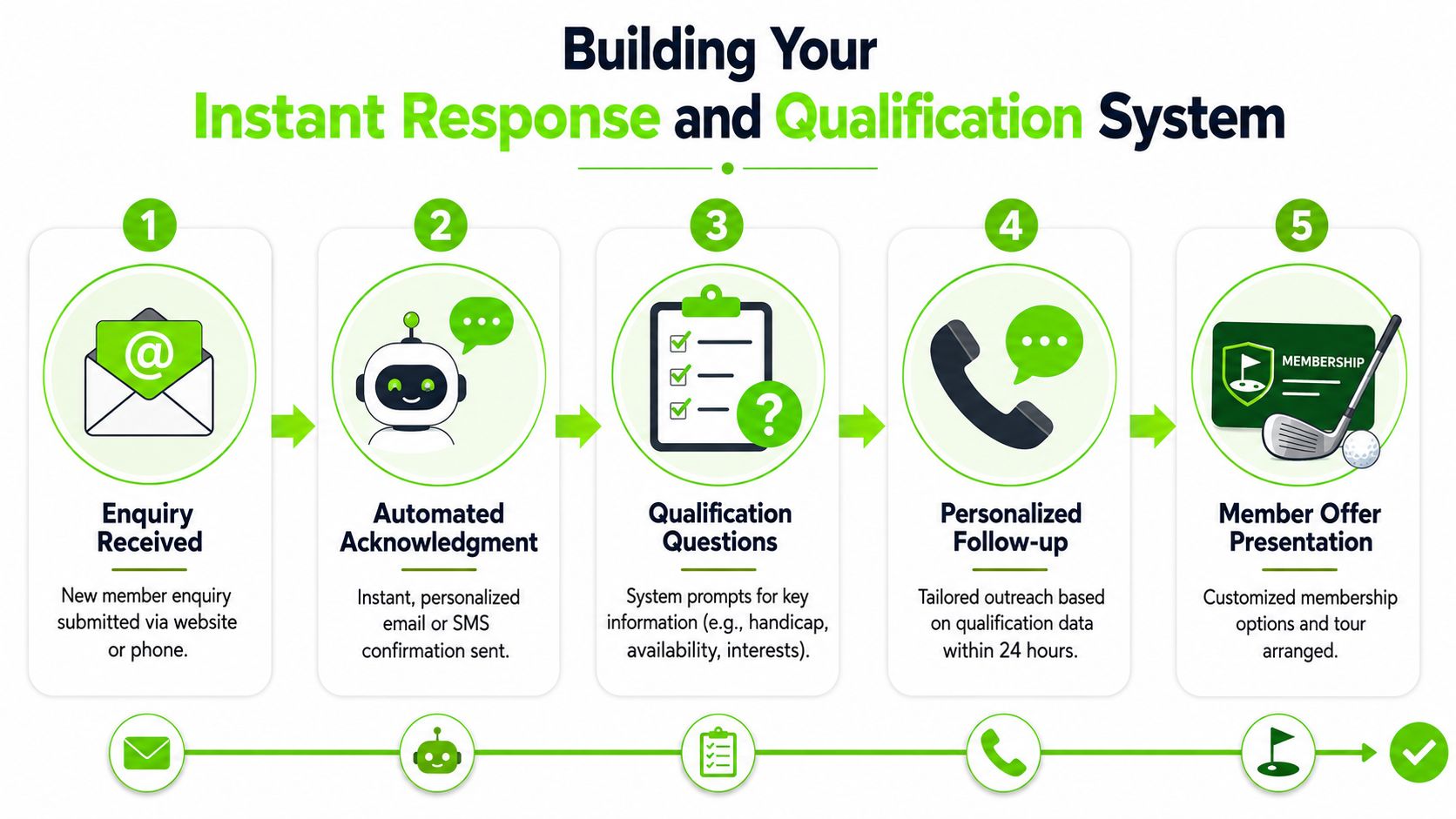
A proper system handles more than confirmation. It should do four jobs at once:
Acknowledge immediately
The prospect should know the enquiry has been received and that the club is responding professionally.Capture context
Basic qualification questions help the club understand whether the person is exploring social membership, full playing rights, a family option, or something more flexible.Route the lead correctly
Enquiries should not sit in a general inbox waiting for manual triage.Create visibility
Management should be able to see status, owner, source, and next action inside one CRM.
Without that structure, clubs default to reactive handling. One staff member calls. Another sends an email. Notes stay in personal inboxes. Nobody knows what happened if the prospect goes quiet.
Qualification should happen early and naturally
Qualification often gets misunderstood. It shouldn't feel like interrogation. It should feel like a helpful guided conversation.
Useful early signals include:
- Playing habits: how often they play and what kind of golf they enjoy
- Availability: weekday, weekend, or mixed access needs
- Joining timeframe: ready now, comparing options, or planning ahead
- Primary motivation: competition, convenience, social life, family use, or better overall value
That information helps the club tailor the next step. A competitive golfer and a busy professional may both enquire, but they should not receive the same follow-up.
For clubs exploring this in more depth, this guide to AI lead qualification for golf clubs is useful because it shows how qualification can happen without adding more manual admin.
Operational reality: If your team has to remember every callback manually, some prospects will be missed.
Automation doesn't replace people. It protects the process
Some clubs hear "automation" and worry it will make the experience impersonal. In practice, the opposite is usually true. Automation handles speed, consistency, and routing. Staff then use the context gathered to have better conversations.
The strongest setup is usually a blend:
| Stage | Best handled by |
|---|---|
| Immediate acknowledgement | Automation |
| Initial data capture | Automation |
| Membership recommendation | Staff member with context |
| Visit booking and relationship-building | Staff member supported by CRM |
This turns the enquiry process from a scramble into a repeatable operating model. Every prospect gets seen. Every prospect gets a timely reply. Every prospect enters a system the club can manage.
Automating Nurture to Convert Enquiries Into Visits
An enquiry is only the opening move. Commitment rarely happens after just one interaction, especially if they are comparing clubs, checking affordability, or trying to work out whether the culture fits them. That is where nurture matters.
The mistake many clubs make is assuming follow-up means sending a brochure and waiting. It doesn't. Nurture is a planned sequence that builds confidence and moves the prospect towards a visit.
Visits are the turning point
For most clubs, the decisive moment is when the prospect comes on-site, sees the course, meets the people, and experiences the atmosphere in person. The nurture process should therefore aim at one clear next step: booking that visit.
A useful sequence often includes a mix of email and SMS, each with a defined purpose:
- Immediate reassurance: confirm the enquiry and explain what happens next
- Value framing: explain who the membership is suited to and what members use
- Objection handling: answer common concerns around flexibility, commitment, culture, and access
- Social proof through experience: show the club environment, events, member life, or playing routines without making exaggerated claims
- Direct invitation: ask for the visit booking clearly and at the right time
Discounting usually weakens the sale
Clubs risk lasting damage if they panic. Industry discussion often defaults to discounting, yet member satisfaction and retention are more closely tied to experience quality and structured nurture systems than to price reductions, according to Players 1st on empowering clubs through member experience.
Discounts can create short-term movement, but they often attract the wrong buying behaviour. Prospects start comparing offers on price alone, and the club ends up defending margin instead of demonstrating value.
Better nurture does more than chase the prospect. It gives them reasons to feel confident about joining.
Structure the sequence around real questions
A strong nurture flow answers what people are already thinking.
First message
Keep it short. Confirm receipt. Tell them when they will hear from someone if human follow-up is coming. Offer an easy path to book a visit.
Follow-up messages
Use each message for one job only. One email can explain membership paths. Another can show what weekday members, families, or newer golfers enjoy. A text message can prompt the booking.
Timing and ownership
Automation should send the sequence, but a named staff contact should still appear in the communications where appropriate. People join clubs. They don't join workflows.
Clubs that want to map this properly can review examples of automated follow-up for golf clubs, especially where the challenge is keeping momentum after the initial enquiry.
Keep the tone helpful, not desperate
There is a difference between persistence and pressure. Good nurture feels organised and relevant. Poor nurture feels like repeated chasing.
A simple test helps. Read each message and ask:
- Does this answer a genuine prospect question?
- Does it make the next step easier?
- Does it reflect the experience the club delivers?
If the answer is no, the message should be rewritten or removed.
Tracking Performance for Predictable Growth
Many clubs track activity but not performance. They know how many enquiries arrived this month, but not which channel created the best prospects, how many booked a visit, or where leads stalled. That makes improvement difficult and budget decisions political.
Predictable growth comes from measuring the full journey.
Start with funnel maths, not vanity metrics
The most useful benchmark in this space is simple and sobering. The average close rate for converting new golf club customers is 5%, meaning clubs need 20 leads to secure one new member. If conversion from strangers to leads is 2%, that requires 50 strangers to produce one lead, or 1,000 strangers for each new customer across the full funnel, based on KPI Golf Management's golf course marketing basics.
That is why wasted enquiries are so expensive. If a club drops even a small number of qualified prospects through poor follow-up, it isn't losing admin efficiency. It's losing the output of a large amount of upstream effort.
The KPI set that actually matters
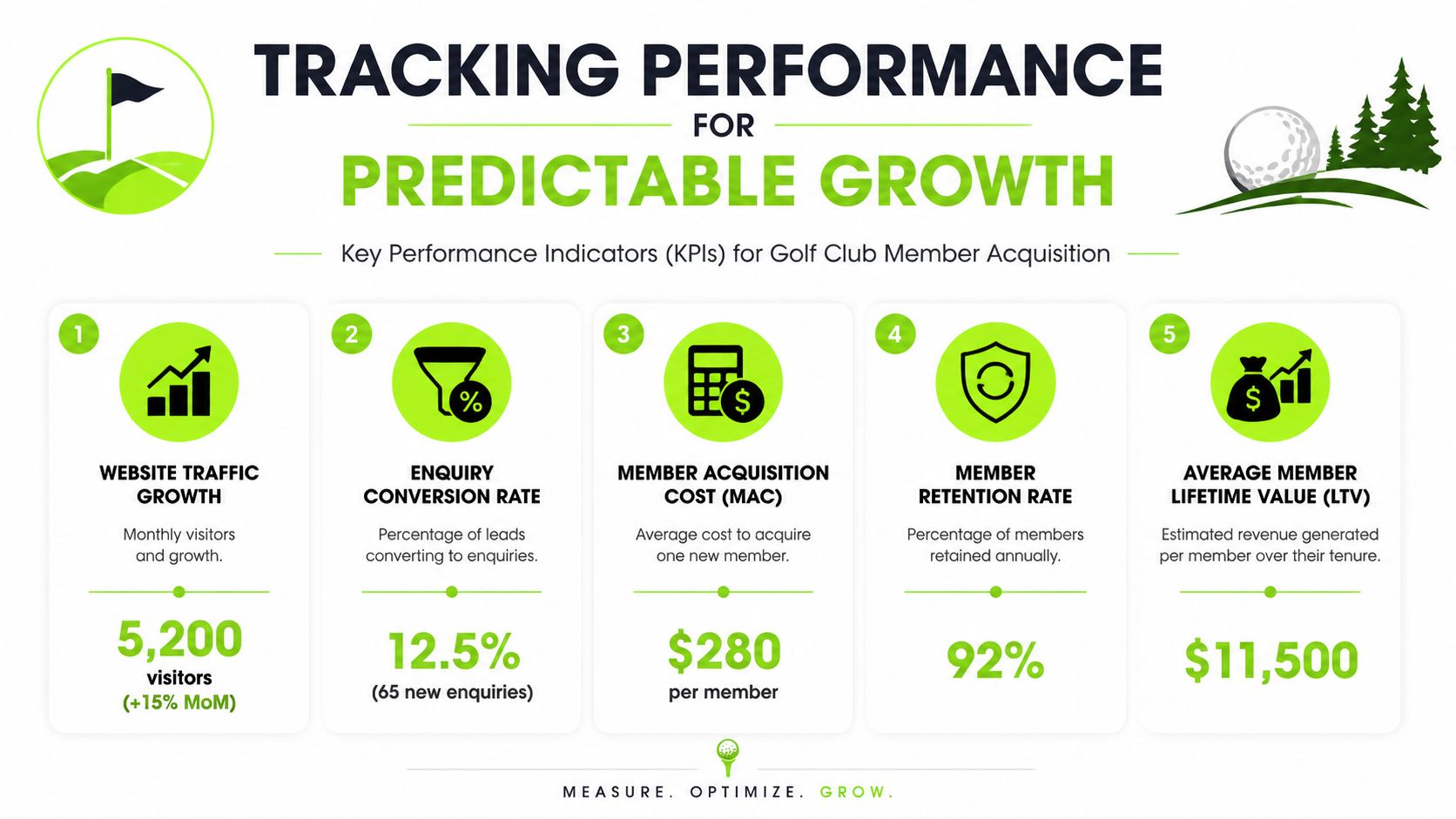
Most clubs don't need a complicated reporting stack. They need a short list of metrics that connect marketing to revenue.
Track these consistently:
| KPI | What it tells you |
|---|---|
| Lead source | Which channels produce genuine membership interest |
| Enquiry-to-visit rate | Whether follow-up is strong enough to move people on-site |
| Visit-to-member rate | Whether the club experience and offer convert effectively |
| Time to first response | Whether the process is fast enough to protect opportunities |
| Member acquisition cost | Whether spend is efficient at the point of sign-up |
Notice what is missing. Impressions, reach, and social engagement may be useful signals, but they don't tell management whether the pipeline is producing members.
Build one clear dashboard
A good dashboard should be understandable by a general manager, secretary, or committee member in minutes. It doesn't need to look impressive. It needs to answer practical questions.
Use one view that shows:
- Where enquiries came from
- How many were qualified
- How many booked visits
- How many converted
- What the cost was at each stage
- Which prospects are still active in the pipeline
This gives the club something most membership drives lack: visibility. Once the team can see the full path from first click to sign-up, decisions become easier. Budgets can move towards what works. Weak follow-up points become obvious. Staff know what needs attention this week.
Management view: If reporting stops at leads, the club is measuring inputs and guessing at outcomes.
Review rhythm matters as much as the dashboard
The numbers only help if someone reviews them regularly and acts on them. Monthly review is usually enough for most clubs, provided the team looks at causes rather than just totals.
Ask practical questions in those reviews:
- Did response time slip
- Did a new landing page improve enquiry quality
- Are some offers creating curiosity but not visits
- Are certain audience segments converting better than others
- Is the pipeline healthy enough to support future membership targets
This is how golf club member acquisition becomes a managed system rather than a recurring scramble. The club stops hoping that interest will turn into members and starts controlling more of the journey.
If your club wants a clearer view of where enquiries are being lost, GolfRep helps build and manage the systems behind predictable membership growth, from lead generation and instant follow-up to CRM visibility and nurture that moves prospects into booked visits.
Ready to tap into our proven growth system?