Golf Club Membership Campaign: Boost Your Club in 2026
Most advice on a golf club membership campaign starts in the wrong place. It tells clubs to buy more attention, post more often, or increase ad spend. That sounds sensible until you look at what usually happens after an enquiry arrives.
At GolfRep, we see the same pattern repeatedly. Clubs don't usually have a visibility problem first. They have a handling problem. The enquiry lands in a shared inbox, a spreadsheet gets updated later if someone remembers, a prospect waits too long for a reply, and the club assumes marketing didn't work.
That diagnosis matters because it changes where you put time, budget, and management focus. Predictable membership growth doesn't come from noise. It comes from a system that captures interest, responds quickly, tracks every conversation, and moves prospects towards a tour and a joining decision with consistency.
Why Your Membership Problem Is a System Problem
The popular view is that clubs need more leads. In practice, many clubs need a better process for the leads they already generate.
The market itself is not the main issue. Total golf club membership in England rose from 730,602 in 2024 to 750,071 in 2025, a 2.66% year-on-year increase, while overall membership growth in the UK increased by nearly 10 percentage points year-on-year, according to England Golf's membership update. Demand exists. Interest exists. The question is whether your club can convert that interest reliably.
A club manager often sees symptoms rather than causes. Membership feels flat. Tours seem inconsistent. Follow-up feels patchy. Committee meetings focus on campaign ideas. But the underlying issue is usually operational. If you can't see where every enquiry came from, who responded, what was said, whether a tour was booked, and why someone didn't join, you don't have a lead generation problem. You have a system problem.
What breaks in most clubs
Three failures show up again and again:
- Slow response time: Prospects enquire when it suits them, not when the office is staffed.
- Poor lead visibility: Email inboxes and spreadsheets don't show a clear pipeline.
- Manual follow-up: Staff rely on memory, diary notes, or individual discipline.
None of those failures are fixed by launching another advert.
Practical rule: If a club can't answer "How many membership enquiries are waiting for follow-up right now?" within a minute, the bottleneck is process, not promotion.
The hard truth is that many clubs leak demand. A prospect can be interested enough to enquire and still go cold if the reply arrives late, feels generic, or never gets followed by a clear next step. That's why the strongest campaigns aren't just about attracting attention. They combine marketing with response systems, CRM structure, and conversion tracking.
Why systems beat activity
A proper golf club membership campaign should behave like a pipeline, not a pile of tasks. Each enquiry should enter one place, trigger an acknowledgement, prompt the next action, and remain visible until it joins, declines, or becomes inactive.
That's also why so much golf marketing disappoints. Clubs judge campaigns by clicks and form fills while ignoring what happened afterwards. We've unpacked that broader issue in why most golf club marketing fails, but the short version is simple. Marketing can create opportunity. Only systems turn it into revenue.
When a club installs a structured process, the mood changes quickly. Fewer leads are forgotten. Staff know who owns the next action. Management gets clear reporting. Tours become easier to schedule. Conversion stops depending on whoever happened to be in the office that day.
That's what makes membership growth repeatable.
Audience Segmentation and Crafting Your Offer
Before a club spends on advertising, it needs to decide who it wants to attract. “Golfers in our area” is not a segment. It's a vague hope.
Useful segmentation is based on behaviour, intent, and likely fit. Clubs that skip this step usually write broad, forgettable campaigns and then wonder why response quality is weak. The offer isn't the problem on its own. The mismatch between message and audience is.

Start with the audiences closest to conversion
The best segments are usually already near your club:
- Lapsed members: They know the course, the culture, and the practicalities.
- Frequent visitors: Green fee players or society guests who already choose your venue.
- Independent golfers: Players with commitment to the game but no club base.
- Underrepresented groups: Messaging often improves when clubs actively include juniors, women, and seniors in how offers are framed.
One audience stands out because many clubs still ignore it. Over 12,000 independent golfers in the UK hold official Handicap Indices through England Golf's iGolf programme, but only 46% of surveyed clubs actively target this segment, as outlined in the European Golf Association note on iGolf best practice. That gap matters because independent golfers already show commitment. They just haven't been given a clear route into membership.
Build the message around fit, not discount
Many clubs fall back on price cuts because they haven't done the harder work of defining value. That usually attracts weaker-fit enquiries and creates margin pressure later.
A better offer answers practical questions:
| Audience | What they care about | What your message should emphasise |
|---|---|---|
| Lapsed members | Whether the club still suits them | What has improved, how rejoining works, who they'll know |
| Independent golfers | Flexibility and belonging | Handicap continuity, access, social integration, simple joining path |
| Younger adults | Convenience and confidence | Time-efficient formats, approachability, clear next step |
| Women and family decision-makers | Culture and comfort | Welcome, visibility, playing opportunities, real member experience |
Clubs benefit when members provide input. If your women's section, junior organisers, or senior members help shape campaign wording, the message tends to sound more credible. It reflects lived experience rather than committee assumptions.
Segmentation isn't a spreadsheet exercise. It's the difference between sending one generic message to everyone and sending the right invitation to the people most likely to join.
For managers who want a useful outside perspective on how behaviour-based groups sharpen communication, Boost customer retention with segmentation is a helpful read. The principle carries over well to golf. People don't join for the same reasons, so they shouldn't all receive the same message.
A practical way to structure this inside the club is to create three or four campaign tracks rather than one master campaign. Each track gets its own audience, landing page, follow-up email sequence, and tour script. If you want a clearer grounding in that thinking, GolfRep has also written about market segmentation for golf clubs.
That's how you stop wasting budget on broad appeal and start building a pipeline from people who are already inclined to say yes.
The Right Channel Mix for Predictable Enquiries
Once the audience and offer are clear, channel choice gets easier. Clubs often overcomplicate this part. They spread budget too thinly, test too many disconnected ideas, and end up with activity that looks busy but produces weak visibility.
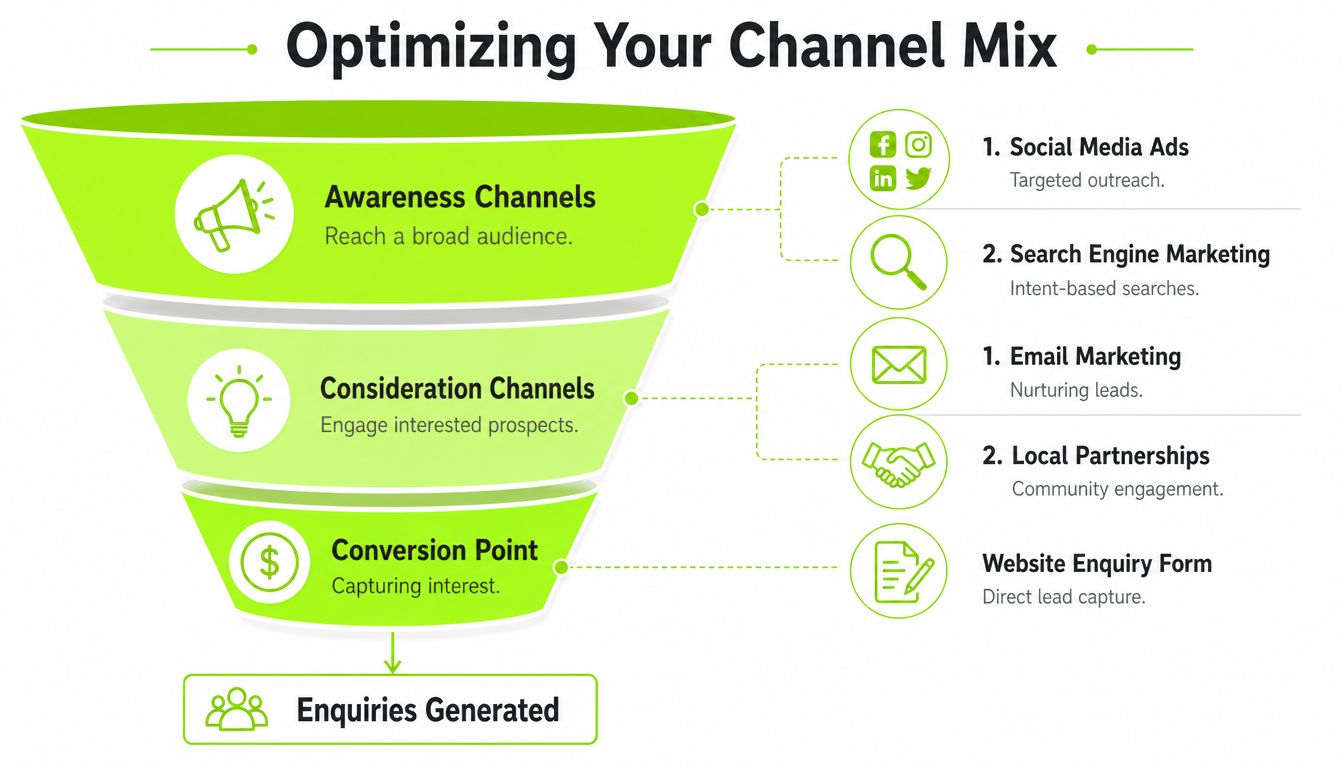
A more reliable model is simple. Use paid social to reach the right local audience at scale. Use email to nurture interest over time. Use your website enquiry point as the conversion gateway. Everything else should support that structure, not distract from it.
Why front-loaded spend works
Timing matters in golf membership. Interest is not evenly distributed across the year, and your budget shouldn't be either.
In UK golf club membership campaigns targeting the January to June window, directing 70% of the annual ad budget to the first six months yields a typical 10:1 ROI when Facebook ads are paired with a centralised CRM and weekly email nurture flows. Email marketing alone averages £36 return per £1 spent, according to James Wilkinson's analysis of golf club marketing spend.
That doesn't mean every club should copy someone else's budget line for line. It means the structure is proven. Invest when intent is highest. Pair paid demand generation with follow-up. Don't run ads into a dead end.
A practical channel decision framework
If a club asks where to put effort, these are the usual priorities:
- Meta ads first: Good for local targeting, audience testing, and consistent enquiry flow.
- Email second: Essential for lapsed databases, tour reminders, and nurture.
- Website forms third: Keep them simple and tied directly to the CRM.
- Search activity selectively: Useful where local search intent is already present.
- Partnerships and referrals as support: Strong for credibility, but rarely enough on their own.
What matters is not just which channels you choose, but how they connect. A Facebook lead form without CRM routing creates admin. An email list without segmentation creates noise. A website form without automation creates delay.
What predictable looks like
A healthy channel mix has a rhythm. Ads generate awareness and initial enquiries. Email keeps the conversation alive for prospects who aren't ready immediately. The website gives every channel a clear conversion point.
The strongest campaigns don't ask one advert to do everything. They let each channel do one job well, then pass the prospect to the next stage cleanly.
For clubs deciding whether paid social is worth the focus, this breakdown of why Meta ads work so well for golf club membership campaigns is useful because it explains the mechanics rather than just praising the platform.
The key trade-off is straightforward. A broad channel mix feels safer because it looks diversified. In reality, it often reduces control. A narrower mix, built around local paid reach, email nurture, and a clear enquiry path, gives managers far better visibility and much more stable enquiry flow.
From Enquiry to Tour The Critical Follow-Up System
This is the point where most campaigns start to fail. Not because the marketing was poor, but because the club treated the enquiry as the finish line rather than the starting point.
A membership enquiry is only a signal of intent. It still needs handling, qualification, scheduling, and follow-up. If those steps depend on inbox monitoring and manual reminders, the prospect experience becomes inconsistent almost immediately.
What a weak follow-up process looks like
Most clubs know this version well. An enquiry comes in late afternoon. The office is busy. A reply goes out the next day, sometimes later. The message is polite but generic. Nobody books a call. Nobody sets a deadline for the next contact. The lead sits in the inbox until someone remembers to chase.
That process creates uncertainty for both sides. The prospect doesn't know what happens next. The club doesn't know whether the person is interested, unavailable, comparing options, or already lost.
The frustration is that these leads often had genuine intent. The 2023/24 Members' and Proprietary Golf Clubs' Survey found that 76% of member clubs report more joiners than leavers, and 71% of golfers say membership still offers good value, according to the Hillier Hopkins golf clubs report. That means the opportunity is real. Clubs just need a follow-up process that respects it.
What a strong follow-up system does
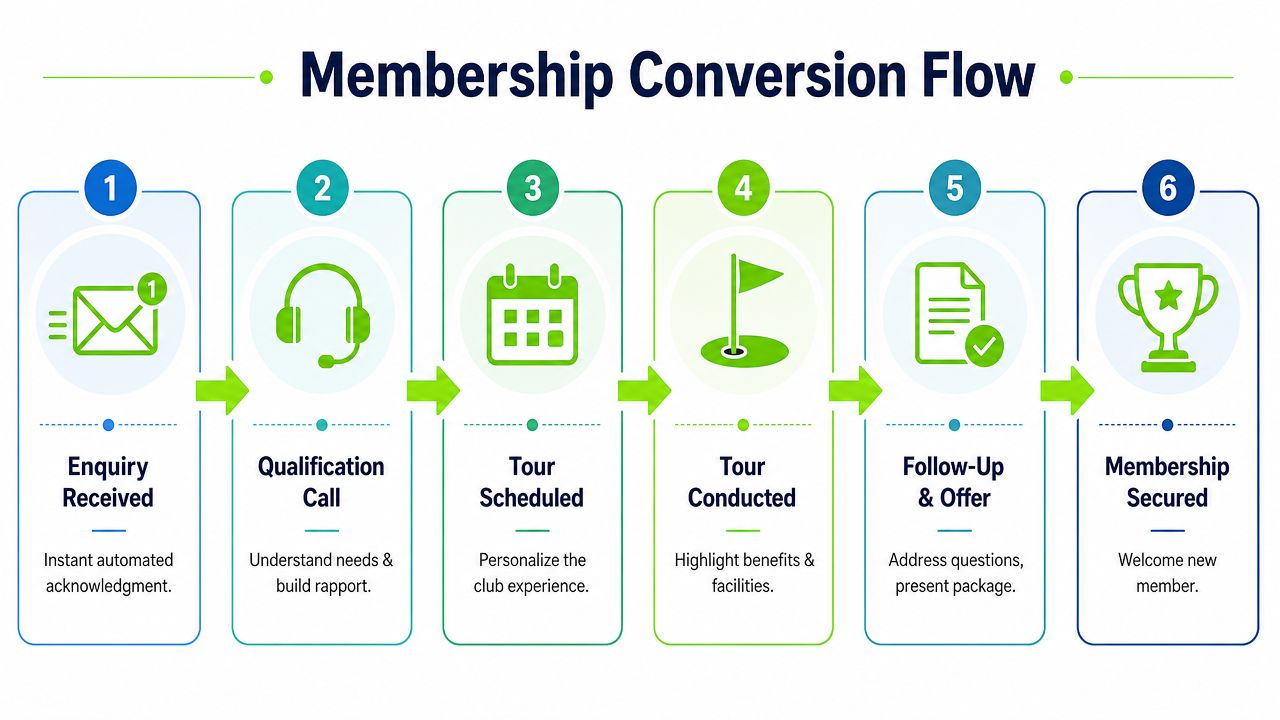
A proper system introduces order immediately. Every enquiry should trigger:
- An instant acknowledgement so the prospect knows they've been received.
- Central CRM logging so the enquiry is visible to the club, not trapped in one inbox.
- A qualification step to understand playing habits, timeline, and membership fit.
- A tour booking action with clear ownership.
- A nurture sequence for anyone not yet ready to visit.
- A post-tour follow-up path that answers objections and prompts a decision.
Automation plays a critical role. Not because clubs want to sound robotic, but because consistency beats memory. Staff still handle the human conversation. Automation handles the timing, reminders, and visibility.
A missed lead is rarely caused by lack of interest. It's usually caused by lack of process.
The CRM is the engine room
Without a CRM, clubs work from fragments. One person has inbox history. Another has tour notes. Someone else has the spreadsheet. Nobody has the full picture.
With a centralised system, every stage becomes easier to manage. Managers can see which campaigns create quality enquiries, which staff convert tours best, where prospects stall, and which follow-up tasks are overdue. That's operational control, not just marketing convenience.
GolfRep is one option clubs use when they want lead generation connected to CRM routing, automation, and structured nurture in one process. The important point isn't the provider. It's the architecture. If your campaign creates enquiries but your handling remains manual, the campaign will hit a ceiling.
The handover that matters most
The move from enquiry to tour is the most important handover in the whole pipeline. A club tour creates context, trust, and momentum in a way email alone never can. But tours don't book themselves.
That's why response speed, next-step clarity, and lead visibility matter so much. Clubs often assume their issue is top-of-funnel volume. In reality, the break is lower down. The enquiry arrives. The process after that is what decides whether the club grows.
Tracking Performance Beyond Just Lead Volume
Lead volume is easy to report and easy to misunderstand. A pile of enquiries can make a campaign look healthy even when very few of those leads become tours, and even fewer become profitable members.
Managers need a reporting view that follows the full path. Not just clicks and forms submitted, but what happened next, what revenue came from it, and whether the club achieved a sustainable improvement in its membership position.
The metrics that actually matter
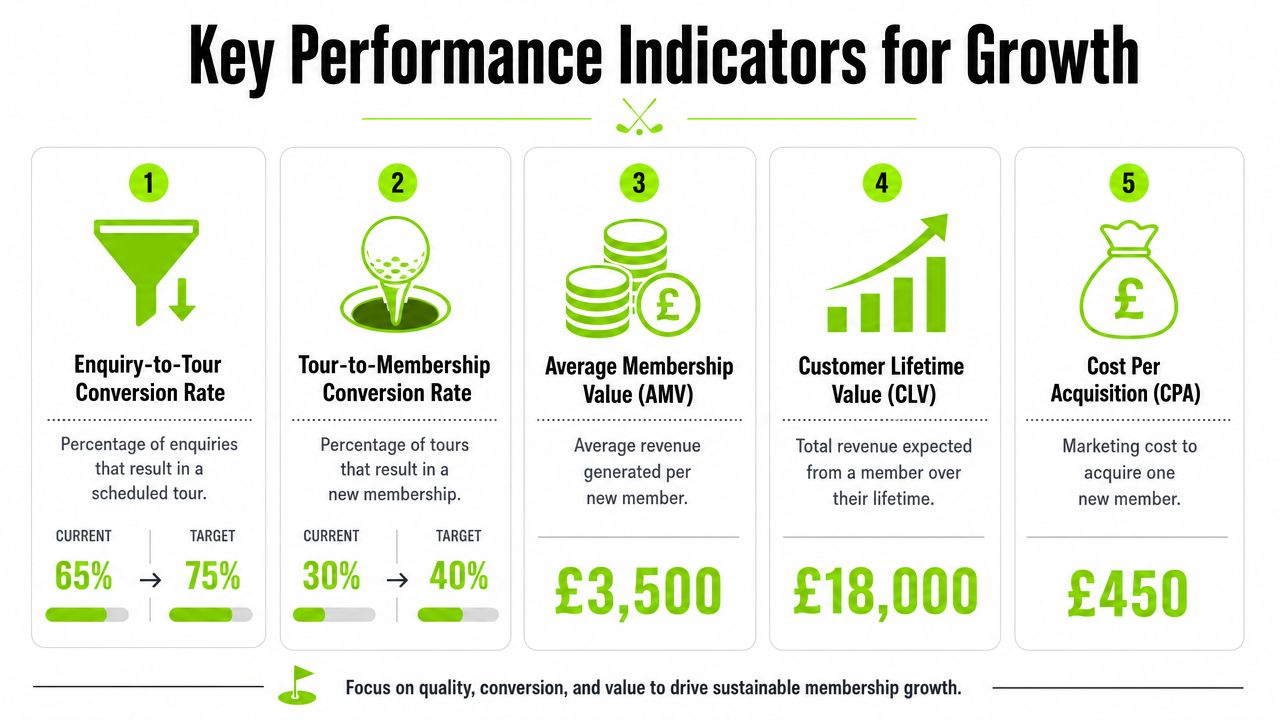
A useful dashboard for a golf club membership campaign usually includes:
- Enquiry to tour progression: Are incoming leads turning into real visits?
- Tour to join outcome: Does the in-person experience convert?
- Source quality: Which channels produce members, not just responses?
- Follow-up completion: Are staff completing the next actions on time?
- Revenue quality: Are new sign-ups strengthening the club financially?
Those measures force better decisions. If one campaign produces many enquiries but few tours, the issue may be targeting or message quality. If tours are happening but joining rates are weak, the problem is more likely in sales process, offer framing, or post-visit follow-up.
Why discount-led reporting is dangerous
A club can make weak decisions if it judges success only by acquisition volume. That's especially risky when pricing concessions are used to push sign-ups.
As noted in Golfshake's report on the health of golf club membership in 2025, a key question is how clubs measure the actual cost of discount-driven sign-ups when VAT at 20% on green fees reduces profitability. The same report notes that Bidston reversed near-closure by eliminating discounts and using automation to qualify high-value leads, achieving double membership growth without sacrificing per-member revenue.
That lesson is bigger than one club. If your dashboard celebrates sign-up count while ignoring margin quality, you can grow in a way that still weakens the business.
Boardroom test: If a campaign report can't show the path from first enquiry to recurring member revenue, it isn't a management tool. It's a summary of activity.
Reporting should support decisions
Good reporting doesn't need to be flashy. It needs to help a manager act. You should be able to spot where leads slow down, where staff need support, and which campaigns deserve more budget.
For clubs that want to sharpen their reporting discipline, especially around channel performance and attribution, PostPulse's social media reporting guide is a sensible resource. The exact examples aren't golf-specific, but the reporting habits are useful: define the right metrics, track consistently, and connect channel output to business outcome.
Once clubs start measuring the full conversion path, they usually stop asking for more raw leads. They start asking better questions. Which enquiries are worth most? Where do prospects stall? Which process changes increase membership value without creating pricing damage? That's where real improvement begins.
Putting It Together Your Sustainable Growth Blueprint
A sustainable golf club membership campaign is not a set of ads. It's an operating system.
The blueprint is straightforward. Start with clear audience segmentation so the club isn't speaking to everyone in the same way. Shape offers around value, fit, and experience rather than defaulting to discounts. Use a focused channel mix that creates steady local enquiries instead of scattered activity.
Then build the part most clubs skip. Put every enquiry into a central system. Respond immediately. Qualify properly. Book tours with clear ownership. Run follow-up automatically when staff are busy. Track each step so management can see where conversion improves and where it breaks.
The blueprint in practice
The clubs that make this work usually share a few habits:
- They reduce admin friction: One pipeline, one view of leads, one next step for each prospect.
- They protect response speed: Enquiries are acknowledged and routed without delay.
- They treat tours as a conversion asset: The visit is planned, not improvised.
- They report on outcomes: Management reviews conversion and revenue quality, not just lead count.
There's a useful parallel in service businesses more broadly. This professional services marketing guide explains why trust, process, and follow-through matter just as much as promotion. Golf clubs are different in product, but not in principle. Prospects still judge competence by how the organisation handles the buying journey.
What to build next
If you're a club manager, secretary, owner, or committee member, the next step isn't asking how to get noisier. It's asking whether your club can handle interest properly when it arrives.
Audit the journey from first enquiry to membership form. Check response time. Check visibility. Check whether anyone can see pipeline stages clearly. Check whether follow-up depends on people remembering. That review usually reveals more upside than another round of disconnected marketing activity.
The clubs that grow predictably don't rely on luck, one-off offers, or heroic staff effort. They build a system that keeps working when the office is busy, when committees change, and when demand rises. That system becomes a long-term asset for the club.
If you want help building that kind of pipeline, GolfRep works with golf clubs to connect lead generation, CRM structure, automation, and follow-up into one clear membership growth system.
Ready to tap into our proven growth system?