Golf Club Member Engagement: What to Measure and Improve

Only 77% of respondents in the 2025 Golfshake Club Membership Survey said they planned to renew for the following year. That survey drew on more than 2,500 golfers, and it is one of the clearest pictures we have of whether a full book of members is the same thing as a committed one.
A club can look healthy in March and still be losing the habit that pays the subscription. Golf club member engagement is not a feeling, and it is not a count of newsletters sent. It is a set of behaviours you can pull from the tee sheet, the competition software and the renewal file.
Committees usually ask one question. Is the club healthy beyond the headline membership count? The useful answer splits the book in two. Total membership is everyone who has paid. Active membership is everyone who has played, booked, attended or entered a competition in the last 90 days. The gap between those two numbers is where next year's revenue is decided.
Engagement Indicators and Benchmarks to Track
The 2025 Golfshake Club Membership Survey also found that 86% of respondents were club members, up from 84% in 2024, and that 50% had belonged to their current club for more than a decade, up from 46%. That is a stable, long-tenured market. It says little about whether the people on a given roll are using the club.
An ageing book can even hide the problem. A member of 15 years' standing may renew out of habit while his rounds steadily fall. Total membership stays flat while active membership drains.
Read engagement as a scorecard of six indicators. Each one measures a different behaviour, and each sits in data the club already holds, in the tee sheet, the booking window and the renewal file. Build your own baseline first and borrow external reference points second.
| Indicator | What It Shows | UK Reference Point | How Often to Check |
|---|---|---|---|
| Renewal intent | Whether members plan to stay | Most intend to renew; the undecided minority is the exposure | Before each renewal window |
| Perceived value | Whether fees feel justified | Ratings have held broadly steady as annual costs have risen | Annual member survey |
| Playing frequency | How often members use the course | A majority of adult members play weekly or more | Monthly rounds per member |
| Tee-time access | Whether members can use the facilities | 74% could easily book a preferred tee time; 30% reported a waiting list, up from 27% (2025 Golfshake survey) | Monthly booking-window review |
| Communication rating | How useful members find club messages | Member scores sit mid-scale rather than strong | Twice yearly |
| Tenure | Strength of long-term attachment | 50% had belonged for more than 10 years (2025 Golfshake survey) | Quarterly membership census |
Renewal intent is the commercial number. When a sizeable minority will not commit to the coming year, the undecided are already drifting before the first reminder goes out. Measure it with a short pre-renewal survey rather than last year's take-up.
Perceived value has held broadly steady even as costs have climbed. Ask it once a year, split by category, so a flexible member and a seven-day member are not averaged into one comfortable score.
Playing frequency is the early warning. A monthly rounds-per-member report from the tee sheet will move before a complaint ever reaches the office.
Tee-time access is the practical test of whether membership can be used. In the 2025 survey, 74% said they could easily book a preferred time, while 30% reported a waiting list, up from 27%. Most members can get on the course, yet lists are growing, which means demand is concentrating into peak slots. Review the booking window every month: a growing list can mean genuine peak pressure, or rules that let a small group hold the best times.
Communication rating and tenure close the set. Members tend to score club messages mid-scale rather than strong, so treat the twice-yearly read as a quality check, not a formality. Tenure is a quarterly census of how long people stay, useful chiefly as the denominator for everything above it.
Practical rule: Strong renewal intent next to falling weekly play is a loyalty asset that is not being used. The next action is participation, not recruitment.
Value for money, booking access and the usefulness of club messages are the drivers a committee can move this season. Tenure you mostly inherit. Treat every external figure as a reference point, then judge movement against last quarter's active membership at your own club, not the total on the roll.
Where Engagement Breaks Down Across the Member Lifecycle
A committee looks at a healthy membership total in March and assumes engagement is fine. Say a 34-year-old joined in April, booked two rounds in her first month, then nothing for six weeks. The roll still counts her. The course does not see her.
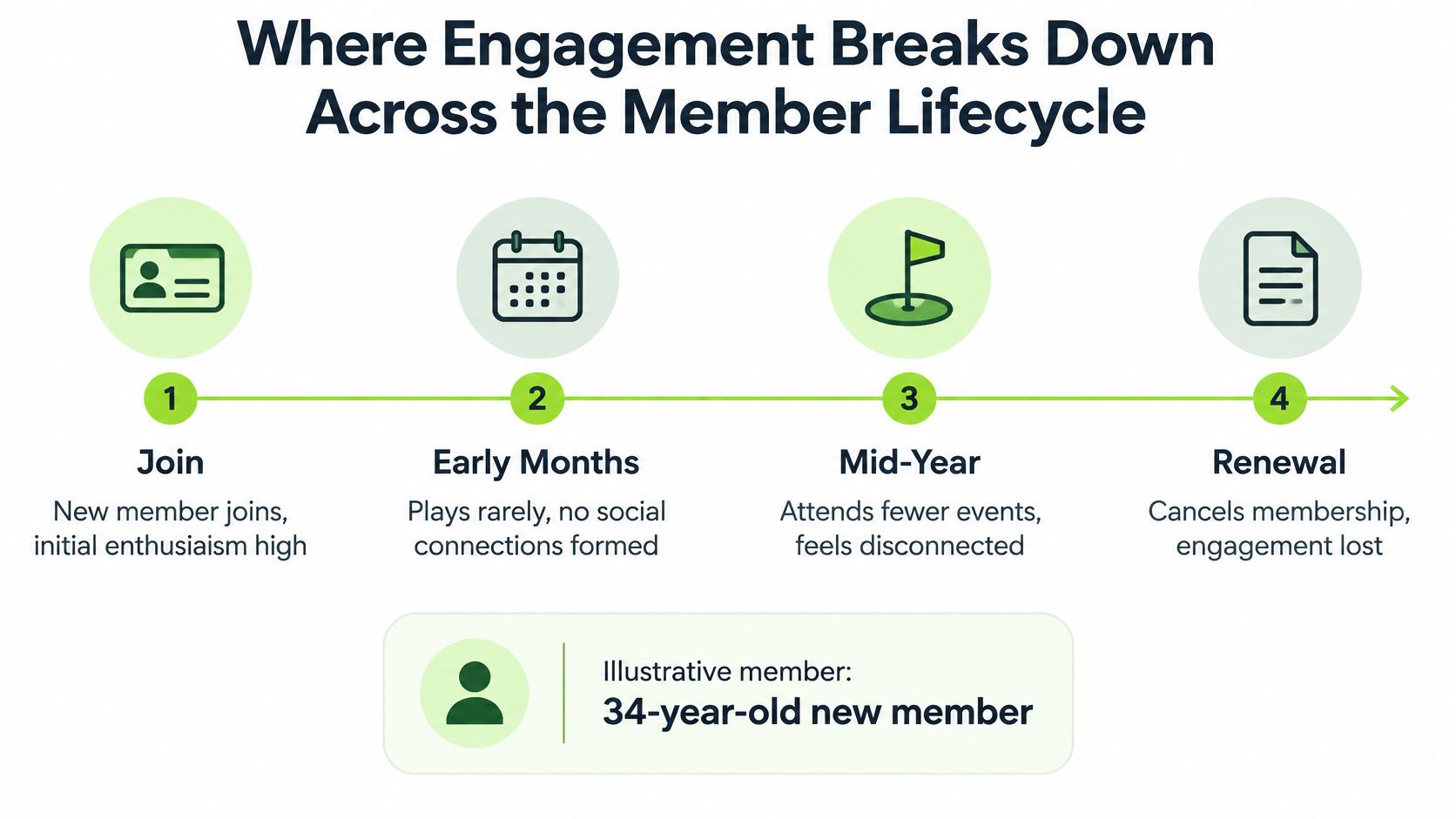
Follow her, and members like her, through five points.
First 30 days. Enthusiasm is high and habits are not formed. The drop-off is a new member with no round in six weeks. The signal sits in the tee sheet, not in a resignation letter.
First 90 days. A playing partner either appears or doesn't. No competition entry, no social event and no second booking means onboarding has stopped. A waiting-list member who has stopped trying to book is the same pattern in a different category. They have given up on access.
First renewal. This is often the highest-risk point. Attendance usually falls months before anyone complains. By the invoice, the decision is already made. New-member onboarding is the work that protects this date, not a leaflet in the welcome pack.
Years two to five. The risk shifts. A long-standing member whose regular fourball has left, moved category or stopped playing will drift without a row. Tenure hides the gap until the renewal conversation.
Sixty days before each renewal date. A reminder that is opened and not acted on is a live member who has not said yes. That is a call, not another email.
England Golf recorded 750,071 club members in 2025, up 2.66% from 730,602 in 2024. Treat that as a market benchmark only. It says nothing about how many of those members played last month. A growing book still leaks revenue if new members never settle, flexible members never book, or beginners leave at the first renewal.
Report both totals to committee every quarter. Total membership is the invoice file. Active membership is anyone who played, booked, attended or entered a competition in the last 90 days. The first change to make is simple. Name one owner for each stage, so a six-week silence has a person, not a shared inbox.
Playing Frequency as the Strongest Early Signal
Weekly play is the earliest honest signal you have. Research in the International Journal of Sport Policy and Politics, drawing on England Golf evidence, found that 95% of UK golf-club volunteers played at least weekly. 63% of adult club members played weekly or more. 98% of those volunteers were club members.
Read the gap carefully. Frequent players are more likely to give time, not the other way round as a proven cause. The link is an association. Test it in your own volunteer list and playing records before you plan referrals or committee succession around it. What you can use now is the direction. People who play weekly are easier to ask, easier to introduce, and less likely to feel the subscription is idle.
Five mechanisms to raise frequency this season
Introduce them in this order. Don't launch all five in one committee meeting.
- Structured roll-ups. A published Saturday and midweek roll-up for new and returning members, with a starter who pairs people rather than leaving them to find a game.
- Buddy matching. Pair by handicap band, age group and preferred time. A 34-year-old who wants 5pm golf will not stick with a Tuesday morning group.
- A beginner-to-member pathway. Set milestones, such as a first nine, a first 18 and a first competition, so progress is visible.
- Monthly team competitions. A team format lowers the fear of posting a card alone. A league playbook for course operators is a useful reference if you want a season structure rather than one-off medals.
- Automated invitations. Trigger them from playing pattern, handicap and preferred time, so the message matches how that member already uses the course.
A member with no round in 30 days gets a personal call from the membership team. A member whose frequency rises for two months running gets an invitation to a team or competition.
Those thresholds are starting points to test, not industry standards. Track rounds by join-month cohort. If April joiners are still playing weekly in July, onboarding is building a habit. If they are not, fix the pathway before you buy more advertising.
Member Satisfaction Drivers Clubs Can Influence
Satisfaction at most clubs comes down to a short list the committee can move. Value for money, booking access, course condition, pace of play, the social welcome, and how fast the office replies. Course condition and pace sit with the greenkeeping and starter teams. The commercial levers are value, access and the welcome.
Value is holding, and it is not secure. In that 2025 Golfshake survey, 71% said membership offered good value, up from 69% in 2024, despite higher annual costs. Don't treat the rise as permission to add fees without a visible return. Members are judging the whole package, including the rounds they didn't get.
Access is the next driver. 74% could easily book their preferred tee time, while 30% reported a waiting list, up from 27% the year before. If your list is growing, split the cause before you change the fee.
Peak capacity needs a different fix from booking rules that favour a small group. Release times, maximum advance days and unused block bookings are rules. A full Saturday morning with empty Tuesday afternoons is a yield and habit problem. One owner should sit with the tee sheet for a month and say which it is.
A driver survey you can run this quarter
Ask members to score each driver from 1 to 5, plus one open question. Record scores by membership type and join year. A member survey that isn't cut this way will flatter the people who already play a lot.
As a rule to test, not a published standard, any driver scoring below 3.5 across two surveys in a row becomes the priority. Give it a named owner and a fix inside the quarter. Compare with the previous survey before you spend. A dip in pace of play is a greenkeeping and starter issue. A dip in welcome is an onboarding issue. They should not share one budget line.
Member Communication That Members Read
Sending regular email is not the same as engaging members. A 2021 Golfshake survey of 650 golfers found that 88% of club members received regular communication. Email accounted for 96% of reported club communications. Facebook was used by 19%, and text or WhatsApp by 14%.
The rating tells a different story. Communication scored 3.59 out of 5 on average, and only 24% called it "very good". Roughly one third of respondents said they were never asked for feedback. That is a one-way mailing list, not a relationship.

Members stop reading when every message looks the same. Split the streams so a competition player can ignore the social note, and a social member is not buried in tee reservations.
| Message Type | Suggested Channel | Suggested Frequency | Measure of Success |
|---|---|---|---|
| Operational notices | Email, with text for urgent changes | As needed | Open rate and fewer repeat enquiries on the same topic |
| Competition information | Email, app or noticeboard | Weekly during the season | Entries per competition |
| Social updates | Email and Facebook | Fortnightly | Attendance at social events |
| Renewal reminders | Email followed by a personal call | 60 and 30 days before renewal | Renewals completed on time |
| Feedback requests | Short email survey, with a call for non-responders | Twice yearly | Response rate and published actions |
Frequencies and channels here are starting points. Test them against open rates and replies, not against how busy the office felt. If you are choosing software for the email stream, a newsletter archive SEO breakdown from Outrank is a practical way to compare platforms before you commit the member file to one of them. For the content itself, these golf club newsletter ideas keep each stream about one job.
Close the loop in three moves
A response route. One reply address or a three-question form, not a suggestion box nobody opens.
A record. Log each comment against the member, the category and the driver it relates to.
A visible reply. Say which comments changed a tee time, a menu or a competition. Publish it on the noticeboard and in the next email.
An illustrative model, not a reported club case, is a three-question survey each month. What should we keep, what got in the way of your last round, and would you renew today? Post the outcome where members can see it. If nothing changed, say so. Silence after a survey trains people not to answer the next one.
Running the Quarterly Review and Choosing One Priority
A scorecard that never reaches a decision is admin. Run one review a quarter, on one page, in about ten minutes at committee.

- Pull four measures per member. Rounds in the last 30 days and the last 90 days, bookings, events attended, and renewal status. Use this quarter's file. Last year's pack will flatter you.
- Group by join month and membership type. New, long-standing and flexible members are not one population. The mistake is stopping at the total on the books.
- Compare each group with your previous quarter. External benchmarks are a secondary check only. Your baseline is the number that should move.
- Flag agreed thresholds. No round in 30 days, or no booking in 60 days, are sensible tests. They are not industry standards. Adjust them after two quarters if they flag everyone or no one.
- Name an owner and a contact date inside seven days. A flag without an owner is a list. We look at stage-by-stage movement and retention at the 90-day mark so a stall is visible before renewal season.
- Record the outcome. Rejoined, still at risk, or lost, with the reason. Logging lost reasons separates a price objection, a weak first experience and a follow-up that never happened. Those are three different fixes.
- Report three numbers. Total members, active members, and renewal intent, plus one action for the next quarter. Anything longer will not be read.
How to pick the single priority
Take the three largest gaps. Ask which one most affects renewals. Choose the one you can change inside a quarter. Track movement stage by stage so the bottleneck is obvious, rather than trying to lift every driver at once.
Set touchpoints at 30, 60 and 90 days after joining. A welcome sequence, and a named buddy where the club uses one, belongs in that handoff. Day 90 is the fairest point to judge whether engagement has stuck, well before the invoice.
If active membership falls for two quarters, look at the member experience before you increase marketing spend.
Clubs with steady renewal intent and weak play should spend the quarter on participation. Clubs with rising lapses should spend it on onboarding and the messages members answer. If the committee wants an outside look at the baseline, that first conversation is a working session on the current book, not a pitch.
GolfRep works with UK clubs on the commercial system behind membership, from how new members are welcomed through to whether they are still playing at day 90. If you want a clear view of where engagement is breaking down in your own book, start with a conversation at GolfRep. We'll look at total members against active members and agree the one priority worth fixing this quarter.
Ready to tap into our proven growth system?