Golf Club Marketing UK 2026: A Growth Partner's Guide

Most advice on golf club marketing in the UK still starts in the wrong place. It starts with traffic, reach, social posts, ad spend, and more enquiries.
That sounds sensible until you look at how many clubs already have interest coming in through email, phone calls, website forms, visitor bookings, open days, and member referrals, but still can't answer a basic question. Who is in the pipeline right now, what stage are they at, and who is responsible for following up?
That gap is where revenue gets lost.
At GolfRep, we see the same pattern repeatedly. A club says it needs more leads, but the underlying issue is usually weaker than that and more fixable. Enquiries arrive into inboxes, mobile phones, handwritten notes, and different staff conversations. Some get a quick reply. Some get a delayed reply. Some get a brochure sent and then disappear. Some visit the club and never hear from anyone again. The problem isn't always demand. The problem is that the process is informal, inconsistent, and mostly invisible.
Golf club marketing UK 2026 isn't about shouting louder. It's about building a system that captures interest, responds properly, tracks every step, and gives the club a repeatable path from enquiry to booking to membership.
The Problem with Golf Club Marketing in 2026
Many clubs still treat marketing as a front-end activity. They focus on the advert, the website refresh, the Facebook campaign, or the seasonal promotion. Those things matter, but they aren't the main choke point.
The choke point usually appears after the enquiry.
A typical club manager or secretary is already juggling visitors, member issues, competitions, hospitality, and day-to-day operations. Marketing enquiries arrive in the middle of all that. If the club relies on memory and goodwill instead of a proper system, follow-up becomes patchy very quickly.
Where clubs actually lose momentum
The common pattern looks like this:
- An enquiry arrives at the wrong time: A prospect calls during a busy period, leaves a message, and no clear owner is assigned.
- A reply goes out, but nothing is tracked: Someone sends pricing or membership details, but no one records whether the person opened, replied, or booked.
- Interest is mistaken for disinterest: A prospect who needed a second or third prompt gets labelled as cold because staff are too busy to keep following up.
- Visits happen without a next step: A guest round, taster day, or informal tour takes place, but the membership conversation is left vague.
That isn't a marketing failure in the usual sense. It's an operating system failure.
Practical rule: If a club can't see every open enquiry in one place, it doesn't have a pipeline. It has scattered conversations.
This is why more advertising often disappoints. Paid traffic poured into a weak follow-up process doesn't create predictable growth. It just exposes the cracks faster.
Why the old approach breaks in 2026
Prospects now expect speed, clarity, and convenience. They don't want to chase for information, wait days for a response, or receive generic membership literature with no context. They want to understand whether the club fits their lifestyle, budget, playing habits, and commitment level.
Committee-led and volunteer-run clubs feel this pressure most sharply because the work is often shared across people with limited time. But larger private clubs and resort operations aren't immune. Scale creates its own version of the same problem. More enquiries, more channels, more handoffs, and less visibility.
The clubs that grow consistently aren't always the ones doing the most marketing. They're usually the ones that handle interest properly once it arrives.
The UK Golf Market Opportunity in 2026
The clubs waiting for a surge of brand-new demand are usually solving the wrong problem.
There is already enough money and playing activity in the UK market to justify tighter commercial systems. IBISWorld estimates the UK golf courses market at £2.8 billion in 2025, following 2.1% CAGR from 2020 to 2025, in its UK golf courses market overview. For a club manager, the point is simple. Small gains in enquiry handling, conversion, and retention have real revenue value because the market itself is large enough to reward operational discipline.
Demand exists. Conversion is the constraint.
The same market reference points to a sizeable base of registered and active golfers across the UK, with particularly strong concentration in England. That matters more than another vague discussion about awareness.
In practical terms, many clubs are already operating inside a live local market. Golfers are comparing nearby venues, testing visitor experiences, reviewing membership categories, and deciding which club feels easiest to buy from. The commercial question is rarely "how do we create interest in golf?" It is "how do we convert existing interest before a competitor does?"
That is why I push clubs to treat marketing and follow-up as one system. Good visibility gets the enquiry. Good process gets the revenue. Clubs that want a clear model for that handover should study a proper golf club follow-up system, not just their ad spend.
What this means for local clubs
Broad awareness activity still has a place, especially for clubs repositioning after a pricing change, course investment, or clubhouse upgrade. But for many UK clubs in 2026, the better commercial move is narrower and more disciplined. Show up where intent already exists, make the offer easy to understand, and remove delay after the first enquiry.
Here is the practical view:
| Market reality | What the club should do |
|---|---|
| Active golfers are already searching locally | Show up clearly in search and map results |
| Prospects compare several clubs at once | Make membership options easy to understand |
| Visitors often test before committing | Build clear routes from casual play to a membership conversation |
| Convenience affects conversion | Remove friction from forms, booking, and follow-up |
This is also where club teams benefit from using integrated marketing tools for growth instead of patching together disconnected inboxes, spreadsheets, booking systems, and contact forms. The trade-off is straightforward. Separate tools can look cheaper at first, but they usually create slower response times, weaker attribution, and more dropped enquiries.
Competitive pressure is now operational
Prospects have become more selective. They expect clear pricing, a straightforward next step, and a timely reply. Clubs still win on course quality, location, and atmosphere, but those strengths only convert if the buying process is handled properly.
A strong club can still lose the enquiry.
I see this constantly. One club has the better product. The other has the faster form response, cleaner membership page, clearer tour booking flow, and a defined post-visit sequence. The second club often gets the deal.
That is the opportunity in 2026. It is not just more visibility at the top of the funnel. It is better commercial performance after interest appears, while the prospect is still active and comparing options.
From Manual Follow-up to System-Driven Growth
The financial logic for fixing the back end is hard to ignore. The Golf Business reported that clubs in the UK and Ireland received on average 17% more in green fee income in 2025 than in 2024, with the average club taking £189,240 in green fees and a £28,000 uplift on the prior year, as covered in its January 2026 industry update.
That isn't just good news for visitor play. It shows there is still real demand flowing into clubs. The question is whether the club turns that activity into repeat rounds, society bookings, membership conversations, and long-term value.

What manual follow-up looks like in practice
Manual follow-up usually depends on good intentions. Staff mean to reply. They mean to chase. They mean to update a spreadsheet. But the system relies on memory, inbox searches, and whoever happens to be on shift.
That creates predictable problems:
- Lead visibility is poor: no one can see the full pipeline at a glance
- Response time drifts: promising enquiries cool off while staff handle operational work
- Attribution disappears: the club can't tell which channels are creating actual revenue
- Handovers break: one staff member speaks to a prospect, another staff member has no context
A club can survive like this for a while. It can't scale like this.
What a system-driven club does differently
A system-driven club treats every enquiry as an asset. It captures the lead immediately, logs the source, triggers a response, and tracks what happens next.
That doesn't need to be complicated. A practical setup often includes:
- One capture point into a CRM so website forms, campaign leads, and referral enquiries all land in the same place.
- Immediate acknowledgement so the prospect gets a useful response even if staff are busy.
- Stage-based tracking such as new enquiry, contacted, booked visit, attended, considering, joined, or lost.
- Task ownership so someone is accountable for the next action.
- Reporting that ties activity to revenue, not just form fills.
For clubs comparing software options and integrated marketing tools for growth, the right question isn't which platform has the longest feature list. It's which setup gives the club clean visibility from first enquiry to signed member.
A CRM isn't there to impress anyone. It's there to stop prospects disappearing into inboxes.
One useful benchmark for clubs reviewing their own process is whether they can answer these questions without guesswork:
| Question | Manual club | System-driven club |
|---|---|---|
| How many live membership enquiries do we have? | Unclear | Visible in one dashboard |
| Who needs follow-up today? | Depends on memory | Assigned automatically |
| Which campaigns create visits and joins? | Hard to tell | Tracked by source |
| What happens after a taster round? | Inconsistent | Predefined next step |
A detailed example of that kind of workflow sits in this guide to a golf club follow-up system.
A club can use HubSpot, ActiveCampaign, a golf-specific CRM, or a purpose-built managed setup. GolfRep is one option for clubs that want lead generation tied directly to CRM capture and structured follow-up. The choice matters less than the discipline behind it.
The commercial trade-off is simple. You can keep treating follow-up as an admin task, or you can treat it as the mechanism that converts demand into revenue.
Choosing the Right Channels to Fill Your Pipeline
More channels do not fix a weak pipeline. They usually hide it.
Clubs often assume pipeline growth is a traffic problem, so they add Facebook ads, boost a few posts, try Google Ads, then blame the channel when results stall. The underlying issue is usually simpler. The club has not decided which enquiries it wants more of, which channels match that intent, and whether the website can turn interest into a tracked next step.

Start with local search before paid media
For a UK golf club, local search is usually the first channel to fix because it captures people already looking for a course, a membership option, a society venue, or a place to play nearby. If that foundation is weak, paid media ends up covering avoidable gaps.
A practical local search setup includes:
- Correct primary category: The club needs to be classified clearly so Google understands what it should rank for.
- Recent photos: Prospects want current proof of course condition, clubhouse quality, practice areas, and social spaces.
- Consistent review generation: Reviews affect both click-through and trust. A club with stale or thin review activity makes every other channel work harder.
- Regular profile updates: Events, offers, open days, and seasonal messages give people a reason to engage.
- Consistent contact details: Name, address, and phone number should match across the site, directories, and profile listings.
This guide on golf club local search visibility gives a useful benchmark for what good execution looks like.
Match each channel to buyer intent
Channel choice should follow commercial intent, not habit. A person searching "golf membership near me" behaves differently from someone scrolling Instagram after work. Treating those two clicks the same is where waste starts.
Use each channel for the job it does best:
| Channel | Best use | Common mistake |
|---|---|---|
| Google Business Profile and local SEO | Capture high-intent nearby searchers | Leaving it half-complete while spending on ads |
| Google Ads | Pick up active demand for memberships, green fees, and societies | Sending paid traffic to generic pages |
| Facebook and Instagram ads | Promote trial experiences, events, and retargeting offers | Asking cold audiences to commit too early |
| Bring back warm prospects who already know the club | Sending one newsletter to every contact regardless of interest | |
| Local partnerships | Create referral demand from nearby employers, hotels, and community groups | Running them informally with no tracking |
The trade-off between paid search and paid social is usually a trade-off between intent and interruption. Search captures demand that already exists. Social helps create interest, re-engage visitors, and fill the top of the funnel with trial offers. Clubs deciding where to put budget first should start with intent, then review this comparison of Google Ads vs Facebook Ads for golf clubs.
The website decides whether the channel pays back
A channel can send the right person to the right page and still fail commercially.
That happens when the membership page is vague, the offer is hard to understand, the enquiry form asks for too much, or the next step feels unclear. I see this constantly. Clubs blame lead quality when the actual conversion leak is on-page friction.
A good destination page does four things well. It explains the offer clearly, gives the prospect a low-friction next step, shows enough proof to reduce doubt, and passes the enquiry cleanly into follow-up. If one of those is missing, spend becomes harder to justify.
Some clubs also need to address the platform behind the site. If updates require a developer for every small change, campaign speed drops and testing rarely happens. For teams reviewing their CMS options, it can help to compare WordPress content platforms before committing to another rebuild.
Channel rule: Do not increase spend until the landing page, form capture, and post-enquiry handling work together.
The clubs that fill pipeline efficiently are not always the clubs using the most channels. They are the clubs using a small number of channels in the right order, with each one feeding a follow-up process that converts interest into booked visits, conversations, and joins.
Automating Your Enquiry and Nurture Process
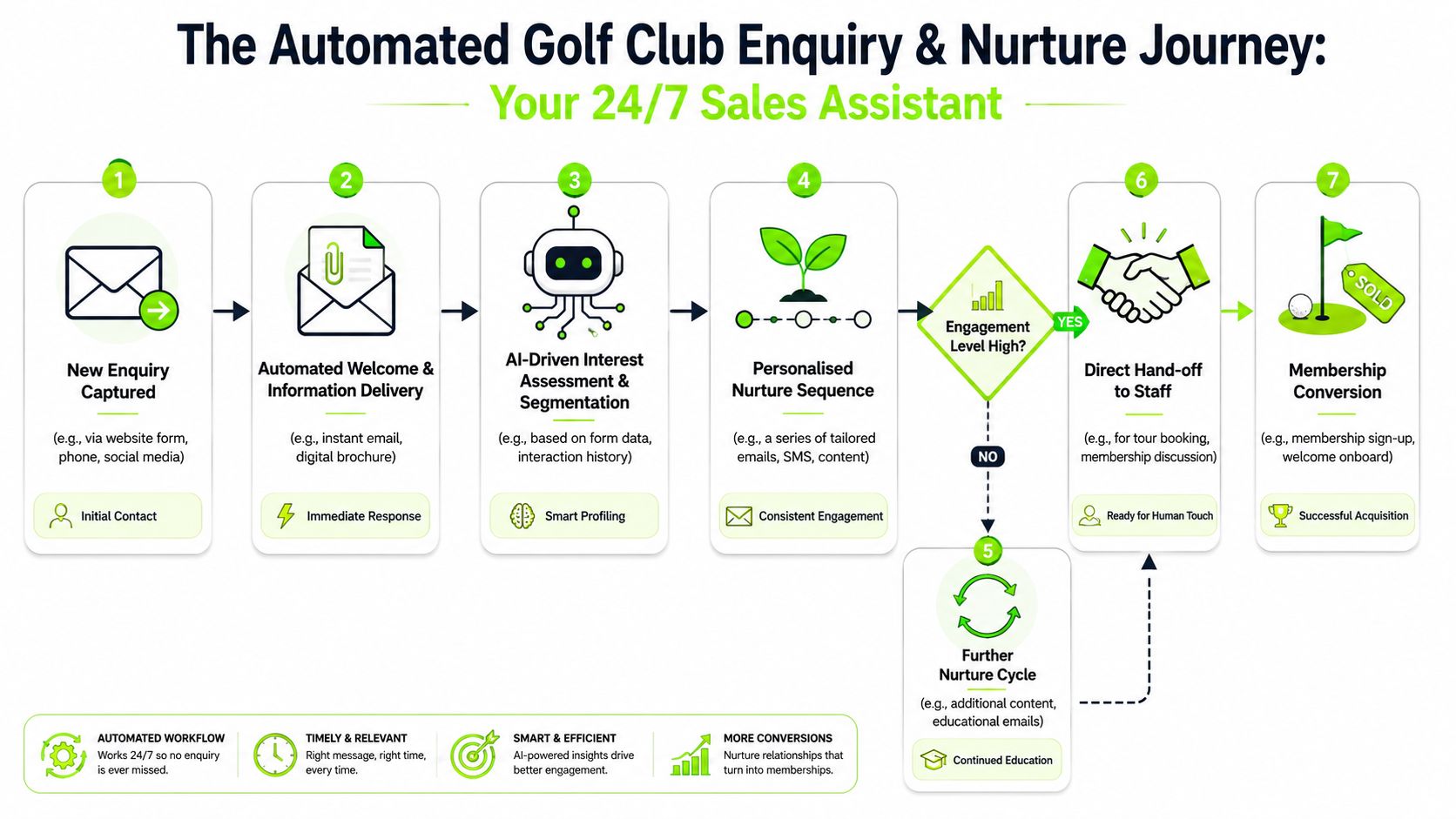
Automation gets talked about as if it belongs to large sales teams or e-commerce brands. In golf clubs, it's much simpler than that. Automation is just the process of making sure every genuine enquiry gets a timely, relevant next step without depending on someone being free at that exact moment.
That matters because private-club membership guidance for 2026 points to 7–9 nurture touchpoints as the conversion window for turning interested prospects into members, and industry data also notes that 65% of casual revenue at an average club was online bookings compared with 35% offline revenue, according to this overview of golf course revenue systems in 2026.
If clubs already rely heavily on digital booking behaviour, they should expect membership prospects to respond well to structured digital follow-up too.
What should happen immediately after an enquiry
The first response sets the tone. Most clubs still underperform here because they treat the initial reply as admin rather than conversion.
A better sequence is:
Instant acknowledgement
Confirm the enquiry has been received. Give the prospect confidence that the club is organised.Useful first information
Send the right material based on interest. Membership prospects need different information from society organisers or casual visitors.Automatic capture into the CRM
The enquiry should create a contact record, source tag, and next action automatically.Internal task creation
Staff should know who owns the follow-up and when it is due.
This isn't about replacing people. It's about making sure staff step into a warmer, better-prepared conversation.
How a proper nurture sequence works
A nurture sequence should move a prospect forward, not just stay in touch. That means each touchpoint needs a job.
A practical club sequence often includes:
- Welcome email: Confirm details and introduce the club clearly.
- Proof of fit message: Explain who the membership category suits and who it doesn't.
- Experience prompt: Encourage a taster day, guest round, or club visit.
- Social proof and reassurance: Share the atmosphere, convenience, and membership pathway without sounding salesy.
- Consultation invite: Offer a direct conversation when the prospect is ready.
- Follow-up reminders: Keep momentum without forcing the decision.
- Closing loop: Record the outcome and either continue nurture or mark as inactive.
If staff have to remember every follow-up manually, the sequence will break under pressure.
Segmentation matters more than volume
One of the biggest mistakes clubs make is sending the same newsletter or brochure to everyone. A retiree considering full membership, a younger golfer looking for flexibility, and a society organiser planning a day out do not need the same conversation.
Good automation uses simple segmentation:
| Prospect type | Useful next step |
|---|---|
| Membership prospect | Tour, taster round, consultation |
| Visitor golfer | Repeat-play offer, booking reminder |
| Society lead | Package details, date discussion |
| Former enquiry | Re-engagement with a clear ask |
The point isn't sophistication for its own sake. The point is relevance.
What clubs should automate first
Clubs don't need to automate everything at once. Start with the points where leads are most likely to go cold:
- Website form responses
- Out-of-hours messaging
- Missed call follow-up
- Tour or trial booking reminders
- Post-visit next steps
Once those basics are in place, staff usually find they have more time for the conversations that need a human touch.
Putting It All Together Sample Campaigns and Budgets
Campaign planning gets clearer when clubs stop asking, "What should we post?" and start asking, "What path will turn an enquiry into revenue?" Budgets only make sense once that path is defined. A club with weak follow-up can waste money at any spend level. A club with a tight enquiry process can make a modest budget work hard.
This is also the point where offer design either protects margin or weakens it. Independent commentary on private-club membership in 2026 points clubs toward tiered structures, preview or trial memberships, freeze options, and clear upgrade paths, as outlined in this discussion of membership marketing trends reshaping clubs in 2026.
That approach gives hesitant prospects a lower-friction first step without teaching the market to wait for discounts.

Example one private members club
A traditional private club usually wants growth without looking price-led. The campaign should present the club properly, but the essential work happens after the form is submitted.
A practical 90-day plan looks like this:
| Phase | Focus | What the club does |
|---|---|---|
| Early period | Foundation | Tighten membership pages, simplify forms, set up CRM stages |
| Middle period | Lead generation | Run local search and paid campaigns around a trial or preview route |
| Later period | Conversion | Book tours, host trial experiences, run structured follow-up |
The trade-off is straightforward. A polished campaign with no follow-up discipline produces interest and very little else. A simpler campaign with fast contact, booked visits, and clear next steps will usually produce more joined members.
Offer structure matters. Instead of cutting fees, the club can promote a preview route, a limited trial period, or a flexible category with a defined upgrade path. That keeps the brand intact and reduces commitment anxiety at the same time.
The measures worth tracking are pipeline measures. Enquiries to conversations. Conversations to visits. Visits to membership discussions. Committees get better decisions from that view than from lead totals alone.
Example two resort or hotel golf operation
A resort has a wider revenue mix, so one generic campaign usually creates friction. Visitor golf, societies, corporate days, and membership interest do not belong in the same journey.
A cleaner split looks like this:
- Visitor campaign: short-booking journey, clear tee-time messaging, repeat-play follow-up
- Society campaign: dedicated package page, concise enquiry form, fast response process
- Membership pathway: retarget frequent visitors and nurture them toward a consultation
The trade-off here is speed versus depth. Society organisers often want date availability and a prompt answer before they want a polished proposal. Membership prospects need enough detail to feel confident, but too many options can slow the decision.
Resorts that convert well tend to route each audience to its own page and keep every enquiry inside one visible pipeline. That lets the team respond differently without losing control of reporting.
Example three volunteer-run or committee-led club
Committee-led clubs often assume limited staff means limited growth. In practice, the bigger issue is unclear ownership.
A lean setup usually works best:
- One clear membership landing page
- One enquiry form that feeds one shared pipeline
- One agreed follow-up process with assigned ownership
- One monthly review of open leads and outcomes
I have seen clubs spend months debating campaign ideas while nobody can say who is meant to call a warm prospect back. That is the leak.
A simple table keeps responsibility visible:
| Responsibility | Owner |
|---|---|
| New enquiries checked | Club manager or secretary |
| Tours or guest rounds booked | Membership lead |
| Follow-up after visit | Assigned committee contact |
| Monthly pipeline review | Committee and operations lead |
Budgeting without guessing
Budget setting should start with the sales process, not a random percentage. Clubs need enough spend to create demand, but they also need enough structure to convert that demand. If the website, CRM stages, response process, and follow-up sequence are weak, adding more media budget usually increases waste.
For a fuller breakdown of planning and spend assumptions, this guide on how much golf club marketing costs is a useful starting point.
In practical terms, the budget usually needs to cover four areas:
- Foundations such as pages, tracking, CRM setup, and local search assets
- Traffic generation through the channels that fit the club model
- Nurture infrastructure including automation, email, and workflow design
- Measurement so the club can see pipeline movement, not just lead volume
That last point gets missed too often. Clubs rarely have a pure lead problem. They have a visibility problem after the lead arrives.
Social content can support the plan, especially for retargeting and local awareness, and teams that want sharper execution can borrow ideas from Klap's viral social media tips. Social output only earns its keep if the enquiry journey behind it is properly managed.
The strongest campaign is the one that produces booked visits, tracked follow-up, and visible conversion at each stage.
Price-led acquisition often fills the pipeline with weak intent. Flexibility-led acquisition tends to attract serious but cautious prospects who are easier to convert with the right post-enquiry process. In 2026, that is usually the better commercial decision for UK golf clubs.
Becoming a Growth-Oriented Club for 2026 and Beyond
The biggest shift in golf club marketing UK 2026 is organisational, not creative. Clubs need to stop treating growth as a series of isolated campaigns and start treating it as an ongoing system.
That system has a few essential elements. Clear local visibility. Fast response to every genuine enquiry. A CRM that shows where each prospect sits. Follow-up that doesn't rely on memory. Offers that reduce friction without cutting the club's value.
Clubs that build those pieces don't just market better. They operate better.
It's also worth resisting the distraction of surface-level activity. Social content has a place, and teams that want to sharpen their posting discipline can borrow ideas from Klap's viral social media tips, but social output only helps if the club can capture and convert the attention it creates.
A growth-oriented club doesn't ask, "How do we get more leads?" first.
It asks, "What happens to every lead we already get, and where does that process break?"
That is the question that tends to deliver the most revenue, the most clarity, and the most confidence around marketing decisions.
If your club wants a clearer pipeline from enquiry to visit to membership, GolfRep helps build the system behind it. That includes lead generation, CRM-enabled follow-up, and conversion tracking designed specifically for UK golf clubs that want predictable growth rather than another batch of untracked enquiries.
Ready to tap into our proven growth system?