Golf Club Google Ads vs Facebook Ads: Which Drives More

The usual advice on golf club Google Ads vs Facebook Ads is too simple. Google captures intent. Facebook builds awareness. That part is true, but it misses the decision that affects revenue.
A club can run good ads on either platform and still see weak results if enquiries sit in inboxes, get forwarded manually, or disappear after one missed call. The channel matters. The follow-up matters more.
That's why the right question isn't just which platform drives more leads. It's which platform fits your club's demand, your sales process, and your ability to turn an enquiry into a visit, a conversation, and a signed membership.
Your Real Challenge Is Conversion Not Leads
Most clubs don't have a platform problem first. They have a conversion system problem.
A campaign can generate interest, but interest alone doesn't create members. If a prospect asks about joining and waits too long for a reply, gets a vague response, or never receives a structured follow-up, the opportunity is lost regardless of whether that lead came from Google or Facebook.
The bigger issue in the UK market is that not every golfer is actively looking for membership at the same time. The R&A's The Next Chapter reported 5.4 million adult UK golfers in 2024, including 2.0 million club members and 3.4 million non-members, while England Golf reported 674,130 affiliated members in 2024/25. That's exactly why generic platform advice often falls short. It doesn't tell a club when search demand in its own catchment is strong enough to justify heavier Google investment, and when social is better for warming up nearby non-members first, as noted in this analysis of Google Ads and Meta differences.
More enquiries can still produce flat results
A membership enquiry is only the start of a sales process. Someone still needs to:
- See the lead quickly before it gets buried in email
- Reply properly with clear next steps
- Track the source so budget decisions aren't guesswork
- Follow up again if the prospect doesn't respond first time
Practical rule: If your club can't see every enquiry, assign ownership, and follow up consistently, buying more traffic only increases waste.
That's why clubs should judge golf club Google Ads vs Facebook Ads in the context of the full pipeline. The ad gets attention. The system gets the result.
For a closer look at what usually breaks after the lead arrives, GolfRep's guide to golf club enquiry conversion is worth reading before you increase spend.
Google Ads for Capturing Active Demand
Google Ads is the clearest option when your club wants to appear in front of people who are already looking.
That matters for membership, society bookings, venue hire, and lessons because the prospect has moved past passive interest. They're typing a need into search and evaluating options. In that moment, your ad isn't interrupting them. It's answering the question they've already asked.
Where Google works best
In the UK, paid search carries structural weight because Google still dominates search usage. Statcounter's UK desktop and mobile market share data shows Google at roughly 93% in recent years, which means Google Ads reaches most high-intent local search traffic when prospects look for membership, tee times, or venue hire. By contrast, UK guidance on Facebook Ads tends to focus on audience targeting and awareness rather than capturing active demand, which is why search is usually the sharper tool at the point of enquiry for clubs according to this Culture Hive comparison.
For a golf club manager, that translates into practical use cases:
- Membership searches such as “golf membership near me”, “join golf club [town]”, or “golf club fees UK”
- Society intent such as “society golf days Kent” or “golf day packages [county]”
- Function and venue hire searches tied to weddings, events, or corporate bookings
What good campaign structure looks like
The mistake many clubs make is throwing everything into one campaign and hoping the platform sorts it out.
A better structure separates intent by service. Membership should not sit in the same campaign as weddings or visitors. The search terms, landing pages, and follow-up process are different.
A practical setup usually includes:
- Service-specific campaigns for membership, societies, events, and lessons
- Tight location targeting around the realistic catchment, not the whole country
- Negative keywords to avoid irrelevant traffic such as job seekers, second-hand equipment searches, or research-only terms
- Clear landing pages that match the search. A membership ad should lead to a membership page, not a generic homepage
Search traffic is expensive when the club is vague. It becomes efficient when the message, page, and follow-up all match the visitor's intent.
Google also gives clubs a cleaner route into measurement. If someone searched, clicked, and submitted an enquiry, the path is easier to track than social traffic that may influence the decision over time rather than create the final click.
What doesn't work
Google Ads underperform when clubs bid on broad terms, send every click to a homepage, or fail to qualify what kind of enquiry they want.
It also struggles when the club assumes search volume will solve everything. If local demand is thin, you can run a tidy campaign and still hit a ceiling. That's one reason many clubs benefit from a mixed approach rather than a single-channel view.
If you're managing campaigns in-house, tools that help optimize Google Ads with AI can help tighten copy, targeting, and budget control. The platform still needs human judgement, but the right tooling can reduce wasted spend.
For clubs weighing search as a lead source, GolfRep's article on golf club paid advertising gives useful context on how paid traffic should connect with membership growth rather than sit as an isolated campaign.
Facebook Ads for Creating Future Demand
Facebook and Instagram Ads do a different job. They don't wait for someone to search. They put your club in front of people who fit the profile of a likely future member, society organiser, or visitor before that person takes action.
That difference is why Facebook can look strong on paper while still frustrating clubs that expect instant membership decisions. Social doesn't usually compress the sales cycle. It starts it.

The real role of Facebook for clubs
A lot of golf participation sits outside immediate membership intent. Some people play casually. Some are interested but not ready. Some haven't compared local clubs yet. Facebook is useful because it lets a club reach those people by location, age, interests, and local relevance, then keep appearing until the offer becomes timely.
The golf club Google Ads vs Facebook Ads debate usually gets oversimplified. Google is often stronger when a golfer has decided to look. Facebook is often stronger when the golfer still needs a reason to care.
Common audience approaches include:
- Local radius targeting around the club's realistic driving distance
- Interest-based targeting linked to golf, equipment brands, coaching, or relevant leisure behaviour
- Retargeting for people who visited key website pages but didn't enquire
- Lookalike-style audience expansion where the platform finds similar users based on existing enquiry or customer data, if the club's setup supports it
Creative matters more on social
Search can win with relevance and timing. Social needs stronger packaging.
A weak Facebook campaign often looks like this: one stock image, one generic line about “membership available”, and no reason to enquire now. That doesn't stop the scroll.
A better campaign usually leans on visual proof and local specificity:
- Course imagery that feels current, not archived
- Short video clips that show condition, atmosphere, and clubhouse experience
- Member lifestyle angles, not just pricing
- Entry-point offers such as an open day, trial visit, beginner pathway, or guided membership conversation
Facebook works when the ad makes the club feel real. Generic creative produces generic interest.
What Facebook leads need after the click
Many clubs commonly get caught out here. Social leads often arrive earlier in the decision journey, so they need more context and more follow-up.
If someone fills in a form after seeing your ad, that person may still be comparing options, checking affordability, or exploring whether joining is realistic. A single email isn't enough. The club needs a process that continues the conversation with useful information, a clear invitation, and reminders that don't rely on staff memory.
That's also why Facebook can be an effective top-of-funnel channel even when the final conversion happens elsewhere. A golfer may first notice your club on Instagram, then search your name later, visit the website, and enquire through Google or direct traffic.
Where clubs waste Facebook budget
The platform usually disappoints when clubs:
- Target too broadly and chase reach instead of relevance
- Run polished ads into weak admin with no lead handling process
- Treat every lead as sales-ready when many need nurturing
- Use Facebook for urgent demand capture that search would handle better
For many clubs, Facebook is most useful as part of a wider system: awareness first, retargeting next, conversion later.
If you want a more detailed look at platform-specific campaign setup, GolfRep's guide to Facebook ads for golf clubs goes deeper into how social campaigns should support membership growth instead of just generating forms.
A Practical Comparison for Golf Clubs
The cleanest way to compare golf club Google Ads vs Facebook Ads is to judge them by job, not by platform preference.
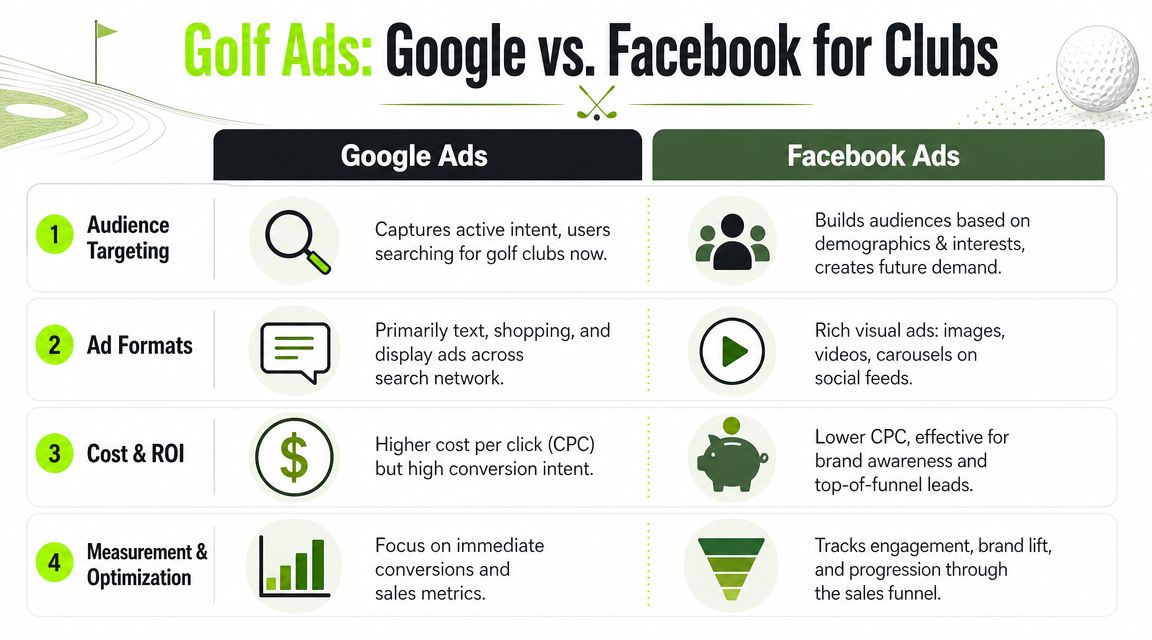
Google usually serves the club that wants to intercept existing demand. Facebook usually serves the club that wants to create demand, shape perception, and stay visible until timing improves. Neither is automatically better in every case.
| Criterion | Google Ads (Search) | Facebook Ads (Meta) |
|---|---|---|
| Audience targeting | Reaches people actively searching for a golf-related need | Reaches people based on profile, interests, behaviour, and location |
| Buyer intent | Usually higher at first click | Usually lower at first click, stronger after nurturing |
| Creative style | Message clarity and offer match matter most | Visual quality, offer framing, and local relevance matter most |
| Speed to enquiry | Often faster when search demand exists | Often slower, especially for membership decisions |
| Use case | Membership capture, society demand, venue hire searches | Awareness, remarketing, local community reach, future member pipeline |
| Measurement | Cleaner direct-response attribution | Broader influence across the funnel, often less direct |
| Operational pressure | Needs strong keyword control and landing pages | Needs strong creative and a reliable nurture process |
Cost and intent are not the same thing
A widely cited benchmark comparison found Facebook Ads average CPC at $0.62 versus Google Search Ads at $2.69, while Google Search conversion rates averaged 4.40% and Facebook Ads 9.21% overall across industries in this benchmark comparison from Stackmatix. For golf clubs, that benchmark is useful because it highlights the trade-off rather than pretending one channel is universally cheaper or better.
The wrong conclusion is that lower click cost means lower acquisition cost. It doesn't.
A lower-cost Facebook click can still produce a weaker commercial outcome if the traffic is curious rather than ready. A more expensive Google click can be worthwhile if it comes from a prospect already looking for membership in your town.
How clubs should actually compare them
Ask four practical questions.
Audience quality
Google gives you declared intent. Facebook gives you inferred fit.
If your area has enough active searchers, Google can be the more direct route to membership conversations. If your area has plenty of nearby golfers who know your club exists but haven't considered joining, Facebook can widen the pool.
Creative demand
Search rewards precision. Social rewards persuasion.
Google ads need good keyword grouping, strong copy, and pages that answer the search immediately. Facebook needs fresh images, better hooks, and offers that create curiosity or trust.
Measurement reality
Google often gets the final click. Facebook often assists the journey.
That doesn't mean Facebook is weak. It means the club needs to understand assisted influence, remarketing, and delayed conversion rather than relying only on last-click reporting.
Operational fit
Search leads often convert faster. Social leads often need more handling.
A platform is only as good as the club's ability to respond, qualify, and move the prospect to the next step.
If you want another useful perspective on how the channels complement each other in paid media, this piece from Market With Boost for paid media is worth reviewing alongside your own campaign data.
Integrating Ad Channels into a Growth System
Advertising isn't the growth system. It feeds the growth system.
That distinction changes how clubs should allocate budget. A manager who only asks which platform gets more leads is still looking at the top of the funnel. The stronger question is what happens to a lead once it enters the club.
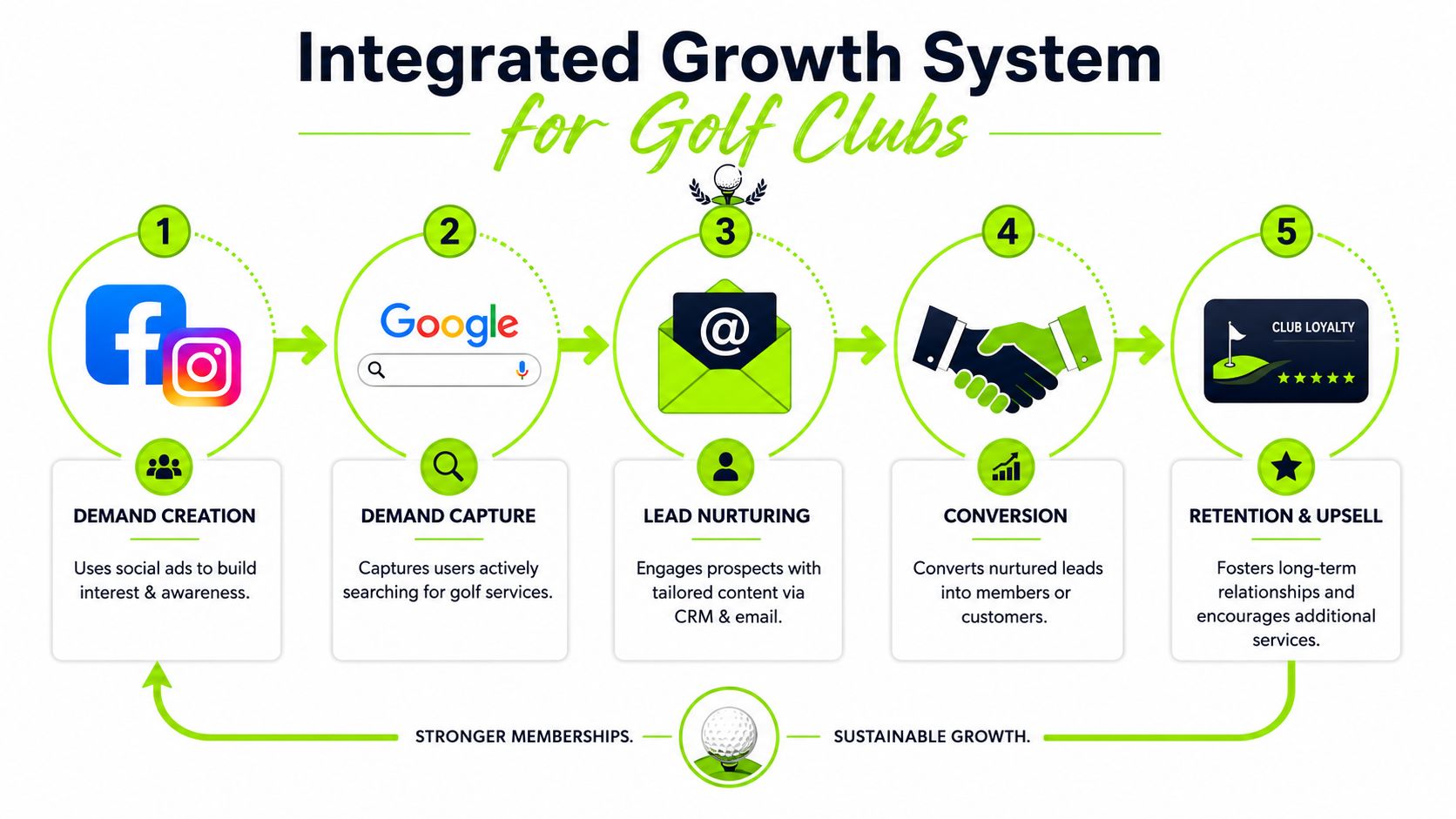
Google and Facebook play different roles in the same pipeline
Independent UK guidance from a golf marketing agency notes that Google Search typically converts faster because users are actively searching, whereas Facebook usually needs more nurturing before conversion, which is why Google Ads is structurally better for high-intent capture and Meta/Facebook is better for demand creation and retargeting in the golf-club context as explained here.
That difference should shape the backend process.
A typical club growth pipeline looks more like this:
- A prospect sees a Facebook ad and becomes aware of the club
- The prospect visits the website but doesn't enquire yet
- The prospect later searches on Google for membership or for the club by name
- The club receives the enquiry
- Follow-up and nurturing determine whether that lead becomes a visit and then a member
When clubs track only the first or last touch, they miss how the channels work together.
What must happen after the enquiry
This is the part clubs often underbuild.
A workable system needs:
- Central lead visibility so every enquiry lands in one place
- Source tracking so the club knows whether the lead came from Google, Facebook, organic search, or referral
- Fast first response with a clear next step, not a vague acknowledgement
- Automated nurture for people who aren't ready to commit on day one
- Status tracking so nobody has to guess whether a lead is new, contacted, booked, or lost
Without that structure, clubs end up with the same pattern. Good campaigns. Patchy follow-up. No reliable attribution. Committee discussions based on opinions rather than data.
System quality decides channel performance
This is why the golf club Google Ads vs Facebook Ads argument often lands in the wrong place. Clubs compare platforms before they've fixed handover, response, and conversion.
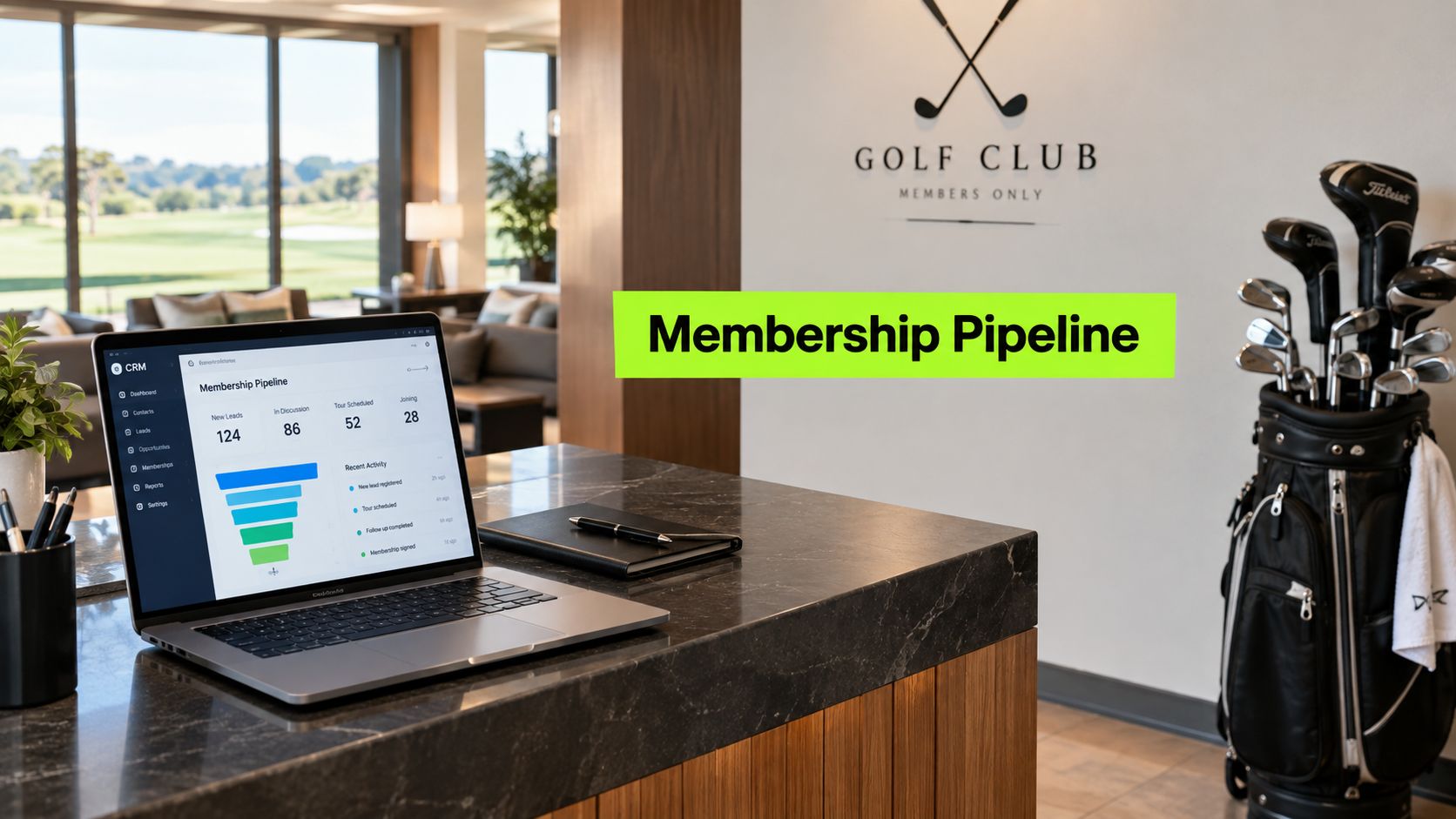
One option in this space is GolfRep, which combines advertising with CRM-based follow-up and tracking so clubs can see where enquiries came from and what happened next. That kind of joined-up setup matters more than the ad account alone because both channels generate value differently.
The platform creates the opportunity. The process converts it.
If you're reviewing how to build a repeatable system for ad conversion, it helps to think beyond ad copy and targeting. Repeatability comes from consistent handling, clear ownership, and measured follow-up after the form is submitted.
Choosing Your Channel Mix Example Playbooks
Most clubs shouldn't choose between Google and Facebook in absolute terms. They should choose the right mix based on objective, local demand, and internal capacity to convert leads.
Playbook for an aggressive membership drive
Put Google first if the club needs conversations now.
That approach makes sense when membership pages are strong, pricing is clear enough to qualify interest, and the team can respond quickly to genuine enquiries. Use Facebook mainly to retarget website visitors and stay visible to prospects who clicked but didn't act.
This setup suits clubs with immediate joining capacity and a clear membership proposition.
Playbook for building a longer-term waiting list
Use a more balanced split when the club wants a steady pipeline rather than short bursts.
Facebook can keep the club in front of nearby golfers, show the atmosphere and member experience, and collect softer expressions of interest. Google then captures the prospects who move from passive interest to active research later.
This works well when the club wants predictability, not just spikes.
Playbook for promoting venue hire or a new facility
Lean more heavily into Facebook and Instagram when the offer is visual and the market may not be searching in large volume yet.
Events, weddings, simulator launches, coaching programmes, beginner pathways, and hospitality offers often benefit from social reach because the audience may respond to the presentation before they ever search for it. Google still has a role for branded and service-led demand capture, but social often carries more of the awareness job.
The decision filter
Use this shortlist when deciding where budget goes first:
- Choose Google first if people already search for what you offer in your area
- Choose Facebook first if your challenge is visibility, awareness, or audience warming
- Use both together if the club wants to create demand and capture it later
- Fix operations first if leads already come in but conversion is inconsistent
The strongest clubs don't just buy traffic. They build a system that turns attention into action, then action into revenue.
If your club wants a more predictable membership pipeline, GolfRep helps connect lead generation, CRM tracking, and structured follow-up so your ad spend isn't judged only by clicks, but by what converts.
Ready to tap into our proven growth system?