Build a Predictable Golf Club Marketing Strategy

Most golf club marketing advice starts in the wrong place. It tells clubs to post more, spend more on ads, improve their website, and generate more enquiries.
That sounds sensible, but it usually misses the primary bottleneck.
A workable golf club marketing strategy isn't just about filling the top of the funnel. It's about building a system that turns interest into booked visits, conversations, and memberships without relying on someone remembering to chase every lead manually. At GolfRep, we've seen clubs spend money creating demand, only to lose those enquiries in inboxes, spreadsheets, or slow follow-up.
That isn't a traffic problem. It's a conversion problem.
The Growth Problem Most Golf Clubs Misdiagnose
The common assumption is simple. If membership is flat, the club needs more leads.
In practice, many clubs already get enough signals of interest to grow. The issue is what happens after the enquiry arrives. As GolfRep has noted in our analysis of outdated golf marketing, the biggest challenge for most golf clubs today isn't generating new enquiries, it's having a system to handle, respond to, and convert them into members.
That distinction matters because most clubs are trying to pour more water into a leaky bucket.
A manager gets a website form on Tuesday, a Facebook message on Wednesday, and an email asking about flexible membership on Friday. None of those leads look urgent in isolation. Then the week gets busy. A competition takes priority, a member issue needs sorting, the secretary is off, and the follow-up slips. By the time anyone replies properly, the prospect has either gone cold or joined another club.
Clubs rarely lose enquiries because people had no interest. They lose them because nobody owned the next step.
This is especially common in committee-led clubs and lean teams. Marketing gets treated as a campaign problem when it's really an operations problem. If lead visibility is poor, response times are inconsistent, and nobody can see where each prospect sits in the process, then more lead generation only magnifies the waste.
We see this pattern often. Clubs ask why they aren't attracting enough members, but the sharper question is whether they can reliably convert the interest they already create. That's the issue behind many of the frustrations covered in why most golf clubs struggle to attract new members.
What a healthier diagnosis looks like
A club with a sound growth model asks different questions:
- Lead ownership: Who responds when an enquiry lands?
- Response process: What happens in the first few minutes, not the first few days?
- Pipeline visibility: Can the club see every enquiry by source, status, and next action?
- Follow-up discipline: Is nurture happening through a system, or only when staff have time?
If those answers are weak, buying more traffic won't fix the underlying problem.
Establishing Goals That Drive Revenue
Most golf clubs set marketing goals that sound reasonable but don't help decisions. "Increase membership" is too broad. "Get more enquiries" is only slightly better. Neither tells you whether the club is buying the right traffic, converting it efficiently, or attracting commercially healthy members.
A stronger approach starts with a handful of numbers that tie activity to revenue.

According to Torro's golf club marketing guidance, golf clubs that actively track and optimise KPIs like membership retention rate and average revenue per member can achieve up to a 25% increase in member retention and a 15% boost in annual revenue. The same source stresses that this requires CRM and booking-platform integration so clubs can capture behavioural data and identify at-risk members before renewal.
The KPIs that matter most
If you're building a dependable golf club marketing strategy, these are the figures worth reviewing first:
- Qualified lead volume: Not every enquiry counts equally. Separate casual interest from prospects who fit your membership profile.
- Lead-to-visit rate: Many clubs discover a significant leak at this stage. Plenty of enquiries never become tours, trial rounds, or meetings.
- Visit-to-member rate: If people visit but don't join, the issue may sit with sales conversations, offer structure, or expectation mismatch.
- Cost per new member: This gives context to ad spend and stops teams celebrating cheap leads that never convert.
- Average revenue per member: A lower-entry product can still be commercially sensible if retention and secondary spend are strong.
- Retention rate: Acquiring members into a weak retention model creates churn, not growth.
Avoid vanity metrics
Some metrics look impressive and still tell you very little.
A club can point to website traffic, social reach, or total enquiries and still have no idea whether marketing is producing profitable members. That's why we push clubs to connect every stage of the funnel. If someone clicks an ad, fills a form, books a tour, joins, and renews, that journey should be measurable.
Practical rule: If a KPI can't help you make a budget or staffing decision, it probably isn't a priority KPI.
Set goals by stage, not just by outcome
It helps to separate targets into three layers.
| Goal layer | What to measure | Why it matters |
|---|---|---|
| Acquisition | Qualified enquiries, source quality, cost per lead | Shows whether campaigns are attracting the right local golfers |
| Conversion | Response time, booked visits, follow-up completion | Reveals whether the club is actually handling demand well |
| Value | New members, ARPM, retention trends | Tells you whether growth is financially healthy |
This changes the conversation inside the club. Marketing stops being judged by surface activity and starts being judged by contribution to revenue, retention, and member quality.
Identifying and Targeting High-Value Golfers
Broad targeting wastes budget. "Local golfers aged 25 to 65" isn't a market segment. It's a postcode map with too many conflicting motivations inside it.
The clubs that grow more predictably usually know exactly who they want more of. Not just by age or income, but by playing pattern, buying trigger, and membership fit.

Build segments around behaviour
A useful segment should help you change messaging, offers, or follow-up. If it doesn't, it's too vague.
Here are three examples we often work from:
- The time-poor professional: Wants convenience, flexibility, and a clear route into the club without feeling tied to a rigid playing pattern.
- The committed golfer: Cares about course condition, competition calendar, and the quality of the membership base.
- The social household: Sees the club as a lifestyle venue as much as a sporting one. Facilities, events, and atmosphere matter.
Each group responds to different language. A serious golfer won't care much about the same message that persuades a busy parent or a younger professional.
Look beyond demographics
Demographics help with media buying, but they don't explain intent. Start with questions such as:
- Why would this person consider joining now?
- What is stopping them from enquiring?
- What would make them book a visit instead of delaying?
- What part of the club experience is most likely to justify the price?
Those answers should shape your campaigns, your landing pages, and your follow-up emails. If your paid social targeting is part of the mix, audience structure becomes more useful than boosting generic posts. A more tactical view of that sits in GolfRep's guide to golf club Facebook ads.
The best targeting isn't just about finding golfers. It's about finding golfers whose needs match what your club already delivers well.
Create a message map
For each segment, define four things in writing:
| Segment | Main concern | Message angle | Next step |
|---|---|---|---|
| Busy professional | Lack of time | Flexible access and easy onboarding | Book a call or visit |
| Serious player | Playing quality | Course, competitions, standards | Arrange a trial round |
| Social member type | Lifestyle fit | Club atmosphere and wider use | Visit the clubhouse |
That level of clarity makes the rest of your strategy easier. Ads become sharper. Sales conversations improve. Follow-up feels relevant instead of generic.
Building Your High-Value Lead Acquisition Engine
Once the audience is defined, lead generation becomes more disciplined. Instead of trying every channel in isolation, build a simple engine where each part does a specific job.
Social ads are useful for creating local demand and putting the club in front of golfers who fit your target profile. Search campaigns are stronger when someone is already looking for membership, a local club, or a trial round. Local SEO supports both by helping the club appear when intent is already present. The website and landing pages then have one job. Convert interest into a trackable enquiry.
That only works if the channels are connected.
For northern UK golf courses, Lightspeed reported that clubs running managed digital marketing for 90 to 270 days saw a 24% increase in total sales, a 21.7% increase in customers, and a 30.5% increase in rounds compared to the previous year. The same source says this growth was supported by a 155.7% increase in Facebook reach and a 505.9% increase in web sessions. The useful lesson isn't "do more Facebook". It's that sustained digital activity can lift results when it feeds a coherent system.
What each channel should do
A healthy acquisition engine usually looks like this:
- Paid social: Builds awareness among the right local audiences and introduces membership messages that fit specific segments.
- Search ads: Captures active intent from people already comparing clubs or looking for membership options.
- Organic search and local presence: Supports credibility when prospects research the club after seeing an ad or hearing about it elsewhere.
- Landing pages: Strip away distractions and focus on one conversion action.
- CRM capture: Records source, campaign, and enquiry type from the first touch.
Quality beats volume
A lot of clubs still ask for "more leads" when they should be asking for better-fit leads.
That changes the ad brief. Instead of generic lines about joining now, speak to a problem the audience already feels. If the target is a professional with limited availability, the message should reduce friction. If the target is a stronger golfer, the message should reinforce standards, competition, and course quality. If the target is a lapsed club member elsewhere, the message should lower the barrier to re-engagement without sounding cheap.
A practical breakdown of channel roles and enquiry capture sits in this guide to golf club lead generation.
The channel mistake clubs make
Many clubs judge channels separately and too early.
A prospect might see a Facebook ad, ignore it, search the club name later, revisit on mobile, then enquire after receiving an email or speaking to a friend. If the club only credits the last click, it often underestimates the channels that start demand. That's why lead source tracking inside the CRM matters so much. It lets the club compare not just enquiry volume, but downstream conversion to visit and member.
The Automated System That Converts Enquiries 24/7
Golf clubs rarely lose enquiries because the ad was weak. They lose them because nobody owns the next step.
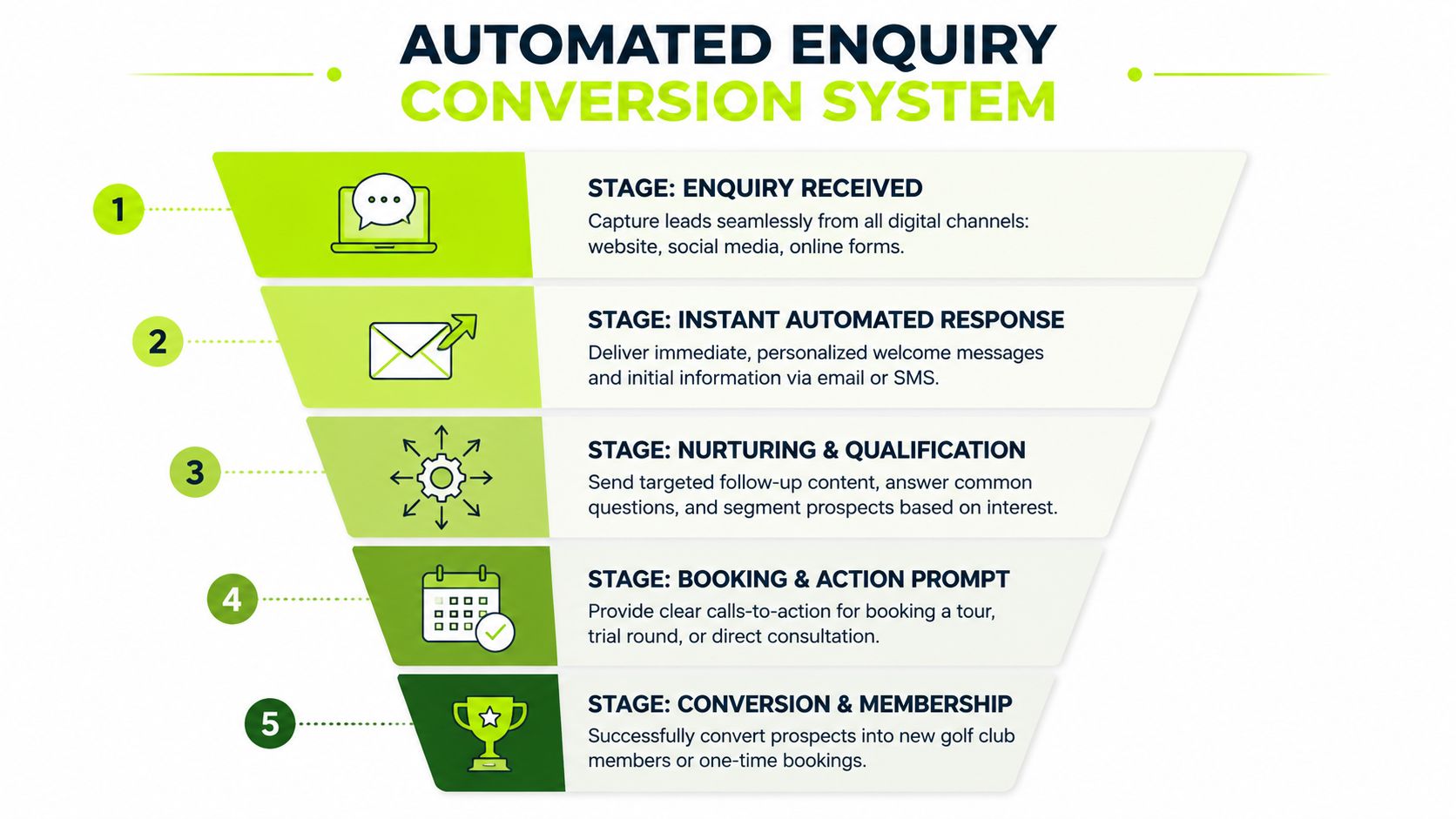
A prospect submits a membership form at 9:14pm, gets no reply that night, hears nothing the next morning, and by lunch they are looking at another club. That is the bottleneck. Lead generation gets the attention. Lead handling decides the revenue.
Start with one source of truth
Once a club is running paid campaigns, referral activity, website forms, and offline enquiries, scattered records stop being a minor admin issue. They become a conversion problem. Staff reply twice to one lead, miss another completely, and cannot see who asked about membership last week but never booked a visit.
The fix is simple in principle and often poorly implemented in practice. Every enquiry needs to land in one CRM, with the source attached and the current stage visible to anyone handling sales.
That record should show:
- Lead source: The channel or campaign that created the enquiry
- Lead status: New, contacted, booked, visited, joined, lost
- Owner: The person responsible for the next action
- Activity history: Calls, emails, notes, and appointments
- Next action: A dated task, not a mental reminder
If the team cannot open one system and see who needs contact today, follow-up will slip.
Fast acknowledgement matters more than polished copy
The first reply has one job. Confirm the enquiry and move the prospect to a clear next step.
That might be an email, SMS, or both. The format matters less than the speed and relevance. A generic confirmation with no action is weak. A short message that confirms receipt, sets expectations, and offers a booking link or named contact gives the prospect confidence that the club is organised.
Then the workflow should adapt. A prospect who requested a tour should not receive the same sequence as someone downloading membership information. A prospect opening every message and revisiting the pricing page should not sit in the same queue as someone who has not engaged since day one.
According to Lightspeed's review of golf marketing technology, segmented email campaigns for UK clubs achieve 25 to 40% higher open rates and 18 to 25% higher click-through rates than broadcast lists. Lightspeed also notes that more advanced systems use lead scoring to push high-intent prospects to sales teams within hours and use behavioural triggers to adjust nurture timing.
A fixed follow-up sequence creates admin. A responsive one creates conversations.
A practical 24/7 conversion workflow
We use a structure like this because it removes ambiguity for staff and keeps momentum with the prospect:
Capture the enquiry
Website forms, ad forms, phone call notes, and front-desk enquiries all feed the CRM with source data attached.Acknowledge immediately
Send a message straight away confirming receipt and offering a useful next action such as booking a call, visit, or trial round.Assign ownership
Every lead needs a named owner. Shared inboxes and informal handoffs are where good enquiries disappear.Trigger the right follow-up
Send different messages based on enquiry type, timing, and behaviour, not one generic sequence for everyone.Drive toward a sales event
The goal is not endless nurturing. It is to secure the next meaningful step, usually a call, visit, meeting, or hosted round.Escalate buying signals
If a prospect clicks repeatedly, replies, books, or views high-intent pages, staff should be prompted to act quickly.
Clubs usually feel the trade-off at this stage. Full manual follow-up can feel personal, but it breaks under volume and staff absence. Full automation keeps speed high, but poor setup makes the club sound cold. The answer is not choosing one over the other. Automation should handle speed, consistency, and reminders. Staff should handle judgement, rapport, and closing.
Automation protects lead quality
Some managers worry that automated follow-up will make the club feel impersonal. That happens when automation is used as a substitute for sales discipline.
Used properly, it does the opposite. It ensures every prospect gets a timely reply, every conversation is logged, and every staff member can pick up the thread without asking the prospect to repeat themselves. That is not less personal. It is better run.
For clubs that do not want to piece this together across separate tools, GolfRep combines advertising, CRM capture, and automated follow-up in a single lead-management setup. The platform matters less than the operating model. Enquiries need to be centralised, visible, and followed up with structure every day, including when the office is closed.
Positioning Offers to Attract Long-Term Members
A lot of clubs undermine themselves when they market flexible membership badly. They present it like a compromise, a discount, or a stopgap. Then they wonder why the offer attracts price shoppers instead of future long-term members.
Flexible products can work well. The mistake is in the positioning.
As noted in The Golf Car Hub's discussion of wider-audience marketing, traditional full memberships are not always a fit for today's busy lifestyles. The same source highlights the challenge for UK clubs. They need to communicate the value of flexible options to new segments without creating the impression that the club is lowering its standards or becoming a discount venue.
Position around fit, not cheapness
The strongest message usually isn't "save money". It's "choose the membership that fits how you play".
That framing protects brand value. It tells prospects the club understands different life stages and playing habits, while keeping the focus on access, usability, and experience.
For example:
- For busy professionals: Emphasise flexibility, ease, and fewer barriers to joining.
- For returning golfers: Emphasise a comfortable route back into regular play.
- For socially motivated prospects: Emphasise the wider club environment, not just tee access.
If the campaign sounds like clearance pricing, the club will attract bargain hunters. If it sounds like thoughtful access design, it will attract better-fit enquiries.
Keep the premium cues intact
When promoting flexible options, don't strip away the elements that make the club desirable. Keep showing the course, the atmosphere, the standards, and the member experience. The product may be more flexible, but the brand shouldn't become apologetic.
A good rule is to separate price communication from value communication. Price tells people what they pay. Value tells them why joining is worth doing now. Clubs that collapse those into one message often weaken both.
Measuring Performance and Optimising for Growth
Clubs rarely have a traffic problem in isolation. They usually have a visibility problem between enquiry and membership. If nobody can see how many leads were contacted, how quickly they were followed up, how many booked a visit, and how many joined, optimisation turns into internal debate.
That is why reporting needs to cover the full path from first click to signed member. At GolfRep, we have seen clubs change agencies, redesign pages, and increase ad spend before fixing the simpler issue. Enquiries were coming in, but the post-enquiry process was inconsistent, slow, or impossible to track.
For membership-focused UK clubs, CUFinder's benchmark data reports that customer acquisition cost for a membership lead ranges from £65 to £85. The same source reports overall website conversion rates average 2.8%, desktop converts at 3.9%, and mobile converts at 1.8%, even though mobile drives 62.5% of all traffic. Those benchmarks are useful, but only in context. A lead at the higher end of the range can still be profitable if the club responds well and converts efficiently. A cheaper lead is not a win if it sits untouched for three days.
What to review every week
Weekly reporting should stay close to operations. The question is simple. What needs attention now?
| Weekly metric | What it tells you | Common issue if weak |
|---|---|---|
| Lead volume by source | Which channels are feeding the pipeline | Budget is sitting in weak channels |
| Response status | Whether enquiries are being handled quickly and consistently | Leads are waiting too long or missed entirely |
| Booked visits or calls | Early conversion health | Follow-up process is weak or unclear |
| Landing page conversion | Whether the page is turning interest into enquiries | Message mismatch, poor form design, or weak offer framing |
| Mobile vs desktop behaviour | Whether usability is reducing demand | The mobile journey is harder than it should be |
A weekly review should produce decisions, not just observations. Pause a weak source. Fix a form issue. Reassign lead handling if response times slip.
What to review every month
Monthly reporting needs to answer commercial questions that affect budget, staffing, and targets.
- Which channels produce joined members, not just leads
- How much the club is paying for qualified demand
- Where prospects drop out between enquiry, visit, and join
- Which offers attract better-fit conversations
- Whether retention and member value support current acquisition spend
Committee reporting often drifts toward surface metrics because they are easy to read. Clicks, impressions, and cost per lead matter, but they do not explain why growth stalls. If mobile traffic is strong and conversion is weak, the issue may sit with form length, booking friction, page speed, or a follow-up gap after submission. If lead numbers look healthy but visit bookings stay flat, the problem usually sits in the handoff process rather than the ad account.
A sample planning view
Clubs do not need an elaborate dashboard to manage this well. They need a planning view that links activity to the next commercial outcome.
| Phase | Months | Key Activities | Indicative Monthly Budget | Primary KPI |
|---|---|---|---|---|
| Foundation | 1-2 | CRM setup, lead tracking, landing pages, core campaigns, response automation | Set based on club goals and local competition | Lead visibility and enquiry handling |
| Stabilisation | 3-4 | Audience refinement, ad testing, follow-up improvements, sales process review | Set based on lead quality and capacity | Booked visits and lead-to-visit rate |
| Optimisation | 5-6 | Budget reallocation, mobile conversion fixes, nurture updates, offer testing | Set based on member acquisition economics | Cost per new member and downstream conversion |
No fixed budget belongs in a template. Catchment size, local competition, membership pricing, and internal sales capacity vary too much. The better discipline is to increase spend only when the club can prove that the next stage of the funnel is under control.
How to Diagnose the Primary Bottleneck
Use a simple diagnostic view.
- Plenty of clicks, few enquiries: The landing page, form, or offer is underperforming
- Plenty of enquiries, few booked visits: Response speed, automation, or follow-up structure is weak
- Plenty of visits, few joins: The sales conversation, membership fit, or proposition needs work
- New joins but weak economics: Retention, pricing, or member value is limiting growth
This is the part many golf marketing articles skip. More lead generation does not fix a club that cannot contact leads promptly, nurture undecided prospects, or track pipeline movement inside a CRM. Growth comes from diagnosing the blocked stage and fixing it with process, ownership, and automation.
Good optimisation means improving the stage that is limiting revenue, then measuring whether that fix changed outcomes.
If your club wants a more predictable golf club marketing strategy, GolfRep helps build the system behind it. That includes lead generation, CRM visibility, automated follow-up, and conversion tracking from first enquiry to membership outcome, so the team spends less time on admin and more time converting the right opportunities.
Ready to tap into our proven growth system?