“The Hidden Reason Your Tee Sheet Isn’t Full”

Most advice about empty tee sheets points in the wrong direction.
When a club sees gaps on Saturday mornings or late cancellations on a bank holiday weekend, the instinct is usually the same. Run more ads. Post more on social media. Offer a deal. Push harder on lead generation.
That sounds sensible, but it often misses the underlying issue behind “The Hidden Reason Your Tee Sheet Isn't Full”. In practice, many clubs don't have an awareness problem. They have a conversion and operations problem. Interest comes in, but the club doesn't consistently capture it, route it, follow it up, and turn it into booked rounds, member visits, or repeat play.
A tee sheet rarely stays patchy because nobody wants to play. More often, it stays patchy because the club handles demand manually, visibility is poor, and nobody owns the gap between enquiry and booking.
Your Tee Sheet Problem Is Not a Marketing Problem
A lot of clubs assume that an empty slot is proof of weak marketing. It usually isn't.
The more common pattern is this. Enquiries arrive through the website, Facebook, email, phone calls, visitor forms, societies, or third-party booking channels. Some get answered quickly. Some sit in an inbox. Some get passed from the office to the pro shop, then to a manager, then nowhere. By the time someone follows up, the golfer has booked elsewhere.
That is the enquiry conversion gap. It sits between interest and revenue, and it drains the tee sheet.
A useful way to think about it is this. Marketing creates opportunity. Systems turn that opportunity into bookings. If the second part is weak, the first part becomes expensive noise.
This is why many clubs can point to decent traffic, regular enquiries, and still feel that bookings are inconsistent. The issue isn't always top-of-funnel attention. It's the lack of a reliable process from first contact to confirmed play.
Where clubs usually lose the booking
The leak tends to show up in familiar places:
- Slow replies: A golfer enquires in the evening and hears nothing until the next day.
- No clear ownership: Staff assume somebody else has responded.
- Poor lead visibility: Management can't see which enquiries booked, which stalled, and which were lost.
- Manual follow-up: Prospects who were interested but not ready disappear.
- Disconnected systems: The website, CRM, and tee sheet don't speak to each other.
Empty tee sheets don't always mean low demand. They often mean demand was handled badly.
That distinction matters because it changes what the club should fix first.
If you're still treating every revenue gap as a traffic problem, it's worth revisiting why most golf club marketing fails. In many cases, clubs don't need more attention. They need a cleaner path from enquiry to booking.
Why More Enquiries Can Make the Problem Worse
More leads sound like progress. But if the club can't process them properly, more leads create more missed chances.
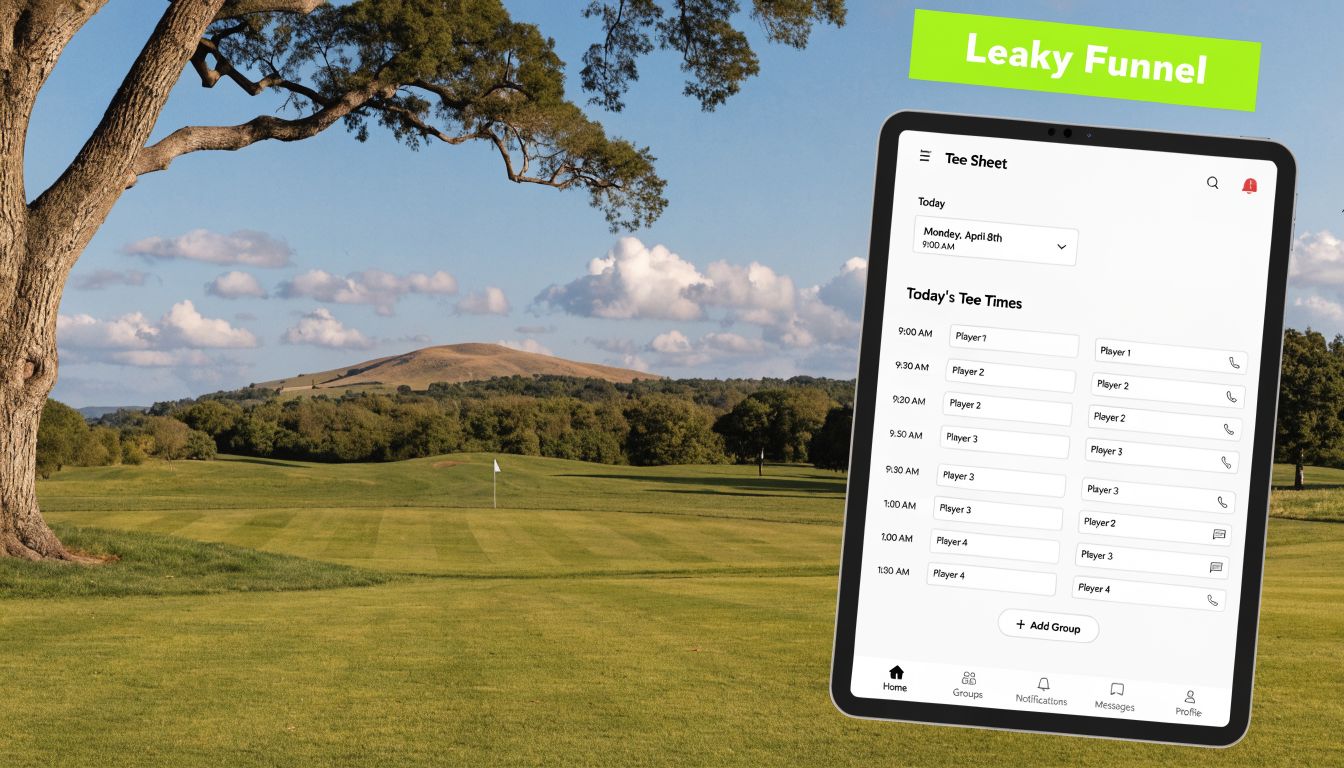
The leaky bucket analogy applies. If your enquiry handling is disorganised, adding more marketing budget is like pouring more water into a bucket with holes in the bottom. The volume goes up, but retention doesn't.
In clubs, the holes are usually operational. A front desk team is stretched. A committee-led approval process slows decisions. A pro shop handles calls well but doesn't log them. An email form sends messages to a general inbox that nobody checks after hours. On paper, the club is generating interest. In reality, it is failing to convert that interest consistently.
More volume increases strain
Poor systems don't just waste spend. They create internal friction.
When more enquiries come in without structure, staff become reactive. The office chases urgent tasks. Follow-up becomes selective. The enquiries that look easiest get attention first. The others drift. That leads to a distorted view of demand, because the club only sees the bookings that survived the chaos.
Data from the 2026 Golf Datagolf UK Tee Sheet Analytics Report states that 68% of private member clubs operate at 72% average weekend utilisation, compared with a top-quartile benchmark of 89%. The same analysis links this gap to static rate structures and inefficient processes, and notes that a 15-20% peak surcharge based on demand forecasts could boost revenue by £45k-£120k annually per course.
That point matters for a simple reason. Even when demand exists, weak process stops a club from capturing its value.
What good clubs track
The clubs that handle demand better usually pay attention to a few basic operating measures:
- Response time: How quickly does someone receive a reply after submitting an enquiry?
- Lead visibility: Can the club see every enquiry in one place?
- Conversion tracking: Can management tell which channel produced the booking?
- Follow-up discipline: Does every non-booked prospect receive a next step?
Practical rule: Don't scale campaigns until you can see, assign, and follow up every enquiry.
More marketing is only useful when the club can absorb it. Until then, you're not solving the tee sheet problem. You're magnifying it.
A Diagnostic Checklist for Your Conversion Gap
Most clubs don't need a full transformation to spot the issue. They need an honest audit.
If bookings feel inconsistent, start with the journey from first enquiry to confirmed tee time. Not what you think happens. What happens on a Tuesday afternoon, on a Friday evening, and on a Sunday when the office is shut.
According to the 2026 UK Golf Benchmarking Survey, fragmented data silos between tee sheet software and CRM systems cause 54% of private clubs to miss repeat guest recapture opportunities. The same survey links this to 18% unbooked peak slots, and points to integrated systems that support automated waitlist refills and cancelled tee time recapture.
That isn't a marketing diagnosis. It's a systems diagnosis.
Ask the awkward questions
The fastest way to find the leaks is to ask questions that are hard to answer off the top of your head.
| Area | Question | Yes / No | Notes |
|---|---|---|---|
| Response speed | Do all web enquiries receive an acknowledgement outside office hours? | ||
| Ownership | Is one named person responsible for each incoming lead? | ||
| Visibility | Can management see all enquiries in one place, regardless of channel? | ||
| Tracking | Can you connect an enquiry to an eventual booking or non-booking outcome? | ||
| Follow-up | Do unconverted enquiries receive planned follow-up rather than ad hoc chasing? | ||
| Integration | Does your CRM or enquiry log connect with your tee sheet process? | ||
| Recapture | When a peak slot is cancelled, is there a reliable waitlist or refill process? | ||
| Reporting | Can you identify where your best enquiries came from last month? |
A lot of clubs answer yes in principle and no in practice. That's the important distinction.
Signs your process is leaking revenue
You don't need complex software to recognise a broken handoff. The warning signs are usually visible on the ground:
- Enquiries live in too many places: phone notes, inboxes, scraps of paper, a pro's memory.
- Staff rely on manual reminders: if somebody is off sick, the follow-up stops.
- The club can't distinguish interest from intent: every lead gets the same treatment, or no treatment.
- Cancelled slots aren't actively refilled: the booking just disappears and the gap remains.
- Repeat guest data isn't usable: the club knows people played before, but can't act on it.
A simple golf club enquiry tracking review usually exposes the problem quickly. Not because clubs lack effort, but because effort without process is hard to sustain.
If nobody can tell you exactly what happens after an enquiry arrives, that process isn't under control.
The Four Pillars of a Predictable Booking Pipeline
A full tee sheet is rarely the product of one clever campaign. It usually comes from a booking system that works reliably under normal conditions, during busy spells, and outside office hours.
That requires structure. The framework we use is simple. Four pillars, each handling a different part of the journey from attention to booking to repeat play.

Pillar one Optimised outreach
In this situation, marketing does matter, but only when it is targeted.
Clubs don't need more vague exposure. They need enquiries from golfers likely to book a round, visit the club, enquire about membership, or return after a guest experience. Broad awareness without intent creates admin, not revenue.
The standard to aim for is relevance. Messaging, offers, landing pages, and calls to action should reflect the type of player you're trying to attract. Visitor golf is different from membership. Society enquiries are different from casual green fee demand. A single generic funnel tends to lower conversion because it blurs those differences.
Pillar two Seamless conversion
This is the handoff point where many clubs struggle.
A good conversion system acknowledges the enquiry immediately, captures the right details, routes it to the right person, and creates a next step without relying on memory. If that sounds basic, it is. But basic done consistently beats clever done occasionally.
This is also the only place in the article where it's worth naming a specific approach. GolfRep builds this through automated qualification, structured CRM routing, and follow-up workflows so clubs can see where leads came from and what happened next.
Good enquiry handling should reduce workload, not create more of it.
Pillar three Exceptional experience
A booking pipeline doesn't end when a tee time is reserved.
If the arrival experience is clumsy, if communication is poor, or if visitors don't get a clear route back into the club, the tee sheet problem returns in a different form. Retention and repeat booking are part of fill rate. The club has already paid the cost of earning that attention. It shouldn't waste it.
This pillar often includes practical steps that don't sound glamorous. Clear confirmations. Useful reminders. Better handover between front of house and golf operations. A defined process for converting guest rounds into repeat rounds or membership conversations.
Pillar four Data-driven insights
This pillar prevents the club from making bad decisions based on assumptions.
One example sits in the tee sheet itself. Research summarised by Easy Tee Golf on tee sheet interval optimisation shows that a 7-minute interval can theoretically allow over 80 parties, but only 51 complete play within a 10-hour window because of backups. The same research shows that optimised intervals based on pace-of-play data are vital for maximising revenue and member satisfaction.
That matters because some clubs try to force more volume into the sheet without fixing the system around it. Shorter intervals look productive until pace slows, queues build, and the round experience deteriorates.
A predictable pipeline depends on decisions grounded in actual booking and play behaviour, not optimistic theory.
Your Action Plan Four Prioritised Fixes
Most clubs don't need to rebuild everything at once. They need to fix the biggest leaks in the right order.

The best starting points are the ones that improve control quickly. They make the enquiry journey visible, reduce response delays, and give staff a process they can maintain.
Fix one Respond immediately even when the club is closed
If a golfer enquires at night and hears nothing until the following day, you've already made the booking harder than it needed to be.
Set up an automatic acknowledgement for every web and email enquiry. Keep it plain. Confirm receipt, explain what happens next, and give a realistic response window. If relevant, include a simple route to book or request a callback.
This doesn't replace a human response. It protects the lead until one happens.
Fix two Put every enquiry in one place
Clubs lose opportunities because information sits in inboxes, notebooks, and separate systems.
A central log can be a CRM. It can also begin as a disciplined spreadsheet if that's what the club is committed to using. What matters is that every enquiry is recorded, assigned, and updated. Once all leads are visible, patterns become obvious. You start to see where delays happen, which channels produce serious intent, and where prospects disappear.
Fix three Build follow-up for the leads that don't book first time
A lot of golfers aren't saying no. They're saying not yet.
That distinction matters. A visitor may need to confirm with friends. A prospective member may want to visit first. A society organiser may be comparing venues. If the club only responds once, then waits, it leaves too much to chance.
Try a simple sequence:
- Immediate acknowledgement: confirm the enquiry and next step.
- Human follow-up: answer the question directly and invite a booking conversation.
- Later check-in: if no action follows, send a polite reminder with one clear option.
Many clubs recover bookings through this method without lowering price.
Fix four Coordinate demand across venues if you operate more than one site
Single-site clubs focus on one sheet. Multi-site operators have a broader problem. Demand at one venue can distort another, especially when booking rules, guest routes, and staff follow-up aren't aligned.
The Macdonald Hotels & Resorts case study highlights that, for multi-site operators, the challenge isn't just filling one tee sheet but coordinating demand across a portfolio. It describes centralised CRM automation used to predict and rebalance regional demand, helping prevent cross-venue cannibalisation and improve fill rates without relying on discounts.
A multi-site group needs one view of demand, not separate local guesses.
That principle applies even if your club only has one site today. The more fragmented your booking and follow-up process becomes, the more your internal teams behave like disconnected venues anyway.
Case Example From Empty Slots to a Thriving Club
The clearest proof usually comes from clubs that stop treating the tee sheet as a pure marketing issue.

Across a broad sample of facilities, anonymised research shared by Priswing on tee sheet fragmentation found that only 50% of tee times are booked as full foursomes, while 20% are booked by three players, 20% by two players, and 10% by single players. That creates the familiar "Swiss cheese" pattern of partial occupancy that clubs struggle to monetise later.
That pattern is familiar because it doesn't begin with demand alone. It often reflects weak control around booking flow, slot management, follow-up, and repeat conversion.
What changed at Bidston
Bidston Golf Club is a useful example because the challenge wasn't solved by merely shouting louder. The club needed a more dependable way to capture interest, qualify it, and move people through a structured process instead of relying on inconsistent manual handling.
The turnaround came from building a proper system around the demand that already existed. That meant better lead handling, clearer visibility, and more reliable follow-up rather than treating each enquiry as a one-off admin task.
The result was tangible enough to change the club's trajectory. If you want to see the wider pattern behind that type of turnaround, this GolfRep client growth case study shows what happens when clubs tighten the path from interest to revenue.
The clubs that improve fastest usually don't start with better adverts. They start with better control.
A thriving club doesn't eliminate every empty slot. It reduces the number of avoidable ones.
Stop Chasing Enquiries Start Converting Them
If your tee sheet isn't full, the hidden reason probably isn't a total lack of interest.
It's usually the gap between someone showing intent and the club doing something useful with it. Slow response. No ownership. Fragmented systems. Weak follow-up. Poor visibility. Those are the issues that keep good slots empty.
That is why more marketing often disappoints. It feeds the top of the funnel without fixing the middle. And the middle is where bookings are won or lost.
The practical shift is straightforward. Stop asking only how to generate more enquiries. Start asking how your club receives, tracks, responds to, and converts the enquiries it already gets. Audit the process thoroughly. Tighten one handoff at a time. Build a system staff can follow on busy days, not just quiet ones.
A reliable tee sheet is usually the result of calm process, not constant promotion.
If you're reviewing your enquiry handling, booking flow, or follow-up process and want a second opinion, GolfRep works with golf clubs on the systems behind predictable growth, from lead visibility and CRM nurture to structured conversion processes that help turn existing demand into booked revenue.
Ready to tap into our proven growth system?