“why Your Golf Club Isn’t Getting Members (even with Good Facilities)”

Most advice on golf club growth still starts in the wrong place. Improve the course. Refurbish the clubhouse. Upgrade the locker rooms. Post better photos. Wait for demand to follow.
That thinking is comfortable, but it isn't reliable.
Many clubs already have facilities good enough to win members. What they don't have is a dependable way to turn interest into joined, paying members. Enquiries come in, but nobody tracks them properly. A visitor has a positive show-round, but no one follows up with structure. A prospect asks about pricing, but the reply is slow, vague, or built around what the club wants to sell rather than what the golfer wants to buy.
That is why “Why Your Golf Club Isn't Getting Members (Even With Good Facilities)” is really a question about operations, not aesthetics. The issue usually isn't that nobody is interested. It's that interest is being mishandled.
The Myth of Good Facilities
A strong course and a well-kept clubhouse matter. They always will. But they are not a membership strategy.
Clubs often assume the product should sell itself. If the greens are good, the practice area is tidy, and the bar looks the part, new members should naturally appear. In reality, good facilities only help once a prospect is already engaged. They don't fix slow replies, unclear offers, poor follow-up, or invisible leads.
The market has become less forgiving. Between 2024 and 2025, the proportion of UK golfers paying less than £1,000 per year for membership fell from 47% to 41%, which increases pressure on clubs to explain value clearly and convert enquiries properly, as shown in Golfshake's membership health reporting for 2025.
That single shift tells you something important. When membership costs rise, prospects don't become more patient or more trusting. They become more selective. They compare. They hesitate. They ask more questions. If your club relies on reputation alone, you're making the sale harder than it needs to be.
Good facilities create interest. They don't create systems
A club can look impressive and still underperform because the buyer journey is weak. This is common in committee-led clubs and busy private members' clubs where responsibility for enquiries sits across several people, none of whom owns the full process.
Typical signs include:
- A contact form that goes to one inbox: If that person is off, busy, or inconsistent, the lead stalls.
- Tours handled differently every time: One prospect gets a warm, thoughtful introduction. Another gets a rushed walk around.
- No follow-up rhythm: After the first conversation, the club waits.
Good facilities improve conversion only after the club has earned the right to be considered.
This is also why word of mouth is no longer enough for golf clubs. Referrals still matter, but they don't replace a process. They only feed it.
What clubs get wrong
The mistaken belief is simple. If numbers are flat, the club assumes it needs more awareness. Often it already has awareness. What it lacks is a working sales and follow-up system.
That changes the question from "How do we get more people to notice us?" to "What happens when someone does notice us?"
When a club answers that truthfully, the underlying problem usually becomes clear.
Your Problem Is a Leaky Bucket Not a Lack of Rain
Most clubs don't have a rain problem. They have a bucket problem.
Enquiries arrive through website forms, social media, referrals, visiting green fees, society bookings, open events, and simple local curiosity. But the club loses people at every stage between first interest and signed membership. More rain won't fix a bucket full of holes.
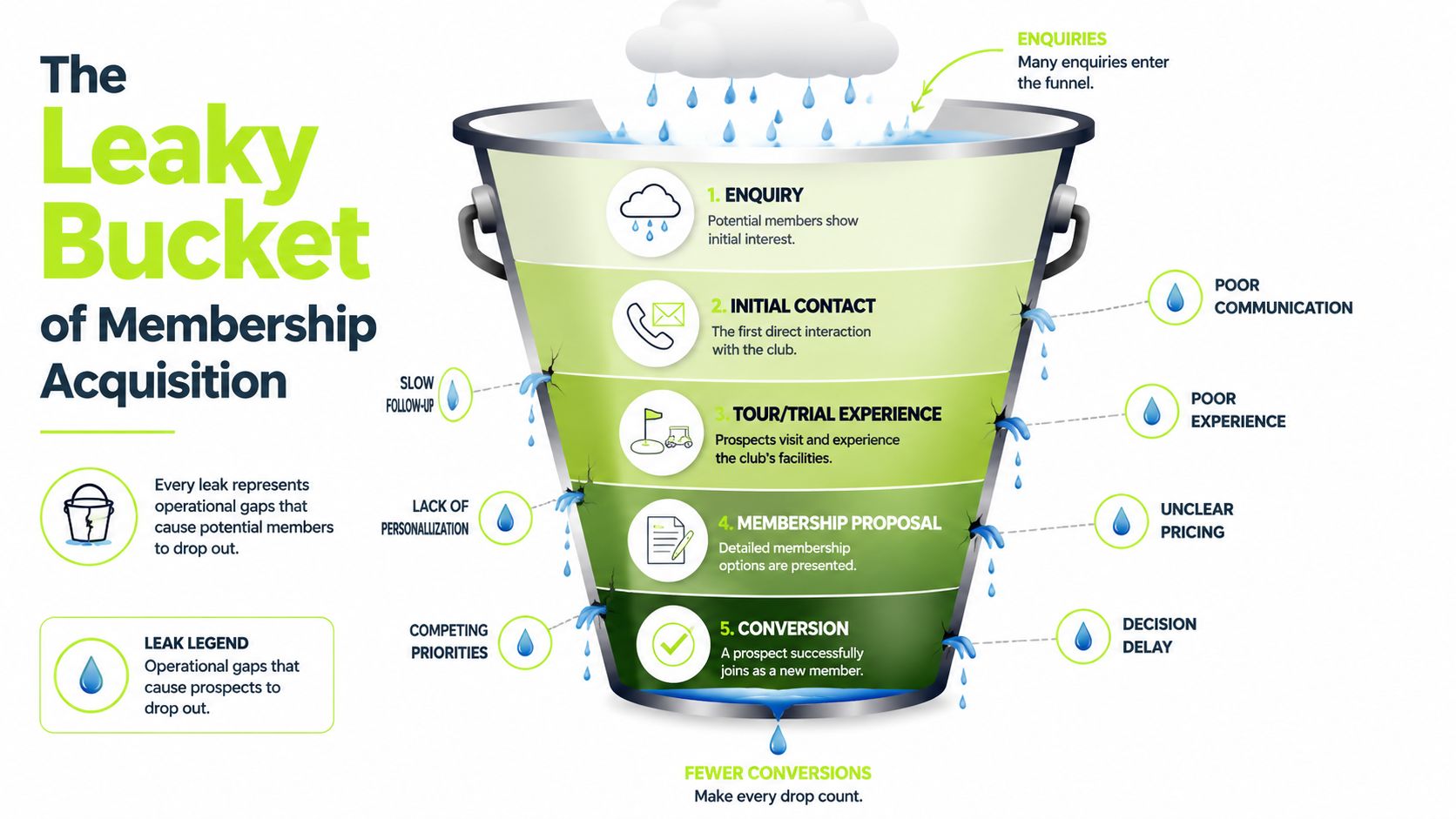
In practical terms, the membership journey usually has five stages. Enquiry, initial contact, tour or trial experience, membership proposal, and conversion. Every stage can leak.
Where clubs lose people
The first leak is often at the very top. A golfer fills in a form or sends an email. The club replies late, replies thinly, or doesn't reply at all in a way that moves the conversation forward.
Then comes the second leak. Someone from the club makes contact, but they treat the prospect as an admin task rather than a potential member. The golfer gets information, but not confidence.
The third leak appears during visits. A show-round should connect the prospect to the club's atmosphere, community, and fit. Instead, many clubs deliver a generic walk-around with no structure, no discovery questions, and no defined next step.
By the time pricing or membership options are discussed, uncertainty has usually crept in. If the prospect can't see the right path for their schedule, budget, or playing habits, they drift away.
The funnel isn't just marketing
Clubs often go wrong by treating membership growth as a top-of-funnel issue when it is mostly a mid-funnel and bottom-funnel issue.
In 2023, European golf memberships fell by 0.6% to just over 4 million, with a drop of roughly 6,000 members during a cost-of-living crisis, according to KPI Golf Management's analysis of private golf course struggles. The same analysis points to a simple reality. Clubs that overlook attracting and converting high-value traffic with data-led systems fail to compete, while clubs using integrated CRM and automated follow-ups build more predictable growth.
That doesn't mean every club needs a complicated stack of software. It means every club needs a visible, repeatable process.
Practical rule: If you can't see every live enquiry in one place, you can't manage membership growth properly.
Diagnosing your membership funnel leaks
| Funnel Stage | Common Leak (Symptom) | Root Cause |
|---|---|---|
| Enquiry | Messages sit unanswered or get a basic reply | No shared ownership, no response standard |
| Initial Contact | Prospect gets information but no momentum | Staff treat contact as admin, not sales |
| Tour or Trial Experience | Positive visit but no decision afterwards | No structured visit process or next-step agreement |
| Membership Proposal | Prospect asks for time and disappears | Pricing is unclear, options don't match needs |
| Conversion | Verbal interest never becomes payment | No follow-up system, no deadline, no accountability |
| Onboarding | New member joins but isn't integrated well | Poor handover between sales, operations, and member experience |
| Retention | Early enthusiasm fades | Club sold access, not belonging |
What to fix first
Most clubs instinctively spend on the top of the funnel. More ads. More posts. More open days.
That can help, but only after the leaks lower down are under control. If a club cannot respond quickly, track interest, follow up consistently, and move people through clear next steps, more enquiries create more waste.
The better approach is to plug the leaks in order. Make response handling visible. Standardise first contact. Build a proper tour process. Write follow-up sequences before you buy more traffic.
Beyond the Fairways Common Operational Gaps
Good facilities do not fix poor handling.
I see clubs lose joiners in ways that barely register internally. The enquiry arrives. Someone means to reply later. A price sheet gets sent without context. Notes sit across inboxes, a spreadsheet, and a manager's memory. Nobody believes a member was lost in that moment, but the prospect experiences a club that feels hard to join.

Slow response kills intent before price becomes the issue
Prospects rarely announce that they chose another club. They go quiet.
That silence usually gets blamed on price, timing, or weak demand. In practice, many clubs lose people earlier than that. Interest has a short shelf life. A golfer enquiring about membership is often comparing options, checking what works for family life, or trying to solve a specific frustration with their current setup. If the club does not reply with speed and purpose, the enquiry cools and the decision gets postponed or made elsewhere.
The first response should achieve three things:
- Confirm the club understood the enquiry: Reply to the actual question rather than sending a generic attachment.
- Create a next step: Offer a call, visit, trial, or meeting with a named person.
- Show ownership: Make it clear who is responsible from this point onward.
That sounds basic. It is also where many clubs fail.
Lead visibility is fragmented, so diagnosis is poor
Many clubs do not have a demand problem. They have a visibility problem.
Enquiries sit in different places. Reception has one version of events. The membership administrator has another. A committee member may have spoken to the prospect at an open day, but that detail never reaches the person following up. Once that happens, management starts guessing. They assume marketing is underperforming because they cannot see the leads already in play.
A club should be able to answer simple questions without a staff huddle. How many enquiries came in this month? Which ones booked a tour? Who needs a follow-up today? Which source is producing actual joins rather than casual interest?
That requires a single operating system for lead handling, not more effort from already busy staff. Clubs looking at golf club automation for enquiry tracking and follow-up usually find the biggest gain is not speed alone. It is shared visibility.
The offer is often explained too narrowly
Clubs often describe membership from the club's point of view. Course access. Competition entry. Handicap management. Tee availability.
That covers features, not motives. Many prospective members are buying routine, social connection, flexibility, and a club that fits the way they live now. Golf Monthly's analysis of golf club membership trends notes that younger golfers are more likely to look for memberships that match lifestyle needs, including wellbeing and flexibility. If your joining conversation stays fixed on traditional benefits, the offer can feel narrower than it is.
This does not mean every club should rebuild its model around younger buyers. It means staff need to explain the value in terms the prospect already cares about.
Friction in the offer creates unnecessary objections
Some resistance is real. Plenty of it is manufactured by the process.
Prospects hesitate when membership categories are hard to compare, when the differences between options are poorly explained, or when the club lists entitlements without translating them into a day-to-day experience. A golfer may be open to joining, but if the package feels rigid or unclear, they delay the decision.
The issue is usually not the existence of structure. Clubs need structure. The issue is expecting prospects to decode it on their own.
Handoffs inside the club are often weaker than leaders realise
A prospect does not care which department owns the next step. They care whether the club feels coordinated.
At many clubs, front of house, the pro shop, management, and membership administration each do their part, but the handoff between them is loose. One conversation feels warm and personal. The next feels transactional. A callback gets promised, then missed. Terms arrive without reference to what the prospect said they wanted. By that stage, trust has already dropped.
This is the operational gap many clubs miss. Conversion is not decided by facilities alone. It is decided by whether joining feels well run.
The Price of Inaction Why Manual Processes Cost You Members
Manual processes feel cheaper because the cost doesn't appear on one invoice. It shows up as drift.
A prospect is interested on Monday. Someone intends to reply on Tuesday. A note sits in an inbox. A voicemail gets heard late. A show-round happens, but the follow-up depends on whether the manager remembers after a busy competition week. None of that looks like a major failure in isolation. Collectively, it suppresses membership growth.
Manual handling creates two costs
The first cost is lost conversion. When clubs don't use a structured system, good prospects disappear into gaps between people, tasks, and timings.
The second cost is staff time. Managers and administrators spend hours checking inboxes, chasing updates, retyping details, and asking each other what happened with a lead. That time should be spent on member experience, sales conversations, and operations that move the club forward.
A proper system doesn't remove the human side of joining. It protects it. It gives staff context, reminders, visibility, and consistency.
Financial pressure makes this more urgent
This matters even more when club finances are tight. GCMA Insights on depreciation and golf club budgeting reports that approximately 20% of UK golf clubs fail to break even, and that top-quartile clubs allocating around 8% of dues to a depreciation sinking fund see 10 to 12% higher membership retention because they can maintain both facilities and growth initiatives.
That has a direct operational lesson. Clubs that are forced into reactive decision-making usually cut or neglect the very systems that support growth. They postpone software, keep using manual processes, and rely on staff heroics. Then emergency costs arrive and membership remains flat.
Manual process versus managed system
The difference is not abstract. It shows up in everyday work.
| Manual approach | Managed system |
|---|---|
| Enquiries live in separate inboxes | All leads sit in one visible pipeline |
| Follow-up depends on memory | Tasks and reminders are triggered automatically |
| Notes are partial or inconsistent | Every interaction is logged in one record |
| Managers guess what is working | Conversion stages can be tracked clearly |
| Prospects receive uneven treatment | Each prospect gets a consistent journey |
Clubs often ask whether a CRM or automation system is affordable. The better question is how much untracked leakage the club is already paying for.
For clubs reviewing options, golf club automation systems and workflows are worth examining because they show how process can be standardised without turning membership sales into a cold, generic sequence.
GolfRep is one example of a provider that combines lead generation, CRM visibility, and automated follow-up for golf clubs. The important point isn't the brand. It's the structure. If the club doesn't build a system that survives holidays, weekends, staff changes, and busy periods, growth will remain fragile.
What inaction usually looks like
It rarely looks like a disaster. It looks like this:
- Enquiries are answered, but too unevenly: Some get excellent service. Others get delayed.
- Visits happen, but outcomes aren't tracked: Staff remember who came in, but not who should be contacted again.
- Committee discussions stay vague: Everyone feels membership is harder, but no one has the numbers to prove where the problem sits.
That is why inaction is expensive. Not because it creates visible chaos, but because it normalises preventable loss.
Auditing Your Acquisition Process Key Metrics to Track
Good facilities do not remove the need for measurement. They increase it.
If a club gets regular membership enquiries but cannot show how those enquiries move from first contact to joined member, the problem is operational. Committees often jump to pricing, competition, or marketing volume because those are easier to debate than process discipline. The fix starts with a baseline.

A useful audit does not need twenty KPIs. It needs a handful of measures that expose where interest is being lost. I usually start with four because they show whether the club has a demand problem or a handling problem. In many cases, the handling problem shows up first.
The metrics that matter most
Enquiry response time
Measure the time from enquiry submission to first meaningful response. An automated acknowledgement has its place, but it does not count if it fails to move the prospect to a call, visit, or clear next step.Lead-to-visit rate
Track how many enquiries book a show-round, trial, or other in-person step. A weak number here usually points to slow follow-up, vague messaging, or staff who are answering questions without asking for the visit.Visit-to-member conversion rate
This shows whether the club experience and follow-up are doing their job. If people visit, enjoy the club, and then disappear, the issue is rarely awareness. It is usually weak post-visit communication, poor offer structure, or no defined close.Time to decision
Measure how long prospects sit in the pipeline before they join or go cold. Long sales cycles are not always bad. High-value memberships often need more consideration. But if nobody can explain the delay, the process is drifting.
Questions managers should be able to answer quickly
A manager should be able to answer these without searching through inboxes, paper notes, and memory:
- How many open membership enquiries do we have right now?
- Which staff member owns each one?
- Which prospects have had no contact in the past few days?
- Which enquiry sources produce joined members rather than just conversations?
- How many visits from the last month still have no recorded outcome?
If those answers are slow or uncertain, the audit has already found the problem.
A simple audit table
| Metric | What to check | What a weak result usually means |
|---|---|---|
| Enquiry response time | Time to first meaningful reply | Poor ownership, inbox delays, no service standard |
| Lead-to-visit rate | Enquiries that book a visit | Weak first contact, unclear invitation, no call discipline |
| Visit-to-member conversion | Visits that become members | Poor visit quality, weak follow-up, no defined close |
| Time to decision | Days from enquiry to outcome | Pipeline drift, missing next steps, inconsistent follow-up |
| Source-to-member tracking | Which channels produce joined members | The club cannot judge return by source |
One practical test works well. Pull the last twenty membership enquiries and trace each one from first contact to current status. If staff cannot do that quickly, the club does not have an acquisition process. It has a collection of individual efforts.
Clubs that improve this area usually make one shift first. They stop treating enquiries as messages to answer and start treating them as opportunities to manage through stages. That change sounds small. Operationally, it is the difference between hoping staff remember and knowing where each prospect stands. A useful example of that kind of structured approach appears in this golf club growth case study where January sales increased by 97% and February sales by 60% vs 2025.
Busy staff can still run a weak process.
A full inbox, a packed tour diary, and plenty of conversations do not tell you whether the club is converting interest. Stage visibility does. Clear ownership does. Measured follow-up does. That is how a club stops guessing and starts building a membership pipeline it can manage.
Case Studies From Stagnation to Sustainable Growth
The clubs that improve don't always start with more demand. They start with better handling of the demand they already have.
That matters because stagnation usually feels mysterious from the inside. Staff feel busy. Enquiries seem to come in sporadically. Some new members join, but not enough to create confidence. The club keeps looking for a silver bullet when the actual fix is process.
-golf-club-lifestyle.jpg)
Bidston Golf Club
Bidston is one of the clearest examples of why operations matter as much as facilities. In 2024, 13% of UK club members cancelled due to cost pressures and course playability issues, and non-members citing playability as a barrier rose 8% year on year. The same reporting notes that clubs adopting AI-driven course monitoring and connecting that insight into CRM nurture flows, like Bidston GC, saw a 22% membership uplift by reducing cancellations and targeting playability-sensitive golfers more effectively, as covered in Golfshake's analysis of why golfers gave up club memberships in 2024.
The key lesson isn't just the uplift. It's the mechanics behind it. When a club can communicate course condition, availability, and reliability with confidence, and then follow up systematically with the right prospects, conversion improves because uncertainty falls.
What changed in practice
The pattern in clubs that recover is usually similar:
- Lead visibility improves: Enquiries stop living in isolated inboxes and become trackable.
- Follow-up becomes structured: Prospects aren't left to drift after a visit or initial call.
- Messaging becomes more relevant: The club talks about fit, experience, and confidence, not just features.
That combination creates momentum. Staff stop guessing. Managers stop relying on fragmented updates. Prospects feel looked after rather than processed.
The broader lesson from growth campaigns
At other clubs, the same logic applies even when the operational problem is less severe. Pipeline growth becomes steadier when the club defines stages clearly, assigns ownership, and builds follow-up around actual member decisions rather than generic admin.
One useful example is this golf club growth case study on stronger January and February sales performance. The useful takeaway isn't just that sales improved. It is that visibility, timing, and nurture were treated as parts of one system rather than separate tasks.
Clubs rarely need a miracle. They need a process that keeps working when the office is busy, the committee is changing, and the season becomes unpredictable.
What these clubs didn't do
They didn't rely on discounts as the primary fix. They didn't assume the course alone would carry the sale. They didn't treat follow-up as optional.
They built a practical pathway:
- Capture every enquiry.
- Respond with speed and context.
- Move people into visits or calls.
- Follow up consistently after interest is shown.
- Track outcomes so the club can improve the next cycle.
That is what turns isolated success into sustainable growth. Not occasional bursts of effort, but repeatable handling.
Conclusion Building a Predictable Membership Pipeline
Good facilities are an asset. They are not a guarantee.
A well-presented club helps a prospect say yes once the club has earned serious consideration. But if enquiries are hidden, replies are slow, tours are inconsistent, and follow-up relies on memory, the quality of the course won't rescue the process.
That is the core issue behind “Why Your Golf Club Isn't Getting Members (Even With Good Facilities)”. Most clubs don't have a visibility problem in the market as much as they have a visibility problem inside their own pipeline. They cannot see where enquiries sit, who owns them, or why they stall. As a result, they keep trying to solve a conversion problem with more promotion.
The clubs that grow more predictably tend to do the opposite. They slow down long enough to audit the journey. They identify where interest leaks out. They put structure around response times, tours, proposals, and follow-up. They make membership growth measurable.
That doesn't make the club less personal. It makes the experience more reliable for the prospect and less fragile for the team.
If your club has invested in the course, clubhouse, practice areas, and overall presentation, that work still matters. But now it needs a matching acquisition process. The opportunity is not only to generate more enquiries. It is to stop wasting the ones you already have.
If your club wants a clearer view of where membership enquiries are being lost, GolfRep helps golf clubs build structured pipelines with lead visibility, follow-up systems, and CRM-based conversion tracking so growth becomes more predictable and less reliant on manual guesswork.
Ready to tap into our proven growth system?