Golf Club Membership Offers: A Tactical Playbook for 2026

Most clubs still treat golf club membership offers as a pricing exercise. That's the wrong fight. In practice, clubs lose more members in the handoff after the enquiry than they ever lose by choosing the wrong headline offer, because the member journey depends on speed, clarity, and follow-up discipline as much as it depends on price.
The market also gives clubs less room to be casual. UK operating costs keep pushing pricing upwards, with the Producer Price Index for membership dues and fees at golf courses and country clubs rising from 192.034 in Dec 2025 to 200.192 in Apr 2026, a roughly 4.2% increase in four months (FRED). At the same time, clubs still have healthy joiner volumes to work with, because Hillier Hopkins found that 59% of members' clubs surveyed had more than 600 playing members in 2024/25, up from 56% in 2023, and the average members' club recorded 75 joiners in 2024 versus 73 in 2023 (Hillier Hopkins golf clubs report).
That combination matters. A good offer still needs to be priced sensibly, but the commercial question is whether your club can respond, qualify, and convert enquiries before interest goes cold. GolfRep's view is simple, clubs don't need more noise, they need a predictable pipeline.
Why Most Membership Offers Underperform
Most committees start with the wrong assumption, which is that a stronger advert, a sharper headline price, or a more generous joining incentive will fix conversion. It won't, not on its own. UK golfer sentiment suggests the issue is not a lack of demand, because 71% of golfers in a 2025 Golfshake survey said membership still offers good value for money, up from 69% in 2024, and 77% said they plan to renew their membership next year (Golfshake).
The problem is usually operational. A prospect fills in a form, waits, loses momentum, then gets passed around by a shared inbox or a volunteer who's busy with club life. By the time someone follows up, the lead has already cooled or booked elsewhere.
The three leaks that matter most
The first leak is slow first response. If a club cannot acknowledge the enquiry quickly, it starts the relationship from a weak position.
The second is inconsistent follow-up. Some prospects get a call, some get an email, some hear nothing until the next committee meeting.
The third is poor qualification. Clubs often invite everyone to the same generic chat, then wonder why visit-to-join conversion feels uneven.
Practical rule: if your club can't see who owns the enquiry, when they last contacted the prospect, and what the next action is, the offer itself is doing too much work.
That's why a membership offer should be judged as part of a system, not as a standalone piece of copy. The same offer can underperform in one club and convert steadily in another, because one club has clear ownership, live tracking, and a disciplined visit process while the other relies on manual memory. Golf clubs don't need a prettier brochure before they need a better operating rhythm.
Positioning Your Club Before You Set the Price
Before a committee starts debating price points or package extras, the club needs to answer three positioning questions. First, what are you really anchored against, a private members' club, a more casual pay-and-play venue, or a nearby resort with heavier facilities? Second, which member group are you designing for first, regular golfers, returning players, seniors, families, or time-poor professionals? Third, what single benefit do you lead with, course access, flexibility, social value, or simplicity?
That clarity matters because the same structure can be read very differently depending on the audience. A committee-led club can lean on belonging, routine, and local identity. A resort course can lead with convenience, facilities, and experience. A private members' venue can emphasise the social side and the consistency of access.
A short worksheet for the committee room
Use these prompts in one meeting and write the answers down before anyone talks price.
- Anchor club: Which competitor is the primary comparison in your postcode, and why would a golfer choose you instead?
- Primary segment: Which group is most likely to convert now, not just eventually?
- Lead benefit: What one thing do you want prospects to repeat back after the visit?
If the committee can't answer those questions cleanly, the offer will drift. You'll end up adding perks to compensate for weak positioning, which makes the offer harder to explain and harder to sell.
A practical way to tighten the wording is to generate a value proposition with AI, then pressure-test the output against how your club sells. The point isn't to automate judgement, it's to sharpen the language before it reaches the market. If you're also reviewing pricing structure at the same time, this internal note on golf club pricing strategy is a useful companion, because positioning and price need to agree.
A good offer doesn't try to be everything. It says, clearly, who it's for and why that golfer should care.
Offer Types That Work for UK Clubs Right Now
The offers that convert in the UK market are usually the ones that reduce friction without making the club look cheap. Flexible structures are attracting attention because Hillier Hopkins found 40% of members' clubs were offering flexible membership in 2024/25, up from 34% in 2023, and 62% allowed joining fees to be paid in instalments, usually over 2 to 3 years (Hillier Hopkins golf clubs report). That matters because many golfers want a clearer entry path, not just a lower number.
A separate point is segmentation. A UK review of 244 clubs found only 18.4% offered any senior discount or incentive, which suggests many clubs still don't build offers around age or life stage even when that's exactly how prospects judge relevance (Golf Support review). Clubs that publish different routes for different usage patterns tend to make the decision easier.
What each offer type does well
Introductory memberships work when the club needs a clear entry route and a fast visit decision. They're strongest when the prospect can test the course and the social fit without feeling trapped.
Flexible or pay-as-you-play structures suit price-sensitive golfers who want predictable access and lower upfront friction. They work because they preserve the club's core value while making the first commitment easier.
Family and junior pathways are strongest when the club wants to widen its local relevance. They make membership feel like a household decision, not an individual purchase.
Weekday-only categories fit clubs with spare capacity outside peak times. They're useful when the objection isn't value, it's time.
Corporate and society-style packages work when the club is selling access, hospitality, and business use together. The offer lands better when it's framed as a repeatable relationship, not a one-off booking.
If you want a practical way to keep these benefits visible after the first enquiry, a resource on boosting brand growth with email is useful because the same logic applies to membership nurture, not just ecommerce retention.
Membership offer formats used by UK clubs
| Offer Type | Best For | Conversion Lever |
|---|---|---|
| Introductory membership | First-time joiners and returning golfers | Lower perceived risk |
| Flexible membership | Price-sensitive prospects | Lower upfront friction |
| Family or junior pathway | Households and younger golfers | Shared decision-making |
| Weekday-only category | Time-limited players | Clear usage fit |
| Corporate or society package | Businesses and organised groups | Repeatable value |
The point isn't to offer all of these at once. The right mix depends on who you're trying to convert and how easy your club is making the first step.
Designing the Enquiry to Visit Pipeline
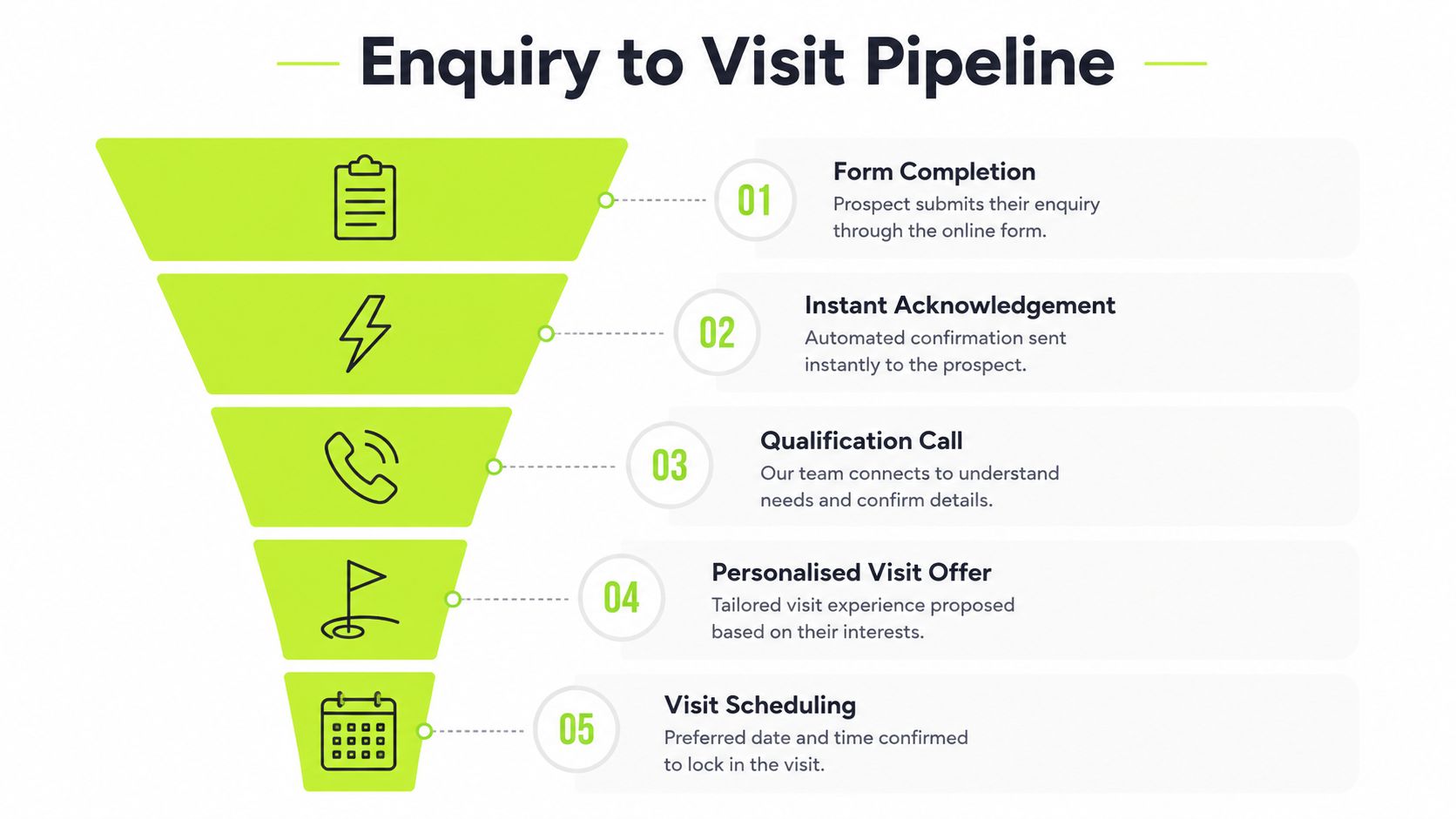
An enquiry is only valuable if someone at the club owns it from the moment it lands. GolfRep builds membership pipelines around that principle, because the biggest loss usually happens between interest and first conversation, not at the point of initial enquiry. A simple five-stage process keeps the handoff visible.
The stages that should exist
- Form completion. The prospect submits the enquiry, and the system captures the lead cleanly.
- Instant acknowledgement. The club confirms receipt straight away, so the prospect knows they haven't disappeared into a void.
- Qualification call. Someone checks usage, timing, and fit, then decides what to offer next.
- Personalised visit offer. The club proposes the right taster or walkaround, not a generic invite.
- Visit scheduling. The booking is locked in, with a named owner and a clear next step.
The practical weakness in many clubs is not one stage, it's the gaps between stages. Shared inboxes create delay. Manual diaries create inconsistency. Committee-led follow-up drifts because nobody can see the pipeline in real time.
Track ownership, not just volume. A club can have plenty of enquiries and still be losing conversions if nobody knows which lead is waiting, which one has visited, and which one needs a call today.
The operating mechanics behind this kind of follow-up are similar to a structured country club membership process, where access, booking, and eligibility are handled in a defined order rather than left to chance. That's why clubs that document the handoff properly tend to feel more in control, even before the marketing changes.
GolfRep's membership funnel approach is built to make the lead visible, assign ownership, and keep the next step moving. If a prospect can't move from form to visit without friction, the offer has already started to leak value.
Messaging, Channels, and Automated Nurture Flows
Most clubs send one or two follow-up emails and hope the prospect replies. That's too thin. Golf club membership offers need a short, structured nurture sequence that moves from acknowledgement to reassurance to visit booking, with email, SMS, and human contact used for different jobs.
A practical nurture pattern
Day 0 should be immediate acknowledgement. The message doesn't need to be clever, it needs to confirm the enquiry, restate the category the prospect asked about, and tell them what happens next. If the offer is built for seniors, returning players, or price-sensitive golfers, the first reply should reflect that segment rather than sending everyone the same template.
Day 2 or 3 is the qualification touch. That can be a short call or a personal email, depending on the club's staffing. The aim is to learn enough to suggest the right visit format.
Day 5 to 7 is the visit prompt. A club can offer a taster round, a walkaround, or a conversation with the team, depending on the member type.
Day 10 to 14 should be a final nudge. At this point, a club can summarise the benefits already discussed and invite the prospect to choose a time.
What automation should do
CRM triggers should handle the repetitive work. When an enquiry lands, the system can send the acknowledgement, assign ownership, and remind staff if no one has called back. If the prospect books a visit, the CRM should switch them out of the nurture branch and into a visit-confirmation flow. If they go quiet, the system should schedule a final follow-up without relying on memory.
For message structure, the logic is simple. Senior prospects respond better to clarity and ease of access. Returning players need reassurance that they'll settle back in quickly. Price-sensitive golfers need a clear explanation of value and monthly predictability, not pressure.
GolfRep uses this kind of CRM-enabled follow-up to keep the pipeline moving without manual chasing. A club's marketing can be fine and still underperform if the nurture flow stops after the first email. The conversation needs enough persistence to reach the visit stage.
Measurement and KPIs That Matter
If a club can't see where enquiries fall away, it can't improve conversion with confidence. The dashboard only needs a few metrics, but they need to be the right ones. GolfRep usually pushes clubs away from vanity reporting and towards numbers that show whether the pipeline is healthy.
The metrics a committee should review
- Enquiry volume shows whether the club is creating enough demand to feed the sales process.
- Speed to first response shows whether the enquiry is being handled while interest is still warm.
- Visit-to-enquiry rate shows whether prospects are moving from interest to a face-to-face conversation.
- Visit-to-member conversion shows whether the offer and the visit experience are doing their job.
- Average joining revenue per acquired member shows the commercial value of each win, not just the count.
The exact benchmark will vary by club, but the dashboard should answer one question every month, where are we losing people? If the enquiry volume is strong but visits are weak, the issue is in the handoff. If visits are happening but sign-ups are light, the offer or the visit conversation needs work.
That makes tracking more useful than reporting. A manager can review those numbers in minutes and know whether the club needs better outreach, better qualification, or a clearer offer. For a wider view of the return behind this kind of measurement, this note on the real ROI of golf club marketing gives the right commercial context.
If your monthly report doesn't show where the pipeline leaks, it's a summary, not a management tool.
The useful habit is to compare month to month, not just against a target. That tells the committee whether the system is tightening or drifting. In membership growth, visibility is the difference between guessing and managing.
Pitfalls, Legal Basics, and a 90 Day Rollout
The most common mistake is over-discounting. A cheaper headline can create more enquiries, but it can also attract the wrong prospects and weaken the club's positioning. The better answer is usually to improve the entry path, make the offer easier to understand, and keep the benefits aligned with how the club is used.
Other failures are more mundane. Terms differ between the website, the receptionist script, and the brochure. Renewal handoffs are missed. Lead data is collected without a clear privacy explanation.
Legal basics that clubs shouldn't ignore
Membership promotions need to be honest, clear, and consistent with what the golfer will get. Clubs also need to handle lead data properly under GDPR, which means having a lawful basis, a clear privacy notice, and sensible retention habits. For promotional giveaways and online acquisition activity, the compliance risk rises when the terms are vague, so this guide on Facebook giveaway rules is a useful reminder of how careful clubs need to be with public-facing offers.
A simple 90 day rollout
- Weeks 1 to 2: finalise the offer, the terms, and the enquiry form wording.
- Weeks 3 to 6: launch the campaign, train the staff, and make sure every lead has an owner.
- Weeks 7 to 12: review the pipeline weekly, adjust follow-up, and tighten the visit process.
The clubs that improve fastest don't keep changing the offer every fortnight. They fix the response system, measure the drop-off, and make one clean adjustment at a time.
If your club needs a membership offer that converts enquiries into visits and sign-ups, GolfRep can build the campaign, the follow-up system, and the CRM workflow around it. Visit GolfRep to see how we help golf clubs create a more predictable membership pipeline without relying on discount-led growth.
Ready to tap into our proven growth system?