Revenue Growth Agency: How Golf Clubs Choose a Partner

Most golf clubs are told they need more enquiries. That advice is convenient, and it's usually wrong. The leak is not always the front door, it's the handling, the response, and the follow-up after the enquiry lands.
A revenue growth agency worth hiring doesn't just create traffic and hope the office copes. It builds a system that makes sure every genuine prospect is seen, chased, tracked, and converted properly. In club terms, that means enquiry response time, lead visibility, conversion tracking, and a process the team can run on a busy day.
If you've ever watched a promising membership enquiry disappear into an inbox, a spreadsheet, or a half-finished phone note, you already know the problem. The clubs that grow consistently are usually the ones that treat enquiry management as an operating system, not an admin task. For a useful parallel on how weak processes cost businesses revenue, the checklist for gym managers is a decent read because the operational mistakes are very similar, even if the setting isn't.
Why Most Golf Clubs Struggle with Enquiry Conversion
The mistake I see most often is simple. A club believes the sales problem is volume, when the problem is conversion. More enquiries won't fix a missed call, a slow reply, or a vague handover between the professional shop, office, and committee.
The hidden bottleneck is usually after the enquiry arrives
A club can have a decent ad campaign, a tidy website, and a healthy enquiry flow, then still lose business because nobody owns the next step. One person assumes another person has replied. A spreadsheet is out of date. A voicemail gets listened to later in the day, if at all. That's not a demand problem, it's an operational one.
This is why GolfRep's own analysis of how clubs lose enquiries matters, because the pattern is nearly always the same, enquiry comes in, response stalls, then the prospect cools off. If you want that argument in more detail, the internal breakdown on how most golf clubs lose 30% of enquiries without realising is worth reading alongside your own process review. The number is less important than the behaviour it points to, which is that clubs often don't have a reliable follow-up chain.
Practical rule: if nobody can tell you who owns the enquiry within five minutes of it landing, you don't have a growth system, you have a hope.
Manual follow-up breaks under pressure
Manual processes depend on memory, discipline, and a quiet office. Clubs don't live in that world. Staff change, weekends get busy, committee members get involved, and enquiries from different channels are handled differently. Once that happens, response quality becomes inconsistent.
A proper revenue growth agency fixes that by making lead handling visible. It should show who replied, when they replied, what happened next, and where prospects stalled. That's the difference between guessing and managing.
Conversion problems are usually leadership problems
Club committees often ask for more leads because leads are easier to measure than conversion discipline. But if your team can't prove how many enquiries became visits, and how many visits became members, you're not managing revenue. You're reporting activity.
A club that wants better results should first ask whether enquiries are being handled with the same seriousness as subscriptions, tee sheet revenue, or bar controls. If the answer is no, more marketing only increases the amount of waste.
Defining Goals and KPIs Before You Start Looking
A club can't choose the right growth partner until it knows what success looks like in its own language. That means turning broad ambitions like “more members” into measures the committee can hold people to. If the goal is vague, every agency looks competent until the numbers arrive.
Start with the business result, not the campaign
Write down the outcome you need. It might be more full memberships, more junior conversions, more corporate bookings, or better retention of existing members. Then work backwards from that outcome to the activity that supports it. A private members' club will usually care about a different mix of enquiry types than a resort or multi-site operator, so don't copy another club's scorecard.
The clearest metrics are usually the least glamorous. Enquiry-to-member conversion rate, cost per booked visit, and lifetime member value matter because they connect marketing spend to club income. Website traffic, social engagement, and generic “reach” are secondary unless they move those business numbers.
You can also use the internal guide on what is marketing analytics to pressure-test whether your current reporting tells the truth or just creates noise. A dashboard that looks busy isn't the same thing as a dashboard that helps a general manager make decisions.
Turn committee language into working KPIs
Committee discussions often use broad terms like “quality leads” or “better engagement”. Those phrases don't help anyone manage performance. Convert them into simple measures the team can update regularly.
Use a short list like this.
- Booked visits from enquiries, because a visit is closer to revenue than an open form submission.
- Enquiry response time, because slow replies kill momentum.
- Conversion by enquiry source, because not every channel performs the same way.
- Membership retention signals, because new business is weaker if existing members are drifting away.
Don't ask an agency to “grow the club” unless you're prepared to define what that means in numbers the office can actually track.
Align the target with club reality
A strong target is ambitious but still tied to capacity. If the club can only handle a certain number of tours, taster days, or follow-up calls each week, the system has to respect that. A growth partner should help you build a plan that fits your staffing, your software, and your current sales process, not a fantasy version of the club.
That's where a good agency separates itself from a busy one. A busy agency sells activity. A serious revenue growth agency builds accountability.
Questions to Ask and Red Flags to Watch For
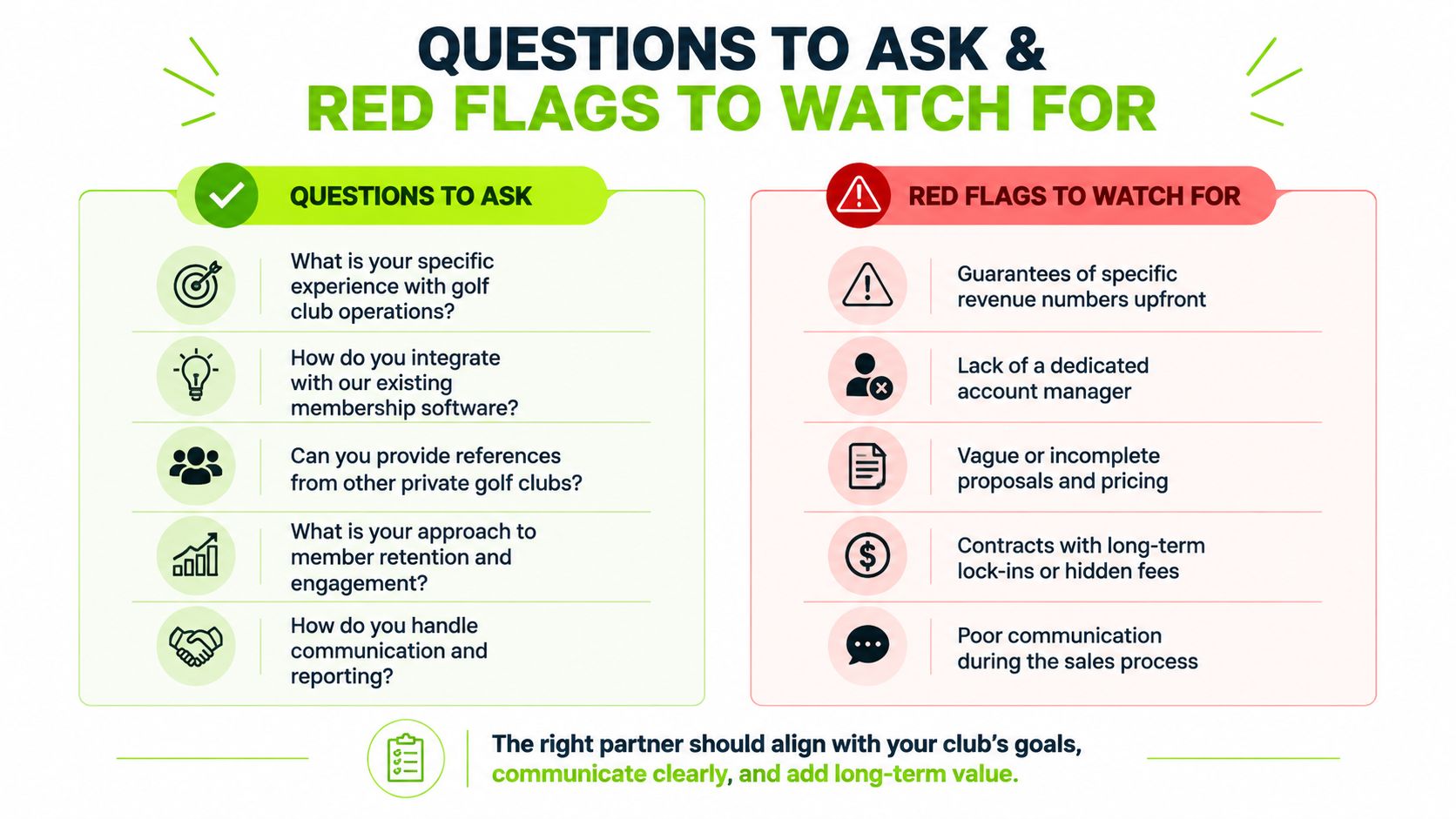
Interviewing a growth partner should feel like a business conversation, not a pitch. If the agency can't speak in the language of club operations, enquiry handling, and follow-up discipline, it's not ready to touch your membership pipeline. Good questions expose whether they understand the realities of golf clubs, not just digital advertising.
Ask questions that force operational answers
Start with the basics. Ask how they handle lead visibility, how they track whether an enquiry became a visit, and how they make sure staff know what to do once the prospect responds. If they can't explain the handover from marketing to the club team, they're probably not thinking about conversion at all.
Ask about CRM integration too. A serious partner should be able to explain how it works with your existing membership software, your spreadsheet habits, or your current office process. If they treat systems as an optional extra, they don't understand why clubs lose opportunities.
One useful comparison point is the best SEO partners for CPAs, not because golf clubs need accountant marketing, but because strong service firms tend to be specific, process-led, and clear about outcomes. Generic promises sound polished. Specific operating knowledge is much harder to fake.
Watch for these red flags
Some warning signs are immediate. Others only appear after the second meeting.
- Lead volume obsession, because more leads mean little if follow-up is weak.
- No clear conversion tracking method, because you can't manage what they can't measure.
- One-size-fits-all campaigns, because golf clubs, resorts, and leisure sites don't behave the same way.
- Guarantees of neat revenue outcomes upfront, because serious partners know the club's own process affects the result.
- No dedicated account manager, because accountability gets blurry fast when ownership is shared around a team.
Compare answers, not polish
Some agencies sound confident because they've learned the right phrases. That isn't the same as understanding your operating environment. Ask them how they would deal with missed calls, unanswered web forms, seasonal demand swings, and internal delays between office and committee approval. The right partner won't dodge those questions.
If an agency spends most of the meeting talking about impressions, clicks, and reach, it's telling you exactly where its priorities sit.
A proper growth partner should sound less like a campaign vendor and more like someone who knows why clubs lose conversions in the first place.
Understanding Pricing Models and Contract Structures
Agency pricing often looks simpler on paper than it is in practice. By the time a proposal includes retainers, setup work, reporting, and performance fees, many clubs lose sight of what they're buying. That's a mistake, because the pricing model shapes behaviour just as much as the campaign itself.
Fixed retainers, performance fees, and hybrids all carry trade-offs
A fixed monthly retainer gives both sides clarity. The club knows the cost, and the agency knows the scope. That works best when the partner is handling ongoing lead generation, structured follow-up, reporting, and system maintenance. The risk is that the agency can drift into delivery mode without enough pressure on conversion outcomes.
Performance-based pricing sounds attractive because it ties payment to results. The problem is that clubs often overlook how those results are defined, tracked, and influenced by the club's own response process. If the follow-up is weak internally, a performance model can become a blame game.
Hybrid structures sit in the middle. They usually combine a base fee with an outcome element, which can help align incentives without putting all the risk on one side. If you're comparing options, the key question is whether the structure rewards the agency for activity or for revenue movement.
| Agency Pricing Models Compared | How It Works | Best For | Risk Level |
|---|---|---|---|
| Fixed monthly retainer | A set fee covers agreed services each month | Clubs that want predictable support and ongoing optimisation | Moderate |
| Performance-based fee | Payment is linked to agreed outcomes | Clubs with clear tracking and strong internal follow-up | Higher |
| Hybrid model | Base fee plus outcome-related element | Clubs that want shared accountability | Moderate |
For a broader cost comparison, GolfRep's own guide on how much does golf club marketing cost is useful when you're checking whether a proposal is competitive or just cleverly packaged.
Read the contract before you read the pitch
Contract length matters because conversion systems take time to settle. Short agreements can create pressure, but they can also stop you from giving the work enough time to mature. Longer terms only make sense if scope, reporting, and exit clauses are written clearly.
Ask what's included, what's billable extra, who owns the data, and how the club gets out if the service slips. If those answers aren't plain English, the proposal isn't ready.
Performance guarantees need careful wording
Some guarantees are genuine, but they still depend on variables the agency doesn't control alone. Response speed, pricing, offer quality, and internal discipline all affect the outcome. A sensible guarantee should be tied to a clearly defined process, not a vague promise that sounds reassuring in a meeting.
Mara's pricing plans are a useful reference point if you want to see how a service business can present structure more transparently. Whatever model you compare, insist on knowing what you're paying for before you sign.
What Onboarding and Implementation Looks Like
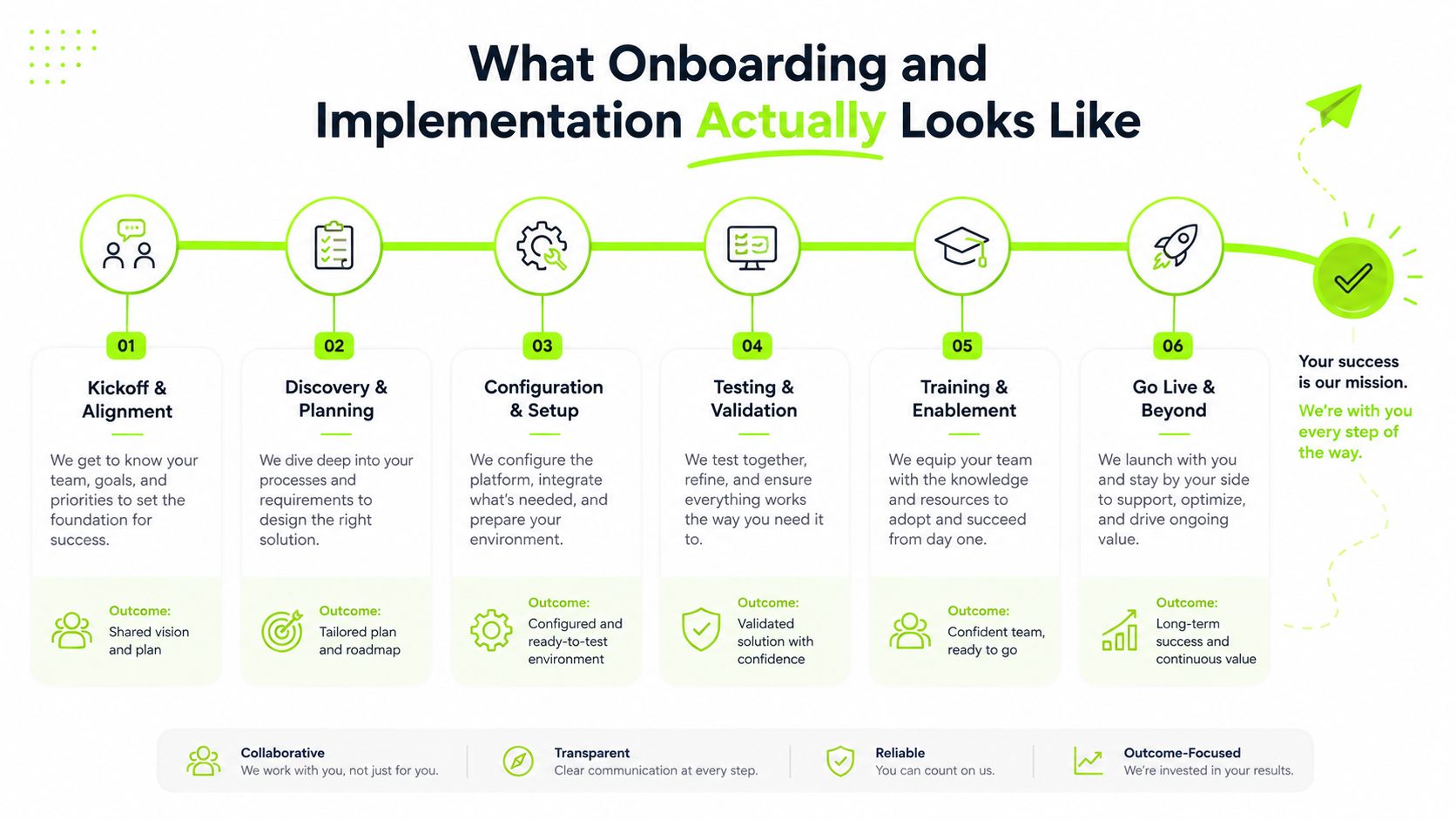
The first few weeks after signing are where most partnerships either gain momentum or lose it. If the agency vanishes into setup work while the club waits for results, the relationship starts badly. Good onboarding should be organised, visible, and practical from day one.
The first job is to make the pipeline visible
The agency should start by mapping where enquiries come from, who handles them, and where they disappear. That means linking the ad side to the club side instead of treating them as separate worlds. CRM integration, contact tagging, response routing, and reporting access matter more than polished slides.
Staff training matters just as much. If the office team, membership lead, or professional knows how to respond but the system still relies on memory, nothing meaningful has changed. Automation should support people and make accountability clear.
The how to get clients for a staffing agency guide is not the point here, but the implementation lesson is similar. Pipeline only improves when process and follow-up are disciplined.
Expect a phased rollout, not instant magic
The first stage should be setup, not sales talk. The agency should confirm tracking, test lead routing, and make sure the right people can see the right information. After that comes live campaign work, automated follow-up, and basic reporting.
Then the work starts. Lead scoring, nurture flows, and response rules need close attention because clubs rarely behave neatly on the first attempt. If the agency offers a tidy launch and then disappears, you are left with unmonitored enquiries and no reliable learning loop.
Implementation is where strong agencies show they understand operations. The campaign is only as good as the system behind it.
Measure progress by behaviour, not by noise
In the early stage, do not obsess over vanity indicators. Look at whether enquiries are being logged properly, whether responses are happening fast enough, and whether the team knows what to do with each lead type. Those are the signs the system is working.
GolfRep's own model sits in this category because it combines advertising with automated follow-up and revenue tracking. That is the kind of setup clubs should demand from any serious partner. It does not mean every club needs the same tools, but it does mean every club needs a process that leaves nothing to chance.
A good onboarding process should leave the committee with fewer unknowns, not more. If you are still unclear on who owns the next step after 30 days, the implementation has not landed.
Real Results from Golf Clubs and Multi-Site Operators
Theory matters less once you've seen how different clubs behave. The same pattern shows up again and again. A club that improves its enquiry handling, tracks conversions properly, and stops relying on manual follow-up tends to build a steadier pipeline than one that keeps buying attention and hoping for the best.
Small clubs often need structure more than scale
Bidston Golf Club is the clearest example in GolfRep's published work. The club moved from near-closure to more than double membership and six-figure recurring revenue after its growth system was rebuilt around predictable pipeline management. That kind of result doesn't come from a prettier advert. It comes from better handling of interest once it arrives.
Addington Palace followed a different path, but the lesson was similar. The club built a steadier pipeline through systematic follow-up rather than relying on one-off bursts of promotion. That is the point most committees miss. Consistency beats drama.
Downes Crediton is another useful reference because it shows how a focused membership campaign can be profitable without being chaotic. Clubs don't need to invent new demand every month. They need to convert more of the demand that already exists around them.
Multi-site operators need central control
Macdonald Hotels and Resorts showed how centralised CRMs and automated follow-ups can work across multiple sites. That matters because the bigger the group, the easier it is for enquiry handling to fragment. Once every site does things slightly differently, reporting gets messy and conversion becomes impossible to compare.
A multi-site operator should care about standardisation first. If each location handles enquiries in a different way, the central team can't spot which site is leaking revenue or which one is converting well. A good system gives head office visibility without forcing every property into an awkward template.
The common thread is process
The clubs that improve usually don't start with bigger budgets. They start by making the next step obvious. Once response time, lead ownership, and conversion tracking are under control, the numbers stop feeling random.
A club doesn't need more optimism around enquiries. It needs fewer opportunities to go missing.
That's the part worth paying attention to when you compare examples. The win is rarely the campaign itself, it's the system that follows it.
Your Decision Checklist for Choosing a Growth Partner
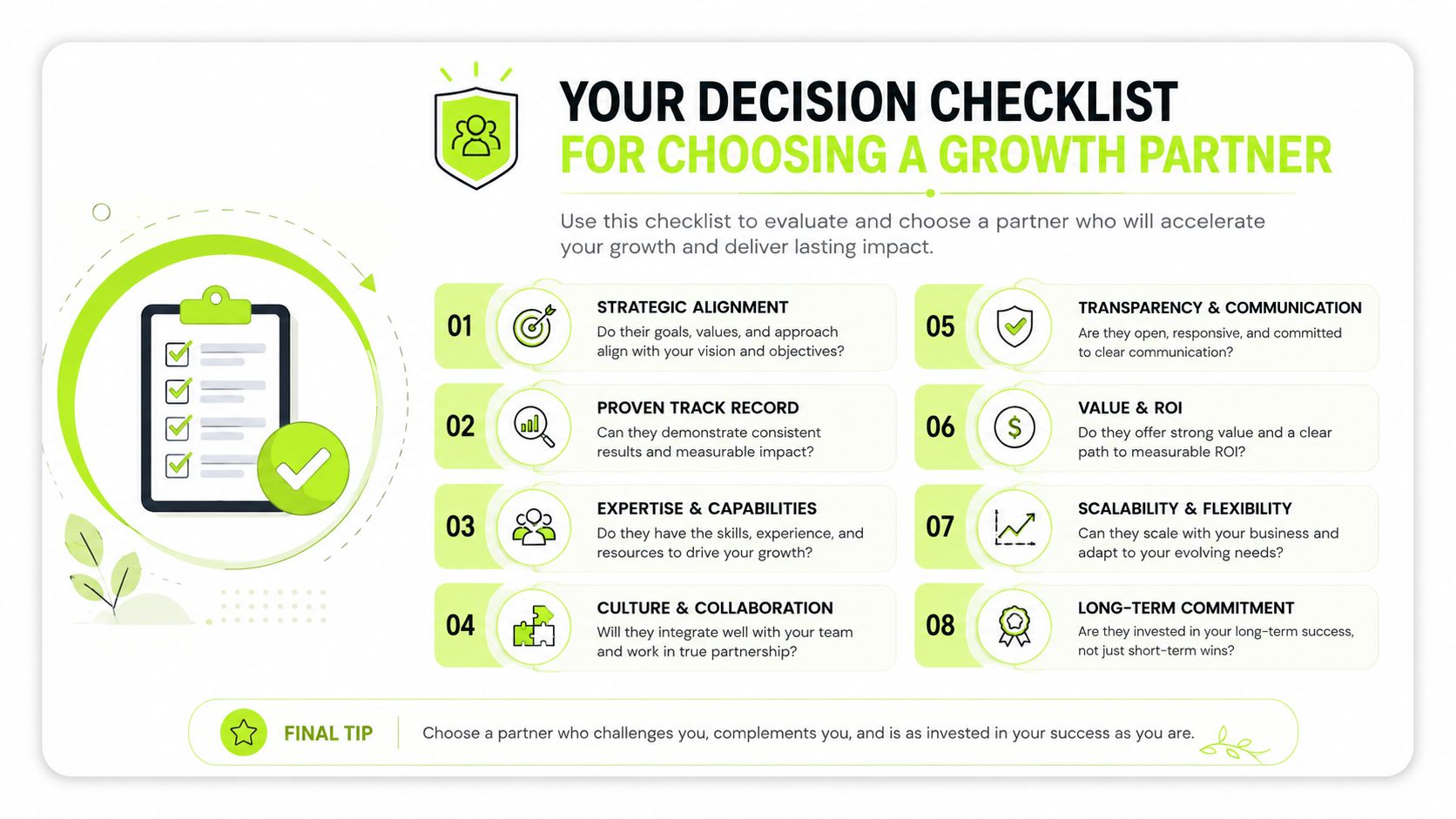
A good decision here should feel methodical, not emotional. If two agencies sound impressive in the room, use a checklist and compare them against the same standards. That removes the noise and makes the conversation about fit, accountability, and operational discipline.
Use these criteria before you sign anything
- Sector understanding, because golf clubs have their own sales cycle and service pressures.
- CRM and follow-up capability, because enquiries must be visible and owned.
- Clear conversion tracking, because activity without reporting is just noise.
- Realistic pricing structure, because hidden extras create mistrust.
- Defined onboarding plan, because setup is where most partnerships wobble.
- Single point of accountability, because committees need one person who answers properly.
- Process over promises, because growth depends on discipline.
- Clarity on internal effort, because the club still has a role to play.
The final test is simple
Ask what the agency will need from your team in the first month. If they can't answer that cleanly, they haven't thought through implementation. Ask how they'll show whether an enquiry became a visit, and whether that visit became a member. If the answer sounds fuzzy, the partnership will probably be fuzzy too.
Golf clubs don't need a fashionable agency. They need a partner that makes revenue more predictable by combining lead generation with structured follow-up and clear systems. That's the standard to hold every proposal against, regardless of how polished the pitch looks.
GolfRep helps golf clubs build a clearer pipeline by combining advertising, automated follow-up, and revenue visibility rather than leaving enquiries to manual chasing. If you want a practical conversation about making your membership process more predictable, visit GolfRep and see how the system is put together.
Ready to tap into our proven growth system?