Build a Golf Lead Generation System That Converts

A club can spend a morning generating enquiries and still have no reliable answer by the afternoon to three basic questions: who is ready to visit, who needs more guidance, and which source is producing members rather than clicks. The problem becomes sharper when the same form serves a committed local golfer, a beginner looking for coaching, a junior enquiry from a parent, and an occasional visitor comparing prices.
A practical golf lead generation system gives each prospect a relevant next step. It connects advertising, enquiry capture, qualification, staff capacity, CRM activity, visits, applications, joining and renewal. The commercial objective isn't a full inbox. It's a repeatable route from the right golfer to recurring revenue.
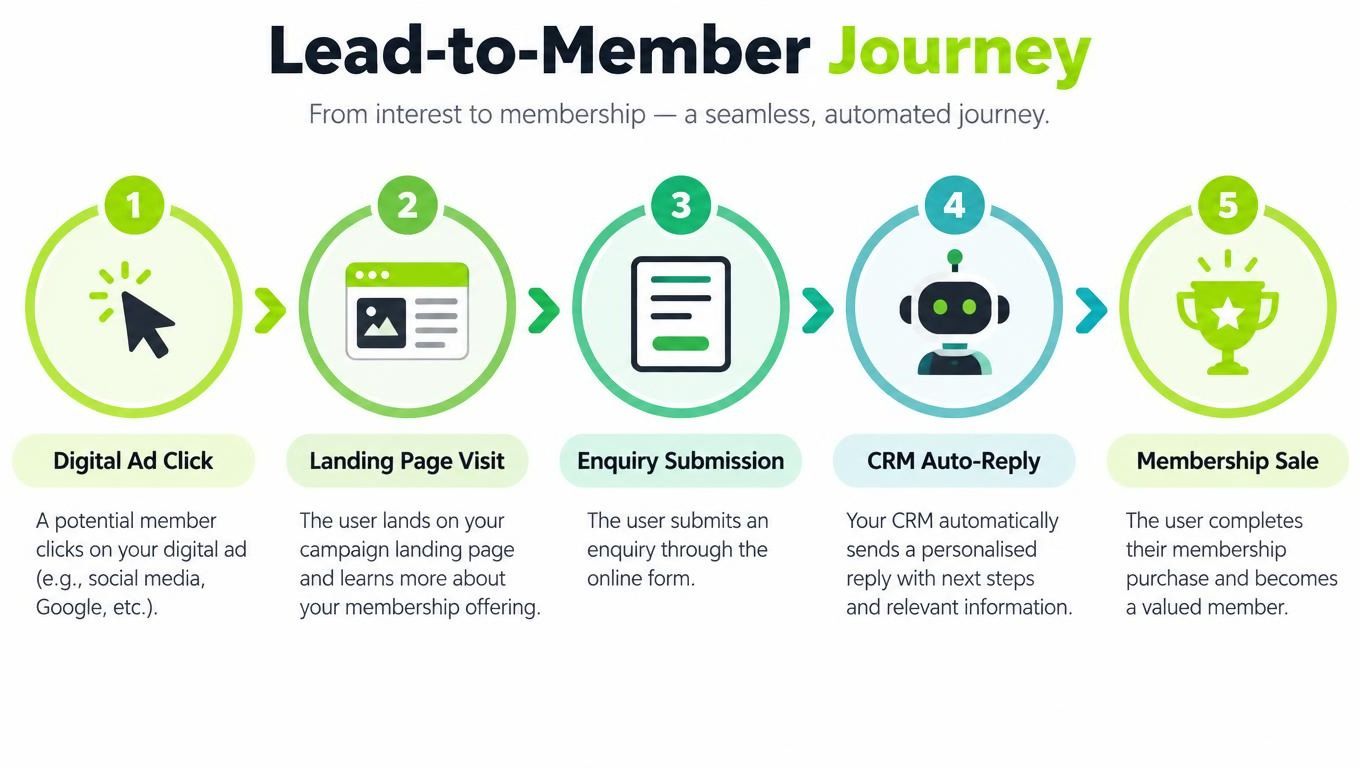
Designing a Lead-to-Member Journey
A typical club scenario is easy to recognise. A Facebook advert promotes an open day, the website receives enquiries, the secretary forwards some to the PGA professional, and someone stores the rest in a spreadsheet. A few people book visits, but nobody can confidently explain how many were contacted, which conversations progressed, or whether the campaign produced members.
That isn't a marketing problem alone. It's a journey-design problem. A sound system manages five connected stages:
- Awareness attracts relevant golfers through referrals, social media, search, local partnerships and useful content.
- Qualification records playing habits, location, budget, confidence and membership intent.
- Conversion moves a suitable prospect towards a tour, taster round, consultation or application.
- Retention turns the new member's first weeks into an active relationship, not a single transaction.
- Advocacy gives satisfied members a clear reason and simple mechanism to refer others.
The stages need different messages and owners. An advert can create awareness, but it can't explain a joining fee to every audience. A CRM can record an application, but it won't create a good onboarding experience without agreed actions from the club team.
Find the current constraint
GolfRep uses ATTRACT → NURTURE → CONVERT → RETAIN as a commercial way to locate the current constraint. If the club has little relevant traffic, improve the offer and acquisition. If leads arrive but staff can't distinguish a full-member prospect from a casual player, improve qualification. If tours happen but applications stall, examine the proposition, pricing, objections and sales conversation. If joining numbers look healthy but renewal is weak, shift attention to onboarding and engagement.
A club shouldn't add advertising budget to a qualification bottleneck. Equally, a well-organised pipeline can't compensate for an offer that doesn't fit local golfers.
For a deeper treatment of the commercial stages, see GolfRep's guide to the golf club membership funnel. Clubs creating short-form video or event content can also compare top AI video generators before choosing a production workflow, provided the content reflects the actual club experience rather than generic golf imagery.
Practical rule: Define the next action for every stage before buying traffic. If the club can't say what happens after a form submission, the campaign isn't ready.
Identifying and Reaching Your Golfer Segments
A golf club's catchment area contains different types of demand, and a generic “join now” advert gives each person the same answer. That wastes both media budget and staff time. The first useful segmentation exercise is simple: record playing frequency, location, budget and membership intent on the initial form.
The UK market shows why that matters. The 2023 UK golf satellite account reported that 2,356,530 adults played golf at least once in the previous four weeks, representing 4.3% of the adult population, while 9.9% played at least once during the previous year. Scotland recorded 6.0% four-week participation and 14.2% annual participation, compared with 4.2% and 9.6% in England, and 4.0% and 9.5% in Wales.
Those differences shouldn't dictate a campaign without local validation, but they should prevent one national assumption. A Scottish club may have a different balance of regular and occasional players from a club in England or Wales. The same principle applies within a county, where commuting patterns, housing, competing clubs and facility type shape the local market.
Build useful segments
Use a short form, not an interrogation. Ask:
- Playing pattern: weekly, occasional, returning to golf, beginner or currently inactive.
- Geography: postcode or town, plus willingness to travel.
- Format: full 18-hole golf, nine-hole play, flexible access, coaching, junior golf, women's golf, indoor golf or social participation.
- Intent: exploring membership, considering a taster, seeking coaching, comparing clubs or looking for a family option.
- Commercial fit: preferred membership type and an honest budget range where appropriate.
A beginner may respond to a welcoming coaching pathway and a first visit. A regular independent golfer may want handicap access, playing availability and a clear explanation of membership value. A parent needs practical information about coaching, supervision and family involvement. These are different sales conversations.
England Golf data reported 1,735 golf clubs and more than 730,000 club members in England, with an average of 21,408 golfers per county. The same dataset recorded the average age of club members falling from 56.18 years in 2023 to 54.99, while the average male member's age moved from 54.98 to 53.78 and the average female member's age from 64.65 to 62.98. The England golf market overview indicates a substantial and changing audience, not a single uniformly older segment.
Match channels to intent
Referrals suit members who can describe the club's culture credibly. Social media works well for visible experiences, beginner stories, events and junior activity. Local search and paid advertising can capture people already comparing clubs or looking for a nearby facility. The 2025/26 Hillier Hopkins survey found that member referrals were the most successful marketing activity for 55% of members' clubs, while social media led for 80% of proprietary clubs and advertising for 67%. Those figures come from the Hillier Hopkins golf-club survey, and they support a mixed channel plan rather than a single universal answer.
Qualifying Enquiries Before They Reach Staff
The difference between manual handling and structured qualification is usually visible in the first working day. In a manual process, a form arrives, a staff member reads it, forwards it, and hopes somebody follows up. In an automated process, the prospect receives confirmation, answers a small number of relevant questions, and enters a route owned by the right person.
Neither approach removes the need for human conversation. Automation removes avoidable sorting and makes ownership explicit.

Separate intent from interest
A person asking about a visit and joining fee deserves a different route from someone downloading a beginner guide. The first may need a call or tour booking. The second may need coaching information and a low-pressure invitation.
A useful routing model looks like this:
| Enquiry signal | Likely next action | Suitable owner |
|---|---|---|
| Wants full membership and lives locally | Book a tour or consultation | Membership lead or manager |
| Plays occasionally and is unsure about commitment | Offer a taster or flexible pathway | Membership team |
| Beginner or returning golfer | Explain coaching and introduction options | PGA professional |
| Junior enquiry | Send family and coaching information, then escalate appropriately | PGA professional or designated club contact |
| Distant or price-led enquiry | Provide transparent information and nurture | Automated workflow, with human review |
The form should collect only information the club will use. Name, contact details, location, playing frequency, preferred format and intended next step are often more valuable than a long questionnaire. A follow-up workflow can then ask a second question after the first response rather than creating friction at the point of enquiry.
For a broader explanation of qualification design and data handling, the sales data process by Pipecorn provides useful context. The club's version should remain practical, with fields that help staff decide what to do next.
Set service standards around capacity
A volunteer-run club can't promise the same coverage as a staffed resort, and pretending otherwise creates disappointment. Set an achievable service-level rule for each route:
- High intent: send an immediate confirmation, offer booking options and assign a named person.
- Medium intent: provide relevant information and place the prospect into a timed nurture sequence.
- Low or unclear intent: capture consent, clarify the prospect's goal and avoid repeated sales calls.
- Junior or safeguarding-related enquiries: route to an appropriately responsible club contact rather than leaving them in a general queue.
The system should show when a lead arrived, who owns it, what response was sent and what action is due. If the membership secretary is unavailable, the workflow needs a backup owner. If the PGA professional is coaching all day, the prospect should receive a useful holding response and a realistic appointment option.
The right automation doesn't replace the club's personality. It protects the team from repetitive administration so staff can spend time on the conversations that need judgement.
The Hillier Hopkins findings also reinforce the need to score sources by outcomes. Referrals, social media and advertising may all produce enquiries, but the commercial comparison comes later, through attended visits, applications and recurring members. A large volume of low-fit contacts can be less valuable than a smaller flow that staff can handle properly.
Implementing a Golf CRM for Tracking and Reporting
A spreadsheet can record a name. It struggles to show the commercial story. Once several people share a file, enter inconsistent statuses or rely on memory for the next action, the club loses visibility between enquiry, visit, application and renewal.
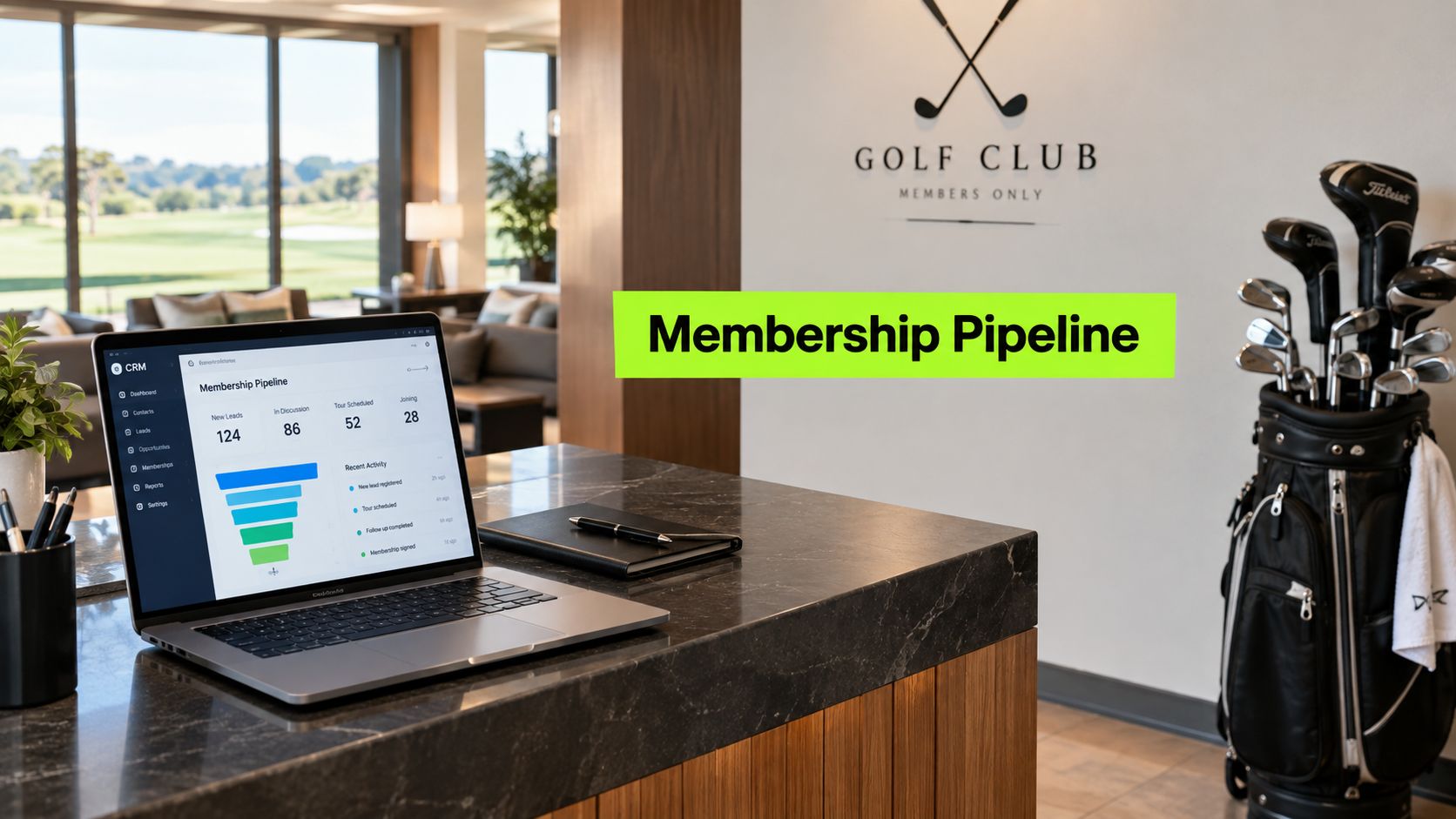
A CRM creates a common pipeline. It should show the source of each prospect, the offer that generated the enquiry, the questions they answered, the staff member responsible, the next task, the visit outcome, the application decision and the eventual membership status.
Capture the fields that support decisions
A useful golf CRM doesn't need every possible detail. It needs consistent information that changes an action or informs a decision:
- Acquisition source: referral, social media, paid advertising, search, event or partner.
- Golfer profile: format, frequency, location, handicap status where relevant and membership intent.
- Pipeline stage: new, contacted, qualified, visit booked, attended, application, joined, declined or nurture.
- Commercial context: preferred membership, joining-fee question, budget discussion and relevant objections.
- Activity record: calls, emails, visit attendance, follow-up tasks and owner.
- Lifecycle status: onboarding, active member, renewal due, at risk or lapsed.
The reporting view should answer operational questions, not just display activity. Which sources create attended visits? Where do prospects stop progressing? Are applications delayed because information is missing, or because the proposition doesn't fit? Which staff member owns the next action?
Report the whole pipeline
A monthly review can use a simple table:
| Pipeline measure | What it reveals |
|---|---|
| Qualified leads by source | Whether acquisition reaches the intended audience |
| Booked visits | Whether qualification creates a practical next step |
| Show rate | Whether reminders, timing and expectations are working |
| Applications | Whether the visit and proposition support a decision |
| New recurring members | The commercial result |
| Renewal and activation indicators | Whether acquisition quality holds over time |
A purpose-built system becomes more useful than a collection of platform dashboards. An advertising account may report clicks and form completions, but the club needs to connect those actions to revenue and retention. GolfRep's approach combines targeted acquisition, enquiry capture, qualification, CRM routing and follow-up, with the pipeline extending through visits, applications and membership outcomes.
The same discipline matters for established clubs. England recorded 750,071 club members in 2025, up from 730,602 in 2024, while junior membership increased from 46,028 to 61,483, according to reporting on England Golf membership. A CRM should distinguish those audiences rather than place every new contact into one adult membership status.
For practical selection criteria, GolfRep's guide to the best CRM for golf clubs is a useful starting point. The key test is whether the system supports the club's actual workflow, including ownership, visits, applications, onboarding and renewal.
Running Nurture Flows That Convert Different Golfer Types
A nurture flow should answer the prospect's barrier, not repeat the same membership advert. Someone who plays every week may need confidence about value and availability. A beginner may first need reassurance that they can enter the sport without already knowing the club's customs. An occasional player may need a flexible route that reduces the fear of paying for unused access.
England's wider participation picture supports this distinction. England had approximately 1.085 million regular golfers in 2024–25, up from about 1.02 million in the previous survey period, according to reported participation data. Separate England Golf-related reporting indicates that more than 55,000 people use iGolf, while non-club members with official World Handicap System indexes represent roughly 7% of players with an index. These audiences shouldn't be pushed into one conventional 18-hole membership journey.
Build routes around the next confidence step
For a beginner, the first objective may be a coaching introduction, not an immediate application. Send a clear explanation of what happens on the first visit, what equipment is needed and who they will meet. For a regular independent golfer, provide practical information about playing access, competitions, handicap arrangements and the membership type that fits their pattern.
A useful flow might include:
- Immediate confirmation: acknowledge the enquiry and show the next available action.
- First follow-up: address the prospect's stated barrier, such as confidence, time, price or format.
- Invitation: offer a taster round, coaching pathway, flexible consultation or social introduction.
- Decision support: explain value, joining fees, capacity and what membership includes.
- Human handover: prompt a call or visit when the prospect shows buying intent.
The timing should reflect the club's operating capacity and the prospect's readiness. A person who doesn't book immediately shouldn't be treated as lost. A no-show deserves a helpful rescheduling message, while an undecided visitor may need an objection-specific conversation rather than another generic promotion.
Measure movement, not opens
Email opens can provide a directional signal, but they don't pay the subscription. Track replies, bookings, attended visits, applications and joining decisions. Record the reason for non-conversion where staff can reasonably capture it, such as price, distance, timing, uncertainty or choosing another club.
Automation tools can help connect forms, messaging and CRM actions. A practical comparison of the top 10 automation tools for Captapi users may help a club assess integrations, but the selection should follow the workflow, not lead it. A technically impressive sequence that sends the wrong offer still creates a poor member experience.
The strongest nurture journey leaves room for the club's people. A PGA professional may be the right person to explain coaching, while a secretary may handle fees and governance. Routing these conversations correctly is more valuable than sending more messages.
Measuring Success and Optimising Your System
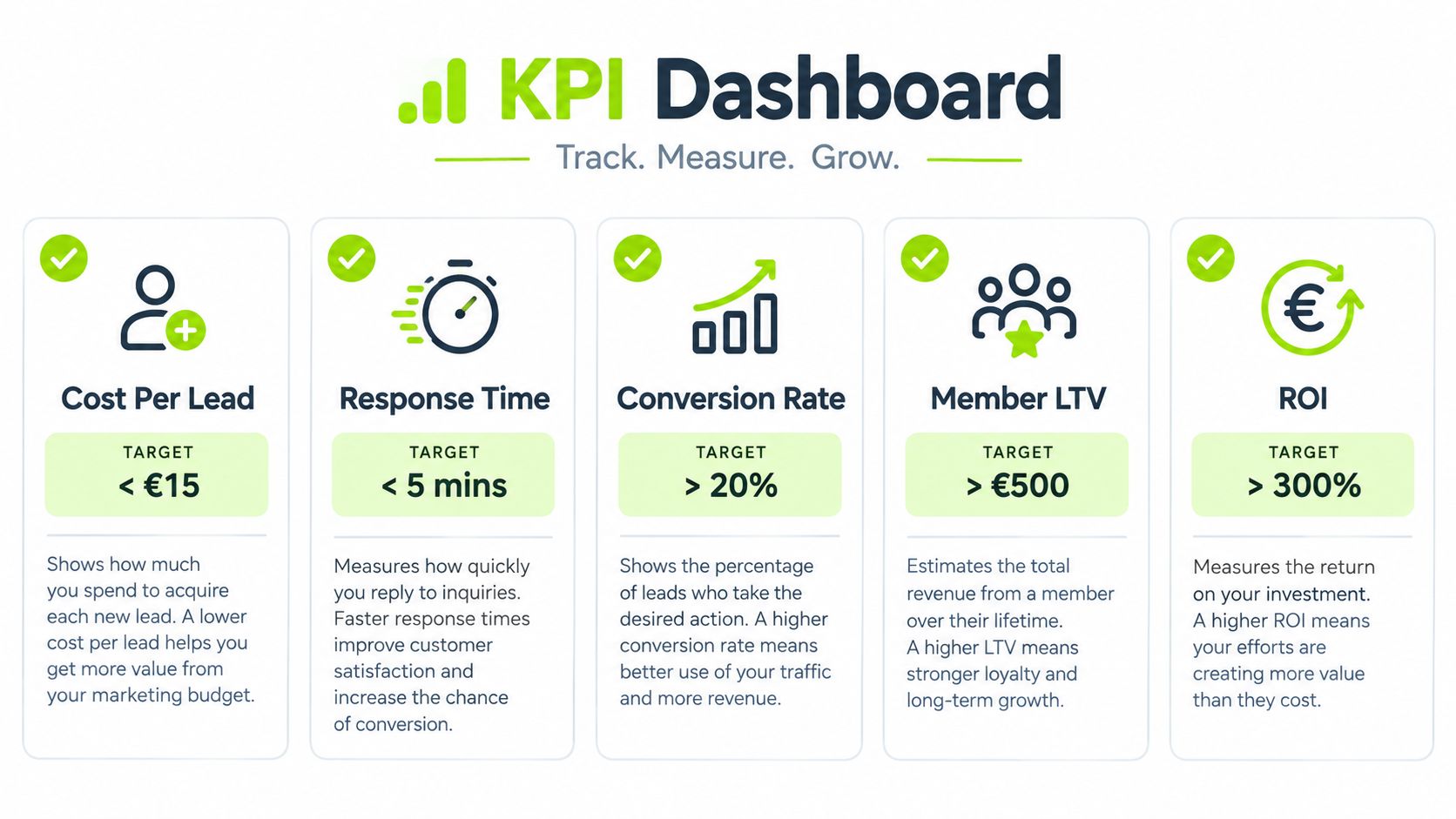
A golf lead generation system earns its place when it helps a club decide what to change next. The dashboard should connect acquisition cost, staff activity, sales progress and member value. It shouldn't stop at cost per lead.
Track these measures by source and golfer segment:
- Cost per qualified lead: shows what the club pays for a contact that fits its target profile.
- Lead-to-appointment rate: tests whether qualification and the offer create a real next step.
- Appointment show rate: reveals the quality of reminders, timing and expectations.
- Appointment-to-join rate: indicates how well the visit and sales process support a decision.
- Twelve-month revenue by source: connects acquisition to recurring commercial value.
The 2025/26 Hillier Hopkins survey supports this outcome-led view, while the Golfshake evidence adds an important retention warning. The Golfshake membership survey found that 77% of respondents planned to renew the following year, 4% said they wouldn't renew and 19% were undecided. It also reported that 50% had belonged to their current club for more than 10 years. These are survey indicators, not a universal churn forecast, but they show why onboarding, usage and renewal signals belong in the same commercial view as acquisition.
Use a constraint-led review
At each review, ask:
- Which stage has the largest practical drop-off?
- Is the problem demand, fit, response coverage, proposition, visit experience or retention?
- Can the club improve that stage without exceeding staff capacity?
- What single operational change will be measured next?
- Has the change improved recurring revenue, not just activity?
A small club may need clearer ownership before it needs another campaign. A resort may need better source-level revenue reporting. An indoor golf facility may focus on repeat visits and bay utilisation rather than membership applications. The system should reflect the business model.
Commercial test: If a campaign produces more enquiries but staff can't qualify, visit and retain them, it hasn't solved the club's constraint.
Start with one clean pipeline, named owners, relevant segments and an agreed report. Review the route from source to renewal, then improve the weakest stage before expanding activity. GolfRep helps golf businesses build and measure acquisition, qualification, CRM follow-up and retention systems, so visit GolfRep to discuss where your club's current commercial constraint sits and what to improve first.
Ready to tap into our proven growth system?