Golf Club Enquiry Management That Converts Every Lead

You're probably already seeing it. The phone rings at reception, a web enquiry lands in the inbox, a committee member forwards a message about “someone interested in joining”, and by the end of the day nobody can say with confidence who replied, when they replied, or whether the prospect ever booked a visit. That's not a marketing problem. It's a golf club enquiry management problem, and it's where good clubs leak revenue while everyone else argues about lead generation.
Most clubs don't need more interest. They need a system that stops interest disappearing before it becomes a conversation. In the UK golf sector, 59club's April 2023 benchmark found only 58% of mystery testers could speak to the correct person on the first call attempt, which means roughly 42% of calls needed a callback and risked losing momentum before the conversation even started (59club UK April 2023 report). That's the kind of leak most committees never see because it happens between the enquiry and the visit, not in the final membership report.
If you run a club, this should matter more than your latest ad creative. The clubs that grow predictably are the ones that control response speed, ownership, and follow-up, because that's where prospects either move forward or vanish. GolfRep's own enquiry loss framework is built around that reality, and the rest of this piece is about turning enquiry handling into a stage-by-stage operating system rather than another inbox full of good intentions.
Why Most Golf Clubs Leak Enquiries Before They Reach the Course
A busy Friday at a club looks organised from the outside. Reception is handling visitors, the membership secretary is caught between meetings, the general manager is juggling three priorities, and a few web forms have arrived without a clear owner. Everyone assumes someone will pick the lead up. In practice, many never do.
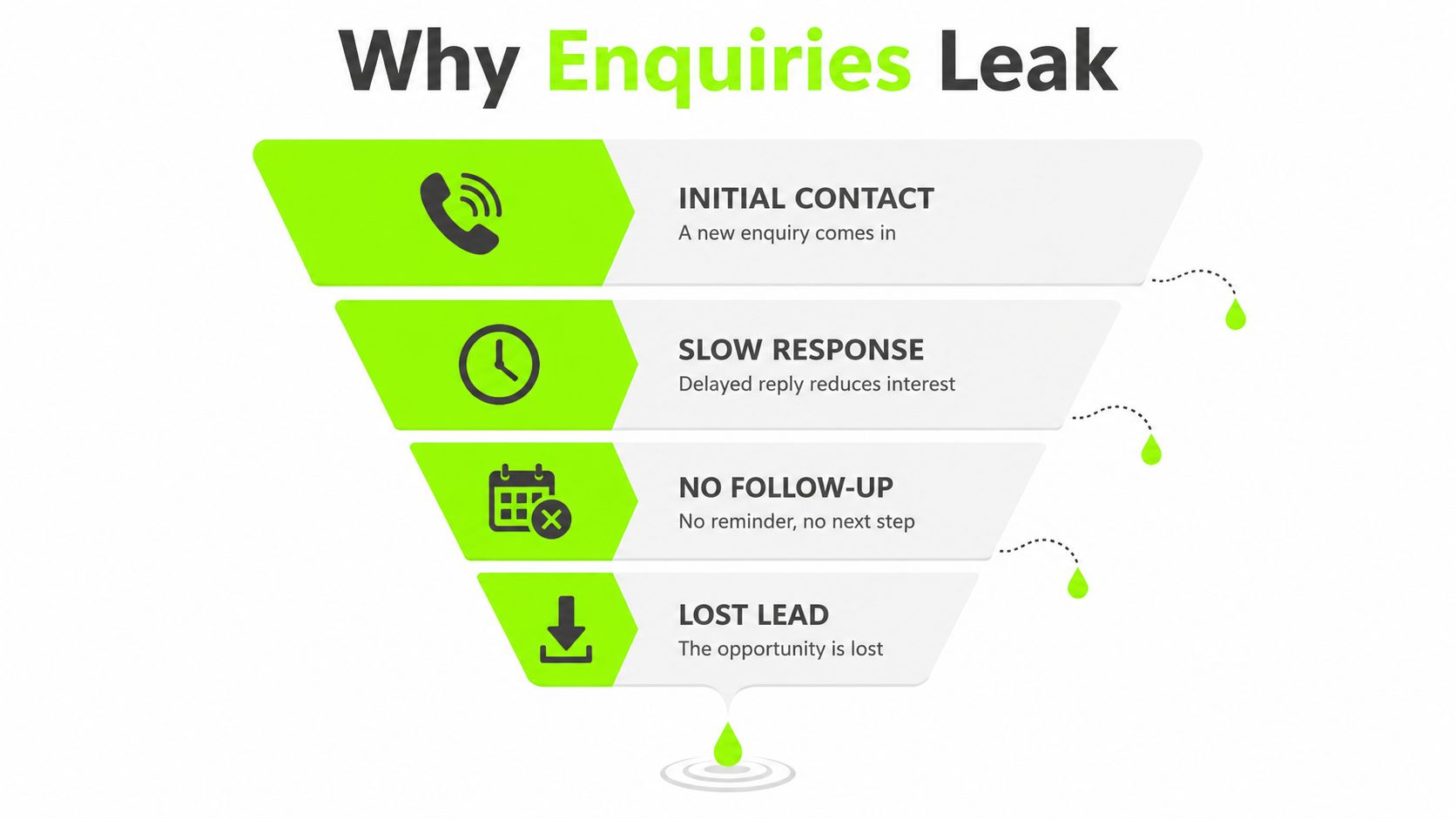
The mistake is treating enquiry handling like admin. It is the first commercial gate in the member journey, and if that gate is loose, every later sales effort gets more expensive and less predictable. Slow callbacks, unclear ownership, and messy handovers are where clubs lose momentum, and GolfRep's analysis of golf club enquiry handling says clubs can lose around 30% of enquiries before a proper discussion even begins.
Where things break down
The failure points are usually plain to see, which is why clubs let them carry on:
- Missed first contact: The enquiry lands, but nobody owns the first reply.
- Slow callback culture: The prospect waits, then moves on.
- Lost context: The enquiry sat in an inbox, so the next person starts from zero.
- No follow-up discipline: A visit gets discussed, then nothing happens.
- No single source of truth: Spreadsheet, inbox, and WhatsApp all hold different versions of the story.
The stronger UK clubs treat enquiry handling as a controlled process. They know who replies, who follows up, and what happens after the first conversation. That is how they protect revenue without discounting or chasing more traffic.
Practical rule: if you cannot tell, within minutes, who owns the lead, you do not have a pipeline. You have a hope.
The fix is to replace hope with a working operating system. Stop the leak at first contact, make the funnel visible, and make sure every enquiry has a next step before the day ends.
The Enquiry Funnel Every Club Should Track
A club that only counts enquiries is flying blind. A club that tracks the funnel can see where interest turns into action, and where it falls apart. GolfRep's framework is simple, but it's stronger than a single inbox total because it turns enquiry handling into a sequence of measurable stages rather than a pile of messages.
The six stages that matter
The funnel should be reviewed as total enquiries, lead response time, enquiry to visit rate, visit to member conversion rate, cost per acquisition, and conversion rate by source. Those six measures tell you whether the club is attracting the right people, contacting them quickly, booking visits, and converting those visits into signed members.
That matters because the problem is often not volume, it's movement. The same enquiry count can hide two very different realities. One club might be converting visitors efficiently, while another is losing prospects before they even get a reply. GolfRep's analysis says clubs can lose around 30% of enquiries before a proper discussion begins, which is exactly why a funnel view is more useful than a monthly enquiry total (GolfRep's enquiry handling analysis).
The questions behind each stage
Use the funnel to ask straight operational questions:
- Total enquiries: Are we capturing every source, or only the obvious ones?
- Lead response time: Who replies first, and how quickly?
- Enquiry to visit rate: Are we getting prospects on site?
- Visit to member conversion: What happens after the tour or taster round?
- Cost per acquisition: Are some channels expensive for no good reason?
- Conversion rate by source: Which leads become members, not just calls?
Most clubs get trapped by judging a channel by how busy it feels instead of how well it progresses through the funnel. A member referral may produce fewer leads than paid ads, but if those leads book and convert more cleanly, it deserves more attention.
If a club can't separate enquiry volume from enquiry quality, the committee will keep funding the wrong things.
The point of this model is diagnostic. Once you know where the drop-off happens, the fix becomes obvious. If response time is poor, fix speed. If the visit rate is weak, fix the handoff. If source quality is uneven, stop rewarding channels just because they created noise.
Setting Up the CRM and Lead Capture That Works
The fix starts with structure. A golf club does not need a complicated platform to get control, but it does need a system that makes every enquiry visible, owned, and searchable. A proper pipeline should move through new enquiry, contacted, qualified, visit booked, and decision, with each stage timestamped and assigned to one person.

Build the form around the decision, not the brochure
Most enquiry forms are too thin. They collect a name and email, then leave the club to do all the work later. Better forms capture enough context to route the enquiry properly, enquiry type, handicap, preferred playing days, visit intent, and a rough postcode area if geography matters. That gives the secretary or membership lead a head start before the first reply.
Your website should also answer the basics without forcing people to chase you. Clubs need clear pricing guidance where appropriate, membership categories, the joining process, and a strong action such as Book a Tour or Arrange a Call. Clubs that treat the website like a brochure keep creating friction at the point where people are ready to act.
Keep the enquiry out of the inbox trap
A good CRM, whether standalone or built on top of a club management system, should stop leads from sitting in generic inboxes. If a form submission goes to an admin email and nobody owns it, the club is back to manual control. That works for a one-off query. It is weak for membership growth.
If you want a simple benchmark, the system should make it obvious who got the lead, when they got it, and what happened next. If it does not, it is not a CRM in any meaningful sense. For a detailed buying perspective, the best golf club CRM guide is a useful reference point for comparing how clubs can organise this properly.
Clubs that want extra qualification at the front end can also use capture more prospects with chatbots, especially where initial questions can be handled instantly before a human steps in.
Use the CRM to remove memory from the process. If staff have to remember who said what, the system is too weak.
GolfRep sits in this category too. The point is not software for its own sake. It is a visible pipeline that lets clubs track source, ownership, and outcome without relying on someone's personal inbox habits.
24/7 Qualification and Nurture Flows That Do the Heavy Lifting
The biggest advantage automation gives a club is not clever messaging. It is consistency. A new enquiry should be acknowledged within minutes, even if the conversation happens later during business hours. Response speed matters because industry guidance for golf clubs says a lead contacted within one hour is five times more likely to convert than one left for 24 hours, and a 2 to 4 hour business-hours response is described as achievable for most clubs and still materially better than average (Golf club response time and conversions).
Build the first few touches properly
The first reply should confirm receipt, set expectations, and invite the next step. From there, run a structured 3 to 4 touch nurture sequence over 2 to 4 weeks. That doesn't mean spamming people. It means staying useful while the prospect is still deciding.
A practical sequence looks like this:
- Instant acknowledgement. Confirm the enquiry and ask one or two qualifying questions if needed.
- Human follow-up. A secretary, membership lead, or GM picks up the warmest prospects.
- Visit reminder. Send a reminder 48 or 24 hours before the taster round or tour to protect attendance.
- Post-visit follow-up. Email within 2 hours after the visit, then call within 24 hours if the prospect has shown buying intent. That cadence is the one GolfRep recommends in its enquiry tracking workflow (GolfRep enquiry tracking workflow).
Qualify before you spend staff time
The best automation does one more thing. It enriches the lead before a person gets involved. Ask for visit intent, preferred playing days, and enough context to judge whether the prospect is a real fit. Then route warm leads to a human and keep colder ones inside the automated sequence until they signal interest.
That is where many clubs waste effort. Staff call everyone the same way, every time, and start from scratch with each enquiry. A better system lets the club spend human time only where it can move the deal forward.
If you want a practical example of how AI can help on the qualification side, GolfRep's AI lead qualification for golf clubs article shows how structured automation can answer basic questions before staff step in.
Staffing, Roles, and the Handoff From Enquiry to Visit
Technology only works when people know their job. That's where many clubs stall. The CRM gets installed, the form works, and then the enquiry still dies because nobody is clear on who owns the next conversation. Ownership, not software, is what usually separates a tidy pipeline from an expensive mess.
Three operating models, three realities
A volunteer-led club often relies on a single membership secretary. That can work if the volume is modest and the secretary is disciplined, but it creates a bottleneck. When that person is away, everything slows down.
A medium-sized club with a general manager and part-time admin support has more flexibility, but only if roles are tight. The admin team can handle first contact and booking, while the GM or membership lead handles higher-value conversations. Without that split, leads bounce around.
A multi-site operator has the strongest opportunity to centralise response speed. A shared enquiry desk or central team can respond quickly, route leads to the right site, and keep reporting consistent. The trade-off is local knowledge, which has to be preserved in the handoff.
Use simple RACI logic
A full RACI matrix doesn't need to be complicated. For most clubs:
- New enquiry: admin or central team is Responsible, GM or secretary is Accountable.
- Qualification: membership lead is Responsible, club contact is Consulted.
- Visit booking: same owner should carry the lead forward, not hand it back.
- Decision stage: one named person follows up, then logs the outcome.
That's the point of the handoff. It should feel smooth to the prospect, not like they've been passed between departments. If someone has to repeat their story twice, the club is already making the sale harder than it should be.
Practical rule: the next conversation should always have a name, a time, and an owner before the current one ends.
GolfRep's work with clubs sits here because response systems are only useful when the people behind them are clear on process. A club can have great advertising and a good website, but if the handoff is vague, the pipeline still leaks.
KPIs, Attribution, and the Optimisation Loop
If you don't review enquiry handling, you're guessing. The monthly review should be short, factual, and built around the same measures every time. That way, the committee or owner isn't debating opinion. They're looking at movement.

What to look at each month
Review these six items together, not in isolation:
- Response Time
- Conversion Rate
- Lead Source Quality
- Pipeline Stage Velocity
- Nurture Flow Engagement
- Total Enquiries to Bookings
That gives you a proper picture of whether the club is improving. If response time gets faster but bookings don't move, the issue is probably the handoff or the visit itself. If bookings are healthy but source quality is poor, the club is spending time on the wrong channels.
The attribution piece is where many clubs underperform. The fix doesn't require enterprise software. Start by tagging every lead as website form, social, referral, member, or walk-in. Then review source and outcome monthly. A volunteer-run club often discovers that member-generated leads convert more cleanly than paid traffic, which changes where effort gets put.
Keep the review practical
A useful monthly checklist for committee-led clubs looks like this:
- Tag every enquiry source immediately.
- Record one owner for every stage.
- Track whether each lead booked a visit.
- Note which visit led to a decision.
- Separate genuine leads from general questions.
- Compare source quality, not just enquiry volume.
That last point matters. Chasing more enquiries is often the wrong target if the club cannot prove which sources create qualified visits and signed members. Golf clubs should care about quality, timing, and conversion, especially when seasonality can distort the picture.
For a broader look at lead generation principles outside golf, HighLevel's lead generation approach is a useful comparison point, but clubs still need to adapt it to their own membership journey and source mix.
Turning Enquiry Management Into Predictable Membership Growth
The clubs that grow predictably usually do three things well. They treat every enquiry as a tracked stage, they make sure someone owns the next conversation, and they refuse to paper over weak systems with discounting. That's the shift most clubs still need to make.
Enquiry management sits between marketing and membership sign-up. If that middle layer is weak, you can spend more on ads, redesign the website, and write better emails, and still lose the same prospects. The problem isn't a lack of interest. It's a lack of control.
The clubs that get this right are the ones that stop asking, “How do we get more enquiries?” and start asking, “Where are we losing the ones we already have?” That question changes the conversation inside the club. It forces attention onto response time, ownership, attribution, and visit follow-through, which are the levers of growth.
GolfRep works with clubs on that operating system because sustainable membership growth needs structure, not guesswork. If you want a pipeline that is visible, organised, and built to convert, start by fixing the enquiry process before you spend another pound trying to generate more noise.
If your club's enquiries are getting lost in inboxes, spreadsheets, or unanswered callbacks, GolfRep can help you build the system behind the growth. Visit GolfRep to see how structured follow-up, CRM tracking, and enquiry automation can turn more of your existing demand into booked visits and signed members.
Ready to tap into our proven growth system?