Golf Club Membership Sales: A Playbook for Growth in 2026
Most advice on golf club membership sales starts in the wrong place. It tells clubs to get more enquiries, spend more on ads, post more on social, and hope volume solves the problem.
Usually, it doesn't.
At GolfRep, we see the same pattern repeatedly. A club has interest in the market, a website that produces form fills, occasional referral traffic, and periods of strong local attention. Then the process breaks. An enquiry sits in an inbox. A committee member wants to review pricing before anyone replies. A prospect gets one polite email and nothing after that. Another lead books nothing because nobody owns the next step.
That is not a demand problem. It is an operating problem.
The Real Reason Your Membership Sales Are Stalling
The market itself is not the main issue. UK golf club membership sales strengthened materially in 2023/24, and only 24% of clubs had more leavers than joiners according to the Hillier Hopkins golf clubs survey. In practical terms, that means roughly three-quarters of clubs were at least holding ground or growing.
So when a club says membership sales have stalled, the first question shouldn't be, “How do we get more leads?” It should be, “What happens to the leads we already get?”
More enquiries don't fix a weak process
Buying more traffic into a messy sales process usually creates a bigger mess. You don't get predictable growth. You get more unworked enquiries, more slow follow-up, and more uncertainty about what is and isn't working.
That's why clubs need to treat membership sales like an operational system, not a marketing campaign. The core job is simple:
- Capture every enquiry
- Respond while intent is still high
- Track every touchpoint
- Move the prospect to a visit, trial, or conversation
- Measure where conversion drops
If those steps aren't in place, acquisition spend becomes expensive guesswork.
Practical rule: If your team can't see every active enquiry and its next action in one place, your membership pipeline is already leaking.
Clubs often know they have a problem, but they struggle to pinpoint where it starts. A useful way to think about it is the same mindset analysts use to find your data's why fast. Don't assume the top of the funnel is broken. Trace the cause of lost growth through the process itself.
A club with declining or inconsistent sign-ups often doesn't need a new slogan. It needs response standards, ownership, automation, and visibility. That's also why the first fix is rarely cosmetic. It's procedural. If that sounds familiar, this guide on what to fix first when golf club membership is declining is a useful starting point.
Diagnosing the Leaks in Your Membership Funnel
Most clubs don't lose membership sales in one dramatic failure. They lose them in small, ordinary moments. A voicemail returned too late. A web form passed between staff. A prospect who asked about flexible categories and never received a clear answer. A tour that was “meant to be arranged” but never was.
That is why diagnosis matters more than assumption.
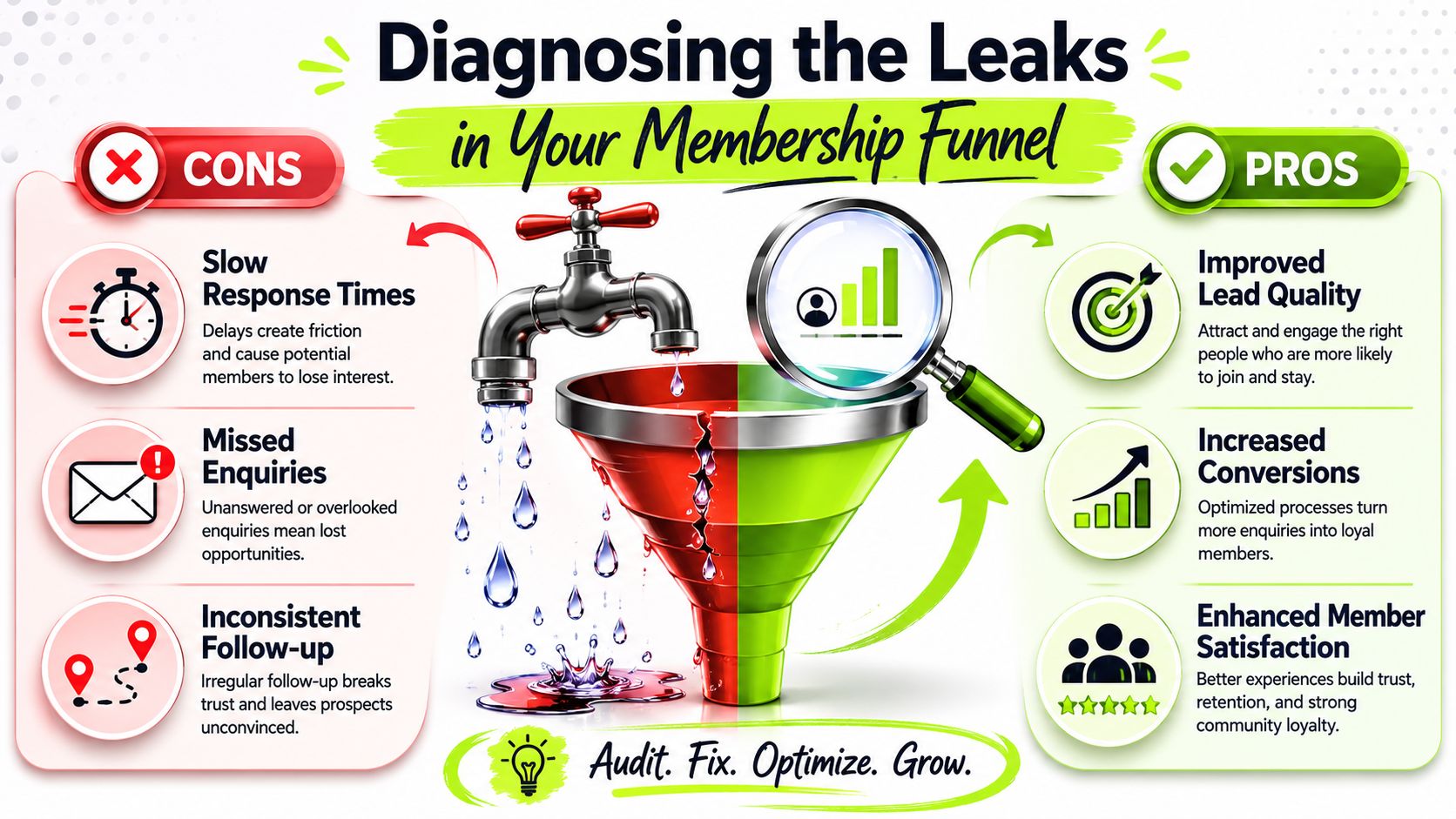
Recent benchmarks show the average sales cycle for new club members increased from 13.3 days in 2022 to 14.7 days in 2023, while organic leads fell 5% and member referrals fell 7.5% versus 2022 in the club sales benchmark summary. That matters because a slower cycle gives more time for indecision, distraction, and poor follow-up to kill momentum.
What a leaking funnel looks like inside a club
A broken process rarely announces itself. It usually looks normal because staff are busy and everyone assumes someone else has it covered.
Common symptoms include:
- Slow first response. Enquiries arrive outside office hours or during busy periods and sit untouched until the next day or later.
- No lead ownership. The prospect belongs to “the club” rather than a named person with a next action.
- Poor visibility. Management can't see how many open enquiries exist, where they came from, or which stage they are in.
- Inconsistent follow-up. One lead gets three calls. Another gets one email. A third gets nothing after the brochure.
- Manual handovers. Notes live in inboxes, notebooks, or committee updates rather than a shared system.
These aren't minor admin issues. They directly affect conversion.
Audit the process, not just the marketing
A useful audit starts with a simple question. Can your club answer, in real time, what happened to every enquiry from the last month?
If the answer is no, the first priority is visibility.
Use this quick diagnostic table:
| Checkpoint | Healthy process | Leaking process |
|---|---|---|
| Lead capture | Every enquiry enters one system automatically | Enquiries arrive through email, forms, calls, and social messages with no central record |
| First response | Immediate acknowledgement and clear next step | Delayed replies and generic messages |
| Ownership | One person is responsible for follow-up | Shared inboxes and vague accountability |
| Pipeline view | Stages are visible to management | Status is known only through memory or inbox searches |
| Follow-up cadence | Timed sequence across email, phone, and SMS if appropriate | One-off reply with no structured sequence |
A club can have decent demand and still underperform badly if nobody can see the pipeline clearly.
The hidden cost of manual handling is not only lost leads. It is false diagnosis. Clubs often believe adverts aren't working when the actual problem is that enquiries aren't being worked consistently after they arrive.
That is why lead visibility matters so much. It changes the conversation from opinion to evidence. Instead of “we don't think Facebook leads are serious” or “referrals used to be enough,” you can review actual progression by source, by staff member, and by stage. This article on how clubs lose enquiries without realising gets into that operational blind spot in more detail.
Building Your Acquisition Engine to Attract the Right Golfers
Once the funnel is visible, acquisition becomes more useful because you can feed a working system instead of a black hole.
The mistake many clubs make is targeting “golfers” as if that is a complete audience definition. It isn't. People don't join a club solely because they play golf. They join because the club fits their routine, budget logic, family life, and expectations around convenience.
A modern acquisition engine starts there.
Build around real joining motives
Post-2024, UK golfers increasingly expect convenience, digital responsiveness, flexible access, social programming, and a smoother online journey, as outlined in this analysis of golf club growth in an uncertain economy. That means your sales messaging cannot rely only on course quality and tradition.
A stronger approach is to map offers and messaging to likely buying situations:
- Hybrid workers who value weekday access, easier booking, and less friction in joining
- Young adults who want coaching, social relevance, and a clear first step without pressure
- Families looking at lifestyle value, not just medals and handicaps
- Returning golfers who want a route back into regular play without feeling locked into the wrong category
That changes both your advertising and your landing pages. Instead of broad claims, you answer practical questions fast. How does booking work? What membership route fits my stage of life? Can I spread payments? What happens after I enquire?
Better targeting starts with better promises
Good acquisition is not about saying more. It is about reducing uncertainty.
Here is the difference in practice:
| Weak message | Stronger message |
|---|---|
| Join our prestigious club | Find the membership route that fits how often you actually play |
| Championship course and friendly atmosphere | Flexible access, clear categories, and a simple online enquiry process |
| Enquire today | Book a call or visit and get the right membership options explained clearly |
Notice the shift. The stronger version helps the prospect imagine the process, not just the product.
Clubs don't need broader messaging. They need clearer relevance.
Local paid acquisition works best when the promise in the advert matches the journey after the click. If you advertise flexibility, the landing page should explain it plainly. If you promote a visit, the booking path should be obvious. If you mention family or social value, the follow-up should continue that theme rather than dropping a generic membership PDF into someone's inbox.
For teams reviewing their process, it can help to study how other sectors improve sales workflows before applying the same discipline to golf club membership sales. The principle is the same. Fewer handoffs, faster acknowledgement, clearer stages, and better qualification lead to cleaner conversion.
If your club is still trying to solve acquisition with broad awareness campaigns alone, it's worth grounding the work in a more practical lead system first. This guide to golf club lead generation is useful when you want leads that fit an actual pipeline, not just extra form fills.
Automating the First Touch for Instant Engagement
The first touch is where many clubs lose the sale before a conversation even begins.
A prospect sees an advert on a Sunday evening, visits the website, fills in a form, and hears nothing. By Monday afternoon, that person has moved on mentally. The original interest is weaker, another option has appeared, or the task has dropped down their list.
That delay is avoidable.
What the first-touch system should do
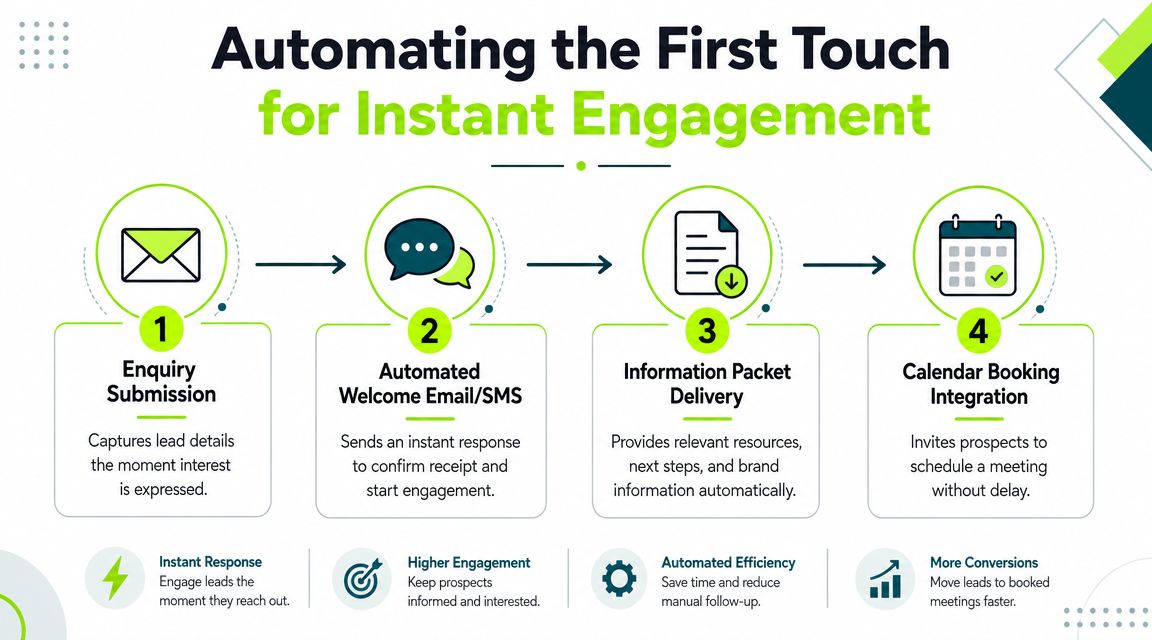
A useful automated setup does four jobs immediately after an enquiry arrives:
Acknowledge the enquiry at once
The prospect should know their message has been received and who will follow up.Deliver the right information
Not every lead needs the same pack. Someone asking about flexible membership should not receive the same generic material as a full seven-day prospect.Capture useful intent signals
Preferred category, likely joining timeline, and interest in a visit all help staff respond properly.Create a task inside the CRM
This is what turns marketing into operations. The lead becomes visible, owned, and actionable.
Without those steps, clubs rely on memory and goodwill. With them, every enquiry enters a structured process.
A practical handoff model
The strongest automation doesn't replace the human element. It protects it.
A simple model looks like this:
- Web form or ad lead arrives
- CRM records source and contact details
- Automated email or SMS confirms receipt
- Relevant information is sent based on the enquiry
- A task is assigned to the right team member
- Follow-up is scheduled if no reply or booking happens
That creates speed without sacrificing personal contact.
Operational note: Automation should handle acknowledgement and routing. Staff should handle judgement, conversation, and closing.
Clubs often worry that automated follow-up will feel impersonal. Poor automation does. Good automation feels organised. It buys time, prevents silence, and gives staff context before they speak to the prospect.
This is also the point where a proper system starts paying for itself operationally. A platform such as GolfRep can combine lead capture, automation, CRM tracking, and nurture into one workflow so clubs are not stitching together inboxes, spreadsheets, and ad platforms manually. The important part is not the brand. It is the discipline. Every enquiry must go somewhere visible, trigger a response, and move to a next action.
What to automate first
If a club is starting from a manual process, don't try to automate everything at once. Begin with the parts that remove delay.
Prioritise these first:
- Instant acknowledgement for all web enquiries
- Automatic CRM entry so no lead lives only in email
- Task creation with a named owner
- Follow-up reminders when no reply has been logged
- Visit booking prompts for engaged prospects
Once that is in place, qualification can become more advanced. But the first win is simple. No enquiry should disappear between submission and human contact.
Converting Enquiries into Committed Members
Conversion is where clubs often become too passive. They answer questions, send information, and wait. The prospect stays in limbo. Interest cools. Nothing feels urgent or guided.
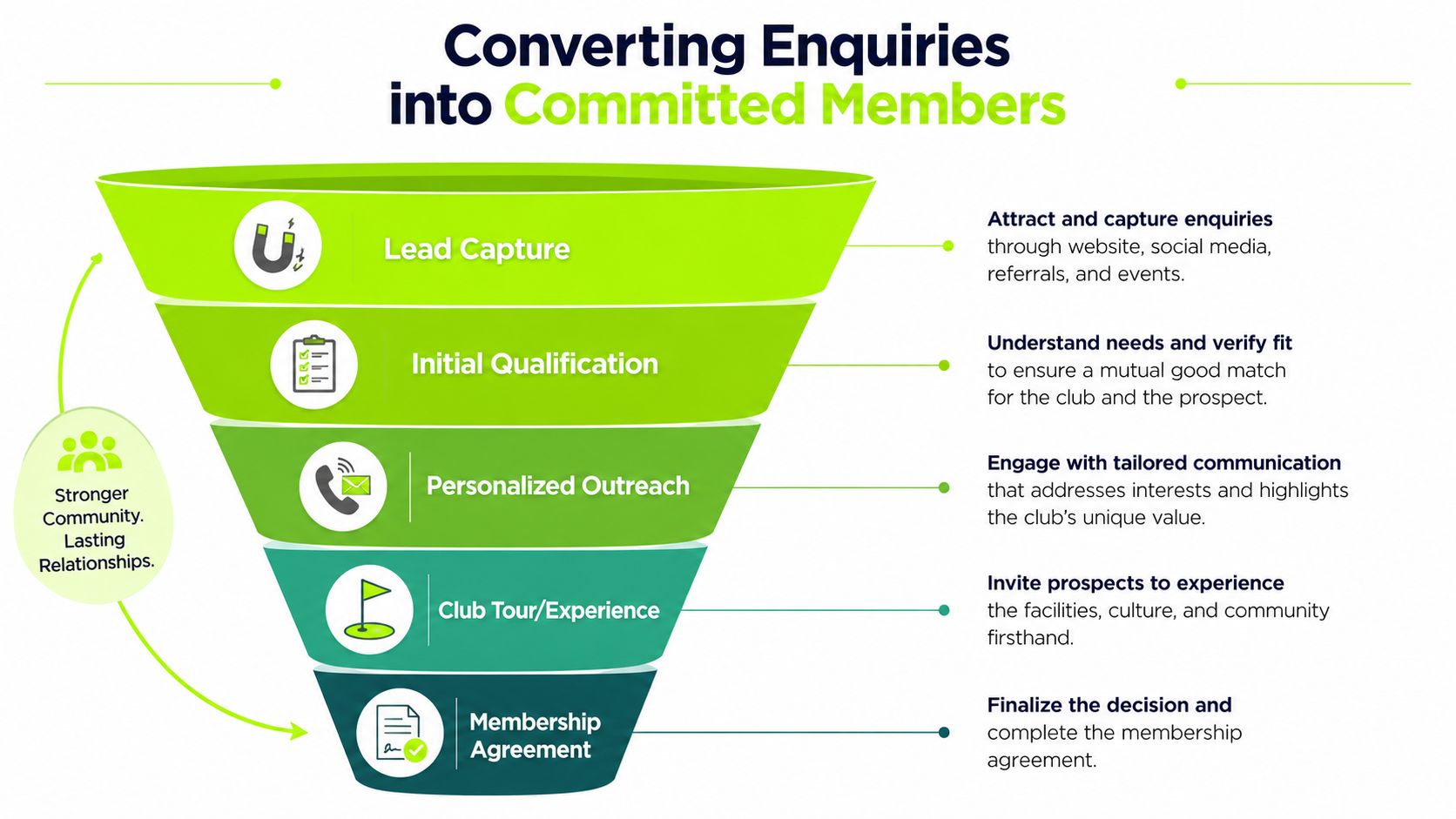
Strong golf club membership sales don't rely on the prospect to build their own journey. The club does that work for them.
Turn follow-up into a guided path
A good nurture flow should move the lead towards one concrete action, usually a call, tour, trial experience, or membership conversation.
That means each touchpoint needs a purpose.
A simple pattern looks like this:
- First follow-up answers the initial enquiry and offers a clear next step
- Second follow-up adds context such as category fit, club experience, or practical joining detail
- Third follow-up invites a visit or conversation with a specific person
- Later touches handle hesitation, timing, or objections without sounding desperate
This is not about chasing. It is about reducing decision friction.
Make the club visit part of the sales process
Many tours are too casual. The prospect gets shown around, hears some history, sees the course, and leaves with a vague impression. That is hospitality, not a sales process.
A better visit does three things well:
| Visit element | What good looks like |
|---|---|
| Preparation | Staff know why the prospect enquired, what category may suit them, and what concerns they may have |
| Experience | The visit connects facilities and membership benefits to that person's life, not just to the club's pride points |
| Next step | The meeting ends with a defined action such as application, follow-up call, or category recommendation |
If there is no next step, the visit was incomplete.
A tour should answer one question clearly. Can this prospect see themselves belonging here?
Simplify offers before you discount
Many clubs damage long-term value through their reactions. They see hesitation and respond by inventing more categories, more exceptions, and more discounts.
That usually makes selling harder.
Prospective members respond better to a small number of clearly defined categories, and evidence suggests UK clubs can raise fees by up to 8% without increasing churn, while a 12% rise is associated with 25% of golfers saying they would leave or downgrade, according to this golf membership pricing analysis. The practical lesson is not “raise prices aggressively.” It is “keep pricing measured and structure clean.”
A stronger conversion model often includes:
- Fewer categories so prospects can understand the options quickly
- Clear value boundaries between categories
- Payment flexibility where appropriate, without muddying the core proposition
- Trial-to-full pathways only if they lead clearly to standard membership rather than endless low-value limbo
What doesn't work well is blanket discounting. It erodes perceived value and teaches prospects to negotiate against the club's own confidence.
The better trade-off is clarity over complexity. Clubs convert more cleanly when staff can explain the offer in plain English and prospects can compare options without feeling they need a committee meeting to decipher them.
Closing the Loop with Reporting and Retention
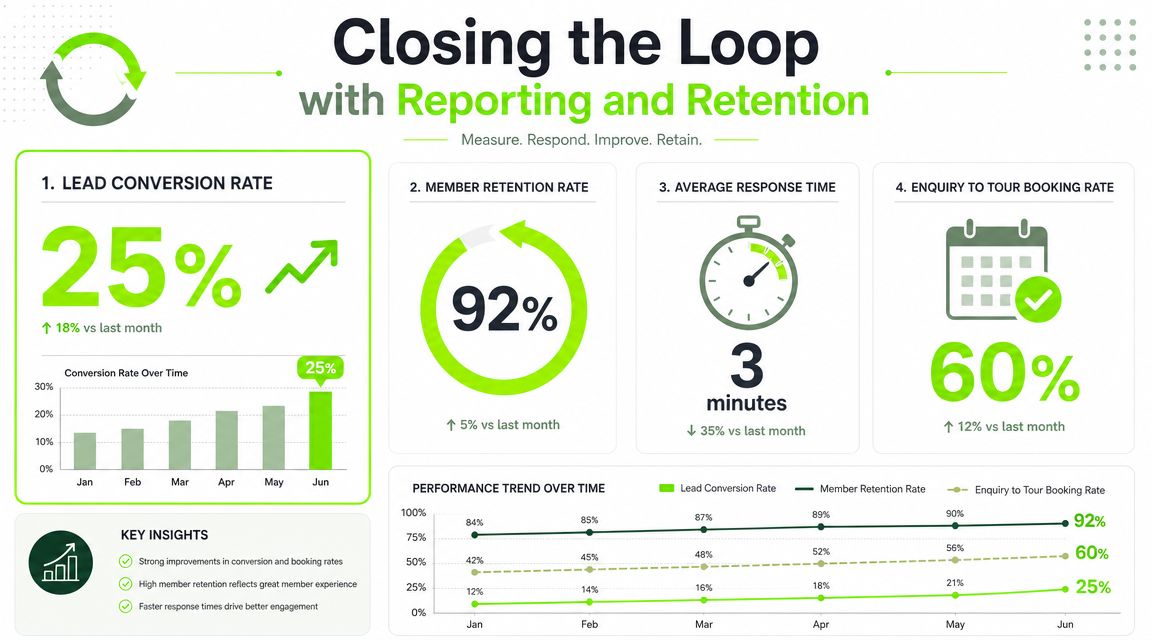
A membership sales process is not finished when someone joins. If you stop measuring at sign-up, you miss the part that makes the whole system stronger next month and next year.
The clubs that grow most steadily are not the clubs that guess better. They are the clubs that can see what happened, understand why it happened, and adjust quickly.
Report on the process, not just the outcome
Most committee reporting is too high level. It focuses on total joins, total resignations, and broad revenue commentary. Those numbers matter, but they don't help you improve the machine.
Useful reporting tracks operational questions such as:
- Which enquiry sources produce serious prospects
- How quickly first responses are being sent
- How many leads are waiting for follow-up
- Which staff actions lead to visits
- Where prospects stall before joining
This kind of reporting changes decision-making. Instead of debating opinions, the club can see where action is needed.
The handover after joining matters
New members often receive plenty of attention before payment and too little after it. That creates an avoidable gap between acquisition and retention.
A better handover includes:
A welcome sequence
Confirm practical details, key contacts, booking information, and early opportunities to engage.An early usage check-in
If someone has joined but not integrated into club life, that should trigger attention.A retention note in the same CRM
The acquisition record should not disappear once the invoice is paid. It should continue into onboarding and engagement tracking.
The system should help the club notice the quiet risk factors. A member who joined for convenience but struggles to book, or one who wanted social connection but attends nothing, is giving the club a retention signal.
Good reporting does not create bureaucracy. It creates accountability and earlier intervention.
Build one version of the truth
Committee-led clubs especially need a single reporting view. Without it, sales updates become anecdotal. One person says enquiries are down. Another says tours felt strong. Someone else thinks price is the issue. Nobody can prove much.
One dashboard, even a simple one, should show:
| Metric | Why it matters |
|---|---|
| Enquiries by source | Shows where serious interest originates |
| Open leads by stage | Reveals backlog and stalled opportunities |
| Tours or visits booked | Measures movement, not just raw enquiry volume |
| Join outcomes by category | Highlights which offers convert cleanly |
| Early retention signals | Connects sales quality to member fit |
That closes the loop. Marketing, sales handling, and retention stop operating as separate conversations.
The wider club economy also matters here. The CMAA private-club benchmark states there are approximately 5,659 private clubs in the country, and 3,887 identifiable clubs with revenues above $1 million generated an estimated $32.6 billion of revenue in 2023, while employing 573,000 people and generating $17.4 billion of payroll according to the CMAA economic impact summary. Golf clubs operate inside that broader membership economy. That is why disciplined reporting matters. Membership acquisition is not a side activity. It sits at the centre of a substantial recurring-revenue model.
If your club is generating interest but struggling to turn enquiries into visits, applications, and long-term members, GolfRep helps build the system behind the sale. That includes lead generation, instant follow-up, CRM visibility, and structured nurture, so your team can stop relying on manual chasing and start running a more predictable membership pipeline.
Ready to tap into our proven growth system?