A Guide to Corporate Golf Day Marketing for UK Clubs

If your club treats corporate golf days as a welcome but unpredictable bonus, you are leaving a serious amount of money on the table. Effective corporate golf day marketing is not about promoting a one-off event; it is about building a predictable, high-margin revenue pipeline that runs like clockwork. The secret is moving from passively taking bookings to proactively creating them with a system that attracts, nurtures, and converts corporate clients year-round.
Why Corporate Golf Is Your Club's Greatest Untapped Asset

From our direct experience working with clubs across the UK, we see the same story play out. The management team views corporate events as a nice extra, not a core part of the business. This mindset is the single biggest barrier to unlocking one of your most profitable assets. Corporate golf is not a fluke; it is a consistent, high-value revenue stream just waiting for a proper system.
The problem is not a shortage of businesses looking to host golf days. The real issue is the lack of a structured process inside the club to handle this interest. Without a clear plan, enquiries get lost, follow-ups are sporadic, and that potential income simply vanishes.
The True Scale of the Opportunity
The market for corporate golf is growing, and it is no longer just for big-city corporations. Recent market analysis shows corporate golf tourism is set to command a huge 35% of the entire UK golf tourism market. That is a significant piece of a market valued at USD 4.6 billion in 2026. You can see the latest UK golf tourism findings here.
What is critical for club managers to grasp is that this opportunity has expanded. It is now dominated by small and medium-sized enterprises (SMEs) using golf days as a powerful way to network and strengthen client relationships.
Your club is likely surrounded by dozens, if not hundreds, of local businesses actively looking for unique ways to engage clients and reward staff. The only question is: do you have the system in place to make your club the obvious choice?
Shifting from Ad-Hoc to Systematic
This guide is about moving past the headache of managing one-off bookings. It is a practical playbook for building a proper corporate golf day marketing engine. We will show you how to create a predictable pipeline that complements your membership income and insulates your club from its seasonal dips. The goal is to build long-term corporate partnerships that fuel sustainable growth.
By implementing a structured approach, you can turn those sporadic enquiries into a reliable revenue stream. We have seen it happen time and again. For a look at how we have helped other clubs achieve this, check out some of our recent work. You can explore our case studies with UK golf clubs.
Designing and Pricing Your Corporate Golf Packages
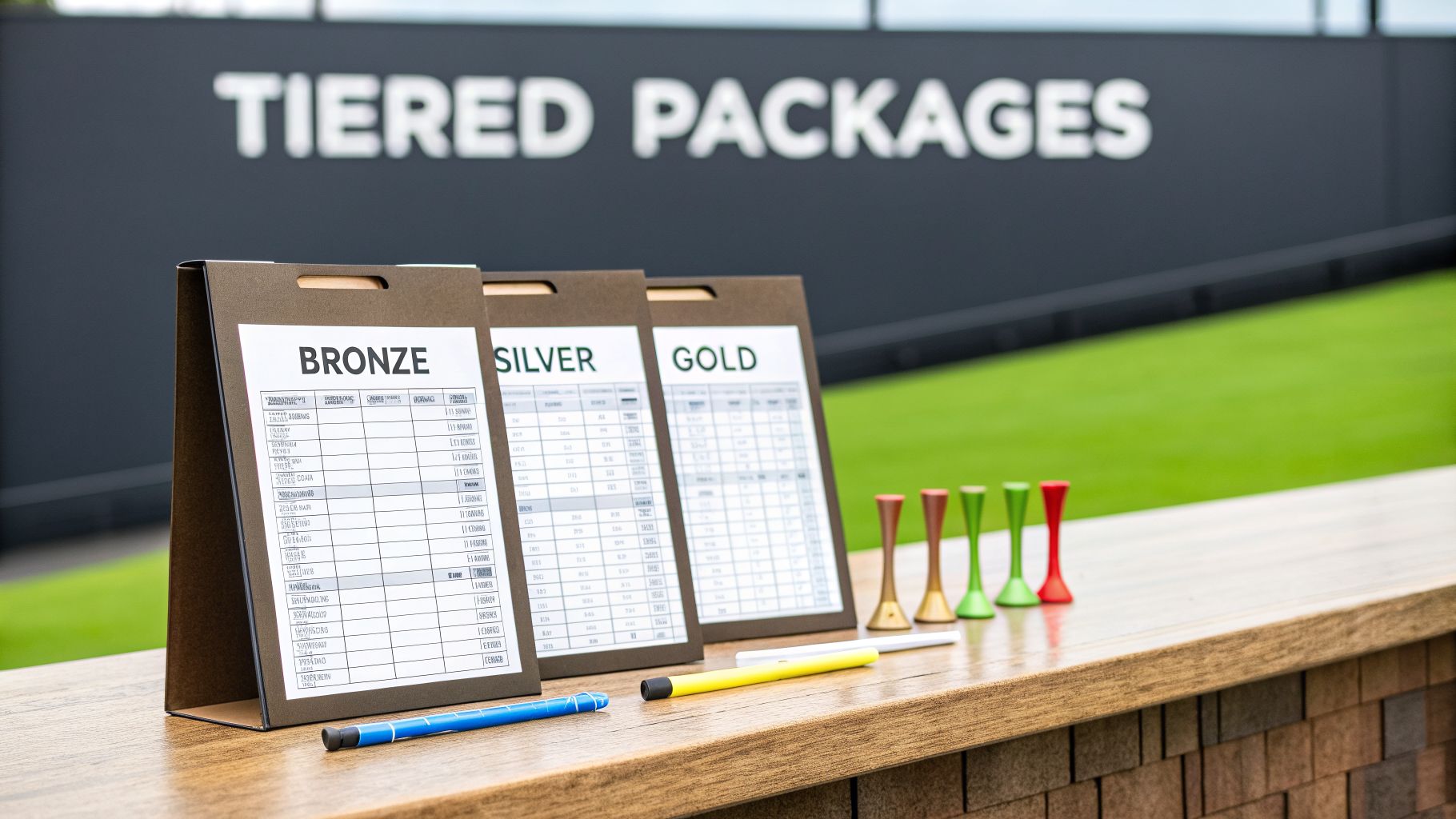
One of the biggest mistakes we see clubs make is offering a single, one-size-fits-all corporate day package. This immediately puts you on the back foot, limiting your audience and forcing a conversation that is only about cost. The reality is, the local SME owner has completely different needs and a different budget than a national firm planning a flagship client event.
Real success with corporate golf day marketing starts with designing tiered packages that speak to this diverse market.
When you present options, the whole dynamic shifts. A potential client stops asking, "How much is it?" and starts thinking, "Which of these is the right fit for us?". Suddenly, the conversation is about value and experience, not just the price tag. Your goal is to create a clear, logical progression from a fantastic entry-level day out to a truly premium, all-inclusive experience.
We have seen clubs have tremendous success by building their offers around three distinct tiers, usually a Bronze, Silver, and Gold structure. It is a simple format that businesses instantly understand, making the sales process far more straightforward for your team.
Nailing Your Baseline Costs
Before you can dream up any packages, you absolutely have to know your numbers. Profitability in this game is not an accident; it is engineered. The very first thing you must do is calculate your rock-bottom, break-even cost per golfer.
This calculation needs to be meticulous, covering every single expense tied to hosting one player for the day. If you miss costs here, they will come directly out of your margins later. No exceptions.
Your baseline cost per head must include:
- Green Fee: Your standard visitor rate or a properly calculated internal cost.
- Catering: The hard cost of all food and drink in your most basic package (e.g., coffee and bacon rolls, a one-course lunch).
- Staffing: A portion of the day's wage bill for course marshals, check-in staff, and the catering team who will be looking after the group.
- Basic Supplies: The cost of scorecards, bag tags, and any other small items you provide as standard.
Once you have that final figure, you have your foundation. Every single package you create must be priced above this number to guarantee you are not subsidising someone else's corporate event.
We have seen so many clubs price their corporate days based on a discounted green fee, completely forgetting the hefty operational and catering costs. You must calculate your true cost-per-head first, then build your packages and profit margins on top of that solid number.
Building Value into Tiered Packages
With your baseline cost sorted, the fun part begins: designing your tiers. The secret here is to add elements that have a high perceived value for the client but are relatively low-cost for your club to deliver. This is how you justify a higher price and create irresistible upsell opportunities.
Take branding, for example. For a business, getting their logo seen by clients is hugely valuable, but for you, placing a few branded tee markers on the course costs next to nothing.
Let's look at how this plays out in a typical structure.
Bronze Package (The Essential Experience)
This is your way in, perfectly designed for smaller businesses or those keeping a close eye on the budget. It covers all the essentials for a brilliant day and should be priced with a healthy profit margin over your baseline cost.
- 18 holes of golf.
- Coffee and breakfast rolls on arrival.
- A one-course meal after the round.
Silver Package (The Enhanced Experience)
This is your workhorse and often the most popular choice. It takes everything from the Bronze package and adds a few high-impact extras that make the day feel more special.
- Includes all Bronze elements.
- Branding: Company branding on tee markers at key holes.
- Catering Upgrade: A two-course dinner or a post-golf BBQ.
- Competitions: Full management of 'Longest Drive' and 'Nearest the Pin' contests, including markers.
Gold Package (The Premium Partnership)
This is your top-of-the-line offering, positioned as a complete event solution. It is for companies that want a seamless, turnkey experience with maximum brand exposure and zero hassle.
- Includes all Silver elements.
- Exclusive Branding: Title sponsor branding on banners, the welcome board, and all printed materials.
- Premium Catering: A three-course dinner in a private room.
- Pro Services: A 'beat-the-pro' competition on a par 3 or a pre-round coaching clinic.
- Prizes: A contribution to the prize table, like four-ball vouchers for your course.
This tiered approach does not just broaden your appeal; it creates a natural conversation for upselling. You will find many clients who called to ask about a basic package can easily be guided towards the superior value and experience offered in the Silver or Gold tiers. For more ideas on how to connect with these clients, check out our guide on leveraging golf for business.
Building a Marketing Engine That Attracts Corporate Bookings
Now that you have designed your packages and priced them for profit, it is time to build a system that consistently brings high-quality corporate enquiries through the door. If you are just relying on sporadic promotional pushes, you will get sporadic results. The key to predictable growth is moving away from that feast-or-famine cycle.
Effective corporate golf day marketing is not about luck; it is about creating a predictable, multi-channel engine that works for you in the background. We are not talking about abstract theory here. These are the practical, repeatable tactics we use to build reliable pipelines for clubs across the UK.
The goal is to stop hoping for corporate bookings and start generating them on demand. This requires a coordinated approach across several key channels, each chosen specifically to reach business decision-makers.
Digital Channels with Pinpoint Accuracy
Let's be realistic: your ideal corporate client is not casually browsing the web for golf days. You have to put your offer directly in front of them where they already spend their time. Paid social media gives you an incredibly precise way to do just that.
LinkedIn Ads: This is the undisputed home of B2B marketing and a goldmine for us. You can target people by their exact job titles, think 'Director', 'CEO', 'Managing Partner', or 'Business Owner'. Better yet, you can narrow it down by company size, industry, and a specific radius around your golf club.
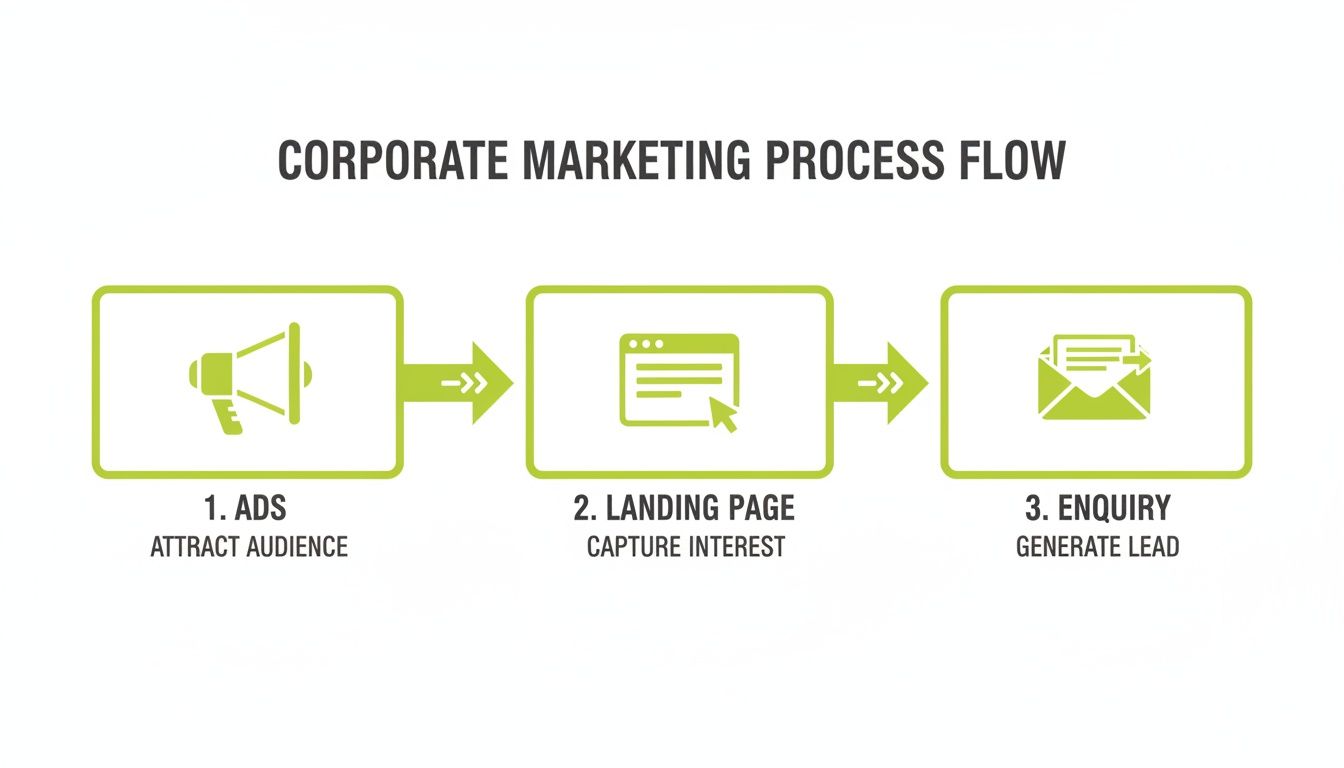
Facebook & Instagram Ads: While they might feel more casual, these platforms are incredibly powerful for reaching local business leaders. You can target individuals who have listed 'Business Owner' as their job title or shown an interest in business networking, local commerce, and, of course, golf itself. The trick is to run a clear campaign that sends them straight to a dedicated corporate landing page.
A small, well-managed budget on these platforms can deliver fantastic results. We often kick off campaigns for our partner clubs with spends as low as £10-£15 per day, focused tightly on a 20-mile radius. When a single booking can be worth thousands, the return on that small investment speaks for itself.
The Unsung Hero: A Dedicated Landing Page
Driving traffic from your ads is just the start. Where you send that traffic is arguably even more important. Please, do not make the classic mistake of sending high-value prospects to your general club homepage.
A dedicated landing page is non-negotiable. This single page has one job and one job only: to turn interest into an enquiry.
It needs to clearly lay out your corporate packages, feature stunning photos of the course and clubhouse, and include testimonials from past corporate clients. Most critically, it must have a simple, prominent enquiry form. This form is your lead capture mechanism, the digital front door for all your corporate marketing efforts.
We see clubs lose valuable leads time and time again because their website sends potential corporate clients on a wild goose chase. A focused landing page with a clear form removes all that friction and will drastically increase the number of enquiries you get for your marketing spend.
Tapping Into Your Hidden Assets
While digital advertising is great for finding new audiences, most clubs are sitting on an untapped goldmine: their existing database. You already have a warm audience of past business contacts and members who are business owners themselves.
Waking Up Your Email List
A targeted email campaign to your existing business contacts is a low-cost, high-impact move. Do not just blast out a generic mailshot. Segment your list and send a personal message that speaks directly to them.
Here’s a snippet of what works:
"Hi [First Name],
As a valued local business, we wanted to personally invite you to consider [Your Club Name] for your next client event or team day. We've just launched our new 2024 corporate packages, designed to provide an unforgettable experience for businesses of all sizes.
You can see the full details here: [Link to Landing Page]
Would you be open to a quick 10-minute chat next week to see how we could tailor a day for your team?"
Direct Outreach on LinkedIn
Empower your general manager or sales lead to connect directly with local business leaders on LinkedIn. A personal, non-salesy message can open doors that ads alone cannot.
Try this simple connection message:
"Hi [First Name], I'm the General Manager at [Your Club Name]. I noticed we're both part of the [Local Area] business community and wanted to connect. We often work with local companies to host client and staff golf days. If that's ever on your radar, I'd be happy to be a resource."
This multi-channel approach ensures you are hitting potential clients from every angle. By combining paid ads, a high-converting landing page, and proactive outreach, you create a system that generates a steady, predictable flow of enquiries. This is the first fundamental pillar of the growth systems we build at GolfRep.
The System for Converting Enquiries into Confirmed Events
Generating a steady stream of corporate enquiries is a great start, but honestly, that is only half the job done. From our experience working with clubs across the UK, we have seen that the single biggest point of failure is not a lack of interest, it is a breakdown in how that interest is actually managed. Real, measurable growth in corporate golf day marketing comes from having a rock-solid system to handle, nurture, and convert every single enquiry into a paid-up booking.
This is precisely where most clubs drop the ball. An enquiry lands in a general manager’s already-flooded inbox, gets missed over a hectic weekend, or gets a reply a few days too late. By then, the event planner has already had a great chat with two other venues. This is not a problem with your staff; it is a problem with your systems.
The marketing gets them to your door, but it is what happens next that determines whether they ever step inside.
Why Speed and Visibility Are Everything
In the world of event sales, speed is the ultimate currency. A prospect who takes the time to fill out your enquiry form is actively looking for a solution right now. A slow response gives them the perfect excuse to find that solution somewhere else. Your club has to be the first one back with a professional, helpful reply.
This is where shifting your thinking from manual tasks to automated systems completely changes the game. It is not about making your team work harder; it is about giving them the right tools to work smarter.
We consistently find that clubs without a system convert less than 10% of their corporate enquiries. By implementing a structured process built around a CRM, we see that figure climb to over 30%, and often much higher. This is not a small tweak; it is a fundamental shift in revenue.
The root of the problem is a chronic lack of lead visibility. When enquiries just sit in an email inbox, they are invisible to everyone except the one person who received them. They get forgotten, accidentally deleted, or simply buried under the daily avalanche of other emails. A Customer Relationship Management (CRM) system solves this by acting as a central, visible hub for every lead.
Building Your Conversion Engine
A proper conversion system is built on two simple but powerful pillars: instant automated acknowledgement and structured manual follow-up. This one-two punch ensures no lead ever falls through the cracks and that your team’s time is focused on the most promising opportunities.
Here is a look at how that system comes to life:
Instant Acknowledgement: The second a business leader submits an enquiry on your landing page, an automated email fires off from your club. This email thanks them for their interest, attaches your digital corporate brochure, and confirms that a member of the team will be in touch shortly. It is a simple touch, but it provides immediate value and sets a professional tone from the get-go.
CRM Lead Creation & Task Assignment: At the exact same moment, the CRM creates a new lead profile with all the prospect’s details. It then automatically assigns a task to your general manager or event coordinator, prompting them to make a follow-up phone call within 24 hours.
This initial automation guarantees 100% lead visibility and a zero-second response time. It immediately puts your club miles ahead of competitors who are still sifting through their inboxes.
This table shows the stark difference between the typical club's process and a system-led approach.
Manual vs System-Led Enquiry Handling
| Activity | Typical Manual Approach (Low Conversion) | System-Led Approach (High Conversion) |
|---|---|---|
| Initial Response | Manual email sent 24-72 hours later (if not missed). No brochure attached. | Instant automated email with brochure. Personalised and professional. |
| Lead Tracking | Enquiry lives in one person's inbox. No visibility for the team. High risk of being lost or forgotten. | Lead is created in a central CRM. Full team visibility. Task assigned for follow-up. |
| Follow-Up | Ad-hoc and inconsistent. Relies on one person's memory. Leads go cold quickly. | Structured sequence of calls and emails. Automated reminders ensure persistence. |
| Staff Focus | Admin-heavy. Staff waste time chasing old information and managing their inbox. | Value-focused. Staff spend time building relationships and closing deals, not on admin. |
| Conversion Rate | Typically under 10%. | Consistently 30% or higher. |
The takeaway is clear: systems do not just organise your workflow; they actively drive revenue by ensuring no opportunity is wasted.
The Structured Follow-Up Sequence
With the automated first touch handled, the system now empowers your team to nurture that warm lead towards a booking. The key here is to be persistent and helpful, not pushy.
A proven follow-up sequence might look something like this:
- Day 1: The manager makes the initial phone call, prompted by the CRM task. The goal is not a hard sell; it is to understand the client's vision and build rapport.
- Day 3: If there has been no contact, an automated follow-up email goes out with a subject line like, "Following up on your corporate golf day enquiry for [Company Name]". This is a great spot to highlight a specific package or a testimonial.
- Day 7: The CRM prompts a second phone call. This is a perfect chance to answer any lingering questions or offer to put a custom proposal together.
- Day 14: A final, friendly automated email offers further assistance, keeping the door open for when they are ready.
This structured process removes all the guesswork and ensures every single enquiry receives consistent, professional attention. It frees your staff to do what they do best: build relationships and close deals. To see how this is built in detail, you can learn more about how we implement a complete golf club follow-up system.
Squeezing Every Drop of Value from the Day Itself (and Securing Next Year’s Booking)
Think of a corporate golf day as more than just a one-off booking. The event itself is a massive commercial opportunity, but the real win? That is turning this year's success into a guaranteed repeat booking for next year.
While the main fee is locked in, a well-run day can significantly boost your final revenue through smart, subtle upsells. The key is to enhance their experience, not just to squeeze their wallet. But the ultimate prize is not the on-day extras. It is making that client a recurring fixture in your calendar. This does not happen by accident; it requires a plan that kicks in the moment the trophies are handed out.
Driving On-Day Revenue
Every interaction on the day is a chance to add a little something extra for the client and generate secondary income for the club. These should not feel like a hard sell, but rather natural, welcome additions to their day.
Food & Beverage Upsells: Most clients book a standard package. That is your opening. Offer simple upgrades like a curated wine selection for dinner, a pop-up gin bar at the halfway house, or a branded cocktail reception to round off the evening.
Club-Branded Merchandise: Your pro shop should be more than just a shop; it is a revenue machine. Put together 'visitor packs' with club-branded balls, markers, and pitchforks. They are perfect take-home gifts for attendees and keep your club’s name in their mind long after they have gone.
On-Course Sponsorships: Look beyond the headline sponsor. You can create smaller, more affordable sponsorship slots that are very attractive to local businesses. Think ‘Nearest the Pin Sponsor’ or ‘Longest Drive Sponsor’, offering prime branding on a tee box for a modest fee.
The commercial impact of a slick golf event can be huge. Just look at the 2025 Open Championship at Royal Portrush. While it operates on a different stratosphere, the estimated £213 million in economic and media benefit it generated proves a vital point. Investing in the event experience creates value far beyond the ticket price through hospitality, brand visibility, and sponsorships. For your club, it means every well-managed corporate day punches well above its weight financially. You can read more on the commercial impact of major golf events here.
The Blueprint for Securing Repeat Business
Your job is not done when the last car leaves the car park. The follow-up is where you cement the relationship and turn a one-time event into reliable, recurring income. You need a system for this, not just good intentions.
The 48 hours after a successful event are pure gold. The positive buzz is at its peak, and so is the client's willingness to commit to doing it all again next year. Do not let that moment pass.
This is where your CRM becomes your most important tool. It helps you track every conversation, set reminders, and make sure your follow-up is prompt, professional, and perfectly timed.
Here is a simple but incredibly effective sequence to follow:
The Immediate Thank You: Within 24 hours, get a personal email over to the main organiser. Thank them for their business, mention a specific highlight you noticed from the day, and if you have them, attach a couple of great photos of their team enjoying themselves.
The Feedback Request: A few days later, send a short and simple feedback survey. Ask what they loved and where you could have been even better. This is not just about gathering data; it shows you care about getting it right.
The Early-Bird Rebooking Offer: One week after the event, it is time to make your move. Pick up the phone and call the organiser to chat through their feedback. During that conversation, slide in a compelling early-bird offer to lock in their date for the same time next year. Maybe you hold this year's price or throw in a small upgrade for free.
By following a clear plan like this, managed through your CRM, you stop simply generating one-off leads. Instead, you start building a pipeline of profitable, long-term partnerships.
Answering Your Burning Questions on Corporate Golf Days
Over the years, working hands-on with clubs all over the UK, we have noticed the same questions and concerns pop up. Moving from a handful of ad-hoc corporate bookings to a consistent, predictable revenue stream can feel like a huge leap. But it is far more achievable than you might think.
Let’s tackle the most common hurdles we hear about from club managers just like you.
"We're a small club with a tight budget. How can we possibly afford this?"
This is a classic chicken-and-egg problem, but the solution is not about having a huge marketing budget. It is about being smart and precise. The goal is to spend wisely by getting your message in front of the right people, which often costs very little to get started.
First, look at the assets you already have. Your member database is a goldmine. Think about it: many of your members are business owners, senior managers, or are well-connected in the local business community. A carefully written email campaign to this warm audience costs you nothing but a bit of time.
When it comes to social media, forget about broad, expensive advertising campaigns. Instead, think small and targeted. A focused ad spend of just £5 to £10 per day on platforms like Facebook or LinkedIn can be aimed directly at 'Business Owners' and 'Company Directors' within, say, a 15-mile radius of your club.
The most crucial investment is not actually in flashy advertising; it is in having a reliable system to handle the enquiries you generate. A lead that came from a 'free' channel is still a huge loss of potential revenue if it falls through the cracks.
With this approach, every pound you spend is working efficiently. The profit from just one new corporate day will almost certainly cover that small initial outlay, and then some.
"We get enquiries, but we're too swamped to follow them all up. How can a system help?"
This is, without a doubt, the single biggest bottleneck we see holding clubs back. It is also exactly where a systematic approach can completely change your club's financial outlook. A simple CRM and automation system is not about replacing your staff; it is about freeing them up to do what they do best: building relationships and closing deals.
Imagine this scenario. A new corporate enquiry comes in through your website. Instantly, the system sends a personalised acknowledgement email with your shiny new brochure attached. At the same time, it logs that lead and automatically sets a follow-up reminder for your manager.
This simple process delivers two huge wins right away:
- No Lead Left Behind: Every single enquiry is captured and tracked in one central place. Nothing gets lost in a crowded inbox or forgotten after a busy weekend.
- A Professional First Impression: Every potential client gets a prompt, professional response. You are already building rapport before your team has even had to pick up the phone.
A good system does not mean more work for your staff. It means they can stop chasing their tails with admin and start having meaningful conversations with genuinely interested, qualified event organisers. That is how you really boost conversion rates.
"What numbers should we actually be tracking to know if this is working?"
To get a real grip on performance, you have to look beyond just counting the number of enquiries. The metrics that truly matter will show you the entire journey, from that first click on an ad right through to the final payment, giving you a crystal-clear picture of what is working and what needs a tweak.
Your key performance indicators (KPIs) should absolutely include:
- Cost Per Enquiry (CPE): This tells you how efficient your marketing is. How much does it cost you to get one person to raise their hand?
- Enquiry-to-Booking Conversion Rate: This is the big one for your bottom line. It reveals how effective your sales process and follow-up are.
- Average Revenue Per Event: Are you just selling the basic package, or are you successfully upselling on catering, prizes, and on-course branding? This tracks the total value of each booking.
- Lead Response Time: Speed is everything. You should be aiming to respond in under 5 minutes. This KPI has a direct and massive impact on your conversion rate.
- Repeat Booking Rate: This is the ultimate measure of a great event and the key to long-term, sustainable income.
By tracking these KPIs, you move from guesswork to data-backed decisions. You will know exactly what your return on investment is and where to focus your efforts for continuous improvement.
At GolfRep, we do not just generate leads. We build the complete, end-to-end growth system that turns corporate interest into predictable, recurring revenue for your club. Discover how our proven process can work for you.
Ready to tap into our proven growth system?