A Guide to Building Your Golf for Business Programme
A successful golf for business programme does more than just host the occasional corporate golf day. It builds a high-value, sustainable revenue stream that you can rely on year after year. This requires a proper framework, one that combines compelling packages, smart outreach, and, most importantly, a structured system for converting enquiries into loyal, repeat clients.
Rethinking Your Golf for Business Strategy
For many golf clubs, the corporate market feels like an untapped opportunity. The problem is, the typical approach is far too passive. Many clubs simply wait for the phone to ring or hope that a large corporate booking will provide an annual revenue bump. This reactive stance leaves a significant amount of money on the table.
Most club managers assume the biggest challenge is generating enquiries from local companies. But from our experience, the real bottleneck is almost always internal. The main obstacle is the lack of a systematic process to capture, handle, and convert corporate enquiries effectively when they do arrive. An ad-hoc approach simply cannot deliver predictable growth.
The Problem with One-Off Corporate Days
One-off events are purely transactional. A club puts in a significant sales effort for a single payday, but this does very little to build a sustainable pipeline of future business. Without a system to manage follow-ups and lock in repeat bookings, you are stuck on a hamster wheel, constantly chasing new leads.
This guide provides a practical playbook for changing that. We will outline how to build a programme that not only attracts the right clients but turns them into long-term partners. The focus is on creating a predictable system that delivers consistent results, transforming your club from a passive venue into a proactive business partner for your local community.
Building a Sustainable Corporate Revenue Engine
To succeed in the modern corporate golf market, you need structure. A robust system is the key to unlocking consistent corporate revenue.
This system is built on three core pillars:
- Strategic Packages: Forget generic pricing. It is time to create tiered offerings that solve specific business problems for your clients.
- Targeted Outreach: Stop waiting for decision-makers to find you. You need to identify and engage them directly.
- Structured Follow-Up: This is crucial. A mix of automated and manual processes ensures no lead ever falls through the cracks.
By shifting your focus from simply generating enquiries to effectively managing them, you can dramatically increase conversion rates and build a reliable, high-margin revenue stream. This mindset is fundamental to many of the golf club growth strategies we implement with our partners.
Designing Your Corporate Golf Packages
To build a successful golf for business programme, the first step is to abandon the one-size-fits-all model. Too many clubs offer a single, generic corporate day and wonder why they struggle to fill the diary. The solution is to create a tiered menu of packages, with each one designed to solve a specific problem for a specific type of business.
This is not just about appealing to a wider range of budgets; it is about making your sales process simpler. Imagine a prospect landing on your website and instantly seeing an option that fits their exact need, whether it is a casual networking morning or a full client appreciation day. The conversation immediately becomes easier because you have already shown you understand their goals.
To get this right, you need to think more like a business consultant and less like a golf club manager. What are the local companies around you trying to achieve? How can your course, clubhouse, and team help them get there? The answers form the bedrock of compelling corporate packages that are much easier to sell.
Moving Beyond a Single Price Point
Creating tiered packages allows you to capture different segments of the corporate market. A local accountancy firm might not have the budget for a full 18-hole shotgun event, but they would jump at the chance for a smaller, more intimate networking event. On the other hand, a large company will expect a premium, all-inclusive experience when entertaining its most valuable clients.
By ‘productising’ what you offer, you provide clear, logical entry points for every type of business. It makes your whole corporate programme more accessible, professional, and easier for prospects to understand.
Here are a few practical ideas for package tiers:
- Entry-Level (e.g., 'The Business Breakfast & 9'): This is your low-commitment, high-value taster package. It is perfect for informal networking or team-building sessions and serves as an excellent way to introduce new businesses to your club.
- Mid-Tier (e.g., 'The Client Day Experience'): This is your classic corporate golf day, but enhanced with real added value. The focus here is on delivering a seamless, high-quality experience for a company’s most important clients and partners.
- Premium-Tier (e.g., 'The Annual Corporate Partner'): Think of this not as an event, but as a genuine partnership. It is a bundle of benefits spread across the year, including a set number of four-balls, branding rights at a tournament, and access to your meeting rooms.
This tiered structure also creates a natural upsell path. A client who has a fantastic experience at a breakfast networking event becomes your warmest lead for booking a full client day six months later.
Defining Your Target Personas
Behind every great package is a clear picture of the ideal customer, or target persona. This exercise is crucial because it informs not just the package features, but your entire marketing message. You have to know who you are selling to and what their professional objectives are.
Let’s sketch out a few common personas you will encounter:
- The SME Owner: They are constantly looking for cost-effective networking opportunities and ways to build their local presence. Your entry-level package is designed for them.
- The Sales Director: Their primary goal is to build and strengthen relationships with high-value clients. Your mid-tier client day package is their perfect solution for making a lasting impression.
- The Marketing Manager: This person is focused on brand visibility, lead generation, and creating unique customer engagement. The branding and event sponsorship opportunities in a premium partnership will immediately catch their eye.
Understanding these personas is the difference between generic marketing and having a meaningful conversation. It allows you to tailor your outreach to speak directly to their professional pain points, making your efforts far more effective.
To help you visualise this, here is a sample table outlining what these tiers could look like in practice.
Example Corporate Golf Package Tiers
As you can see, each package offers a distinct value proposition. The goal is to create a clear "good, better, best" scenario that guides the client to the right choice for their specific business objective.
Pricing for Value and Profitability
When it comes to pricing, it is crucial to anchor it to the value you deliver, not just the sum of green fees and catering costs. You need to account for every element that contributes to the overall experience.
This includes tangible items, but do not forget the powerful intangible benefits you offer:
- Exclusive use of the clubhouse lounge or terrace.
- Prime branding opportunities visible to your members and visitors.
- Access to your club professional for clinics or a 'beat the pro' contest.
- The prestige and reputation associated with your club’s brand.
By bundling these elements together, you create a perceived value far greater than the sum of its parts. This strategy protects your margins and positions your club as a premium destination for business. With corporate demand on the rise, this positioning is more vital than ever. The UK golf tourism market is projected to hit USD 6.9 billion by 2035, driven in large part by this demand for high-quality corporate experiences. As you can read more details about this market growth and its drivers, it is clear that now is the time to create well-structured, value-packed offerings.
Building Your Corporate Lead Generation Engine
Once you have your corporate packages defined, the next task is getting them in front of the right people. Simply hoping your website and word-of-mouth will do the heavy lifting is a recipe for slow growth. To create a predictable pipeline, you need to build an active lead generation engine that consistently brings in qualified corporate enquiries.
This is about shifting from a passive mindset to a proactive, multi-channel strategy. The aim is to create an ‘always-on’ system that finds your ideal business personas where they already are and gives them a compelling reason to connect with you.
Reaching Out to Local Decision Makers
Waiting for busy business leaders to stumble across your website is a flawed strategy. You need to start the conversation yourself. One of the most direct ways to connect with those SME owners, sales directors, and marketing managers you identified earlier is through targeted outreach on professional networks.
LinkedIn is an excellent platform for this. It allows you to pinpoint and connect with decision-makers at local companies that match your target profile.
A simple, effective process looks like this:
- Pinpoint Your Prospects: Use LinkedIn’s search filters to build a focused list of local business leaders. Think ‘Managing Director’ in ‘Cheshire’ or ‘Head of Sales’ in ‘Surrey’.
- Make a Personal Connection: Send a connection request with a brief, non-salesy note. Your goal here is to open a dialogue, not to immediately pitch your packages.
- Offer Something of Value: Once connected, share something useful. This could be a short guide to running a successful client event, positioning your club as a helpful authority.
- Introduce Your Offer: After you have established rapport, you can then introduce your golf for business offerings when the time is right.
This approach requires more patience, but it is about building genuine professional relationships.
Data-Led Digital Advertising
While organic outreach is excellent for relationship building, paid advertising gives you the power to reach a larger audience with precision and at scale. Platforms like Meta (Facebook) and Google have sophisticated targeting options that can put your message squarely in front of your ideal corporate clients.
- Facebook & Instagram Ads: Here, you can target users based on their job titles, business interests (like ‘B2B marketing’), and online behaviour. A campaign promoting a downloadable ‘Corporate Golf Day Planner’ is a great way to capture contact details from interested prospects.
- Google Ads: This is about capturing active intent. When a local marketing manager searches for "corporate event venues near me," you can make sure your club is at the top of their results.
The key to any successful ad campaign is not just the ad itself, but where you send the traffic. A dedicated landing page with a single, clear call-to-action is essential for turning clicks into actual leads. Never just send them to your homepage.
The biggest challenge for most clubs is not a lack of interest, but a failure to handle the enquiries they do get. A structured system ensures every lead from your campaigns is captured, tracked, and followed up on without delay.
Tapping Into Your Existing Network
Often, your most powerful marketing asset is your own membership. Many of your members are business owners, directors, or senior managers. They are your best advocates and a source of high-quality, warm introductions.
You cannot just assume they will make referrals. You need a simple, formalised system to encourage it.
Consider setting up a member referral programme with clear, attractive incentives. This could be anything from a discount on their subscription to a pro shop voucher for any successful corporate booking they introduce. Done right, this transforms your members into an active, motivated sales force.
The Importance of Digital Systems
As you generate more enquiries, the need for a solid digital infrastructure becomes obvious. The recent surge in online activity at UK golf clubs makes this clear. One report found that while overall green fee revenue jumped 17% to an average of £189,240 per club, online sales grew by a massive 25%, compared to just 4% for offline sales. This shows how vital modern digital systems are for capturing revenue. You can discover more insights from the 2025 Green Fee Market Report to see the full picture.
The same logic applies to generating corporate leads. A dedicated landing page that feeds directly into a CRM system is no longer a 'nice-to-have'; it is a fundamental requirement. This setup gives you complete lead visibility, so you know exactly where every enquiry came from and what stage it is at. Without it, you are operating blind, unable to measure the return on your marketing spend or ensure leads are followed up on promptly. This is a core part of how to effectively use your golf club website to promote your offerings.
Mastering Enquiry Handling and Conversion
Generating a steady stream of corporate leads is a great achievement, but it is only half the battle. This is the exact point where so many golf clubs lose revenue. The challenge is not getting companies interested; it is having the right systems in place to handle and convert those high-value enquiries without letting any slip away.
Without a solid process, even the warmest leads go cold quickly. A potential client takes time to fill out a detailed form on your website. They expect a prompt, professional response. If they are left waiting for days while your team is busy, their initial interest will fade, and they will likely contact a competitor. In the world of business sales, speed and structure are everything.
This is where the difference between an ad-hoc approach and a real system becomes clear. Relying on a mix of spreadsheets, a shared email inbox, and memory is a sure-fire way to miss out on significant bookings. To build a reliable revenue stream from your golf for business programme, you need a process that guarantees nothing is forgotten.
Why a CRM Is Your Most Valuable Asset
A Customer Relationship Management (CRM) system is the engine room for any serious corporate sales effort. It acts as the single source of truth, giving you total lead visibility from the first click to the final invoice. Instead of information being scattered across inboxes and notepads, you get a clean, organised sales pipeline.
Having that central hub is a game-changer. It means anyone on your team can instantly see the entire communication history with a prospect, know what stage they are at, and understand what needs to happen next. It eliminates guesswork and ensures every potential client gets a seamless, professional experience.
The right system frees your team to focus on building relationships and closing deals, not getting bogged down in administration. It shifts your sales process from reactive and chaotic to proactive and controlled.
The diagram below illustrates the front end of a structured lead process. This is the foundation for tracking and managing everything effectively.
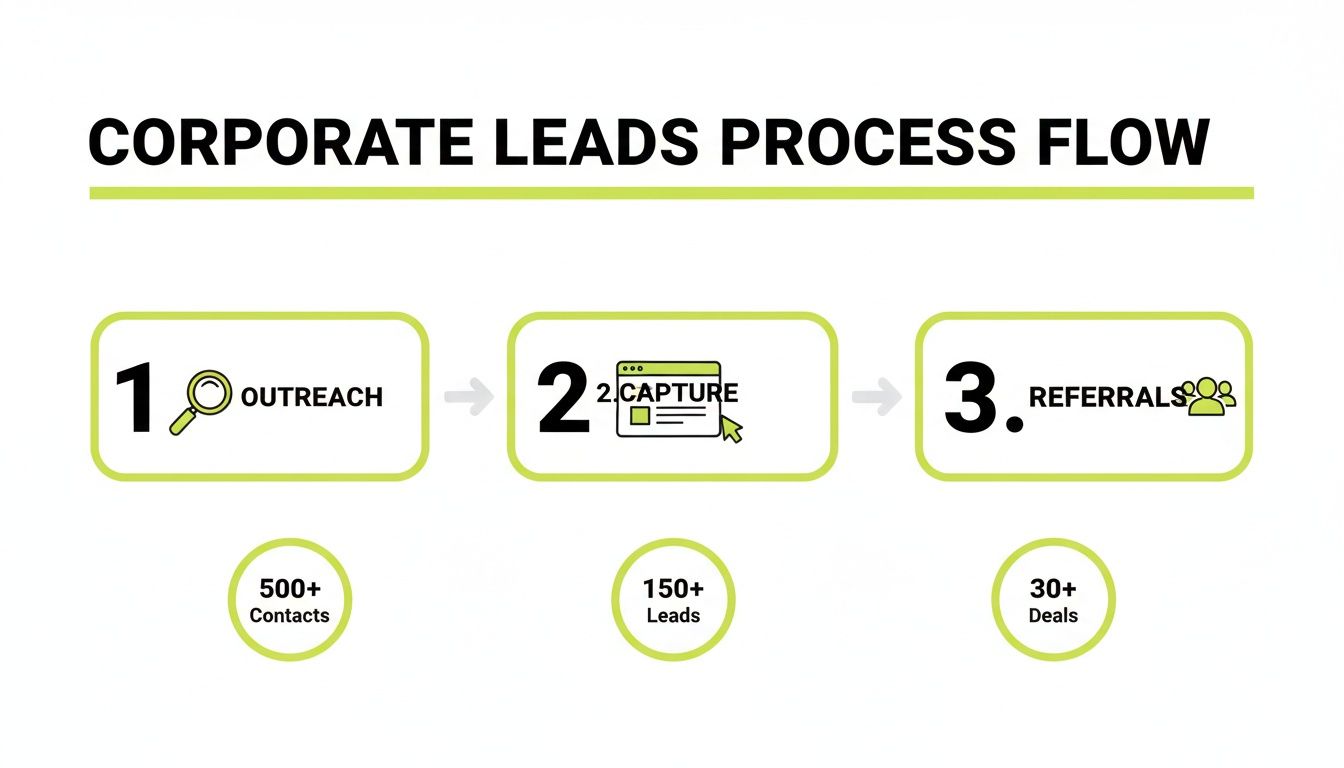
This visual breaks down how different lead sources should all funnel into one central capture point. That is your starting line for the organised follow-up that a CRM makes possible.
A Proven Follow-Up and Nurture Process
Once a lead is in your system, the real work begins. A one-size-fits-all follow-up will not cut it. The way you engage someone who simply downloaded your brochure must be completely different from how you handle an event manager asking for a quote for 50 golfers.
This is where setting up automated nurture sequences becomes so powerful. You can design specific email workflows for different types of enquiries, ensuring you are sending the right message at the right time.
- Brochure Download: An automated email can send the document instantly. This can be followed by a short series of emails over the next few weeks highlighting key package features, sharing testimonials from other companies, or answering frequently asked questions.
- Direct Booking Enquiry: The system can send an immediate alert to your sales manager for a personal phone call, while simultaneously sending an automated email to the prospect to confirm receipt of their request and let them know when to expect a call.
This blend of automation and a personal touch is key. Automation handles the instant, time-sensitive tasks, ensuring no one is left waiting. This frees up your people to focus their energy on the high-intent conversations that actually close deals.
Guiding Prospects Without Being Pushy
The purpose of your follow-up is to build rapport and gently guide the prospect toward a decision. This requires a well-thought-out sequence of messages and calls, not just random check-ins.
For instance, a follow-up call after a brochure download could sound like this: "Hi [Name], I saw you downloaded our corporate brochure earlier. I'm not calling to sell you anything today, just wanted to make sure it came through okay and see if you had any initial questions about our corporate days."
It is consultative, not aggressive. You are opening a dialogue and positioning yourself as a helpful expert. As you learn more about their needs, you can offer tailored suggestions, proving that your club is the right partner to help them achieve their business goals. For a deeper dive into these techniques, check out our complete guide to improving your golf club sales process.
Manual Process vs. Automated System
The difference between a manual approach and a system-driven one is night and day, affecting everything from response times to your final conversion rate. Let's compare them.
A disorganised, manual process is often the biggest bottleneck holding back corporate revenue. Enquiries get lost, follow-ups are inconsistent, and potential deals fall through the cracks due to a lack of structure. A systematic approach, powered by a CRM, solves these problems.
Ultimately, a robust system is what separates clubs that see sporadic corporate income from those that enjoy predictable, scalable growth. It is not about working harder; it is about working smarter by putting processes in place that do the heavy lifting for you.
Executing Flawless Corporate Events to Drive Repeat Business
Securing the booking for a corporate golf day is a great result, but it is not the finish line. The actual execution of the event is your single biggest opportunity to turn a one-off client into a loyal partner who returns year after year.
This is where the truly great clubs separate themselves. It is the small, thoughtful details that clients and their guests talk about long after the event that make all the difference. You are not just providing a venue; you are proving you are a professional partner invested in their success.
A flawless event does not happen by magic. It is built on a solid, repeatable process that covers everything from the moment the contract is signed until long after the last guest has gone home.
Pre-Event Communication and Planning
The groundwork for an excellent corporate day is laid weeks or even months in advance. Your goal is to make the event organiser's job as easy and stress-free as possible. Proactive, clear communication is the key to building their confidence and ensuring there are no last-minute problems.
A simple pre-event checklist works wonders. It does not need to be complicated:
- The Confirmation Pack: As soon as the booking is confirmed, send a professional pack. Include the signed agreement, a clear schedule for the day, menu options, and the name and direct contact details for their dedicated coordinator at your club.
- Logistics Check-in (Two Weeks Out): A quick call or email to confirm final guest numbers, check for dietary requirements, and ask about any specific branding or on-course competition needs. This avoids eleventh-hour scrambles.
- Final Details (72 Hours Out): One last, brief touchpoint to confirm the itinerary, tee times, and final arrangements. This simple act gives the client tremendous peace of mind.
This structured approach shows you are organised and allows your team to anticipate needs rather than just reacting to problems.
On-the-Day Coordination and Execution
When the event day arrives, your team's performance is everything. Every interaction is an opportunity to impress. The current positive energy in UK golf is a massive asset; with participation booming and clubhouses buzzing, the atmosphere is already set. Recent figures show golf rounds in Great Britain have surged, with a 15% year-to-date increase that continues the game's post-pandemic popularity. You can explore more data on the sustained golf boom to get the full context.
A well-run corporate event is your most powerful sales tool. When guests have a brilliant experience, they become your future clients. The goal is not just to satisfy the organiser; it is to impress every single person they bring with them.
To make that happen, your on-the-day plan needs to be watertight.
- A Personal Welcome: The organiser must be greeted by their dedicated contact upon arrival. No hand-offs or confusion, just a familiar, welcoming face.
- Clear Signage: Professional, well-placed branding and directional signs make guests feel expected and prevent them from getting lost. It is a small touch that speaks volumes.
- Efficient Registration: Nothing kills the mood faster than a long queue. A well-staffed, organised registration desk gets the day off to a smooth, positive start.
- On-Course Presence: Visible and helpful course marshals are essential. Ensure the halfway house is also running efficiently.
The seamless combination of these elements creates a memorable experience, reflecting brilliantly on both your club and the company hosting the event.
Post-Event Follow-Up to Secure Future Business
What you do in the hours and days after the event is just as critical as what you do on the day. Do not let that positive momentum go cold. A systematic follow-up plan is absolutely essential if you want to turn a great day into repeat business for your golf for business programme.
This follow-up sequence should be built into your CRM process.
- The Thank You (within 24 Hours): Send a personalised email to the organiser, thanking them for their business. If you have good photos from the day, include one or two.
- The Feedback Request (48 Hours Later): A short, simple survey shows you value their opinion and gives you invaluable, actionable insights to make your next event even better.
- The Rebooking Call (One Week Later): This is the most important step. Get on the phone with the organiser. Discuss their feedback, and then pencil in a date for next year. You can even offer a small early-bird incentive to secure the commitment.
- The Nurture Sequence: If they are not ready to book immediately, add them to a "Past Corporate Client" list in your CRM. This allows you to stay in touch with relevant updates, ensuring you are top-of-mind when they start planning again.
This disciplined process is how you move a client from a single transaction into a long-term revenue cycle. It is the bedrock of a truly profitable and predictable corporate events programme.
Your Questions Answered
To conclude, let's tackle some of the most common questions we hear from golf club managers and committees. These are the practical concerns that come up time and again when building a systematic golf for business programme.
How Much Should We Really Be Spending on Marketing?
This is a frequent question, but we would challenge you to reframe it. It is not about picking a number out of the air; it is about return on investment. The focus needs to be on smart, data-led advertising where you can track every pound spent against the revenue it brings in.
When you have a well-oiled system, ideally powered by a good CRM, you gain that clarity. You can start with a modest budget, prove the model works, and then scale up your investment with confidence once you see a clear, positive ROI. It takes the guesswork out of your marketing spend.
How Can Our Already-Swamped Team Handle All These New Enquiries?
A fair question. The solution is not to hire more people or add more to your team's already full plate. The answer is better systems.
The point is to make your existing team more efficient, not more stressed. A properly configured CRM with automated follow-ups can handle that crucial initial contact 24/7, guaranteeing a rapid response without anyone having to lift a finger.
This automation frees your team from handling initial, low-level enquiries. It means they only get involved with qualified, high-intent leads who are ready for a proper conversation. The process shifts from being chaotic and demanding to structured and manageable, letting your people focus on what they do best: building relationships.
What's the Single Biggest Mistake Clubs Make with Corporate Golf?
Treating it like a series of one-off, transactional sales instead of a long-term relationship programme. It is the most common and costly mistake we see. This mindset leads to inconsistent revenue and a never-ending, exhausting cycle of chasing brand new business.
The fix is a systematic approach. You need rock-solid processes for capturing and nurturing new enquiries, backed by an exceptional event experience. This focus on operational excellence, combined with structured post-event follow-up, is what turns one-time bookings into repeat business and valuable referrals. That is how you build a predictable, profitable revenue stream for your club.
Building a predictable corporate revenue engine requires more than just a great course. At GolfRep, we combine data-led advertising with automated CRM systems to help our partner clubs build a consistent pipeline of high-value business. Discover how our Growth System can work for you at https://www.golfrep.co.
Ready to tap into our proven growth system?