Golf Club ROI Marketing: A Playbook for 2026

Most advice on golf club marketing starts in the wrong place. It tells clubs to get more reach, more clicks, more followers, and more enquiries.
That sounds sensible. It also hides the actual problem.
In practice, golf club ROI marketing rarely fails because a club didn't generate enough interest. It fails because the club couldn't see where enquiries came from, didn't respond consistently, or left follow-up to busy staff working from inboxes, notebooks, and memory. The leak is usually operational, not promotional.
That matters because marketing isn't just what happens before an enquiry. It's the full path from first click to signed member, booked green fee, event registration, or repeat visitor. If that path is patchy, more ad spend doesn't solve the issue. It only pushes more people into a weak process.
The Real Reason Your Marketing Spend Fails
Most clubs assume they have a lead problem. More often, they have a conversion problem.
An enquiry comes in through the website. Someone means to call back later. The day gets busy. A visitor fills in a membership form but receives no immediate acknowledgement. A prospect books a tour, then hears nothing until the morning of the visit. None of that shows up neatly in a social media report, but it's exactly where return disappears.
More leads won't fix weak handling
If your follow-up is inconsistent, buying more traffic is expensive self-sabotage.
A club can run polished ads, publish strong creative, and still see poor return because the back end isn't built to convert interest into action. Staff may be doing their best, but manual systems break under pressure. Email inboxes get missed. Phone call notes stay with one person. Committee-led decision making slows responses further.
Practical rule: If you can't track, assign, and follow up every enquiry, you are not ready to scale ad spend.
This is why vanity-led marketing so often disappoints. It produces activity without control. Website visits rise. Social engagement looks healthy. The club feels visible. Yet management still can't answer simple commercial questions such as which campaign produced membership tours, which source produced signed members, or how many enquiries went untouched.
The real bottleneck sits after the click
The strongest clubs treat lead handling as part of marketing, not a separate admin job.
That means:
- Every enquiry is logged in one place, not spread across forms, inboxes, and scraps of paper
- Response responsibility is clear, so no prospect waits because everyone assumed someone else replied
- Follow-up is structured, with reminders, tasks, and status updates
- Outcomes are visible, so leadership can see what became of each lead
A lot of clubs recognise this only after a disappointing campaign. They don't need another platform. They need a better operating model. That's why the most useful starting point is to understand why most golf club marketing fails, then fix the process before increasing budget.
Good marketing creates demand. Good systems convert it. Clubs need both, but only one of them usually gets proper attention.
Rethinking Your Goals Beyond Vanity Metrics
The first job in golf club ROI marketing is defining what "return" means.
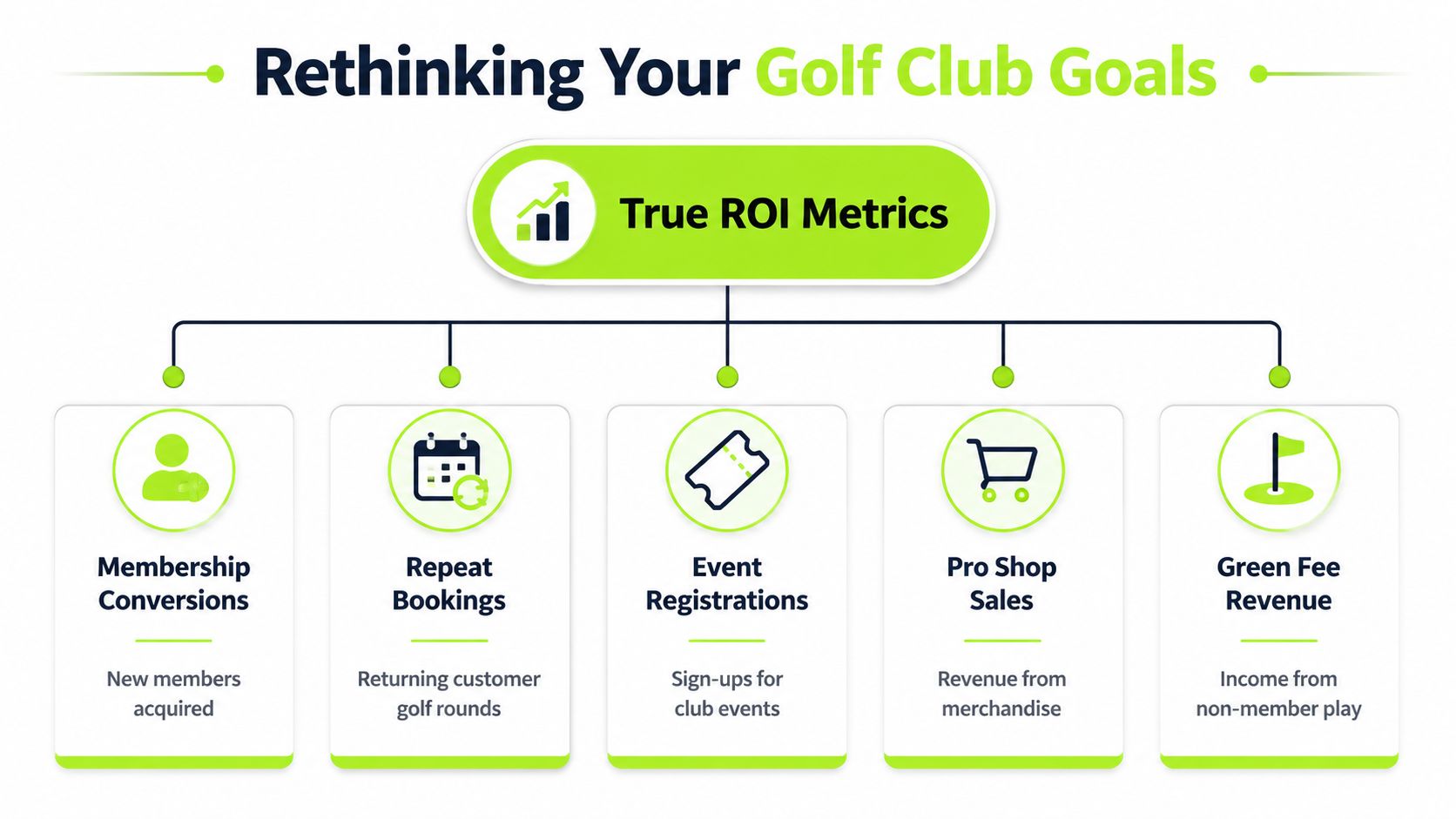
For most clubs, it isn't likes or impressions. It isn't even traffic on its own. Return means commercially useful actions. Membership conversions, paid bookings, event sign-ups, retail sales, and repeat visits all matter because they connect marketing activity to revenue.
A useful visual looks like this:
Start with CAC and LTV
Two figures change the quality of almost every committee conversation.
Customer Acquisition Cost (CAC) tells you what it costs to acquire one new member or one new customer from a specific campaign or channel.
A simple working formula is:
- CAC = total marketing and sales cost / total new customers acquired
If a club spends on ads, agency support, software, and staff time to drive membership acquisition, all of that should be considered. Otherwise the number looks flattering but isn't useful.
Lifetime Value (LTV) tells you what a customer is worth over time. For a golf club, that may include subscription income, food and beverage spend, competition entries, coaching, buggy use, guest rounds, and retail purchases. Each club's model differs, so the exact calculation should reflect its own revenue mix.
A practical formula is:
- LTV = average annual customer value x expected retention period
A simple club example
Suppose a club wants to assess membership marketing rather than generic awareness activity.
It would list the full cost of attracting and converting new members over a set period, then divide that by the number of signed members. Next, it would estimate what an average member contributes over the period they usually remain with the club. Once those two figures sit side by side, the conversation changes. You're no longer asking whether marketing feels expensive. You're asking whether the acquisition cost is sensible relative to member value and payback.
The hardest board-level question isn't "Did the campaign perform?" It's "Was the member worth what we spent to acquire them?"
That question matters because broad industry commentary often stops short of giving golf clubs a proper payback lens. As noted in NGCOA's discussion of marketing strategies, existing coverage often says clubs should track conversions, but it rarely answers the harder question of what level of spend is justified for membership acquisition and when it pays back.
For a deeper look at that commercial framing, see the real ROI of golf club marketing.
What not to use as your main scorecard
These metrics can still be useful diagnostics. They just shouldn't lead decision making.
- Likes and shares tell you very little about commercial return
- Website traffic matters only if it produces measurable enquiries or bookings
- Low cost per lead can be misleading if those leads never convert
- Reach is not revenue
Clubs that get serious about ROI stop asking, "How many people saw it?" They ask, "What did those people do next?"
Building Your Measurement Foundation
If you can't connect marketing activity to revenue, every budget discussion becomes opinion-led.
That is why measurement sits at the centre of golf club ROI marketing. Not because clubs need more dashboards, but because they need one reliable trail from first touch to outcome. Industry guidance for golf clubs in growth mode recommends spending 5% to 7% of gross revenue on marketing, with 10%+ suggested for new launches or aggressive expansion, and it ties that spend to trackable outcomes such as enquiries and conversions in an attribution-led model, as outlined in Golfmanager's marketing budget guidance.
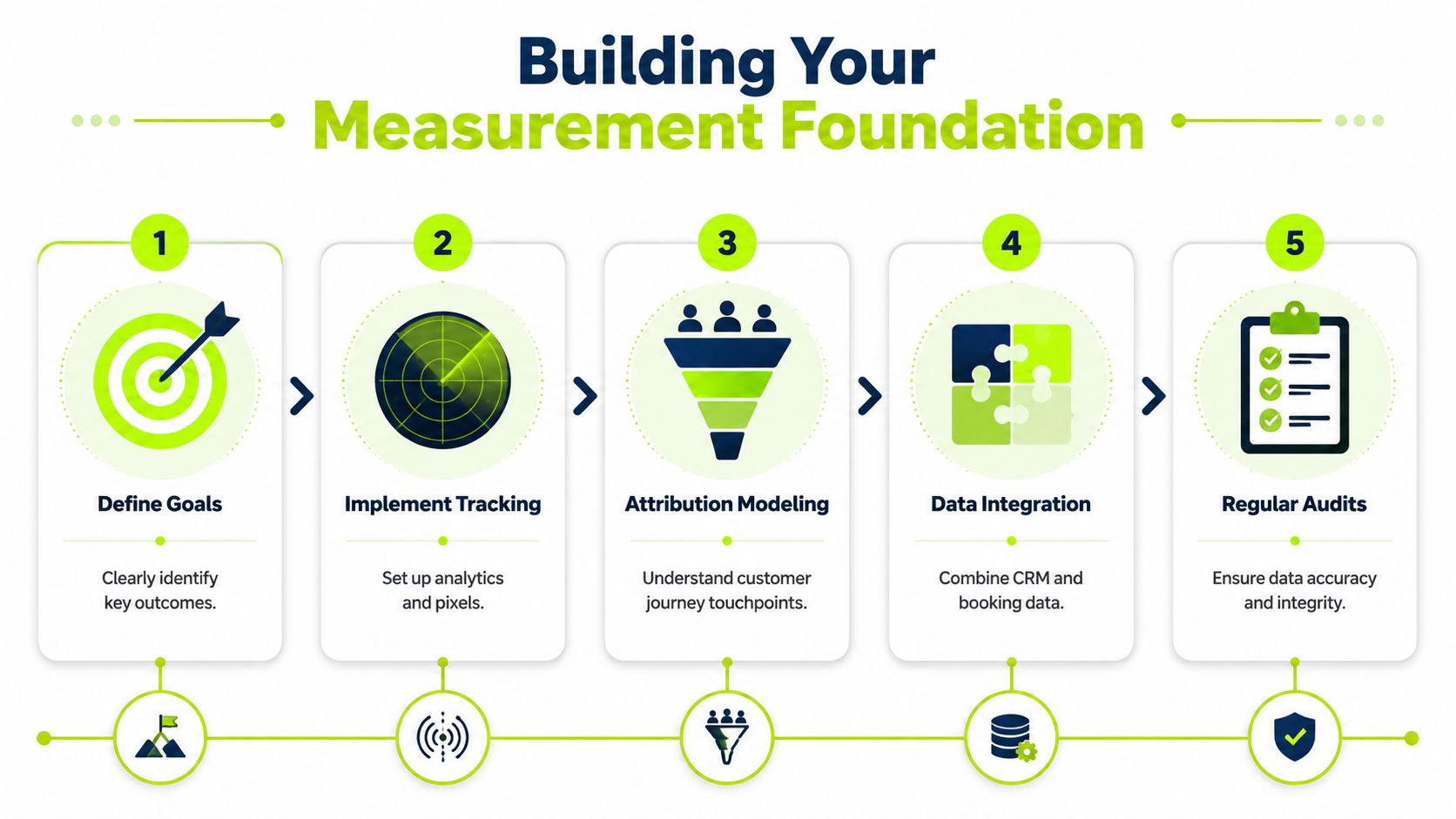
Here is the basic operating picture:
What the stack actually needs to do
A workable setup doesn't need to be complicated. It does need to be connected.
At minimum, most clubs need these pieces working together:
- Ad platform tracking from Google Ads and Meta, so campaigns can record key actions
- UTM-tagged links so traffic sources remain visible inside analytics and CRM records
- Website conversion tracking for forms, calls, bookings, and key button clicks
- A CRM that stores every enquiry, assigns ownership, and records progress
- Booking or membership outcome data so leadership can see which enquiries became revenue
Without that chain, teams end up with fragmented reporting. The ad platform claims success. The website shows traffic. The office has a spreadsheet. Nobody can reconcile them.
One source of truth beats five partial reports
The biggest change isn't technical. It's managerial.
When a club moves from scattered systems to a central record, simple questions become answerable:
- Which channel brought in this membership lead?
- Did anyone respond?
- Was a tour booked?
- Did the prospect join?
- How long did that take?
- Which campaigns brought in enquiries that converted?
A marketing report without CRM outcome data is only half a report.
Many clubs often underestimate the value of structure. They think measurement means more analytics. In reality, it means fewer blind spots. Staff stop guessing. Managers stop relying on anecdotes. Committees stop debating channels based on personal preference.
Build the discipline, not just the setup
Tracking breaks when nobody owns it.
That's why measurement needs regular checks. Form fills should be tested. Lead sources should map correctly into the CRM. Staff should update statuses consistently. If one person logs outcomes properly and another doesn't, the whole reporting picture becomes unreliable.
A practical place to tighten this is golf club enquiry tracking, because enquiry visibility is usually the first operational gap that blocks ROI analysis.
Clubs don't need perfect attribution from day one. They need a trustworthy baseline. Once that's in place, budget decisions get sharper very quickly.
Optimising Marketing Channels for Profitability
Once measurement is in place, channel selection becomes much simpler. You stop asking which platform is fashionable and start asking which one produces profitable outcomes.
That shift matters because channels behave differently. Some capture existing intent. Others create it. Some bring in quick enquiries that look cheap but convert poorly. Others generate fewer leads with stronger buying intent.
Google Search and Meta do different jobs
A golfer searching for membership terms on Google usually has more immediate intent than someone scrolling through Facebook or Instagram. That doesn't make Google automatically better. It means the enquiry should be judged differently.
Meta often works well for stimulating demand, promoting offers, showcasing the club experience, and retargeting previous website visitors. Google Search is usually stronger when someone already knows what they want and is actively comparing options.
The mistake is treating all leads as equal.
If Meta delivers a lower cost per lead but Google produces a higher proportion of serious conversations, the cheaper channel may be less profitable. This is why a proper framework tracks spend by channel and maps each enquiry to outcomes, with optimisation centred on conversions and creative testing rather than vanity metrics, as set out by Media Vantage's ROI framework for golf marketing.
Judge channels by quality, not volume
A useful channel review asks questions like these:
- Did the channel generate real enquiries or just landing page activity?
- Did those enquiries progress to tours, calls, bookings, or serious conversations?
- Which source produced signed members, not just form submissions?
- Was follow-up quality the same across all channels?
- Did creative testing improve conversion quality over time?
Where creative testing fits
A/B testing matters, but clubs often overcomplicate it.
Start with practical variables:
- headline angle
- offer framing
- imagery
- form length
- landing page copy
- call-to-action wording
If you're producing multiple ad variants quickly, tools such as ShortGenius AI ad generator can help teams draft and iterate creative concepts faster before running proper live tests. The point isn't to automate judgment. It's to shorten the production cycle so the club can test more deliberately.
The winning advert isn't the one with the most clicks. It's the one that starts the most profitable customer journey.
What usually doesn't work
Three patterns show up repeatedly when clubs review channel performance:
- Choosing channels based on committee preference rather than evidence
- Stopping campaigns too early before enough conversion data exists
- Scaling spend on lead volume alone without checking downstream quality
Profitable marketing channels are rarely discovered by instinct. They are identified by disciplined tracking, patient testing, and honest review of what turned into revenue.
The Conversion Engine Your Club Needs
A golf club can spend well, track accurately, and still lose return if follow-up is weak.
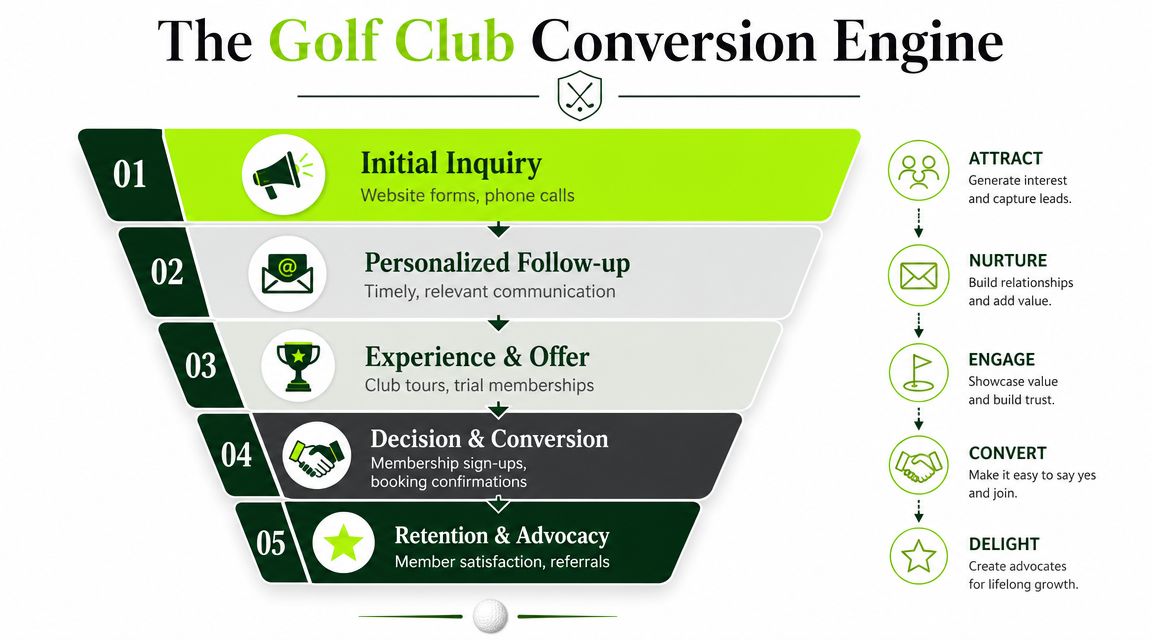
This is the part most clubs leave to chance. An enquiry arrives and enters a vague middle ground where somebody intends to deal with it. That's where opportunities disappear. The fix is a conversion engine. A structured system that responds, nurtures, assigns ownership, and moves prospects towards a clear next step.
A simple model looks like this:
Before and after the system
Without a conversion engine, the process usually looks familiar.
A prospect submits a membership enquiry. They receive no instant confirmation. A staff member plans to call later. Notes sit in an inbox. Nobody knows whether the lead has been contacted. A week later, the prospect has moved on or joined a club that replied properly.
With a conversion engine, the sequence changes immediately:
- the enquiry enters the CRM
- the prospect receives an instant acknowledgement
- a task is assigned to a named staff member
- follow-up happens against a clear timeline
- each touchpoint is logged
- the next step is explicit, such as a call, a tour, or a trial experience
That operational difference has more impact on return than most clubs realise.
Reputation and response both affect acquisition cost
Marketing starts before the click and continues after it.
In a GolfNow consumer study, 52% of golfers said they consult online ratings and reviews before booking, rising to 74% among GolfNow users, which underlines how reputation influences conversion before a prospect even reaches your club, as reported in GolfNow's consumer insights article.
If reviews are weak, trust drops. If enquiry handling is slow, momentum dies. If the booking path is clunky, acquisition cost rises because the club has to pay for more traffic to produce the same commercial outcome.
Clubs often blame the ad when the real issue is what happened in the hour after the enquiry arrived.
What a working nurture flow includes
This doesn't need to feel robotic. It needs to feel organised.
A strong follow-up system usually includes:
- Immediate acknowledgement by email or SMS so the prospect knows the enquiry landed
- Clear staff ownership so one person is responsible for the next contact
- Timed reminders that stop leads going cold in busy periods
- Status tracking such as new, contacted, booked, toured, proposal sent, won, or lost
- Relevant follow-up content that answers likely objections and reinforces club value
- A defined next step rather than vague open-ended conversation
The strongest clubs don't rely on memory. They rely on process.
That is why the conversion engine is the most overlooked driver of golf club ROI marketing. Better ads can help. Better systems change the result.
Reporting That Drives Decisions Not Paralysis
Most committees don't need a thick report. They need a small set of numbers they can trust.
Good reporting turns marketing from a black box into a management discipline. It shows where money went, what happened next, and which levers need attention. Poor reporting does the opposite. It floods people with platform screenshots, broad engagement metrics, and commentary with no operational meaning.
This is the standard to aim for:

Keep the monthly dashboard simple
A useful monthly report should fit on one page before any deeper notes. It should combine marketing activity, lead handling, and commercial outcomes.
| Metric | Definition | Example Target |
|---|---|---|
| Total Spend | Total monthly investment across ads, software, and campaign delivery | Within agreed budget and tied to tracked outcomes |
| New Enquiries | Total new leads generated in the month | Consistent month-to-month flow |
| Contact Rate | Share of enquiries that received a recorded response | Near-complete follow-up coverage |
| Booked Visits or Calls | Prospects who moved to a meaningful next step | Steady progression from raw enquiry |
| New Members | Signed members attributed to tracked activity | Positive trend over time |
| Cost per Enquiry | Total spend divided by total enquiries | Stable or improving against lead quality |
| Cost per Member | Total spend divided by new members acquired | Sustainable relative to member value |
| Lead Source Mix | Where enquiries came from | Spend weighted towards productive channels |
| Response Lag | Time between enquiry and first follow-up | Fast, consistent handling |
| Conversion by Stage | Movement from enquiry to contact to visit to sign-up | Bottlenecks identified early |
What the numbers should trigger
A report is only useful if it changes action.
If cost per enquiry rises, review channel mix, targeting, and creative. If contact rate falls, the issue probably sits with staffing, ownership, or CRM discipline rather than advertising. If booked visits are weak despite healthy enquiry volume, the offer or the follow-up sequence likely needs attention. If cost per member worsens while lead volume looks strong, lead quality is probably being overvalued.
A good dashboard doesn't just report performance. It tells the club where the process is breaking.
What to leave out
Cut anything that doesn't help a decision.
That often means removing:
- platform jargon
- inflated awareness metrics
- duplicate charts from different systems
- commentary that explains activity but avoids outcomes
Committees respond better when the relationship between spend, handling, and results is obvious. Clarity builds trust. Trust makes budget decisions easier.
From Marketing Spend to a Predictable Growth System
The clubs that get the best return don't treat marketing as a series of disconnected campaigns. They treat it as a system.
That system starts with commercial goals rather than vanity metrics. It depends on proper measurement so every enquiry can be traced to an outcome. It improves when channels are judged by profitability instead of popularity. A key to its conversion is that the club has a follow-up engine, not just a lead form.
This is the practical shift that matters. Marketing stops being a gamble and becomes an operational process. Staff know who owns each lead. Managers can see which channels produce value. Committees can judge spend against real outcomes rather than opinion.
In other words, golf club ROI marketing isn't about finding one clever advert. It's about building a reliable path from interest to revenue.
When a club does that well, performance becomes easier to manage. Weak points are visible. Good channels earn more investment. Poor processes get fixed early. Growth becomes more predictable because it is measured and repeatable.
That is what clubs should be aiming for. Not more noise. More control.
If your club wants to build a clearer pipeline from enquiry to membership, GolfRep helps golf clubs put the right systems in place. That means lead generation, structured follow-up, CRM visibility, and reporting that shows what drives revenue.
Ready to tap into our proven growth system?