Golf Club Committee Marketing: Playbook for 2026 Success
Most advice on golf club committee marketing starts in the wrong place. It starts with visibility, social posts, leaflet drops, or the next open day. That sounds sensible, but it skips the part that usually decides whether marketing works at all.
For most committee-led clubs, the problem isn't a shortage of interest. It's the lack of a reliable way to capture, respond to, track, and convert that interest. Enquiries arrive through email, phone calls, Facebook messages, website forms, visitor bookings, and conversations in the clubhouse. Then they sit with one volunteer, get passed to a secretary, or disappear between meetings.
That isn't a marketing issue in the narrow sense. It's an operating issue.
At GolfRep, we see the same pattern repeatedly. Committees ask for more enquiries when they should first ask harder questions. Who owns incoming leads? How quickly does someone reply? Where are prospects logged? Who follows up after a club visit? Which channels produce people who join, not just people who click? If a committee can't answer those questions, more promotion usually creates more waste.
The Real Marketing Challenge Facing Your Club
A lot of clubs still treat marketing as a communications task. Post more on social media. Refresh the website. Put an offer on the homepage. Run an open day and hope the diary fills.
That approach feels active, but it often produces scattered results because nobody has built the system behind it. Guidance for clubs has made this point clearly. Many committee-led clubs default to price cuts, but the stronger answer is to market without eroding value by building a governance and conversion system around owned data, reviews, and a simple joining journey, as outlined in this club marketing guidance.
Why more enquiries can be the wrong goal
If your club takes days to respond, doesn't log every lead, and has no agreed follow-up process, more enquiries don't solve the problem. They expose it.
The committee then sees inconsistent outcomes and assumes the campaign didn't work. In reality, the campaign may have done its job, but the club had no reliable method for turning interest into booked visits and membership conversations.
Practical rule: Don't increase promotional activity until the club can see every enquiry, assign ownership, and follow up consistently.
This matters even more in volunteer-led environments. Committee members change. Availability changes. Priorities change. A system has to survive all three.
What usually works and what usually fails
The clubs that make steady progress tend to do a few simple things well:
- They assign ownership: One person owns lead visibility, even if several people help with follow-up.
- They remove guesswork: The committee knows what happens when an enquiry arrives on a Tuesday afternoon or a Sunday evening.
- They protect value: They explain why the club is worth joining instead of reaching first for discounts.
- They review before they spend: Strategy comes before ad budget.
What usually fails is equally predictable:
- Shared inbox chaos: Everyone assumes someone else replied.
- One-off campaigns: Activity spikes, then stops when the volunteer driving it gets busy.
- Internal disagreement: The club promotes offers before agreeing what sort of member it wants to attract.
- No handover thinking: Knowledge sits in personal email accounts and private notebooks.
Before any committee spends money on ads, print, or external help, it needs role clarity and a strategic review process. That single step prevents wasted spend, avoids internal friction, and gives the club a decision-making framework that lasts longer than one season.
Establish Your Marketing Governance and Roles
Most committees don't need a bigger marketing plan first. They need a clearer operating model. If nobody knows who decides, who executes, and who reports back, even sensible ideas turn into loose ends.
A strong starting point is a member survey followed by a board-level strategic review. Club strategic planning guidance describes this process as the "cornerstone" for understanding member value perceptions and aligning marketing with the club's position before launch, as explained in this club strategy whitepaper.
Start with governance, not graphics
A new committee is often tempted to begin with visible jobs. Redesign the poster. Rewrite the leaflet. Start posting more often.
Those jobs matter, but they sit downstream of bigger decisions. Before anything goes live, the committee should agree:
- Who the club wants to attract
- What the joining journey should feel like
- What value the club won't compromise on
- Who signs off campaigns
- Who owns reporting
Without those decisions, marketing turns into debate. One person wants a family message. Another wants a competitive golf message. Someone else pushes a price-led campaign. None of them are fully wrong, but the club can't market three different identities at once.
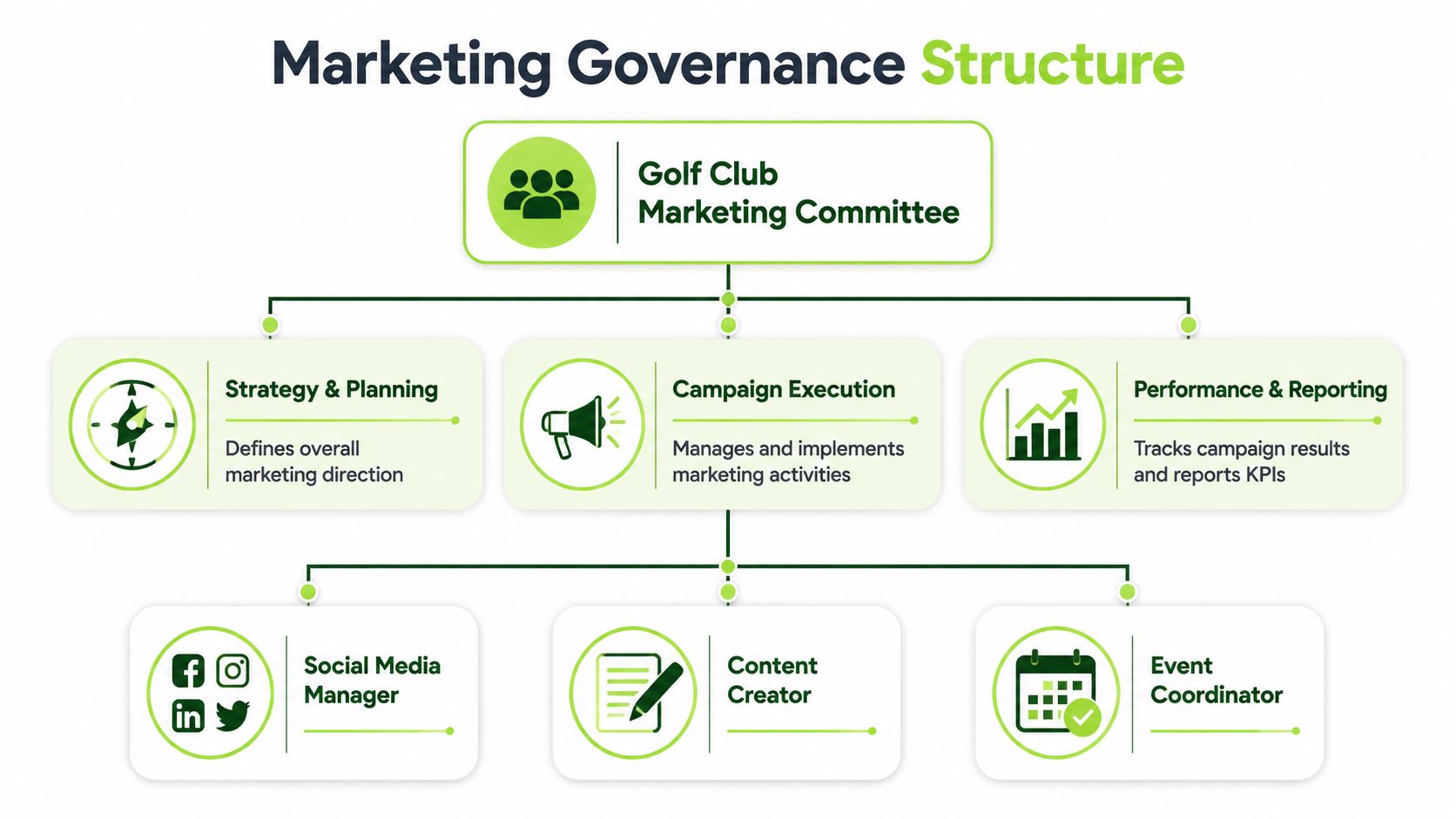
A practical governance model
For committee-led golf club committee marketing, keep the structure simple.
| Function | Core responsibility | Typical owner |
|---|---|---|
| Strategy and planning | Positioning, annual priorities, campaign approval | Board or committee lead |
| Campaign execution | Website updates, email sends, social posts, event promotion | Staff member, volunteer, or external partner |
| Performance and reporting | Lead tracking, response monitoring, monthly review | Secretary, manager, or designated committee member |
A workable role split often looks like this:
- Committee lead: Approves priorities and resolves internal conflict.
- Operations contact: Handles the practical side of tours, calls, and joining conversations.
- Marketing executor: Publishes campaigns and keeps assets current.
- Reporting owner: Tracks lead sources, follow-ups, and outcomes.
One person can cover more than one role in a smaller club. The point isn't complexity. It's accountability.
Build a calendar the committee can actually maintain
Most clubs don't need an elaborate annual document. They need a usable one. A 12-month calendar should include the campaign, owner, deadline, audience, and follow-up process for each activity.
Use classic tactics, but treat them as part of a system:
- Open days: Not just footfall. Capture names, email addresses, attendance, and post-event follow-up status.
- Visitor database building: Every society day, green fee booking, and taster session should feed the mailing list where permission allows.
- Local business partnerships: Make them measurable. Track which partner generated each enquiry.
- Website updates: Tie each page change to a conversion aim such as a tour request or membership enquiry.
- Member referrals: Define how referrals are logged and who follows up.
Governance isn't bureaucracy. It's the reason good ideas still get executed when the person who suggested them is no longer on the committee.
A committee that does this well doesn't just run marketing. It builds a repeatable decision system.
Build Your Annual Membership Marketing Calendar
The difference between random activity and useful marketing usually shows up in the calendar. Clubs that market ad hoc tend to post when someone remembers, promote events too late, and follow up inconsistently. Clubs that plan properly create momentum because each campaign supports the next one.
A Scottish golf club marketing plan published in 2022 noted that membership numbers were "dropping slightly per annum" and recommended structured actions such as collecting visitor email addresses, building a newsletter, using social media, hosting open days and local events, and working with local businesses. The same source also reflects the value of SMART objectives, including goals such as a 10% membership increase in broader club marketing guidance, all of which supports a repeatable approach to committee marketing in this planning document.

Stop thinking in posts. Start thinking in campaigns.
A boosted social post is usually a one-off announcement. A campaign has a target audience, a call to action, a data capture method, and a follow-up plan.
That distinction matters. If the committee boosts a post about membership, it may generate attention but little usable information. If the club runs a campaign for a spring open day with a landing page, enquiry form, automated acknowledgement, and post-event follow-up list, it creates an asset the club can learn from and reuse.
For a deeper framework, GolfRep has outlined a practical golf club marketing strategy that connects annual planning with lead handling and conversion.
A simple shape for a 12-month calendar
You don't need every month to carry the same weight. You do need continuity.
A workable annual rhythm often includes:
- Pre-season activity: Refresh membership pages, set campaign themes, prepare lead capture forms, organise spring events.
- In-season visibility: Open days, beginner sessions, local partnerships, visitor follow-up, content from busy club periods.
- Mid-season review: Check which channels are producing real conversations and which are just creating noise.
- Late-season nurture: Stay in touch with prospects who didn't join immediately but may reconsider for the next intake.
- Off-season preparation: Survey members, clean the database, document results, and approve next year's priorities.
Make every activity a data capture point
Many calendars often fall short. They list tasks, not outcomes.
For each campaign, the committee should write down four things:
| Campaign element | What to define |
|---|---|
| Audience | Who the club is trying to reach |
| Offer or message | Why this audience should respond |
| Data capture | What information the club will collect |
| Follow-up route | Who replies and what happens next |
That applies to every format. An open day should collect contact details. A local business partnership should have a trackable referral route. A social post should point to a form or page that the club can monitor. A visitor booking confirmation should include the next logical invitation.
Good calendars don't just organise activity. They organise learning.
When a committee works this way, it stops asking whether marketing is "worth it" in broad terms. It starts asking which campaign produced enquiries, which audience booked visits, and which messages attracted the right type of member.
Run Data Driven Member Acquisition Campaigns
Most committees have tried social media. Fewer have run proper acquisition campaigns.
The difference isn't technical jargon. It's discipline. A boosted post pays to show a message to more people. A data-driven campaign defines the audience, chooses the destination, tracks the response, and measures what happened after the click.
That matters because golf club committee marketing shouldn't aim for vague reach. It should aim to attract people who are likely to visit, fit the club, and move towards membership.
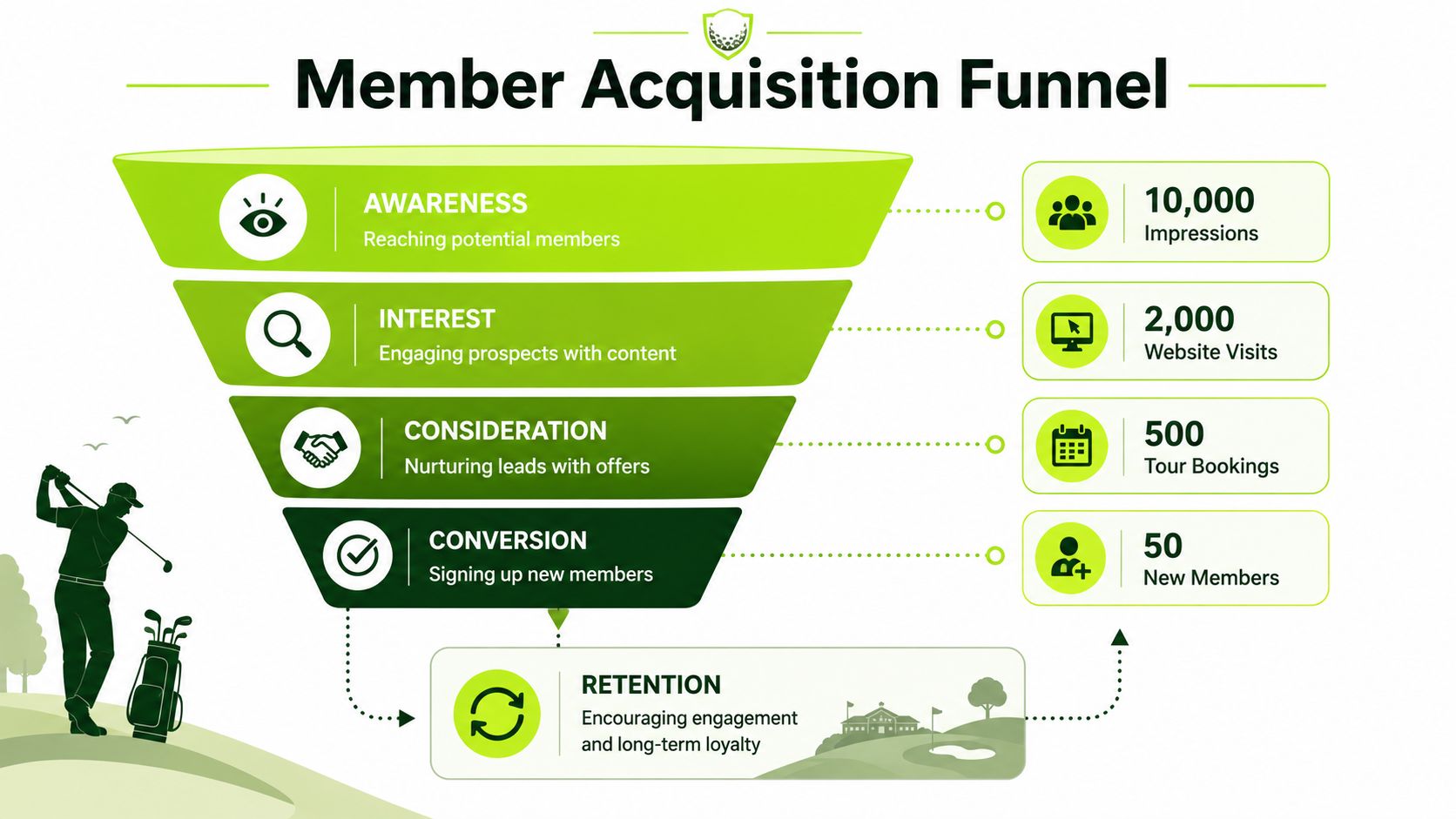
A practical way to think about this is as a measurable funnel. Membership marketing guidance recommends tracking how many leads each channel produces day by day so clubs can move spend away from poor performers and towards stronger lead sources, as outlined in this article on measurable membership funnels.
What channel attribution looks like in plain English
Channel attribution sounds more complicated than it is. It means knowing where each enquiry came from.
If someone books a tour, the club should know whether they came from:
- Facebook or Instagram ads
- Google search
- A local event
- A referral partner
- Direct website traffic
- Offline promotion
Without that visibility, budget decisions become opinion-led. Committees then argue about what "feels" effective instead of checking what produced leads that moved forward.
For clubs wanting a more practical view of campaign measurement and attribution, this guide to data-driven golf marketing gives a useful overview.
Why speed and systems belong in the same conversation
Lead generation and lead handling are often treated as separate problems. They aren't. They are one process.
A campaign can bring in exactly the right prospect, but if that prospect waits too long for a reply, the value of the campaign falls immediately. That's why the acquisition system has to include response management, lead visibility, and follow-up.
Often, clubs benefit from using a CRM and basic automation. GolfRep is one option used in the golf sector to combine advertising, CRM tracking, and automated follow-up, but the bigger point is structural rather than vendor-specific. Every committee needs one place to see incoming leads, record their source, and trigger the next action.
A better standard than "we ran some ads"
Ask these questions after any member acquisition campaign:
- Which audience responded best?
- Which channel produced actual conversations, not just clicks?
- How many leads reached the next step?
- Where did prospects stall?
- What should the club stop doing next month?
The campaign is only half the job. The other half is deciding what the committee should do more of, less of, or not at all.
That mindset is what turns digital promotion from occasional spend into a controlled acquisition process.
Convert Enquiries with a Disciplined System
An enquiry has a short shelf life. If the club doesn't respond clearly and follow up properly, interest cools fast.
Most committees lose growth. Not because the club is unattractive. Not because the campaign failed. Because nobody built a disciplined conversion process that works on busy days, weekends, and handover periods.
What a CRM actually does for a golf club
A CRM is a system that keeps every lead in one place. Instead of relying on inbox searches, handwritten notes, or somebody's memory, the committee can see who enquired, when they enquired, what they asked for, and what happened next.
That creates three immediate benefits:
- Visibility: Nobody has to guess whether a prospect has been contacted.
- Consistency: Every lead moves through the same process.
- Accountability: The committee can see where follow-up broke down.
A basic process might include automatic acknowledgement, manual personal contact, a tour invitation, reminder follow-up, and a post-visit membership conversation. It doesn't need to be complicated. It does need to be documented.
Build a response sequence the club can keep up with
Most clubs fail by making follow-up too dependent on goodwill. A better approach is to agree a sequence that happens every time.
For example:
- Immediate acknowledgement through email or text so the prospect knows the enquiry was received.
- Personal response from the club with the right next step, usually a call, tour, or meeting.
- Scheduled follow-up if the prospect doesn't reply first time.
- Post-visit nurture with answers to common questions and a clear joining route.
- Outcome logging so the club knows whether the lead joined, paused, or went cold.
Some clubs also benefit from a qualification stage, especially if they receive varied enquiries and want to focus staff time on the best-fit prospects. The principles in this guide on how to qualify leads for businesses are useful here because they help committees separate genuine membership interest from casual browsing in a structured way.
Turn budget discussions into a simple business case
Committees often struggle to defend marketing spend because they present it as activity. Boards respond better when it is framed as an investment linked to a process.
Use a simple template:
| Metric | What to record | Why it matters |
|---|---|---|
| Enquiries received | Total by campaign or channel | Shows whether activity generated interest |
| Contacted | Number that received a personal response | Exposes response gaps |
| Booked visits | Number progressing to a club visit or meeting | Measures movement through the pipeline |
| Joined | Number converting to membership | Links marketing to club growth |
Then ask practical questions:
- Where are enquiries being lost?
- Does the club respond the same way every time?
- Is someone reviewing stalled leads each week?
- Which stage needs fixing before adding more spend?
If the committee can't answer those questions, the case for more advertising is weak. If it can answer them, budget conversations become far easier because the board is no longer funding hopeful activity. It is funding a process the club can inspect and improve.
A disciplined conversion system doesn't remove the human side of joining. It protects it by making sure no genuine prospect gets ignored.
Measure KPIs and Create a Sustainable Budget
Many committees still judge marketing by visible activity. Was the post well received? Did people comment on the flyer? Did the open day feel busy?
Those signals can be useful, but they don't justify budget. Boards need a clearer line between spend and outcome. For clubs in growth mode, golf club ROI guidance recommends budgeting 5% to 7% of gross revenue for marketing, with 10%+ suggested for new launches or aggressive expansion, and it ties that spend to tracked outcomes such as enquiries, bookings, and cost per member in this ROI guidance for golf clubs.
Measure what the committee can act on
Good reporting should help the committee make a decision. If a metric doesn't support a decision, it probably belongs lower down the list.
Focus on operational KPIs such as:
- Enquiry volume: Are campaigns generating enough interest to support membership goals?
- Response handling: Are prospects being contacted properly and visibly?
- Tour or visit bookings: Are enquiries progressing into meaningful conversations?
- Cost per member: Is spend turning into signed members, not just traffic?
These are board-level metrics because they connect activity to club growth.
A budget should be built to survive committee turnover
The annual budget isn't just a finance document. It's part of the club's memory. When a new committee arrives, they should be able to see what was allocated, what was tracked, and what the club expected in return.
That is why documentation matters. If the budget sits only in one treasurer's spreadsheet and the campaign logic sits only in one volunteer's head, the club will repeat the same arguments next year.
Use a simple working table like this:
| Category | Activity | Estimated Annual Cost (£) | Metric to Track |
|---|---|---|---|
| Website | Membership page updates and enquiry forms | [Insert club estimate] | Enquiries submitted |
| Events | Open days and taster sessions | [Insert club estimate] | Attendees and follow-up outcomes |
| Paid media | Search or social campaigns | [Insert club estimate] | Leads by channel |
| CRM and automation | Lead tracking and response workflows | [Insert club estimate] | Response visibility and booked visits |
| Content and email | Newsletter and nurture communications | [Insert club estimate] | Replies and re-engagement |
| Local promotion | Partnership activity and offline materials | [Insert club estimate] | Referred enquiries |
Why handover paperwork is a growth asset
Some committees treat handover notes as admin. That's a mistake. Handover paperwork protects every future budget conversation.
If next year's committee can see what was spent, which KPIs were tracked, and which decisions were made, they inherit a functioning commercial record instead of a pile of opinions. That continuity is strategic. It reduces waste, shortens ramp-up time, and gives the club a much better chance of improving rather than resetting each year.
Create Handover Materials for Future Committees
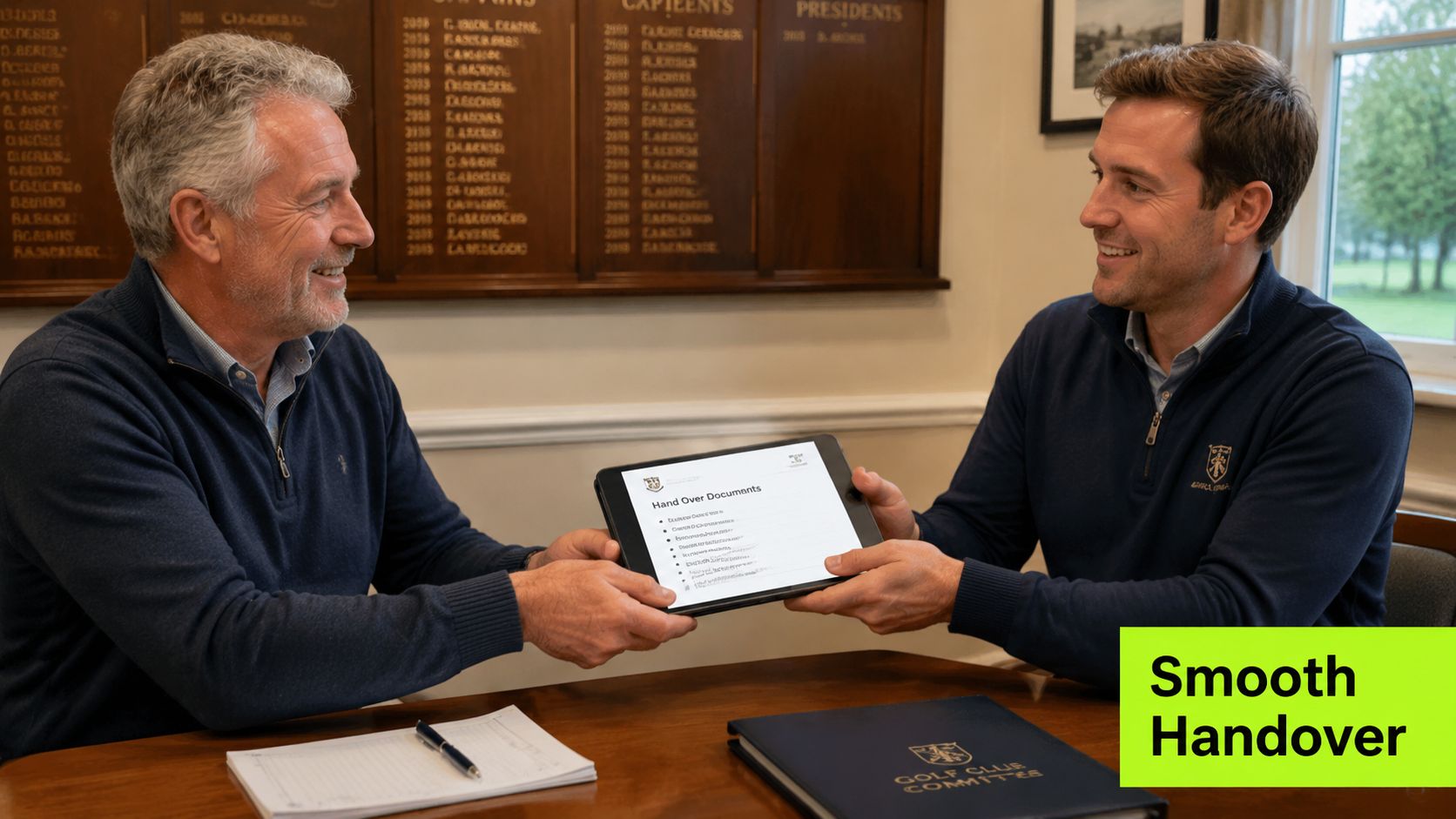
Volunteer turnover is the hidden tax on golf club committee marketing. A capable volunteer builds a good process, leaves at the end of their term, and the next group starts again from scratch.
That cycle doesn't happen because committees don't care. It happens because most clubs document events and minutes better than they document growth systems.
What your marketing playbook should contain
Every club should maintain a simple marketing playbook that can be handed to the next committee without a long verbal explanation.
Include:
- Governance structure: Who approves, who executes, who reports.
- System access: Logins, ownership records, and where each account is held.
- Campaign calendar: The approved annual rhythm and key dates.
- Lead handling process: What happens from first enquiry to joining conversation.
- Reporting templates: The KPI format used at committee or board level.
- Creative assets and copy: Reusable email templates, event invitations, and landing page text.
- Channel notes: Which sources have historically produced useful enquiries.
- Supplier list: External partners, points of contact, and renewal dates.
If your club is reviewing systems, this guide to golf club CRM software is a sensible starting point because CRM choice affects how easy handovers become.
Keep the handover usable
The playbook shouldn't be a long narrative. It should be a working document.
A good test is simple. Could a new committee member open the file, log into the systems, see the current pipeline, understand this season's campaigns, and continue the process without chasing three former volunteers for context? If not, the handover isn't finished.
Clubs don't lose momentum because one campaign underperforms. They lose momentum when each new committee has to rebuild the machine.
The committees that outperform over time are rarely the ones with the loudest promotion. They are the ones that leave behind a clearer, stronger operating system than the one they inherited.
If your club wants to build a more predictable membership pipeline, GolfRep helps golf clubs combine lead generation, CRM visibility, and structured follow-up so committee-led growth doesn't rely on memory, manual chasing, or one motivated volunteer.
Ready to tap into our proven growth system?