Golf Club Membership Recruitment: A Practical UK Guide
Most golf club membership recruitment advice starts in the wrong place. It tells clubs to get more enquiries, buy more ads, and run more promotions, as if the problem is volume. In UK clubs, that's usually a distraction. The leak is what happens after someone raises their hand, because clubs lose good prospects in the gap between first enquiry and first human follow-up.
The numbers back that up. Hillier Hopkins found members' clubs averaged 70 new members in 2022, down from more than 90 in both 2020 and 2021, while average leavers rose to 48 per club from 35 in 2021; 23% of members' clubs had more leavers than joiners in 2022, compared with 0% in 2021 (Hillier Hopkins 2022/23 Golf Clubs Report). That's not a marketing story. That's a conversion system under pressure.
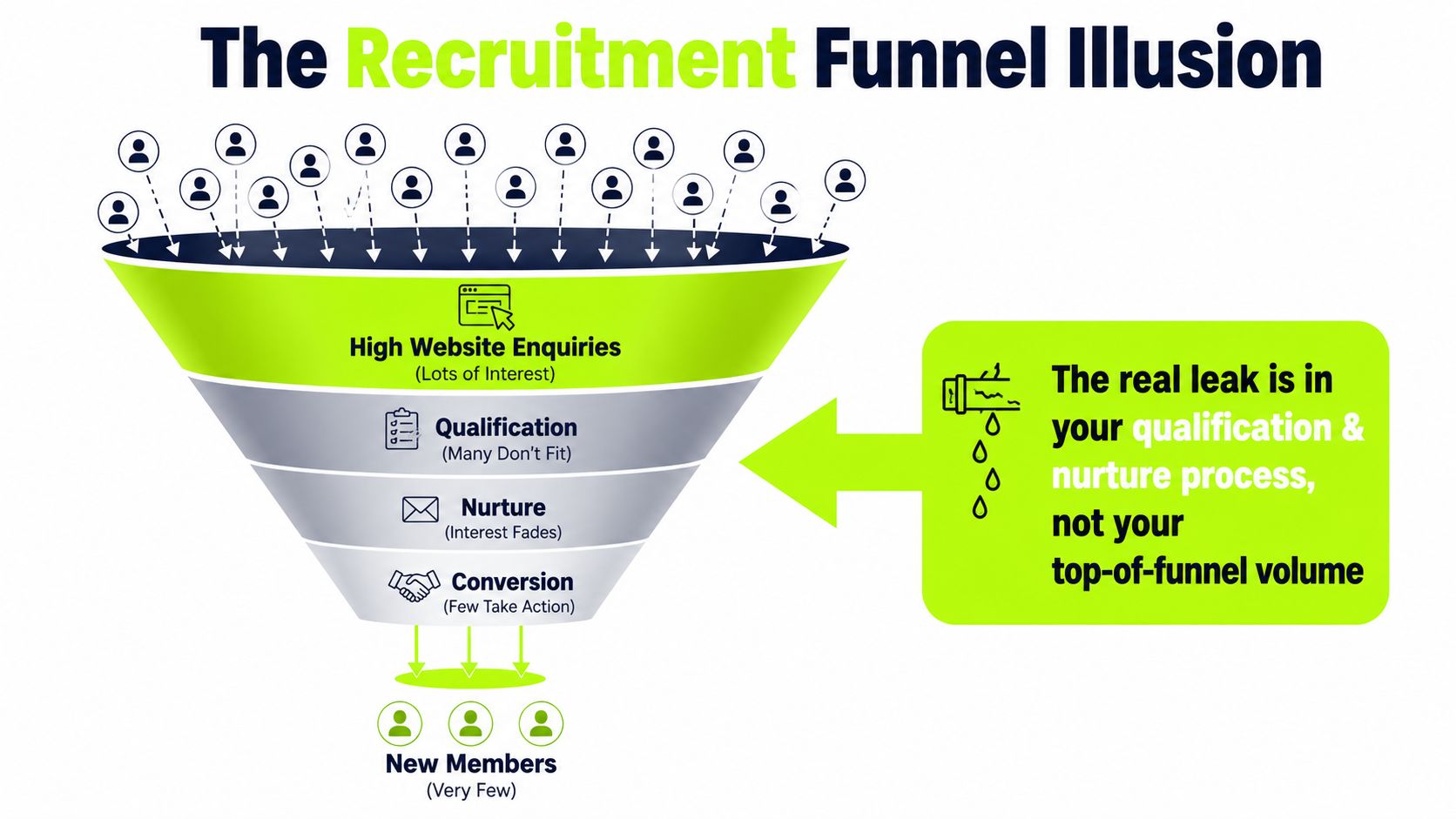
Golf clubs don't need another thin campaign. They need a pipeline that captures interest, qualifies it fast, routes it cleanly, and follows up until the visit is booked. That's the difference between a noisy funnel and golf club membership recruitment that holds up under scrutiny.
Why More Enquiries Will Not Fix Your Recruitment Problem
More enquiries feel like progress because they're easy to count. But if the club can't answer quickly, qualify properly, and follow up with discipline, those enquiries leak out before anyone gets the chance to convert them.
UK evidence on enquiry handling is blunt. Clubs without a structured follow-up process typically convert only 10% to 15% of trial green-fee players into full members, while GolfRep's cited UK benchmarks say clubs capture only 5% to 7% of local golfers as members even though about 20% of residents within 30 miles play regularly (GolfRep member acquisition benchmarks). That gap isn't fixed by pushing harder on awareness. It's fixed by building a system that handles the middle of the funnel properly.
The numbers say the market is already interested
The point isn't that clubs have no demand. The point is that demand is being wasted. If a local golfer, visitor, or trial player has already shown interest, your job is not to re-educate them from scratch. Your job is to move them through a process that feels clear, responsive, and easy.
Practical rule: every extra enquiry source is useless if it feeds the same slow inbox.
This is why GolfRep treats recruitment as a conversion problem first and a lead generation problem second. You can spend more to fill the top of the funnel, but if response time is poor and ownership is unclear, the middle still collapses. For a related discussion of where clubs lose enquiries, see how most golf clubs lose 30% of enquiries without realising.
The sharp takeaway is simple. Stop asking how to get more leads before you've asked how many of your current leads are reaching a named person, getting qualified, and being chased to a visit.
Defining the Member Profiles Worth Recruiting
Weak recruitment usually starts with vague targeting. “Everyone who likes golf” is not a profile, it's a wish. Good clubs choose a few realistic member types, then build the offer around the barriers those people mention.
The first filter is local reality. Look at your member data, the age and gender patterns already inside the club, and the catchment area around you. UK and broader golf-industry guidance points to the same issue, clubs know they should review trends and demographics, but many never turn that into a campaign that speaks to a specific group (market segmentation guidance).
Build profiles around barriers, not labels
A useful profile has three parts. Who they are, what keeps them from joining, and what makes your club a sensible next step. That might be a time-poor golfer who wants easy access, a woman returning to the game who wants social comfort, or a family looking for weekend value without a formal sales pitch.
The best value proposition is not a slogan. It's one paragraph that answers why join, what it costs in plain terms, and how joining works. UK club guidance says the website should explain exactly why to join, the cost of joining, and how to join, but too many clubs stop there and never convert that clarity into a live recruitment system (UK club marketing hints and tips).
Use this structure for each profile:
- Profile name: keep it practical, like “local weekday golfer” or “family-minded casual player”.
- Primary barrier: cost perception, time, confidence, social fit, or convenience.
- Value proposition: one paragraph that deals with that barrier.
- Best proof point: a photo, route around the club, membership category, or taster format that matches the profile.
The clubs that recruit well don't try to sound broad. They sound specific enough that the right person feels seen.
Segmentation matters. If your message is built for nobody in particular, it usually persuades nobody at all. If it is built for a clear local group, it can cut through quickly because the offer feels like a fit, not a sales line.
Choosing Acquisition Channels That Fit UK Catchments
Channel choice should follow the profile, not the other way round. A club with a strong local catchment and a clear value proposition does not need every possible channel. It needs a small, focused mix that suits how the right prospect discovers and revisits the club.
The weakest assumption in golf club membership recruitment is that all channels are equal. They aren't. Some create awareness, some create intent, and some create the first conversation. If you spread budget across six channels, you usually end up with noise instead of pipeline.
What to prioritise and why
NGCOA's 2024 report found new organic leads fell by 5% versus 2022 and 9% versus 2021, while member referrals fell by 7.5% versus 2022 and 50% versus 2021 (NGCOA trends and forecasting). That matters because clubs that used to rely on word of mouth now have to work harder to generate the same flow of interest. Organic and referral channels still matter, but they're no longer enough on their own.
Paid search, local SEO, partnerships, and open days each play a different role. Paid search catches active intent. Local SEO supports discovery when someone is comparing options. Partnerships with local businesses and PGA professionals can add credibility. Open days and member referrals work best when the club already has a strong follow-up process behind them.
| Channel | Funnel stage | Typical cost per enquiry | Best-fit persona | Speed to first enquiry |
|---|---|---|---|---|
| Paid search | Intent capture | Varies by market | Ready-to-join local golfer | Fast |
| Local SEO | Discovery | Lower than paid media over time | Researching local prospects | Slower |
| Partnerships | Consideration | Usually modest | Community-led or trust-led prospects | Medium |
| Open days | Conversion support | Event cost based | Curious visitors and trial players | Fast on event days |
| Referrals | Trust transfer | Low direct spend | Friends of existing members | Variable |
For a practical media comparison, GolfRep's guide on Google Ads vs Facebook Ads for golf clubs is worth reading if you're deciding where early budget should sit.
The rule is simple. Fund the channels that fit your catchment and feed your CRM reliably. Don't chase volume from channels you can't follow up properly.
Capturing and Qualifying Enquiries Without Losing Them
Most clubs break the chain here. A prospect clicks, fills a form, rings reception, or asks a pro shop question, and the enquiry disappears into a shared inbox, a generic voicemail, or a desk that nobody owns. That's not a marketing issue. It's a process failure.
59club's service-quality benchmark showed mystery shoppers reached the correct person on the first call only 58% of the time, which means roughly 42% of calls needed a callback, and clubs achieved only 28% of the measured interaction picture versus 77% for best performers (59club benchmark). If a prospect can't reach the right person quickly, you're giving them a reason to keep looking elsewhere.
Build capture so the club can act fast
Start with the form. Ask only what you need to qualify the enquiry, such as name, contact details, membership interest, and one or two fit questions. Do not create a wall of fields that feels like admin. The goal is enough information to route the lead properly, not to interrogate the prospect.
Then route every source into one pipeline. Website forms, phone calls, social enquiries, open-day sign-ups, and referral leads all need to land in the same CRM view. Each enquiry should get one owner, one stage, and one next action. If nobody owns it, it gets missed.
If the enquiry has no named owner, it doesn't have a follow-up process.
The first response should be instant by email, and preferably SMS as well if the prospect has opted in. That first message should confirm the enquiry, state who will follow up, and give one simple next step. The routing logic should separate hot enquiries from general interest so the team knows what to prioritise the moment it lands.
A helpful external reference on handling conversion properly is top conversion tips for small businesses, because the same principle applies here, reduce friction and make the next step obvious.
GolfRep's own membership workflow reflects this approach, instant acknowledgement, qualification, staff task creation, pipeline stages, and automated nurture. That's the right model for clubs that want lead visibility instead of a pile of unread messages.
Running a 14-Day Nurture Sequence That Books the Visit
A good nurture sequence does not feel clever. It feels timely. The prospect gets useful contact, clear reasons to visit, and enough nudges that booking a taster session becomes the easiest next step.
A simple sequence that works in practice
On day zero, send the instant welcome email and, if allowed, a short SMS. The subject line should be plain. Something like Thanks for your enquiry, here's the next step. The body should confirm the enquiry, name the follow-up owner, and invite the prospect to book a visit or reply with a question.
On day two, send a value-led email. Keep the message about the club experience, not the sales pitch. Use a subject such as What joining looks like at our club. The aim is to answer the obvious objections before they become delays.
On day five, send social proof. That could be a short member story, a photo-led email, or a simple explanation of who the club suits best. The point is not to oversell, it's to help the prospect picture themselves there.
On day seven, make the first personal phone attempt. That call matters because some prospects are happy to read but not ready to book online. If there's no answer, leave a clear voicemail and log the outcome in the CRM.
On day twelve, send the final booking prompt. The subject line should make the action obvious, like Shall we get your visit in the diary? This is the moment to ask for a yes or no, not to keep hinting.
A visit sequence that stays structured tends to convert better than one that depends on a club callback. Clubs lose momentum when response is slow, and GolfRep's cited benchmark says the average enquiry response time is 47 hours and 32 minutes (GolfRep membership marketing benchmark). That delay gives the prospect time to drift, compare, or join somewhere else.
Where automation should stop
Automation should handle the first reply, reminders, and routing. A human should handle the call, the booking conversation, and any prospect with a serious objection or a strong fit. The handoff has to be deliberate. If automation keeps talking after the prospect has shown interest, it feels lazy. If a person steps in too late, the lead has already cooled.
The test: if the prospect replies today, could a named person respond before the day ends?
That one question tells you whether your nurture is built to win visits or just built to send emails.
Converting the Visit Into a Sign-Up Without Resorting to Discounts
A taster visit should never feel like a random tour. It should feel like a guided decision. If a serious prospect leaves the clubhouse unsure what happens next, the club has wasted its best sales moment.
Structure the visit around decisions
Assign one named host. That person should know the profile, the enquiry source, and the likely objection before the prospect arrives. Build a route that shows the clubhouse, a useful part of the course, and the facilities that match the reason they enquired in the first place.
The follow-up should be written within 24 hours. It should restate the membership fit, answer any remaining concern, and give a clear decision window. You do not need a discount to create urgency. You need clarity, timely contact, and a next step that feels sensible.
If the prospect is cost-sensitive, frame the value against the membership category rather than trying to reduce the price. Explain what each category gives them and why the club recommends one over another. Payment options can help remove friction without training the market to wait for a deal.
A strong visit process also respects the prospect's decision style. Some people need information. Others need reassurance. A few need only a simple path to sign-up once they've seen the place and met the right person. The visit should make each of those routes obvious.
The old habit of dangling joining-fee offers can weaken the offer if it becomes the club's default answer. A better system is to make the category, the value, and the joining steps unmistakably clear, then back it up with a professional handoff after the visit. That's how you convert interest without turning the club into a discount seller.
Measuring the Pipeline and Planning the First 90 Days
Recruitment should be run like an operational routine, not a campaign launch. If the team can't see where enquiries stop moving, they can't fix the bottleneck. Weekly review is the discipline that keeps the system honest.
The numbers to watch
Track cost per qualified enquiry, response time, visit booking rate, visit-to-sign-up rate, and the first 90 days of retention for new joiners. The exact mix depends on the club, but the logic is the same. You're measuring how many people enter each stage and how many move on.
A sensible rollout is to keep the first phase tight. Use one or two channels, one CRM pipeline, one follow-up sequence, and one weekly review meeting. If the process works, expand. If it doesn't, fix the bottleneck before spending more.
| Phase | Focus | Review point |
|---|---|---|
| Weeks 1 to 4 | Build capture, routing, and ownership | Are all enquiries landing in one place? |
| Weeks 5 to 8 | Launch nurture and booking flow | Are visits being booked promptly? |
| Weeks 9 to 12 | Review conversion and tighten follow-up | Which stage is losing the most prospects? |
For clubs starting from a low baseline, the right budget is the one that funds one focused channel mix and the CRM work needed to make it usable. If the club can't answer leads well, more media spend just creates more disappointment.
If you want a system rather than a campaign, the first 90 days should be treated as a rebuild. GolfRep helps clubs do that with paid lead generation, qualification, and automated follow-up in one pipeline, but the principle applies to any club serious about predictable growth.
If your club wants a recruitment process that tracks enquiries properly, responds faster, and turns visits into members without leaning on discounts, speak to GolfRep. We build the systems that make golf club membership recruitment measurable, predictable, and easier to manage week after week.
Ready to tap into our proven growth system?