Golf Club Commercial Strategy: A Practical Playbook

Most golf clubs are told to solve commercial pressure by generating more enquiries. That advice is often premature. If calls disappear into voicemail, web forms sit unanswered, and nobody can say which prospects have toured, received an offer, or gone cold, extra traffic merely feeds a broken process.
A sound golf club commercial strategy starts with conversion infrastructure. GolfRep works from the operational reality that clubs need a visible pipeline, rapid response, clear products, and disciplined follow-up before they increase acquisition spend. The market is large, but opportunity only becomes revenue when someone owns the next action.
Why More Enquiries Won't Fix the Problem
The first commercial question is not how to generate more leads. It is what happens to every enquiry the club already receives.
A prospective member might call during a busy period, submit a form after viewing the membership page, or send a social message. A delayed reply gives that person time to contact another club. UK lead-response analysis found that 78% of customers buy from the first company to respond, while the average response time was 47 hours and only 7% of businesses responded within five minutes. It also reported that a response within five minutes made a business 100 times more likely to connect with a prospect than a response after 30 minutes. The lead-response crisis analysis gives clubs a useful benchmark for testing their own process.
Often, the issue is unowned demand rather than a lack of it. A manager assumes the membership secretary will reply, the secretary expects the professional to call, and the prospect hears nothing. Qualification also needs judgement. Guidance on how unqualified sales inquiries overwhelm sales teams applies to clubs, but an unfamiliar enquiry is not automatically a poor one.
Practical rule: Before buying more traffic, trace a real enquiry from first contact to final outcome.
Audit recent enquiries by source, response time, owner, next action, tour booking, offer, and outcome. Check whether the website gives each prospect a clear next step, such as booking a visit, speaking with the membership secretary, or requesting a category recommendation. GolfRep's analysis of why most golf club marketing fails reaches the same operational conclusion: attractive promotion cannot compensate for a weak route to conversion.
The CRM should show every open enquiry, its owner, and its next action without a committee member asking three people for updates. That visibility lets the club judge acquisition properly. Until the pipeline is visible, extra advertising can hide the underlying failure rather than solve it.
Situational Analysis Before You Spend a Penny
Commercial decisions become clearer when a club separates market opportunity from internal capacity. A situational analysis should create a factual starting point for the committee, not another presentation full of general observations.
Begin with membership. Export current categories, joining dates, renewal dates, playing frequency where available, and recorded reasons for leaving. England Golf's 2025 data lists 1,735 affiliated clubs and more than 730,000 club members in England, while the average club-member age fell from 56.18 to 54.99 years. Male average age declined from 54.98 to 53.78, and female average age from 64.65 to 62.98. England Golf membership and club data points towards a substantial, mature membership base that is gradually becoming younger. That supports segmented messaging rather than a single membership advert.
Then map the catchment area. Mark competitor clubs, transport routes, housing growth, employers, hotels, schools, and existing member concentrations. England has around 50 clubs per county on average, which reinforces the importance of local positioning rather than relying on a national message. This practical guide to identifying market opportunities is useful when turning that local information into a prioritised commercial view.
Examine demand and delivery together
Review enquiry records by source and category. Separate full membership, junior, family, social, corporate, society, visitor, and lesson enquiries. A club may discover that its strongest demand is not the product it currently promotes.
Interview recent joiners and lapsed members. Ask what triggered the decision, which alternatives they considered, what nearly stopped them, and whether the joining process felt straightforward. Alongside that research, inspect the assets that support the promise:
- Course condition: Identify where the playing experience supports or undermines the proposition.
- Clubhouse and food and beverage: Check whether the facilities suit the segments being targeted.
- Events and partnerships: Assess unused space, corporate potential, and local relationship strength.
- Capacity: Confirm tee-time, coaching, parking, staffing, and operational limits before promoting growth.
Use a simple matrix to force a decision.
| Opportunity Segment | Current Penetration | Competitive Pressure | Revenue Potential | Fit Score |
|---|---|---|---|---|
| Full playing | Low, medium, or high | Low, medium, or high | Low, medium, or high | 1 to 5 |
| Juniors and families | Low, medium, or high | Low, medium, or high | Low, medium, or high | 1 to 5 |
| Social members | Low, medium, or high | Low, medium, or high | Low, medium, or high | 1 to 5 |
| Corporate and societies | Low, medium, or high | Low, medium, or high | Low, medium, or high | 1 to 5 |
The output should identify a small number of opportunities with a clear owner, product, capacity check, and next commercial action. Trends are less valuable than a decision the club can implement.
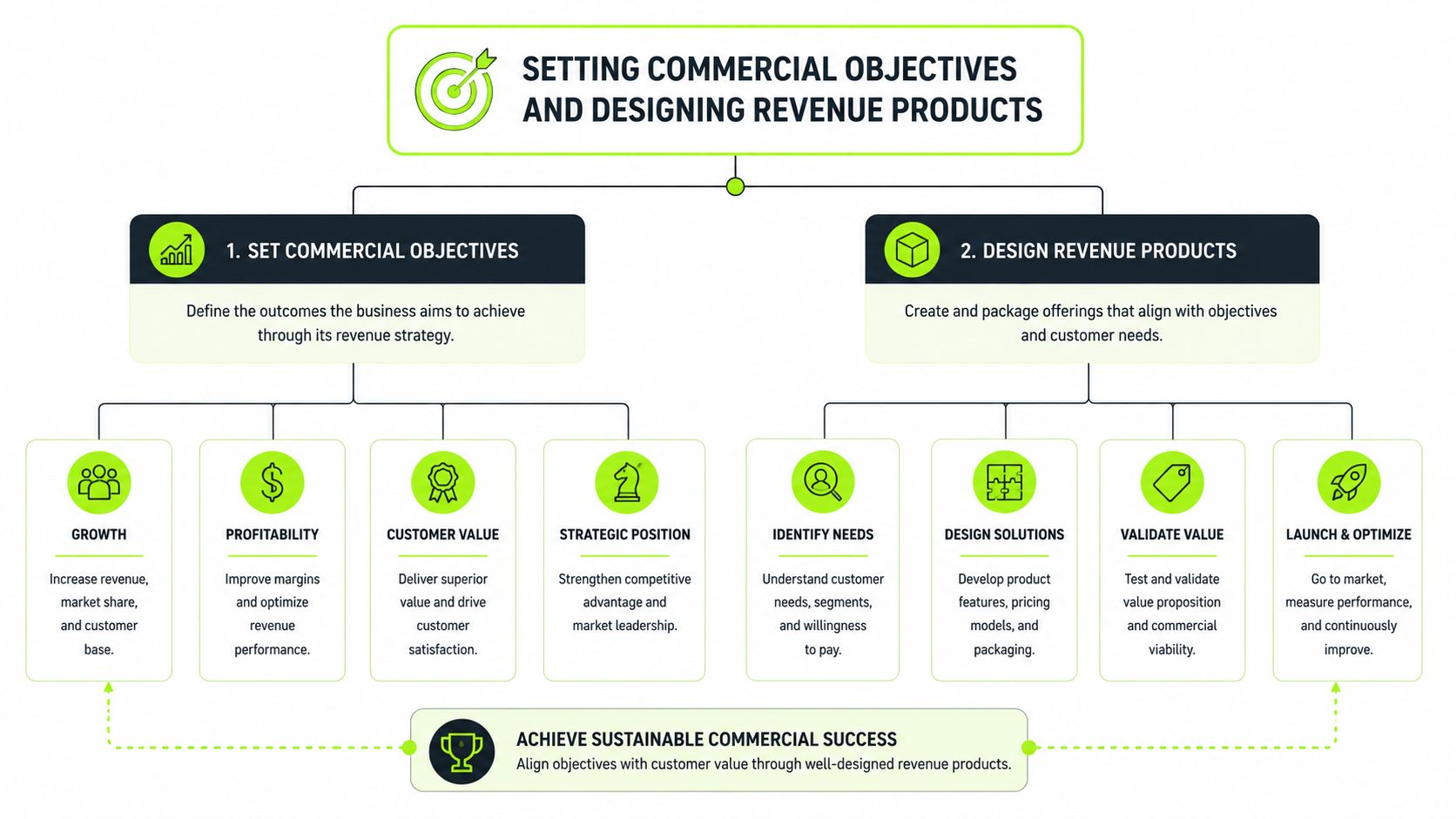
Setting Commercial Objectives and Designing Revenue Products
Committees can't approve “more growth” as a workable objective. They can approve a defined commercial outcome, an owner, a period, and the measures that show whether the plan is moving.
Start with one primary objective for the period. It might focus on full playing membership, junior participation, recurring social revenue, or corporate events. Then identify the leading indicators that sit before the final result:
- Enquiries received: Track the volume and source of relevant interest.
- Qualified conversations: Record whether the prospect fits a product and has a realistic timeline.
- Visits or tours completed: Measure movement from digital interest to physical experience.
- Offers accepted: Separate genuine commercial progress from unqualified form submissions.
- New members retained: Check whether the product and onboarding matched expectations.
The objective should connect directly to a revenue product. A club that wants more families needs more than a “family membership” label. It needs clear eligibility, playing access, guest rules, coaching options, social benefits, pricing, and a simple joining route.
Build a portfolio, not a single offer
A practical portfolio may include:
- Full playing membership: For prospects who value access, routine, and club identity.
- Social membership: For people who want community, dining, events, or limited golf.
- Corporate membership: For employers seeking relationship-building and hospitality.
- Junior membership: With language and onboarding designed for parents as well as young players.
- Trial pathway: A defined route from introductory experience to a considered membership decision.
Each product needs a price, a benefit hierarchy, an eligibility rule, a capacity assumption, and an owner for enquiries. Avoid adding categories to appear flexible. Too many options create uncertainty and make staff less confident when recommending a route.
Underused capacity can support carefully designed packages. A weekday product may suit people with flexible schedules, while a social package could connect club events and food and beverage spend. Bundling should add value without training the market to wait for discounts. The commercial test is whether the offer reaches a defined segment and produces a healthy retained relationship.
Use golf club package deals as a prompt to examine how benefits are packaged, but make the final portfolio fit the club's capacity and positioning. A committee should sign off each product with expected demand, operational implications, and the evidence that will trigger refinement.
Choosing Acquisition Channels That Fit a Golf Club
Acquisition channels aren't interchangeable. A channel that creates broad awareness may be poor at producing immediate membership conversations, while a smaller referral source may produce fewer enquiries but stronger intent.
| Channel | Typical Cost per Enquiry | Enquiry Quality | Time to Revenue | Best For |
|---|---|---|---|---|
| Paid search | Variable | High when search intent is clear | Short to medium | Local membership and visitor demand |
| Paid social | Variable | Mixed, requiring qualification | Medium | Families, juniors, and local awareness |
| Organic search and content | Ongoing effort | High for specific local searches | Medium to long | Capturing researched demand |
| Partnerships | Relationship cost | Often high within a defined audience | Medium | Hotels, employers, professionals, and societies |
| Member referral | Low direct cost | Often strong | Short to medium | Trust-led introductions and community growth |
Paid search works when the landing page matches the search. Someone looking for membership in a particular area should reach a page with relevant categories, access information, pricing guidance, proof of experience, and a direct next action. Paid social can introduce the club to families or younger audiences, but it usually needs stronger qualification and nurturing.
Organic visibility compounds through useful local pages, accurate Google Business Profile information, clear membership content, and answers to practical questions. Partnerships reach audiences a club may struggle to access alone. A hotel can introduce visitors, a professional can refer lesson clients, and a local employer can open a corporate conversation. Member referral often carries trust, but it naturally depends on the strength and activity of the existing network.
Use a planning split, not a permanent formula
For a mid-sized UK club, a 60/30/10 split can provide a starting allocation across paid, owned, and partnership or referral activity. It isn't a universal rule, and the allocation should change when the product, season, or capacity changes. The important discipline is to assign each channel a purpose and judge it by qualified pipeline, not clicks.
Untargeted display advertising and broad-reach press features often struggle because they create attention without a clear conversion path. They can have a role in a local brand plan, but they shouldn't receive priority while high-intent search, referral handling, or partner follow-up remains weak.
Enquiry Handling and the CRM Nurture Engine
The operating system should make the right action easy for a small team. It doesn't require a large sales department. It requires ownership, templates, a rota, and a single record of what happens next.
Engineer the first response
Set a five-minute response target for live enquiries during staffed hours. A rota can assign responsibility to the membership secretary, professional, duty manager, or trained administrator. If the primary owner doesn't respond, an SMS alert or fallback task should move the enquiry to the next person rather than leaving it unattended.
The first response should acknowledge the enquiry, answer the immediate question, and offer a specific next step. A phone call is appropriate for a call lead. An email or SMS can confirm receipt and invite a conversation when the prospect submits a form. Staff who answer calls should use a confident, natural greeting. A library of proven phone greeting templates can help clubs standardise the opening without making conversations sound scripted.
UK research cited by BDaily reported that calling a lead within two minutes produced a 42% increased probability of sales conversion compared with waiting up to five minutes, while the five-minute comparison group had a 24% probability of conversion. The BDaily sales-response comparison shows why a club should measure minutes, not merely whether someone eventually replied.
Capture enough context to qualify properly
Qualification shouldn't feel like an interrogation. Ask what the prospect wants from the club, when they would like to join, how often they currently play, who else is involved in the decision, and which category they're considering. Record the answers in consistent fields:
- Timeline: Immediate, seasonal, researching, or uncertain.
- Household composition: Individual, couple, family, or junior household.
- Playing habits: Frequency, preferred days, current club, and ability where relevant.
- Budget band: A useful range that helps staff recommend a suitable route.
- Next action: Call, tour, lesson, event, or information follow-up.
Use pipeline stages that everyone understands: New Enquiry, Qualified, Toured, Offer Made, Converted, and Lost. Every open record needs a next action and due date.
Build a 21-day nurture sequence
A practical sequence can combine an immediate acknowledgement, useful membership information, an invitation to visit, a short SMS reminder, a personal call on day 7, and further contact that answers common objections. The sequence should stop or change when the prospect replies, books, joins, or asks not to be contacted.
One in four university enquiries in a UK mystery-shopping study received no reply, and only one in six received follow-up after the first response. The ICEF mystery-shopping findings illustrate the risk of treating the first reply as the end of the process.
A small club can use a lightweight CRM such as HubSpot, Pipedrive, or Zoho CRM, connected to a shared inbox, website forms, calendar booking, and SMS service. For a club under 600 members, GolfRep can provide another approach by combining lead capture, automated qualification, CRM pipeline management, and structured nurture around membership enquiries. The tool matters less than clean fields, clear ownership, and regular review.
If the CRM is messy, don't attempt a grand rebuild. Archive dead records, standardise stages, define mandatory fields, and train staff on one workflow. Prospective members may take time to decide, but that makes structured follow-up more valuable, not less. Manual memory is not a nurture system.
KPIs, Reporting and What the Committee Should See
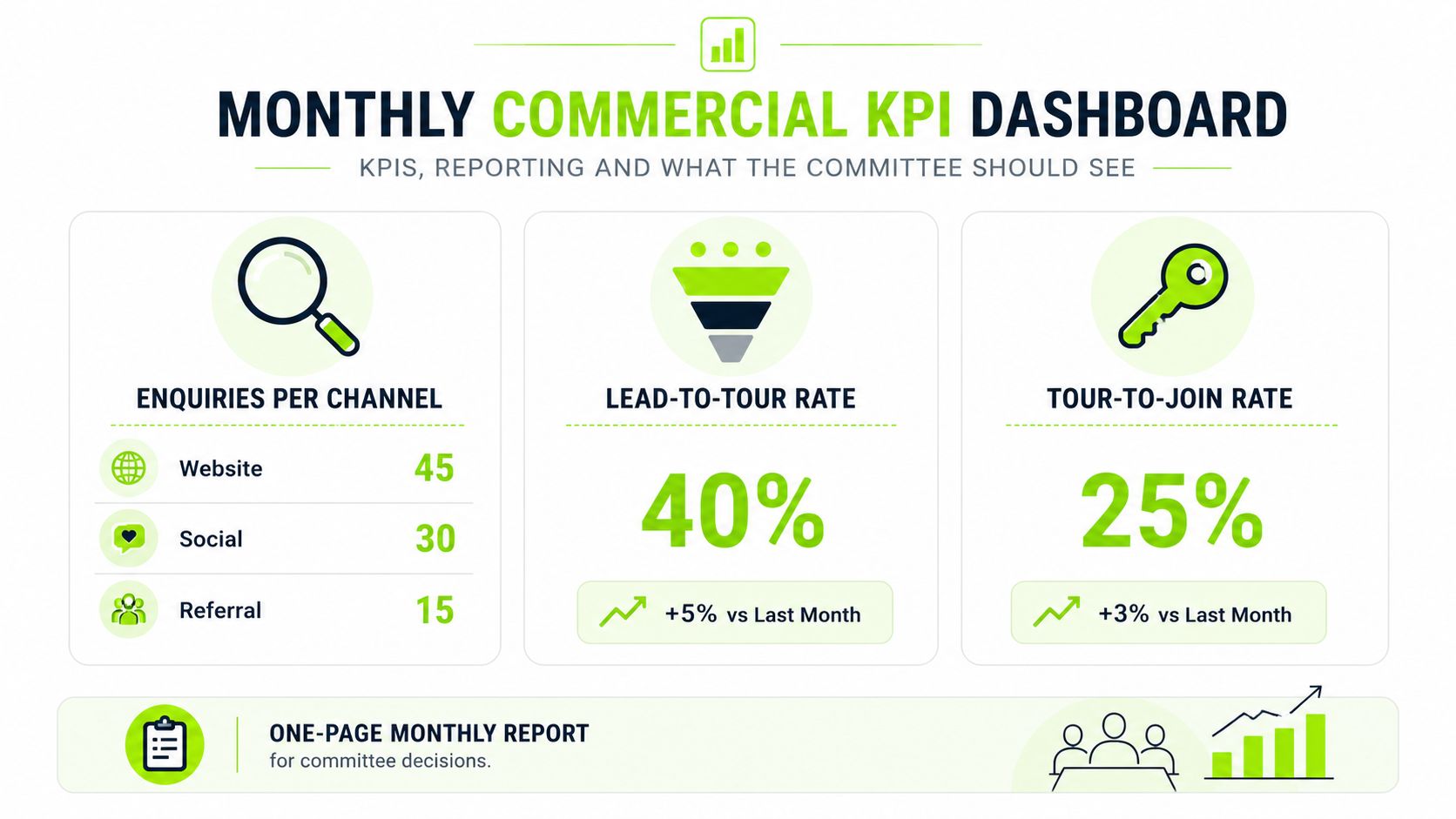
A committee doesn't need a huge dashboard. It needs a consistent one-page view that shows whether demand is being handled, whether prospects are moving, and whether new members are staying.
The monthly report should include:
- Enquiries by channel: Website, search, social, referral, partnership, phone, and other identifiable sources.
- Lead-to-tour rate: The proportion of qualified enquiries that visit.
- Tour-to-offer rate: Whether the club is presenting a suitable route after the visit.
- Offer-to-member conversion: The commercial outcome of those conversations.
- Average revenue per new member: Compare products, not just total sign-ups.
- 90-day membership retention: Check early experience and onboarding quality.
- Pipeline value by stage: Separate likely near-term revenue from unqualified interest.
Diagnostic measures explain movement. Track first-response time, attribution accuracy, and lost reasons such as price, timing, location, capacity, competitor choice, or no contact. For paid campaigns, a practical reference for structuring essential PPC KPIs can help the team avoid reporting clicks without commercial context.
The report should show trends, owners, and decisions required. Don't allow a large enquiry total to hide weak tour completion or an offer pipeline that nobody is progressing.
Four warning signs deserve immediate discussion:
- Response time exceeds 90 minutes and continues to rise.
- Conversion falls below 8% for a meaningful reporting period.
- First-quarter churn exceeds 6%.
- Pipeline value declines for two consecutive months.
These thresholds are supplied as management triggers, not universal industry benchmarks. They should prompt investigation rather than automatic judgement. Review the report in a dedicated 45-minute monthly meeting, separate from the financial report, with a fixed agenda covering movement, causes, owners, and decisions.
A 90 Day Phased Implementation Plan
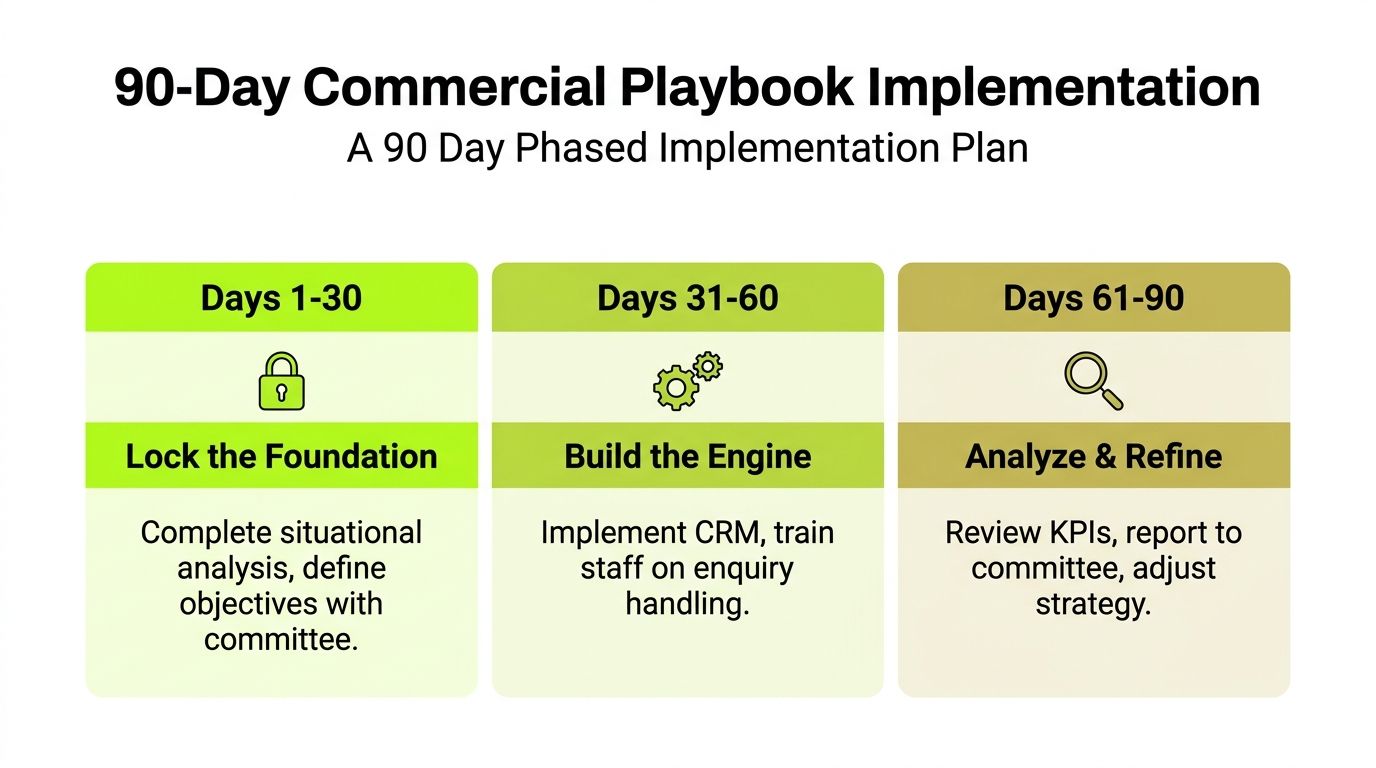
A small club team shouldn't try to rebuild every commercial activity at once. Three phases give the general manager, marketing lead, and membership secretary enough focus to establish the system before increasing demand.
Days 1 to 30, lock the foundation
The marketing lead audits website forms, phone enquiries, social messages, source tracking, and existing spreadsheets. The membership secretary reviews member categories, renewal information, recent joiners, lapsed members, and current enquiry outcomes. The general manager brings course, clubhouse, staffing, capacity, and financial constraints into the same discussion.
The committee should sign off the situational analysis, priority segments, commercial objective, initial product portfolio, and reporting definitions. Install response-time tracking and record a baseline for enquiries, tours, offers, conversions, and lost reasons. Hold a weekly checkpoint, with the final week deliberately carrying buffer because data cleaning and ownership decisions usually take longer than expected.
Days 31 to 60, build the engine
Write or refine the membership pages and pricing explanations. Configure the CRM stages, required fields, task ownership, calendar booking, email templates, SMS fallback, and the 21-day nurture sequence. The membership secretary owns triage, while the marketing lead checks source attribution and message consistency.
Run initial subject-line or message tests, brief the team on the qualification script, and review live records rather than relying on training examples. The general manager resolves operational blockers, such as unclear tour availability or delayed approval of category terms. The committee checkpoint should approve the workflow, product wording, and first dashboard.
Days 61 to 90, activate and refine
Only after the engine is working should the marketing lead turn on capped paid search, targeted social activity, partnership referrals, and member-get-member promotion. Route each activity to a defined product and landing page. The membership secretary runs the trial-to-member conversion process, while the general manager reviews capacity, pricing, and service delivery.
Review the main KPIs weekly during the activation period, then hold a structured committee meeting at the end of the phase. Sign off the channel budget, product changes, ownership model, and next testing priorities.
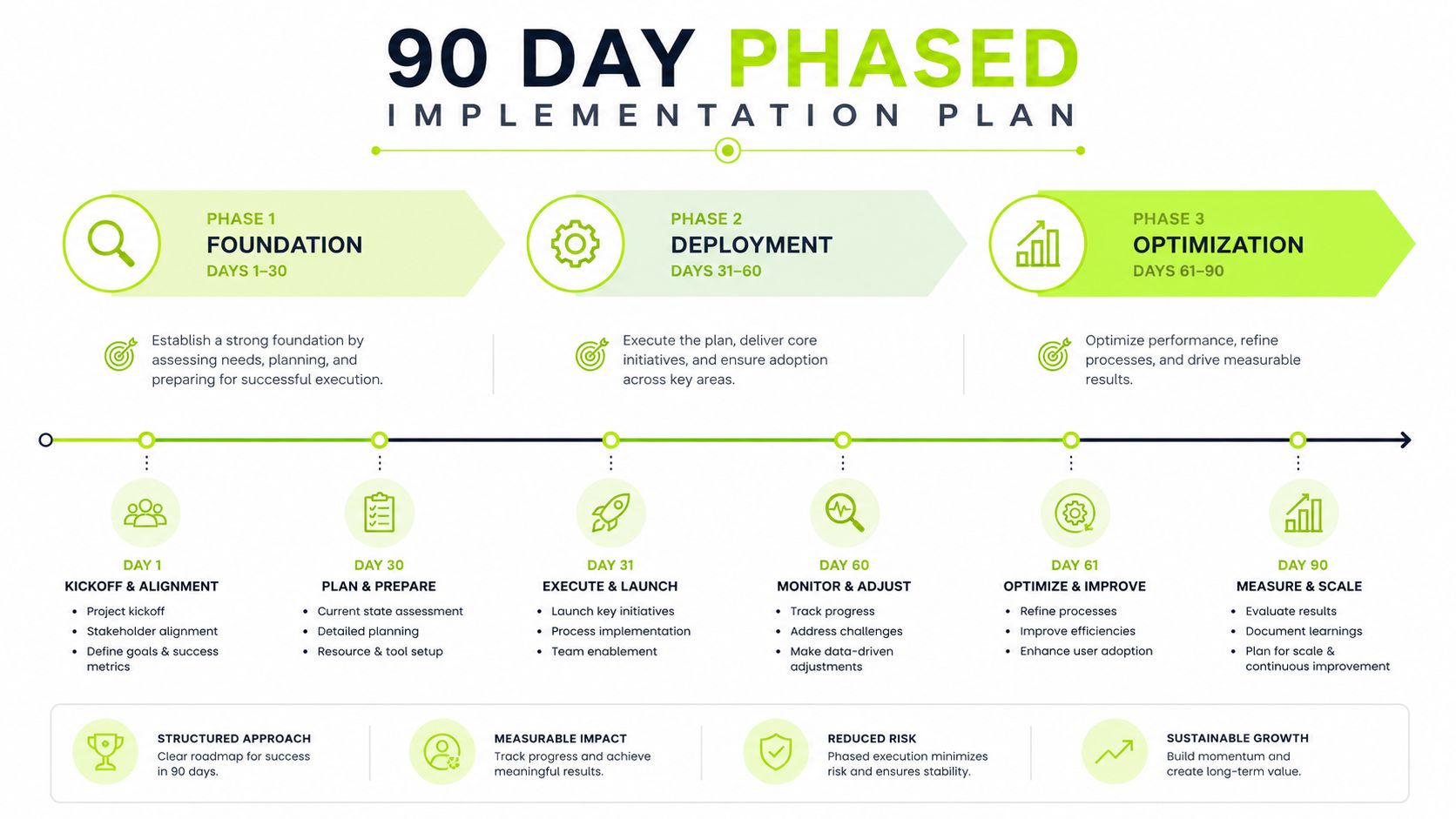
The sequence matters. Clubs often underestimate setup time, especially when records are fragmented across inboxes, spreadsheets, phones, and personal knowledge. Build contingency into the fourth week, keep the first acquisition budgets controlled, and judge the plan by qualified conversations, completed visits, retained members, and visible pipeline movement.
GolfRep helps golf clubs build predictable pipelines by combining targeted lead generation with rapid enquiry handling, CRM visibility, and structured nurture systems. Visit GolfRep to discuss an evidence-led commercial strategy built around your club's products, capacity, and membership objectives.
Ready to tap into our proven growth system?