Golf Club Business Strategy: A Practical Growth Framework
More enquiries won't fix a golf club that takes two days to reply. That advice sounds sensible because an empty pipeline is visible, while missed follow-up is buried in personal inboxes, spreadsheets, and unanswered telephone messages. In practice, golf club business strategy is won after the enquiry arrives, when somebody responds quickly, takes ownership, records the next action, and makes visiting the club easy.
The UK market offers plenty of demand to work with. The commercial problem is turning interest into a visit, a visit into an application, and an application into a member who renews. This framework focuses on the operational choices that decide whether that happens.
Why Most Golf Clubs Grow Slower Than They Should
Most clubs don't have an enquiry problem. They have a conversion system problem.
The uncomfortable claim that prospective members disappear between first contact and decision is often repeated without a verifiable source, so it shouldn't be presented as a measured UK statistic. What can be measured is the delay behind many lost opportunities. A UK sector analysis cited by GolfRep reports an average response time of 47 hours and 32 minutes, and says an enquiry answered within one hour is five times more likely to convert than one left for 24 hours. The figures are set out in GolfRep's analysis of enquiry conversion.
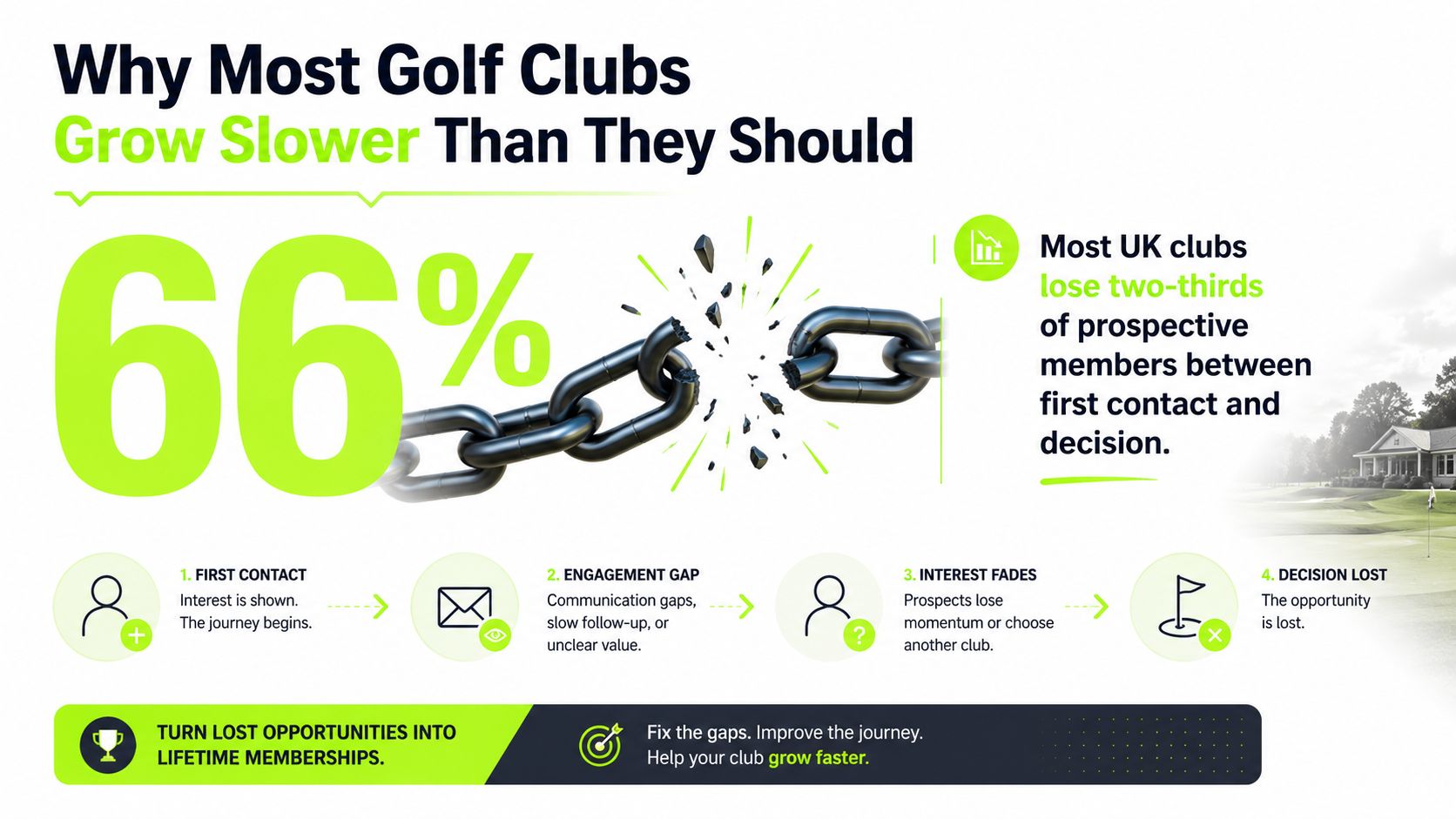
That delay usually starts with a form that sends an email to one person. If the membership secretary is on the course, the general manager assumes somebody else will reply, or the duty manager doesn't know a lead exists, the prospect receives silence. By the time a response arrives, they may already have visited another club.
Four operational failures
- Slow response times: Enquiries wait for office hours, committee availability, or someone to notice an inbox notification.
- Inconsistent follow-up: One prospect receives a call, another gets a brochure, and a third is forgotten after a promising conversation.
- No enquiry-to-member pipeline: Clubs can count enquiries and members, but can't see which sources, staff actions, or visit experiences connect the two.
- Tradition-led pricing: Membership categories remain unchanged because the club has always charged that way, not because utilisation or buyer behaviour supports the structure.
Practical rule: Treat every enquiry as an owned sales conversation, not as an email for someone to deal with later.
The R&A's 2023 UK golf satellite account records 5.356 million adults playing golf at least once in the previous 12 months, 2.357 million playing at least once every four weeks, and about 889,000 club members in the UK. Existing members are therefore only one part of the addressable market. A club's growth plan should concentrate as much on retention, response, and conversion mechanics as on generating more clicks.
Reading the UK Golf Market Before You Plan
Before changing the website, pricing, or advertising, establish which golfers your club is trying to serve. The R&A data shows a wide gap between annual participation and regular club membership, while England Golf's more recent figures show participation extending beyond the traditional member model.
England Golf reported that more than 12.6 million adults in England played some form of golf in the last 12 months. That included 7.3 million playing on a 9- or 18-hole course and 5.3 million using off-course formats such as ranges, simulators, adventure golf, or Topgolf-style venues, as reported by the Golf Club Managers Association. Those audiences don't all want the same membership, and some may not yet think of themselves as club members.
England Golf also reported 10.2 million scores submitted in 2024, with general play rounds rising from 3.9 million to 4.4 million, while average member age fell from 56.18 to 54.99. The figures point to a broader participation base and a changing route into club golf, rather than a market that can be understood through legacy categories alone.
| Segment | Recent Trend | Strategic Implication |
|---|---|---|
| Regular golfers | A substantial participation base sits outside club membership | Build follow-up that converts occasional play into repeat visits |
| Juniors | Club membership growth has been especially strong in this segment | Design family and junior journeys around progression, not only price |
| Women and under-40s | Growth has been weaker than junior growth in club survey data | Test messaging, playing formats, and times that reflect actual barriers |
| Off-course golfers | Ranges, simulators, adventure golf, and similar formats contribute materially to participation | Create a clear bridge from casual activity to a course visit |
| Flexible members | Adaptable packages are becoming more common | Define the usage pattern and retention route before launching a tier |
Hillier Hopkins found that 40% of members' clubs and 64% of proprietary clubs offered adaptable membership packages in its 2024/25 survey, as reported in GolfRep's market opportunity analysis. Flexible membership isn't automatically a growth strategy. Without a planned next step, it can become a collection of discounted sign-ups with weak renewal prospects.
The useful question isn't, “How do we reach more golfers?” It's, “Which golfers are close enough to our offer to visit, join, and remain active?”
Positioning, Pricing, and Membership Architecture
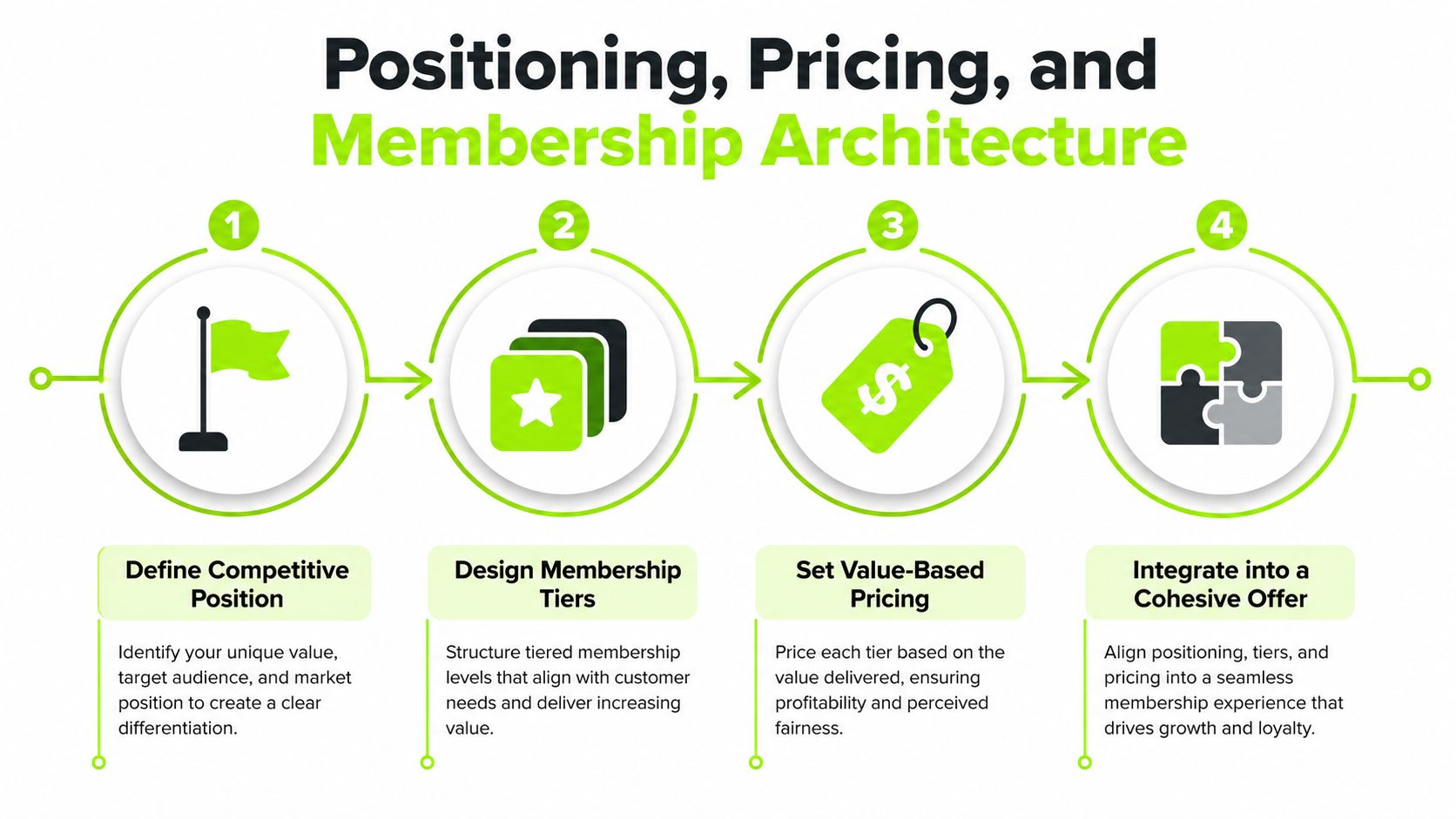
Positioning, tier design, and pricing should be decided together. A premium destination club, a family-friendly local club, and a value-led pay-and-play venue can all grow, but they shouldn't present the same offer or measure value in the same way.
Start with the position
First, decide what the club is known for. The choice might be premium service, accessible value, family participation, a destination experience, or a particular playing environment. This isn't a slogan exercise. It determines which prospects deserve priority and what evidence the club must show during the enquiry process.
Next, audit the current categories against actual demand. If full membership is the only clear option, prospects who play at different times or with different levels of commitment are forced into a poor fit. A structure such as 7-day, 5-day, and flexible membership can make sense when each tier reflects a defined usage pattern, access rule, and progression route.
The price must then follow the value and likely utilisation. A five-day category shouldn't be copied from a neighbouring club because its annual fee looks familiar. Use tee-time demand, underused periods, visitor revenue, and member behaviour to explain why each tier exists. Hillier Hopkins reported that non-member green fees averaged £108, compared with £43.50 for member rounds, in its 2022 findings, published through Golfshake's summary of club membership economics. That difference makes visitor capture and yield important parts of the pricing conversation.
Make the offer intelligible
Category names should match how prospects describe themselves. “Intermediate flex hybrid category” may make sense internally, but “weekday membership” or “flexible golf membership” is easier to understand and search for.
A board should be able to answer three questions for every tier:
- Who is it for?
- What playing pattern does it support?
- What is the next step if the member's needs change?
The golf club pricing strategy guide can help committees work through that connection between positioning, access, and price. The key is not to create more options for their own sake. It is to create a small number of defensible choices that staff can explain and a prospect can select without a second meeting.
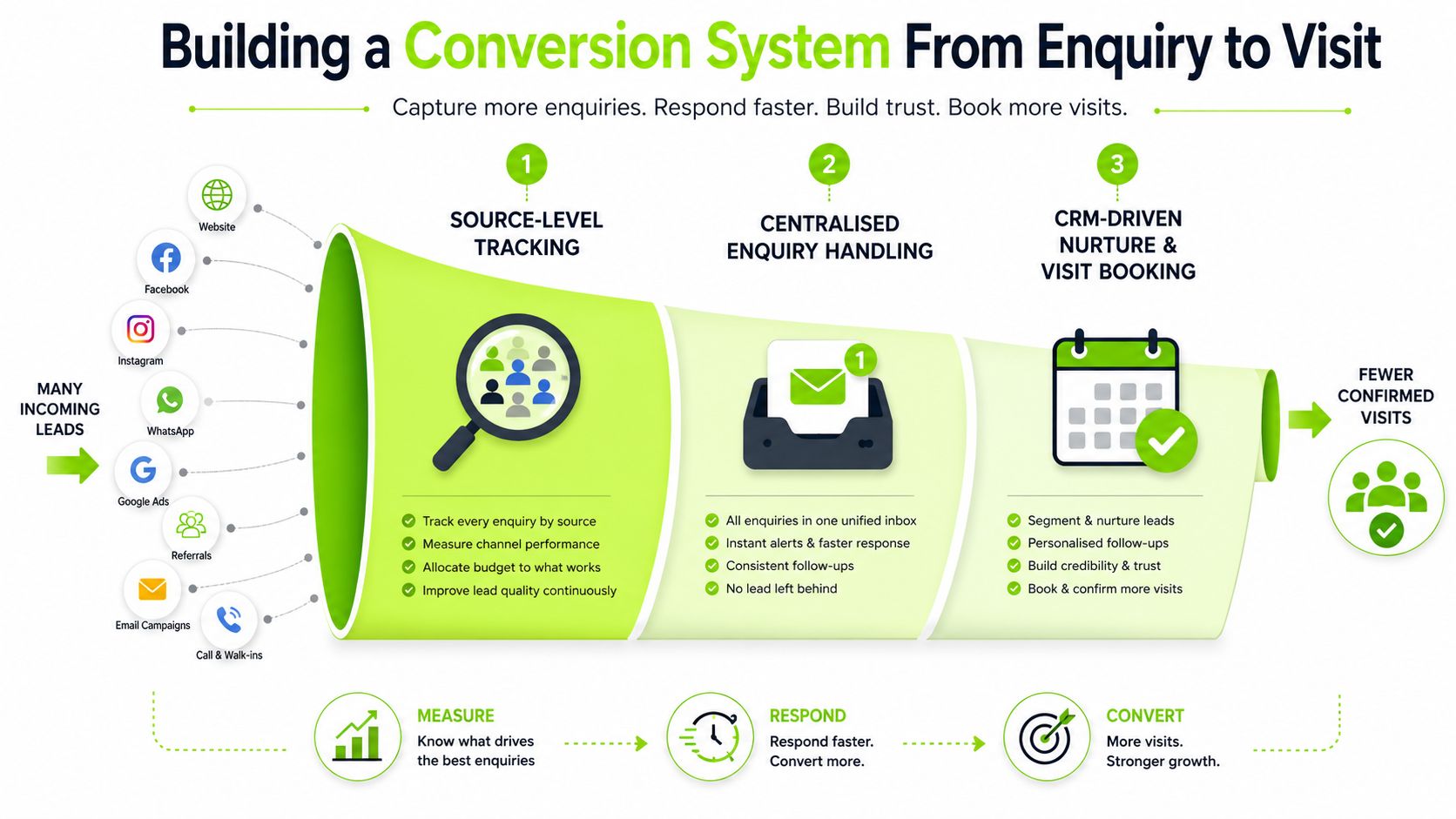
Building a Conversion System From Enquiry to Visit
Lead generation, enquiry handling, and nurture are one process. Separating them creates the familiar situation where advertising produces interest, the website captures it, and nobody has clear responsibility for what happens next.
Start by recording the source of every enquiry. Website forms, telephone calls, social media messages, third-party listings, and referrals should enter one visible record. A shared inbox or CRM should be accessible to the membership team, general manager, and relevant professional staff, with a named owner for every open conversation.
The response benchmark should be operational, not aspirational. GolfRep's analysis reports that a lead answered within one hour is five times more likely to convert than one left for 24 hours, while the average response time to membership enquiries is 47 hours and 32 minutes. Clubs can close much of that gap without hiring a larger team.
A workable handover
Use a simple sequence:
- Immediate acknowledgement: Send an SMS and email confirming receipt, setting expectations, and offering a useful next step.
- Internal alert: Notify the duty manager through a shared channel such as Microsoft Teams or Slack, rather than relying on a personal inbox.
- Discovery call: Ask about playing frequency, preferred days, family needs, experience level, and what prompted the enquiry.
- Visit booking: Offer a taster round, trial day, or guided visit before the call ends.
- Post-visit follow-up: Record objections, send the agreed information, and schedule the next contact rather than hoping the prospect replies.
The form itself matters. Ask only for information that helps staff respond properly, and make the next step obvious. Clubs reviewing their forms can use these best practices for form design as a practical reference.
Three weak links appear repeatedly. Forms go to an individual's email address, nobody is assigned ownership, and the club stops following up once the visit ends. A central record fixes visibility, an owner fixes accountability, and a defined cadence prevents goodwill from becoming the only sales process.
CRM, Automation, and the Retention Engine
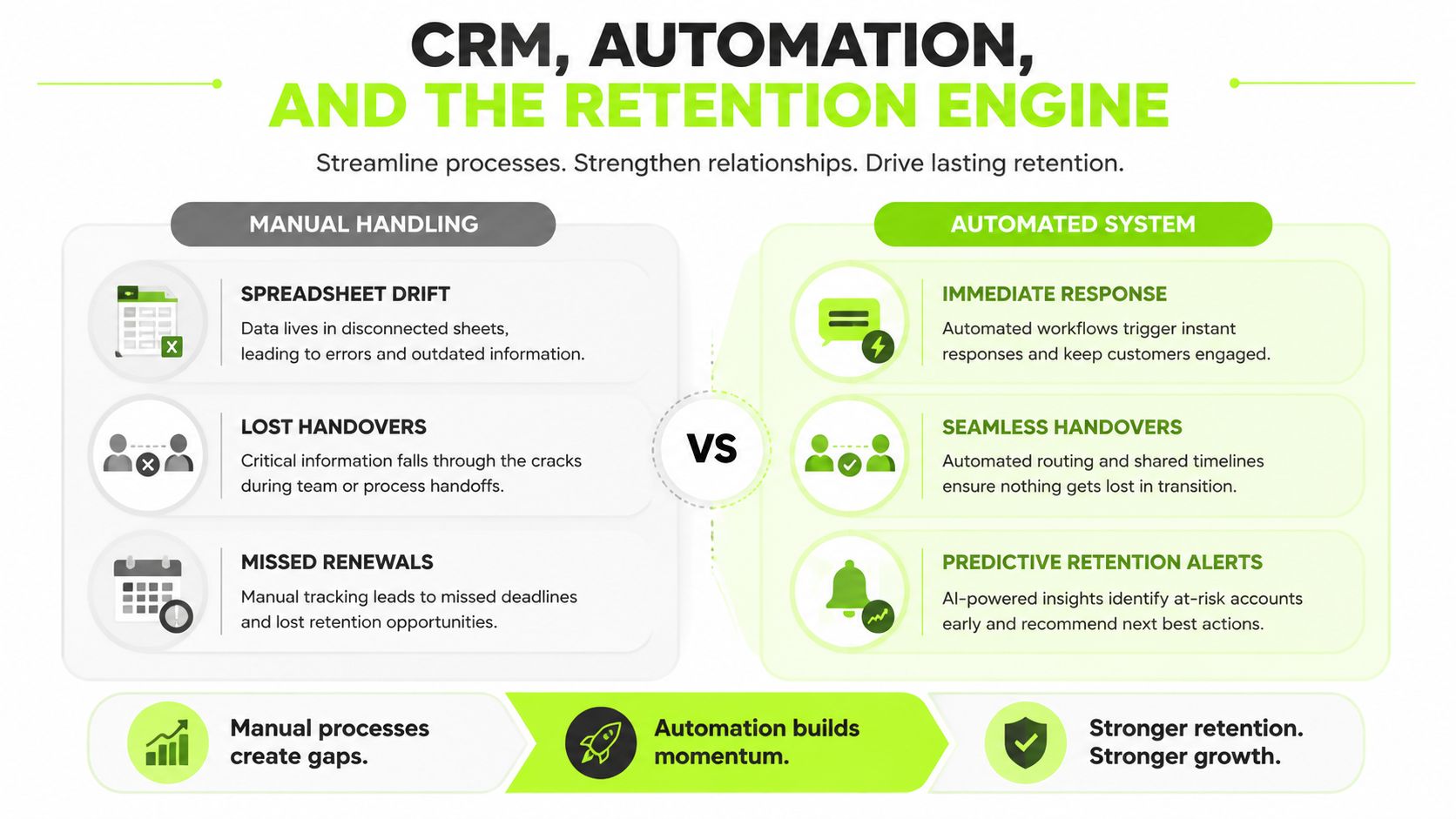
A spreadsheet can record names. It can't reliably manage a pipeline when several people handle enquiries, prospects need different information, and renewal conversations must begin before expiry.
Manual follow-up depends on memory and goodwill. Response times drift when staff are busy, handovers lose context, and an enquiry can sit untouched after an employee leaves. Renewal conversations then start too late, while lapsed members disappear without a structured attempt to understand or recover the relationship.
A proper club CRM gives each contact a status, source, category, owner, next action, and history. Automation should support staff rather than replace judgement. A new enquiry might trigger an acknowledgement, a category-specific nurture sequence, a reminder to arrange a call, and a task after a visit. Renewal workflows can prompt contact 90, 60, and 30 days before expiry, provided those timings fit the club's own membership calendar.
What the system should show
A useful CRM should make these questions easy to answer:
- Which source created the enquiry?
- Who owns the next action?
- Has the prospect visited?
- What objection is blocking a decision?
- Which members are approaching renewal?
- Which former members haven't received a save attempt?
GolfRep's documented segment data reports that clubs using automated CRM and segmented nurture sequences grew membership enquiry-to-join conversion by 36%, compared with a 4% decline for clubs using manual follow-up. That claim belongs to GolfRep's own documented context, so it shouldn't be treated as a universal benchmark for every club. It does, however, illustrate the commercial difference between a visible, repeatable process and one dependent on individual effort.
Automation becomes valuable when it protects the moments staff commonly miss. The golf club CRM guide covers the practical role of a shared pipeline, automated acknowledgement, lead ownership, and follow-up. The system still needs sensible categories, accurate data, and someone responsible for acting on alerts. Technology won't rescue an offer that nobody understands, but it can stop a good enquiry being forgotten.
KPIs and Dashboards That Actually Matter
A Monday morning review should answer what happened, why it happened, and who will act. A dashboard filled with website sessions and social followers may look active, but those measures don't tell a committee whether enquiries became visits or members.
Track eight operating measures:
| KPI | Healthy UK benchmark | Action when it drops |
|---|---|---|
| Enquiry volume by source | Set a club baseline by source | Check channel quality and demand before increasing spend |
| Average response time | Set a service rule the team can meet | Reassign ownership and add acknowledgement automation |
| Taster visit booking rate | Establish a baseline from recorded enquiries | Review the call script, offer, and available visit slots |
| Enquiry-to-join conversion | Compare by source and membership category | Investigate qualification, pricing, and follow-up gaps |
| Average days to join | Establish the current journey length | Identify stalled stages and overdue tasks |
| Member utilisation rate | Compare access rights with actual use | Revisit categories, tee-time allocation, and member value |
| Net revenue per member | Calculate after direct membership servicing costs | Review tier economics and non-membership spend |
| 90-day renewal rate | Track by category and joining cohort | Contact at-risk members earlier and examine onboarding |
There isn't one verified, universal healthy range for these KPIs across UK clubs. A coastal proprietary venue, a busy members' club, and a smaller volunteer-run operation have different economics. The discipline is to set an internal baseline, choose a target, and assign a named person to each response.
Build one decision view
A club can combine CRM enquiry data, member utilisation from its club management system, and finance figures from its accounts package in Google Data Studio or Power BI. The dashboard should refresh daily if the systems allow it, but the review rhythm matters more than visual polish.
Use source-level conversion to challenge advertising decisions. Use days to join to expose handover failures. Use net revenue per member to prevent cheap acquisition from being mistaken for growth, and use renewal data to show whether the original offer delivered lasting value.
Retire any metric that no named person can act on within a week. Reporting is only useful when it changes a decision.
What This Looks Like in Practice at UK Clubs
GolfRep's documented club examples show how different venues apply the same operating principles. The details matter because a members' club, a proprietary venue, and a pay-and-play operation don't need identical pricing or messaging. They do need visibility from first enquiry to commercial outcome.
A 27-hole members' club
A 27-hole members' club rebuilt its enquiry pipeline around CRM capture. Before the change, the reported response time was 38 hours. After the process was rebuilt, it fell to under 90 minutes, and trial-to-member conversion rose from 11% to 23% over two seasons. The improvement came from recording every enquiry, giving staff ownership, and connecting the trial visit to a defined follow-up process.
The commercial lesson is straightforward. A club doesn't need to create an entirely new audience before fixing a slow handover. Existing interest becomes more valuable when staff can see it, respond to it, and continue the conversation.
A proprietary club
A proprietary club combined structured social media lead generation with automated trial-day nurture sequences. That process generated 47 qualified trial bookings in a quarter when previous activity had been ad hoc. The important output wasn't the number of posts or impressions. It was a set of booked opportunities that staff could prepare for and follow through.
The club's system made the trial day part of the conversion journey rather than the end of an advert. Prospects received relevant information before attending, and the team had a clear next action afterwards.
A pay-and-play venue
A pay-and-play venue introduced membership tiers and seasonal packages, then used dashboard tracking to move spend towards the source producing the strongest conversion. This approach connected offer design with channel performance, rather than promoting every package to every golfer.
Committees setting their own quarterly priorities may find the 2026 OKR growth playbook useful for turning broad ambitions into owned actions. The venue examples below summarise the documented commercial changes without adding outcomes that weren't provided.
| Club Type | Primary Change | Response Time Before/After | Conversion Lift | Members Added |
|---|---|---|---|---|
| 27-hole members' club | CRM capture and structured trial follow-up | 38 hours to under 90 minutes | 11% to 23% trial-to-member conversion | Not provided |
| Proprietary club | Lead generation and automated trial nurture | Not provided | Not provided | Not provided |
| Pay-and-play venue | Tiered packages and source-level dashboard tracking | Not provided | Not provided | Not provided |
Where to Start This Week
You don't need to buy software or appoint an agency to expose the first operational problems. Start with evidence from your own club, then introduce the process that a CRM would eventually formalise.
Day one
Pull the last 50 membership enquiries and record when each arrived, when somebody first replied, who replied, whether a visit was offered, and what happened next. Include telephone calls and social messages where possible. The result may be uncomfortable, but it will replace assumptions with a usable baseline.
Day two
Write three short templates for a new enquiry, a trial booking, and post-trial follow-up. Keep the tone human, include a named contact, and give the prospect one clear action. Templates shouldn't create robotic communication. They should prevent staff from starting from a blank screen during a busy day.
Day three
Define two or three membership tiers with clear prices and usage rules. Avoid a buffet of vague options. For each category, write down who it suits, when the member can play, what is included, and what happens if their needs change.
Day four
Sketch a single dashboard with enquiry volume, response time, trial bookings, and conversions to member. A spreadsheet is sufficient for the first version. If the team can't maintain those fields consistently, a more advanced platform won't solve the underlying discipline problem.
Day five
Schedule a 30-minute committee review of the enquiry log and agree one operating rule, such as answering all enquiries within two hours during office hours. Give the rule an owner and review exceptions rather than debating whether the target feels ambitious.
UK clubs already have a sizeable and changing market to serve. The R&A records millions of annual and regular golfers beyond the existing member base, while England Golf data shows participation across course and off-course formats. The immediate opportunity is to handle current demand properly, learn which segments stay, and build the system before spending more on acquisition.
GolfRep helps clubs connect lead generation with structured follow-up, CRM visibility, automated acknowledgement, booked visits, and revenue tracking. If your committee wants to identify where enquiries are being lost and build a more predictable membership pipeline, visit GolfRep to discuss the process.
Ready to tap into our proven growth system?