Golf Club Revenue Management Software Guide

A general manager can usually tell you the club's headline turnover, membership total and visitor income. The harder question is where revenue is being created, where it's being lost and which team owns the next commercial action. A tee sheet may show that a Saturday is full, but it won't necessarily show whether the club priced that demand well, converted those visitors into repeat customers or collected the society deposit on time.
That's the practical distinction between a booking system and golf club revenue management software. A booking system records transactions. A revenue management system connects demand, pricing, membership, follow-up, billing and reporting so the club can make better decisions across the whole operation. For UK clubs, particularly member-owned and committee-led clubs, that wider view matters because commercial decisions must improve income without weakening trust.
Understanding Golf Club Revenue Management Software
A Saturday tee sheet is full, yet the club cannot explain whether the visitors paid the right rate, bought lunch, joined the CRM follow-up or returned the following month. In many clubs, the professional checks bookings, the office reviews membership invoices, the bar manager monitors till reports and the secretary assembles a committee paper from separate spreadsheets. Each record may be accurate, but the commercial picture remains fragmented.
Golf club revenue management software connects those records so management can assess the whole customer and the whole transaction. It links demand, pricing, membership, CRM activity, payments and reporting. That creates a basis for total club yield, where green fees, subscriptions, events, bar sales and repeat visits are considered together.
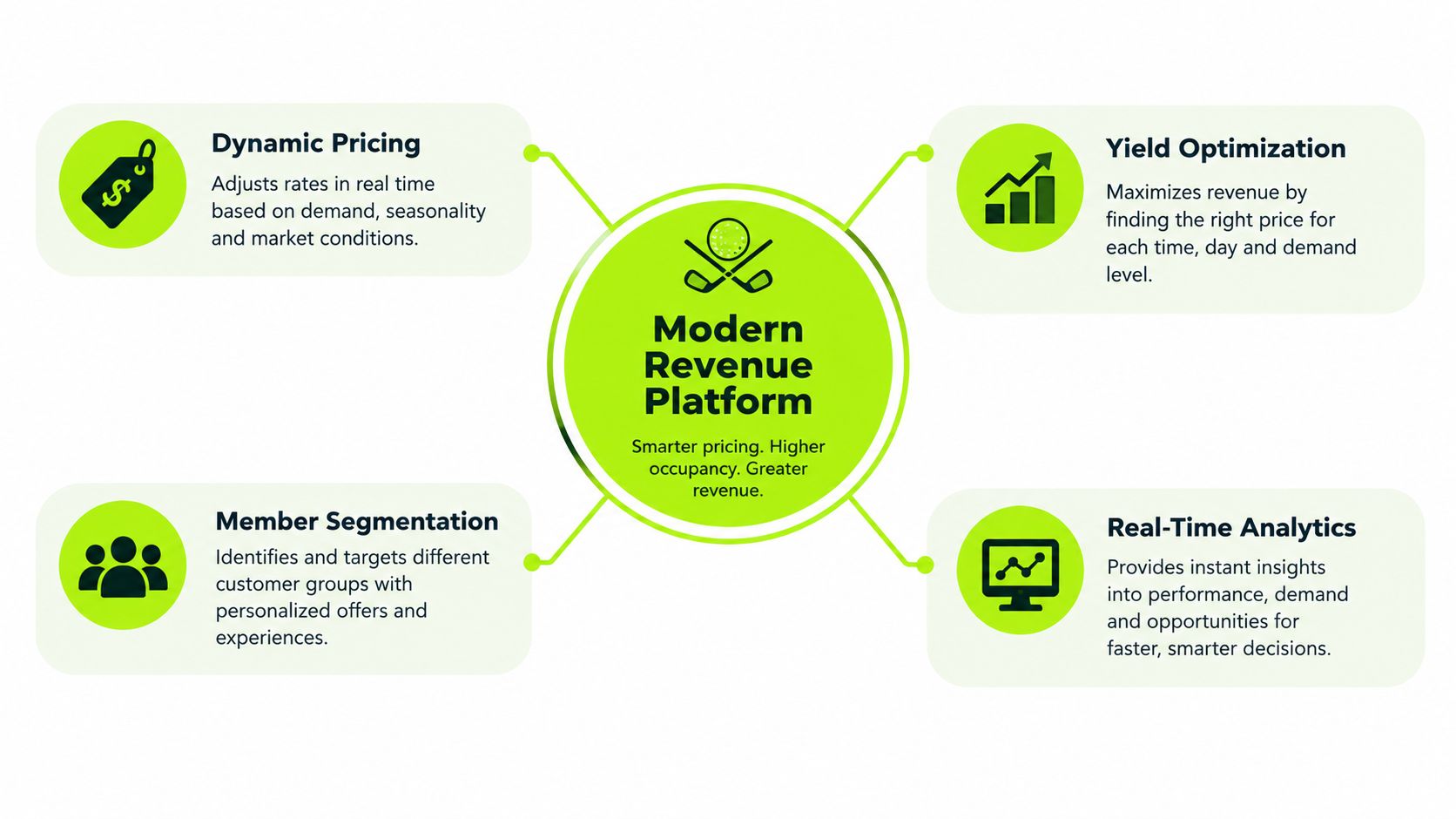
From tee-sheet software to a commercial operating system
A practical platform should connect these operational layers:
- Tee-sheet activity: Booking time, date, channel, golfer type, price and cancellation status.
- Membership records: Enquiries, joining stages, renewals, resignations, usage and payment status.
- CRM workflows: Lead ownership, follow-up tasks, visit bookings, quote activity and conversion outcomes.
- Billing and payments: Subscriptions, deposits, unpaid balances, levies, food and beverage and retail transactions where integrations allow.
- Reporting: Revenue by product, occupancy by daypart, booking pace, customer segment and campaign source.
The value comes from connecting the information to an owner and an action. A visitor who books once should enter a repeat-play workflow. A prospective member who attends an open day should have a named follow-up owner. A society organiser should receive a deposit reminder before the booking becomes a debt-collection problem.
That operating model needs governance as well as software. At a member-owned club, the committee may approve visitor pricing rules, product changes and reporting definitions, while staff manage the daily exceptions. Proprietary clubs may move faster, but they still need controls around discounts, member treatment and customer consent. Record who approved each rule, which segment it applies to and when the result will be reviewed.
The UK market is already operating at a scale where disconnected systems create avoidable work. In the 2024/25 Hillier Hopkins Golf Clubs Report, 77% of members' clubs and 73% of proprietary clubs reported annual turnover above £1 million, compared with 68% and 54% respectively in 2023. The same survey found that 59% of members' clubs had more than 600 playing members, while 81% generated over £150,000 in annual bar revenue.
A tee-sheet diary cannot show all of that income or the customer decisions behind it.
Practical rule: Treat the tee sheet as one revenue source inside the club, not as the club's entire revenue system.
Hospitality businesses provide a useful comparison because they assess booking pace, availability and secondary spend together. Clubs examining that approach can review short-term rental profit optimization, then adapt the mechanics to golf's membership promises and committee controls.
The buying question is therefore broader than which pricing function to add. Identify the data that must pass between the tee sheet, CRM, membership, finance and point-of-sale systems first. A wider overview is available in this guide to golf club management software.
Core Features That Drive Commercial Performance
A vendor demonstration can look impressive while showing very little about commercial performance. The useful test is whether each feature changes a decision, protects income or gives a member of staff a clear next action.
Dynamic pricing needs controls, not just automation
Dynamic pricing adjusts visitor rates according to demand conditions rather than applying one static rate to every comparable tee time. The inputs may include booking pace, day of week, seasonality, available capacity and local trading conditions. A quiet weekday afternoon may need a different offer from a popular weekend morning, but the system should adjust within rules approved by the club.
That last point matters. A committee-owned club may accept responsive visitor pricing while rejecting unexplained price changes for members. Configure member and visitor segmentation before configuring price rules. Then set a floor price, define which products can change, and record who approved the rule.
Dynamic pricing also shouldn't be confused with increasing prices when a tee sheet fills. A sensible system can move prices up or down, with the aim of balancing yield and occupancy. The PGA guide to tee-sheet optimisation provides UK golf context for this approach and cites examples including 19% average green-fee revenue growth, 32% visitor revenue growth within six months, and a 78% uplift at one Northamptonshire club. Those figures belong to specific reported examples, not to a guaranteed outcome for every club.
CRM automation captures value after the booking action
Pricing can improve the value of available inventory, but it can't recover every lost opportunity. The CRM should receive enquiries and bookings, assign ownership, trigger follow-up and record the outcome.
A practical workflow might send a confirmation immediately, a reminder before arrival and a relevant repeat-play message afterwards. For membership, the workflow may move a prospect from enquiry to visit, proposal, decision and joining. For societies, it can prompt the organiser to confirm numbers, pay a deposit and select food or drinks.
The important design choice is not the number of emails. It's whether each workflow reflects a real club process and gives staff visibility when a customer needs personal contact.
Integrated billing completes the revenue picture
Revenue management breaks down when billing remains separate. The platform should show whether a society deposit has been paid, whether a membership invoice is overdue, whether a levy has been applied and whether a customer has bought related services.
Not every club will have one system for every transaction. Integrations with payment providers, accounting platforms and point-of-sale systems can still create a usable commercial view. The key is to agree which system owns each record, how often data synchronises and who resolves discrepancies.
A documented UK multi-site implementation used CRM across 9 golf courses, managing 160,000 contacts, 5,500 members and more than £14 million in revenue, while 30 sales seats supported nearly 4 million marketing emails in 2022. The GolfRep CRM example shows why centralised ownership and segmentation become important as operations grow beyond one course or one office.
When reviewing features, separate administration from commercial impact. Online booking convenience is useful, but the stronger question is whether the system helps the club sell the right inventory, retain the right customers and report the result.
Measuring Success With The Right Revenue KPIs
A revenue system earns its place when the management team can connect an operational change with a commercial result. A dashboard showing website visits and total bookings may look busy, yet still leave the club unable to explain whether yield has improved or whether extra volume arrived at an unprofitable rate.
Start with a small weekly dashboard. Managers should be able to review it in a committee or management meeting without asking an administrator to rebuild the figures manually. Each measure needs an owner, a clear definition and an agreed action when performance moves outside the club's expected range.
The weekly view
Track available tee-time capacity by daypart, occupied capacity, average realised rate, visitor revenue and cancellations. Compare those measures with the club's own trading pattern rather than an arbitrary industry target. A full sheet sold at a low rate may call for a different decision from a half-full sheet sold at a strong rate.
Add membership activity to the same report. New enquiries, visits booked, applications, joiners, leavers and unpaid balances show whether subscription income is becoming more or less secure. England had 1,735 golf clubs and more than 730,000 golf club members in 2025, while the average member age fell to 54.99 from 56.18. These figures from England Golf's national data support monitoring both current usage and the future composition of the membership.
Secondary spend deserves its own line. Report food and beverage spend, retail spend and other paid services per golfer where the data is available. A tee-time promotion that fills capacity without generating related spend may still suit a quiet period. The management team should see that outcome clearly rather than assume every booking carries the same value.
CRM data should connect the activity to a customer record. A visitor booking, a society enquiry, a lapsed member and a renewal conversation need consistent source and outcome fields. Without that link, the club can measure transactions while missing the reasons behind them. This is particularly important where a proprietary club has commercial targets, or where a member-owned club needs evidence that supports committee approval for pricing and campaign decisions.
The monthly view
Use the monthly review to examine trends, cohorts and the consequences of earlier decisions:
- Revenue per available tee time: Measures the value of all saleable capacity, including unfilled inventory.
- Revenue per occupied tee time: Shows the value of bookings the club secured.
- Renewal conversion: Shows how many eligible members renew and where the process loses people.
- Enquiry-to-join conversion: Connects marketing and sales activity with subscription revenue.
- Secondary spend per golfer: Measures commercial value beyond the initial booking.
- Arrears and collection rate: Identifies cash-flow risk before it becomes a budget problem.
- Daypart occupancy: Shows where pricing, packages or targeted demand generation may be appropriate.
- Repeat visitor rate: Tests whether the club is building a relationship rather than selling isolated rounds.
The monthly pack should separate volume, rate and margin wherever the underlying data allows. A rise in occupancy can hide weaker realised rates. More membership enquiries can conceal a poor application process. A committee can govern those trade-offs more effectively when the report shows the decision, the result and the relevant customer segment together.
| KPI Category | Specific Metric | Commercial Purpose |
|---|---|---|
| Tee-sheet yield | Revenue per available tee time | Measures the value of total sellable capacity |
| Occupancy | Occupancy by daypart | Identifies underused periods and peak demand |
| Membership | Renewal conversion | Protects recurring subscription income |
| Acquisition | Enquiry-to-join conversion | Shows which demand sources create members |
| Retention | Usage by member cohort | Flags declining engagement before resignation |
| Secondary spend | Spend per golfer | Measures the wider value of each visit |
| Cash flow | Unpaid balances and deposit collection | Reduces avoidable revenue leakage |
| CRM | Follow-up completion and outcome | Tests whether automated processes create action |
To understand campaign economics, pair every source with cost, conversion and resulting revenue. The practical guidance in how to measure marketing effectiveness provides a useful framework, provided the club extends the analysis beyond lead volume to joined members, renewals and customer value.
The dashboard should support decisions rather than become a league table for staff. Use it to identify the current constraint, agree an action, measure the result and record what changed. That record gives managers a defensible commercial case when a committee reviews pricing, membership activity or CRM investment.
Implementing Revenue Systems Across Your Club
A revenue platform can fail before launch if the club treats implementation as an IT project rather than an operating change. Staff need to know which records matter, who owns each action and what the new process replaces.
The safest approach is phased. Start with data and process discipline, then introduce automation and pricing rules once the underlying information can be trusted.
Phase one assessment and planning
Map the current journey from booking or enquiry to payment, visit, renewal and repeat purchase. List every system involved, including the tee sheet, membership database, payment gateway, accounting package, point-of-sale system and spreadsheets.
Clean the data before migration. Remove duplicate contacts, identify incomplete records and agree naming conventions for members, visitors, societies and prospects. Decide which information the club is entitled to retain and who can access it.
Phase two configuration and integration
Configure the core records, user permissions, pipeline stages and reporting fields. Connect payment gateways and, where appropriate, Xero so managers can see how invoices, deposits and receipts affect cash flow. Test the integrations with realistic transactions rather than relying on a successful technical connection.
Choose one quick win. Automating society deposit reminders is often easier to validate than launching a complex pricing model because the process has a clear trigger, owner and outcome. Other suitable starting points include membership visit reminders or renewal task allocation.
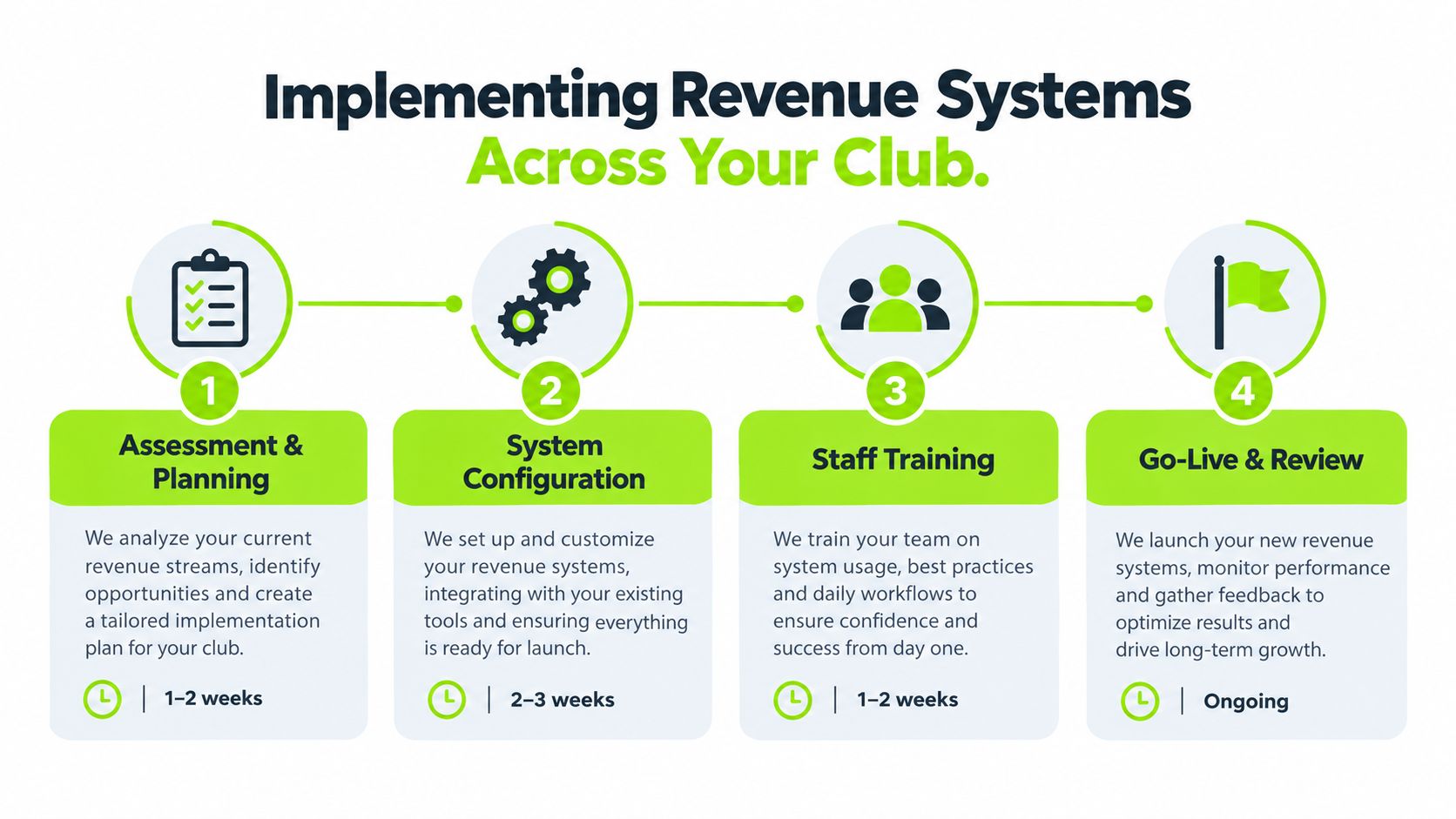
Phase three staff training
Train the people who use the system during real trading conditions. Reception staff need to find and update records quickly. The professional team needs to understand booking categories and customer notes. Managers need to interpret reports and intervene when a workflow stalls.
Use short role-based sessions rather than one large technical presentation. Give each team a written process for common situations, such as a cancelled society, an undecided membership prospect or a member with an overdue balance.
Adoption test: If staff still keep a private spreadsheet because the platform doesn't show what they need, the implementation isn't complete.
Phase four controlled go-live
Run the new and old processes in parallel only long enough to verify the records. Set a named owner for data quality, integration issues and staff questions. Review the first reports with the team, then correct the process before adding more automation.
Introduce dynamic pricing rules gradually. Begin with a limited set of visitor inventory, a clearly documented price floor and manual approval. Once the club can explain the outcome, expand the rules to other products or dayparts.
A phased rollout protects trading continuity and gives the committee evidence that each change has been tested. It also prevents a common mistake, buying functionality before the club has agreed how people will use it.
Selecting The Right Software Vendor For Your Needs
The right vendor depends on the club's operating model, not on the longest feature list. A single-site proprietary facility may need fast booking, payments and yield controls. A member-owned club may place greater weight on permissions, audit trails, member segmentation and committee reporting. A multi-site operator needs central visibility without forcing every venue into identical commercial rules.
Compare the platform, not the presentation
A basic tee-sheet provider may offer dependable booking and payment functions. That can be sufficient if the club already has strong CRM, accounting and reporting processes. A broader commercial platform should connect those functions and make the relationships between them visible.
Ask the vendor to demonstrate a real process from start to finish:
- Create a visitor booking and show how the customer is segmented.
- Change demand conditions and show how a price rule responds.
- Cancel the booking and demonstrate the refund or re-sale process.
- Record a follow-up action and show where staff see the task.
- Add a society deposit and display its payment status.
- Produce a report that separates members, visitors, societies and other income.
If the demonstration jumps between disconnected screens or relies on manual exports, ask what the club will need to maintain every week.
Questions that expose practical limitations
Put these questions in the tender document:
- Data ownership: Can the club export all customer, booking and activity data in a usable format?
- Integration: Is there a documented API, and which payment, accounting, CRM and point-of-sale integrations are supported?
- Governance: Can the club set different permissions for managers, reception, professionals and committee reporting?
- Auditability: Does the system record who changed a price, rule, customer record or payment status?
- Support: Who answers urgent questions during busy weekend trading and what response process applies?
- Scalability: Can the platform support additional sites, products, users and customer segments without creating separate data silos?
- Contract terms: Are implementation, training, integrations, payment processing and data exports included or charged separately?
Don't accept “it can be configured” as an answer without seeing the configuration. A feature that requires vendor intervention for every small change may become an operating cost and a governance bottleneck.
For clubs assessing CRM depth specifically, the guide to choosing a CRM for a golf club can help frame the difference between contact storage and a managed commercial pipeline. The final decision should also include the people who will use the system, not only the person who negotiates the contract.
Managing Risks And Securing Committee Buy-In
A committee may support better commercial performance while still rejecting a pricing project that appears difficult to explain or unfair to members. Visitors could see different prices for similar tee times, staff could inherit extra administration, and trustees could be asked to defend rules they did not set. The proposal must address those operational and governance concerns before approval.
Dynamic pricing requires a written policy. It should define which products can change, when changes are permitted, the boundaries for each rate and the person authorised to approve operational adjustments.
Build governance into the configuration
Set controls such as:
- Price floors: Define the lowest visitor price for each relevant product and daypart.
- Member protection: Keep member rates, competitions and agreed entitlements outside visitor pricing rules unless the committee approves a change.
- Segmentation: Separate members, visitors, societies, juniors, guests and promotional users so one rule cannot affect every customer.
- Approval rights: Give a named manager authority over routine changes, while the committee approves the policy and its limits.
- Audit trails: Record the rule, date, approver and demand rationale for each pricing change.
- Communication templates: Explain that rates reflect available capacity and demand, rather than arbitrary discounting.
The CRM must support these controls. If a visitor price changes but the customer record, booking source and follow-up activity remain disconnected, the club cannot judge whether the yield came from better pricing or merely from a different customer mix. Revenue management should therefore sit within the club's wider operating system, alongside bookings, marketing and retention activity.
Report exceptions as well as averages. When a member asks why a visitor rate changed, reception needs an answer based on the published policy and recorded conditions.
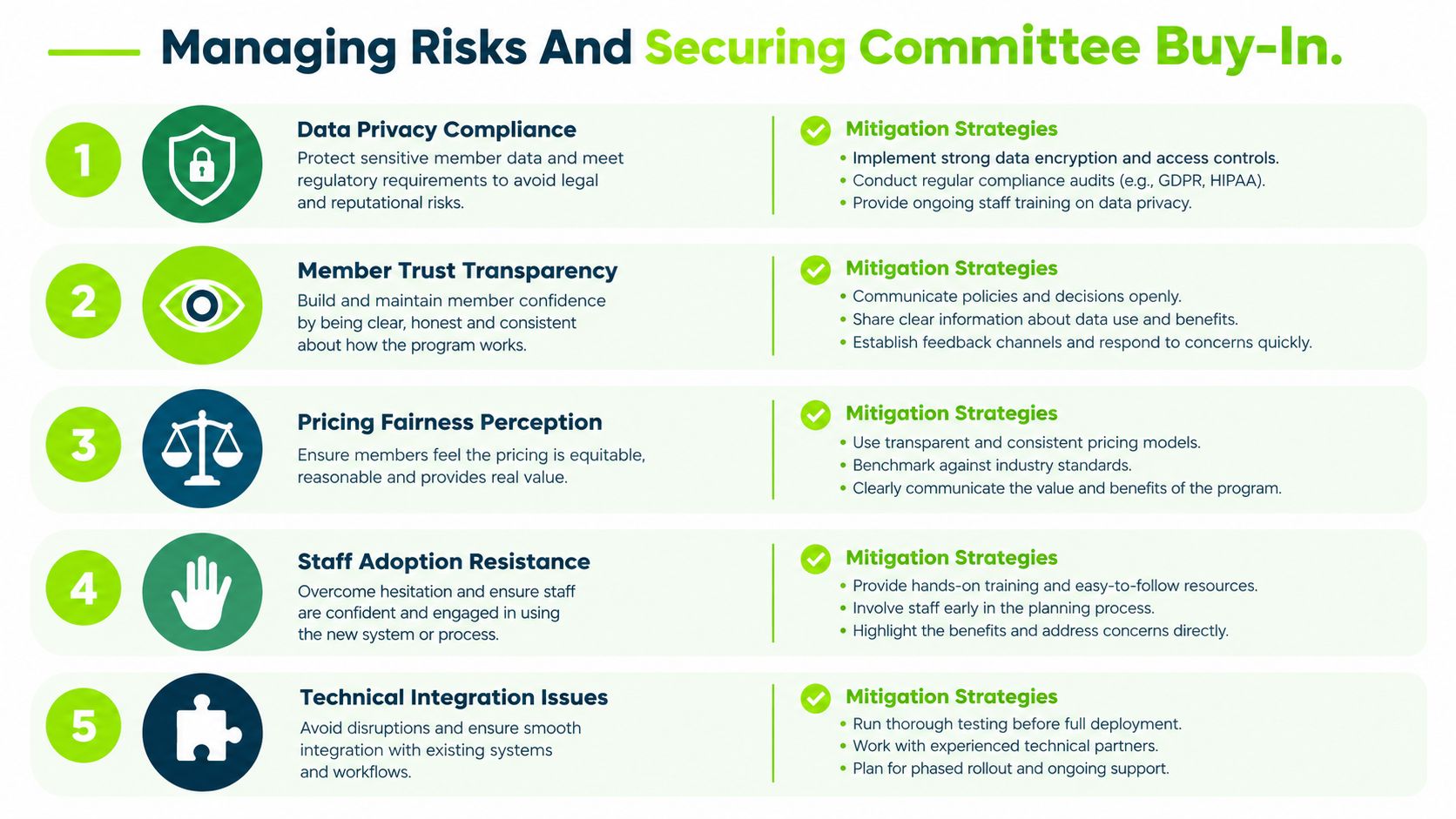
UK clubs often manage several material income streams, so commercial decisions need to be explainable rather than automated without oversight. The 2024/25 survey found that only 3% of clubs reported turnover below £600,000, compared with 11% in 2023, according to the Hillier Hopkins report. The wider the operation, the more important clear ownership, reporting and approval limits become.
Present a short pilot proposal covering the inventory, price boundaries, member safeguards, reporting cadence and review date. Volunteers and directors can then assess evidence from a controlled test without approving an uncontrolled change across the club.
Revenue management software should improve the return from available capacity while remaining inside rules members understand. The right system gives managers practical control and gives the committee a clear audit trail.
GolfRep works with golf clubs to connect acquisition, CRM follow-up, conversion, retention and revenue reporting. Visit GolfRep to discuss a structured assessment of whether pricing, data, sales process or retention is the main constraint at your club.
Ready to tap into our proven growth system?