Golf Club AI Assistant: CRM, Leads & KPI Tracking
Most advice about a golf club AI assistant starts in the wrong place. Clubs don't usually need more enquiries, they need a better system for answering, qualifying, and converting the enquiries they already have.
That's the practical shift GolfRep sees on the ground in the UK market. Member interest comes in through website forms, phone calls, email, social channels, event enquiries, and visitor questions, but too many clubs still rely on inboxes, handovers, and memory to keep the pipeline moving. The result is slow follow-up, weak visibility, and missed sign-ups.
A golf club AI assistant only becomes useful when it helps the club run a cleaner commercial process. Used well, it shortens response time, keeps information consistent, logs activity into the right system, and gives managers a clearer view of where interest is stalling.
Why Most Golf Clubs Misunderstand AI Assistants
The biggest mistake is treating AI like a lead source instead of an operational layer. That mindset pushes clubs towards chat widgets and generic automation, then leaves the primary bottleneck untouched: the handoff from interest to action.
In the UK, that handoff matters more than most clubs admit. The market is still heavily club- and membership-led, so the value sits in how quickly a prospect gets answered, how well the enquiry is qualified, and whether the next step is visible to staff and committee members. The launch of the Players 1st AI Assistant in 2024 showed that the sector is already moving in that direction, because it was positioned to turn survey data into actionable club insights in seconds using golf intelligence, not generic web search, and it was notable enough to be covered by Golf Business News and Golf Business Technology.
The real problem is not demand
Clubs rarely suffer from a lack of interest. They suffer from slow replies, inconsistent follow-up, and no shared view of what happened after the first contact. That's why AI is becoming useful in reporting, analytics, and managerial tasks, as highlighted by the Golf Club Managers' Association in its discussion of AI's role in helping clubs save time and improve profitability, alongside a broader service-automation picture where natural-language AI chatbots can handle 78% of member inquiries autonomously GCMA.
Practical rule: if a club can't see where enquiries land, who owns them, and which ones convert, AI won't fix the leak. It'll just make the leak look more modern.
The useful question is not whether an assistant can answer quickly. It's whether it helps the club move a prospect from question to visit to membership without staff having to reconstruct the journey later. That's where AI starts to behave like part of the club's commercial operating system, not a novelty on the website.
Auditing Your Club Before Choosing an AI Assistant
Before any club buys software, it needs a clear map of how enquiries move today. Most weak implementations begin with the tool, then force the club to adapt around it. That usually creates duplicated admin and frustrated staff.
Start with the enquiry entry points. List every place a prospect can make contact, website forms, email, phone, social messages, visitor packs, event enquiries, and walk-ins. Then check how each one is handled, who sees it first, how quickly it gets a response, and where the record lives after the first reply.
A second check is data quality. If membership data, visitor data, and event data are scattered across spreadsheets and booking systems, the assistant will inherit those gaps. AI amplifies structure, it doesn't create it from nowhere.

Map the journey before the technology
The simplest audit is the one most clubs skip. Trace a single enquiry from first contact to outcome, then note every handover, delay, duplicate entry, and missing follow-up. If a committee member, office manager, and head professional all have different versions of the same lead, automation will just move the confusion faster.
Use the GolfRep CRM guide to pressure-test how your current records are stored, updated, and used for follow-up. That matters because an assistant is only as good as the process it sits inside.
A useful way to judge readiness is to ask three direct questions:
- Where do enquiries sit now? If the answer is “in different inboxes and a spreadsheet,” the club needs process work before AI.
- Who owns follow-up? If ownership changes by channel or by staff rota, the system needs a clear rule.
- What happens after the first response? If there's no follow-up sequence, the club is leaving conversion to chance.
Clean systems make AI useful. Messy systems make AI expensive.
Many clubs waste money. They buy a tool to solve response speed, but their real problem is unresolved ownership. Until that's fixed, the assistant won't be a growth asset, it'll be another place where enquiries disappear.
Choosing the Right Type of AI Assistant for Your Club
Not every assistant is built for the same job, and that's where a lot of clubs go wrong. Some tools are good at answering routine questions. Others are better at summarising club data. A few are built for front-line booking and enquiry handling, but only if they're connected to the club's own systems.
A generic chatbot can help with basic website questions, but it often struggles once the conversation moves into pricing, availability, membership routes, or event specifics. Golf-specific analytics assistants are stronger when the issue is reporting or insight generation. The Players 1st AI Assistant is a good example of a golf-club analytics model because it was built to turn survey data into board-ready actions from golf intelligence, while the document-grounded assistant model used by Noteefy's pro shop assistant is the better technical pattern when clubs want dependable answers based on their own tee sheet, amenities, and operating policies Golf Course Technology Reviews.
Match the assistant to the job
The smartest buying decision is usually the unglamorous one. Pick the tool that matches the workflow you need to improve.
If the issue is insight, choose something that can summarise structured club data. If the issue is enquiry handling, choose something grounded in your own documents and booking logic. If the issue is mixed, then the vendor needs to show how it separates front-line communication from back-office reporting.
A useful external reference point is Yellow.ai's buyers guide to conversational AI solutions, which is worth reading because it forces the same kind of due diligence clubs should use, integration depth, answer control, and operational fit.
The trade-off is simple. Broad training can make an assistant sound fluent, but it can also make it less reliable. Document grounding is narrower, yet it usually gives clubs more consistent answers and less risk of invented detail.
Ask one awkward question in every demo, “What happens when the answer isn't in the script?” If the vendor can't show the fallback, the system isn't ready for member-facing use.
There's also a governance angle here. Golf Genius documents an AI Assistant that only appears where the AI Agent is enabled, which is a reminder that mature golf software still treats AI as a controlled layer, not a free-for-all. For committee-led clubs, that control matters more than marketing polish.
Integrating AI with CRM and Booking Systems
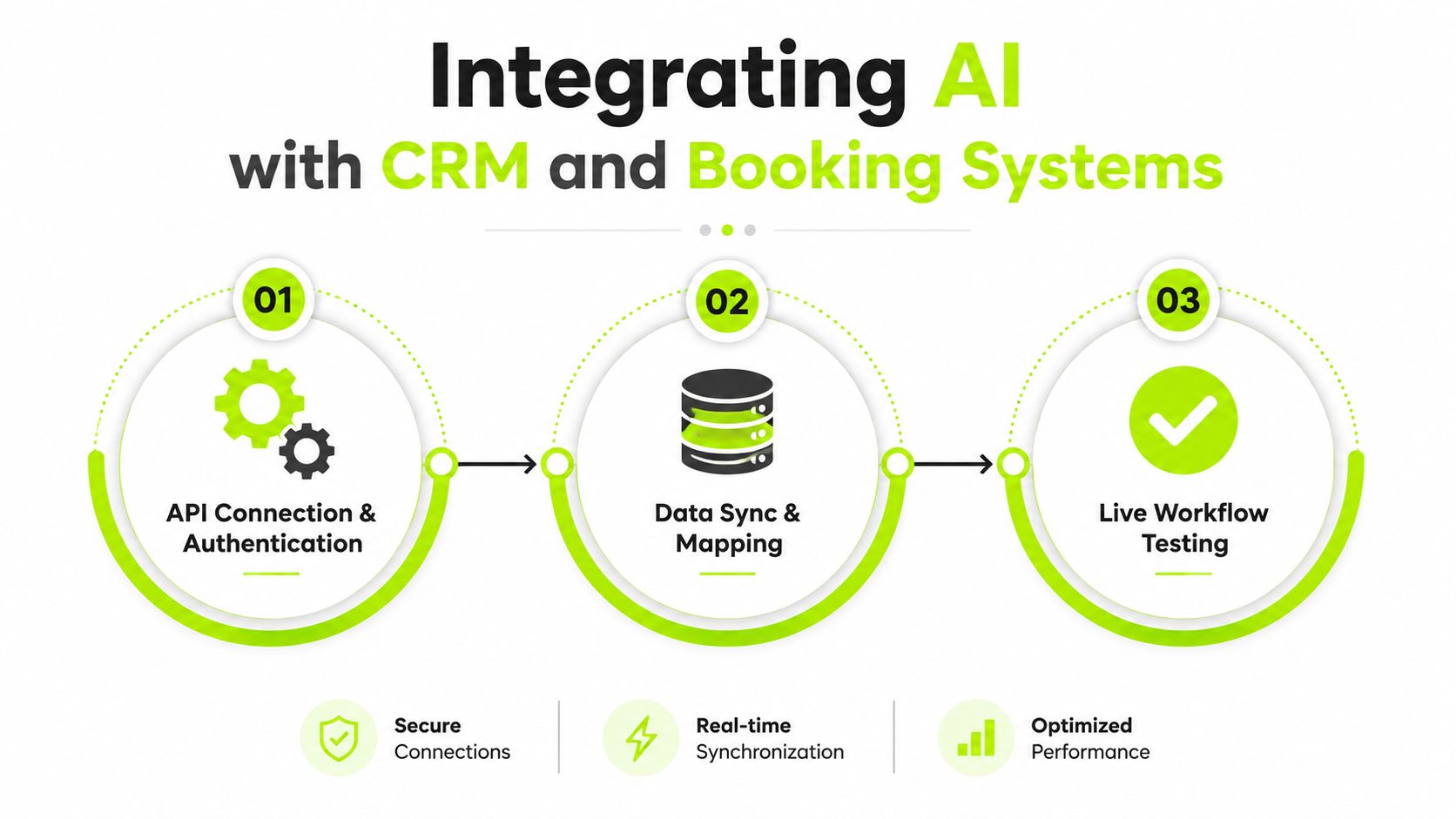
A golf club AI assistant becomes commercially useful when it can read and write data into the systems that drive follow-up. Without that, it's just a smarter FAQ. Clubs should treat integration as the main event, not an afterthought.
The core connections are usually straightforward. The assistant should create or update contacts in the CRM, check booking availability where that's permitted, tag the enquiry type, and trigger the right next step. If a visitor asks about membership on a Friday evening, the assistant should not just answer the question, it should log the lead, categorise intent, and queue the morning follow-up.
That workflow is what makes the difference between lost interest and visible pipeline. It also gives managers a record of who said what, when, and through which channel.
Build the sequence in the right order
Start with the CRM, then the booking system, then the nurture workflow. Clubs that reverse that order often end up with automation that looks clever but can't support real follow-up.
A practical sequence looks like this:
- Capture the enquiry. The assistant identifies the lead source, enquiry type, and contact details.
- Write it into the CRM. The record is created or matched against an existing contact, so duplicate data doesn't fragment the pipeline.
- Trigger the next action. That might be a call task, an email sequence, a visit offer, or a membership brochure.
If the club also runs events or hospitality, the same logic applies to those journeys. An assistant that can't support booking handoffs, event interest, or visitor play is still useful, but only in a narrow sense.
GolfRep's own model fits naturally into the conversation, because its growth system combines lead generation with CRM-powered nurture and 24/7 follow-ups rather than treating enquiry handling as a separate job. That's the kind of setup clubs should compare against any AI tool they're considering.
For a more detailed view of how structured follow-up changes lead handling, see the GolfRep guide to lead nurture.
The technical warning signs are easy to spot. If the assistant can't map fields cleanly, can't handle duplicate contacts, or can't pass a lead into a proper workflow, the integration isn't finished. Clubs don't need more dashboard noise. They need a system that makes every enquiry visible and every handoff traceable.
Staff Workflows, Governance and Compliance
AI adoption fails quickly when staff don't trust the answers. That's why governance matters as much as functionality. If a secretary, membership manager, or pro shop team member thinks the assistant might give the wrong price, the wrong policy, or a different answer on another channel, they'll work around it.
For committee-led clubs, the approval chain has to be clear. Someone owns the content source, someone checks tone and accuracy, and someone decides when a query should be escalated to a human. Without that structure, the club risks inconsistency across website, email, phone, and messaging channels.
Keep humans in the loop where the risk is high
The best use of AI is often not full autonomy. It's reliable support. Routine enquiries can be handled quickly, but pricing exceptions, membership disputes, and policy edge cases should go to a person.
Training matters too. Staff need to know what the assistant is allowed to answer, what it should never answer, and how to correct it when something changes. If opening times, dress code rules, or joining fees change, the knowledge base has to change on the same day, not after the next committee meeting.
That's especially important in clubs where volunteers and part-time staff rotate through the same inboxes. A tool can't compensate for unclear ownership.
From a compliance angle, clubs should be careful with any personal data passed into AI systems. Member and prospect information needs to be handled under the club's normal data protection controls, and the club should be able to explain who can see what, where records are stored, and how long they're retained.
If your team can't explain the escalation rule in one sentence, the rule isn't clear enough.
There's also a cultural point. AI works better when it removes admin, not when it tries to replace relationship-led sales. Prospects still want a human conversation before they join most clubs. The assistant should make that conversation easier to start, not harder to trust.
Tracking KPIs and Avoiding Common Implementation Pitfalls
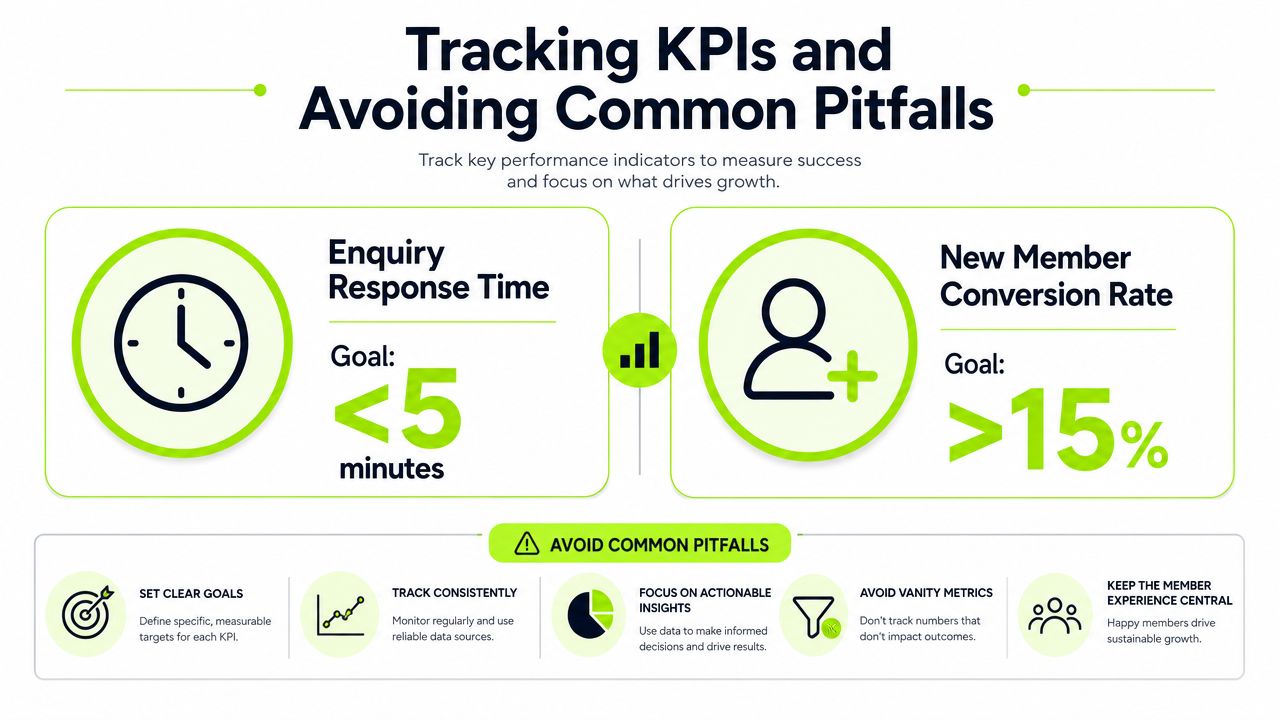
If a club can't measure conversion, it can't improve it. That's why the right KPIs matter more than chat volume or page views. The metrics that tell you whether an assistant is helping are enquiry response time, lead-to-visit conversion, visit-to-member conversion, and pipeline visibility.
The first two are the most practical starting points. Response time shows whether the assistant is reducing delay. Conversion shows whether it's producing movement, not just activity. For support teams and service workflows more broadly, AgentStack's guide to support KPIs is a useful reminder that speed and resolution quality need to be tracked together, not in isolation.
Measure the handoff, not just the conversation
A club can have plenty of interaction and still miss the commercial outcome. That's why each stage needs a visible owner and a clear measure.
Use the GolfRep enquiry tracking guide to shape your internal reporting. Then keep the measurement simple enough that the secretary, general manager, and committee can all read it without interpretation.
The most common implementation mistakes are predictable:
- Over-automating high-value conversations. Membership decisions still need human judgement.
- Ignoring offline channels. Phone and walk-in enquiries still matter in many clubs.
- Letting content drift. If pricing and policies change, the assistant must change with them.
- Measuring the wrong thing. Activity isn't the same as conversion.
- Failing to review handoffs. The weak point is often after the first reply, not before it.
The best clubs treat the assistant as part of a wider operating system. They review enquiry flow, response quality, and follow-up discipline together, then adjust the process when the numbers show a drop-off. That approach creates predictability, and predictability is what most golf clubs are missing.
If your club wants a practical view of how AI, CRM, and follow-up work together, GolfRep can help you audit the current enquiry journey, fix the handoff points, and build a system that tracks responses through to booked visits and sign-ups. Visit GolfRep to see how that looks in practice and start turning the enquiries you already receive into a clearer membership pipeline.
Ready to tap into our proven growth system?