A Guide to Golf Club Lead Management in the UK

When it comes to growing your membership, most clubs focus on the wrong problem. They think the answer is to generate more enquiries, but the real secret to sustainable growth is what you do with the interest you already have.
As a growth partner for UK golf clubs, we see it countless times: clubs pour money into marketing, convinced a lack of leads is the problem, only to see little change. The truth is, the bottleneck is not at the top of the funnel; it is in the messy, often non-existent, process for turning an interested prospect into a paying member.
The Real Reason Your Golf Club Is Losing Members
When membership numbers dip, the gut reaction for many club managers is to crank up the marketing spend. More ads, more emails, more social media posts. The thinking is straightforward: more visibility equals more enquiries, which should mean more members. But this assumption skips over the most crucial part of the entire journey.
For most clubs, the challenge is not a shortage of interest. It is the complete lack of a structured system for handling that interest once it arrives. Without a reliable process, high-value prospects, people genuinely keen to join, are inevitably slipping right through your fingers.
The Problem with Post-it Notes and Memory
Let’s play out a common scenario. A potential new member, excited about joining, fills out the enquiry form on your website. What happens next?
In far too many clubs, that email simply lands in a general inbox. It sits there, waiting for a busy staff member to spot it between booking tee times and handling member queries. Hours pass. Maybe even a day or two. By the time someone gets around to replying, that initial spark of enthusiasm has fizzled out. Worse, they have already had a welcoming call from your competitor down the road.
This is the chaos of relying on manual processes. It creates huge vulnerabilities that cost you members.
- Painfully Slow Responses: A long delay sends a clear message: "You are not a priority for us."
- Haphazard Follow-Up: Relying on memory or scribbled notes means follow-up is sporadic at best and non-existent at worst.
- Zero Visibility: Without a central system, you have no idea how many leads you have, where they came from, or what stage they are at.
These are not just minor admin headaches; they are direct leaks in your revenue pipeline. Every mishandled enquiry is a potential member, and their significant lifetime value, walking away.
At GolfRep, we see this pattern on repeat. Clubs get the leads in, but the operational gaps mean they cannot convert them. Predictable growth only happens when you fix the conversion process first.
A Strong Market with High Stakes
The good news is that demand for golf memberships in the UK is robust. Recent industry data shows the proportion of members’ clubs with more than 600 playing members rose from 56% in 2023 to 59% in 2024.
While these clubs welcomed an average of 75 new members, they also saw the number of leavers climb from 56 to 63. With nearly half (48%) of all members' clubs now reporting waiting lists, the opportunity is massive. In this competitive climate, poor lead management is not just a missed opportunity; it is actively losing ground to clubs that have their processes in order. You can explore these findings in the complete 2024-25 golf clubs report.
This guide is your playbook for moving away from a reactive, inconsistent approach. We will show you how to build a predictable pipeline that combines lead generation with the systems and processes needed to ensure no prospect is ever left behind. The goal is to stop chasing more leads and start converting more of the ones you have already earned.
Auditing Your Current Lead Management Process
Before you can build a better lead management system, you need an honest look at what is happening right now. Most club managers we talk to have blind spots where enquiries seem to vanish, or they genuinely believe they are faster to respond than they actually are.
The point of an audit is to map out the entire journey for a potential member, from their very first click or call to the final outcome. It is not about finding fault; it is a diagnostic tool. You are simply looking for the cracks in the system. This raw data is what we will use to build a process that actually turns interest into income.
Mapping Your Enquiry Channels
First, list every single way a potential member can get in touch. You will probably find there are more than you think.
Common channels we see include:
- Website: Enquiry forms for membership, society days, or the general ‘contact us’ page.
- Phone Calls: The lifeblood of many clubs. Calls coming into the pro shop, the main office, or even the bar.
- Email: Direct emails to a general address like
info@or to specific people on your team. - Social Media: Direct messages on your club’s Facebook or Instagram pages.
- Walk-ins: The classic "pop-in" from someone who lives locally and is curious.
- Third-Party Platforms: Leads that might come from golf directories or external tee-time booking sites.
For each one, ask yourself: who gets the enquiry, and what happens next? Is that process written down and followed by everyone, or does it depend entirely on who is working that day? Inconsistency is the biggest killer of new member sales.
The Litmus Test: Response Time
If there is one thing that matters more than anything else at this early stage, it is enquiry response time. A prospect’s interest is at its absolute peak the moment they reach out. Every hour you wait is an invitation for that excitement to cool off or for them to start looking at the club down the road.
Here’s a simple but incredibly revealing exercise: get a friend to do a "mystery shop" for you. Have them fill out your website enquiry form and then, separately, call the club at a few different times.
How long did it take to get a reply? Was it a few minutes, a few hours, or even a day or two? A delay of just a few hours can be fatal to an enquiry. Initial enthusiasm is a perishable good.
This little test gives you an immediate, unbiased snapshot of the real-world experience you are providing. If the response is slow, confusing, or worse, never shows up, you have just found your first major leak.
To help you get organised, it is a great idea to put this information into a simple audit table. This helps you see your current performance at a glance and highlights the biggest problem areas.
Lead Source and Response Time Audit
Use this template to get a clear picture of how your club is currently performing across all channels. Be brutally honest with the timings.
Once you have filled this out, you will have a clear, data-driven snapshot of where your lead process is breaking down. These are the bottlenecks and dropped balls that are costing you new members. With this insight, you are ready to start designing a system to plug those gaps for good.
Designing Your Centralised Lead System
You have done the hard work of auditing your current processes and you know exactly where those promising enquiries are falling through the cracks. Now for the satisfying part: building a system that actually works. This is not about paying for complex new software, but about creating one central place, a single source of truth, for every single lead your club generates.
That central hub is your Customer Relationship Management (CRM) system. If you think CRMs are just for big corporate sales teams, think again. For a modern golf club, a CRM is simply the operational backbone that ensures every potential new member gets a prompt, professional, and consistent experience. It is what turns a trickle of sporadic interest into a predictable pipeline of new members.
Choosing and Setting Up Your CRM
First things first, you need to pick the right platform. The good news is that many modern CRMs are surprisingly easy to use and can be moulded to fit a golf club's unique needs without requiring a degree in computer science. The key is to start simple.
When you are looking at options, make sure you choose one that lets you create custom fields. This is absolutely critical. You need to capture information relevant to a golf club, not some generic B2B company.
Here are the essential custom fields we always recommend setting up from day one:
- Membership Type of Interest: (e.g., Full 7-Day, 5-Day, Junior, Corporate)
- Current Handicap: (Even a 'not applicable' option is useful data)
- Lead Source: (How did they find you? Website, Facebook Ad, Phone, Walk-in)
- Enquiry Date: (Crucial for tracking how quickly your team responds)
Getting this information upfront gives your team the power to have genuinely meaningful conversations from the very first call or email. For a deeper dive into picking the right platform, have a look at our comprehensive guide to the best golf CRM systems.
Automating Your Lead Capture
One of the biggest wins you will get from a CRM is killing off manual data entry for good. The goal is to connect your system directly to your website's enquiry forms. When a prospect fills one out, a new contact record should be created automatically in your CRM, instantly populated with all their details.
This one change is a genuine game-changer. It means no more leads sitting unread in a cluttered general-enquiries inbox. No more details scribbled on a notepad that gets lost under a pile of paperwork. Every single web enquiry is captured, logged, and ready for your team to follow up on, giving you complete visibility.
This diagram shows how that ideal flow should look in practice, from the initial enquiry right through to the first action.
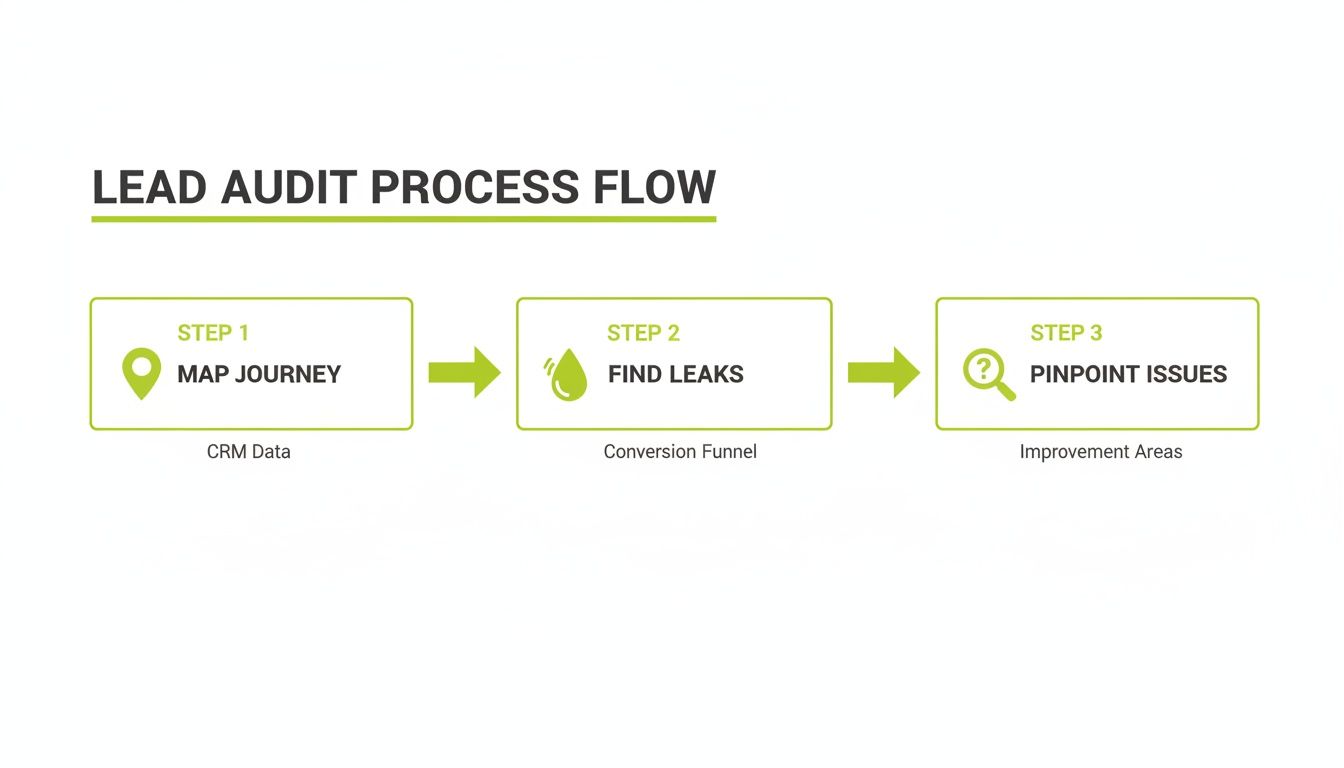
Automation here is all about bridging that gap between a prospect showing interest and your team being able to respond, ensuring no one is ever left waiting in silence.
Designing Your First, Most Critical Automation
Now that you have leads flowing cleanly into your CRM, it is time to set up your first and most important piece of automation: the instant acknowledgement.
This is a simple, automated email that goes out the very second someone submits an enquiry. It does not need to be fancy. Its only job is to reassure the prospect that you have received their message and to let them know when they can expect to hear from a real person.
A simple, personalised acknowledgement email, sent within seconds of an enquiry, can dramatically improve the prospect's perception of your club. It confirms their interest is valued and buys your team valuable time to prepare a more detailed, personal response.
Make no mistake, the opportunity right now is huge. The UK golf membership market is incredibly strong, with forecasts showing 86% of surveyed UK golfers expect to be club members in 2025. With 30% of clubs reporting waiting lists and 39% now charging joining fees, the demand is clearly there. For club managers, this represents a massive opportunity, but only if you have the systems in place to convert that interest effectively.
This is exactly the principle GolfRep applies for its partners. By combining intelligent lead generation with a structured CRM and follow-up system, we build predictable membership pipelines. Building a simple, smartly configured CRM is the first real step towards achieving that same predictability for your own club.
Designing Nurture Sequences That Actually Convert

Getting an enquiry to land automatically in your CRM is a fantastic first step. But this is where the real work, and the real opportunity, in modern golf club lead management begins. A name sitting in a database is just that; the challenge now is to guide that person from mild curiosity to active interest.
This is the job of lead nurturing. It is how you build a relationship through a series of thoughtful, automated communications. This approach replaces ad-hoc manual follow-ups with a structured journey, designed to educate, build trust, and keep your club top-of-mind. A well-crafted nurture sequence can dramatically increase the likelihood a prospect books a tour and, ultimately, decides to join.
Building Your Nurture Blueprint
The goal here is not to hammer potential members with sales pitches. That is a fast track to the unsubscribe button. Instead, your sequence should feel genuinely helpful, delivering real value with every message. It is your chance to tell your club’s story in a way a single phone call never could.
A solid sequence often includes a blend of emails and perhaps even SMS messages, staggered over several weeks. Each touchpoint has a specific purpose.
Here is a proven framework:
- Email 1 (Day 1): The instant acknowledgement we talked about earlier. It confirms you received their enquiry and lets them know what to expect next.
- Email 2 (Day 3): Showcase what makes you unique. Is it the championship-standard course? The lively social calendar? The family-friendly atmosphere? Tell that story.
- Email 3 (Day 7): Bring in the social proof. This is the perfect time for testimonials from happy members or a short video from a recent club event. Help prospects picture themselves as part of your community.
- Email 4 (Day 12): Tackle common questions head-on. You can pre-empt their concerns about the joining process, club etiquette, or the quality of your practice facilities.
- Email 5 (Day 18): Make the next step clear and easy. This is your primary call to action, inviting them to book a personal tour to experience the club for themselves.
This structured approach guarantees persistent but professional follow-up, and it all happens without your team having to manually track every conversation. The system does the heavy lifting, warming up prospects so that when a staff member does make a call, it is a much warmer, more productive conversation.
The Power of Smart Segmentation
Of course, not all leads are the same. A prospect asking about a flexible 5-day membership has very different priorities from a parent looking into your junior academy. This is where qualification logic and segmentation become your most powerful tools.
Using the custom CRM fields you have already set up (like 'Membership Type of Interest'), you can create distinct nurture paths for different types of enquiries. This ensures the right message always reaches the right person.
A prospect interested in corporate membership should not receive emails about the weekend roll-up. Personalisation, even when automated, shows you have been listening from the very first click.
This level of detail turns your marketing from a generic broadcast into a one-to-one conversation. It allows you to speak directly to a prospect’s specific interests and motivations, making them feel seen and understood. This is a cornerstone of effective golf club lead management because it systematically builds the rapport needed to secure a new member.
For those wanting to explore this further, you can find more advanced strategies in our guide to the best lead nurturing best practices.
Ultimately, the objective is simple. By the time a prospect finishes a nurture sequence, they should be well-informed, feel a genuine connection to your club, and be primed for a personal conversation. This automated groundwork frees your team from chasing cold leads, allowing them to focus their energy on what they do best: building relationships with highly qualified individuals who are ready to join.
Aligning Your Team and Measuring Success
All the automated systems and nurture sequences in the world can only take you so far. They build a fantastic foundation for growth, but a system is only as good as the people running it. This is where technology hands the baton to your team, and making that transition seamless is the secret to turning prospects into long-term members.
It is the human element that seals the deal. This is where a genuinely interested person becomes a delighted new member. Getting this right means defining who does what, creating a consistent process for that first personal interaction, and making sure everyone on staff knows how to bring a lead from the digital world into a real-world club experience. Without this crucial alignment, even the most sophisticated CRM will fall flat.
Defining Roles and Handoffs
Your CRM and email sequences are designed to do the heavy lifting, qualifying leads and warming them up until they are ready for a real conversation. That moment is the critical handoff point. You need a rock-solid process that dictates exactly who takes over once a lead hits a certain milestone, like requesting a tour of the club.
Who gets the notification? Is it a dedicated membership coordinator, your club professional, or the general manager? The right answer depends on your club’s structure, but what matters is that the role is formally assigned and that person knows the ball is in their court.
Their responsibilities should be crystal clear:
- Prompt personal follow-up: This is not an email; it is a phone call, ideally within a few hours of their request.
- Contextual conversation: Using the info already gathered in the CRM (like their membership interest or current handicap) to have a truly personal and relevant chat.
- Conducting compelling tours: This is about more than just showing off the facilities. It is about selling the unique atmosphere, the community, and the experience of your club.
- Answering specific questions: Being ready to address any final queries that stand between the prospect and a decision.
This clear handoff ensures the momentum built by your marketing is not wasted. It injects the warm, personal touch that ultimately convinces someone to join.
Scripts and Guidelines for a Consistent Experience
Consistency is everything. You do not want your staff sounding robotic, but giving them simple scripts and guidelines ensures every potential member gets the same high standard of service and information.
For example, a short guide for conducting club tours can make sure all your key selling points are hit every single time, from the quality of the greens to the vibrancy of the clubhouse bar. A few talking points for that first phone call can also help staff feel confident and stay on-message. This is not about reading from a script verbatim, but about equipping your team to represent the club brilliantly.
A defined process, from the automated handoff to the final welcome handshake, removes guesswork and variability. It makes the member journey predictable for your staff and impressively professional for the prospect.
Tracking What Truly Matters
Finally, to know if your lead management strategy is actually working, you have to measure it. A data-driven approach removes the guesswork, giving you complete clarity on what is working and what needs a tune-up. Your CRM dashboard should give you an at-a-glance view of your most important Key Performance Indicators (KPIs).
Do not get lost in the data. Focus on tracking a handful of core metrics that directly reflect membership growth:
- Lead Volume by Source: Are your best enquiries coming from the website, social media ads, or member referrals?
- Enquiry to Tour Rate: What percentage of qualified leads are actually booking a visit to see the club?
- Tour to Member Conversion Rate: Of those who tour the club, how many sign up to become members?
- Overall Lead to Member Rate: What is your end-to-end conversion percentage, from first enquiry to new member?
Tracking these numbers gives you an objective view of your performance. A low conversion rate from tour to member, for instance, might tell you the tour experience itself needs refining. If you are getting plenty of leads but very few book a tour, your follow-up emails might need a rethink. This continuous feedback loop is the key to building a predictable, sustainable pipeline of new members for years to come.
Turning Enquiries Into Predictable Revenue
Let us be honest, lasting growth is not about constantly chasing more and more golfers. It is about building a robust system that converts the genuine interest your club is already generating every single day. A proper lead management process is what bridges the gap between a potential member’s first casual look and them paying their first year of membership fees.
So, how do you build this predictable revenue engine? It really boils down to four key areas. First, you need a brutally honest audit of your current process to see where potential members are slipping through the cracks. Once you have that clear picture, you can set up a central CRM to act as a single source of truth, capturing every single enquiry.
From there, it is about designing smart, automated nurture sequences that build a relationship and gently guide people towards booking a tour. And finally, you have to get your team aligned with simple, clear processes and KPIs so everyone knows their role and you can track what is working.
This is the exact philosophy we put into practice at GolfRep. We help clubs shift from a reactive, often chaotic approach to a structured one that combines the right tech with proven human processes. The result is a predictable, measurable pipeline of new members.
Sustainable growth comes from building a reliable system to convert the interest you already have. This is how you secure your club's financial future without resorting to discounts or compromising your brand.
By focusing on making the most of your existing demand, you stop simply collecting enquiries and start generating real revenue. You are no longer just chasing prospects; you are building a community, one member at a time. This is not just another marketing fad; it is a blueprint for long-term financial health.
To see how we can apply these principles at your club, you can learn more about our strategic club marketing services.
Frequently Asked Questions
It is completely normal to have a few questions when you are looking at setting up a more formal lead management system. Let's walk through some of the most common ones we hear from golf club managers across the UK.
Is a CRM System Too Complex for Our Small Team?
That is a fair concern, but the old image of CRMs as clunky, complicated software is thankfully a thing of the past. Modern systems are much more intuitive and can be tailored to the exact, often simpler, needs of a club like yours.
The trick is not to try and boil the ocean. Start with the basics. Just focus on getting your website leads captured automatically and triggering that first instant email response. That one piece of setup alone immediately frees up hours of admin time and ensures no enquiry ever slips through the cracks. It lets your team focus on what they are best at: building relationships with interested golfers, not getting bogged down in manual data entry.
How Quickly Will We Actually See Results?
You will feel the difference in your daily workload almost instantly. For a start, your enquiry response time will drop from hours (or even days) to just a few seconds as soon as the system goes live.
When it comes to converting those enquiries into new members, you will start seeing tangible results within the first 60 to 90 days. This window gives enough leads time to move through your new automated follow-up sequences, providing you with real data on what is resonating and what needs a tweak. The goal is not a one-off spike in sign-ups, but a steady, predictable improvement in your membership conversion rates over the long term.
The single biggest mistake we see is inconsistency. Relying on one person's memory or a messy spreadsheet inevitably leads to dropped leads and a poor experience for potential members. A structured system, powered by a CRM, removes this human error.
This guarantees every single enquiry gets the same prompt, professional, and persistent follow-up. That consistency is the absolute foundation for building predictable, sustainable growth for your club.
At GolfRep, we specialise in building these predictable growth engines for clubs. Our approach combines data-led advertising with robust CRM systems to turn local golfers into long-term members. Schedule a no-obligation discovery call with us today to see how we can help your club hit its growth targets.
Ready to tap into our proven growth system?