Golf Club Society Day Marketing: A Complete Playbook
Most advice on golf club society day marketing starts in the wrong place. It starts with ads, social posts, and the push to get more enquiries.
That sounds sensible. It usually isn't.
For most clubs, the bigger problem is what happens after someone gets in touch. A society organiser sends an enquiry on Tuesday afternoon. The email lands in a shared inbox. Someone means to reply after the members' competition setup, then a supplier call comes in, then the phone goes, then Friday arrives. By that point, the organiser has already heard back from two other venues.
That's not a marketing failure. It's a conversion failure.
At GolfRep, we see this repeatedly. Clubs don't always need more top-of-funnel activity. They need a tighter process for capturing, qualifying, responding to, and converting the demand they already create. If your enquiry handling is manual, slow, and spread across inboxes, notebooks, and memory, your society pipeline will always feel inconsistent even when demand is there.
A leaky bucket doesn't need more water first. It needs the holes fixed.
The Real Bottleneck in Society Day Growth
The common target inside golf clubs is "more enquiries". Committee meetings drift towards reach, website traffic, boosted posts, and whether the latest offer got enough clicks. Those things matter, but they sit too early in the process to explain why society revenue stays flat.
The primary bottleneck is usually much lower down. It sits between first contact and confirmed booking.
A club secretary or manager often handles society interest alongside memberships, visitor bookings, events, catering issues, and day-to-day operations. That creates three predictable problems:
- Slow replies: organisers compare venues quickly and often book the club that responds first with a clear next step.
- Lost detail: group size, preferred date, budget, format, and catering notes get trapped in emails or written on paper.
- No pipeline visibility: nobody can say which enquiries are live, which are quoted, which need a callback, and which were lost.
A lot of clubs recognise this only after reading patterns like those described in how most golf clubs lose enquiries without realising. The issue isn't usually effort. It's that the handling process depends too heavily on busy people remembering to do everything manually.
Practical rule: If an organiser can enquire without entering a tracked system, your society pipeline is already unreliable.
That matters because society days are one of the few revenue lines a club can often grow without changing its membership structure. The operational burden is lower than a major strategic change, but only if the enquiry journey is organised.
Good golf club society day marketing doesn't stop at lead generation. It builds a repeatable path from first interest to deposit paid. Once that system exists, marketing becomes easier because every enquiry has somewhere to go, someone to follow up, and a status the club can see.
First Define Your Target Organiser and Packages
Before you spend on promotion, decide who you're trying to attract. "Golfers" is too broad to be useful.
The buyer is the organiser, not the whole group. That person cares about reducing hassle, avoiding embarrassment, and making the day feel well run. They're not buying eighteen holes in isolation. They're buying confidence that the club will help them pull off a good day.
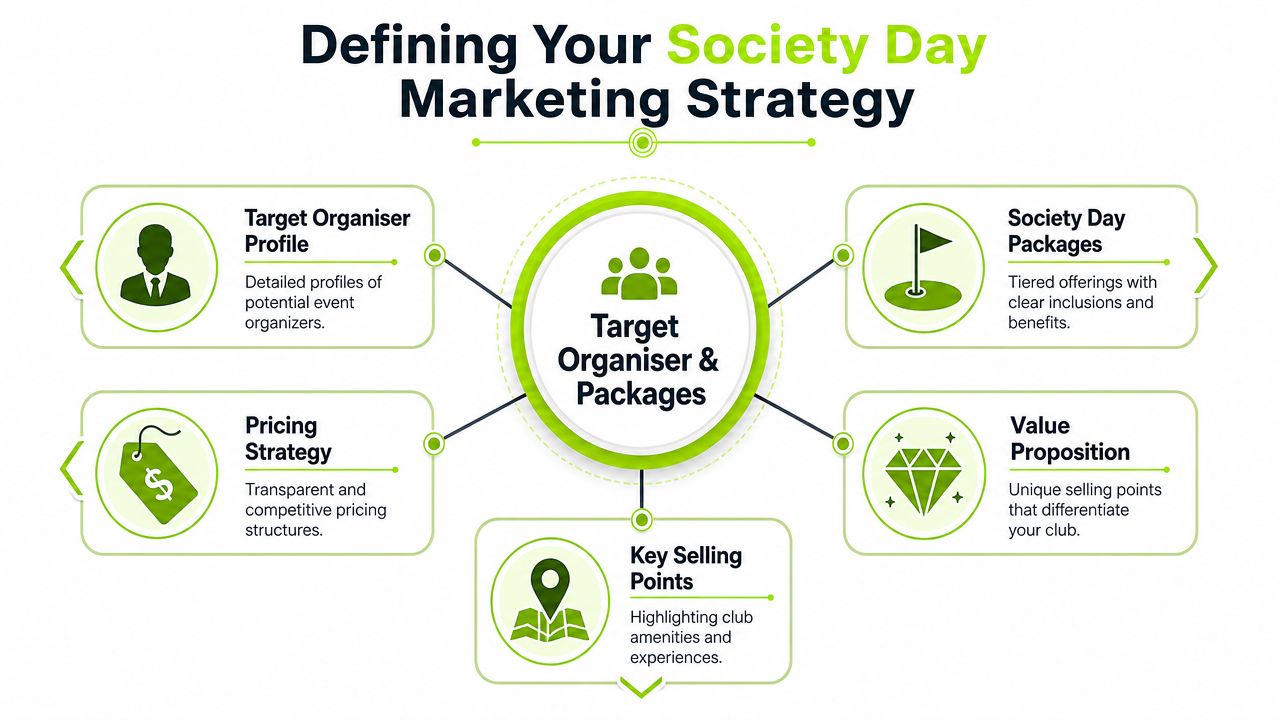
Build two organiser profiles first
Most clubs should start with at least two distinct organiser types.
Corporate organiser
This buyer is often booking on behalf of a business, client group, or internal team. They care about reliability, presentation, catering quality, parking, easy invoicing, and whether the club can handle mixed abilities without confusion. They usually want a tidy proposal, quick replies, and a clear point of contact.
Casual society organiser
This is the pub society captain, the annual mates' trip organiser, or the long-running local group contact. They still care about organisation, but they are often more price-aware and more interested in value, pace of play, food portions, prizes, and a friendly atmosphere than polished corporate presentation.
Those profiles should shape your packages, imagery, and messaging. They should also shape who appears in your marketing. UK participation data cited in this golf industry write-up on community and events notes that in England, 44.5% of golfers in 2024 were women, with meaningful participation from adults aged 16 to 34. If your society marketing only shows older male fourballs, your creative is narrower than the market you're trying to win.
Package for decisions, not for internal convenience
Many clubs sell society days as a loose rate card. Coffee and bacon roll, maybe. Meal upgrade if asked. Prize table optional. That's easy for the club to write but harder for the organiser to compare.
A better approach is to package the decision.
Three tiers are usually enough:
- Bronze: a simple, entry-level society day with golf and core food included
- Silver: a stronger hosted experience with upgraded catering and practical extras
- Gold: a more complete event package for organisers who want fewer moving parts
This isn't about dressing up the same day with nicer names. It's about making buying easier.
What each package should answer
Every package page or proposal should answer these questions clearly:
- What's included: golf, food, prizes, nearest-the-pin setup, scorecards, reserved dining area, organiser support
- Who it's for: corporate hosting, annual societies, local groups, mixed-ability days
- What makes it easy: booking process, deposit terms, point of contact, final numbers deadline
- Why your club: course quality, access, clubhouse, service standards, flexibility
A useful way to think about this is through how customer orientation drives growth. The core idea is simple. Clubs grow faster when they organise offers around the buyer's priorities, not the club's internal habits. Society packages should reduce friction for the organiser first.
For a practical example of front-end offer structure and lead capture, GolfRep's guidance on society lead generation for golf clubs is relevant because it treats the package and the data capture process as one connected system, not two separate tasks.
The best society package is often the one that's easiest to understand, easiest to compare, and easiest to book.
Activating Your Marketing Channels
Once the offer is clear, channels become easier to run because you know what you're asking people to do. Without that clarity, clubs end up promoting "society days available" into the void and hoping the right organiser notices.
A working channel plan should do two jobs at once. It should generate attention, and it should capture enough information to let the club prioritise the right enquiries.
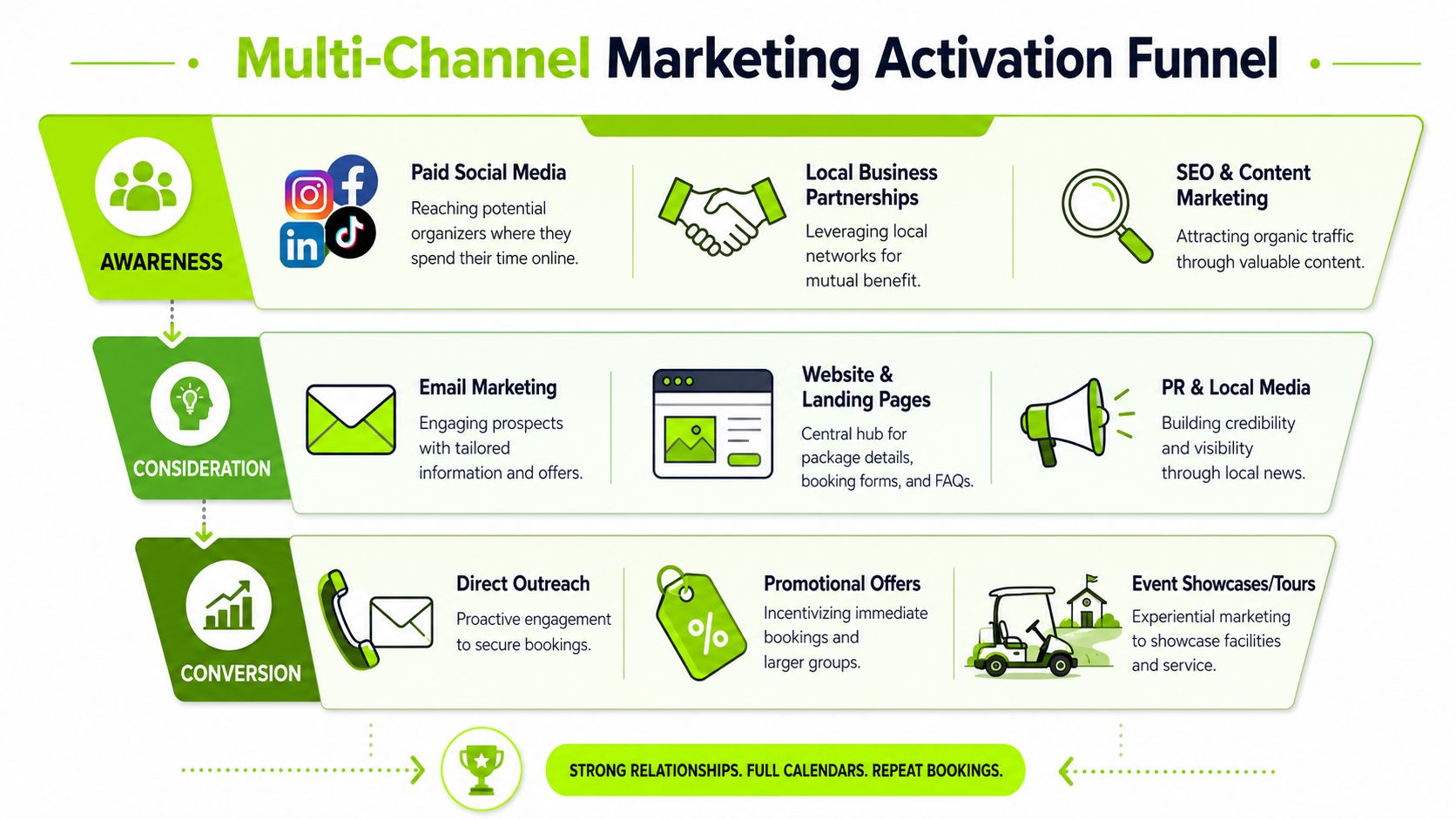
Paid social for interruption and qualification
Paid social works well when the offer is strong enough to stop scrolling. A useful UK golf example appears in this digital marketing case study, where a single targeted offer generated society leads and 18 society bookings in less than 30 days. The campaign used an incentive to grab attention, then a short survey captured qualifying details such as society name, group size, nearest town, favourite course, and phone number.
That model matters because it separates curiosity from commercial value. The club doesn't just get names. It gets enough context to decide who to call first.
For paid social, keep the creative simple:
- Use one clear promise: an organised society package, a hosted day, or a specific incentive tied to booking
- Show the experience: clubhouse, breakfast setup, prize table, and welcoming arrival matter more than random course drone shots
- Ask for useful detail: preferred month, approximate group size, organiser phone number, and whether food is needed
Search for active demand
Search behaves differently. It captures organisers already looking for a venue.
If someone searches for a society golf day near your town or county, they don't need a brand awareness campaign. They need a page that answers practical questions fast. Your society landing page should include:
- Clear package summaries
- Strong visuals of the course and hospitality spaces
- A short enquiry form
- Common organiser questions
- A direct next step
Clubs often bury society information under generic visitors' pages. That's a mistake. Search traffic should land on a page built for organisers, not on a broad page that also tries to serve green fee visitors and membership prospects.
Email and database reactivation
Your own database is usually underused.
Past organisers, visitor bookers, member guests, and local business contacts already know the club exists. They don't need a hard sell. They need a reason to consider the club for a group booking. Segment the messages rather than sending one general email blast.
A practical split looks like this:
- Past society organisers: ask about repeat dates and offer early planning support
- Members and their guests: encourage introductions to workplace or social groups
- Local businesses: frame the day around hosting, team time, or client entertainment
- Lapsed enquirers: re-open the conversation with a refreshed package or better booking process
Partnerships and direct outreach
Not every society booking starts with an ad. Clubs can create pipeline through local relationships.
Good partnership targets include:
- Hotels and accommodation providers: useful for groups travelling in
- PGA professionals and coaching contacts: especially where they know active groups or organiser networks
- Business networks and chambers: relevant for corporate and mixed social events
- Local charities and fundraising organisers: many need venues with clear event support
This channel works best when the club gives partners something concrete to share. A one-page package summary, a landing page, and a named contact usually outperform vague "we do societies" messaging.
Clubs get better results when every channel points to the same conversion path. One offer, one landing page, one form, one follow-up system.
Building Your Unfair Advantage The Enquiry Conversion System
Most clubs think their competitive advantage is the course, the clubhouse, or the price. For society business, that's only partly true.
Your real advantage can be your response system.
In the UK, where 76% of adults use the internet for search, organisers expect fast digital follow-up. As noted in this hospitality marketing article, many clubs focus on promotion but overlook the conversion infrastructure needed for instant responses and simple booking flows. That's often where society business is lost.
What a weak system looks like
The weak version is familiar. Enquiries come in by email, phone, Facebook message, and website form. Nobody sees the full picture. One organiser gets a quick reply. Another waits. A third receives a price but no follow-up. Weeks later, the team remembers to check back, only to find the date has gone elsewhere.
That system depends on memory and goodwill. It doesn't scale, and it doesn't protect revenue.
What the conversion system should do
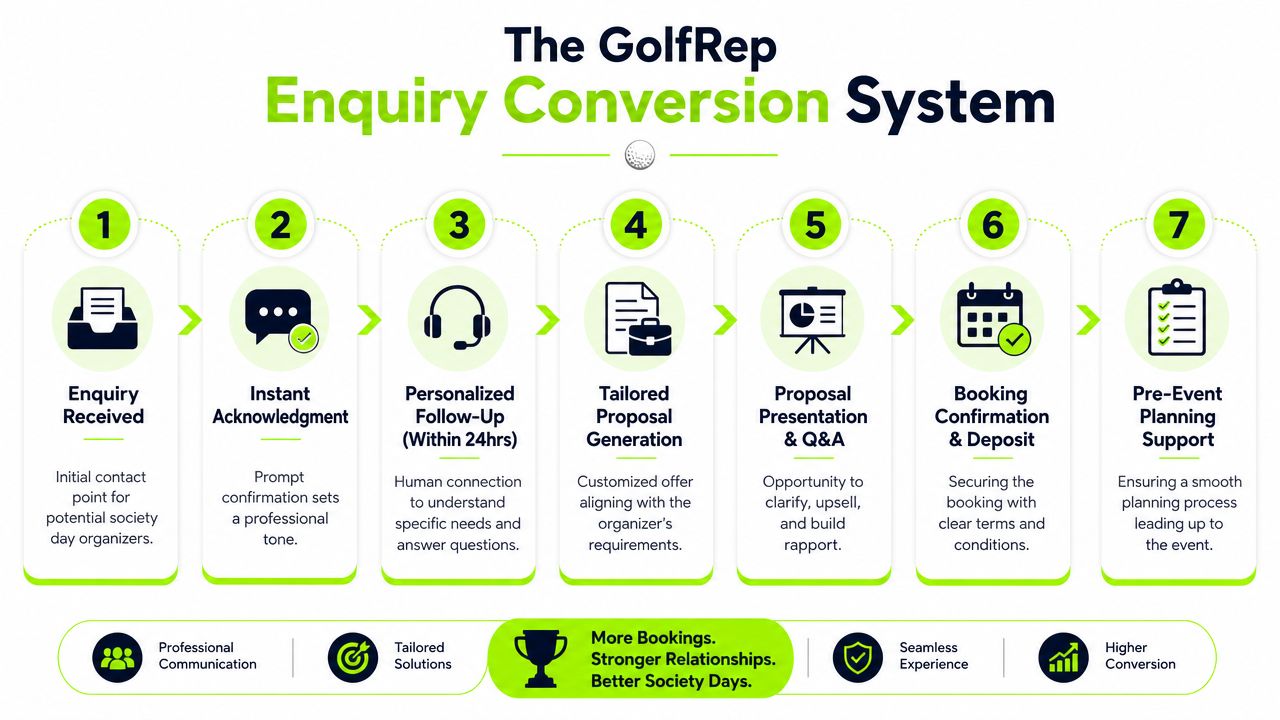
A strong enquiry conversion system is simple, but it must be disciplined. Every enquiry should pass through the same stages:
Capture the enquiry in one place
Every source should feed into a single record, not separate inboxes and spreadsheets.Send an instant acknowledgement
The organiser should know their enquiry has been received and when to expect a reply.Assign a clear owner
One person should be responsible for moving the enquiry forward.Prompt personal follow-up quickly
Not a generic brochure. A relevant response based on group size, likely package, and date request.Track status visibly
New, contacted, quoted, follow-up due, deposit received, lost, rebook next year.Automate reminders and nurture
If the organiser doesn't reply, the system should prompt the next message or call.Secure the booking cleanly
Proposal, confirmation, deposit request, and handover to operations should all be structured.
The minimum automation every club should install
You don't need a complex enterprise setup. You need reliable basics.
The minimum stack usually includes:
- A CRM: somewhere to log source, contact details, group notes, and deal stage
- An auto-response: immediate confirmation with next-step expectations
- Task reminders: so personal follow-up isn't left to memory
- Email templates: for quote sending, chasing, and pre-event coordination
- A simple reporting view: open enquiries, aged enquiries, upcoming society bookings
One option clubs use is a golf-specific growth setup such as GolfRep's enquiry conversion system for golf clubs, which focuses on lead visibility, automated follow-up, and tracked pipeline stages. The important point isn't the logo on the software. It's that every enquiry enters a system built to respond, remind, and report.
A society organiser doesn't experience your internal workload. They only experience your speed, clarity, and follow-up.
Before and after the system
Before
An organiser asks about a Friday in September. The club replies two days later with a PDF. No next action is scheduled. The organiser goes quiet. Nobody follows up because the inbox has moved on.
After
The enquiry hits the CRM. An acknowledgement goes out instantly. The manager gets a task to call. The organiser receives a customized proposal. If there is no reply, the system prompts a follow-up. If the date is unavailable, an alternative is offered. If the organiser isn't ready, they stay in a nurture flow until timing improves.
That's the difference between enquiry handling and pipeline management. One is reactive. The other is dependable.
Strategic Pricing for Society Day Packages
A lot of society pricing is still built backwards. The club adds up a rough cost, adds some margin, checks a competitor's leaflet, and lands on a per-head number.
That method feels safe, but it ignores two critical issues. First, not every tee time has the same commercial value. Second, the package isn't just golf. It's a combination of inventory, hospitality, staff time, and perceived convenience.
Start with inventory value
A society booking at a quiet time can be useful capacity fill. The same booking at a premium slot can displace higher-value business or create unnecessary discounting.
That means pricing should vary based on factors such as:
- Day of week
- Time of day
- Seasonality
- Expected demand on the tee sheet
- Food and beverage complexity
- Event support required from staff
If your pricing doesn't reflect those realities, you can win bookings and still underperform financially.
Build the package from revenue layers
Think in layers instead of a single green fee number.
The core layers are usually:
- Golf value: the tee time inventory itself
- Food and beverage value: breakfast, lunch, dinner, drinks packages
- Operational value: registration support, scorecards, prize setup, reserved areas
- Upsell value: nearest the pin, longest drive, pro shop vouchers, branded extras, upgraded dining
Some clubs hide these extras because they don't want to feel pushy. That's a mistake if the options are useful. A well-structured package helps the organiser choose. It doesn't force them to haggle.
Sample Society Day Package Tiers
| Feature | Bronze Package (The Classic) | Silver Package (The Premium) | Gold Package (The Ultimate) |
|---|---|---|---|
| Golf | Standard society round | Standard society round with priority presentation | Premium slot or enhanced hosted format |
| Food and drink | Coffee and bacon roll, one meal option | Upgraded catering and more menu choice | Full hospitality flow with premium dining options |
| Organiser support | Basic booking coordination | Dedicated planning support and clearer event setup | High-touch planning with fuller pre-event coordination |
| Competition setup | Basic cards and scoring support | Added competition organisation | Enhanced event presentation and prize support |
| Group suitability | Price-sensitive local groups | Established societies wanting smoother delivery | Corporate and high-expectation groups |
| Upsell opportunities | Prize table add-ons | Drinks, vouchers, upgraded meal choices | Branded extras, premium prizes, extended hospitality |
Protect margin without killing demand
The practical question isn't "How cheap can we go?" It's "Which package, at which time, creates the best return for this slot?"
That shifts the conversation from blanket discounting to selective pricing discipline. A quieter midweek slot might justify a stronger offer. A prime slot might need firmer rates and less package flexibility.
Society pricing should reward fit, not just volume. The right group in the right slot is worth more than the biggest group at the wrong price.
When clubs get this right, the package becomes easier to sell because it feels considered. The organiser sees options. The club protects margin. The sales conversation gets simpler.
The Host-to-Repeat Business Operational Checklist
A confirmed booking isn't the finish line. It's the handover point.
Clubs lose repeat society business when the booking process is decent but the actual day feels improvised. Organisers remember whether the details were right, whether staff knew who they were, and whether the club made them look organised in front of their group.
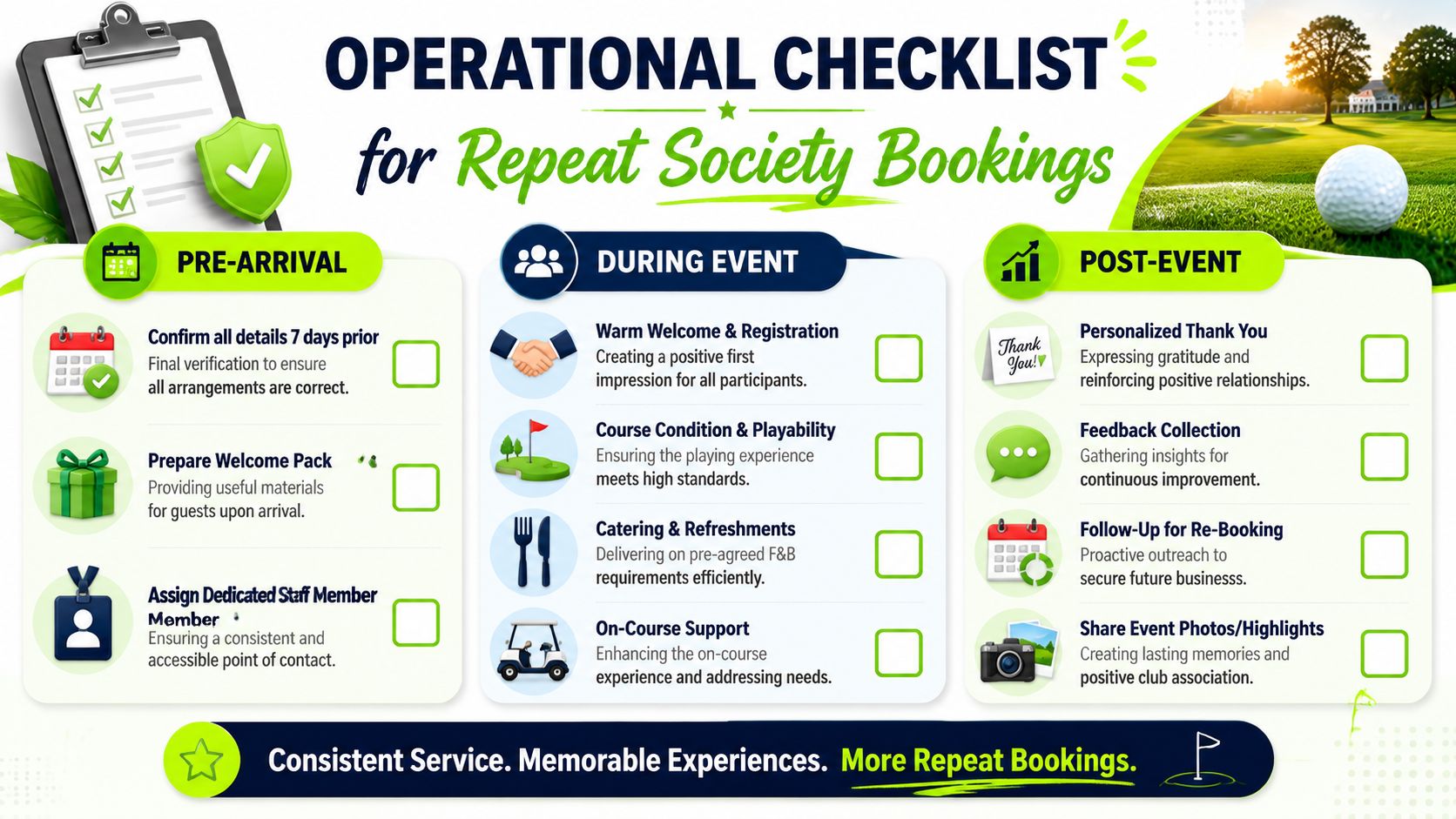
Pre-arrival checks
A week before the event, the club should confirm everything in writing and make sure one staff member owns the day.
Use a simple checklist:
- Final numbers: lock in attendance, start times, and arrival window
- Food details: confirm menu choices, dietary needs, and service timing
- Competition format: check scoring method, nearest-the-pin requests, and prize plans
- Payments: confirm deposits, balances, and invoicing arrangements
- Internal briefing: tell the pro shop, bar, kitchen, and starter exactly what's happening
On-the-day delivery
Most organisers don't expect perfection. They do expect competence, warmth, and visible coordination.
What matters most on the day:
- A clear welcome: the group shouldn't have to hunt for the right person
- Prepared materials: cards, notices, buggies, and dining setup ready before arrival
- Smooth timing: food, teeing off, and post-round service shouldn't clash
- Named support: one person the organiser can go to without repeating details
A warm arrival does more than create goodwill. It reduces organiser stress immediately.
Post-event follow-up
Many clubs stop after the meal is served and the scores are read out. That's where long-term value gets missed.
Follow up while the day is still fresh:
- Send a thank-you message: make it personal and mention the group's day
- Ask for feedback: not a huge survey, just useful comments on the experience
- Capture reusable detail: preferred month, typical group size, favourite format
- Ask about next year: if the day went well, don't wait for them to remember later
If a society day was good enough to repeat, the club should be the first one to ask for the repeat booking.
Operational consistency is one of the simplest forms of marketing. It creates testimonials, referrals, and annual rebookings without another round of acquisition spend.
Creating Your Society Day KPI Dashboard
If your dashboard only shows enquiries, it won't tell you whether your society marketing is working. It will only tell you that activity happened.
A club can increase leads and still hurt revenue if it fills strong slots at weak rates or spends time quoting groups that never fit the diary. That's why society reporting needs to connect marketing activity to capacity and yield.
Track the numbers that affect revenue
Industry guidance in this golf revenue management article recommends tracking occupancy, direct booking share, RevPAR, and average rate per round.
For society-day use, those definitions are practical:
- Occupancy = rounds played divided by available rounds
- Direct booking share = direct rounds divided by total rounds
- RevPAR = green-fee revenue divided by available capacity
- Average rate per round = green-fee revenue divided by rounds played
Those metrics do something enquiry counts can't. They show whether a society campaign filled unused inventory profitably or moved discounted groups into valuable slots.
Add conversion metrics alongside revenue metrics
The financial view needs an operational companion. A useful dashboard for society business should also track:
- Enquiry-to-quote rate
- Quote-to-booking rate
- Average time to first response
- Deposit conversion
- Lost reason
- Repeat booking count
These don't need to be complicated. Most clubs can track them in a CRM pipeline and a simple reporting sheet if the stages are set up properly.
A practical dashboard layout
A workable monthly view usually has three blocks.
| Dashboard area | What to include | Why it matters |
|---|---|---|
| Pipeline health | New enquiries, quoted, follow-up due, pending deposits | Shows whether the team is keeping up with live demand |
| Commercial performance | Occupancy, direct booking share, RevPAR, average rate per round | Shows whether society activity is helping revenue quality |
| Retention and learning | Repeat bookings, common objections, lost reasons | Helps improve offer design and follow-up process |
Many clubs sharpen their decision-making through this approach. Instead of saying "the campaign felt busy", they can ask better questions.
For example:
- Did the campaign fill off-peak slots or discount peak demand?
- Which package tier converted best?
- Which source produced booked revenue, not just form fills?
- Where are bookings being lost, before quote, after quote, or before deposit?
The right KPI dashboard changes club conversations from marketing opinion to operational evidence.
When the dashboard is set up well, golf club society day marketing becomes easier to manage. You stop chasing vanity metrics and start seeing the commercial shape of the pipeline.
A 90-Day Rollout Plan and Quick Wins
Most clubs don't need a dramatic rebuild. They need a short run of disciplined changes applied in the right order.
Days 1 to 30
Start with the conversion basics and the offer.
Week 1
Audit every current enquiry route. Website forms, phone calls, email inboxes, social messages, and member referrals all need to be mapped. If an enquiry can arrive without being logged, fix that first.
Week 2
Define your organiser types and finalise three society packages. Keep the package names simple and the inclusions clear.
Week 3
Write your auto-response, quote template, follow-up emails, and internal handover notes. Assign one owner for society enquiries.
Week 4
Set up your CRM stages and task reminders. Your quick win here is simple. Every enquiry should now receive an acknowledgement and a visible status.
Days 31 to 60
Now build the front-end flow.
Week 5
Create or rewrite the society landing page. It should answer organiser questions clearly and make enquiry easy.
Week 6
Build one short enquiry form that captures qualifying detail. Keep it practical, not long.
Week 7
Prepare audience segments for email and outreach. Past organisers, local businesses, member introductions, and lapsed leads should all be separated.
Week 8
Plan your nurture schedule. Expert golf-marketing guidance in this event promotion training video recommends starting promotion for major events 1 to 3 months in advance and smaller events 4 to 6 weeks in advance, with send frequency increasing in the final week. The key lesson is that one post or one email isn't a campaign.
Days 61 to 90
Launch with control, not noise.
Week 9
Turn on one paid channel and one owned channel. For example, paid social plus segmented email. Keep the offer and landing page consistent.
Week 10
Review lead quality, not just lead count. Tighten form questions if the wrong organisers are coming through.
Week 11
Check response handling. Are callbacks happening? Are quotes being chased? Are deposits being requested consistently?
Week 12
Review the full funnel. Keep what produced qualified opportunities and clean up what created admin without bookings.
The clubs that get traction fastest usually don't do more. They remove friction sooner.
If your club wants a more reliable society pipeline, GolfRep helps build the practical system behind it: lead capture, CRM stages, automated follow-up, enquiry visibility, and the operational structure that turns interest into booked revenue. That's often the difference between a club that's busy and a club that's predictable.
Ready to tap into our proven growth system?