Footgolf Arrowe Park: Grow Your Club in 2026
A lot of club managers are chasing the same outcome right now. More footfall, more family traffic, more non-member activity, and some way to make the club feel relevant beyond a shrinking pool of regular golfers.
That instinct is right.
But most clubs stop at the activity itself. They launch something accessible, get a burst of interest, then handle bookings through scattered emails, a paper diary, or whoever happens to answer the phone. The result is predictable. Interest arrives. Revenue leaks. Nobody can say what converted, who came back, or which casual visitor could have become something more valuable.
Arrowe Park is a useful example because it shows both sides of the equation. On one side, footgolf is a smart diversification move. On the other, it exposes the operational gap that many clubs still ignore. If you attract a broader audience but don't capture, track, and follow up properly, you've built footfall, not a pipeline.
Beyond the Tee Box A New Source of Enquiries
You can see why Footgolf at Arrowe Park works as a concept. It gives a traditional golf site a lighter, more accessible front door. Families, casual groups, and people who would never book a standard round can still step onto the property, spend time there, and form a first impression of the venue.
That matters more than most clubs realise. A beginner-friendly product often does more than generate direct booking income. It creates fresh enquiries, new names in the database, and new reasons for local people to engage with the club.
The mistake is assuming that demand is the hard part. It often isn't. The hard part is what happens after somebody shows interest. Did they book online? Did they call? Did anyone capture their details properly? Did anyone follow up with a junior coaching offer, a driving range promotion, or a family event invitation? Most clubs still don't have a clear answer.
Activity brings attention. Systems create value
A diversification product like footgolf should be treated as an enquiry engine, not just a leisure add-on. That's the commercial lens many clubs miss.
If a family books a casual session, you've got a moment of access. You know they live close enough to visit. You know they're open to a sporting activity. You know at least one person in that group has made a booking decision. That is useful commercial information, but only if you treat it that way.
The club that responds quickly and records every enquiry properly will outperform the club with the better poster campaign.
Clubs thinking seriously about diversified traffic should study how golf club event marketing can support repeat engagement. The lesson isn't just how to promote an activity. It's how to connect that activity to a wider customer journey.
Arrowe Park shows the opportunity clearly. The visible product is footgolf. The hidden opportunity is the data, follow-up, and conversion process behind it.
Understanding the Arrowe Park Footgolf Model
Arrowe Park isn't a novelty site trying to bolt on a gimmick. It's an established municipal venue with real scale. GolfNow lists Arrowe Park Golf Club as built in 1932, with an 18-hole, par-71 course measuring 6,403 yards, and describes it as a year-round course. That matters because it frames footgolf properly. This isn't replacing golf. It's broadening the site's commercial use.
The venue also has physical room to do it sensibly. Active Wirral states that Arrowe Park sits within 400 acres of parkland, and that the 18 holes cover over a third of Wirral's largest park. The same venue has hosted 9-hole family footgolf activity. For club managers, that's the blueprint. Use part of a large traditional site to open the door to a different audience without compromising the core product.
What makes the model commercially sound
The strongest part of the Arrowe Park model is restraint. It hasn't tried to turn the whole facility into an entertainment venue. It has used a portion of the estate for a compact, family-oriented activity that fits around the broader operation.
That distinction matters. Clubs get into trouble when they launch diversification ideas that conflict with the main golf experience. Arrowe Park's approach suggests a cleaner route:
- Use land with a secondary purpose rather than forcing change onto the main course
- Offer a shorter format that suits families and casual visitors
- Keep the proposition simple so first-time players don't need much prior knowledge
- Protect the core golf identity while still widening local appeal
Why managers should pay attention
Many clubs have underused space. Sometimes it's an old academy area, a tired par-3 loop, spare land near the practice ground, or a part of the site that doesn't contribute enough revenue relative to its footprint. Managers often look at those areas as maintenance responsibilities. They should look at them as commercial inventory.
Practical rule: If an area of the property isn't helping you win new visitors, retain members, or generate secondary spend, it needs a new job.
Arrowe Park's footgolf offer works because the site already had the ingredients. Established venue. Large footprint. Public accessibility. Family-friendly positioning. The lesson isn't "copy footgolf exactly". The lesson is to audit your estate properly and ask which part of it could support a lower-friction product that introduces new people to the club.
That's a more useful question than asking how to get more golfers through the gate.
The Complete Player Experience and Rules
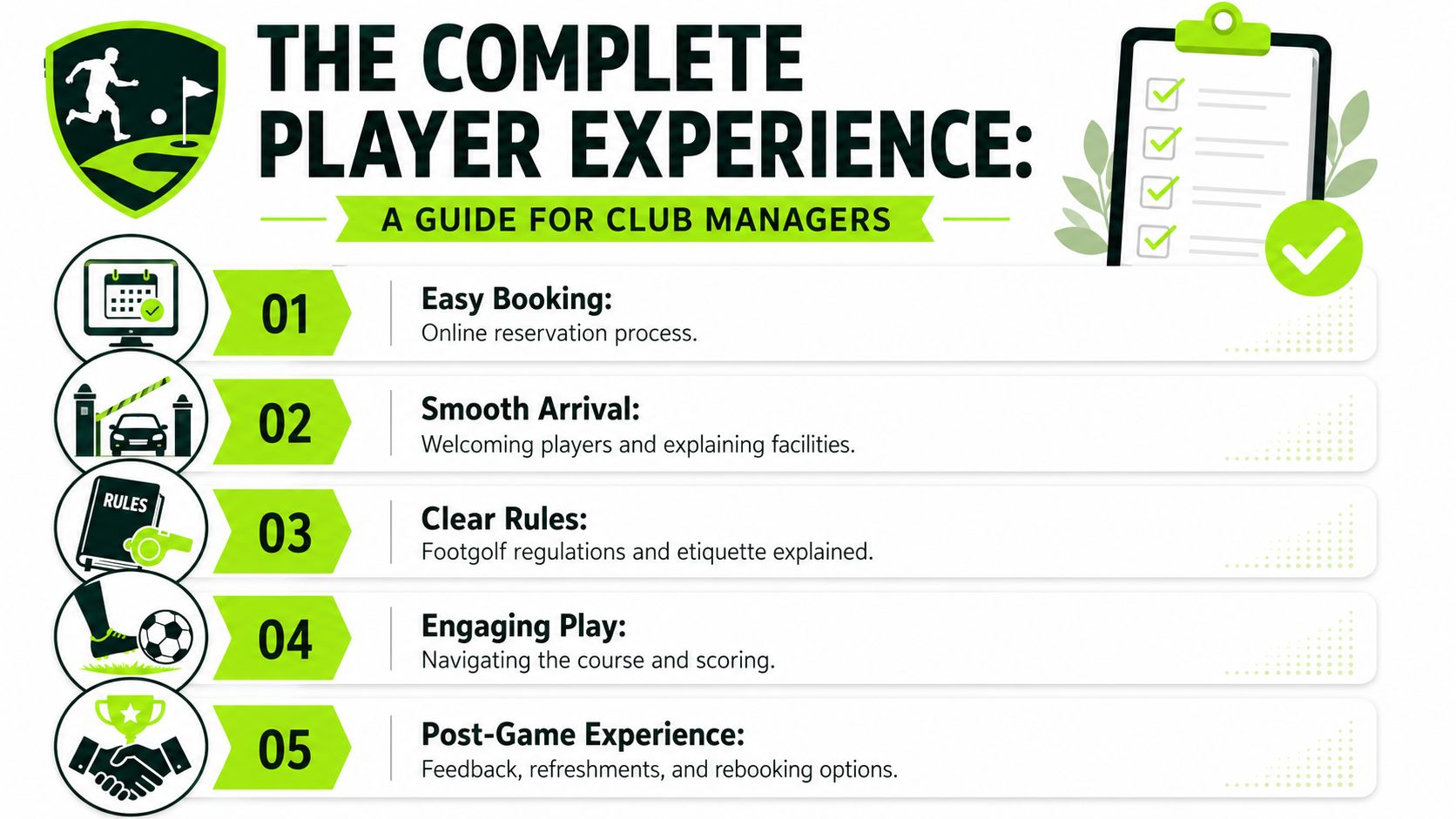
A player doesn't judge Footgolf at Arrowe Park only by the holes. They judge the whole journey. Can they understand the offer quickly, book without friction, arrive without confusion, and start playing without feeling like they've broken an unwritten club rule?
That's where a lot of clubs lose people. Not because the activity is weak, but because the experience around it is vague.
At Arrowe Park, the playing format is straightforward. Footgolf there is played on a 9-hole course using a size 4 or 5 football and 21-inch cups. That sort of clarity is valuable because it makes the product legible to a first-time visitor. They can picture it before they arrive.
What the player journey should feel like
For a manager, the useful exercise is to walk the experience in order.
| Stage | What the player needs | Where clubs usually fail |
|---|---|---|
| Booking | A simple way to reserve | Too many steps or unclear availability |
| Arrival | Fast orientation | Nobody explains where to go |
| Start of play | Rules and expectations | Assumptions replace clear guidance |
| During play | Confidence and flow | Players get stuck on etiquette or layout |
| Finish | Next step | No rebooking prompt or follow-up |
The booking stage is often the first weak point. If a player has to call during limited hours, wait for a callback, or send a general enquiry email, you've added friction before they've even arrived. Casual activities need a casual booking process. If the experience feels formal too early, some people won't bother.
Arrival is the second test. New players need quick reassurance. Where do they check in? What ball do they use? What footwear is suitable? Where does the first hole begin? Managers who treat those questions as obvious are making a mistake. They aren't obvious to somebody who has never visited a golf facility before.
Rules aren't a small detail
Rule clarity is one of the most overlooked parts of the customer experience. It isn't just an operations matter. It's a conversion matter.
The same Arrowe Park source notes that 45% of UK Footgolf players cite confusion over out-of-bounds rules as a barrier to participation. That's not a niche issue. That's a commercial warning. If players don't understand the local rules, they don't relax into the experience. They hesitate, ask staff basic questions repeatedly, argue within the group, or leave feeling the game was harder to follow than it should have been.
A club manager should take three direct actions:
Put site-specific rules in writing
Don't rely on generic footgolf rules from memory. Explain local boundaries, starting procedures, and any access restrictions in plain English.Repeat those rules at more than one point
Show them at booking, on arrival, and at the first tee area. Repetition reduces confusion.Train staff to explain rules consistently
If one team member says one thing and another says something else, the whole experience feels amateur.
Clear rules don't make the product feel stricter. They make it feel easier.
The experience after the game matters too
Many clubs leave money on the table after a group finishes playing. They might want drinks, food, another family activity, or a reason to return. Yet too many venues treat the session as finished the moment the final score is written down.
A better approach is simple:
- Ask for feedback while the visit is still fresh.
- Offer the next relevant action, not a generic sales pitch.
- Capture permission to follow up with future family or beginner-friendly offers.
That could mean a return visit, a school holiday activity, a coaching taster, or a casual event. The point is not to push. The point is to continue the relationship instead of ending it at the payment screen.
Operational Insights for Your Golf Club
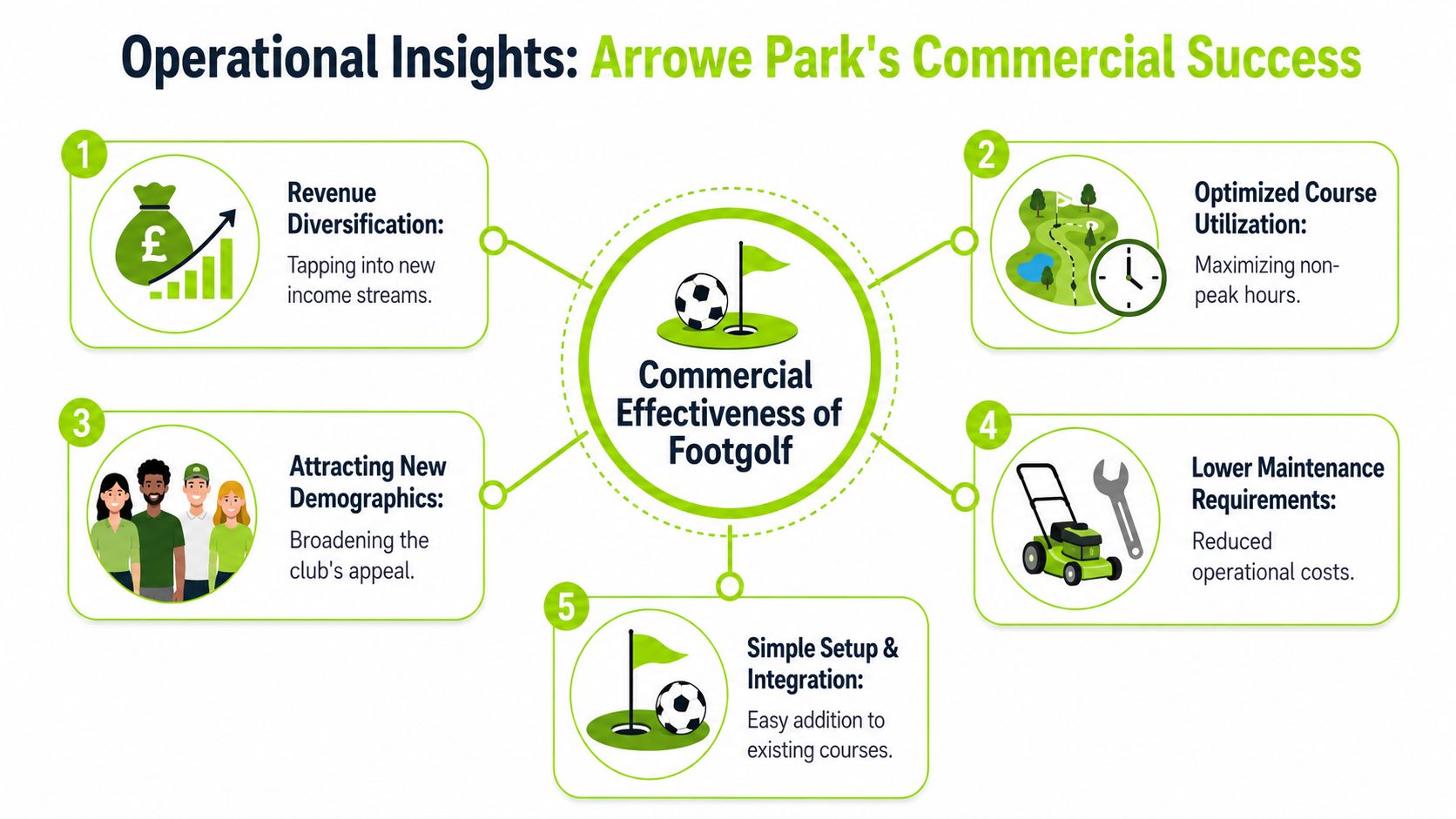
Arrowe Park's commercial logic is straightforward. It uses an established golf site to serve a different kind of customer without forcing the main golf product to carry the entire burden of growth.
That matters because many clubs are trying to solve a demand problem with the wrong product mix. They keep asking how to sell more traditional golf to people who aren't ready for traditional golf. A shorter, simpler activity often solves that entry barrier far better.
The four commercial levers
Managers looking at their own site should assess diversification through four practical lenses.
Land use
Arrowe Park shows the value of assigning a commercial role to part of the estate that can support a lighter-format activity. If you've got underperforming ground, don't just maintain it. Reposition it.
Audience expansion
Footgolf doesn't depend on golfing confidence. That's why it pulls in families, mixed groups, and local visitors who would never identify as golfers. This isn't a minor distinction. It's how a club widens the top of its funnel.
Operational fit
A compact activity tends to fit more easily into a mixed-use venue than a full-scale reinvention. It can sit alongside golf, food and beverage, coaching, and events without creating identity confusion.
Time suitability
Shorter experiences are easier to book spontaneously. That gives clubs a product for visitors who can't commit to a full round, don't own clubs, or want an easier first step onto the property.
What to review at your own site
If you're considering a similar model, don't begin with marketing. Start with an operational audit.
- Map underused areas and ask whether they can support a beginner-friendly activity
- Review staff handling of casual bookings, phone calls, and email enquiries
- Check your booking journey for unnecessary steps and missing customer data
- Assess crossover opportunities into lessons, food and beverage, events, and repeat visits
If your booking and enquiry systems are weak, adding a new activity can expose the weakness faster. That's why clubs looking at diversification should also study how a golf club booking system can support enquiry capture and visibility.
A new activity can increase demand. It doesn't fix operational disorder.
Arrowe Park is useful because it proves the diversification concept. The harder question is whether your club could handle the increased casual traffic properly once it arrives.
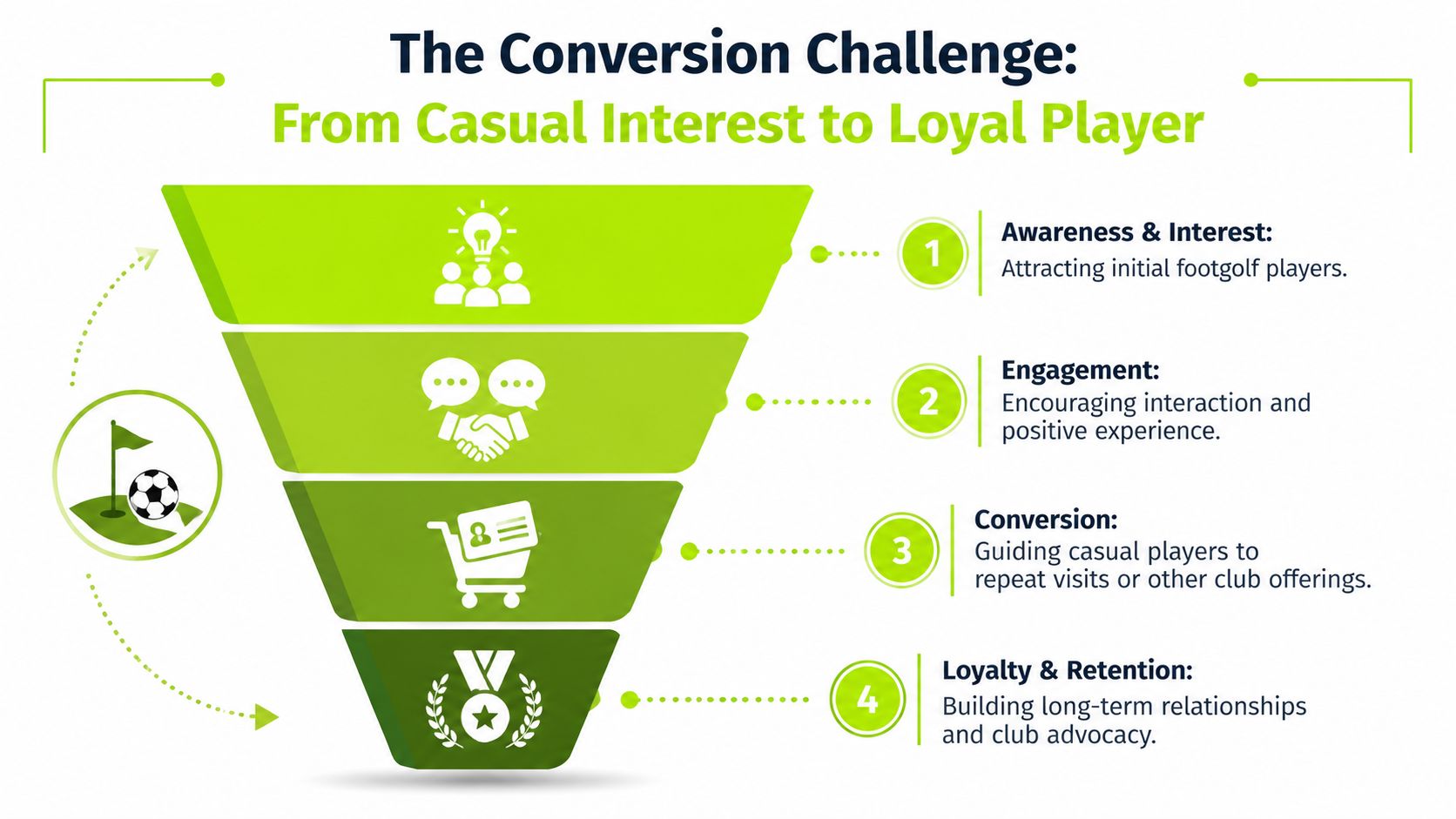
The Hidden Challenge Converting Casual Interest
Most clubs get the problem backwards.
They think the win is generating more enquiries. More website visits. More social engagement. More family bookings. More local attention. Those things matter, but they are not the bottleneck. The bottleneck is what your team does with the interest once it appears.
Footgolf is a good example because it attracts lighter-commitment visitors. That's positive, but it changes the operational demand on the club. You don't just get committed golfers asking informed questions. You get casual enquiries, first-time visitors, families comparing options, and people who need a quick reply before they decide what to do this weekend.
Where clubs lose value
Ask yourself a few blunt questions.
When somebody books a casual activity, where is their data stored? Can you see every enquiry in one place? Can you tell whether they returned? Did anyone follow up? If a parent asks about beginner golf for a child after a footgolf visit, who owns that lead and how is it tracked?
In many clubs, the answers are uncomfortable. One person has some notes. Someone else saw the email. The booking sits in one system, the payment in another, and the follow-up never happens because nobody was assigned to do it.
That is not a marketing issue. It's a lead management issue.
Manual handling breaks first
Casual demand exposes weak processes quickly because it arrives in bits and pieces. A phone call here, an online form there, a message on social media, a walk-in question at reception. Manual systems don't cope well with fragmented demand.
Common failure points look like this:
Slow response
The enquiry comes in, but nobody gets back to it quickly enough.Poor visibility
Staff can't see the full history of what that person asked, booked, or attended.No segmentation
A family footgolf visitor gets the same generic communication as a society organiser or membership prospect.No conversion tracking
The club can't tell which activities create repeat business and which merely create noise.
If you can't see the journey from first enquiry to second visit, you aren't managing growth. You're hoping for it.
Casual visitors are not low value
Some managers still misread the opportunity. They treat diversified traffic as secondary because it doesn't look like traditional golf demand.
That's short-sighted.
A casual visitor can become a repeat visitor. A repeat visitor can become a café customer, a junior parent, an academy lead, an event booker, or eventually a golfer. But none of that happens reliably through goodwill alone. It happens when the club records the right details, responds quickly, and follows a process.
The clubs that win in this space don't just create attractive entry products. They build disciplined systems behind them.
Building a Predictable Revenue Pipeline
Once a club accepts that the core issue is conversion handling, the solution becomes much clearer. You need a system that turns scattered interest into a trackable pipeline.
That doesn't mean making the experience feel corporate. It means making sure no valuable enquiry disappears because it arrived at the wrong time, through the wrong channel, or to the wrong staff member.
The core system every club needs
A predictable pipeline starts with a central place to capture every lead. Phone calls, forms, event bookings, footgolf enquiries, coaching interest, and membership questions should not live in separate pockets of the business.
From there, clubs need structured follow-up. Not random reminders when somebody remembers. Structured follow-up.
A simple framework works best:
- Capture the enquiry properly with contact details and source
- Respond quickly with the information needed to book or decide
- Tag the enquiry type so communication stays relevant
- Trigger follow-up after the visit or missed booking
- Track outcomes so management can see what converts
What this changes in practice
When clubs build the process properly, a casual activity stops being a one-off sale and starts acting like a feeder product.
A footgolf visitor might get a return offer for another family session. Another might be better suited to a beginner group lesson. A parent might be interested in junior coaching. A local group organiser might later book an event. The point is not to force everyone into the same path. The point is to make sure every path is visible.
That's why a lot of clubs need to think beyond promotion and study how golf clubs can build a predictable revenue pipeline. The activity creates the opening. The system turns that opening into repeatable commercial value.
Best practice: Build the follow-up before you launch the offer. If you wait until enquiries arrive, you'll already be behind.
Clubs often say they need more leads. Many need better control of the leads they already have.
Your Next Move From Activity to Asset
Footgolf at Arrowe Park is a strong case study because it proves a simple point. A traditional golf venue can widen its audience by offering something more accessible, more family-friendly, and easier to try than a full round of golf.
That's the visible success.
The less visible lesson is more important. Diversification only becomes a real growth strategy when the club can capture, manage, and convert the interest it generates. Otherwise the activity stays isolated. People visit once, enjoy it, and disappear from view.
If you're a club manager looking at Footgolf at Arrowe Park and thinking about your own site, don't just ask whether you have the land or the demand. Ask whether your team can track an enquiry from first contact to repeat visit. Ask whether response times are fast enough. Ask whether follow-up is structured. Ask whether management can see what is converting.
That's the difference between adding an activity and building an asset.
If your club wants a more reliable way to turn enquiries into booked visits, repeat spend, and long-term revenue, GolfRep helps golf clubs build that system properly. The focus isn't just generating more interest. It's making sure your club can see it, respond to it, and convert it consistently.
Ready to tap into our proven growth system?