Golf Club Revenue Systems: 2026 Growth Guide

The loudest advice in golf right now is usually wrong. Clubs are told to chase more enquiries, buy more ads, or discount prime tee times, yet many already have enough demand coming in. The key leak is what happens next, when enquiries land in shared inboxes, get passed around informally, or sit long enough for the prospect to book elsewhere.
That's why golf club revenue systems matter more than another campaign idea. A club doesn't grow because it gets busy, it grows because every membership lead, visitor enquiry, society request, lesson enquiry, and event booking is captured, routed, followed up, and tracked through to outcome. Hillier Hopkins' Members' and Proprietary Golf Clubs' Survey 2024/25 shows how much more that matters now, with 77% of clubs reporting turnover above £1 million in 2024, up from 68% in 2023, and only 3% below £600,000, down from 11% the year before, while 81% of members' clubs generated annual bar revenue above £150,000, up from 70% Hillier Hopkins report. Revenue is already multi-stream, so the club that manages the handoff well usually outperforms the club that just chases more volume.
Why Most Golf Clubs Already Have Enough Enquiries
The biggest mistake I see is the belief that a club needs more leads before it can grow. In practice, most clubs already have a steady mix of membership interest, visitor traffic, society enquiries, coaching requests, and hospitality demand. The problem is not usually a shortage of interest, it's a shortage of structure.
A shared inbox can hide that loss for months. An enquiry looks “received”, but nobody owns it, nobody logs the next action, and nobody checks whether the prospect was ever contacted properly. That's how revenue leaks happen, not with a dramatic failure, but with slow decay.
Practical rule: if an enquiry does not have a named owner and a visible next step, it is already at risk.
The current club market makes that worse, because the money is spread across more than one source. In the CMAA's 2021 finance and operations report, membership dues accounted for 54.1% of operating revenue, while food, beverage, and social events contributed 23.1%, golf operations and golf shop 11.1%, and all other operating revenue 5.1% CMAA finance and operations report. That mix means one generic follow-up process can't serve every lead type properly.
The better lens is simple. Clubs don't just need attention at the top of the funnel, they need conversion infrastructure. If a membership prospect is handled like a society organiser, or a coaching enquiry is left waiting behind a bar booking, you lose momentum before price ever becomes the issue. The internal pattern is explored in more detail in how most golf clubs lose 30% of enquiries without realising, but the core point is straightforward, response time and ownership matter more than most committees realise.
Predictable growth starts when the club stops treating enquiries as notifications and starts treating them as revenue assets. That shift changes who owns the lead, how fast it gets handled, and whether the club can see where money is slipping away.
Mapping Your Club's Revenue Streams and Lead Types
Most clubs talk about “leads” as if they're all the same. They aren't. A membership enquiry, a society booking request, a green fee visitor, and a coaching lead behave differently, convert on different timelines, and need different follow-up.
The practical starting point is to map the money first, then map the lead types that feed it. The CMAA's board brief noted that greens fees and guest fees provided approximately 28% of revenue in the 2017 to 2019 period, while golf shop revenue rose from about 25% in 2018 to nearly 29% in 2020 CMAA board brief. That is a useful reminder that visitor income and retail income behave differently from membership dues, so they should not be shoved into one pipeline.
Revenue streams need separate handling
A membership prospect often needs reassurance, comparison, and a visit. A society organiser usually needs availability, package detail, and a quick answer. A coaching enquiry needs a calendar slot and a human touch. If those are all left in the same queue, the club blurs urgency, and urgency is where revenue is won or lost.
The internal guide on your guide to the golf club revenue structure is useful here because it frames the club as a portfolio of income streams, not a single sales channel. That mindset helps staff stop asking “Did we get the enquiry?” and start asking “What kind of revenue could this enquiry become?”
Build a simple lead map
Use three questions for every incoming enquiry.
- What did they want? Membership, visitor round, coaching, event, or society.
- Who should own it? The person who can move it forward without internal chasing.
- What happens next? A call, an email, a booking, a quote, or a visit invitation.
If the team cannot answer those three questions in under a minute, the system is too vague.
The operational reason this matters is that clubs are mixed businesses. Hospitality, retail, events, lessons, and membership all have different conversion paths. A generic CRM tag is not enough. You need a structure that lets the club see recurring revenue separately from one-off income, which is the only way to make the right commercial trade-offs later.
Building the Core Revenue System Infrastructure
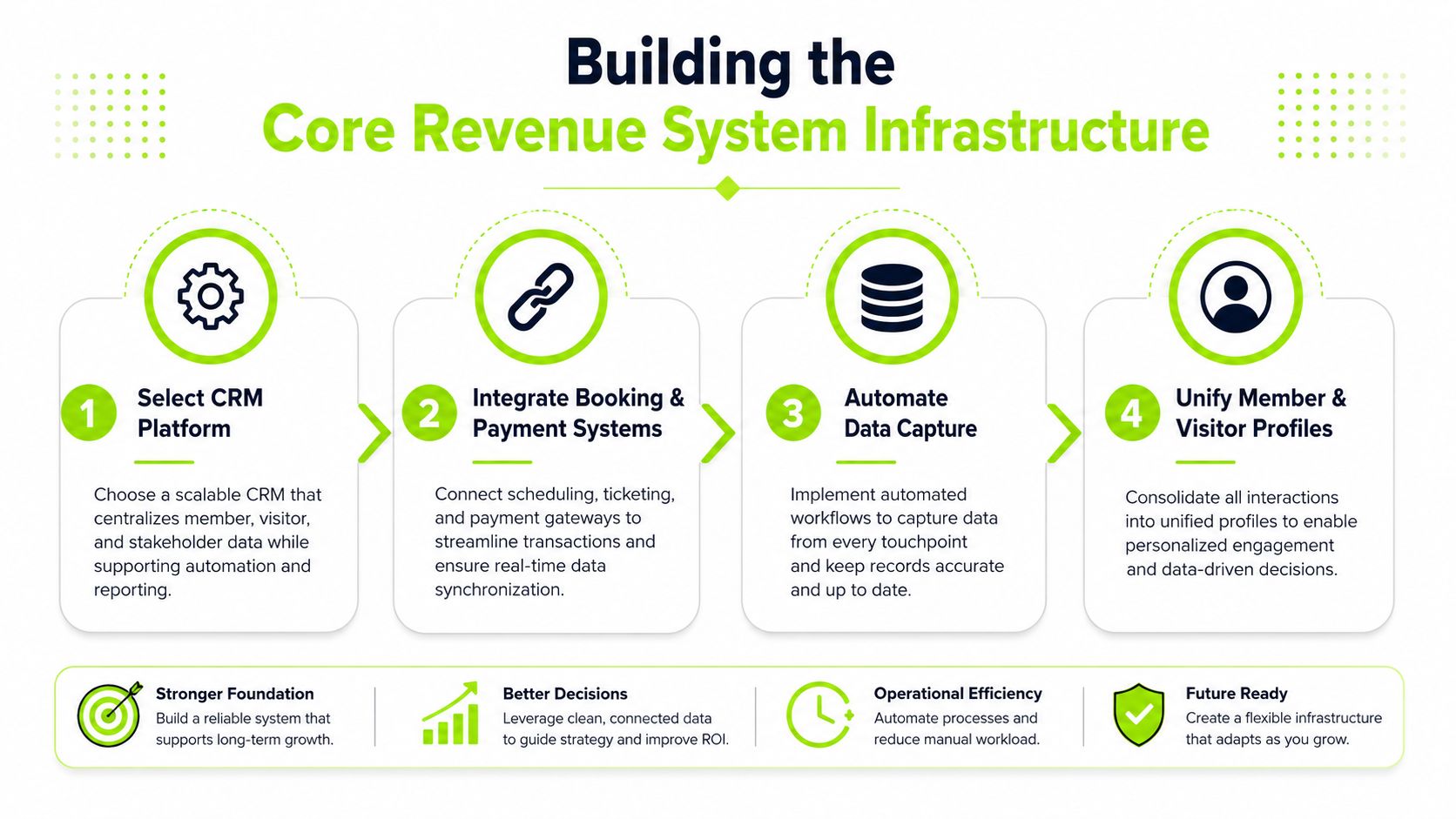
A workable system starts with one rule, every enquiry must enter one place and leave with an owner. If the lead lives in email, WhatsApp, a spreadsheet, and somebody's memory, it isn't a system. It's a liability.
Choose the CRM around workflow, not features
The right CRM for a golf club is the one that can capture enquiries from every source, assign them immediately, and show stage status without extra admin. That includes website forms, campaign landing pages, phone enquiries, and manual entries from the front desk. If the staff still have to retype details into a second sheet, the club has already introduced friction.
GolfRep is one option in this space, because its model combines enquiry capture, CRM visibility, automated nurture, and conversion tracking in one workflow. The point is not the brand name, it's the operating principle, one record per lead, one owner per lead, one visible next step per lead.
Route by intent, not by convenience
Membership enquiries should go to the membership lead. Society bookings should go to the events or hospitality owner. Coaching should go to the PGA professional or lesson coordinator. That sounds basic, but too many clubs still rely on whoever happens to open the inbox first.
Operational truth: speed matters less than clarity if nobody knows who is meant to respond.
Once routing is set, automate the first acknowledgement. A fast, polite confirmation message tells the prospect they have been heard and buys staff time to respond properly. The best systems also separate follow-up paths by lead type, because a membership prospect might need several touches, while an event organiser may need a price and a call back the same day.
For clubs that want a practical reference point on automated sequence design, streamline agency email marketing is a useful external read because it shows how structured email timing supports follow-up discipline rather than replacing it. The key lesson for clubs is simple, automation should create consistency, not impersonality.
Unify data once, not repeatedly
A lead should be logged once, then updated through the same record. That record should show the source, the owner, the stage, and the next action. If a lead stalls, the system should make that visible before the prospect disappears.
Most manual processes fail. People mean well, but memory-based follow-up is inconsistent, especially across busy reception teams, part-time staff, and volunteer-run environments. A central workflow reduces those gaps and gives managers a proper view of what is open, what is pending, and what has gone cold.
Designing Nurture Flows That Convert Enquiries Into Visits
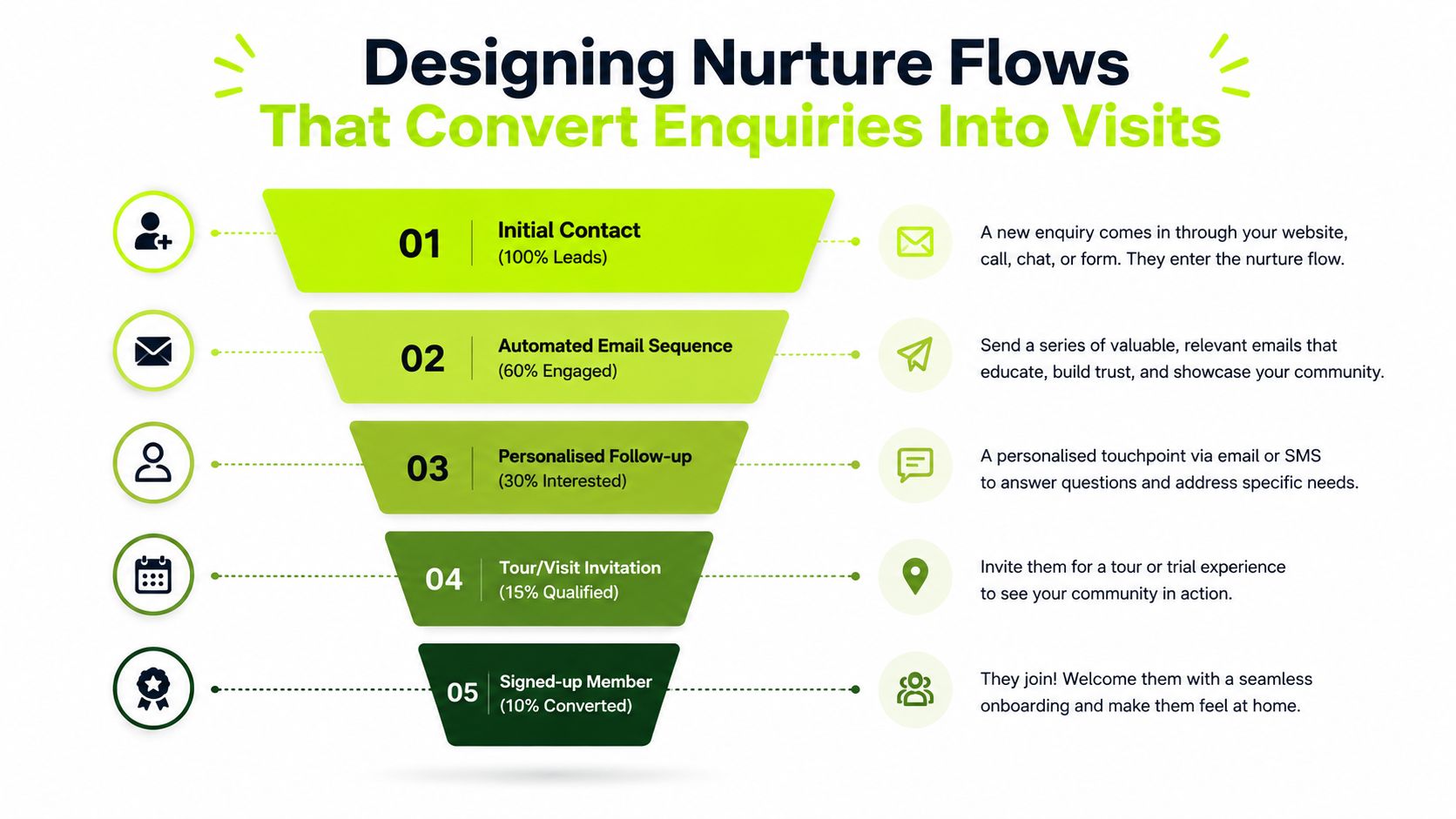
Once the infrastructure exists, the follow-up itself has to do the work. A nurture flow is not a sales script. It's a sequence that keeps the club relevant until the prospect is ready to act.
Match the cadence to the lead type
A membership lead rarely converts on the first touch. They usually need reassurance about value, fit, and culture, plus a reason to visit. Society organisers move faster, but they still need precision on dates, format, and inclusions. Coaching enquiries often need the shortest path, with a direct prompt to book a slot.
The mistake is to write one sequence and reuse it for everyone. That creates the wrong tone, the wrong timing, and the wrong ask. A good membership nurture flow can stretch over weeks, while a society sequence should feel immediate and useful.
Use content that answers the next question
Prospects don't need a barrage of sales copy. They need clarity. Send the next relevant piece of information, such as a membership overview, a visitor booking link, or a lesson timetable, then invite the prospect to take a simple next step. That is better than pushing for a hard close before they have confidence.
A club can also segment based on behaviour. If someone opens emails but doesn't book, they may need a call. If they visit the website repeatedly, they may be comparing options and need stronger proof of fit. If they go quiet after the first reply, the sequence should gently re-engage without nagging.
The internal guide on golf club lead nurture goes deeper into how clubs can build that structure without making the communication feel mechanical. The practical aim is always the same, keep the conversation alive long enough for the prospect to move.
Keep the timing disciplined
The timing matters as much as the message. If the club waits too long, the lead cools. If it overcontacts, the prospect disengages. Good nurture feels organised because it follows a pattern, not because someone remembers to send “a quick follow-up” whenever they find a gap.
For event teams, a resource like track KPIs for event success is a helpful reminder that event work should be measured as a process, not a one-off win. Clubs can apply the same discipline to membership and visitor leads, because the principle is identical, follow-up should be visible, repeatable, and tied to an outcome.
Measuring What Matters With Revenue KPIs
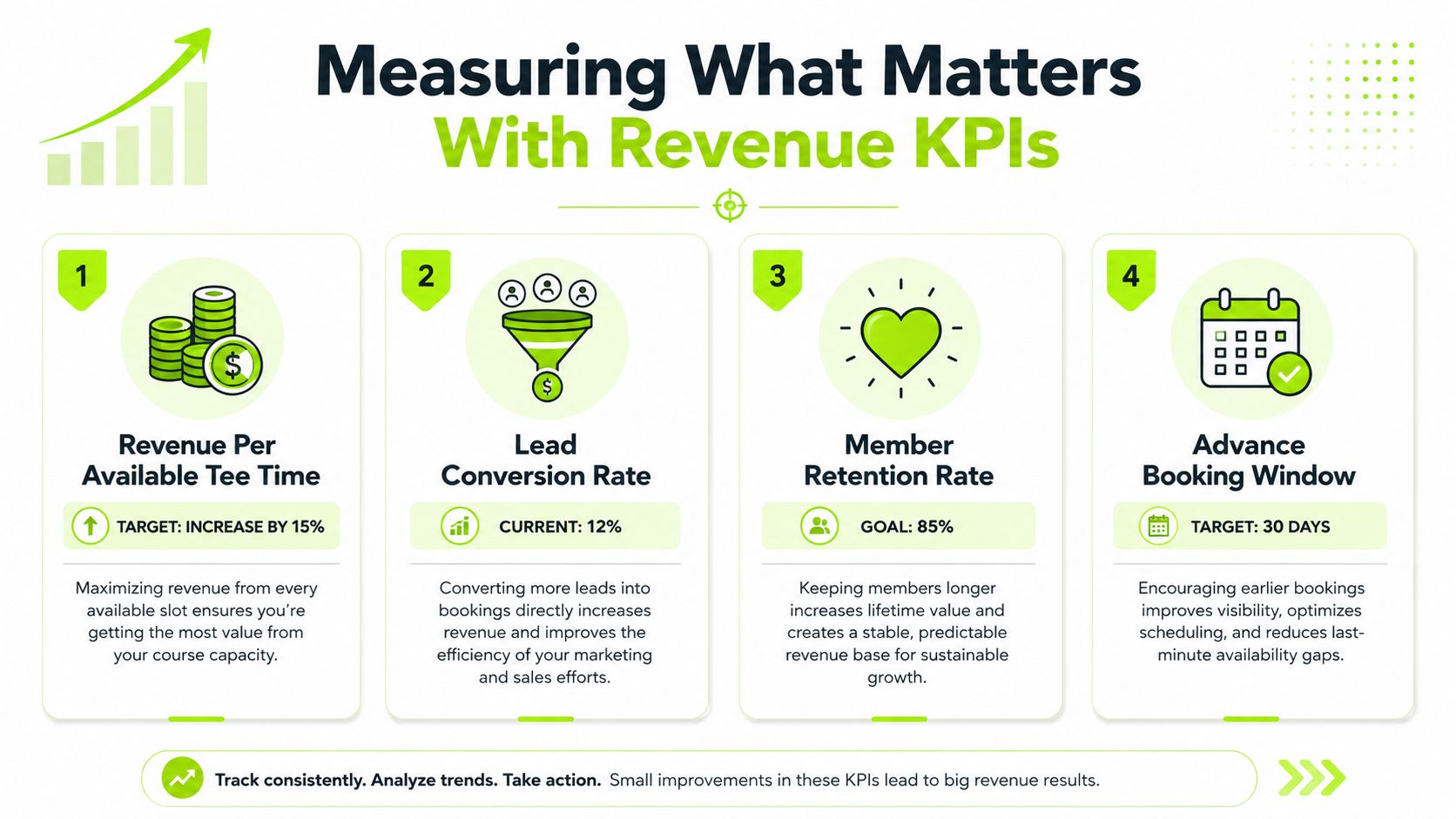
A club can't improve what it can't see. The issue is that many committees and management teams track activity, not performance. Total enquiry volume looks reassuring, but it doesn't show whether the right leads were handled well or whether value leaked between stages.
Focus on metrics that reflect sellable inventory
One of the most useful measures is revenue per available tee time (REVPATT), which Bobby Jones Links defines as total greens and cart fee revenue divided by the total number of tee times available Bobby Jones Links KPI guide. That matters because it measures how effectively a club monetises the inventory it can sell, not just how busy the sheet looks.
That also explains why occupancy alone can be misleading. A full tee sheet can still underperform if slots are poorly allocated, demand is misread, or channels are not tied back to revenue outcomes. The better question is not “Was it busy?” but “Did the available inventory produce the right return?”
Compare lead quality by source
Clubs should track conversion by source, not just by volume. A channel that sends fewer enquiries can still be more valuable if it produces more visits, better membership fits, or stronger repeat spend. That's where source tracking and pipeline visibility earn their keep.
The CMAA's Universal Key Club white paper defines Operating Revenue per FME as total operating revenue divided by the number of full member equivalents, and it defines FME using annual dues revenue relative to the full dues-paying category CMAA Universal Key Club white paper. That gives clubs a standardised way to compare performance across different membership structures, which is useful when a board wants to understand whether growth is making the club stronger.
Build a dashboard the team will use
The best dashboard is the one the management team can read quickly. It should show enquiry response time, conversion by source, open pipeline stages, and the revenue metric the club cares about most. If a dashboard only reports on what already happened, it's too late to change behaviour.
Useful rule: if a KPI doesn't change a decision, it doesn't belong on the main screen.
That decision might be pricing, slot allocation, follow-up priority, or which enquiry source deserves more attention. The point of measurement is not reporting for its own sake, it's to help the club act earlier and waste less.
Real-World Results From Clubs That Fixed Their Systems
The clubs that improve fastest usually don't start with a bigger offer. They start with better handling. The change is often operational first, commercial second.
Bidston Golf Club is a strong example from GolfRep's own work. The club was revived from near-closure, with more than double membership and six-figure recurring revenue after its growth system was rebuilt around structured follow-up, visibility, and pipeline discipline. The outcome matters, but the mechanism matters more, the club stopped letting interest disappear in disconnected admin and started treating each enquiry as a tracked process.
Addington Palace followed a different path, but the lesson was similar. Steady pipeline growth came from making the enquiry journey clearer and more accountable, rather than relying on a burst of promotions. Downes Crediton also showed how a rapid membership campaign can be profitable when the club has a proper response framework behind it, because speed and structure support each other.
Multi-site operators face the same problem at a larger scale. Macdonald Hotels and Resorts needed centralised CRM handling and automated follow-ups across sites, which is exactly where fragmented processes tend to break down. Once follow-up becomes system-led, managers can compare performance across clubs instead of guessing where leads are being lost.
The common thread across all of these examples is not clever messaging. It's operational control. The clubs that win are the clubs that know where the enquiry came from, who owns it, what the next step is, and whether it converted. Everything else is noise.
Your Action Plan for Implementing a Revenue System
Start with the leak, not the dream. If enquiry handling is inconsistent, fix that first before adding more offers, more channels, or more complexity. The fastest gains usually come from reducing response time and giving every enquiry a named owner.
First 30 days
Audit every enquiry source, including membership, visitor rounds, societies, coaching, and events. Write down where each enquiry lands, who sees it, and how often it gets a follow-up. Then remove duplicate handling wherever possible so leads stop bouncing between people.
Days 30 to 60
Choose the CRM workflow and map the routing rules. Build simple automations for acknowledgement, ownership, and next-step reminders. Keep the logic practical, membership goes to membership, events go to events, and no enquiry should sit without a visible stage.
Days 60 to 90
Launch nurture sequences by lead type and build a dashboard that shows response time, pipeline status, and conversion by source. Train staff on how the system works, then review the data weekly so gaps are visible early. If the team doesn't trust the process, they'll drift back to manual habits.
A good rollout also needs patience. Data migration can be messy, and staff buy-in takes repetition. The answer is not to overhaul everything at once, it's to make the highest-value handoff reliable, then improve the next one.
For clubs that want support turning enquiry capture, CRM visibility, and follow-up into one predictable workflow, GolfRep builds systems around those exact steps. If you want a practical review of where your club is leaking revenue, visit GolfRep and start with the enquiry process you already have.
Ready to tap into our proven growth system?