Golf Club SMS Marketing: A Practical 2026 Guide

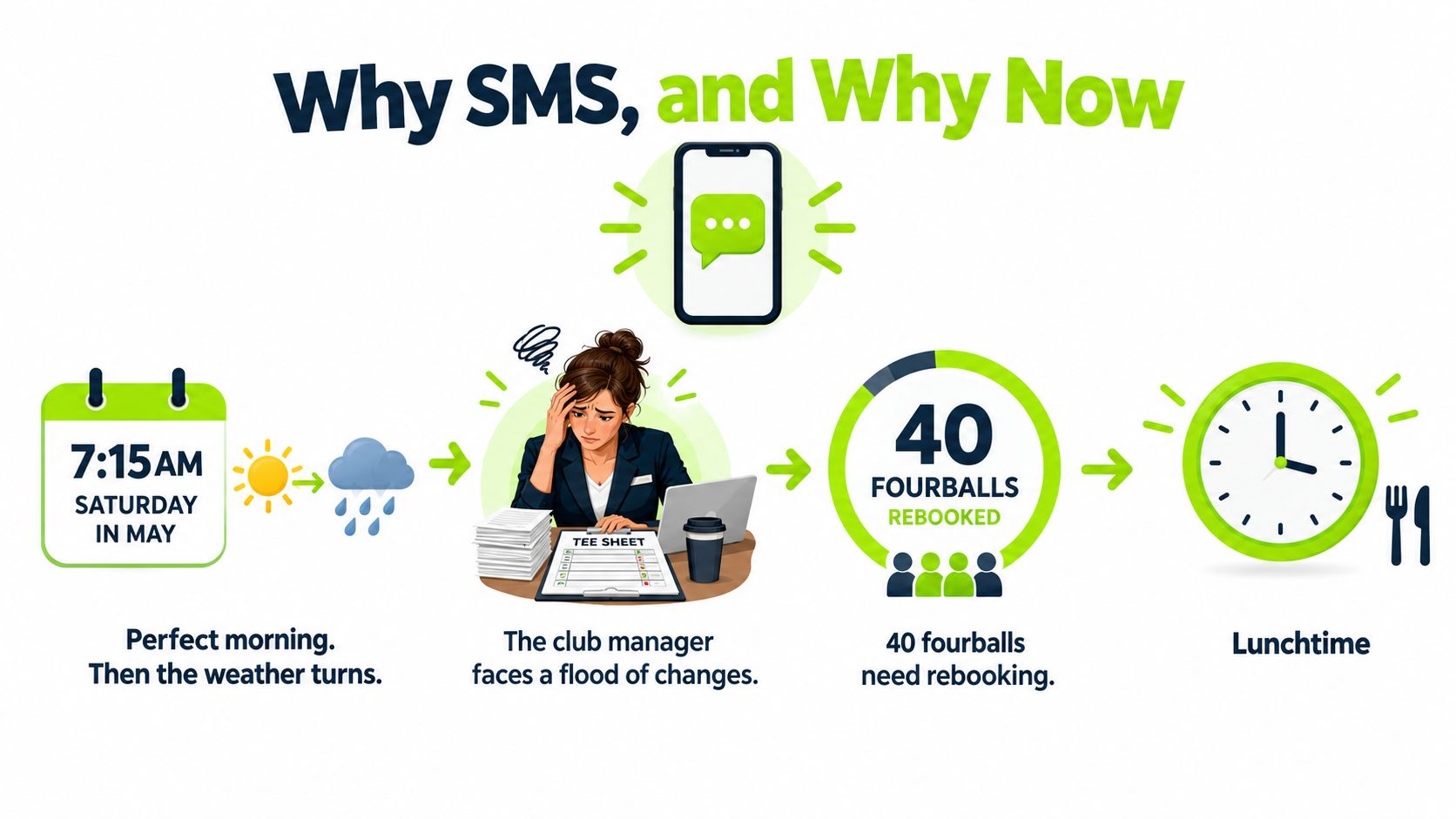
It's 7.15am on a Saturday in May. The forecast has changed overnight, two society days are at risk, and the general manager needs 40 fourballs rebooked before lunchtime. The email campaign is already sitting below overnight booking confirmations, weather alerts and supplier invoices. The tee sheet, however, still has to pay the wages.
That's where golf club SMS marketing earns its place. Not as another channel for newsletters, brand stories or routine promotions, but as a high-intent, moment-of-need tool for situations where a message needs to be seen and acted on quickly. Used badly, SMS irritates members and burns trust. Used properly, it supports the commercial moments where speed affects revenue.
Why SMS, and Why Now
SMS fits the moments that can change during a round of business. A weather warning can affect a society booking, a frost delay can create a wave of calls, and a last-minute cancellation can leave an otherwise sellable tee time empty. A short text can prompt a confirmation, a reply or a booking while the opportunity still exists.
UK attention data supports that role. A 2025 UK SMS and email marketing report found that 97% of respondents read SMS messages, with 19% reading all of them and 47% reading most of them. The same report found that SMS outperforms email for immediate attention. For a golf club, that makes it more suitable for tee-time reminders, event invitations, renewal prompts and urgent availability than for broad awareness.
The channel also has commercial relevance beyond visibility. UK consumer research found that 93% of UK consumers have either signed up for SMS marketing or are open to doing so, with adoption rising 7% year over year. The same UK consumer report found that 50% of shoppers made unplanned purchases after receiving a text, while another UK benchmark reported 67% had purchased after a brand text and 79% said a discount would make them more likely to subscribe. Those figures don't mean every club should start discounting tee times. They show that branded texts can influence action when the offer and audience are relevant.
The channel's limits
SMS costs more per send than email, carries very little room for explanation and can't deliver a club's full proposition. It also demands restraint. A message that arrives at the right moment feels useful. The same message sent repeatedly to people who don't need it feels intrusive.
Clubs should therefore assign SMS a narrow job:
- Tee-sheet protection: Fill cancellations, manage weather changes and recover no-shows.
- Booking confidence: Confirm visitor rounds, society details and event attendance.
- Commercial prompts: Support renewals, hospitality upsells and relevant event registration.
- Fast enquiry handling: Acknowledge a membership enquiry instantly, then route it to a person.
GolfRep's own approach follows ATTRACT → NURTURE → CONVERT → RETAIN. SMS supports each stage selectively, but it shouldn't carry the whole journey. Email remains more suitable for detail, while social channels and the website build awareness and explain the experience. Managers comparing channel roles may also find GolfRep's 2026 golf club marketing trends useful when planning the wider mix.
For two-way workflows outside golf, how Fitness GM streamlines SMS offers a useful example of how replies, automation and staff action can work together. The principle transfers well to golf: the message is only valuable if the club can handle the response.
UK Consent and Compliance Essentials
A golf club sending marketing texts is handling electronic direct marketing under PECR. The ICO says valid consent must be knowingly and freely given, clear and specific, identify the organisation and communication type, and involve a clear positive action such as ticking a box or selecting an icon. A pre-ticked box, vague wording or bundled consent isn't a sound foundation.
The club also needs to consider data protection law alongside PECR. Keep a record showing who consented, what they consented to, when they consented, where they consented and the wording they saw. Your privacy notice should explain how the club uses mobile numbers, and every marketing text should identify the sender and provide a straightforward opt-out route. The ICO guidance on electronic and telephone marketing should sit within the club's operating procedure, not in a forgotten legal folder.
Separate service messages from marketing
A booking confirmation, cancellation notice or course-status alert can be a service communication when it's necessary to administer an existing booking or relationship. A message promoting membership, hospitality, a competition or an unrelated event is marketing and needs the appropriate permission.
A visitor who books a tee time hasn't automatically opted in to membership marketing. A renewal form should have a separate SMS marketing box. An event sign-up shouldn't bundle permission for general club communications into the registration process.
The soft opt-in is narrower than many clubs assume. It can apply to existing customers where the club collected their details during a sale or negotiation for a similar product or service, offered a clear opt-out when collecting the details and includes an opt-out in every message. It applies to texts as well as emails, and it stops being available when the person opts out. It doesn't rescue a club that has no reliable record of how the number was collected.
| Scenario | Is SMS opt-in valid? | Why / what to do |
|---|---|---|
| Visitor books a tee time | Not automatically for marketing | Send necessary booking information, but request separate marketing consent for offers or membership messages. |
| Member ticks an unticked SMS box on a renewal form | Yes, if the wording is specific | Store the wording, timestamp, source and selected communication type. |
| Event attendee accepts event updates only | Limited to that stated purpose | Don't add the contact to general club promotions without separate permission. |
| Existing customer receives a similar-service offer under the soft opt-in | Potentially, if every condition is met | Confirm the original sale or negotiation, the opt-out at collection and the opt-out in each message. |
| Contact replies STOP | No further marketing texts | Suppress the number across the club's systems and record the withdrawal. |
Ofcom says spam texts are unlawful unless the recipient previously gave permission. UK mobile users can report unwanted texts by forwarding them to 7726, and continuing complaints can go to the ICO. If 7726 reports start appearing, stop the relevant automation, preserve the consent records, investigate the source and suppress the affected numbers. Review the club's privacy policy alongside the consent journey, because a compliant checkbox can't compensate for unclear data handling.
Building a Permission-First List
Permission is captured at the point where the club has a genuine reason to ask, not by uploading every mobile number held in the member database.
Start with the website booking flow. Use a dedicated, unticked checkbox that says what the person will receive, identifies the club and makes clear that consent is optional. The confirmation screen can offer a second opportunity, but it shouldn't assume that completing a booking equals marketing permission.
Use the same discipline across physical and assisted touchpoints:
- Society and event forms: Separate event administration from future promotions, with distinct choices for organisers and attendees.
- Spike bar and pro shop QR codes: State the club name, message purpose and opt-out method beside the code.
- Front-desk tablet: Let the duty manager capture consent during a walk-in, then show the wording on screen before the contact confirms.
- Booking confirmations: Keep transactional updates separate from promotional invitations, even when both use the same number.
For digital collection, store the timestamp, source, exact wording, IP address and user agent. For offline collection, record the staff member, location, date and wording displayed. The record needs to let a manager answer a simple question: “What did this person agree to receive?”
Make the CRM the authority
The SMS platform shouldn't become a second, conflicting database. Your CRM or member platform should hold the mobile number, consent status, consent source, consent date and separate channel flags for SMS, email and WhatsApp.
That structure matters when a member accepts transactional alerts but refuses marketing, or when a society organiser consents to event updates while individual guests don't. A single suppression status should feed every sending system, so a STOP reply removes the person from all marketing workflows rather than one campaign.
Run a quarterly hygiene review. Identify dormant numbers, correct duplicates, confirm that opt-outs have propagated and ask inactive contacts to re-permission themselves where appropriate. Never import a bought list. A supplier can provide plausible numbers, but it can't provide permission from your members.
Choosing Your Provider and Stack
The right provider depends on the job the club needs the channel to perform. Native texting inside a member platform is convenient, while a dedicated gateway usually provides stronger routing, reply handling and integration control. WhatsApp can carry richer content, but it isn't a substitute for a permissioned SMS process.
| Channel | Strengths | Weaknesses | Best fit for |
|---|---|---|---|
| Native SMS in a member platform | Close to member and tee-sheet data, simple for staff | May offer limited segmentation, automation or two-way handling | Booking alerts, member notices and routine administration |
| WhatsApp Business | Rich media, conversational replies and useful event content | Requires channel adoption, templates and careful permission management | Scorecards, event flyers, itinerary details and service conversations |
| Email plus SMS suite | Familiar campaign tools, journeys and reporting | Generic tools may lack golf workflows and robust STOP or HELP handling | Clubs with an established CRM team and clear integrations |
| Dedicated UK SMS gateway | Routing control, sender-ID options, webhooks and two-way messaging | Requires configuration, governance and technical ownership | Time-sensitive workflows linked to a CRM or tee sheet |
| RCS | Potentially richer messaging than standard SMS | Device, network and platform coverage can vary | Carefully tested supplementary campaigns, not the core channel |
A sensible default for many UK clubs is a UK-based SMS gateway connected to the club CRM, with WhatsApp used for richer media. Check sender-ID registration, delivery routes, throughput, data-processing terms, UK or EU data residency, two-way replies, CRM webhooks and pricing by message segment.
Don't assess price only by the headline rate. Ask how long messages are split, whether inbound replies cost extra, how failed delivery is handled and whether a dedicated number is rented. A practical guide to understanding phone number rental pricing can help managers compare the less visible parts of the bill.
Avoid the email-tool shortcut
Bolting SMS onto a generic email platform often creates operational gaps. Many tools don't handle keyword opt-in, STOP and HELP responses, sender identity or character limits in a way that suits club staff. A message may technically send while the consent record, reply ownership and tee-sheet action remain disconnected.
Ask each supplier to demonstrate one complete workflow. A visitor books, receives a confirmation, replies with a question, and the pro shop sees the reply. A member opts out, and the suppression reaches every campaign. If the provider can't show that flow, don't approve the purchase.
For a wider comparison of conversational channels, see GolfRep's guide to WhatsApp marketing for golf clubs. The decision should be driven by the required customer action, not by whichever channel appears newest.
Segmenting Members and Visitors Properly
A club's SMS list should never be one large audience called “all contacts”. The tee sheet and membership records already contain enough operational detail to create useful segments, provided the club maintains the data consistently.
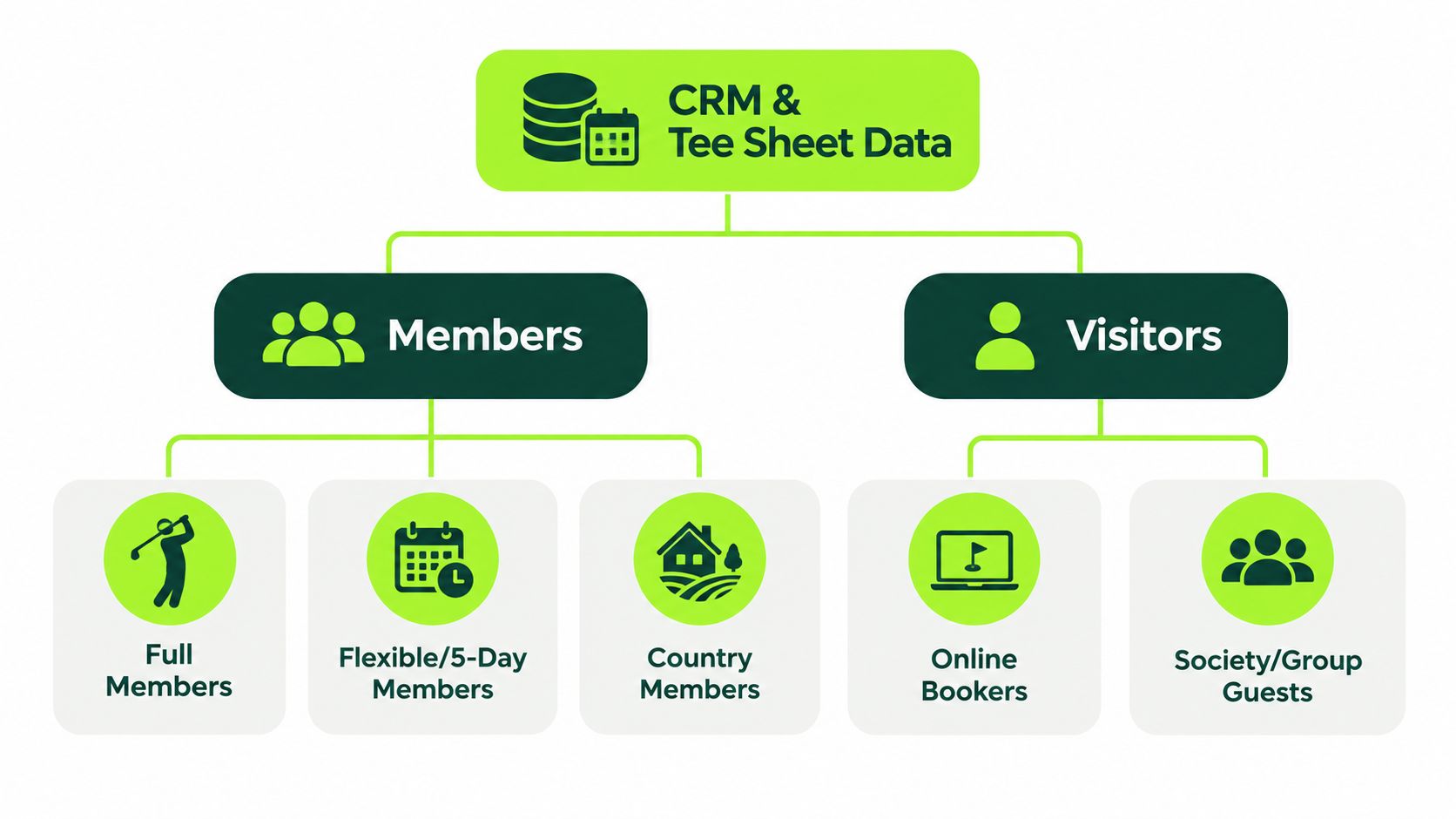
Begin with a primary segment that describes the relationship:
- Full members
- Flexible or five-day members
- Intermediate members
- Junior members
- County or country members
- Lifestyle and family members
- Visitors
- Society or group guests
Then add a lifecycle stage. A contact can be a prospect, new joiner, probationary member, renewing member or lapsed member. Add intent flags for open competitions, lessons booked, society days, visitor bookings and previous event attendance.
The contact should have one primary segment and useful secondary flags. Those flags might include preferred tee time, handicap band, last booking source, last visit and whether the person is an organiser or a participant. Don't create an unmanageable taxonomy. If staff can't explain how a tag is populated, remove it.
A practical Saturday example
Suppose the club has a Saturday morning fourball available because of a cancellation. The target audience isn't every member with a mobile number. It is full members with marketing consent who regularly book Saturday morning tee slots and haven't already booked that day.
The CRM applies those rules, the SMS tool sends the short prompt, and the booking link records the response. Flexible members can receive a different message later if the slot remains open. Juniors, country members without relevant access and contacts with transactional-only permission stay suppressed.
That distinction protects the member experience and improves the commercial decision. A relevant message can fill capacity without making the whole database feel marketed to.
Segmentation should live in the CRM, not inside separate SMS lists. That gives the club one set of rules for email, SMS, WhatsApp, sales tasks and reporting. Resources on targeted segmentation strategies are useful for the general principle, but the club should build segments around its actual membership categories and tee-sheet behaviour.
Club-Specific SMS Use Cases and Templates
SMS earns its cost when the recipient already has a relevant reason to act. The examples below are deliberately short, operational and tied to a trigger. Treat the wording as a starting point, then test it against the club's tone and booking process.
Visitor tee-time reminder
Trigger: A confirmed visitor booking in the tee-sheet system.
Timing: The morning before play or at the club's agreed reminder point.
Guardrail: Send as a service message where it relates to the booking. Suppress promotional content unless the visitor has marketing consent.
Sample: “Riverside GC reminder: your tee time is tomorrow at 10.20am. Please arrive 20 minutes early. Questions? Reply HELP or call 01234 567890.”
The club can add a course-status link when conditions may affect play. Keep the reminder focused on arrival, timing and practical preparation.
Society confirmation and payment
Trigger: A society organiser confirms the date and the deposit or balance is due.
Timing: Immediately after the booking milestone, then only at agreed service points.
Guardrail: Send the organiser the payment link and itinerary. Send players only the information relevant to their participation.
Sample organiser text: “Your Riverside GC society day is confirmed for 14 June. Pay the deposit securely: [link]. Reply ORGANISER for help.”
Sample player text: “Riverside GC society day, 14 June. Check-in 8.15am, first tee 9.00am. Full itinerary: [link].”
The automation should branch by role. The organiser needs a payment action, while individual players need timing, arrival and event information.
Last-minute fourball fill
Trigger: A tee slot becomes available and matches the selected audience's playing pattern.
Timing: Only while the slot remains commercially useful.
Guardrail: Send to opted-in contacts who can book the slot, not to members who have only accepted transactional texts.
Sample: “Saturday 11.20am fourball just opened at Riverside GC. Book now: [link]. Offer subject to availability. STOP to opt out.”
This is a marketing message, even if the time is short. The club needs marketing consent and a clear opt-out.
Lapsed-member renewal
Trigger: A member reaches the club's defined renewal or lapsed stage.
Timing: During the renewal window, coordinated with the wider renewal journey.
Guardrail: Use the approved membership proposition, not a generic discount, and stop the sequence after renewal or opt-out.
Sample: “We'd love to welcome you back to Riverside GC. Renewal options are available here: [link]. Reply VISIT to speak with the team. STOP to opt out.”
The UK consumer research indicates strong willingness to act on relevant brand texts, but relevance matters more than volume. A lapsed member should receive a reason to return, not repeated reminders with no new information.
Junior camp registration
Trigger: A parent or guardian has consented to receive the relevant communication.
Timing: When places, forms or payment steps require action.
Guardrail: Keep the adult's record as the communication owner and don't assume a junior's contact details carry marketing permission.
Sample: “Junior camp places are open for 5 August. Parent information and registration: [link]. Questions? Reply CAMP.”
Course-status alert
Trigger: The course team records frost, a competition restriction, trolley ban or temporary closure.
Timing: As soon as the operational decision is confirmed.
Guardrail: Send only to affected bookings or member groups where appropriate. Avoid adding unrelated promotions.
Sample: “Riverside GC update: trolleys are banned today due to ground conditions. Your tee time remains on. Details: [link].”
No-show or cancellation follow-up
Trigger: The booking system records a missed tee time or late cancellation.
Timing: After staff have checked the record and applied the club's policy.
Guardrail: Use a factual tone, state the next action and avoid punitive language in an automated message.
Sample: “We missed you for today's 10.20am tee time. Please contact the pro shop about the booking: 01234 567890. Thank you.”
Event reminder and feedback
Trigger: Registration for a captain's drive, mixed open competition or Christmas dinner.
Timing: At the practical point when attendance details matter, followed by a feedback request after the event.
Guardrail: Separate event administration from future marketing permission.
Sample: “Reminder: Riverside GC Christmas dinner starts at 7.00pm tonight. Please arrive by 6.30pm. Menu details: [link].”
For a post-round message, keep the action simple. A short survey link may be appropriate, but don't turn every service interaction into an upsell.
KPIs, Optimisation and Troubleshooting
Review SMS every week. Quarterly reporting is too slow for a channel that can affect today's tee sheet, and total sends alone tell a general manager very little.
The core dashboard should show:
- Delivery rate: Use above 98% as the operational target, based on the UK benchmark cited by Textmagic. Investigate failures by provider route, sender ID and number quality.
- Reply rate: For tee-time reminders, treat above 8% as a useful health threshold from the campaign playbook, but compare like with like. A service reminder and a renewal prompt shouldn't share one benchmark.
- Conversion to booking: Count members or visitors who book within four hours of the SMS, then split results by use case.
- Opt-out rate: Treat above 3% per send as a red flag for investigation. Review relevance, frequency, audience and timing before sending again.
Broader UK SMS benchmarking places open rates around 98% and click-through rates around 19–35%, while independent SMS marketing guidance reports about a 45% response rate. These figures should be treated as context, not a promise for a golf club. The commercial measure is whether the message produced a booking, renewal, recovered no-show or completed event action. The SaleCycle SMS marketing guide provides further context on why time-sensitive communications often suit the format.
Use a simple review loop
Each month, select the weakest campaign and ask four questions:
- Did the audience have a genuine reason to act?
- Was the message sent at a sensible time?
- Was the call to action a booking link, a reply keyword or a phone call?
- Did the CRM record the commercial outcome?
Rewrite the opening line, test it against a comparable control segment and document the result. Change one major variable at a time. If the tee sheet link gets clicks but no bookings, inspect the mobile booking path before blaming the message.
Troubleshoot by symptom
Delivery fails: Check sender-ID registration, number formatting and provider routing. Confirm that failed numbers are suppressed rather than repeatedly retried.
Opt-outs spike: Audit send frequency, audience relevance and time of day. Check whether a service workflow has accidentally included a promotional offer.
Replies arrive but conversions stall: Give replies an owner, shorten the message and test a clear keyword against a direct booking link. A response without staff action isn't revenue.
Complaints reach 7726: Pause the affected campaign, review the consent trail, suppress the reporting numbers and investigate whether the message was expected. Ofcom's guidance on reporting spam texts explains the reporting route that mobile users can use.
Give the marketing assistant a one-page playbook containing the approved segments, consent rules, templates, triggers, escalation contact and weekly dashboard definitions. GolfRep can help a golf business connect SMS triggers to acquisition, sales processes, CRM follow-up, conversion and retention, rather than treating texts as isolated broadcasts. Visit GolfRep to discuss a practical SMS and revenue workflow for your club, built around the moments where faster action can protect bookings and member income.
Ready to tap into our proven growth system?