“Golf Club Membership Declining? Here’s What To Fix First”

Most advice about falling membership starts in the wrong place.
It says you need more visibility, more campaigns, more social posts, more offers. That's comforting, because it turns the problem into a marketing issue. For most golf clubs, it isn't one.
The harder truth is that many clubs already get enough interest to grow. They just don't handle that interest well enough. Enquiries sit in inboxes. Follow-up depends on whoever is least busy that day. Trial visits happen, then no one checks back in. Flexible members join, use the club, and drift because nobody guides them towards a bigger commitment.
That is the story behind “Golf Club Membership Declining? Here's What To Fix First”.
The market has clearly been under pressure. In Q1 2023, UK golf saw a dip in registered memberships despite strong rounds played, with rising living costs pushing members to rethink subscriptions, as reported in PlayMoreGolf's review of the membership challenge. That matters. Affordability is real.
But clubs often use external pressure as an excuse for internal weakness.
If rounds are still being played, interest in golf hasn't disappeared. What's breaking is the path from interest to membership, and from membership to renewal. That's why the first fix isn't another promotion. It's your operating system.
If your club doesn't know where enquiries came from, who replied, what was said, when the next touchpoint is due, or why people dropped off, you don't have a demand problem. You have a process problem.
And process problems are fixable.
Introduction The Real Reason Your Membership Is Declining
Clubs like to blame the market when membership drops. That story is convenient, and it is often wrong.
Golf interest has not disappeared. People still play, compare clubs, ask about packages, bring guests, and test whether your club feels worth the commitment. The drop usually happens later, inside your process. An enquiry waits too long. A visit gets booked without a clear next step. A prospect receives a price list instead of a reason to join. The club loses the sale before anyone notices there was one to lose.
That is the issue. Your membership decline is usually an operations problem dressed up as a marketing problem.
If your team cannot show a clear path from first enquiry to visit, from visit to follow-up, and from follow-up to signed membership, your club does not need more promotion first. It needs a better system for handling demand already coming in. A documented golf club sales pipeline fixes more growth problems than another round of ad spend.
The same principle sits behind managing the entire customer journey. Every touchpoint affects conversion. Slow replies, vague messaging, handoff errors, and missing follow-up are not small admin issues. They are revenue leaks.
Here is what usually breaks:
- Enquiries land with no owner. Staff assume someone else replied, or they respond when operational work slows down.
- Prospects get information, not guidance. Sending rates and categories is not the same as helping someone choose the right path into the club.
- Visits happen without a conversion plan. A good experience on site means little if nobody follows up quickly and directly.
- Interested members drift out of the funnel. There is no scheduled nurture, no deadline, and no accountability.
Committee-led clubs feel this harder because decisions and follow-up get spread across too many people. No one sees the full pipeline. No one owns the outcome.
Fix that first. Tighten response times, assign ownership, standardise follow-up, and make every enquiry move through a defined membership journey. Clubs that do this stop guessing why numbers are down and start controlling the result.
Diagnose Your Leaky Bucket Before Turning On The Tap
If your first response to lower membership is “we need more leads”, stop.
Adding more enquiries into a broken process just creates more unworked enquiries. It doesn't solve the underlying problem. It hides it for a month or two, then the same issues show up again.

Start with one uncomfortable question
Could you tell me, today, exactly how many membership enquiries your club received in the last month, where each came from, who responded, which ones booked a visit, which ones went quiet, and which ones joined?
Most clubs can answer part of that. Very few can answer all of it.
That's why diagnosis comes first. You need lead visibility before you need more lead volume. If the pipeline is blurry, decisions get made on gut feel, and gut feel usually overestimates how well the club is following up.
A useful outside perspective on this sits in broader service industries too. The principle behind managing the entire customer journey applies directly to clubs. Every touchpoint shapes the outcome, not just the first enquiry.
Run a real audit, not a committee discussion
Don't start with a meeting. Start with a test.
Submit a genuine-looking enquiry through your website. Send one via Facebook. Call the pro shop. Ask a friend to do the same and compare what happened. You're not checking whether someone was polite. You're checking whether the club has a repeatable process.
Look for these failures:
No central capture point
Enquiries land in personal inboxes, paper notes, WhatsApp messages, or memory. Once that happens, tracking is already broken.No response ownership
Everyone assumes someone else replied. Nobody owns the lead from first contact to outcome.No defined next step
The prospect receives information but no invitation to visit, speak, trial, or compare options.No follow-up schedule
If the lead doesn't reply straight away, the club goes silent.No reason codes
When someone doesn't join, nobody logs why. Price, timing, confusion, poor fit, no callback. It all gets lost under “not interested”.
The fee trap is often self-inflicted
The industry has created a dangerous pattern. Data reported by National Club Golfer on club membership decline and fee pressure showed 92% of UK clubs planned fee increases in 2023 despite losing 6,000 members in Q1, with 64% of members aged 50+. That's a warning sign, not a strategy.
When a club loses members and responds mainly by raising prices, it often ends up protecting short-term revenue while weakening long-term volume. That's not growth. That's managed contraction.
Clubs don't usually have a pricing problem in isolation. They have a weak conversion and retention engine, then try to charge their way out of it.
If your enquiry handling is patchy, your onboarding is vague, and your renewals are passive, fee rises become a cover for operational inefficiency.
Audit the pipeline stage by stage
Use a simple review sheet. You don't need fancy software to start. You do need honesty.
| Pipeline stage | What to check | What often goes wrong |
|---|---|---|
| Enquiry received | Was every enquiry logged in one place? | Leads go missing across inboxes and staff members |
| First response | Did the prospect get a useful reply quickly? | Delayed, generic, or incomplete responses |
| Qualification | Did anyone learn what type of membership fits? | Same brochure sent to everyone |
| Visit or call booked | Was there a clear invitation to progress? | Information sent with no next step |
| Follow-up | Was there a defined sequence after silence? | One email sent, then nothing |
| Outcome tracking | Was the result recorded with a reason? | Club has no idea why prospects drop off |
If you want a stronger framework for visualising this, our guide to a golf club sales pipeline breaks down the stages clubs need to track properly.
A leaky bucket is rarely one big hole. It's usually ten small ones that nobody owns.
Fix Your Enquiry Handling System Immediately
The first operational fix is simple to describe and uncomfortable to implement.
Stop letting membership sales live in email chains, paper notes, and staff memory.
That setup feels manageable when enquiry levels are low. It collapses as soon as the club gets busy. Prospects don't care that the secretary was tied up, the pro was coaching, or the committee hadn't reviewed the latest pricing sheet. They judge the club on the speed and quality of the response they receive.

Build one source of truth
You need a central system where every membership enquiry is captured, updated, and visible. That can be a proper CRM, not a spreadsheet with good intentions.
The point isn't software for the sake of software. The point is control.
A central system should show:
- Who the prospect is
- Where they enquired from
- What type of membership they may fit
- What contact has happened
- What next action is due
- What outcome was reached
Without that, you can't manage performance. You can only hope.
Split speed from substance
Many clubs delay responses because they believe the initial reply needs to be thorough. It doesn't.
The first reply should be immediate and reassuring. Then the detailed human follow-up can happen with context and purpose. Automation earns its place by providing an instant acknowledgement that confirms the enquiry has been received, sets expectations, and keeps the prospect warm while your team prepares the right next step.
A useful reference point is how service businesses use an AI-powered live chat solution to capture and respond to enquiries outside office hours. Golf clubs don't need to copy every tactic, but they should learn the lesson. Prospects often enquire when your team is unavailable.
The club that responds clearly and consistently usually beats the club with the prettier brochure.
Replace ad hoc follow-up with a sequence
Most memberships aren't lost because the offer was terrible. They're lost because nobody stayed on the case.
A proper follow-up system doesn't need to be complicated. It needs to be scheduled. Every new enquiry should trigger a sequence that includes acknowledgement, qualification, a clear call or visit invitation, and further contact if there's no reply.
A practical version looks like this:
Immediate acknowledgement
Confirm receipt, thank them, and tell them what happens next.Human reply with relevance
Ask useful questions. Playing frequency, age bracket if relevant to category, weekday or full access preference, current club status, interest in trial options.Clear progression step Invite them to a visit, a callback, or a personalized membership discussion. Don't end with “let us know if you have any questions”.
Planned follow-up
If they haven't replied, contact them again with a useful reason. Clarify value, answer common concerns, or offer a simple next step.Outcome and reason logging
Joined, deferred, too expensive, poor timing, chose another club, not enough usage expected. Log the reason.
Before and after looks very different
The chaotic version is familiar. A prospect submits a form on Sunday. Someone sees it Monday afternoon. A PDF gets emailed over. No one checks whether it was opened. Nobody books a visit. The lead goes cold.
The structured version is much stronger. The prospect gets an immediate acknowledgement, then a specific reply. Their details sit in one system. A call or visit is offered. If they don't respond, the system reminds the team to follow up. The club can see where they are in the pipeline at all times.
That's the difference between hoping and operating.
If your current process depends on one organised person carrying the whole thing, it isn't a system. It's a vulnerability. A stronger golf club follow-up system removes that fragility and gives the whole team visibility.
What to fix this week
Don't wait for a full digital transformation project. Start with a few essential steps:
- Create one inbox or form destination for all membership enquiries.
- Assign one owner for response oversight, even if others help with calls or tours.
- Write standard first-response templates that can be personalised quickly.
- Define next-step options so every enquiry moves somewhere.
- Set follow-up tasks instead of relying on memory.
- Track outcomes so you can see where the leaks are.
Clubs rarely need more activity first. They need fewer dropped balls.
Build A Structured Membership Journey Not Just A Price List
A price list isn't a strategy.
Many clubs think they've modernised because they now offer several membership types. Full, five-day, points-based, flexible, intermediate, trial. That's useful, but it doesn't solve much on its own. Products don't convert people. Journeys do.
The biggest mistake is treating flexible membership as an endpoint rather than the first stage of a relationship.
Emerging evidence from PlayMoreGolf's retention analysis shows that flexible members are increasingly not upgrading to full membership because of cost, while 43.5% of UK golfers are paying over £1,000 annually. The issue isn't the existence of flexible options. It's the absence of an engagement and value-stacking system that makes the upgrade feel logical.
Flexible without nurture becomes a holding pattern
A flexible member often joins with uncertainty. They may be testing the club, managing budget, fitting golf around family, or returning after time away. That golfer doesn't need pressure. They need proof.
If all they receive is an invoice, occasional club news, and the same generic promotions everyone else gets, why would they upgrade? The club hasn't built the case.
Many committees often misread the numbers, seeing flexible membership as underperforming, when in reality the funnel after purchase is missing.
A membership category is only as strong as the pathway attached to it.
Show value in use, not in brochures
The club already knows the benefits of belonging. The member often doesn't feel them in a concrete way.
That's why communication needs to move from static information to progressive value demonstration. The goal is to help the member understand what they're getting, what they're using, and when a higher tier starts to make practical sense.
A stronger journey includes:
Activity-triggered messages
If a flexible member is using the course regularly, they should receive relevant communication tied to actual behaviour, not generic blanket messages.Clear value comparisons
Show when their current usage is approaching the point where another category may offer better value or convenience.Community integration
Invite them into club life. Events, competitions where relevant, member introductions, and touchpoints that make the club feel familiar.Upgrade timing based on behaviour
The offer should appear when the numbers and the experience support it, not because it's the end of the month and someone needs a target.
Map the journey like an operator
A practical membership journey should answer four questions.
| Journey question | Weak club answer | Strong club answer |
|---|---|---|
| Why did they join this category? | We didn't ask | We recorded their motive |
| How do we know they're engaged? | We assume from occasional play | We track usage and interaction |
| When should we present an upgrade? | Whenever we remember | When behaviour shows readiness |
| What message supports the upgrade? | “Would you like to go full?” | A tailored explanation of value and fit |
That's the shift. You stop selling membership types in isolation and start designing progression routes.
Don't confuse affordability with price alone
Clubs often respond to resistance by focusing only on reducing commitment. That's understandable, but incomplete.
People will pay when the value is visible, relevant, and timely. They hesitate when pricing is clear but the outcome is vague. If the prospect or member can't connect the fee to a better golfing life, community access, practical convenience, or savings against their actual usage, the number feels heavy.
So build communications around usage, access, belonging, and progression. Not just tariff sheets.
A well-run membership structure should feel like guidance, not a menu.
Systemise Your Member Retention and Referrals
Acquisition gets the attention. Retention and referrals decide whether growth sticks.
Too many clubs treat renewal as an annual admin event and referrals as a vague hope. Both need systems. If you leave them to chance, members lapse unnoticed and your best advocates stay unused.
Run renewals before renewal date
The clubs that keep members don't start the conversation when the invoice goes out. They start much earlier, while there's still time to correct drift.
According to Golf Monthly's review of membership decline and future club models, a data-driven renewal timeline can lift retention by 15-20%, and a 90-day pre-renewal nurture flow built around engagement is a critical part of that. The same piece notes that generic email blasts can produce response rates below 10%.
That should change how clubs think about retention. One standard renewal letter is not a strategy. It's administration.
A better renewal system starts by segmenting members before renewal:
- Highly engaged members need reinforcement, appreciation, and a smooth renewal path.
- Quiet members need reminders of unused value and reasons to reconnect.
- Price-sensitive members need suitable options and a clear conversation before they disappear.
- At-risk members need personal outreach, not another bulk email.
Build a 90-day retention cadence
A sensible renewal rhythm doesn't need gimmicks. It needs timing and relevance.
Try this structure:
Early value reminder
Reach out well before renewal and summarise what the member has accessed or benefited from.Mid-cycle check-in Ask if anything is stopping renewal. Objections surface at this stage while there's still room to respond.
Relevant intervention
If the member has been inactive, offer a conversation about the right category or ways to re-engage.Final guided renewal
Make the process simple. Remove friction. Confirm next steps clearly.
Operational warning: If every member gets the same renewal email, your club is telling active and disengaged members that it sees them as identical.
Referrals need structure, not posters
The same clubs that say “our members are our best ambassadors” often have no formal way to turn that belief into action.
A referral programme works when it is visible, simple, and tracked. Members need to know what the offer is, who it suits, and what happens after they make an introduction. If referrals disappear into the same messy inbox as normal enquiries, you waste the trust built by the existing member.
The best referral systems usually include:
A clear member offer
Keep it easy to explain and easy to remember.Named ambassadors or engaged members
Some members naturally bring others in. Use that deliberately.Tracked introductions
Record who referred whom, when, and what happened next.Fast handling of referred leads
A warm lead still goes cold if the club is slow.
There are useful lessons in adjacent sectors too. The mechanics behind churn strategies for gym owners map surprisingly well to golf clubs because both depend on habit, belonging, and perceived value over time.
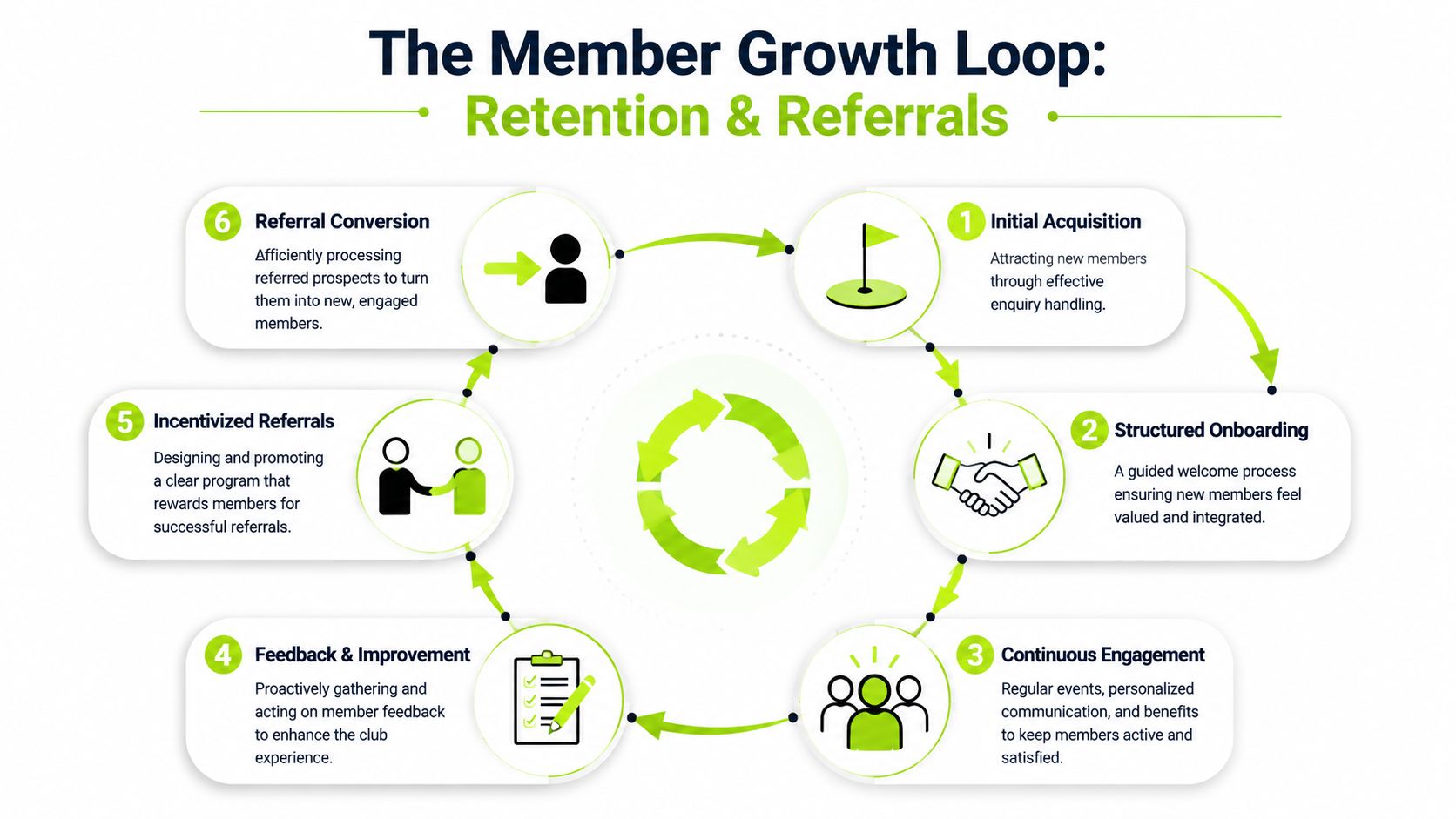
Join retention and referral into one loop
Retention and referral shouldn't sit in separate mental boxes.
Members who feel welcomed, seen, and guided are far more likely to stay. Members who stay and feel positive are more likely to recommend. Referred prospects who join need a strong onboarding experience so they become the next stable members in the cycle.
That loop only works when the club records actions and follows through.
If you want a practical rule, it's this: every saved renewal is growth, and every satisfied member should have a visible path to introduce someone else.
Stop Guessing And Start Measuring What Matters
If you only measure total members, you'll miss the underlying story until it hurts.
Member count is an outcome. It isn't a management tool. It won't tell you whether your enquiries are being ignored, whether visits are converting, whether flexible members are stalling, or whether one membership segment is carrying the club while another slips.
Track the engine, not just the result
By 2025, sentiment had improved, with 57.4% of golfers reporting growth at their clubs, and junior membership growth rising by over 10 percentage points, according to Golfshake's survey of club membership health in 2025. But the same survey found 81% of golfers expected fee increases in 2026. That means growth and affordability tension are now happening at the same time.
So don't settle for “members are up” as your only lens. You need to know which segments are growing, which ones are vulnerable, and where conversion is improving or weakening.
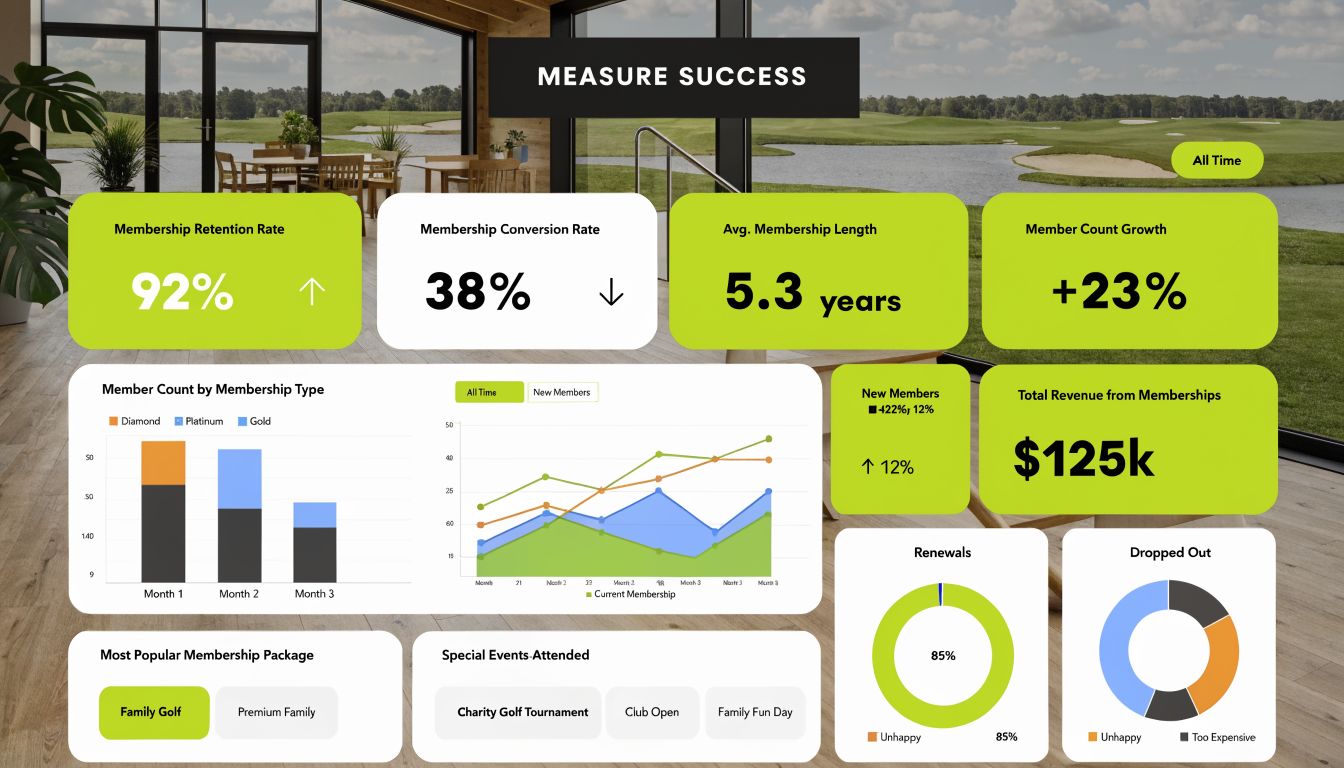
The KPIs worth looking at weekly
You don't need a complicated dashboard. You need a useful one.
Focus on these measures:
Enquiry volume by source
Website, social, referral, walk-in, phone, campaign. If you don't know the source, you can't judge quality.Enquiry-to-visit conversion
How many prospects moved from interest to an actual visit, tour, or membership conversation.Visit-to-join conversion
Whether your in-person sales process is working.Renewal rate by segment
Not one blended number. Break it down by category where possible.Flexible-to-full progression
A vital indicator if you offer multiple pathways.Reason for loss
Price, timing, wrong category, no response, no perceived value, chose another club.
Keep the dashboard understandable
A club manager shouldn't need a data analyst to run this.
Use a short monthly view like this:
| Metric | Why it matters | Basic question to ask |
|---|---|---|
| Enquiries received | Shows demand flow | Are we attracting enough interest? |
| Enquiries contacted | Shows handling discipline | Did we actually reply to everyone? |
| Visits booked | Shows movement | Are prospects progressing? |
| Memberships sold | Shows conversion outcome | Are visits turning into joins? |
| Renewals completed | Shows retention strength | Are current members staying? |
| Segment movement | Shows strategic direction | Are juniors, women, flexible members, or full members moving up or down? |
A useful next step is to build reporting around the same principles discussed in this guide to data-driven golf marketing, where visibility matters as much as activity.
What gets measured at the right stage gets improved. What gets reviewed only at year end becomes a surprise.
Use the numbers to make better decisions
Measurement should change behaviour.
If enquiry volume is healthy but visits are low, your follow-up is weak. If visits are strong but joins are poor, your sales conversation or membership fit is off. If renewals are slipping in one category, don't increase fees blindly. Check whether that group has a value perception issue, a usage issue, or a product mismatch.
The goal isn't more reports. It's fewer guesses.
Once a club can see the path from first contact to recurring revenue, decisions become calmer and more accurate. That's when growth starts to feel predictable.
Conclusion From Reactive Firefighting to Predictable Growth
Membership decline rarely gets fixed by shouting louder in the market. It gets fixed by removing friction inside the club.
The priority order is clear. Diagnose the leaks. Centralise enquiry handling. Build a real membership journey instead of a static price list. Run retention and referrals through systems, not memory. Measure pipeline health, not just end-of-year totals.
Clubs don't need more random activity. They need a repeatable way to capture interest, follow up properly, convert with confidence, and retain members with intent. That's how reactive firefighting turns into predictable growth.
If your club wants a clearer, more structured way to turn enquiries into visits, visits into members, and members into long-term revenue, GolfRep helps build the systems behind that growth. The focus isn't generic marketing. It's creating a predictable pipeline with proper follow-up, CRM visibility, and conversion processes that clubs can implement.
Ready to tap into our proven growth system?