Golf Club Instagram Ads: A Guide for UK Managers
Most advice on golf club Instagram ads starts in the wrong place. It starts with reach, reels, likes, follower growth, and content ideas. That advice isn't useless, but it misses the commercial problem most clubs have.
The hard part usually isn't getting somebody to raise a hand. The hard part is knowing who enquired, replying quickly, tracking what happened next, and moving that person from interest to visit to membership. If that system is weak, Instagram ads don't fix it. They just expose it.
For a UK club manager, that's the primary lens to use. Instagram is valuable because it's a visual, local-consideration channel where the course, clubhouse, food, events, coaching, and membership experience can be shown before a prospect ever speaks to the office. But the ad itself is only the front door. Predictable growth comes from the full pipeline behind it.
The Real Problem With Golf Club Instagram Ads
The most common brief clubs give is simple: "We need more enquiries."
Sometimes that's true. Often it isn't.
Many clubs already generate interest through social, referrals, website traffic, open events, visitor play, and local awareness. What they don't have is a reliable process for capturing that interest, responding properly, and converting it into booked visits and signed members. That distinction matters because Instagram can generate attention quite quickly, but attention without process rarely turns into revenue.
Why more leads can make things worse
If a club sends paid traffic into a weak follow-up process, three things usually happen:
- Enquiries get missed: inboxes fill up, website forms go to one person, and nobody has clear ownership
- Response times drift: prospects go cold while staff are on the course, in meetings, or dealing with day-to-day operations
- No one sees the full picture: marketing, membership, and admin all hold fragments of the same lead journey
The result is familiar. The ads appear busy. The club sees clicks, messages, and maybe a rise in form fills. But nobody can say with confidence which campaign produced booked tours, which postcode areas convert well, or which prospects need another follow-up.
Instagram ads should be treated as a local demand-capture system, not a content calendar.
That is the part most generic advice skips. In the UK, Meta's ad ecosystem is still powerful, but clubs increasingly need lead forms, instant follow-up, and CRM integration to convert interest into actual visits. Without that, Instagram often stays stuck as an awareness channel with weak return. That wider point is worth keeping in mind when reviewing why most golf club marketing fails.
Vanity metrics don't pay the subscription
Likes can be useful feedback. Comments can signal interest. Follower growth can show that your content is landing.
None of those metrics tell you whether the club has built a pipeline.
A committee might feel reassured by a polished reel with strong engagement. A manager might feel the campaign is working because the post "did well". But if the same club can't tell which enquiries booked a visit, which visits became members, or which source produced the best quality lead, then the marketing is still being judged at the wrong level.
A better question is this: when someone clicks an Instagram ad, what happens next, and who owns that journey?
That's where golf club Instagram ads either become a steady acquisition channel or another line item that feels difficult to justify.
Setting Your Campaign Foundations for Success
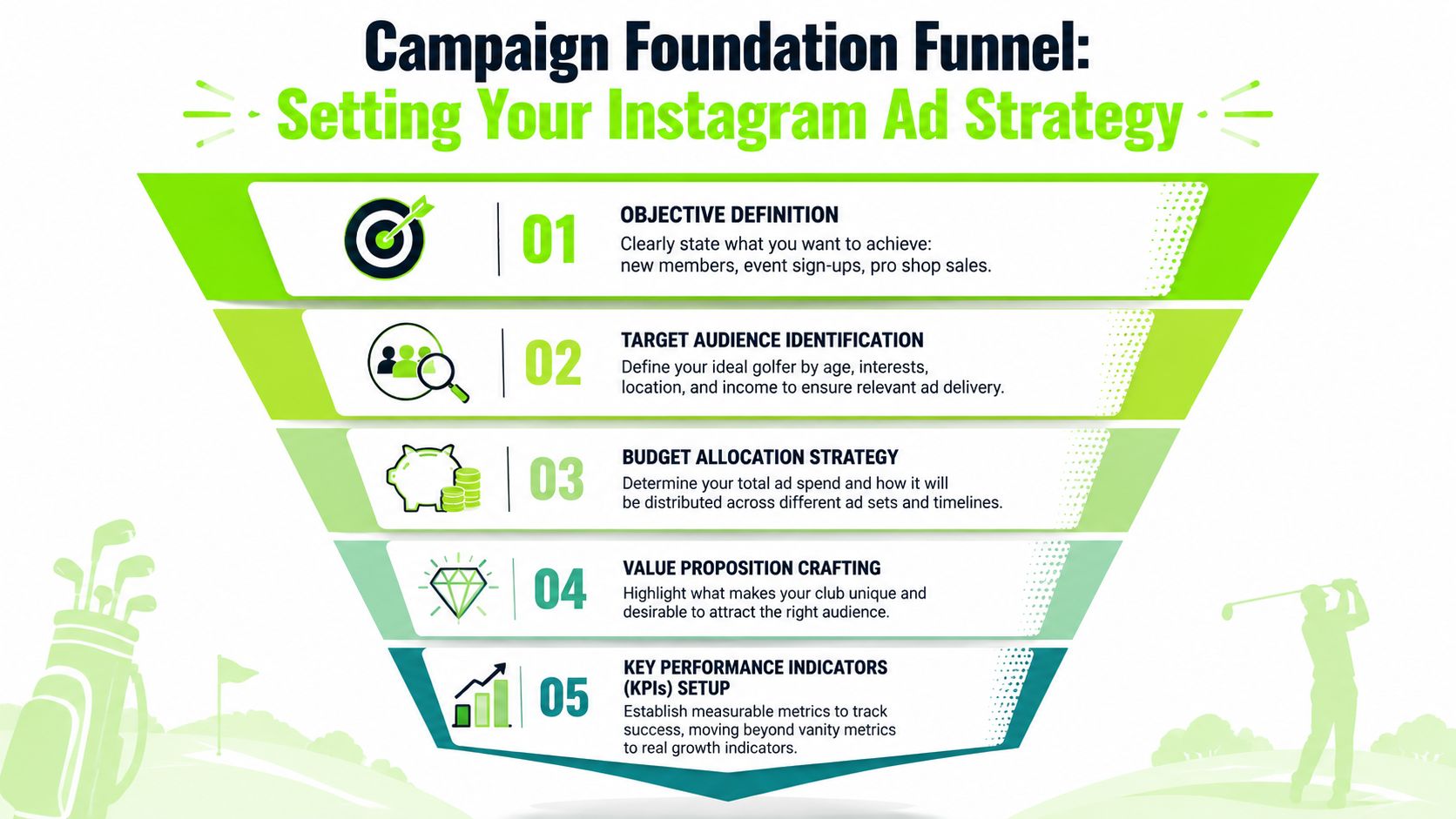
Before spending anything, get the campaign architecture right. Most wasted budget comes from weak foundations, not weak media buying.
Start with one commercial objective
Don't ask one campaign to do five jobs.
If you want golf club Instagram ads to perform, each campaign should be tied to a single business outcome. That might be membership enquiries, open day registrations, academy bookings, society leads, or visitor rounds. The mistake is bundling all of that into one vague brief such as "promote the club."
A clean setup usually looks like this:
- Membership campaign: focused on joining, tours, and information packs
- Event campaign: built around one date and one registration action
- Visitor campaign: aimed at a specific playing experience or seasonal availability
- Coaching campaign: centred on beginner sessions, lessons, or group programmes
When the objective is blurred, the creative gets messy, the landing page becomes generic, and staff don't know how to handle the incoming lead.
Build around the local buyer, not the imagined one
A lot of advice still treats Instagram as if it's only for younger golfers. That misses the membership reality.
As noted in Divot Collective's short-form content strategies for golf courses, England Golf says the membership base is heavily concentrated in older adults. That's why the better question isn't how to get more likes. It's how to show value, social proof, and ease of joining to a time-poor, premium-seeking adult in the local catchment.
That changes how you target and how you write.
Instead of chasing broad interest, define a realistic travel shed around the club and think about the buyer in practical terms:
| Audience factor | Better planning question |
|---|---|
| Geography | Who will realistically drive to the club regularly? |
| Life stage | Are they buying for themselves, a partner, or a family? |
| Intent | Are they comparing clubs, restarting golf, or moving area? |
| Value sensitivity | Do they want prestige, flexibility, community, or convenience? |
A useful outside reference for thinking about platform fit and message clarity is this entrepreneur's social media growth guide. Not because golf clubs should copy generic business tactics, but because it helps frame the difference between posting for attention and building a structured acquisition path.
Define the offer before the creative
Many clubs jump straight to imagery. The stronger sequence is objective, audience, offer, then creative.
Your offer doesn't have to mean a discount. In fact, for many private clubs, discount-led messaging attracts the wrong conversation. Better offers often reduce friction rather than slash price.
Examples include:
- Membership open day invitation: a low-pressure first step
- Request a membership pack: useful when the buyer needs time to consider
- Book a club tour: stronger for warmer audiences
- Try a taster round: helpful when experience is the barrier
Practical rule: If the prospect can't tell what to do next within a few seconds, the campaign isn't ready.
For a deeper look at how this applies inside Meta itself, see GolfRep's guide to golf club Meta ads. The principle is simple. Precision beats breadth. Clear intent beats busy promotion.
Designing Ad Creative and Copy That Connects
The best golf club Instagram ads don't look like adverts made by committee. They look like a believable preview of the club experience.
That matters because golf is a visual, emotional purchase. People aren't only assessing fairways and fees. They're judging atmosphere, standards, pace of life, social fit, and whether they can see themselves there.
Show the club, don't announce it
Promotional flyers dressed up as Instagram ads rarely work well. Static graphics packed with logos, prices, and too much text ask the audience to do too much too fast.
Short video is usually the better starting point. A practical benchmark from the USGTF guidance on social media marketing for golf professionals is to keep instructional video assets around 60 seconds or less, using them as a teaser that pushes viewers to a website or email list for the full explanation. For clubs, that translates well into ad creative built around one clear action.
Good examples include:
- a short walk-through of the first tee and practice area
- a membership manager introducing the club in plain English
- a quick sequence showing course condition, clubhouse, food, and social spaces
- a "meet the pro" clip tied to a beginner programme or coaching offer
What usually doesn't work is trying to explain the full membership structure, visitor pricing, event calendar, and heritage of the club in one ad.
Copy should narrow the decision
The copy has one job. It should help the right person take the next step.
That means writing for fit, not writing for applause.
A membership-focused ad might use language around convenience, quality of course, community, and ease of joining. A visitor campaign might lean into condition, welcome, and availability. An open day ad should be more direct and date-led.
A few practical principles help:
- Lead with the benefit: not the club's internal description of itself
- Keep one CTA: request a pack, book a visit, register now
- Match the audience tone: premium doesn't have to mean stiff
- Use proof points carefully: course views, clubhouse scenes, real staff, real members
Creative hygiene matters more than novelty
Clubs often ask whether they need polished production. Usually, they need relevance and consistency more than cinematic editing.
Use natural light. Film vertically. Keep clips steady. Avoid over-explaining. Most importantly, rotate themes so the audience doesn't keep seeing the same message.
If you need inspiration for writing tighter overlay text or post hooks, this list of Instagram captions for golf can be useful as a prompt library. The key is not to lift lines blindly. Adapt them to your club's tone and your specific offer.
One ad, one audience, one action. That's a better rule than trying to make every ad say everything.
Optimising The Path from Ad Click to Enquiry
A strong ad can still fail if it sends people to the wrong page.
This is one of the most expensive mistakes in golf club Instagram ads. A prospect clicks because the ad makes a specific promise, then lands on a homepage with twelve menu options, generic welcome text, and no clear next step. Interest leaks out immediately.
Why the homepage usually underperforms
In the UK, Instagram remains a major paid channel because golf is a visually driven, local-consideration purchase. Clubs can use paid Instagram ads to put their course, clubhouse, and events in front of local golfers before they ever visit the website or call the pro shop, as outlined in Lightspeed's guide to Instagram marketing for golf courses.
But that paid traffic arrives with intent shaped by the ad. If your ad promotes a membership open day, the landing page should continue that exact conversation. Not redirect it into the full website.
A campaign page works better because it removes distraction and carries one message from click to form.
What a dedicated landing page needs
The page doesn't need to be clever. It needs to be aligned.
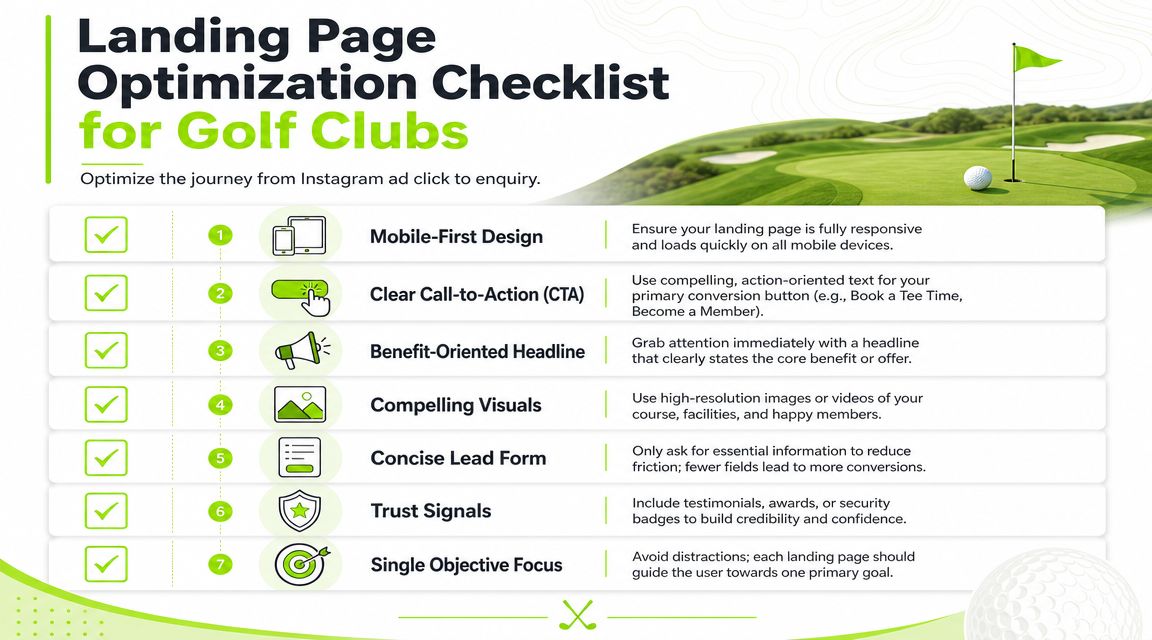
A useful checklist looks like this:
- Headline match: the first line should reflect the promise made in the ad
- Visual continuity: use imagery that feels clearly connected to what the prospect just saw
- Simple explanation: a few short benefit-led points beat long institutional copy
- Visible trust signals: testimonials, club atmosphere, staff credibility, or member experience
- Short form: ask only for the information needed to start the conversation
- Clear next step: tell them what happens after they enquire
A dedicated page also makes reporting cleaner. If traffic goes to one offer-specific page, it's much easier to see which campaigns drive qualified responses and where drop-off happens.
Friction kills intent
Every extra field, every confusing button, every vague promise lowers conversion quality.
A prospect who is casually browsing may tolerate a poor user journey. A prospect coming from paid traffic usually won't. They're deciding quickly whether the club feels organised, welcoming, and worth their time.
That's why the post-click journey deserves as much attention as the ad itself. If this is a weak area in your club, GolfRep's guide on golf club enquiry conversion is a useful reference point.
If the landing page asks the user to think too hard, the campaign has already lost momentum.
Turning Enquiries Into Members With a Growth System
An enquiry isn't the win. It's the handover point.
Many clubs then lose the value they paid to generate. The prospect fills a form, sends a message, or requests a pack, and then the process becomes manual, inconsistent, and hard to see. One staff member replies quickly. Another waits until the next morning. A third assumes someone else has already handled it.
Every lead needs a system of record
If you can't see every enquiry in one place, you can't manage pipeline properly.
That means connecting your forms, Meta lead flows, website actions, and follow-up activity into a CRM or central lead system. The point isn't software for software's sake. The point is visibility.
You need to know:
| Pipeline question | Why it matters |
|---|---|
| Who enquired? | Basic lead ownership |
| Which campaign drove it? | Better budget decisions |
| Has anyone replied? | Prevents lead decay |
| What happened next? | Tracks movement to visit |
| Is follow-up complete? | Stops leads falling through gaps |
Without that structure, clubs rely on memory and inboxes. That's fine at low volume. It breaks as soon as campaigns become consistent.
Speed and sequence beat ad spend
The clubs that convert well don't just generate demand. They handle it properly.
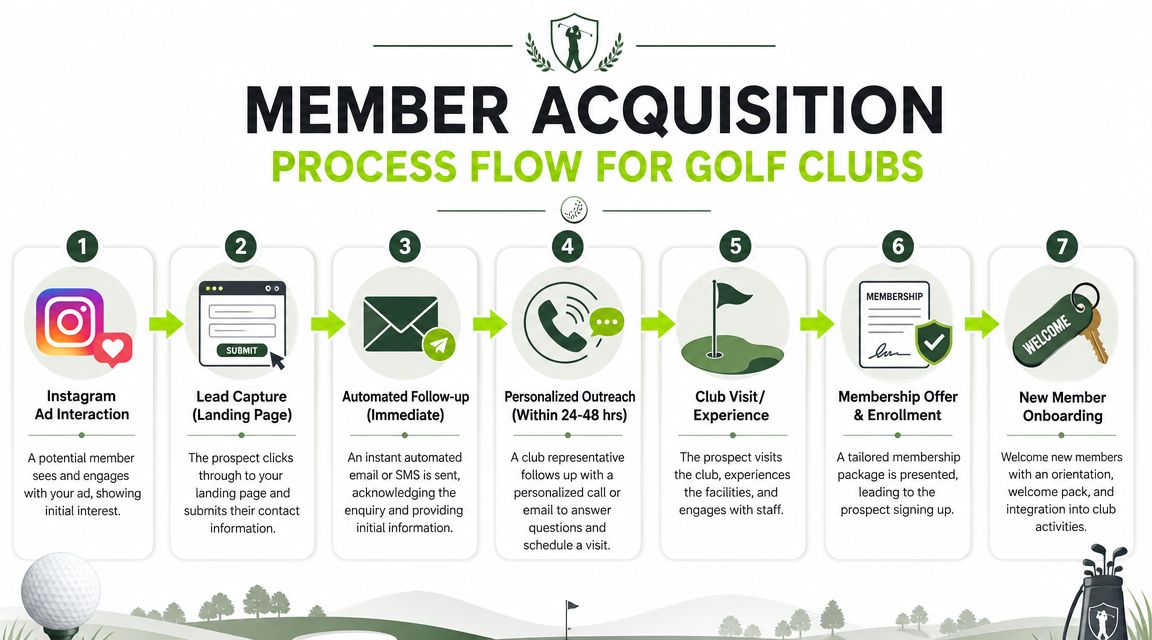
A good process often includes:
- Immediate acknowledgement through email or SMS so the prospect knows the enquiry has been received.
- Fast personal contact from the right club representative while intent is still fresh.
- Clear invitation to the next step such as a call, a tour, an open event, or a taster round.
- Nurture follow-up if the prospect isn't ready to decide immediately.
- Status tracking so no one is overlooked.
This matters more than many clubs realise. A lot of prospects aren't saying "no". They're delaying, comparing, discussing with a partner, or waiting for the right moment. Structured nurture keeps the club present without becoming pushy.
Build for the real buying cycle
Membership decisions are rarely instant.
Some prospects want a brochure and a month to think. Some want to visit next week. Some enquire after seeing an ad and then go quiet until the weather improves, their work schedule changes, or they revisit the idea later in the season.
That is why golf club Instagram ads work best as part of a wider operating system. The ad creates the opportunity. The follow-up sequence, CRM visibility, and consistent lead ownership create the conversion path.
Clubs don't usually have an enquiry problem. They have a lead-handling problem.
When managers shift their focus from "how many leads did we get?" to "how many quality leads moved to booked visits and membership conversations?", performance becomes much easier to improve.
Measuring, Analysing, and Optimising for Growth
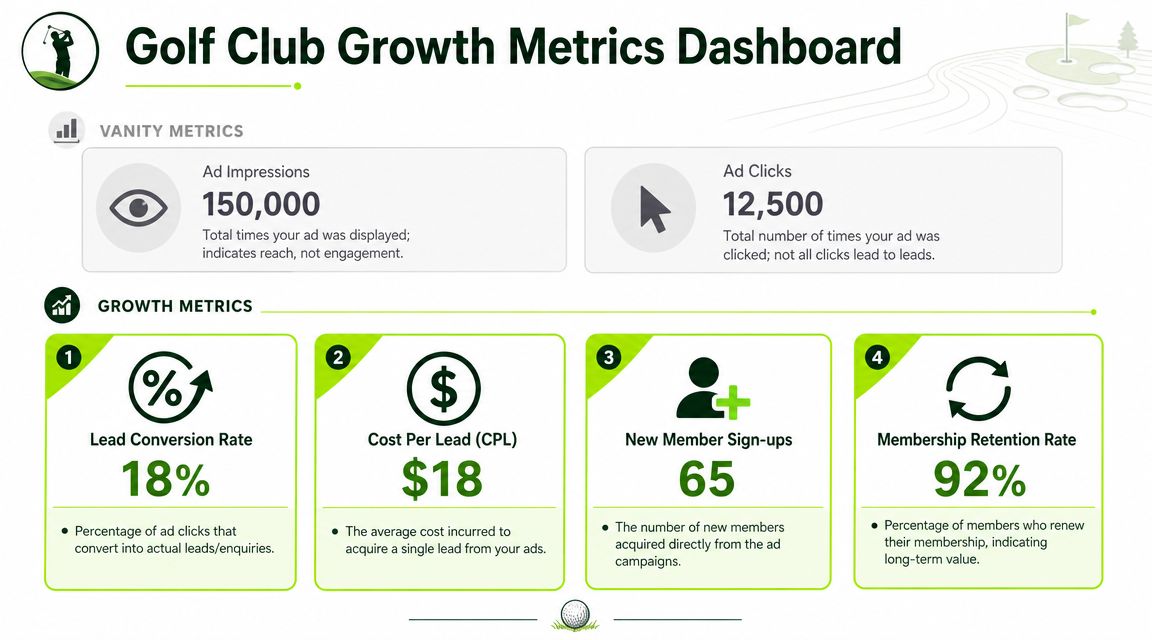
Measuring golf club Instagram ads by clicks, comments, or follower growth gives an incomplete view of performance. Those numbers can show that people noticed the ad. They do not tell a club manager whether the campaign is producing booked visits, membership conversations, or profitable growth.
Measure the full path, not the platform in isolation
Instagram should be measured as one part of the acquisition system. That means tracking what happens after the click through Meta Pixel and Conversions API, then matching that data against what the CRM shows further down the line. A useful discipline is to scale spend only once the campaign is producing a healthy return, as discussed in this Instagram ads measurement discussion.
A common pitfall is optimising for easy platform signals because they arrive fast and look encouraging in Meta Ads Manager. Club revenue is shaped further down the path. Completed enquiries, booked visits, show-up rates, and joins are the numbers that justify budget.
That distinction matters in practice. I have seen campaigns with mediocre click-through rates produce strong membership pipelines because the audience was well matched and the follow-up process was tight. I have also seen campaigns with cheap traffic go nowhere because the enquiry path and CRM process were weak.
The metrics that matter
For most club managers, the key numbers start as operational measures and then flow into financial ones.
Track these consistently:
- Completed enquiries: not just form starts or landing page visits
- Booked visits or calls: a strong signal that lead quality is holding up
- Enquiry-to-visit rate: shows whether the post-click process is doing its job
- Visit-to-membership rate: shows whether the sales conversation and club experience are converting interest
- Return before scaling: use this as a control before increasing spend
The ad platform covers the early part of the journey. The CRM, sales tracking, and membership reporting need to cover the rest.
A simple decision framework
When results dip, diagnose the blockage before changing budget or creative.
| Symptom | Likely issue |
|---|---|
| High reach, weak response | Audience or offer is too broad |
| Good click volume, low enquiries | Landing page or form friction |
| Strong enquiries, few visits | Slow follow-up or weak nurture |
| Plenty of visits, low joins | Sales process, offer fit, or on-site experience |
Many clubs lose weeks. Creative gets changed first because it is visible and easy to edit. The harder truth is that performance problems often sit in the handoff between the ad, the enquiry form, the CRM, and the team responsible for follow-up.
Attribution also needs some maturity. Instagram can influence demand that converts later through branded search, direct traffic, or a phone call to the pro shop. If the CRM does not capture source context and progression, the campaign will look weaker than it is. If the CRM captures only the lead and not the outcome, the club still cannot judge profitability with confidence.
The clubs that improve month after month do not chase perfect attribution. They build tracking that is good enough to spot bottlenecks, hold the team accountable, and improve one stage of the pipeline at a time.
If your club wants a clearer system for turning social demand into booked visits and new members, GolfRep helps UK golf clubs build that pipeline with lead generation, CRM visibility, and structured follow-up that goes beyond vanity metrics.
Ready to tap into our proven growth system?