Why Is My Golf Club Losing Members and How to Fix It

Most clubs respond to falling membership by buying more attention. They print another leaflet, increase advertising, promote a joining offer, and wait for the enquiries to arrive. That advice misses the uncomfortable question: why is my golf club losing members when people are still playing golf?
The answer is often closer to home than a committee wants to admit. Prospects aren't answered quickly, follow-up depends on one busy secretary, taster rounds aren't designed to convert, new members aren't welcomed properly, and nobody can explain what happened to last month's enquiries. The club may have a marketing problem, but more often it has a conversion and retention problem.
The next member may already be in your inbox. GolfRep approaches club growth from that operational angle, combining lead generation with structured follow-up and CRM systems so managers can see what happens from first enquiry to membership and renewal.
The Uncomfortable Truth About Membership Decline
Falling membership doesn't automatically mean falling demand. England Golf data for 2025 shows that club membership in England reached 750,071, described as the highest level in at least 13 years, while broader participation reached 12.6 million adults in the last 12 months. The Golf Business coverage of the England Golf figures points to a market with plenty of golfers, not an empty pipeline.

That creates a serious management question. If participation is healthy while individual clubs lose committed members, the club isn't being punished by the market. It may be failing to turn casual play into membership, or failing to make existing members want to stay.
A major UK benchmark from BRS Golf illustrates the paradox. In Q1 2023, registered member numbers across its UK and Ireland club base fell by about 6,000 over three months. The losses were concentrated in England, Scotland, and Ireland/Northern Ireland, while Wales was flat. The GCMA summary of the BRS Golf membership figures records that 19% of the lost members came from England, 28% from Scotland, and 53% from Ireland and Northern Ireland.
The local effect can be severe. The same report noted 19 English clubs losing more than 100 members, with another 30 clubs losing between 50 and 100. That isn't a small reporting issue. It shows how quickly a club's base can erode when renewal decisions, enquiry conversion, and member experience aren't actively managed.
The numbers clubs usually don't track
Most committees know how many enquiries arrived. Far fewer know:
- How long each prospect waited for a response.
- How many booked a show round.
- How many attended but didn't join.
- Which follow-up messages they received.
- How many new members became active during their first few months.
- Why members who resigned decided to leave.
That gap creates false confidence. An enquiry count can look healthy while the club loses opportunities between the web form and the first visit. A renewal percentage can look reassuring while undecided members compare alternatives.
The operational reality: enquiries are only the top of the funnel. Membership is won or lost in the response, the visit, the welcome, and the follow-up.
The popular advice says the club needs more leads. The more useful diagnosis is usually this: the club needs lead visibility, faster responses, consistent follow-up, and clear ownership. Until those basics work, extra advertising feeds more prospects into the same leak.
Why Clubs Lose Members Even When Golf Is Booming
Golf clubs lose members for two broad reasons. Some problems sit outside the club, such as local demographics, a strong nearby competitor, a course closure, or a location that no longer suits the people who live around it. Other problems are internal and therefore fixable, but clubs often mistake them for market weakness.
Hillier Hopkins' Members' and Proprietary Golf Clubs Survey provides a useful warning. Average new joiners fell from over 90 in 2020 and 2021 to 70 in 2022, while average leavers rose from 35 in 2021 to 48 in 2022. In that survey, 23% of clubs reported more leavers than joiners in 2022, and 50% recorded an overall reduction in member numbers. The Hillier Hopkins golf clubs survey shows why acquisition alone isn't enough. Churn can overtake acquisition inside a single subscription cycle.
The internal causes tend to repeat. A web enquiry sits unanswered. A phone message goes to the wrong person. A visitor receives a tour but no clear next step. A prospect likes the course but can't understand the joining process. A new member pays, then struggles to find playing partners or discover events. Existing members face poor tee-time access, limited variety, or rising costs without a stronger sense of value.
A UK survey reported by Golf Business News found that 70% of clubs said subscriptions had decreased over the previous five years. Female membership was down at 75% of clubs, and youth membership was down at 60%. The Golf Business News report on the Sky Sports News club golf survey indicates that the decline isn't evenly distributed. Clubs need to know which groups are leaving, not just whether the total has changed.
Demand-side versus internal causes
| Cause Category | Examples | Typical UK Indicator | Where to Look First |
|---|---|---|---|
| Demand-side | Local population change, nearby competition, course closure risk | Fewer relevant golfers in the club's catchment | Catchment review, competitor comparison, local participation |
| Internal conversion | Slow replies, missed calls, weak show-round process | Enquiries exist but visits and joins remain unclear | Inbox, call logs, enquiry records |
| Internal experience | Poor onboarding, weak social integration, limited tee access | Members join but fail to become active | First-month contact, event attendance, tee-time feedback |
| Internal value | Pricing feels disconnected from access and benefits | Prospects hesitate or members delay renewal | Renewal conversations, exit reasons, usage patterns |
| Internal management | No owner, no CRM, manual follow-up | Staff give different answers and lose track of prospects | Process map, weekly pipeline review, source tracking |
Pricing still matters, but reducing fees isn't a complete retention strategy. If the club responds slowly, provides no social route into membership, and can't demonstrate access or value, a discount may attract a short-term joiner without fixing the reason members leave.
The practical conclusion is blunt. Retention is a systems problem before it's a budget problem. Give one person responsibility, track every stage, and make the member journey consistent enough that goodwill isn't the only thing holding it together.
Diagnosing the Real Problem in Your Club
A manager can diagnose most membership problems without buying specialist software first. Start with a four-layer audit that connects operational activity to member behaviour. The aim isn't to create a complicated report. It's to find the point where interest, attendance, engagement, or renewal breaks down.
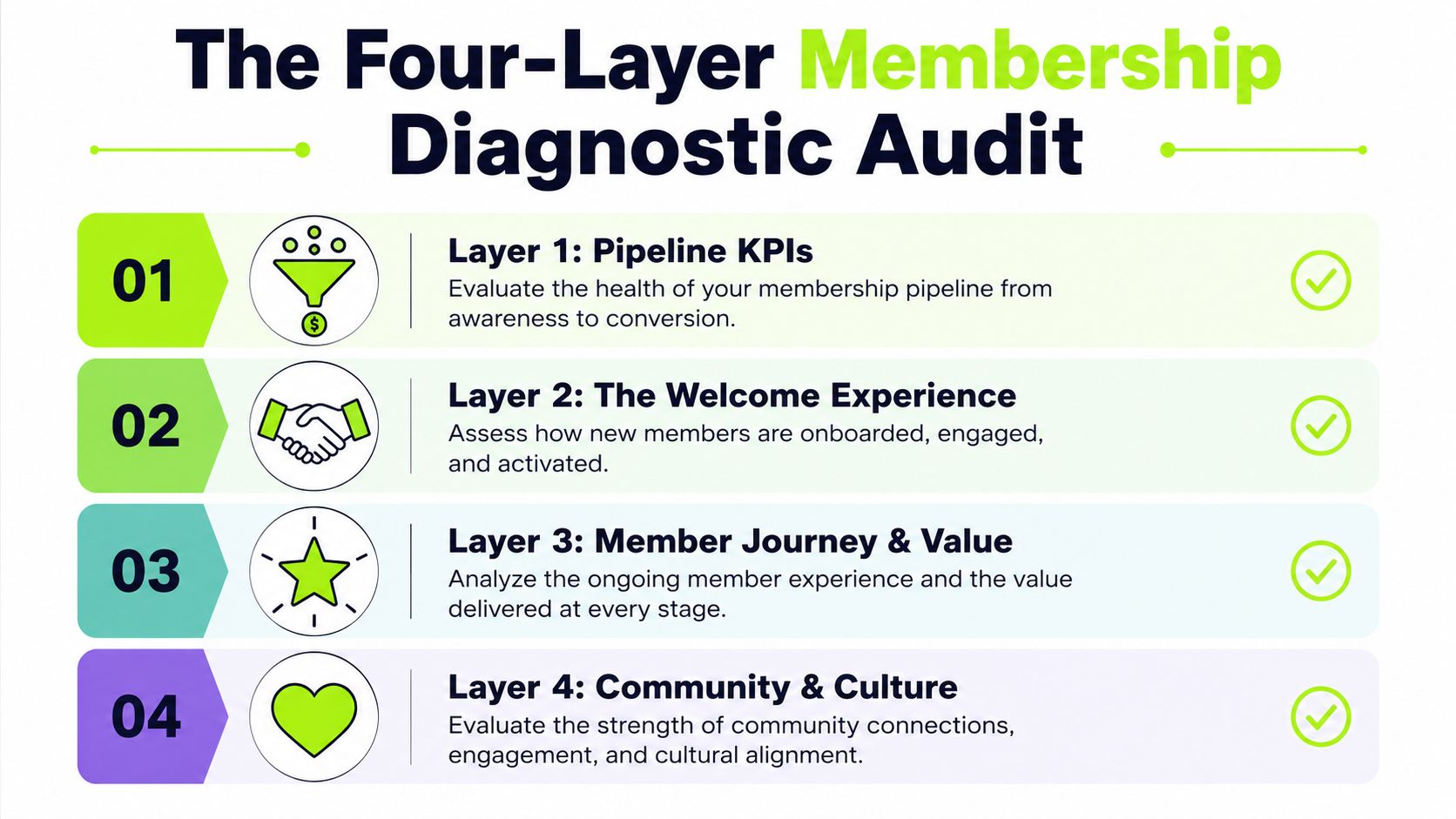
Layer one starts with the pipeline
Pull every enquiry from the website, phone, email, walk-in, social media, and referral sources into one sheet. Record the source, date, assigned person, first response time, show-round status, outcome, and next action.
A response-time target within two hours can provide a useful management standard, but don't treat the target as achieved because staff intend to meet it. Review timestamps. If the club can't prove when a prospect was contacted, it doesn't have response-time control.
Then check the journey:
- Enquiry to visit: Are prospects booking a show round or taster?
- Visit to join: Does the visitor leave with a clear membership recommendation and next step?
- Join to active member: Does the new joiner play, attend, and meet other members?
- First renewal: Which joining cohorts renew, and which disappear?
For a fuller view of member loss, use GolfRep's guide to golf club churn rate as a reference point for organising resignation and renewal data.
Layers two to four reveal the experience
Send a short pulse survey at 30, 90, and 180 days. Ask whether the member feels welcome, understands how to use the club, has found playing partners, sees value in the subscription, and intends to renew. Use a simple reason code for leavers, such as price, access, social fit, playing frequency, service, health, or relocation.
Next, compare join-date cohorts. A cohort that joins during an open day may behave differently from one generated through a referral. If one intake produces more inactive members, inspect the experience attached to that intake rather than blaming the members.
Finally, interview the staff who handle enquiries. Ask who owns the inbox, who returns missed calls, what happens after a taster round, and where the team records next actions. Managers should also look for hidden signals of team disconnection because inconsistent internal communication often appears to prospects as poor service.
A Monday audit can be completed with a spreadsheet and a quiet afternoon. Flag missing timestamps, unassigned enquiries, visits with no outcome, new members with no welcome contact, and leavers with no coded reason. Those gaps matter more than a polished committee presentation.
Short-Term Fixes That Stop the Bleeding
Clubs don't need a rebrand or a major course project to improve retention. A committee can change the operating rhythm within weeks if it assigns owners and measures the result.
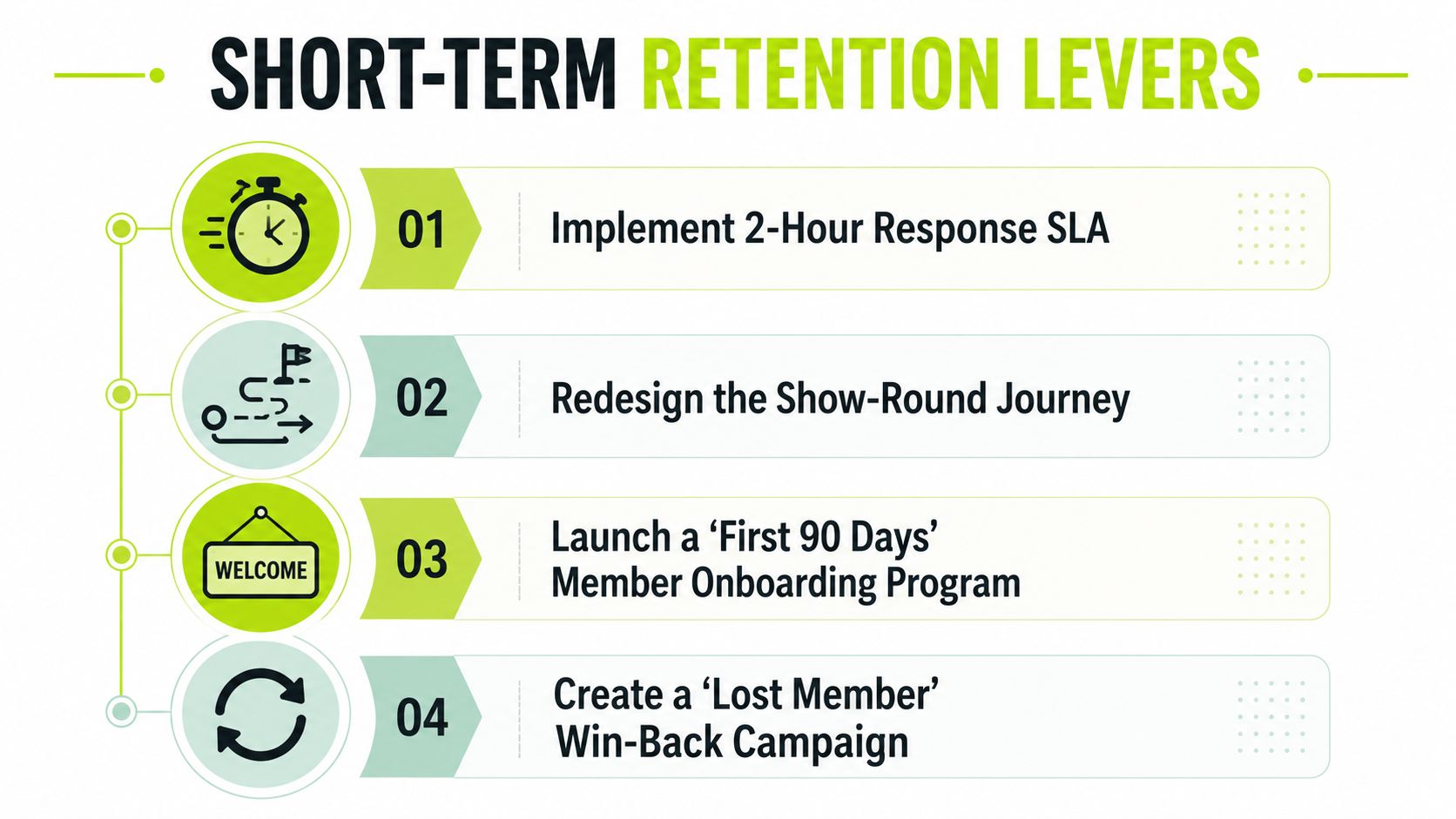
Make response speed a managed duty
Name one membership lead and one backup. Every enquiry should receive a prompt acknowledgement, a useful answer, and a proposed next step. A reply that says only “we'll get back to you” creates work without creating momentum.
Set a response standard within four working hours, with the more demanding internal aim of responding within two hours where staffing allows. Review performance weekly rather than relying on individual memory. A CRM can assign enquiries, display overdue tasks, and preserve the conversation when staff change.
Design the show round to sell the right membership
A show round isn't a guided walk around the property. Before the visit, ask how often the prospect plays, when they want to play, who they play with, and what has frustrated them about previous clubs. During the visit, connect the course and facilities to those answers.
End with a clear recommendation. If the visitor isn't ready, record the objection and schedule the next contact. Track the enquiry-to-visit rate and visit-to-join rate so the manager can distinguish a traffic issue from a sales-process issue.
Protect the first 90 days
New members need more than a welcome email. Give them a named contact, an introduction to suitable playing groups, a calendar of events, and a simple explanation of booking, competitions, practice facilities, and clubhouse routines.
Check in during the first month, then again before the member becomes disengaged. The relevant signal isn't whether the member opened a newsletter. It's whether they played, met people, and understood the value of belonging.
Re-engage before resignation
Build a list of members who haven't played recently, missed welcome events, or have raised an unresolved concern. Contact them with a relevant invitation, not a generic “we miss you” message. A low-pressure playing opportunity, social introduction, or conversation with the membership lead can reveal a solvable issue.
A structured golf club reactivation campaign can help organise this work. GolfRep's systems combine lead generation, CRM tracking, automated nurture, and follow-up workflows, but a club can apply the same discipline with a well-owned spreadsheet while it proves the process.
Practical rule: every prospect and every at-risk member must have a named owner, a recorded next action, and a date for that action.
What Predictable Membership Growth Looks Like in Practice
The strongest lesson from club growth work is also the least glamorous. Clubs improve when staff stop treating enquiries as isolated messages and start treating them as a pipeline with defined stages.
I won't invent before-and-after case studies or claim conversion gains that haven't been verified. The evidence available in the UK does support a different conclusion: clubs need to measure the movement from interest to membership and from membership to renewal, then change the part of the process that fails.
That makes the following comparison a management model, not a claim about a particular club.
| Metric | Before | After |
|---|---|---|
| Enquiry ownership | Shared inbox with unclear responsibility | Named membership lead and backup |
| Response visibility | Staff estimate speed from memory | Timestamp recorded for every contact |
| Show-round process | Tour ends without a defined next step | Visit includes needs questions, recommendation, and follow-up |
| Follow-up | Occasional manual reminders | Scheduled tasks and nurture stages |
| New-member experience | Welcome depends on individual staff | First-90-day contacts and introductions |
| Renewal insight | Resignations recorded as broad totals | Leavers coded by reason and cohort |
| Committee reporting | Enquiry volume and total members | Pipeline stages, activity, joins, engagement, and renewals |
The operating changes that matter
A private members' club should begin with CRM tagging. Separate sources, membership categories, visit status, objections, and next actions. This lets the manager see whether the club is attracting unsuitable prospects or failing to follow up with suitable ones.
A municipal-style club may need a clearer route from casual golfer to recurring member. A taster experience, flexible category explanation, and follow-up conversation can turn an occasional player into someone who understands why membership fits.
A multi-course group needs consistency across sites. Standardise response fields, follow-up stages, reporting language, and ownership while allowing each venue to present its own character. Central visibility prevents one location from losing opportunities that another location would have handled better.
The three signals of a working system are straightforward:
- Fewer unassigned enquiries and overdue follow-ups.
- More prospects moving from enquiry to attended visit.
- Clearer reasons for both joining and leaving.
The club doesn't need a clever campaign every quarter. It needs staff to complete the same important actions every week, then review what those actions produced.
Your 90-Day Membership Recovery Plan
A recovery plan should be simple enough to begin on Monday and specific enough to survive the next committee meeting. Assign an owner for every deliverable. If responsibility belongs to “the club”, it belongs to nobody.
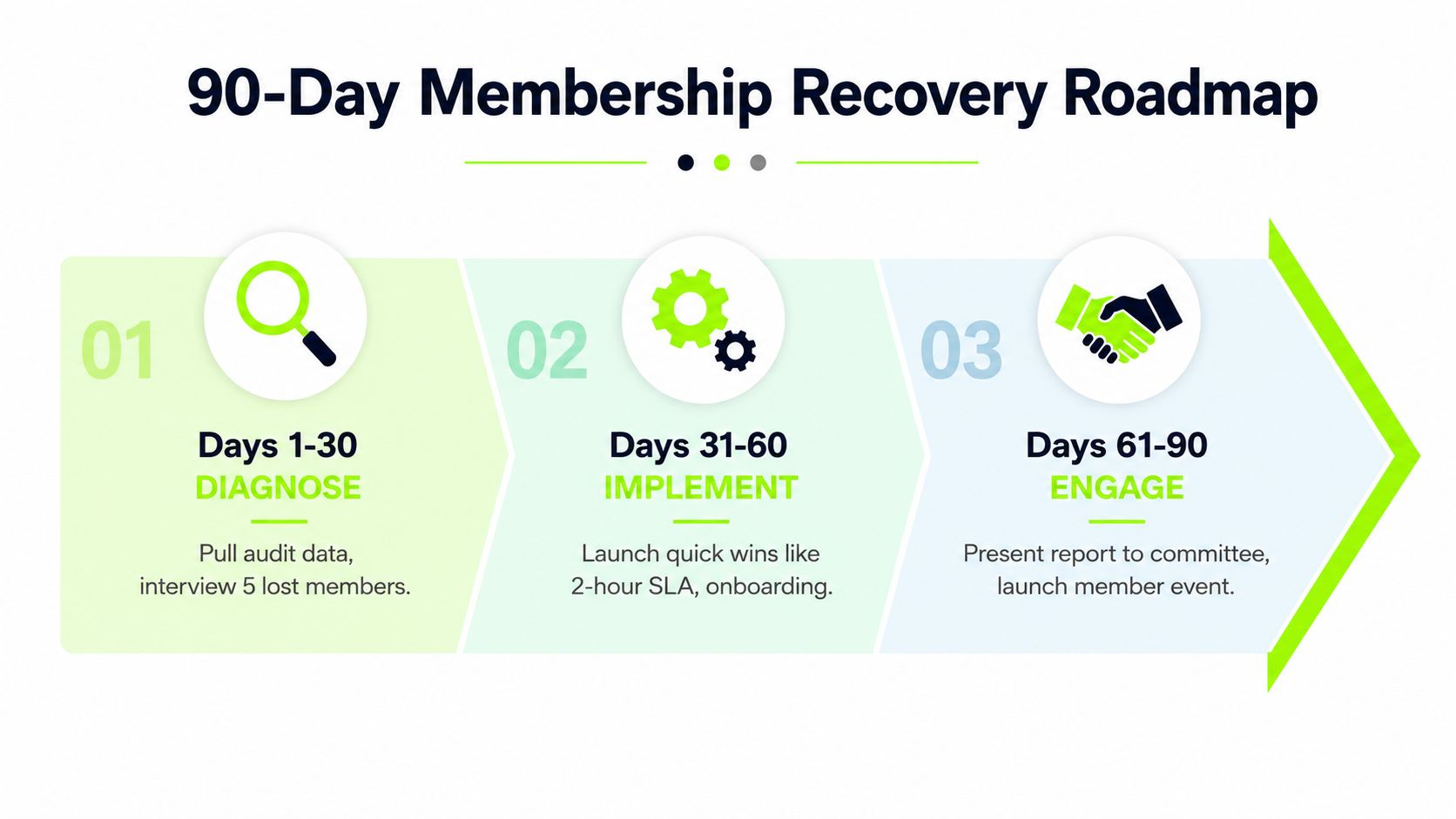
Days 1 to 30, diagnose
The general manager owns the audit. Export enquiries, membership records, resignations, and renewal information into one working file. The membership lead maps the current journey from first contact to joining, including every handover and delay.
Run a short 10-question member survey covering welcome, access, value, social connection, communication, playing frequency, and renewal confidence. Speak directly with recently lapsed members where possible. The deliverable is a one-page diagnosis showing the biggest pipeline gap and the most common retention concerns.
Use a basic spreadsheet if the club has no CRM. The visible outcome should be agreement on one priority, not a long list of ambitions.
Days 31 to 60, fix the pipeline
The membership lead owns response standards, follow-up sequences, and taster-round changes. The golf professional, front-of-house team, and membership committee should agree what each person does before, during, and after a visit.
Create enquiry stages such as new, contacted, visit booked, visited, considering, joined, and closed. Add next-action dates. Introduce first-month and first-quarter welcome contacts, then track whether new members play and engage.
Managers who need more acquisition alongside better conversion can review how to generate 50 golf membership enquiries in 90 days, but extra enquiries should follow process improvements, not replace them. The visible outcome is a pipeline where every open opportunity has an owner and a next step.
Days 61 to 90, scale what works
The general manager chairs a weekly pipeline meeting. Keep it short. Review new enquiries, overdue actions, visits, joins, inactive new members, resignations, and reasons for loss.
The committee receives a monthly dashboard, not a collection of anecdotes. Run a re-join campaign for recently lapsed members, using the coded reasons from the audit to make the message relevant. Invite the wider membership to a well-organised event that helps existing members reconnect, rather than treating events as standalone entertainment.
Print a dashboard with these fields:
- Enquiries by source.
- Response time and overdue actions.
- Visits booked and attended.
- Membership joins.
- New-member activity.
- At-risk members contacted.
- Resignations by coded reason.
- Renewal confidence.
The final deliverable is a repeatable management routine. The visible outcome is that the club can explain what changed, who owns it, and what the next decision should be.
Building a Club That Stops Losing Members for Good
A discount can create a spike. A leaflet campaign can create attention. A committed secretary can rescue a busy month. None of those things creates durable membership stability on its own.
The clubs that protect themselves install a repeatable operating system. Every enquiry is captured. Every prospect receives a timely response. Every show round has a planned next step. Every new member receives structured onboarding. Every resignation carries a useful reason. Every week, someone reviews the pipeline and acts before a problem becomes a resignation.
The membership profile makes this especially important. Hillier Hopkins reported that 64% of golf club members were aged 51 and over, while female membership represented 18% of total membership and junior membership represented 9%. Golf Business News' summary of the Hillier Hopkins survey shows why clubs need deliberate replacement and inclusion strategies rather than hoping the next generation will appear automatically.
Retention also sits in the middle of the member journey. Current members may feel positive yet remain vulnerable to cost pressure, limited tee-time access, playing less often, wanting more variety, or dealing with health issues. UK survey coverage reported that 77.9% said they would definitely renew, while 18.3% were undecided, with those concerns among the main reasons for doubt. Golf Business coverage of the cost-of-living pressures facing clubs highlights the risk in that undecided group. They haven't resigned, but they still need attention.
The standard a committee should expect
A healthy club should be able to answer five questions at any time:
- Who owns each open enquiry?
- How quickly did the club respond?
- What stopped each non-joiner from joining?
- Which new members show signs of weak engagement?
- Why did each recent leaver decide not to renew?
If the answers rely on memory, the club doesn't have a membership system. It has a collection of individual efforts.
GolfRep helps clubs build predictable pipelines by combining lead generation with structured follow-up, CRM visibility, automated nurture, and conversion tracking from first enquiry through to membership. Visit GolfRep to assess where your club's enquiry and retention process is leaking, then turn that diagnosis into an owner-led improvement plan.
Ready to tap into our proven growth system?