Predictable Golf Club Revenue Growth: 2026 Strategy Guide

Most advice regarding golf club revenue growth begins in the wrong place. It suggests that clubs should purchase more advertisements, increase social media activity, or launch another membership promotion. That approach appears logical until you examine what happens inside most clubs after an enquiry arrives.
A prospect fills in a form on Friday evening. Someone emails on Saturday morning asking about trial rounds. A society organiser phones during the lunch rush. By Monday, nobody's quite sure who replied, what was said, or whether that person ever booked a visit. The issue isn't always demand. It's the gap between interest and follow-up.
That gap is where revenue leaks.
The Real Reason Your Golf Club Is Not Growing
Most clubs don't have a lead generation problem first. They have a lead handling problem.
A club secretary is covering admin, phone calls, diary changes, visitor bookings, competition queries, and member issues. In that environment, new enquiries get treated like interruptions rather than revenue opportunities. They sit in an inbox, on a voicemail, or in someone's memory.
That creates a predictable pattern. Marketing brings attention. Enquiries come in. Staff respond when they can. Some prospects go cold. Others join the club down the road because that club replied first and made the process easier.
What clubs often misdiagnose
Managers often say, "We need more leads."
Sometimes that's true. More often, the club already has enough interest to grow, but not enough structure to convert that interest consistently. If a prospect has to wait days for a reply, repeat their details twice, or chase for a visit, the club has made buying harder than it needs to be.
Practical rule: If your team can't see every enquiry, assign ownership fast, and follow up without relying on memory, growth will stay erratic.
This is why GolfRep's view is simple. Predictable golf club revenue growth comes from systems, not bursts of activity. Good advertising matters, but only when the club has a reliable way to capture, respond to, and convert the demand it creates.
The hidden cost of manual follow-up
Manual processes feel manageable until the club gets busy. Then they break.
Common signs include:
- Missed first contact: Calls go unanswered and email replies drift.
- No lead visibility: Nobody can say how many membership, society, or event enquiries came in last month.
- Inconsistent follow-up: One prospect gets a tour invitation. Another hears nothing.
- No accountability: Enquiries belong to "the office" rather than a named process.
A club's reputation also gets shaped by these moments. Slow replies, unclear communication, and patchy service affect trust before a visit ever happens. If you're reviewing how your club comes across online as well as offline, these local business reputation management tips are useful because they connect response standards, review handling, and customer perception in a practical way.
Growth usually improves when clubs stop asking, "How do we get more attention?" and start asking, "What happens in the first hour after someone shows interest?"
Beyond Generic Ads: Targeting High-Value Local Golfers
Broad advertising wastes budget. Golf club revenue growth comes from attracting people who are both likely to join and realistically able to use the club.
That usually means local golfers within a sensible drive time, not anyone who happens to click an ad. The strongest campaigns focus on intent, location, and fit.

Start with your ideal member profile
Before spending a pound on Google or Meta, define who you're trying to attract.
A useful profile includes:
- Location: People within a practical travel radius for regular play.
- Playing pattern: Frequent golfers, returning golfers, or lapsed members from nearby clubs.
- Commercial fit: Prospects who are aligned with your fee structure and club culture.
- Life stage: Retired golfers, working professionals, families, or beginners all respond to different messages.
The ad copy, landing page, and follow-up should reflect the audience. A private member club selling community, access, and quality shouldn't advertise like a discount visitor course.
Use local intent, not generic reach
The most effective campaigns narrow the field quickly.
A strong local acquisition setup often includes:
Google Search for active demand
Target people already searching for golf membership, local golf clubs, trial rounds, or society golf in your area.Meta for profile matching
Build audiences around the type of golfer you already serve well, then refine based on geography and likely interest.Geo-fencing and drive-time logic
Focus on golfers within a realistic radius, not a county-wide catchment that looks impressive in reporting but converts poorly.Lookalike audiences from existing member data
If your CRM or membership list is clean, you can use that data to help platforms find similar local prospects.
Better targeting doesn't just lower wasted spend. It improves lead quality, which makes every later stage of conversion easier.
Match the ad to the next step
Many clubs lose good traffic because the message and destination don't line up. An ad promising membership information should not send people to a generic homepage with no clear path forward.
The handoff needs to be clean:
| Ad promise | Better destination |
|---|---|
| Membership interest | Dedicated membership page with enquiry form |
| Trial round message | Landing page with visit or trial request |
| Society promotion | Specific society pack request form |
| Event interest | Event brochure or function enquiry page |
For clubs reviewing paid social specifically, this guide to Facebook ads for golf clubs is useful because it focuses on campaign structure rather than vanity metrics.
The point isn't to create more noise. It's to bring in the right people, in the right area, with a clear next action. Once that's working, you can scale with confidence. If it isn't, bigger budgets create a bigger admin burden.
Automating Enquiries to Maximise Conversion Rates
Fast response isn't a nice extra. It's part of the sales process.
In the UK golf market, clubs using data-led digital marketing with CRM automation have achieved an average return on ad spend of over 1,620%, and clubs that reduce enquiry response times to under one hour see conversion rates up to 30% higher than clubs averaging 30-hour response times, according to The Revenue Club's 2025 benchmark data. The same benchmark also notes that this approach can generate over 500 membership enquiries annually per club, with a 9% website conversion rate.
Those numbers matter because they confirm what most managers already suspect. Prospects don't wait patiently while the office catches up.
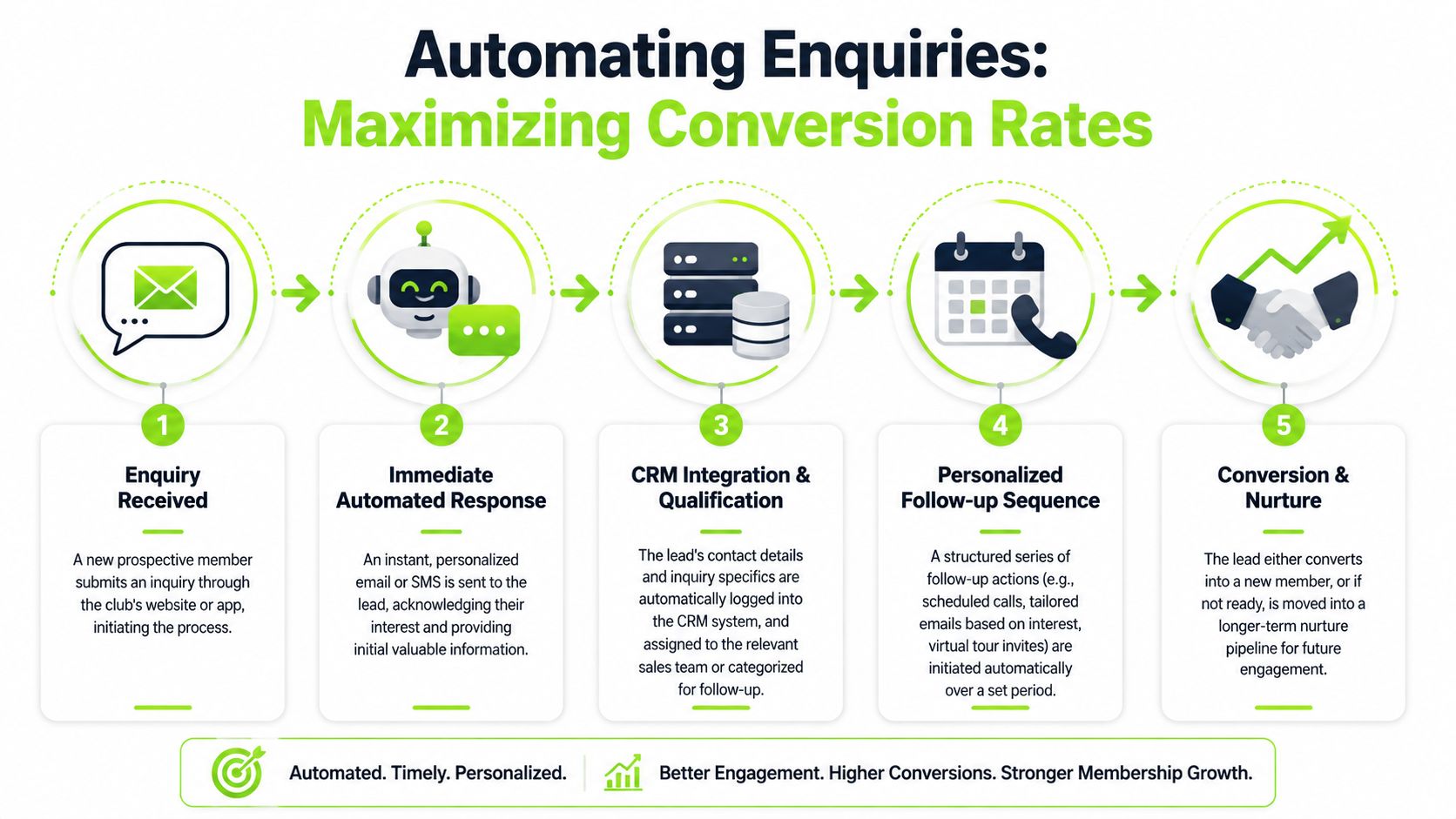
What automation should actually do
Automation isn't about replacing staff. It's about removing delay and inconsistency.
A sensible setup should:
- Acknowledge the enquiry instantly with an email, SMS, or web chat response.
- Capture key details such as membership interest, playing level, preferred joining timeline, and contact preference.
- Send the lead into a CRM so it isn't trapped in someone's inbox.
- Assign ownership so a member of staff knows what's theirs to follow up.
- Trigger the next step such as a visit invitation, brochure, or call task.
If you rely on a contact form that sends an email to a shared inbox, you don't have a system. You have a notification.
The first hour decides too much
Many clubs underperform in this area. They assume a prospect who is interested will still be there tomorrow.
Sometimes they will. Often they won't.
A membership enquiry usually comes with comparison shopping built in. The prospect is looking at several clubs, checking fees, location, availability, and feel. The club that replies quickly, answers clearly, and offers a simple next step gains an advantage before any sales conversation starts.
The winning club is often the one that makes it easiest to move from curiosity to visit.
That doesn't require a large sales team. It requires a reliable process.
A practical automated flow
A good enquiry workflow looks more like an operations system than a marketing campaign.
| Stage | What happens | Why it matters |
|---|---|---|
| Enquiry submitted | Web form, chatbot, or landing page captures the lead | No manual rekeying |
| Instant acknowledgement | Personalised confirmation goes out immediately | Prospect knows they've been seen |
| Qualification | Questions sort membership, society, and event intent | Staff time goes to the right enquiries |
| CRM assignment | Lead is tagged and routed | Nothing gets lost |
| Follow-up task | Call, email, or visit invitation is scheduled | Momentum continues |
Clubs can build this with tools such as HubSpot, connected forms, chat automation, and booking workflows. Golf club automation systems are worth reviewing if you want a clearer picture of how these processes fit together in a club environment.
GolfRep works in this part of the stack by combining lead generation with automated qualification and CRM follow-up, which is often the missing piece for clubs that already get enquiries but don't convert enough of them.
What doesn't work
The weak version of automation is just an autoresponder saying, "Thanks, we'll be in touch."
That isn't enough. Good automation should move the prospect forward, not just confirm receipt.
Avoid these traps:
- Generic replies: They acknowledge contact but don't answer the prospect's likely questions.
- No qualification: Every enquiry lands in the same pile, regardless of intent.
- No tracking: Staff can't tell which leads booked visits or became members.
- No service standard: The system starts well, then goes silent once a human step is required.
Automation works when it shortens response time, improves visibility, and gives staff a cleaner handover. Used properly, it doesn't make the club feel robotic. It makes the club feel organised.
Building Your Membership Nurture Pipeline
Most membership enquiries don't convert on first contact. Not because the prospect isn't suitable, but because timing, confidence, and comparison all get in the way.
A golfer might like the club and still need to think about cost, schedule a visit around work, speak to a partner, or finish a current membership elsewhere. If your follow-up depends on someone remembering to "check back next week", the pipeline will stall.

A realistic nurture sequence
A good nurture pipeline gives the prospect a reason to keep moving. It doesn't nag. It reduces uncertainty.
One practical sequence looks like this:
Day 1
Send a welcome email with a short introduction to the club, a clear summary of membership options, and a virtual tour or photo-led overview.Day 3
Follow with a message that answers common objections. This can include a member testimonial, playing flexibility, or what the joining process looks like.Day 7
Offer a concrete next step such as a trial green fee, hosted visit, or meeting with the membership team.Day 14
Send a direct call to action to book a site visit or speak to the club.
That structure reflects the follow-up pattern described in the benchmark methodology from the earlier source, but what matters most is consistency. Every prospect should get the same baseline experience, with personalisation added where relevant.
What a good CRM changes
Without a CRM, follow-up lives in inboxes, notebooks, and memory. With a CRM, the club can see where each prospect sits.
That changes behaviour in practical ways:
- The team sees open enquiries clearly rather than searching through email chains.
- Tasks get assigned so no lead sits unowned.
- Communication history stays visible even if more than one staff member is involved.
- Prospects can be segmented by membership type, urgency, or source.
Operational view: A nurture pipeline isn't sales theatre. It's a way of making sure genuine interest doesn't disappear between admin tasks.
Keep it personal without making it manual
Many clubs avoid structured nurture because they think it will feel impersonal. In practice, the opposite is usually true.
When repetitive tasks are automated, staff can devote their time to the moments that matter. A thoughtful call before a site visit. A personalized answer about competition access. A quick message after a trial round. Those touches are only possible when the routine communication is already handled.
A simple comparison makes the point:
| Manual follow-up | Structured nurture |
|---|---|
| Depends on staff memory | Runs on schedule |
| Replies vary by person | Core messaging stays consistent |
| Leads disappear quietly | Pipeline stages stay visible |
| Busy weeks break the process | System continues working |
The clubs that convert steadily don't chase harder. They build a rhythm that carries prospects from first enquiry to decision with less friction.
Pricing for Profit and Retaining Your Best Members
Discounting feels like action. It fills gaps quickly, gives committees something visible to approve, and can create a short burst of enquiries.
It also creates problems. It lowers perceived value, attracts price-led buyers, and makes it harder to protect future pricing. For golf club revenue growth, discounting is often the easiest lever to pull and the hardest damage to unwind.

Use pricing metrics that reflect reality
Clubs need pricing decisions tied to capacity and member value, not instinct.
Two useful measures are:
RevPARR Revenue per available round. This helps you understand what your tee sheet is producing, especially at peak times.
ARPM
Average revenue per member. This brings membership fees together with spend in areas like food and beverage or the pro shop.
These metrics push the conversation in the right direction. Instead of asking, "Should we cut prices to fill space?" the better question is, "Which inventory should be protected, and how do we increase value per member without hurting retention?"
What the benchmark data says
According to financial benchmarks adapted for UK golf club operations, UK premium golf clubs that keep annual membership churn below 8% can achieve a 35.8% EBITDA margin. The same benchmark states that ancillary revenue can contribute 15% to 27% of total growth, and that shifting 30% of peak tee times to direct, non-discounted bookings can increase average green fees by as much as 15%.
That tells you two things. First, retention is not a soft measure. It has direct financial impact. Second, direct control of premium inventory matters more than broad discount exposure.
A full tee sheet isn't automatically a healthy one. Margin depends on who booked, what they paid, and what they spent beyond the round.
Better options than blanket discounts
If pricing is under pressure, use structure instead of panic.
Consider approaches like:
Tiered membership design
Build options around usage patterns, access windows, and added value. Keep the ladder clear so members can move up, not just down.Peak-time protection
Reserve premium inventory for members and direct bookings rather than handing your best slots to discounted channels.Ancillary spend planning
Think beyond subscriptions. Coaching, retail, food and beverage, and hosted events all affect member value.Churn monitoring
Watch renewals closely. Exit reasons tell you more than casual complaints do.
For clubs thinking about recurring value and package design more broadly, these subscription pricing for industry groups offer a useful outside perspective on how tiering and retention logic can work without defaulting to cuts.
If you want to review where money is really being made across memberships, visitors, and secondary spend, this breakdown of golf club revenue structure helps frame the conversation.
Retention is a growth strategy
Clubs often put huge effort into replacing members they could have kept.
Retention improves when the club notices risk early. Reduced attendance, lower spend, repeated service complaints, or disengagement from competitions often show up before cancellation does. A decent CRM and a disciplined reporting rhythm make those signals easier to spot.
The strongest clubs don't just sell memberships well. They protect member value after the sale.
Your Golf Club Growth Implementation Checklist
A club doesn't need to rebuild everything at once. It does need to stop treating growth as a collection of disconnected tasks.
Use this checklist as an operational audit. If several boxes are unchecked, that's usually where revenue is being lost.
Targeting and ads
- Define your ideal member clearly by location, playing pattern, commercial fit, and lifestyle.
- Check campaign geography so ads focus on realistic drive-time audiences, not vanity reach.
- Align every ad with a dedicated landing page instead of sending traffic to a generic homepage.
- Separate membership, society, and event campaigns so messaging matches intent.
Lead response and automation
- Audit your actual enquiry response time across phone, email, forms, and social channels.
- Put instant acknowledgement in place so every lead gets a professional first response outside office hours.
- Add qualification questions to forms or chat flows to sort serious interest from general browsing.
- Make ownership obvious so each enquiry is assigned, not left in a shared inbox.
Manager's check: If you asked today how many live membership enquiries are waiting for follow-up, could someone answer immediately?
CRM and nurturing
- Use one visible pipeline for all active enquiries.
- Build a follow-up sequence with useful content, not repeated "just checking in" emails.
- Track visit bookings and sign-ups by source so you know which channels produce outcomes.
- Review lost leads monthly to identify where prospects stopped progressing.
Pricing and retention
- Review peak-time availability and decide which inventory should be protected from discounting.
- Assess membership tiers to make sure they support upgrades rather than cannibalising full-fee products.
- Track revenue beyond subscriptions so ancillary spend isn't left out of decision-making.
- Watch member churn closely and log the reason when someone leaves.
A club that follows this checklist won't solve everything overnight. It will, however, create the conditions for more predictable golf club revenue growth. That's usually the turning point. Less guesswork, fewer dropped enquiries, and better decisions based on what the club can clearly see.
Frequently Asked Questions About Golf Club Growth
We are committee-run and don't have a dedicated sales team. Can this still work
Yes. In fact, committee-led clubs often benefit the most from structure because too much knowledge sits with a few busy people.
You don't need a sales department to improve conversion. You need a clear process for who receives enquiries, how quickly the first reply goes out, where the lead is stored, and what follow-up happens next. Automation handles the repetitive parts. Staff or volunteers then step in at the points where personal contact matters.
The mistake is assuming that because the club is small, the process can stay informal. Informal systems break first.
We already have a website and booking software. Why add anything else
Because having tools isn't the same as having a joined-up system.
Many clubs have a website, a booking engine, and an email inbox, but no proper handover between them. An enquiry arrives, but nobody tracks whether that person booked a visit, came to the club, or joined. That's the gap.
The goal isn't to pile on more software. It's to connect forms, automation, CRM visibility, and follow-up so your team can see the whole path from first contact to revenue.
What if our budget is tight
Then focus on the leaks before the expansion.
If the club is already receiving a steady level of demand, improving response speed, visibility, and follow-up usually makes more sense than increasing ad spend. Tight budgets require prioritisation, and the first priority should be making sure existing opportunities are not being lost through delay or poor handling.
Start with the basics:
- Map your enquiry journey from first contact to membership decision.
- Measure response time across all channels.
- Set up a simple nurture flow for membership prospects.
- Review where discounting is replacing proper pricing discipline.
The clubs under the most pressure rarely need more activity first. They need better control of the activity they already have.
How long does it take to see whether the system is working
You can usually tell quite quickly whether operations are improving because visibility changes first.
The early signs are straightforward. Staff know how many enquiries are live. Follow-up stops depending on memory. Prospects get faster replies. Visit bookings become easier to trace back to source. Those operational improvements come before longer-term revenue gains, but they are what make sustained growth possible.
We don't want the club to feel too commercial. Will this make it feel impersonal
Not if it's done properly.
Good systems protect the club experience. They remove admin friction, stop prospects being ignored, and make communication more consistent. That gives your team more time for meaningful conversations, hosted visits, and member care.
A club feels impersonal when people have to chase for answers. It feels professional when the process is smooth.
If your club is generating interest but struggling to convert it into memberships, societies, and booked visits, GolfRep helps build the systems behind predictable growth. That includes targeted demand generation, faster enquiry handling, CRM visibility, and structured follow-up that fits how golf clubs operate.
Ready to tap into our proven growth system?