“What Actually Works in Golf Club Marketing in 2026”

Most advice about golf club marketing in 2026 still points to the same answer: get more leads.
That sounds sensible, but for most UK clubs it's the wrong diagnosis. Interest in golf isn't the core issue. The market is active, golfers are still searching, and clubs are already generating enquiries through websites, calls, social media, Google Business Profile, visitor bookings, and referrals. What separates a thriving club from a struggling one is usually what happens next.
A club can spend money on ads, improve its website, and sharpen its offers, then still underperform because leads sit in an inbox, get passed between staff, or receive a reply too late. That's not a traffic problem. It's an operating problem.
“What Works in Golf Club Marketing in 2026” isn't a list of shiny channels. It's a much simpler argument. Marketing works when a club has a reliable system for capturing, responding to, tracking, and converting interest. Without that, even good campaigns leak value.
The Real Challenge in Golf Club Growth Isn't What You Think
The common assumption is that clubs need to create demand.
The evidence says otherwise. On-course participation in the UK has surpassed 29 million golfers, marking the eighth consecutive year of growth, and the industry has logged over 80 million rounds played according to State of Golf 2026 market data. That matters because it changes the conversation. For many clubs, the market already wants to play.
The fundamental constraint sits inside the club.
Where clubs actually lose growth
Most lost revenue doesn't come from a weak advert. It comes from familiar operational gaps:
- Slow first response: an enquiry arrives on a Friday afternoon and no one follows up until Monday
- Poor lead visibility: one staff member has the email, another takes the call, and nobody sees the full history
- Inconsistent follow-up: a prospect gets one reply, then silence
- No conversion tracking: the club knows how many enquiries came in, but not how many became visits or members
- Manual handoffs: sales responsibility sits between the manager, secretary, membership chair, and pro shop
These gaps are easy to normalise because they often sit inside “how we've always done it”. But buyers don't experience it that way. They experience delay, uncertainty, and friction.
Most clubs don't have a lead generation problem. They have a lead handling problem that makes every marketing channel look weaker than it really is.
Why this matters more in 2026
The golfer considering membership today behaves differently from the traditional picture many committees still have in mind. Prospects compare clubs quickly, expect clear information, and often make their shortlist before they ever visit. If your club responds slowly, gives vague answers, or leaves people to chase, you train serious buyers to look elsewhere.
That's why the strongest clubs now treat growth as a process, not a campaign. They don't just ask, “How do we get more enquiries?” They ask better questions:
- How quickly do we reply?
- Can the whole team see every live enquiry?
- Do we know which enquiries are active, cold, booked, visited, or ready to join?
- Do we have a consistent follow-up sequence instead of relying on memory?
Those questions lead to much better results than debating whether to post more on Facebook.
Why Your Enquiry Handling Process Defines Your Success
A club's most valuable marketing asset isn't its logo, website, brochure, or social media account.
It's its enquiry handling process.
That process decides whether interest turns into visits, conversations, applications, and paid memberships. When it's structured, marketing becomes efficient. When it's loose and manual, every channel underperforms.

What a real enquiry system includes
A proper system doesn't need to feel complicated. It needs to cover a few essential elements well.
- Immediate capture: every form fill, phone enquiry, message, and referral should land in one visible place
- Fast acknowledgement: the prospect gets a prompt confirmation that the club has received the enquiry
- Clear ownership: one named person is responsible for the next action
- Defined follow-up: there's a sequence, not just a single reply
- Pipeline visibility: active opportunities are visible to staff and decision-makers
- Outcome tracking: the club can see which enquiries booked a visit, which stalled, and which converted
That sounds obvious. In practice, many clubs still run this from a shared inbox, handwritten notes, or disconnected spreadsheets. That creates avoidable drift.
Manual follow-up is where good leads go to die
The biggest mistake isn't bad intent. It's reliance on memory.
A manager means to call back after a meeting. A committee member plans to send pricing after the weekend. A prospect asks for a tour and nobody logs it properly. Weeks later, everyone assumes the lead “wasn't serious”.
Often the lead was serious. The process wasn't.
A helpful way to think about this is as a pipeline, not a pile of messages. Every enquiry should move through clear stages, with a next step attached. Clubs that want a practical example of how structured sequences work can review this automated lead follow up system guide. The principle is simple. Prompt reply, consistent nurturing, and visible ownership outperform ad hoc follow-up every time.
Practical rule: If a lead can enter your club without being visible to the right people, you don't have a marketing system. You have a blind spot.
The difference between activity and progress
Many clubs feel busy. Busy isn't the same as controlled.
A structured process lets the club answer useful questions at a glance:
| Question | Weak process | Strong process |
|---|---|---|
| Who enquired this week? | Someone has to check email and forms | Visible in one place |
| Who needs follow-up today? | Based on memory | Triggered by system |
| Who booked a visit? | Tracked unevenly | Clearly marked in pipeline |
| Which source produces members? | Largely unknown | Measured consistently |
That visibility changes decision-making. It stops the usual guessing and replaces it with facts from the club's own pipeline.
For clubs reviewing how they currently handle incoming interest, this deeper look at golf club enquiry conversion is worth reading because it focuses on the point where most revenue is won or lost.
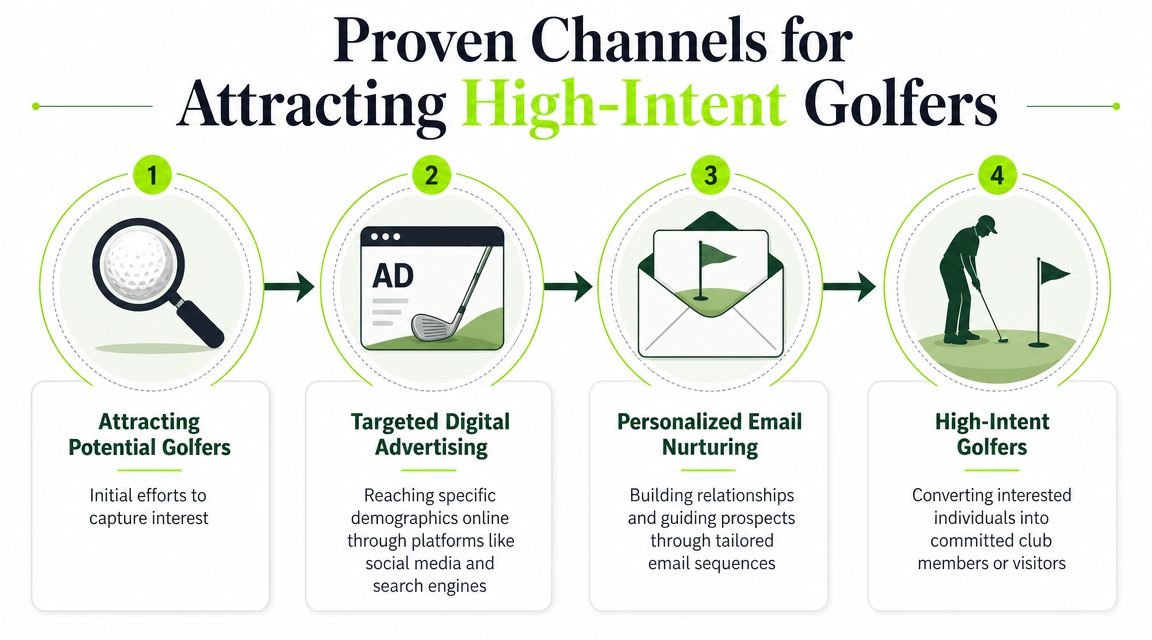
Proven Channels for Attracting High-Intent Golfers
Once the enquiry handling side is under control, channel performance improves quickly because the club can convert the demand it creates.
In practice, two channels continue to stand out for attracting serious prospects. AI-powered Meta advertising can deliver a 278% ROI with cost-per-lead under £15, while an optimised Google Business Profile can drive 3x higher visibility with 47% of that traffic converting to qualified leads, according to digital marketing benchmarks for golf clubs. Those figures matter, but only if the club has strong follow-up behind them.
Meta works when targeting is tight and the handoff is fast
Meta is effective for one reason. It reaches local golfers where they already spend time, and it allows clubs to present a clear reason to enquire.
The clubs that get results usually do a few things right:
- They use a specific offer: not “join our club”, but a clear membership conversation, visit invitation, or category-specific option
- They target locally: broad campaigns waste spend and generate weak intent
- They remove friction: simple forms, clear next steps, and mobile-friendly pages matter
- They connect ads to follow-up: the enquiry shouldn't sit waiting for someone to notice it
Generic awareness advertising lacks efficacy when it is not supported by an operational strategy. Many clubs execute attractive campaigns that produce early inquiries, but these efforts falter when follow-up procedures are inadequate. While the advertisement often receives the blame, the actual problem is typically found within the conversion path.
Google Business Profile catches buyers close to decision
Meta creates demand capture from interruption-based attention. Google Business Profile does something different. It catches intent that already exists.
When someone searches for a club near them, compares options, checks reviews, looks at photos, or wants basic membership information, your profile often becomes the first serious touchpoint. That makes profile quality commercially important, not just a housekeeping task.
Clubs that perform well on local search tend to keep the basics under control:
- Current photos: not just the course, but clubhouse, practice areas, and member atmosphere
- Accurate information: opening details, contact channels, and easy directions
- Consistent review generation: recent reviews carry weight
- Clear service signals: enough context for a prospect to understand the club quickly
A neglected Google Business Profile sends the same message as an unanswered enquiry. It tells the buyer the club is difficult to deal with.
The real trade-off with channels
The trade-off isn't paid versus organic. It's visibility versus readiness.
Paid channels can create momentum quickly. Organic local search often captures stronger intent over time. Most clubs need some mix of both. But if the back-end process is weak, adding more traffic increases the amount of value the club fails to convert.
That's why channel selection should follow three questions:
- Can we respond quickly to every enquiry that comes in?
- Can we track source to outcome?
- Can we nurture people who aren't ready to decide immediately?
If the answer is no, more spend won't fix the problem. Better handling will.
The Technology Engine Powering Predictable Growth
Clubs don't need a complicated technology stack. They need a practical one.
The modern golf consumer is increasingly digital. Off-course participation has reached 37.9 million, and 74% of golf shops are growing through digital self-service and technology integration, according to golf consumer behaviour data. That shift matters because buyer expectations formed outside the club now affect how people judge the club.
If someone can book, browse, compare, and communicate easily everywhere else, they expect the same level of convenience from a membership enquiry.
CRM means one version of the truth
For a club manager or secretary, a CRM is not a buzzword. It's the place where every enquiry lives.
Instead of searching email threads, checking form notifications, and asking colleagues for updates, the club can see:
- who enquired
- when they enquired
- what they asked about
- what has been sent
- who owns the next action
- where they sit in the pipeline
That level of visibility matters even more in committee-led clubs, where responsibility can be shared across several people. A CRM keeps the process from becoming personal and inconsistent.
For clubs thinking about how better reporting changes marketing decisions, this article on data-driven golf marketing is a useful reference point.
Automation handles speed and consistency
The simplest automation often creates the biggest improvement.
A prospect fills in a form asking about membership. Instead of waiting until staff are free, they receive an immediate acknowledgement, useful next-step information, and a prompt that a club representative will contact them. Internally, the right person gets notified and a task is created.
That doesn't replace human contact. It protects it.
Without automation, clubs rely on office hours and memory. With automation, the club responds the same way every time, even when the team is busy. That consistency is what turns a fragile process into a dependable one.
The point of automation isn't to sound robotic. It's to make sure no serious enquiry gets ignored while staff are doing other jobs.
AI should qualify and support, not confuse
AI gets discussed badly in golf marketing. Many clubs hear “AI” and assume it means gimmicks or generic chatbots.
Used properly, AI helps with practical jobs:
- sorting enquiries by intent
- drafting fast first responses
- flagging stale leads that need attention
- supporting personalised follow-up at scale
- summarising conversations so the team can act quickly
That matters because clubs often have limited administrative capacity. AI can reduce the burden of repetitive communication while keeping a prospect warm until a human conversation happens.
What technology should actually do for a club
If the stack is right, it should make these five things easier:
| Function | What it should achieve |
|---|---|
| Lead capture | Every enquiry enters one system |
| Response automation | Immediate acknowledgement and routing |
| Pipeline tracking | Clear stages from enquiry to member |
| Reporting | Visibility by source, status, and outcome |
| Nurture | Ongoing follow-up without relying on memory |
If technology adds complexity without improving those outcomes, it's the wrong setup.
What This Looks Like in Practice Three UK Club Case Studies
Theory matters less than execution. The clearest way to judge what works is to look at the pattern behind clubs that improved their position.

A club with interest but no control
One club had a familiar problem. Enquiries were arriving, but they were spread across forms, direct emails, and informal follow-up from different people. The committee believed awareness was the issue because membership growth had stalled.
The primary issue was visibility. Once the pipeline was centralised, follow-up responsibilities became clear and inactive leads were no longer lost in inboxes. The club didn't need more randomness at the top of the funnel. It needed order in the middle.
A club that needed steady pipeline rather than bursts
Another club didn't want occasional campaign spikes. It wanted a consistent flow of suitable prospects without having to rebuild the process every month.
The answer wasn't a bigger creative campaign. It was a repeatable system: clearer capture points, staged follow-up, proper reporting, and a reliable way to move prospects from enquiry to visit. That changed the quality of decision-making inside the club because everyone could see what was active, what had gone cold, and where attention was needed.
A club launching a focused membership push
A different example involved a club promoting a specific membership category. In many clubs, these campaigns fail because the messaging goes out but the handling remains generic. Prospects ask category-specific questions and receive slow or inconsistent responses.
The stronger approach was to build the campaign around the journey after the click. Enquiries were tagged correctly, relevant information was sent quickly, and follow-up matched the category being promoted. That alignment between message and process is often what makes a campaign commercially worthwhile.
Clubs rarely fail because nobody was interested. They fail because the buying journey felt vague, slow, or disconnected.
What the strongest examples have in common
Across different club types, the same principles show up:
- One pipeline instead of scattered enquiries
- Fast acknowledgement instead of delayed manual replies
- Defined stages instead of guesswork
- Consistent nurturing instead of one-off contact
- Reporting on outcomes instead of opinions
Clubs looking for real-world examples of how these systems are applied can review the broader golf club growth case studies available in the market. The important lesson isn't that every club should copy the same campaign. It's that clubs grow more predictably when they build the same operational discipline behind their marketing.
Building Your Growth Plan Budgets KPIs and Timelines
Most clubs don't need a complete overhaul. They need a disciplined starting point.
The first step is to stop measuring marketing by volume alone. More enquiries can feel encouraging, but they don't tell you whether the club is getting better at turning interest into revenue. The KPIs that matter are the ones that expose movement through the pipeline.
The KPIs worth tracking
This is the scorecard clubs should care about.
| KPI | What It Measures | Benchmark Target (2026) |
|---|---|---|
| Enquiry response time | How quickly a prospect gets an initial reply | As fast as operationally possible, ideally immediate acknowledgement |
| Enquiry-to-visit rate | How many enquiries progress to a club visit or serious conversation | Use your current baseline and improve it steadily |
| Visit-to-member rate | How well in-person interest converts | Track by membership category |
| Cost per enquiry | The cost to generate initial interest | Compare by channel, not in isolation |
| Cost per new member | The true acquisition cost | Use this as the commercial decision metric |
| Lead source conversion | Which channels create members, not just traffic | Review monthly |
| Pipeline ageing | How long leads sit without movement | Stale leads should trigger action |
| Follow-up completion | Whether planned contacts actually happen | Aim for consistency, not improvisation |
A useful companion read on interpreting early-stage buying signals is this guide to data-driven lead qualification indicators. It helps sharpen the thinking around what activity should trigger follow-up and what should be monitored.
Budgeting for systems before campaigns
A common budgeting mistake is spending on promotion first and trying to organise the process later.
That order usually creates waste. If the club can't see, assign, and nurture leads properly, every pound spent on traffic becomes less efficient. A better sequence is:
- Fix capture and visibility
- Set response rules
- Create follow-up sequences
- Install tracking
- Then scale traffic
This doesn't mean clubs should stop marketing until everything is perfect. It means the back-end should improve before the front-end spend rises.
A realistic implementation rhythm
A workable growth plan usually follows a practical progression rather than a big-bang launch.
First phase
Audit every enquiry source. Forms, phone calls, inboxes, walk-ins, referrals, visitor databases, and social messages all count. If a lead can arrive without being tracked, that needs fixing first.
Second phase
Define the pipeline. Keep it simple. New enquiry, contacted, follow-up due, visit booked, visited, proposal sent, joined, lost, nurture.
Third phase
Build communication rules. Decide who responds, what gets sent first, when reminders trigger, and how inactive leads are reactivated.
Fourth phase
Add channel spend once the process is stable. At that point, campaign results become much easier to judge because the club can see what happened after the click.
Good marketing plans don't start with creative ideas. They start with operational clarity.
The budget conversation committees should have
The useful committee question isn't “How much should we spend on marketing?”
It's “Do we have the systems to make marketing spend pay back?”
That shift improves decisions quickly. It moves the conversation away from isolated tactics and toward measurable commercial outcomes. Clubs that budget this way usually become calmer operators because they stop reacting to every short-term fluctuation in enquiry volume.
Making the Shift From Reactive Marketing to a Predictable Growth System
Reactive marketing still dominates many clubs.
An advert goes live. A social post gets published. A promotion gets mentioned in a newsletter. Then the club waits and hopes the phone rings. If some enquiries arrive, everyone gets busy. If they don't convert, the channel gets blamed and the cycle starts again.
That approach is familiar, but it's fragile.
A predictable growth system works differently. It treats marketing as one connected process. Traffic generation matters, but only because it feeds a visible pipeline. Response handling matters because speed shapes first impressions. Follow-up matters because not every buyer is ready on day one. Reporting matters because committees and managers need evidence, not hunches.
What changes when a club makes the shift
The biggest change is cultural before it is technical.
Staff stop relying on memory. Committees stop debating in the abstract. Management gains a live view of demand rather than trying to reconstruct it from emails and anecdotes. The club becomes easier to run because the growth process is no longer hidden inside individual effort.
That's also why the most useful performance conversations often come from outside golf. This broader perspective on improving sales efficiency with Voicedial is relevant because it reinforces the same core idea: performance improves when teams track the right actions and remove delays from follow-up.
What actually works in 2026
The answer is less glamorous than many expect.
What works is a club that can capture every enquiry, respond quickly, track movement, nurture consistently, and measure outcomes by source. Paid media can work well. Local organic search can work well. Email can work well. Referrals can work well. But none of them rescue a weak process.
The clubs that grow most reliably aren't always the loudest marketers. They're the ones that handle demand professionally.
That's the central point behind “What Works in Golf Club Marketing in 2026”. Not more noise. Better systems.
If your club is serious about growth, start by reviewing the journey after an enquiry comes in. That's where the largest gains usually sit. Once that system is in place, every other marketing decision gets clearer, cheaper, and easier to improve.
If you want help building that kind of predictable membership pipeline, GolfRep works with golf clubs across the UK to put the right lead generation, CRM visibility, and follow-up systems in place so enquiries don't get lost and growth becomes measurable.
Ready to tap into our proven growth system?