Build a Golf Club Sales Pipeline: Convert Leads to Members

Most advice on membership growth points clubs towards the top of the funnel. Run more ads. Post more on social. Refresh the website. Buy more traffic.
That advice is often incomplete.
For many clubs, the bigger issue isn't enquiry volume. It's what happens after the enquiry arrives. A prospect fills in a form, sends an email, books a visitor round, or asks about membership at reception. Then the process becomes manual, inconsistent, and hard to track. Someone means to call them back. Someone assumes another colleague already replied. Notes sit in an inbox or on a spreadsheet. Interest cools.
A golf club sales pipeline fixes that. It gives every enquiry a place, an owner, a next step, and a reason to move forward. Instead of hoping good prospects don't slip through the cracks, you build a system that handles them properly.
The Real Problem with Membership Growth
The common assumption is simple. If membership is slow, the club needs more leads.
In practice, many clubs already have enough interest to grow. They just don't have enough control over how that interest is handled. More enquiries into a weak process usually creates more missed follow-up, more confusion, and more wasted spend.
The shape of the problem matters in golf because membership decisions rarely happen quickly. Golf Life Insights reported that the typical transition window for a prospective member lasts 12 to 14 months in the UK, and nearly 80% of prospective members are searching for both a golf club and a home at the same time, while 50% prefer to live outside the gates of the club community, according to its 2025 buying trends report. That isn't a market where one enquiry form and one follow-up email will do the job.
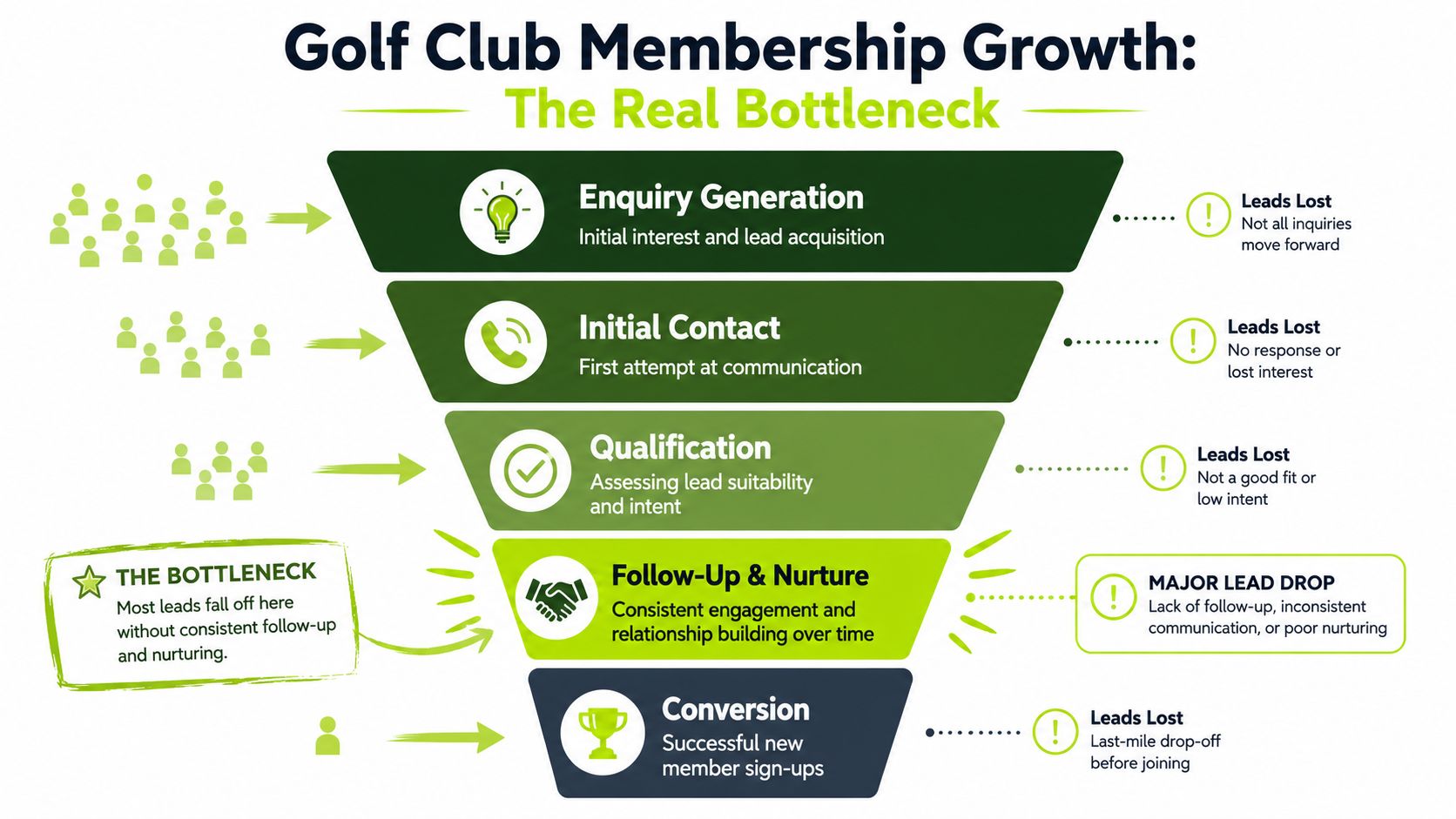
Where clubs actually lose people
Most membership enquiries aren't lost because the prospect hated the club. They're lost because the club never built enough momentum.
That usually happens in a few familiar places:
- First response is slow: the enquiry lands, but nobody replies quickly or clearly.
- No qualification happens: staff don't record what type of membership the person wants, when they may join, or what concern is holding them back.
- Follow-up is ad hoc: one person chases hard, another forgets, and nobody can see the full history.
- Visits aren't managed properly: tours happen, but the next step isn't agreed before the prospect leaves.
- Older leads disappear: prospects who may join later are treated as cold, even though golf decisions often take time.
Practical rule: If your club can't see every open enquiry and the next action due for each one, you don't have a pipeline. You have a list.
There's another hidden issue. Most clubs only work with people who identify themselves directly, even though a large share of website traffic leaves without filling in a form. If you're reviewing broader demand signals, this guide on addressing website visitor anonymity is useful because it shows why visible enquiries are only part of the picture.
A lot of golf marketing also fails because it treats lead generation as the whole job. It isn't. Clubs need a conversion system after the click, after the email, and after the first call. We've written more about that in why most golf club marketing fails.
Order beats effort
Busy club managers often try to solve this with effort. They work harder, chase more manually, and keep more notes.
That doesn't scale.
A proper golf club sales pipeline brings order to the chaos. It gives your team a defined route from enquiry to membership, with clear stages, ownership, and follow-up. Once that's in place, you stop asking, "How do we get more leads?" and start asking better questions.
Which enquiries are most likely to join? Which stage is leaking? Who hasn't been contacted? Which visits haven't moved to application?
Those are pipeline questions. They lead to better decisions than buying more traffic.
Defining Your Pipeline Stages and Lead Sources
A pipeline doesn't need to be complicated. It needs to be clear.
The mistake most clubs make is using vague labels such as "hot lead" or "interested". Those labels sound useful but create arguments later. One person's hot lead is another person's casual enquiry. Your stages should describe what has happened, not how optimistic somebody feels.
A practical five-stage model
For most UK clubs, this simple structure works well:
| Stage Name | Goal | Key Action to Advance |
|---|---|---|
| New Enquiry | Capture and log interest | Assign owner and make first response |
| Contact Made | Confirm two-way contact | Qualify needs and propose visit or call |
| Visit Booked | Secure in-person engagement | Send confirmation and pre-visit details |
| Toured Club | Move from interest to intent | Record objections and send application |
| Application Sent | Drive decision and completion | Follow up until signed or closed |
Capstone Hospitality describes membership sales as a measurable funnel with distinct stages for awareness, lead nurturing, decision, and action, supported by CRM-triggered follow-ups, personalised emails, and an efficient application flow in its guide to optimising a membership sales funnel. That principle matters because it forces the club to define progression properly.
What each stage should mean
The value of stages comes from entry and exit rules.
New Enquiry means the club has received a form, call, email, referral, or walk-in expression of interest. It should not stay there after the first response attempt is made.
Contact Made means a real two-way interaction happened. The club has confirmed interest, captured key notes, and knows what next step fits. If staff leave leads here without a scheduled action, this stage becomes a parking bay.
Visit Booked should only be used when there is a confirmed date or agreed appointment. Not "invited to visit". Not "said they may pop in". Booked means booked.
Toured Club means the prospect has experienced the club in person, whether that's a full membership tour, hosted round, or structured consultation. During this stage, many clubs fail to capture objections while they're still fresh.
Application Sent means the person has been given a clear route to join, with pricing, terms, and next steps explained. The club should know exactly what would move them from considering to deciding.
A good stage answers one question clearly. What happened that is objectively true?
Map every lead source into one system
The top of the pipeline should collect enquiries from every source the club already uses.
That usually includes:
- Website forms: membership pages, contact pages, visitor enquiry forms
- Email and phone: direct enquiries to the office, secretary, or membership contact
- Walk-ins and reception: casual questions that often go unrecorded
- Referrals: introductions from members, PGA professionals, or local partners
- Social campaigns: paid and organic traffic that creates direct messages or form fills
If those sources feed into different places, the pipeline breaks before it starts. A form builder with stronger structure can help here. For clubs reviewing better data capture, examples of engaging sign-up forms are useful because they show how to collect intent cleanly without making forms clunky.
We cover the operational side of this in more detail in golf club lead management, but the core principle is simple. Every enquiry enters one visible process, no matter where it started.
Follow one enquiry through the stages
Take a typical example.
A golfer submits a website form asking about flexible membership. The enquiry enters New Enquiry. A staff member replies, speaks to them, and learns they recently moved area, want weekend access, and are comparing two clubs. That moves to Contact Made.
The club then books a Saturday visit and coffee with the manager. Now it's in Visit Booked. The prospect attends, sees the course, asks about competition access, and meets a current member. After that meeting, the manager sends the right membership option and application paperwork. The enquiry moves to Toured Club, then Application Sent once the joining route is live.
That is a pipeline. Every movement reflects a real event. Every stage tells the team what should happen next.
Setting Up Your CRM for Visibility and Control
A spreadsheet can hold names. It can't run a pipeline well.
Once enquiries start coming from different channels, and several people are involved in responding, spreadsheets become fragile. Versions drift. Notes get missed. Nobody knows whether the latest update is in the file, the inbox, or somebody's head. A CRM gives the club one visible place to manage the full journey.

Build the board around how your club sells
The most useful CRM setup is usually visual. A kanban-style board works well because staff can see where each enquiry sits and which deals have stalled.
Keep the setup practical. Start with the stages you use. Then add fields that help staff respond better, not fields that only make the system look thorough.
Useful custom fields often include:
- Membership interest: full, flexible, intermediate, academy, corporate, social
- Playing profile: current golfer, returning golfer, beginner, visitor, member elsewhere
- Source: website, referral, walk-in, phone, email, campaign
- Decision timing: immediate, this season, later in the year, exploring options
- Objections noted: price, location, time, culture fit, waiting for partner decision
- Consent status: what communications the contact has agreed to receive
Many clubs overcomplicate things. If staff won't complete the fields during a real working day, the CRM design is wrong.
Segment properly and stay compliant
The PGA's UK guidance says segmentation should be based on purchase behaviour, playing profile, demographics, psychographics, and engagement, and it stresses that consent, preference management, and responsible use of data are critical in its article on why segmentation matters in golf retail. For clubs, that means the CRM isn't just a sales tool. It's also the place where data handling has to be organised properly.
A few practical rules help:
- Record consent clearly: don't rely on assumptions from a general contact form.
- Separate operational follow-up from broad marketing: staff need to know the difference.
- Connect systems where possible: enquiry forms, booking systems, lesson data, and membership platforms shouldn't all sit in separate silos.
- Use preferences sensibly: a prospect interested in beginner coaching shouldn't receive the same follow-up as a low-handicap golfer comparing full membership options.
Operational note: Segmentation only works if the same person can be recognised across systems. If your booking platform, inbox, and member database all hold different versions of the same contact, follow-up gets messy fast.
What good visibility looks like
A club manager should be able to open the CRM and answer a short list of questions without asking anyone else:
- Which new enquiries arrived today?
- Who owns each one?
- What stage is each prospect in?
- Which leads haven't had a recent action?
- Which visits are booked this week?
- Which applications are waiting on follow-up?
When that view exists, performance stops depending on memory.
For clubs comparing setup options, GolfRep's CRM system approach is one example of how golf-specific pipelines can be structured around lead source tracking, follow-up, and membership stages rather than generic contact management. The exact platform matters less than the discipline behind it. One source of truth. Clear ownership. Clean data.
Automating Follow Up and Nurturing Enquiries
Two membership enquiries come in on the same day.
The first goes into a shared inbox. A staff member sees it between other tasks, replies later, forgets to log the conversation, and plans to follow up after the weekend. The weekend gets busy. By the time anyone checks again, the prospect has already visited another club.
The second enters a structured workflow. They receive an immediate acknowledgement. The CRM logs the lead, tags the source, and assigns the right staff member. A follow-up task appears automatically. If no call is completed, the system prompts another action. If the prospect isn't ready yet, they move into a nurture sequence rather than disappearing.
That difference isn't about flashy tech. It's about reliability.
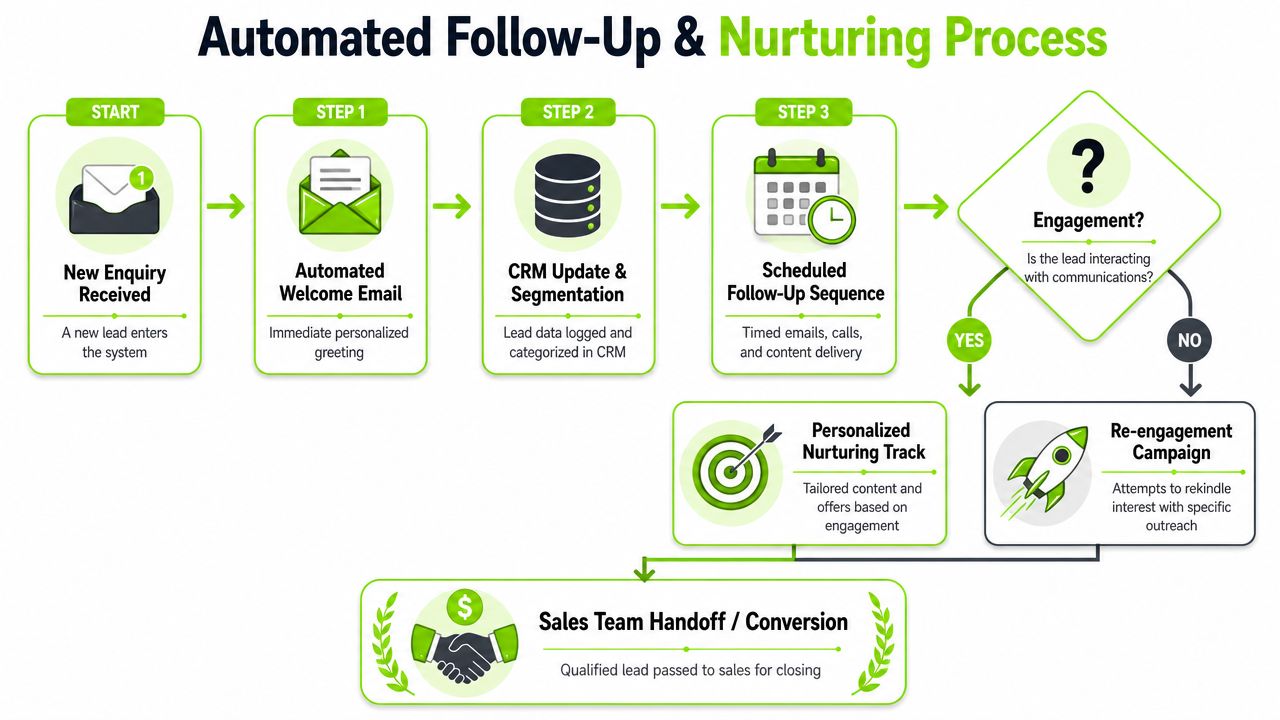
What to automate first
Most clubs don't need advanced automation on day one. They need the basics handled consistently.
Start with these:
- Instant acknowledgement: confirm the enquiry was received and set expectations for next contact.
- Internal task creation: assign ownership so a named person follows up.
- Lead routing: send the right type of enquiry to the right person.
- Visit reminders: reduce no-shows and keep the prospect warm before arrival.
- Application follow-up: prompt action when someone has shown intent but not completed the process.
GolfNow Business says cost remains the largest barrier to entry for many golfers in its article on golf statistics for facility owners. That matters because automation shouldn't push discounts by default. It should build trust and reduce uncertainty.
A better nurture sequence
If a prospect isn't ready to join, that doesn't mean they're dead. It usually means they need more confidence.
A useful nurture sequence might include:
- Early reassurance: a clear, human acknowledgement that explains what happens next
- Club context: membership categories, playing opportunities, and who the club suits
- Visit invitation: a simple reason to come and see the place rather than decide remotely
- Objection handling: practical answers around flexibility, culture, beginner friendliness, or value
- Re-engagement: a later check-in tied to seasonality, events, or renewed interest
Don't automate noise. Automate the parts your team forgets, delays, or handles unevenly.
The content should feel like a guided decision process. Not a drip campaign written by software. If price sensitivity is the issue, show value. Explain access, community, competitions, coaching, course quality, pace of integration, and what new members can expect. A rushed discount often attracts the wrong decision and weakens the club's positioning.
Keep automation human
Automation works best when it clears the admin and improves timing. It fails when clubs use it to avoid real conversations.
For example, if a prospect clicks multiple emails, replies with a question, or books a visit, that should trigger personal outreach. The system supports the relationship. It doesn't replace it.
Some clubs also use conversational tools to handle first-contact questions outside office hours. For managers considering that route, this overview of SMB marketing growth with chatbots is useful as a general reference point. The key is restraint. A chatbot can collect intent and route enquiries. It shouldn't trap serious prospects in a scripted loop when they want a human answer.
One option clubs use for this is GolfRep, which combines lead capture, automated follow-up, source tracking, and CRM-based nurture so membership enquiries move into a managed pipeline rather than a general inbox.
Tracking KPIs and Optimising Performance
A golf club sales pipeline is only valuable if the club uses it to make decisions.
Many teams look at total enquiries first because it's the easiest number to find. That tells you almost nothing on its own. A busy pipeline full of weak or neglected opportunities can look healthy on paper while producing very little.
Focus on movement, not just volume
Mural's guidance on pipeline measurement notes that a common target is 3x pipeline coverage versus quota, but that win rate and probability of close matter more than raw volume in its piece on essential sales pipeline metrics. It also highlights the risk of overloading the pipeline with low-probability deals.
That principle applies directly to clubs. A list of names isn't a pipeline. A controlled set of genuine opportunities is.
The most useful KPIs usually answer four questions:
| KPI | What it reveals | What to check if it's weak |
|---|---|---|
| Lead response time | How quickly the club reacts to interest | Inbox ownership, alerts, working hours, task assignment |
| Enquiry-to-visit rate | Whether follow-up creates enough real appointments | Call quality, email clarity, value proposition, friction in booking |
| Visit-to-application rate | Whether in-person experience creates intent | Tour quality, objection handling, membership fit, next-step clarity |
| Stage ageing | Where deals are getting stuck | Missing follow-up tasks, unclear ownership, poor qualification |
Read the blockage correctly
Different bottlenecks need different fixes.
If response time is poor, don't start by rewriting email copy. Fix routing, notifications, and ownership first.
If lots of prospects speak to the club but few book visits, the issue is usually weak qualification or weak invitation. Staff may be giving information without guiding toward a decision point.
If prospects visit but don't apply, the club should review what happens after the tour. Was pricing explained properly? Did someone ask what was holding them back? Was a clear next step agreed?
Key takeaway: Every weak conversion point is a process problem before it's a marketing problem.
Keep the pipeline clean
Pipeline reviews should be regular and unsentimental.
Ask simple questions:
- Is this lead still active?
- What is the next action?
- Who owns it?
- What would make it close?
- Has it stalled long enough to reclassify or close?
Clubs often resist closing old opportunities because it feels like losing potential business. In reality, dead leads clog forecasting and hide where the actual work sits. A clean pipeline is easier to manage and easier to improve.
Testing should also stay practical. Try different follow-up timings. Adjust visit invitations. Change how membership options are presented after a tour. Compare what happens when a manager calls versus emails first. Small operational changes often have a bigger impact than broad marketing changes because they influence real decision points.
From Manual Chaos to Predictable Growth
A club without a sales pipeline usually operates on good intentions.
Staff try to stay on top of enquiries. They mean to follow up. They remember the hot prospects and lose sight of the quiet ones. The process feels busy, but nobody has a clear view of what is moving towards membership.
A club with a pipeline works differently. Every enquiry enters one system. Stages are defined. Follow-up happens on purpose. Management can see what is waiting, what is progressing, and what has stalled. That shift is what turns membership growth from reactive to predictable.
What changes in day-to-day practice
The operational gains are straightforward:
- Less guesswork: staff know who owns each enquiry and what happens next
- Better follow-up: leads aren't left sitting in inboxes or notebooks
- Clearer forecasting: managers can see likely joins rather than rely on instinct
- Stronger conversion: the club improves the process it already controls
The biggest mindset shift is this. More enquiries don't solve a weak process. A stronger process makes every enquiry more valuable.
Consider two clubs. One keeps chasing fresh interest because it doesn't trust its own follow-up. The other builds discipline around enquiry handling, visit booking, nurturing, and closing. The second club is far more likely to grow steadily because it has removed the leak in the bucket.
The standard worth aiming for
A good golf club sales pipeline doesn't need to feel corporate or complicated. It should feel organised.
The prospect should experience prompt replies, relevant follow-up, and a clear route from first interest to visit, application, and joining. The club team should experience visibility, control, and less admin chaos. That's the primary reward.
If your current process depends on memory, manual chasing, and scattered notes, the next improvement isn't another campaign. It's a system.
If your club wants a clearer way to handle membership enquiries, GolfRep helps golf clubs build structured pipelines with lead tracking, CRM follow-up, and nurture systems that turn existing enquiry volume into a more predictable membership process.
Ready to tap into our proven growth system?