Master Your Premium Tee Time Strategy for Peak Revenue
A premium tee time strategy is not about simply increasing your prices. It is a more intelligent way of operating. You identify your most sought-after tee times and package them to reflect their genuine market value, moving your club away from a reliance on discounts and towards a model built on delivering real value.
This is about shifting from a volume game to a value-driven approach. The goal is predictable, high-margin revenue from your best asset: your course.
Why Your Club Needs a Premium Tee Time Strategy Now

The ground has shifted for UK golf clubs. A significant surge in demand, coupled with the near-universal adoption of online booking, has opened up a substantial opportunity to rethink how revenue is generated. For too long, the default tactic was to slash prices to fill the tee sheet. This practice chips away at margins and ultimately devalues the experience you offer.
That old model is no longer effective. Today, the main challenge for most clubs is not a lack of interest; it is the inability to handle, respond to, and convert enquiries for your best tee times effectively. Every missed call or delayed email represents lost revenue.
Shifting from Volume to Value
A proper premium tee time strategy is a calculated move to get the most from your prime inventory, like coveted weekend morning slots or long summer evenings. Instead of treating every tee time as equal, you start managing them as the valuable, finite resources they are.
This requires a mental shift. We are no longer just filling slots; we are crafting an enhanced experience that naturally justifies a higher price. This can be as simple as:
- Bundling in extras: Consider range tokens, a post-round drink, or guaranteed buggy hire to create a complete package.
- Focusing on the experience: Position these times as an exclusive event, complete with first-class service from the moment the golfer arrives.
- Targeting your audience: Create specific offers for different groups, whether it’s corporate clients, visiting golf societies, or tourists.
The real aim is to build a predictable and sustainable revenue stream by focusing on the quality of each booking, not just the quantity. This protects your brand and ensures your most valuable inventory delivers the return it should.
The Data Tells the Story
Recent industry figures support this approach. In 2025, UK golf clubs saw green fee revenue jump by an impressive 17%, hitting an average of £189,240 per club. This growth was overwhelmingly driven by online channels. Online sales shot up by 25% and now account for a staggering 67% of all casual green fee revenue.
By contrast, offline sales crept up by just 4%. This is a clear signal of how crucial digital tee sheets and intelligent pricing have become.
Once you have a structured system in place, you gain total lead visibility over your sales pipeline. You can track enquiries, monitor conversion rates, and see exactly which packages are hitting the mark. This is where GolfRep helps clubs build that predictable growth. We combine targeted lead generation with the automated CRM systems needed to turn initial interest into confirmed, paid-for bookings.
It is all about building a solid process that turns enquiries into reliable income, whether you’re looking to maximise weekend yield or increase midweek tee time revenue. This guide will show you exactly how to build that process for your club.
Designing and Pricing Your Premium Packages
Let’s be practical. A successful premium tee time strategy is not about guesswork or simply inflating your weekend green fees. It is about designing compelling packages that golfers see as genuinely valuable, turning your best inventory into a top-tier product.
The process starts by recognising that your most desirable tee times, those coveted weekend morning slots or tranquil summer evenings, are finite, valuable assets. Rather than just selling the time, you are selling an experience. By bundling these prime slots with thoughtful extras, you create a distinct offering that stands apart from a standard round. This is the bedrock of a strategy that enhances yield, not just price.
Building Value Beyond the Green Fee
Before you can put a price on a premium package, you have to define the value you are offering. What can you combine with a round of golf to create an experience that feels truly superior? The aim is to create a package that feels like more than the sum of its parts.
Think about bundling items that add tangible value and convenience. We have seen clubs have great success with combinations like these:
- Comfort and Convenience: Including a buggy hire is a simple but effective win, especially for peak times when they are in high demand anyway.
- Warm-Up and Practice: A token for the driving range or access to the short-game area before the round is a small touch that golfers appreciate.
- Food and Beverage: Nothing says hospitality like a bacon roll and coffee on arrival or a post-round drink in the clubhouse. It is an easy add-on.
- Retail Vouchers: A small voucher for the pro shop not only enhances the perceived value but also encourages extra spending on the day.
These additions transform a simple tee time booking into a complete day out. Suddenly, the conversation shifts from "How much does it cost?" to "Look what I get for my money." It is a crucial mindset shift for attracting golfers who prioritise the overall experience over pinching pennies.
The Power of Dynamic Pricing
With your packages defined, the next piece of the puzzle is pricing. A static price list for your premium offerings is a missed opportunity. A dynamic pricing model, on the other hand, lets you adjust rates based on real-time demand, booking windows, and other key variables. There is a reason the travel and hotel industries live by this model: it works.
We only have to look at the data. With record rounds played across Great Britain in 2025, up 14% from the year before, it is clear that demand is there. Clubs that have confidently implemented premium strategies are reaping the rewards. This was especially true for weekend times in high-demand areas like Southeast England, where top Surrey and Berkshire courses saw green fees pass £150, and at championship links in Scotland, which commanded over £200. The market has proven that visitors will pay for a premium experience, especially at sought-after venues.
Do not make the common mistake of seeing dynamic pricing as just a tool for increasing prices. Its real power is in its flexibility. It allows you to maximise revenue during peak demand while offering better value during quieter periods, helping you fill more of your tee sheet without resorting to deep, brand-damaging discounts.
Of course, this approach needs a system that can handle the adjustments for you. Trying to manage this manually is a recipe for inefficiency and mistakes. An effective booking engine connected to your CRM gives you the control to set pricing rules that automatically respond to booking patterns, ensuring you always capture the optimal value for every single tee time.
Creating Tiers for Different Needs
To demonstrate how you can structure different packages, here is an example of a tiered system. This approach allows you to cater to different motivations and budgets, making your premium offerings accessible to a broader range of golfers while clearly signposting the value at each level.
Premium Package Tiers Example
| Feature | The Sunrise Special (Early Weekend) | The Corporate Classic (Weekday PM) | The Championship Experience (Peak Weekend) |
|---|---|---|---|
| Green Fee | Included | Included | Included |
| Buggy Hire | 50% Discount | Included | Included (GPS enabled) |
| Range Balls | 1 Token | 2 Tokens | Unlimited Access |
| Food & Bev | Coffee & Bacon Roll | 2-Course Lunch | 3-Course Meal & Drinks Voucher |
| Retail | - | 10% Pro Shop Voucher | £20 Pro Shop Voucher |
| Extras | - | Personalised Scorecards | Course Guide & Gift Pack |
This table illustrates how you can build incremental value. The "Championship Experience" is not just more expensive; it is demonstrably a more comprehensive and luxurious day out, justifying the higher price point.
Segment Your Visitors for Targeted Offers
Finally, remember that not all visiting golfers are the same. A truly effective premium strategy segments your audience and tailors packages to their specific needs. You will find your visitors generally fall into a few distinct categories.
| Visitor Segment | Primary Motivation | Potential Package Focus |
|---|---|---|
| High-Value Individuals | Prestige, convenience, and quality | All-inclusive experience: buggy, range balls, food & beverage |
| Corporate Groups | Entertaining clients, team building | Branded materials, private dining options, competition management |
| Travelling Golfers | Experiencing a top-rated course | Multi-round deals, club hire, local lodging recommendations |
| Local 'Pay & Play' | Securing a desirable weekend time | Simple bundles like a round with a post-game pint or buggy hire |
By creating packages for these different groups, you can market your offerings with precision. A corporate client has entirely different needs and expectations than a golf tourist, and your packages must reflect that.
This segmentation ensures your message reaches the right people, dramatically increasing the chances of an enquiry and, ultimately, a booking. This is where a structured system to track leads and their interests becomes invaluable, turning initial interest into a predictable and profitable revenue pipeline.
Automating Your Booking and Follow-Up Process
You have designed some brilliant premium packages and priced them perfectly. That is a great start, but it is only half the job. The real test comes down to how you handle the enquiries and bookings. If your process relies on staff juggling phone calls and emails, you have a major weak point, especially with high-value leads who expect a swift, professional response.
Slow enquiry response times are booking killers. A potential customer looking to book a "Championship Experience" for their group will not wait a day for a call back. They will simply move on and book with a competitor. This is where automation stops being a 'nice-to-have' and becomes essential.
Before you can automate, you need something valuable to sell. This simple framework covers the fundamentals of creating your premium packages.
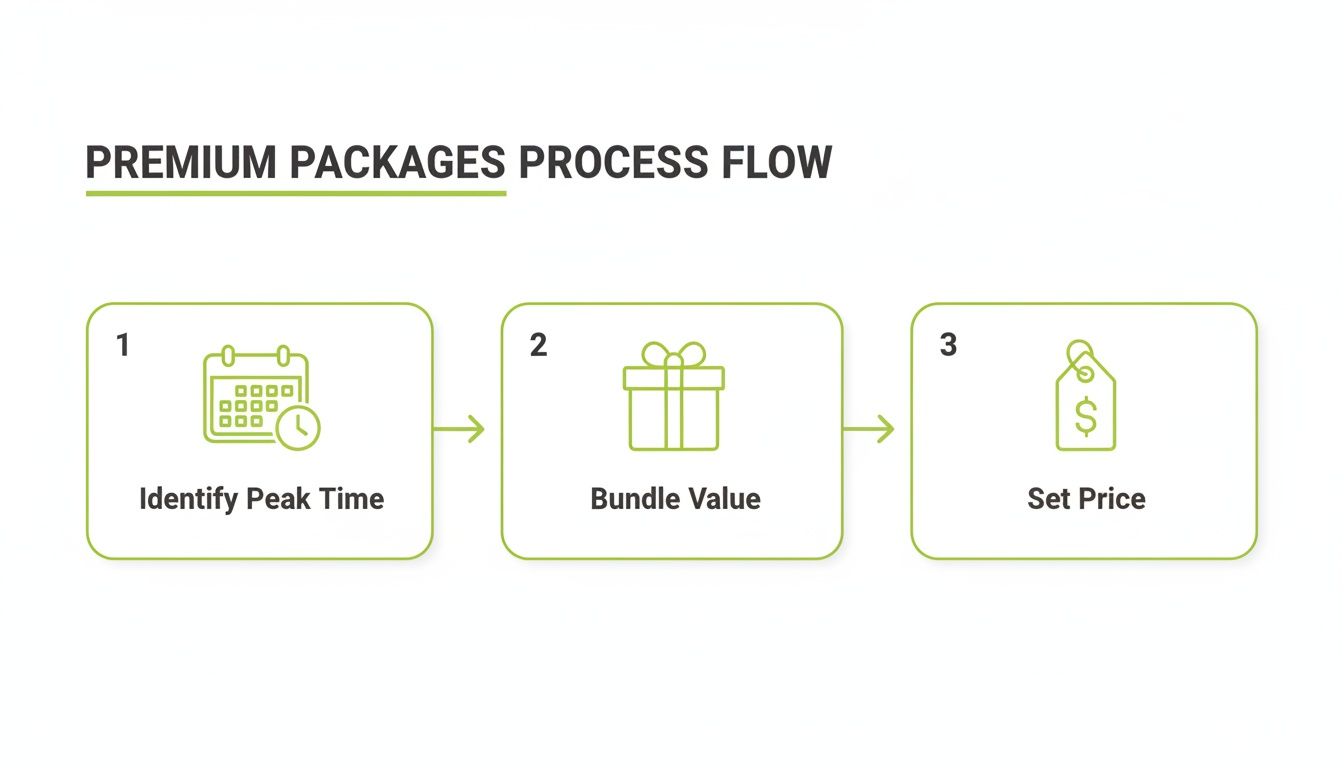
It is a straightforward process: identify your most valuable inventory, bundle it with appealing extras, and then set a price that reflects the new, enhanced experience. This forms the bedrock of your premium strategy.
The Role of a CRM and Automation
From our experience, the main challenge for most clubs is not a lack of interest; it is the inability to manage that interest effectively. This is precisely the problem that a Customer Relationship Management (CRM) system, paired with smart automation, is built to solve. It provides a central hub for every lead and automates your communications, ensuring no enquiry ever falls through the cracks, day or night.
A properly configured system does not create more work; it does the opposite. It takes all the repetitive, time-consuming tasks off your team's plate. This frees up your staff to focus on what they do best: delivering an exceptional experience for the golfers who are on the course.
At its heart, automation is all about consistency and speed. It ensures every lead gets the same prompt, high-quality follow-up, whether they enquire at 2 PM on a Tuesday or 10 PM on a Sunday. This structured approach gives you total lead visibility over your sales pipeline and makes your revenue far more predictable.
A Practical Automated Workflow
Let’s walk through what this looks like in practice. This is not theory; it is a workflow we regularly implement for clubs to turn initial interest into a confirmed booking.
Imagine a golfer lands on your website and is intrigued by your "Corporate Classic" package. They fill out a simple form to request more information. What happens next is crucial.
The moment they click 'submit', the system should send an automated email. This is not just a plain text acknowledgement. This email delivers a professionally designed brochure or a link to a private landing page with all the details: pricing, what is included, and a clear 'Book Now' button. This immediate response not only qualifies the lead but also showcases your club's professionalism.
Now, the system's nurture sequence kicks in. If the golfer has not booked within 24 hours, a second automated email can be sent. It could be a friendly reminder or perhaps a powerful testimonial from a past corporate client.
If a few more days pass without action, another email can go out. This one might highlight a specific, compelling feature of the package, like the post-round dining experience or the GPS-equipped buggies.
This entire sequence runs in the background, keeping your club top-of-mind without a single staff member having to manually track leads or draft follow-up emails. Everything is logged in the CRM, giving you a crystal-clear picture of where every prospect is in their journey. For a deeper dive, check out our guide to golf club automation.
Moving Beyond Manual Processes
Relying on manual systems is inefficient. Staff get busy, emails are missed, and follow-ups are forgotten. Each of these small failures represents lost revenue, especially when dealing with premium bookings worth hundreds, or even thousands, of pounds.
A systemised, automated approach provides a decisive edge:
- Speed to Lead: We know that improving enquiry response time within the first five minutes can have a massive impact on conversion rates. Automation makes this happen every single time.
- Lead Visibility: You can see your entire sales pipeline at a glance. How many enquiries came in this week? How many converted? Which packages are generating the most interest?
- Predictable Revenue: Once you have a clear view of your conversion tracking, you can begin to accurately forecast future visitor revenue with confidence.
Putting a system like this in place is the critical step that separates clubs with a hopeful strategy from those with a predictable, high-yield revenue engine. It transforms your website from a static online brochure into an active, 24/7 sales tool that captures, nurtures, and converts your most valuable customers.
Marketing Your Premium Offerings to the Right Golfers
Now that you have designed your premium packages and have the booking systems in place, it is time to get the word out. This is where many clubs stumble. The instinct is often to fall back on old habits like blanket discounts, but that completely undermines the exclusive, high-value experience you have just created.
The goal is not simply to attract more golfers; it is to connect with the right ones. We are looking for players who prioritise a memorable day out over a bargain-basement green fee. This calls for a marketing approach that is less about shouting a price and more about telling a compelling story of quality and exclusivity. It is a game of precision, not volume.
Reaching High-Value Prospects with Targeted Advertising
The good news is your ideal customers are out there, and modern advertising platforms provide incredibly powerful ways to find them. Instead of casting a wide, expensive net, we can pinpoint the very people most likely to book a premium package.
Social media platforms, in particular, let you get remarkably specific. Think about the digital footprints your ideal customer leaves. You can build audiences by targeting individuals based on their interests and online behaviour, such as:
- Interests: Focus on people who follow luxury car brands like Porsche or Range Rover, frequent high-end hotels, or are members of other prestigious golf clubs.
- Demographics: Zero in on specific postcodes known for affluence, higher income brackets, or company directors within a certain radius of your club.
- Behaviour: Reach golfers who have recently visited golf travel sites or interacted with premium equipment brands online.
This surgical approach means your marketing spend is focused entirely on qualified prospects, not wasted on golfers who will never convert. Of course, the message has to be just as sharp as the targeting. Your adverts need to sell the experience, not just the tee time.
Showcase what makes the package truly special. Use high-quality, evocative imagery of your course, your clubhouse, and the unique elements of the experience. A beautifully shot photo of a perfectly prepared bacon roll on a sunlit patio can be far more powerful than a simple list of features.
Your objective is to make the golfer feel the value of the experience long before they even see the price tag.
Segmenting Your Database for Email Marketing
Do not overlook the resource you are already sitting on: your email list. These are people who already know your club. But a "one-size-fits-all" email blast is a missed opportunity. The key to unlocking this potential is smart segmentation.
By dividing your database into smaller, more specific groups, you can send offers that feel personal and relevant. For a premium strategy, two segments are particularly valuable:
- Past High-Spenders: Pull a list of golfers who have previously paid your highest green fees or booked during peak weekend slots. These players have already proven they are willing to pay for quality and are your most likely first customers for new premium packages.
- Corporate & Group Enquirers: Anyone who has previously asked about a corporate golf day or a group booking should be on a separate list. You can then reach out with packages specifically designed for client entertainment or team-building events.
Using a modern CRM system makes this kind of segmentation simple. It is the difference between generic marketing and a welcome invitation, and it will have a dramatic impact on your conversion tracking and booking numbers. For more practical advice on this, check out our guide on using digital marketing to fill your tee times.
The Broader Economic Context
Focusing on a premium strategy is not just a smart commercial move; it is becoming a strategic necessity. The UK golf course industry is set to become a £2.8 billion market by 2026. This growth, coupled with ever-rising operational costs, means that developing strong premium revenue streams is vital for long-term financial health.
The recent surge in green fees, driven largely by online booking channels, showed us that the clubs which commanded higher prices were the ones that thrived. By combining this pricing power with automation, you gain a clear, transparent view of your marketing effectiveness, from the first ad click all the way through to a confirmed booking.
Ultimately, your marketing is the final, crucial piece of the puzzle. It connects your carefully crafted offerings with the golfers who will truly appreciate and pay for them. By mixing precise digital advertising with intelligent email segmentation, you can build a reliable, predictable flow of high-value business that will become a new growth engine for your club.
Measuring What Matters: How to Track and Optimise Your Premium Strategy
Launching your premium packages is an excellent start, but the real work, the part that drives sustainable profit, begins the moment they go live. A great strategy is not a one-off project; it is a living part of your commercial operations that you constantly refine.
To get this right, you need to look past traditional, high-level numbers. While metrics like total rounds played are useful, they do not paint the full picture. A truly successful premium offering is measured by a much sharper set of Key Performance Indicators (KPIs) that reveal its real impact on your bottom line.
Shifting from Volume to Value
The goal here is not just to be busier; it is to be more profitable. Chasing a high number of rounds can be a pointless exercise if most of them were sold at a deep discount. The new focus has to be on value, not just volume.
This is where a properly configured CRM, like Clubessential or Lightspeed Golf, becomes your most valuable asset. It stops being a digital address book and turns into a powerful dashboard, giving you a clear view of what is working and what is not. Without that clarity, you are just guessing.
In our experience, the most common mistake clubs make is launching new packages without any system to measure them properly. They cannot tell you which packages are selling, which marketing channels are driving the best leads, or what the actual return on investment is. You end up making decisions without data.
Essential KPIs for Your Premium Tee Time Strategy
To truly gauge the success of your efforts, you have to track the right data points. The good news is that a robust CRM system should make this information easily accessible on a central dashboard, saving you from the nightmare of manually digging through spreadsheets.
Here is a look at the essential metrics that will help you measure the real impact of your premium offerings and make smarter decisions for growth.
Essential KPIs for Your Premium Tee Time Strategy
A breakdown of traditional vs. strategic metrics to help managers measure the true impact of their premium offerings.
| Metric | What It Measures | Why It Matters for a Premium Strategy |
|---|---|---|
| Average Yield Per Available Tee Time | The average revenue generated by each tee time slot, whether booked or not. | This is the ultimate health check. It moves beyond just looking at booked times and shows how effectively you are monetising your entire tee sheet, rewarding you for selling premium slots at a higher price. |
| Enquiry-to-Booking Conversion Rate | The percentage of enquiries for premium packages that convert into confirmed, paid bookings. | This directly measures the effectiveness of your sales process and enquiry response time. A low rate often points to slow responses or a breakdown in your nurture sequence, exactly the issues an automated system is designed to fix. |
| Revenue Contribution of Premium Packages | The total revenue generated specifically from your premium offerings as a percentage of overall green fee income. | This KPI proves the financial power of your strategy. It shows that a small number of high-value bookings can significantly boost your bottom line, justifying the focused effort. |
| Lead Source Tracking | Identifies which marketing channels (e.g., social media ads, email campaigns, organic search) are generating the most valuable enquiries. | You need to know where your best customers are coming from. This data allows you to double down on what works and stop wasting your budget on channels that do not deliver high-value leads. |
As you can see, these metrics move far beyond simply counting players and provide a much deeper insight into the commercial performance of your club.
Using Data for Continuous Improvement
Collecting this data is not just an administrative task. Its real purpose is to give you the insights needed to constantly refine and improve your approach. Your CRM dashboard should immediately highlight opportunities and weaknesses, telling you exactly where to focus your attention.
For instance, imagine you see that your "Championship Experience" package is getting lots of enquiries but has a poor conversion rate. This is a significant red flag, likely pointing to a disconnect between the price and the perceived value.
This is the perfect time to run a test. You could try two different approaches:
- Test A: Keep the package the same but test a slightly lower price point.
- Test B: Keep the original price but add a tangible extra, like a branded gift or a complimentary drink.
By tracking the conversion rates of both tests, you let the data tell you what your customers actually want. This iterative cycle of testing, measuring, and refining turns guesswork into a clear, predictable system for growth. It is how you ensure your premium tee time strategy evolves and consistently delivers better results, season after season.
Your Premium Tee Time Strategy Questions Answered
Switching to a premium tee time model is a significant move, and it is bound to raise questions in the clubhouse and the committee room. We understand. Over the years, we have heard the same questions from managers and owners time and again.
Let's tackle them head-on, based on what we have seen work in practice.
Will a Premium Strategy Alienate Our Regular Visitors or Members?
This is easily the number one worry, but the short answer is no, not if you implement it correctly. A smart premium strategy is not about increasing prices across the board. It is about being selective.
You are only focusing on a small fraction of your inventory: those two to four most sought-after slots on a Saturday morning that are always fully booked weeks in advance. The key is to be completely transparent. Frame it as an enhanced, all-inclusive package for golfers looking for that top-tier experience, not as a penalty for your loyal base.
Crucially, your members' booking rights and dedicated tee times must remain untouched. Your standard visitor green fees for off-peak and shoulder times also stay exactly as they are. This is simply about separating your most valuable tee times to meet a specific demand, ensuring you are not leaving money on the table without upsetting your core golfers.
We Are a Small Club with Limited Staff. How Can We Manage This?
This is a common misconception. Many clubs see a new strategy and immediately think of the extra workload for an already stretched team. In reality, the right systems and processes do the heavy lifting for you and actually free up your staff.
As we have highlighted, the main challenge for most clubs is not generating enquiries; it is the administration involved in handling them. A well-configured system with smart automation takes care of the repetitive tasks that consume so much time.
Imagine a system that instantly replies to every enquiry, qualifies the lead without anyone lifting a finger, and sends perfectly timed follow-up reminders. This gets your team out of the business of chasing people and allows them to focus on delivering a fantastic experience for the golfers who are right there at the club. The system works 24/7, making sure no opportunity is lost.
How Do We Determine the Right Premium Price Without Just Guessing?
Pricing should never be a shot in the dark. You cannot just add £20 to your peak green fee and hope for the best. It has to be a logical process built on solid data.
Start with your tee sheet. Dig into your booking data and pinpoint the exact times that are always the first to go. These slots have proven, built-in demand and are your prime candidates for a premium package.
Scope out the competition. Take a look at what comparable courses in your area are charging for their top-tier visitor times. This is not about copying them, but it gives you a vital benchmark for what the local market will tolerate.
Bundle the value. The 'premium' part of the price is justified by what you include. Do not just sell the tee time; sell an experience. Adding tangible extras like a coffee and bacon roll, a basket of range balls, or a buggy makes the price feel fair and shifts the golfer’s focus from cost to overall value.
Test, measure, and tweak. Launch your initial packages and keep a close eye on what happens. A good CRM will give you clear conversion tracking, showing you precisely which packages and price points are being snapped up. Let real-world booking behaviour, not guesswork, guide your pricing strategy over time.
This methodical approach takes the uncertainty out of pricing and helps you build a new, predictable, and profitable revenue stream.
A structured premium tee time strategy is a powerful engine for growth. At GolfRep, we specialise in helping clubs build predictable pipelines by combining targeted lead generation with the automated CRM systems needed to convert interest into revenue.
Discover how our Growth System can work for your club at GolfRep
Ready to tap into our proven growth system?