Golf Club Marketing That Actually Works: 2026 Strategies

Most advice on golf club marketing starts in the wrong place. It tells clubs to get more leads, post more content, boost more offers, and run more ads. That sounds sensible until you look at what happens in reality inside most clubs after an enquiry arrives.
The key failure point is rarely demand. It's what happens next.
A prospect fills in a form on Tuesday night. Nobody sees it until Wednesday afternoon. A society organiser asks about dates and gets a reply when they've already moved on. A membership lead visits the website, shows clear intent, then disappears into an inbox with no structured follow-up, no pipeline view, and no consistent next step. Clubs often call this a marketing problem when it's really an operational one.
Golf club marketing that works isn't about generating attention in isolation. It's about building a system that captures interest, responds quickly, qualifies intent, and keeps the conversation moving until the person books a visit or joins.
That shift matters because the clubs that grow steadily don't treat marketing as a set of disconnected campaigns. They treat it as a conversion process.
Why Most Golf Club Marketing Misses the Mark
Most golf clubs don't have a traffic problem. They have a lead handling problem.
The usual pattern is familiar. A club runs ads, refreshes the website, posts more on social media, and sees enquiries come in. Then the process becomes manual. One person checks the inbox. Another tries to ring people back between meetings. Follow-up depends on who is in the office, how busy the week is, and whether the original enquiry included enough detail.
That creates lead leakage. Not because the club isn't trying, but because the system isn't built to convert interest reliably.
More enquiries don't fix a weak process
A club can spend well at the top of the funnel and still get poor results if the back end is loose. If response times are slow, if nobody owns the pipeline, or if there is no visibility of where prospects sit, more budget just creates more waste.
That is why broad advice about visibility and engagement often misses the underlying commercial issue. Clubs need a process that protects exclusivity and member culture while still speaking to people who aren't already insiders. Industry guidance has highlighted that many clubs struggle to broaden appeal without damaging price integrity or alienating current members, and that a two-track strategy for prospects and existing members is often the missing piece in private club marketing, as noted in this analysis of private golf club messaging and CRM strategy.
Practical rule: If your team can't see every active membership, visitor, event, and society enquiry in one place, your marketing isn't underperforming. Your follow-up process is.
That tension shows up in committee-led clubs especially. The committee wants growth, but doesn't want the club to feel commoditised. Management wants more members, but doesn't want to trigger complaints from existing ones. The answer isn't louder promotion. It's sharper segmentation and better control of communication.
Busy clubs still lose easy wins
A lot of clubs are active. Very few are organised.
That difference matters. Being busy can hide weak conversion. Staff are answering calls, dealing with members, handling events, and keeping the operation moving. In that environment, enquiries get treated as admin rather than revenue opportunities. Nobody deliberately ignores them, but they don't get worked properly either.
Common symptoms include:
- Slow first response because forms land in a general inbox
- Inconsistent follow-up because nobody owns the next step
- Poor visibility because prospect status lives in notes, spreadsheets, or memory
- Mixed messaging because different staff answer the same question in different ways
If that sounds familiar, it's worth reviewing the most common golf club marketing mistakes clubs still make. The biggest one is assuming the campaign is the system.
It isn't. The system starts after the click.
Defining Your Ideal Member and Crafting Your Message
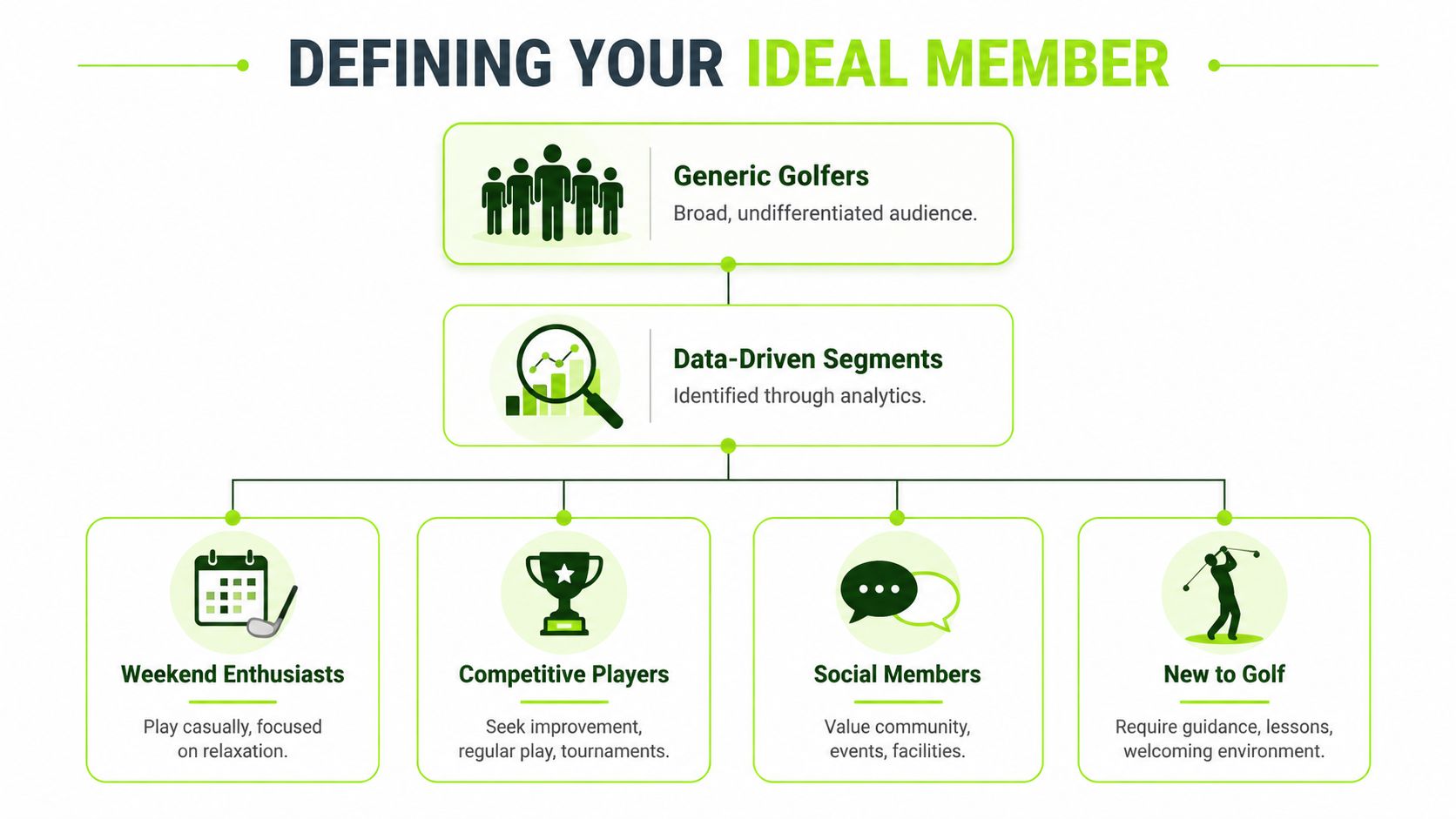
The clubs that waste the most on marketing usually target "golfers" as if that were a useful audience. It isn't.
"Golfers" includes competitive players, occasional weekend visitors, people returning to the game, women exploring a welcoming club environment, active seniors, beginners who need confidence, and families looking at lifestyle as much as sport. They don't all respond to the same message, and they shouldn't all see the same offer.
Start with who the club actually wants more of
Before writing ads or changing the website, define the member mix the club wants to grow. That means looking at current membership, usage patterns, available tee sheet capacity, clubhouse demand, and the type of culture the club wants to protect.
National data gives useful context. England Golf reports 732,000 affiliated members in 1,858 clubs, with women and girls at 25% of membership and seniors aged 55+ at 41%, which is why segmented acquisition matters and why a generic membership message misses obvious opportunities. The same source notes that women and girls are the fastest-growing audience, making that segment especially important in club growth planning, according to this summary of England Golf participation and club targeting data.
That doesn't mean every club should chase the same segment. It means every club should make a deliberate choice.
Build messages for real people, not committees
A useful way to do this is to define a small set of ideal member profiles, then map each one to a distinct message.
If your club wants more:
- Women new to club membership, lead with welcome, flexibility, social confidence, and visible female participation
- Active seniors, speak to playing access, routine, community, and lifestyle value
- Working professionals, focus on convenience, practice access, flexible use, and a strong club environment beyond the course
- New golfers, remove intimidation and explain the first steps clearly
This is just structured audience work. If you need a simple framework for understanding your perfect customer, buyer persona thinking can help clubs sharpen messages before they spend on ads.
Most clubs don't have a lead quality problem. They have a message mismatch. They attract the wrong enquiry because they speak too broadly.
What the message should actually say
The practical test is simple. If the home page, ads, and follow-up emails all say "Join now" with no context, the club is asking the prospect to do too much interpretive work.
A stronger message answers three questions quickly:
| Question | What the prospect wants to know |
|---|---|
| Is this club for someone like me? | Culture, welcome, membership fit |
| What do I get beyond golf? | Social spaces, food, dining, lifestyle |
| What should I do next? | Book a visit, request details, arrange a tour |
For clubs working on membership growth, that usually means changing the content mix as well as the targeting. The strongest golf club membership marketing is specific about the audience it wants and disciplined about the message it sends.
Generic marketing talks to everyone and persuades no one.
Smart Acquisition Channels for Predictable Enquiries
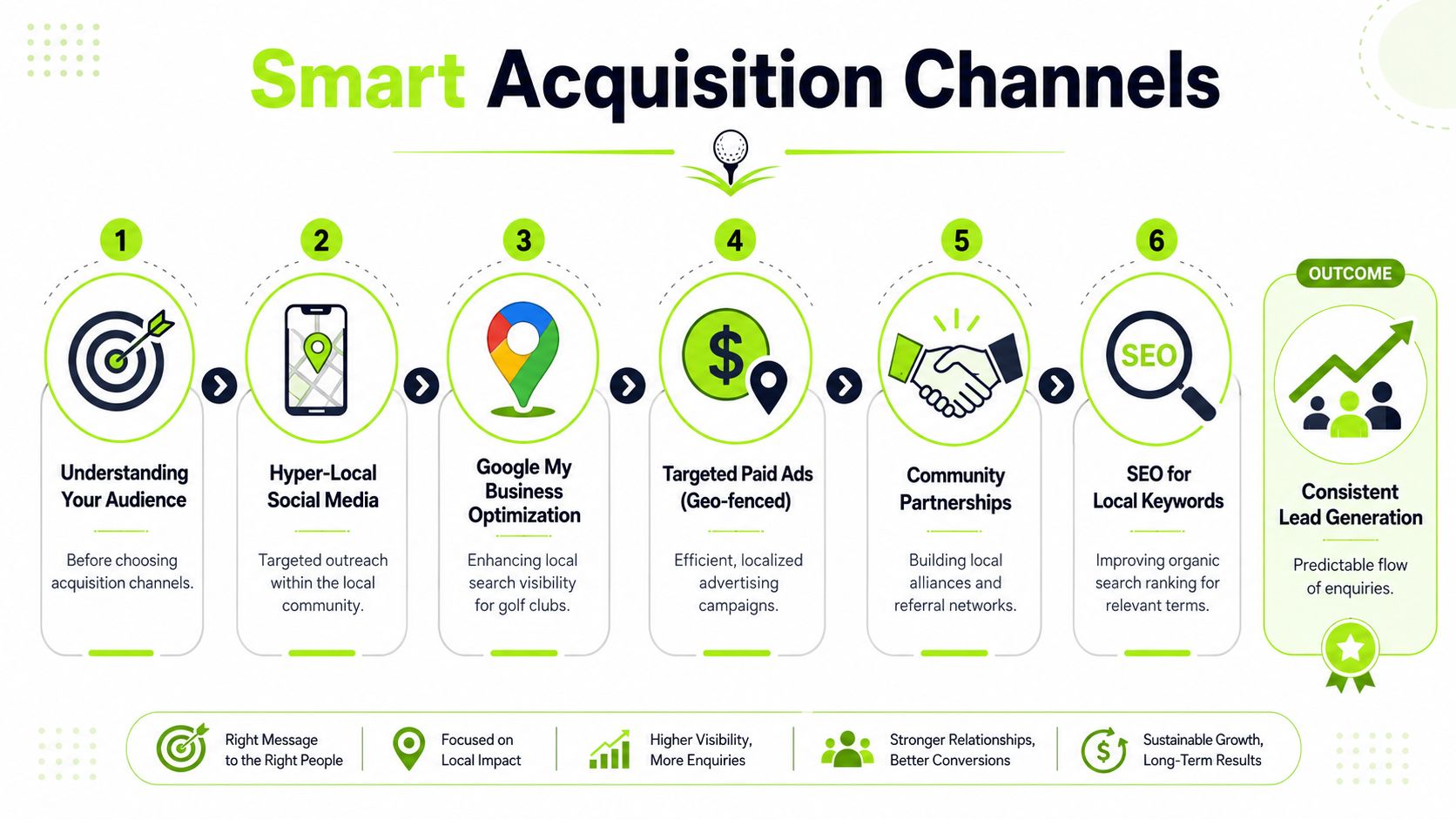
A predictable pipeline needs more than one source of demand, but those sources must feed into one measurable process. That is where many clubs go wrong. They run a few social campaigns, some local SEO work, perhaps a paid search campaign, and treat each one as a separate activity.
The better approach is to make every acquisition channel serve the same purpose. Generate qualified local interest and push it into a central database where the club can track and work each enquiry properly.
What channels tend to work best
For most UK clubs, the practical mix is usually a combination of paid and owned channels.
Paid search captures people already looking for membership, golf near them, society bookings, or visitor rounds. Intent is high, which makes the traffic useful if the landing page and response process are organised.
Paid social works differently. It creates demand among local golfers who fit the right profile but may not be actively searching today. In such cases, segmented creative matters. A women-focused welcome campaign shouldn't look like a competition promotion. A family-friendly club offer shouldn't be presented like a county match ad.
Local SEO keeps the club visible when prospects do their own research. Many membership decisions include repeat searches, map checks, image reviews, and website visits before a person ever enquires.
Email is often overlooked at the acquisition stage, but it matters because not every visitor converts on day one. If a club can capture details cleanly and continue the conversation, acquisition becomes more efficient over time.
The key is system design, not channel choice
Operator guidance is clear that digital acquisition should be run as a measurable conversion system, using structured SEO, paid search, social activity, and segmented weekly emails into a central database. The same guidance warns that clubs often underinvest in content calendars and creative assets such as photography and video, which makes campaigns harder to sustain and weaker in market. That operator view is outlined in this piece on measurable golf marketing systems and weekly communication discipline.
That last point gets ignored too often. Weak creative doesn't just look ordinary. It reduces trust.
A club with dated imagery, thin copy, and no real proof of clubhouse life usually attracts lower-intent enquiries because the prospect can't see enough to justify action. If your team is improving video output, this guide to optimizing video ad performance is a helpful reference for producing clearer, more usable ad creative.
A practical channel model for clubs
The easiest way to keep this controlled is to assign each channel a job.
- Search campaigns capture existing demand from high-intent prospects
- Social campaigns create local awareness among chosen segments
- SEO pages support research and trust during evaluation
- Email capture keeps non-ready prospects in the pipeline
- Remarketing reconnects with people who showed interest but didn't enquire
Operational view: A campaign is only useful if the club knows where the enquiry came from, who owns the follow-up, and what happens next.
This is why clubs need to stop thinking in terms of occasional promotions. The more useful model is an always-on engine with measured acquisition and clear next steps. If you're reviewing the best way to advertise golf club membership, the right answer isn't one channel. It's one process fed by several channels.
Converting Interest into Action with Automated Systems
Most results are won or lost at this point.
A club can have good targeting, strong creative, and healthy enquiry flow, then still underperform badly because the response process depends on staff finding time. That is not a criticism of staff. It's a design flaw. Membership sales, event bookings, and society enquiries shouldn't rely on somebody remembering to reply after lunch.

Response speed changes the economics
A 2025 UK report covering more than 50 clubs found that golf-club marketing produced an average return on ad spend of 1,620% and more than £320,000 in attributable revenue, alongside average yearly volumes of 500+ membership enquiries, 350+ society enquiries, and 400+ event enquiries. The same report said average enquiry response time was 30 hours, and that faster response was consistently linked to higher conversion rates, according to The Revenue Club's 2025 golf-club performance report.
That should change how clubs think about marketing spend. You're not just buying clicks or form fills. You're buying a chance to start a sales conversation. If that conversation starts late, value disappears fast.
What automation should actually do
Automation isn't there to replace the club. It's there to remove avoidable delay and inconsistency.
A practical automated workflow should handle the first layer of conversion work:
| Stage | What the system should do |
|---|---|
| Enquiry arrives | Send an immediate acknowledgement |
| Early qualification | Ask a few relevant questions about interest and timeline |
| Routing | Separate membership, visitor, society, and event intent |
| Booking | Offer a visit, call, or tour slot where appropriate |
| Handover | Push the lead into CRM with full context |
That is the point where a structured platform earns its keep. Instead of waiting for someone to manually triage the enquiry, the process starts instantly and consistently. GolfRep is one option clubs use for this kind of workflow, combining lead capture, automated qualification, and CRM handover so staff can focus on qualified conversations rather than inbox sorting.
Manual follow-up breaks under normal club conditions
The clubs that rely fully on manual response tend to hit the same problems:
- Gaps after hours when enquiries arrive in the evening or at weekends
- No qualification so staff spend time on weak leads and miss strong ones
- Uneven staff coverage during holidays, events, or busy periods
- No standard next step which leaves prospects waiting or drifting
The strongest argument for automation isn't convenience. It's consistency under pressure.
If your response quality drops the moment the office gets busy, you don't have a sales process. You have good intentions.
What good conversion handling looks like in practice
A strong system doesn't need to be complicated. It needs to be dependable.
When someone enquires about membership, they should get an immediate reply, a sensible next question, and a clear invitation to progress. If they are early in the journey, the system should keep them warm. If they are ready for a visit, the system should help book it. If they are not a fit, the club should know that quickly rather than carrying dead leads in the pipeline.
That is what golf club marketing that works looks like at the point of conversion. Not noise. Not more forms. Just faster, cleaner movement from interest to action.
Using CRM to Nurture and Convert Over Time
Not every prospect is ready when they first enquire. Many aren't even close.
One of the biggest mistakes clubs make is treating membership interest like a short sales cycle. A person downloads a brochure, opens an email, or books a visitor round, and the club behaves as if a decision is imminent. Often it isn't. The person may still be comparing clubs, discussing a move, trying to understand the lifestyle fit, or deciding whether membership is the right commitment at all.
A market report based on 8 million+ data points and surveys of 55,000 private golf buyers found that the decision window for people searching for both a golf club and a home typically lasts 12 to 14 months. The same report notes that prospective members want practical lifestyle cues such as food and beverage, social spaces, and flexible dining presented clearly across the website, social media, and tours. That's why sustained nurture matters so much, as shown in the 2025 Golf Life Insights buying trends report.
What a long buying journey looks like
A typical prospect might first encounter the club through an ad or a recommendation. They visit the website, look at membership pages, then do nothing. A few weeks later they return, browse the clubhouse and dining pages, perhaps enquire, then go quiet again. Months later they attend an open event or book a round. Only after that do they seriously consider joining.
Without a CRM, those interactions feel fragmented. With one, they form a visible timeline.
That matters because the club can then respond to the specific stage of intent rather than guessing.
The role of nurture
A useful nurture sequence doesn't just repeat "join now". It gradually reduces uncertainty.
That may include:
- Lifestyle content that shows the social side of the club
- Visitor experience emails that explain what a first visit feels like
- Membership guidance that clarifies categories, process, and fit
- Event invitations that create low-pressure opportunities to engage
- Follow-up after tours or rounds that answers questions raised in person
Prospects don't need more volume. They need the right information at the right point in their decision.
Many clubs miss the sale. They either stop communicating too early or push too hard too soon. Both are forms of poor timing.
CRM makes patience operational
The value of CRM isn't that it stores names. It's that it turns long-term follow-up into a repeatable process.
Instead of relying on somebody to remember who visited three months ago, the club can trigger structured emails, notes, reminders, and tasks around actual behaviour. Someone who opened dining content might get more lifestyle-led follow-up. Someone who attended a tour but didn't join may need a softer check-in later. Someone who asked about family use should not receive the same message as a low-handicap competitive player.
A good nurture process feels calm and informed. It doesn't chase. It stays visible.
Over time, that is often what decides the outcome. Not the first ad, but the club that stayed organised throughout the full decision window.
Building Your Club's Predictable Growth Pipeline
The clubs that grow consistently don't rely on one campaign, one staff member, or one seasonal push. They build a pipeline that works even when the club is busy.
That pipeline starts with sharper targeting. It continues with measured acquisition across search, social, SEO, and email. It gets stronger when response is immediate, qualification is structured, and every enquiry enters a visible system rather than an inbox lottery. It compounds when CRM nurture keeps the club present during a long decision cycle.
The full model is simple to understand
At a practical level, the system has four parts:
- Target the right people with offers and messages that fit the member segments the club wants to grow.
- Capture demand cleanly through channels that can be tracked and managed.
- Respond and qualify quickly so interest becomes conversation while intent is still high.
- Nurture over time until the prospect is ready to book a visit or commit.
That is the difference between marketing activity and revenue infrastructure.
What clubs should stop doing
Many clubs don't need more tactics. They need fewer weak ones.
Stop relying on generic membership pages with no clear next step. Stop treating form fills as if they are self-converting. Stop measuring success by clicks, impressions, or how busy the inbox feels. Stop assuming a staff member can manually manage every enquiry properly on top of everything else.
Bottom line: Predictable growth comes from systems that reduce delay, improve visibility, and make follow-up consistent.
Golf club marketing that actually works is rarely flashy. It is organised. It respects the way people actually choose a club. And it gives management clear visibility from first enquiry to joined member.
If your club wants a clearer picture of how that kind of pipeline works in practice, GolfRep shares how UK golf clubs are combining targeted lead generation, automated follow-up, and CRM nurture to turn more enquiries into booked visits and memberships without relying on manual chasing alone.
Ready to tap into our proven growth system?