Modern Sales Systems for Golf Clubs That Drive Revenue

When we talk about a ‘sales system’ for a golf club, we are not talking about hard-sell tactics or chasing people down the fairway. It is simply about professionally managing enquiries to convert genuine interest into revenue. It is the difference between sporadic sign-ups and a predictable, reliable growth model.
A proper system gives you a complete view of your entire pipeline, tracking every potential member from the moment they first click on your website right through to shaking their hand as a newly paid-up member.
The Real Cost of a Broken Sales Process

For most golf clubs in the UK, the problem is not a lack of people wanting to play golf. The real challenge, and where huge amounts of revenue leak away, is the inconsistent and often chaotic way membership enquiries are handled.
Think about it. When a potential member fills out a form on your website or calls the club, what happens next? That single moment is what defines your club’s growth potential.
Without a structured process, those valuable enquiries often fall into a black hole. They might land in a general manager's inbox and get buried for days, be scribbled in a notebook that gets lost, or rely entirely on one person's memory to follow up. This is not just inefficient; it is actively costing your club members and money.
Why Manual Processes Fail
Relying on memory and spreadsheets creates several critical problems that directly hit your bottom line. These are the kinds of issues that often stay invisible to the committee or management until a proper system brings them into the light.
The most common failure points we see are:
- Slow Response Times: In this game, the first club to respond professionally often wins the new member. A delay of just a few hours is enough for a prospect's initial excitement to fade, or worse, for them to get in touch with a competitor down the road.
- Inconsistent Communication: If different staff members handle enquiries, they might give out conflicting information or use completely different tones. This creates a disjointed and unprofessional first impression.
- Zero Lead Visibility: Without a central hub, it is impossible to know how many leads you actually have, where they came from, or what stage they're at. Good luck trying to plan or forecast anything with that level of uncertainty.
- No Conversion Tracking: You cannot improve what you do not measure. A manual system gives you no reliable way to see how many enquiries actually convert into a booked tour or a full membership, so you are flying blind on what is actually working.
The biggest revenue leak in a golf club is not the marketing budget. It is the combined value of all the enquiries that are mismanaged, ignored, or forgotten about after you have already paid to generate them.
A well-designed sales system for golf clubs fixes these problems. It replaces administrative chaos and guesswork with a predictable, professional process that feels seamless to the potential member.
It ensures every single enquiry is captured, responded to instantly, and then nurtured effectively towards becoming a long-term, happy member. This is not about being 'salesy'; it is about respecting the interest someone has shown in your club and delivering an experience that lives up to its quality.
To see how these factors play out, you can learn more about the common reasons why golf club leads don't convert in our detailed article.
The Core Components of a High-Performing Sales System
A great sales system for a golf club does not need to be complicated. It is really about having practical, connected parts that work together to turn a casual enquiry into a committed member, all while taking the admin headache away from your team. We are aiming for a smooth, professional process for both the potential member and your staff.
At its core, a high-performing system stands on two main pillars: a central database for all your data and smart automation to handle the repetitive, time-consuming tasks. It is this combination that gives you the structure to manage enquiries properly, even when you are busy, ensuring no one ever slips through the cracks.
The whole point is to finally ditch the disorganised spreadsheets and scribbled notes and move into a single, organised hub where every conversation is tracked and managed.
The Central Hub: A Customer Relationship Management (CRM) System
First things first, the most critical piece of the puzzle is a Customer Relationship Management (CRM) system. Think of it as the digital filing cabinet for every single prospective and current member. It becomes your single source of truth, getting rid of the guesswork and messy spreadsheets for good.
Instead of enquiry details being scattered across different email inboxes or notebooks, the CRM captures and organises everything in one secure place. This gives you complete lead visibility. Anyone on your team can instantly see who an enquirer is, how they found you, what information they have received, and what the next step should be.
This organised approach is what makes your communication consistent and professional every single time. For a deeper dive into picking the right platform, our guide on choosing a golf CRM system has some specific advice.
The Engine: Smart Automation
Once you have that central hub for your data, the next component is automation. This is what turns your sales process from reactive to proactive, making sure every single enquiry gets an immediate, professional response, 24/7.
When a potential member enquires online, their interest is at its absolute peak. Automation lets you engage them in that exact moment, not hours or days later when that initial excitement has completely faded.
Automation can take several key tasks off your team's plate, freeing them up to do what they do best: build genuine relationships.
- Instant Responses: Automatically sends a personalised email or text the moment an enquiry lands, acknowledging their interest and letting them know what is next.
- Lead Qualification: Can ask a few simple, automated questions to figure out what they are looking for (e.g., a 7-day vs. a 5-day membership).
- Information Delivery: Sends out your digital brochure or a link to a video tour of the course without anyone needing to lift a finger.
This frees your staff from repetitive admin and lets them focus on high-value work, like making personal follow-up calls to genuinely interested people or hosting fantastic club tours. The system handles the heavy lifting at the start, making sure your team’s time is spent where it really counts. Together, the CRM and automation create a seamless flow that captures, nurtures, and converts interest with an efficiency you just cannot match manually.
Manual Process vs System-Driven Sales Process
To really see the difference, let's compare the all-too-common manual approach with a structured, system-driven one. The contrast in efficiency and the potential member's experience is stark.
This is not just about being more organised; it is a fundamental shift in how you manage growth. A system-driven process not only makes your team more effective but also provides a far more professional and engaging experience for every single person who shows an interest in your club.
Mapping the Modern Member Journey From Enquiry to Sign-Up
Before you can improve your membership sales, you have to get inside the head of a potential new member. Their journey does not start when they call your reception; it begins online, often with a casual click on a social media ad or a Google search for local clubs. A proper sales system is built to manage every single touchpoint along this path, making sure the experience feels seamless and professional from that very first interaction.
The ultimate aim is to convert that initial online curiosity into a scheduled visit. The club tour is still the single most important moment in the entire sales process. It is when a prospect gets a real feel for the place and can start picturing themselves there. Everything your sales system does before that point is geared towards one thing: getting them through the door, already impressed and excited to see more.
From Digital Interest to a Physical Visit
A potential member’s journey almost always kicks off on their phone or laptop. They find you through a targeted ad, a blog post, or maybe a simple "golf clubs near me" search. Your website's enquiry form is effectively your digital front door, and this is where a good system immediately proves its value. It captures their details instantly and accurately, so no lead ever gets lost in a crowded inbox or scribbled on a notepad.
Instead of an enquiry sitting idle for hours (or even days), the system kicks into gear, triggering a well-timed nurture sequence. This is not just blasting out generic marketing emails. It is about building a digital relationship with a series of automated, yet personalised, communications.
A typical sequence might look something like this:
- An instant SMS or email hits their phone, confirming you have received their enquiry.
- A little while later, another message arrives with a link to your digital brochure or a virtual tour video.
- A day or two after that, a friendly email might highlight a specific club benefit you think they will care about, like your vibrant social calendar or popular junior academy.
The diagram below breaks down the core components that make this journey happen.
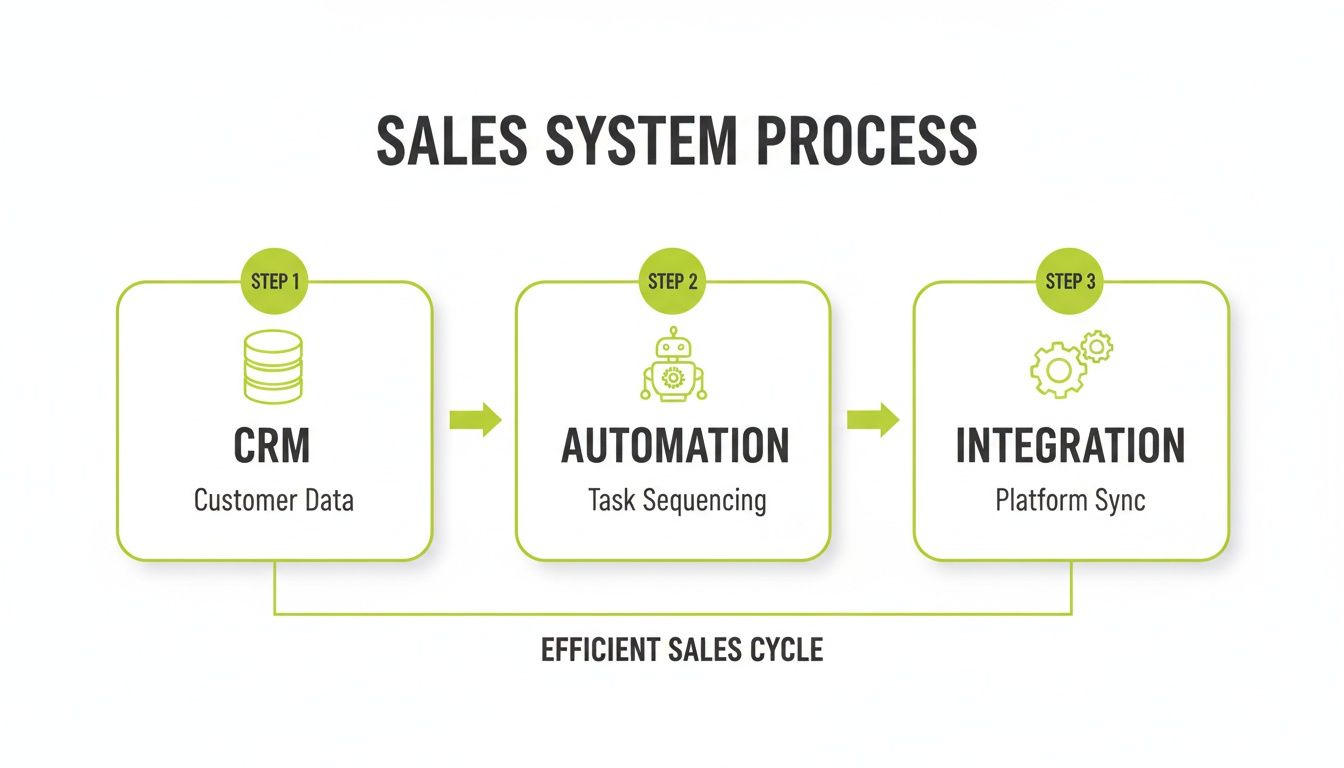
It shows how a central CRM, smart automation, and key integrations work in harmony to build a sales engine you can actually rely on.
Structuring a Compelling Journey
The best nurture sequences are not just a random collection of messages. They are strategically designed to educate, build value, and gently encourage the prospect to take the next step, all without coming across as pushy. For instance, an automated email could share a few glowing testimonials from current members or explain the different membership options that might suit them, based on the information they gave in their initial enquiry.
The real goal of a nurture sequence is to make the decision to visit your club feel like the most natural, logical next step. When they arrive for their tour, they should already feel like they know the place and are confident it could be the right club for them.
By automating these crucial early communications, you guarantee that every single enquiry gets the same high standard of follow-up. It completely removes the risk of someone being forgotten during a busy spell, freeing up your team to focus on what they do best: delivering a brilliant, personal experience when people actually visit.
To see how this fits into the bigger picture, you can read our complete guide on the ideal golf club sales process. This system is what turns a cold digital enquiry into a warm, genuinely interested prospect who is ready to be wowed.
Getting Your Sales System Up and Running: A Practical Timeline
Putting a modern sales system in place is a project, not a flick of a switch. But with a clear plan, any golf club can make the transition smoothly, keep disruption to a minimum, and start seeing the benefits almost immediately. It is all about moving from selecting the right tools to defining clear roles for your team, making sure everyone is confident and ready to go.
A realistic implementation timeline is usually somewhere between four to six weeks. This gives you enough breathing room for proper setup, moving your data across, training the team, and testing everything without feeling rushed. The aim here is to build momentum, not create chaos.
Who Does What? Defining Roles and Responsibilities
One of the very first things to sort out is ownership. A system is only as good as the people using it, so establishing clear roles from day one is absolutely crucial for success. If responsibilities are blurry, even the best technology will fall flat.
Think about who will take charge of these key areas:
- The System Owner: Who is the go-to person for the system? This is often the General Manager or Membership Secretary who keeps an eye on its performance and makes sure it is being used properly.
- Enquiry Management: When the system flags a warm lead, who picks up the phone? This could be a dedicated sales person, or perhaps someone in the pro shop or office team.
- Data Monitoring: Who is going to keep an eye on the performance dashboards? This person tracks the important numbers, like enquiry volume, conversion rates, and how many visits are being booked, to see what is working and what is not.
By assigning these roles early, you build in accountability. It ensures the system becomes a core part of your club's daily rhythm, rather than just another piece of software that gets forgotten about.
A Phased Rollout Plan
A smart implementation follows a logical sequence. We guide clubs through a process where each stage builds on the last, creating a sales engine that is both powerful and reliable.
Here is what a typical rollout looks like:
- System Selection and Setup (Weeks 1-2): First, we help you choose the right CRM and automation platform, one that fits your club’s specific needs. Then, we get it configured to match your membership categories, lead sources, and unique way of communicating.
- Process Mapping (Week 2): This is where we sit down with your team and map out your ideal sales journey. We define exactly what happens when an enquiry comes in, which automated messages go out, and at what point a personal follow-up call is triggered.
- Team Training (Week 3): This part is all hands-on. We train your staff on how to actually use the system day-to-day. The focus is on practical tasks: viewing new leads, making notes after a call, and understanding the sales pipeline at a glance.
- Go-Live and Monitoring (Week 4 Onwards): Time to switch it on. For the first few weeks, we keep a close eye on performance, iron out any little kinks, and provide ongoing support. This ensures your team feels confident and the system is already starting to deliver results.
This structured approach takes the guesswork and anxiety out of adopting new technology. It guarantees your sales system for golf clubs is not just installed, but properly embedded into your club's culture, driving predictable and sustainable growth.
The move towards a digital-first world is impossible to ignore. In 2025, UK golf clubs reported a record 17% jump in green fee revenue, and online sales rocketed by 25% to account for 67% of all casual sales. Clubs still relying on manual, pen-and-paper processes risk being left behind as online channels become the main driver for new business. You can dive deeper into these trends in this report from The Golf Business.
Tracking Success and Optimising for Long-Term Growth
Putting a new sales system in place is a great start, but it is not a 'set and forget' solution. The real value is unlocked when you start consistently tracking your performance and making smart, data-driven tweaks. This is the shift from simply reacting to enquiries to proactively managing your membership growth.
Think of it as building a culture of continuous improvement. By keeping a close eye on the right numbers, you will know exactly what is working, what is not, and where you can refine your approach. This ensures your club grows not just in size, but in a profitable and sustainable way.

Key Metrics That Actually Matter
It is incredibly easy to get swamped by data. A well-designed sales system for golf clubs will give you a clear dashboard that cuts through the noise and puts the most important Key Performance Indicators (KPIs) front and centre. Forget vanity metrics; these are the numbers that truly matter:
- Enquiry Volume: Simply put, how many potential new members are coming into your pipeline each week or month? This is your top-line indicator of whether your marketing is generating enough interest.
- Average Response Time: How fast are you (or your system) getting back to a new lead? In our experience, this needs to be measured in minutes, not hours. Speed is everything in the initial stages.
- Visit Booking Rate: What percentage of genuinely interested people actually book a club tour? This is a critical checkpoint for your automated nurture sequences. Are they doing their job?
- Visit-to-Member Conversion Rate: Of all the prospects who tour the club, how many actually join? This number tells you a lot about your in-person experience and the strength of your follow-up process.
- Cost Per Acquisition (CPA): How much are you spending in marketing to get one new member through the door? This is the bottom line for profitability.
If you only track these five KPIs, you will have a crystal-clear picture of how your sales process is performing. It completely removes the guesswork and forces you to make decisions based on what is really happening, not what you think is happening.
Using Data to Make Smarter Decisions
Once you have these numbers at your fingertips, you can start asking the right questions. For example, let's say you are getting a lot of enquiries, but your visit booking rate is disappointingly low. That is a massive clue. It probably means your initial automated messages are not hitting the mark. Maybe the offer is confusing, or the value just is not coming across.
Armed with that insight, you can make a targeted change. You could try rewriting that first email, or perhaps add an SMS with a compelling member testimonial. Then, you watch the data to see what happens. This constant cycle of tracking, analysing, and adjusting is what turns a good sales process into a brilliant, predictable engine for growth.
Common Questions About Golf Club Sales Systems
It is completely normal to have questions when you are thinking about changing how your club handles membership enquiries. Let’s tackle some of the most common concerns we hear from managers, secretaries, and committee members weighing up a proper sales system.
Our Club Is Run by Volunteers. Is a Sales System Too Complex?
Quite the opposite, actually. For a club that relies on volunteers or has limited staff hours, a structured system is a game-changer. It takes the pressure off by automating those crucial first responses and making sure every single enquiry is neatly organised in one central place. No more lost leads in a jumbled inbox.
A well-set-up system brings clarity. It guarantees consistent, professional follow-up even when different people are picking up the slack on different days. The trick is to implement a process that is straightforward and easy to use, not a clunky piece of software that creates more work. We focus on building systems that are powerful behind the scenes but simple to manage day-to-day.
We Do Not Want to Seem Aggressive or ‘Salesy’
This is a really important point, and a concern we hear all the time. A modern sales system is not about high-pressure tactics or pushy phone calls. It is about providing professional, timely, and genuinely helpful communication to people who have already shown an interest in your club.
Think of it this way: the system simply ensures that when someone raises their hand, their enquiry is acknowledged right away and they get the information they need without delay.
A professional system avoids the "salesy" feeling by building value and trust through helpful communication. It replaces inconsistent, manual follow-ups with a process that makes a prospective member feel valued, not pressured.
You are using smart automation to share details about the course, the clubhouse atmosphere, and what makes your membership special. It professionalises your entire approach from the very first click.
How Much Does a Sales and CRM System Typically Cost?
The investment can vary quite a bit, from fairly cheap off-the-shelf software to a fully integrated growth system. But the initial cost is not the most important factor. The return on investment is.
A system that costs a few hundred pounds a month but does not actually convert enquiries into members is an expensive mistake. On the other hand, a system that brings in just a couple of new members each month will pay for itself many times over. The focus should always be on the result, not just the price tag.
How Long Does It Take to See Results?
You will feel the initial impact almost instantly. The moment the system goes live, you gain complete visibility over every new enquiry, and you will see a massive improvement in your response times. That immediate professional touch makes a huge difference.
Within the first 30 to 60 days, you should start seeing a real, measurable increase in booked club visits and better conversion rates as the automated follow-up sequences do their job. The bigger, long-term benefits, like a predictable pipeline of new member revenue, really start to take shape over the first three to six months as you build up data and refine your approach.
At GolfRep, we build predictable revenue pipelines for UK golf clubs by combining lead generation with the structured follow-up systems needed to convert them. To see how we can help your club grow sustainably, find out more about our approach.
Ready to tap into our proven growth system?