Sales Pipeline Visibility for Golf Clubs: A Practical Guide

A Monday morning at a golf club often starts with more questions than answers. The weekend has produced website forms, phone messages, walk-ins, referral introductions and requests for membership information, but nobody can say with confidence which prospects were contacted, which booked a visit, which applications are progressing, or whether last month's campaign produced members who are still engaged.
That isn't a reporting inconvenience. It affects marketing decisions, staff time, capacity planning and revenue forecasts. Sales pipeline visibility gives a club one connected view of the journey from first local interest through enquiry, visit, application, joining, usage and renewal. It shows where prospects are moving, where they're stalling and whether apparent growth is producing sustainable membership income.
For GolfRep, the practical question isn't whether a club owns a CRM. It's whether the commercial team can use reliable information to identify its current constraint, intervene intelligently and measure what happened next.
What Sales Pipeline Visibility Actually Means at a Golf Club
A general manager reviewing the weekend's activity should be able to answer straightforward questions. How many membership enquiries arrived? Which ones came from referrals, paid advertising, an open day or organic search? Who owns each follow-up? How many visits were booked, and did those visits happen? Which prospects applied, joined or entered a waiting list?
A contact list can't answer those questions. Neither can a spreadsheet that only records names and enquiry dates. Visibility means connecting each record to a stage, an owner, a next action, a source and an outcome, then continuing that record beyond the joining decision.

The difference between records and usable visibility
A club may have hundreds of contacts but little commercial understanding. Records might be duplicated between the membership system, an email inbox and a marketing platform. A prospect may appear as an active opportunity even though nobody has contacted them recently, while another may have joined but still be counted as a live lead.
A useful pipeline follows the full journey:
- Anonymous demand: local website visits, campaign responses and other identifiable signals before a person makes contact.
- Enquiry and qualification: the golfer's motivation, location, playing habits, preferred category and likely timing.
- Visit and application: whether the prospect booked and attended a tour, then progressed to a formal application.
- Joining and membership: the decision, start date, payment position and membership category.
- Retention and renewal: usage, engagement, referral behaviour, renewal status and cancellation reason.
The wider UK market is already moving towards digitally managed operations. In 2023, 61% of UK SME employers reported using web-based software, up from 50% in 2022, an increase of 11 percentage points and a 22% relative rise according to this UK CRM overview. That doesn't prove that every club has a mature CRM, but it shows that connected operational software is becoming normal for smaller organisations.
A club with visibility can decide where marketing spend is justified, where staff intervention is needed, whether capacity is restricting growth and which sources produce members who stay. Clubs reviewing fragmented systems may also benefit from guidance on how to diagnose data visibility issues before buying another reporting tool.
Practical rule: If a manager can't trace a member back to the source, stage and actions that produced the joining decision, the club has data, but it doesn't yet have pipeline visibility.
The Eight Stages of a Golf Membership Pipeline
A golf club needs stages that reflect how membership decisions happen. Generic labels such as “lead”, “opportunity” and “customer” are too broad. A casual visitor enquiry, a lapsed-member conversation and an application awaiting committee approval require different actions and shouldn't be mixed in one count.
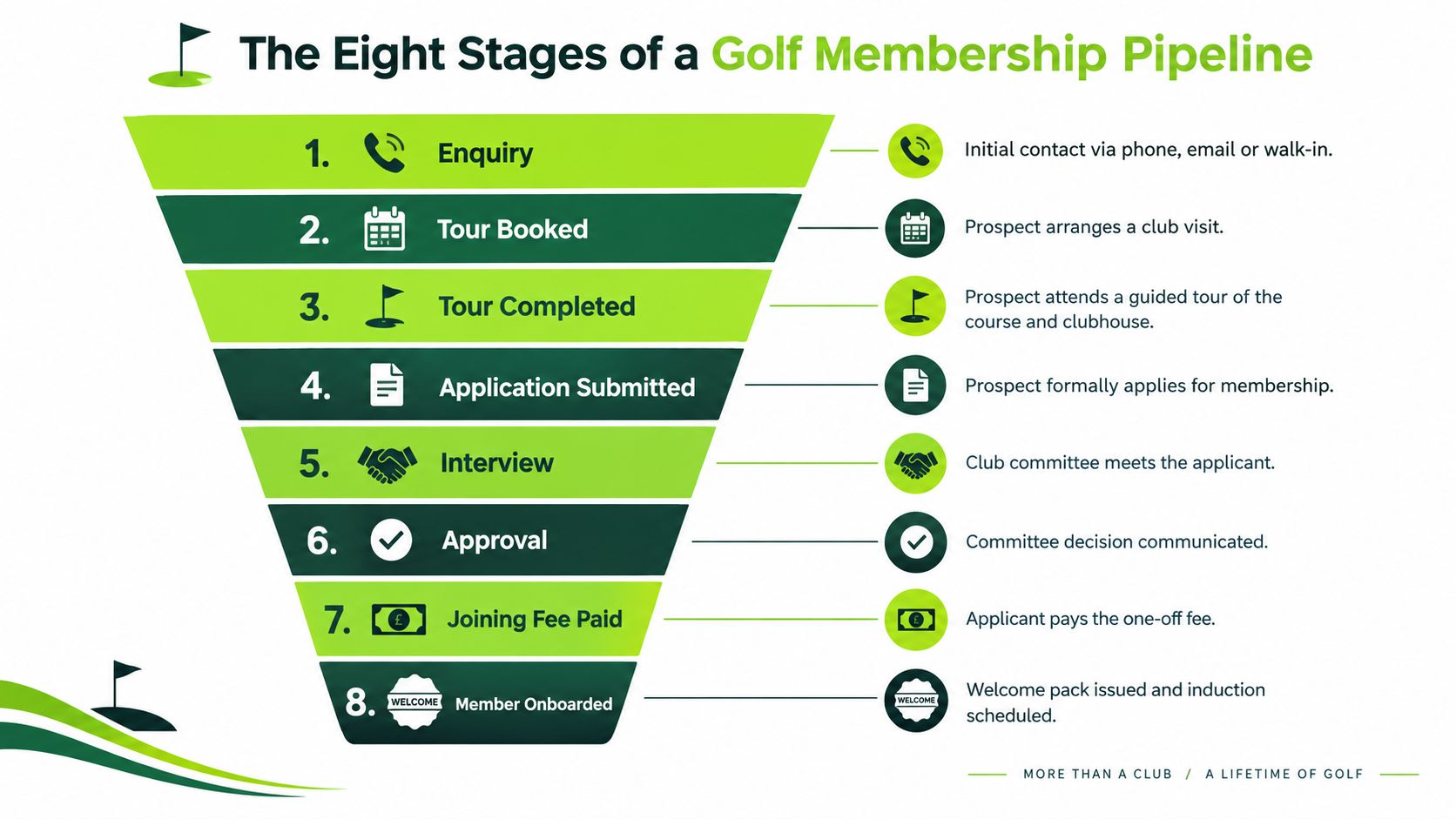
Define the stages by observable actions
1. Enquiry received. Record the source, date, contact details, golfer type and owner. A website form without usable contact information shouldn't count as an active opportunity.
2. Qualified. Confirm that the prospect fits a relevant membership category, understands the broad proposition and has a realistic decision timeframe. Record the preferred category and the next action.
3. Visit booked. Capture the appointment date, host, purpose of the visit and expected decision date. A proposed visit that hasn't been agreed by the prospect remains an enquiry.
4. Visit attended. Record attendance, key questions, objections, playing requirements and agreed follow-up. A calendar booking that the prospect missed shouldn't be treated as a completed visit.
5. Application submitted. Store the application date, category, joining requirements and any outstanding information. This stage should represent a formal action by the prospect, not a verbal expression of interest.
6. Joining decision. Record whether the application is approved, declined, deferred or awaiting a decision. Ownership must remain clear while the application is open.
7. Member active. Capture the start date, membership type, payment status and onboarding actions. A person who has been approved but hasn't completed the joining process shouldn't appear as an active member.
8. Renewal. Continue the record into renewal, with usage, contact history, renewal date and any cancellation or resignation reason. Acquisition reporting then becomes member-value reporting.
Every active record needs source, owner, lifecycle stage, last contact date, next action, expected decision date and membership category. If one of these fields is missing, the record may still be useful operationally, but it shouldn't be included in a confident forecast.
The stages also need exit rules. “Qualified” should require evidence of fit. “Visit attended” should require attendance. “Application submitted” should require a completed application. Clear definitions stop staff from advancing records to make the pipeline look healthier than it is.
The Metrics That Turn a Pipeline Into a Management Tool
A weekly dashboard should help a manager decide what to do, not display activity. The strongest measures connect one stage to the next and reveal whether the constraint sits in marketing, follow-up, the visit experience, the joining process or available capacity.
The core calculations are straightforward:
| Metric | Formula | What a healthy number looks like | What a movement tells you |
|---|---|---|---|
| Enquiry-to-visit conversion | Visits booked divided by qualified enquiries | A stable rate appropriate to the club's categories and audience | A fall may indicate weak qualification, slow contact or an unclear visit proposition |
| Visit-to-application conversion | Applications divided by attended visits | A consistent rate across comparable periods | A fall points towards visit experience, pricing, fit or follow-up |
| Application-to-joining conversion | Joiners divided by submitted applications | A reliable rate after allowing for approvals and capacity | A fall may indicate committee delays, unclear requirements or unsuitable applications |
| Average days per stage | Total days in stage divided by records leaving stage | Short, explainable movement with limited ageing | Rising duration exposes stalled actions or decision bottlenecks |
| Source-to-revenue cost | Attributable spend divided by joining revenue from that source | Positive economics after considering retention and category value | A high cost may reflect poor source quality, weak conversion or underreported revenue |
There's no universal healthy percentage for a UK members' club. Categories, joining processes, local competition, price positioning and capacity vary too much. A club should establish its own baseline from clean records, compare like with like and investigate meaningful movement rather than importing a benchmark from a different business model.
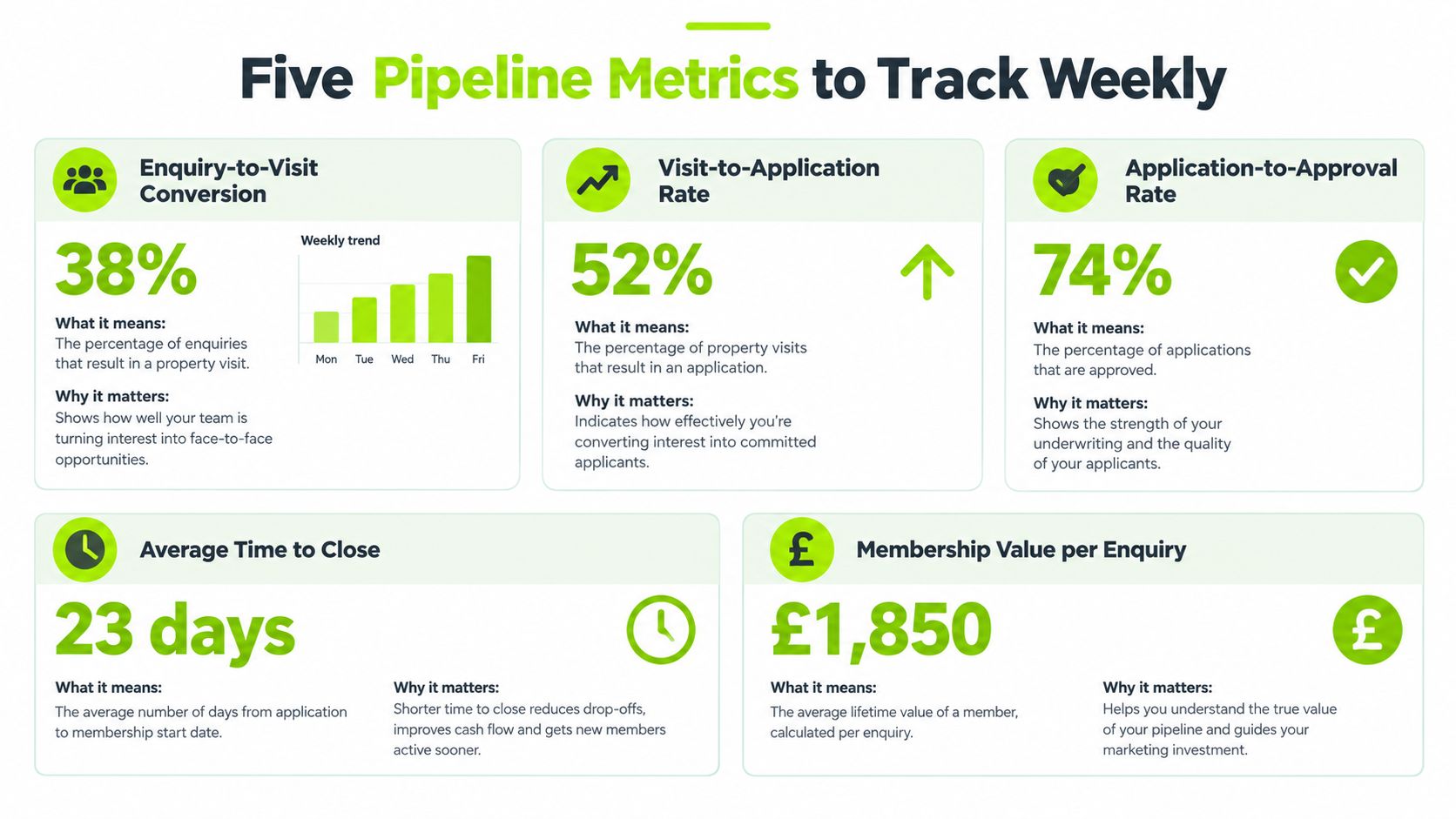
Read the metrics together
A fall in enquiry-to-visit conversion with stable visit-to-application performance usually points upstream. The club may be attracting the wrong audience, responding too slowly or failing to explain what happens during a visit. Strong enquiry-to-visit conversion followed by weak visit-to-application conversion points towards the experience, proposition or qualification process.
Strong application numbers with slow joining decisions suggest a process issue rather than a demand issue. That could involve committee availability, paperwork, payment instructions or category restrictions.
The reporting model should also connect source to longer-term value. The Dynamics 365 sales features overview is useful for understanding how a broader sales system can connect activities, records and reporting, but a club doesn't need enterprise complexity to begin. A well-maintained spreadsheet can answer the first questions if the definitions are consistent.
For a practical starting point, use this lead tracking system as a reference for the fields and ownership rules that make weekly review possible. Avoid vanity measures such as website traffic or total form submissions unless they can be connected to visits, joins and subsequent member value.
Choosing and Configuring a CRM That Fits a Golf Club
The right CRM is the simplest system that staff will maintain and managers can trust. A technically impressive platform fails if the membership administrator has to duplicate every contact, the PGA professional can't see the next action, or the general manager receives a report nobody has agreed to use.
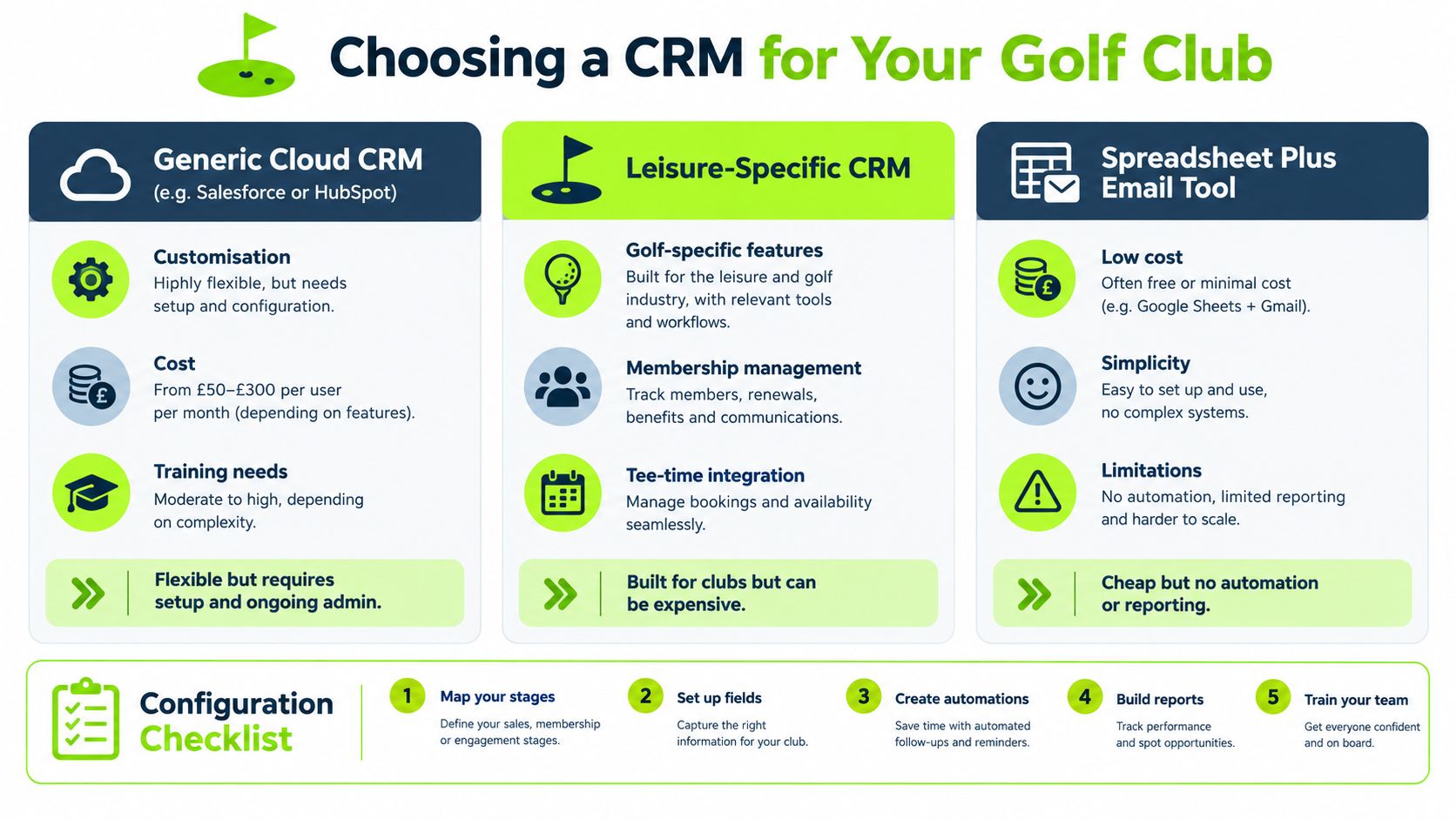
Three configurations appear regularly in UK golf.
Compare the practical options
Generic cloud CRM. Platforms such as HubSpot or Salesforce offer flexible fields, automation and reporting. They can support complex multi-site operations, but they require careful setup, integration work and ongoing administration. A club must decide how the CRM connects to its membership, finance, email and tee-sheet systems.
Leisure-specific CRM. A golf or hospitality platform may understand categories, membership records and tee-time relationships more naturally. The trade-off is flexibility, licensing cost and the possibility that its marketing or reporting functions are less adaptable than a general CRM.
Club-management system with a sales view. This can reduce duplicate records because operational and membership information sit closer together. It may be the most practical route for a smaller club, but the sales view can be too limited if it doesn't support source attribution, follow-up tasks, stage history or campaign reporting.
A spreadsheet paired with an email tool can be a sensible temporary arrangement when the team is small. It becomes dangerous when different staff keep separate versions, free-text stages proliferate or nobody can identify the current owner.
Configure the minimum viable data model
Whatever platform a club chooses, enforce these fields from the start:
- Source: Referral, website, campaign, open day, visitor, lapsed member or another defined option.
- Stage: One of the agreed membership stages, with clear entry and exit criteria.
- Ownership: A named person responsible for the next action.
- Next action and due date: A specific task, not “follow up”.
- Expected joining date: A date supported by the prospect's stated timing or process position.
- Membership type: Full, flexible, junior, off-peak or another relevant category.
- Last contact date: The latest meaningful interaction, not an automated email.
- Status reason: Lost, deferred, waiting list, unavailable category or approved but incomplete.
Add rules that flag overdue next actions, records with no recent activity, duplicate contact details and joining dates unsupported by a booked visit or documented commitment. The UK adoption gap matters here. CRM use is described as standard among medium-sized UK businesses, more moderate among small firms and extremely low among microbusinesses in government-referenced commentary on CRM software and hidden sales.
A small club should choose simplicity over theoretical capability. For teams comparing implementation requirements, Wisely CRM consultancy services provide useful context on configuration and process support. GolfRep can also be included once as an operational option, with a visual pipeline showing enquiry stages, ownership, next steps and bottlenecks. A club assessing the wider approach can review CRM for golf clubs alongside its existing membership and tee-sheet systems.
Reporting Standards That Committees and General Managers Will Actually Use
A CRM doesn't create accountability by itself. The club needs an agreed reporting rhythm, with different information for the person doing the work, the manager making weekly decisions and the committee reviewing commercial direction.
Use three reporting levels
Daily follow-up list: The membership or marketing lead needs overdue actions, new enquiries, today's visits, unanswered contacts and applications waiting for information. This is an action list, not a management dashboard.
Weekly pipeline review: The general manager should see records by stage, movement since the previous review, ageing, source, expected joins and specific interventions required. The meeting should focus on decisions. Who needs help? Which records should be requalified? Which action has an owner and date?
Monthly committee report: The committee needs a concise view of enquiry volume, stage conversion, expected joining dates, source contribution, membership capacity and renewal position. It shouldn't contain every contact note.
A useful monthly page might show:
- New qualified enquiries by source
- Visits booked and attended
- Applications and expected joining dates
- Joiners by membership category
- Waiting-list movement
- Acquisition spend connected to joining revenue
- Renewal risks and cancellations
- Decisions required from the committee
The report must use the same definitions as finance and operations. If finance counts revenue at payment, marketing counts a member at application and the membership team counts approval as conversion, the committee is comparing incompatible figures.
Clubs should agree definitions before building charts. The guide to measuring marketing effectiveness is relevant because marketing performance only becomes useful when it connects spend and source to commercial outcomes.
A report earns its place when a named person can take a named action from it.
Assign one owner for data quality, one owner for weekly review and one person responsible for approving stage definitions. Train staff on the process using real club examples, not generic CRM demonstrations. If the report isn't discussed in meetings, staff will quite reasonably conclude that updating it doesn't matter.
Where Visibility Exposes a Bottleneck Instead of a Lead Shortage
A visible pipeline can reveal that the club has enough demand. The constraint may sit in membership capacity, category design, tee-time availability, approval procedures or waiting-list management.
The wider market illustrates why this distinction matters. England recorded 750,071 club members in 2025, a 2.66% year-on-year increase, while 98% of recreational golfers and 96% of leisure golfers expected to keep playing, according to UK golf trend reporting. England Golf also reported a rise of 90,000 in golf-club membership in its membership update. These figures describe a growing and competitive market, but they don't mean every prospect should be pushed towards immediate full membership.
Hillier Hopkins' 2025/26 survey found that 77% of members' clubs reported growth, 63% had more than 600 playing members, 55% identified member referrals as their most successful marketing activity, and 48% had a waiting list, up from 46% the previous year in the survey report. A club can therefore have strong referral demand while lacking immediate capacity in the category the prospect wants.
Separate fit from speed
When qualified demand exceeds available places, use segmented paths:
- Full membership: Continue towards the earliest realistic start date.
- Flexible or off-peak membership: Offer a category that fits capacity and playing preferences.
- Junior or family route: Use separate eligibility, communication and onboarding rules.
- Future availability: Record the desired category, preferred start date and agreed contact rhythm.
- Alternative facility or service: Redirect suitable prospects to lessons, indoor golf, visitor packages or other available products without pretending they're equivalent to membership.
The pipeline should show earliest feasible start date, category fit, expected playing demand and waiting-list position. Communications must be transparent. A prospect who receives repeated sales messages for a category that isn't available will lose confidence, even if the club's marketing activity looks strong.
Capacity planning also needs operational input. Tee-sheet restrictions, competition calendars, staffing and onboarding availability can change the actual joining date. Managers should forecast both commercial demand and deliverable capacity, then measure pipeline health by fit, expected revenue, likely retention and start date, not only by conversion speed.
England Golf's broader participation figure covers more than traditional club membership. Its published description of golf reaching more than one in four adults when all forms of participation are included appears in its participation update. Clubs should therefore distinguish existing members, lapsed members, casual golfers, beginners, visitors and range or indoor users instead of counting every contact as the same opportunity.
Building a Pipeline That Extends Into Retention and Renewal
A member who has paid is not the end of the commercial journey. The record should continue with start date, payment status, induction progress, usage, contact history, renewal date and cancellation or resignation reason.
That extension separates acquisition performance from member-value performance. A campaign may generate strong joining numbers while first-year retention is weak because onboarding, expectations or engagement have failed. If the pipeline stops at sign-up, the club will credit marketing for revenue that doesn't become sustainable membership income.
Add post-join signals
Track whether the new member has:
- Received a welcome communication and induction invitation
- Used the facility or booked a tee time
- Met relevant staff or joined a group
- Responded to early engagement messages
- Referred another golfer
- Confirmed renewal intention
- Raised a service issue or indicated a reason to leave
England Golf's retention resources treat retention as a distinct operational issue, which is the right approach for club reporting. Acquisition, onboarding, engagement and renewal should have connected records but separate ownership and measures.
Hillier Hopkins' 2024/25 survey found that members' clubs averaged 75 joiners, while an average of 21 people moved from waiting lists into membership at the latest renewal in its golf clubs report. That distinction matters. A club should forecast new acquisition and existing waiting-list demand separately, then compare both with available categories and renewal capacity. The same survey reports that 59% of members' clubs had more than 600 playing members and 71% used referrals, making source and outcome tracking particularly important.
A practical next meeting checklist is:
- Agree the eight stage definitions and exit rules.
- Remove duplicate and inactive records from active pipeline.
- Assign an owner and next action to every live opportunity.
- Add category, start-date and waiting-list fields.
- Review conversion and stage duration weekly.
- Add onboarding, usage and renewal fields.
- Identify the current constraint, then choose one intervention to test.
- Review the result before changing the next part of the process.
Sales pipeline visibility is therefore an operating history, not a dashboard project. The clubs that use it well identify whether their current constraint is demand, qualification, visits, approvals, capacity, onboarding or retention. They fix that constraint, measure the movement and then move to the next one.
GolfRep helps golf clubs map the full commercial journey from local demand through enquiries, visits, joining decisions and renewal, with practical CRM, follow-up and revenue reporting. If you want to identify the largest visibility or conversion constraint in your club, visit GolfRep to discuss the next step.
Ready to tap into our proven growth system?