Launch a Winning Padel Membership Campaign in 2026
A lot of clubs are in the same position right now. The courts are ready, interest is there, and the team assumes the next step is simple: run some ads, offer a joining incentive, and wait for memberships to come in.
That's usually where the problems start.
A padel membership campaign rarely fails because nobody clicked. It fails because enquiries sit in inboxes, landing pages collect names without context, follow-up is inconsistent, and nobody can see which leads are moving towards a membership decision. The campaign creates activity, but not a reliable system.
For club managers, that distinction matters. A promotion is temporary. A pipeline is operational. If your courts need filling consistently, the job isn't just to generate interest. It's to capture it properly, respond quickly, nurture it with structure, and track what converts into revenue.
Beyond Building Courts The Real Membership Challenge
New padel courts create optimism. They also expose weak processes very quickly. A club can invest in facilities, branding, and launch activity, then discover that demand arrives in bursts and disappears just as fast because nobody owns the follow-up.
That's why the usual advice to “do more marketing” misses the point. Marketing can create the enquiry. It can't rescue a slow response, a weak landing page, or a team that has no visibility on who asked for what. Clubs don't need more disconnected activity. They need a process that turns interest into joined members.
The opportunity is large enough that this can't be handled casually. The USPA report on padel participation growth says the SFIA 2026 report counted 1,073,000 Americans who played padel in 2025, while USPA said club membership grew 51.5% year-over-year in 2025 and individual membership grew 53.5%. Those are US figures, not UK figures, but they show what happens when awareness and access improve. Clubs need a conversion model ready before attention arrives.
Why enquiries aren't the finish line
A club might get a healthy response to a launch offer and still underperform commercially. That happens when:
- Leads go nowhere: An enquiry form is submitted, but nobody logs it centrally.
- Staff rely on memory: Follow-up depends on who was on shift that day.
- Offers outrun operations: Intro campaigns bring in trial players, but no structured route exists into recurring membership.
- Reporting is shallow: The club knows how many leads came in, but not which source produced actual joins.
The real bottleneck in a padel membership campaign isn't usually traffic. It's what happens after someone raises their hand.
This is the same principle behind good padel club marketing systems. Clubs that grow predictably don't treat lead generation and conversion as separate jobs. They connect ads, forms, CRM, response time, and nurture into one operational flow.
The shift that changes results
The mindset shift is simple. Stop asking, “How do we get more enquiries?” Start asking, “What happens in the first 24 hours after an enquiry arrives?”
That question changes everything. It forces a club to define ownership, response standards, lead stages, and conversion tracking. It also makes campaign spend easier to justify because you can see which activity creates members rather than just clicks.
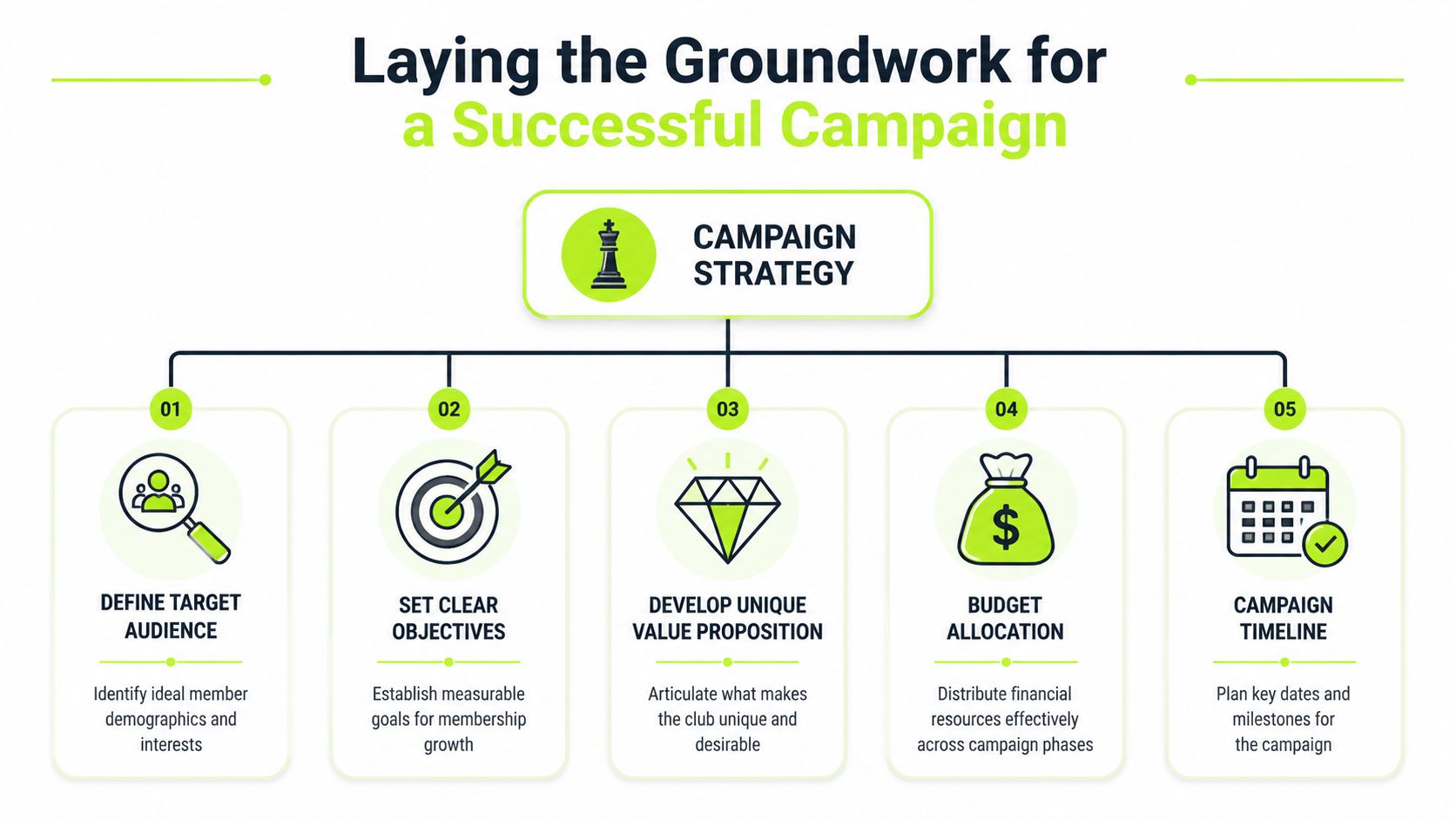
Laying the Groundwork for a Successful Campaign
A club opens enquiries for a new membership push on Monday. By Friday, the manager is pleased with the lead count and frustrated with the sales. A few prospects booked a trial. Several never replied after the first message. Staff are already debating whether the offer was wrong, even though the main problem is usually earlier in the process.
Good campaigns are set up backwards. Start with the type of member the club wants, the route that turns interest into a paid join, and the numbers that show whether that route is working. Ad creative matters later.
Choose your first audience carefully
Early-stage clubs often target everyone within a reasonable drive time. That usually produces enquiries, but not always the right kind. If court access is limited, the wrong audience can fill peak slots, create pressure on operations, and still leave membership revenue below target.
Mondo's guidance on building a padel community points to a smarter starting point. Prioritise segments with stronger retention potential and plan around actual member value, not just initial response. In practice, that means asking who is likely to play regularly, book coaching, join leagues, bring family members, or refer others.
Useful filters before launch:
- Playing intent: Are they trying padel once, or looking for a club they will use weekly?
- Time profile: Can they use quieter inventory, or will they only want the busiest evening slots?
- Revenue fit: Are they likely to buy only the entry offer, or move into memberships, events, and coaching?
- Social fit: Will they help build the kind of community the club wants to keep?
A full diary can hide a weak membership mix.
Clubs that already run paid social for other racquet or leisure offers can apply the same audience discipline used in Meta ads for golf clubs. Start with the segment most likely to convert and stay. Expand only after the club can see who turns into real members.
Build an offer that gets action without creating discount dependence
The first offer should lower commitment, not lower perceived value. That is a real trade-off. A trial that is too expensive suppresses response. A trial that is too cheap attracts people who disappear as soon as the incentive ends.
The safer option is to give prospects a clear next step into the club. Trial bundles, beginner courses, referral-led starter packs, and off-peak entry points can all work if they connect to a defined membership conversation. If they do not, the campaign produces activity instead of revenue.
A sensible offer framework often looks like this:
| Offer type | What it does well | Main risk |
|---|---|---|
| Intro trial | Reduces hesitation for first-time players | Attracts bargain hunters if there's no follow-up path |
| Referral reward | Brings in warmer prospects with social trust | Stalls if current members aren't prompted properly |
| Off-peak package | Uses spare capacity intelligently | Can confuse buyers if benefits aren't explained clearly |
| Partner-led offer | Reaches local audiences efficiently | Weak execution if staff don't track source and follow-up |
This is also where clubs can borrow a useful lesson from AI for ecommerce conversions. The principle is the same across industries. Interest only has value when the next step is easy, tracked, and followed up consistently. Padel clubs do not need ecommerce tools, but they do need the same discipline around conversion points.
Set KPIs around conversion, not just response
If the team only tracks leads, they will optimise for lead volume. That usually pushes targeting wider, lowers lead quality, and makes follow-up harder for front-of-house staff.
Track the points that show whether the club can turn demand into paid membership:
- Lead-to-contact rate: How many enquiries get a real response and conversation?
- Speed to first follow-up: How quickly does the club reply after form submission?
- Trial or visit booking rate: How many leads move from interest to attendance?
- Membership conversion rate: How many attendees join?
- Source-to-member performance: Which channel brings members, not just enquiries?
These numbers force better decisions. If response is high but booking is weak, the offer or message may need work. If bookings are strong but joins are low, the issue is often the trial experience or follow-up sequence. If one source produces plenty of leads and very few members, cut waste early.
This groundwork is what makes the rest of the campaign predictable. Without it, clubs buy attention and hope staff can convert it. With it, every enquiry enters a system built to produce members.
Building Your High-Conversion Digital Funnel
Most clubs don't need a complicated campaign stack. They need a clean one.
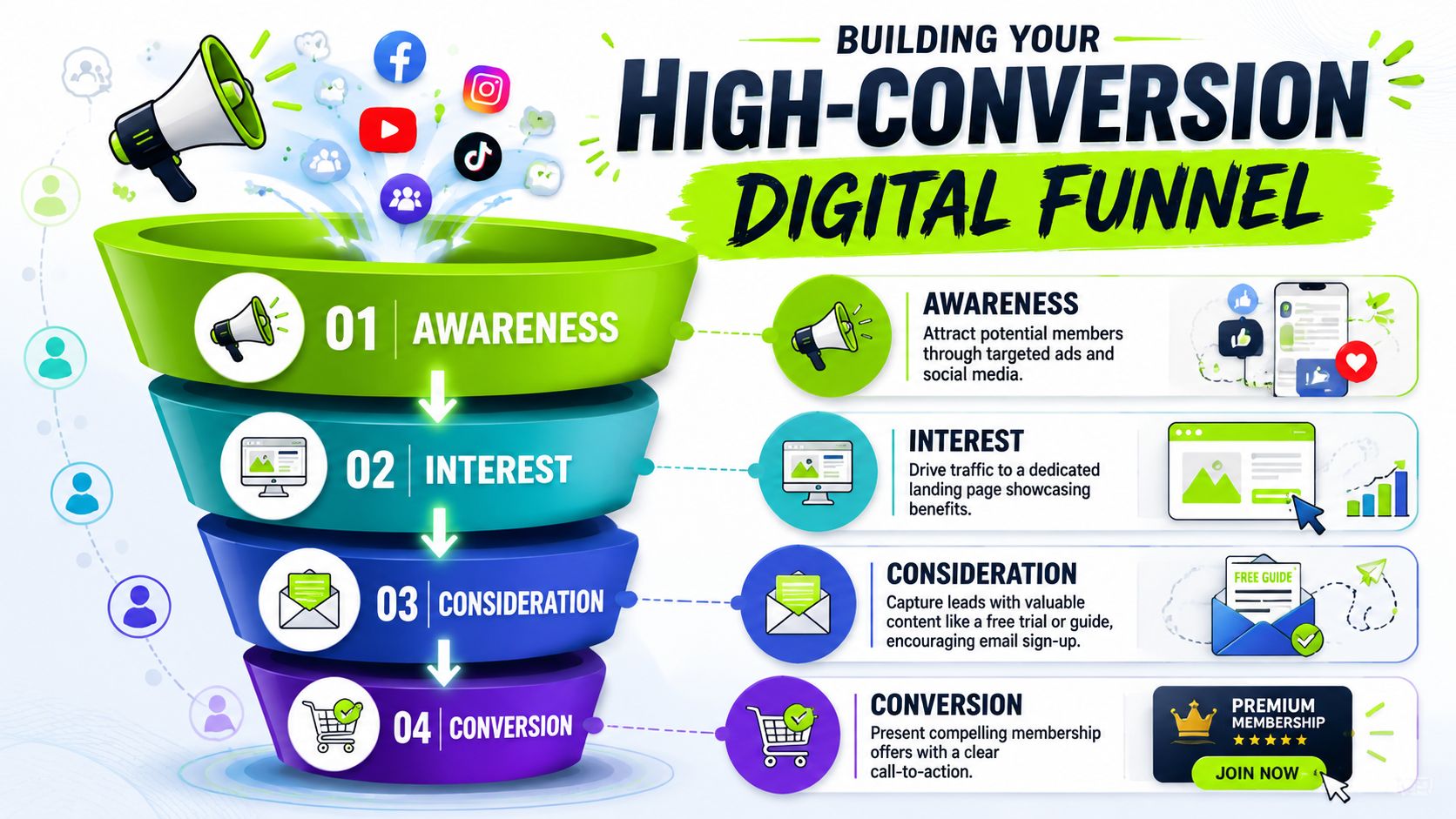
A high-performing padel membership campaign usually works because every part has one job. The ad creates interest. The landing page captures intent. The CRM records the enquiry. The follow-up sequence moves the lead towards a decision. If any one of those parts is weak, the whole funnel leaks.
Start with warm audiences before chasing strangers
One of the most reliable UK models is simple. AceRally's guide to a padel membership campaign recommends targeting warm audiences first, such as email subscribers, website visitors, and past enquirers, then following with a postcode-radius cold campaign on Meta and Google. It also recommends a minimal landing-page form, automated nurture, and prompt follow-up. The same guide says this structure can add 20–50 new members in a single campaign.
That logic is sound. Warm audiences already know the club, so they usually need less persuasion and less ad spend to move. Cold audiences still matter, but they should come second, not first.
A practical order of operations looks like this:
- Re-engage existing demand through your database, recent site visitors, and old enquiries.
- Run local paid traffic within a defined catchment using beginner-friendly creative.
- Send every response to one dedicated landing page instead of splitting traffic across multiple pages.
- Push each lead into a CRM immediately so no form submission depends on manual forwarding.
Keep the landing page lean
Landing pages for membership campaigns often fail because clubs try to say everything at once. Long paragraphs, multiple offers, too many buttons, and generic imagery create uncertainty.
A better page is narrower and more direct. It should answer five things quickly:
- What is on offer
- Who it is for
- Why this club is worth considering
- What happens after someone enquires
- What action to take now
The form should ask for the minimum needed to start a conversation. If you ask for too much, completion drops. If you ask for too little and don't connect it to a CRM, the sales team has no context.
Make the CRM the operational centre
At this stage, most clubs either become organised or stay reactive.
The CRM shouldn't be treated as a storage cupboard for leads. It should function as the operating system for the campaign. Every lead should land there automatically, be tagged by source, assigned a status, and enter a follow-up flow. That creates lead visibility and removes the usual scramble of checking inboxes, call logs, and spreadsheets.
For clubs used to handling enquiries manually, the change is immediate. Staff stop asking, “Did anyone get back to this person?” and start asking, “Where is this lead in the pipeline?”
That same discipline is visible in other sectors. Some of the ideas discussed in Lynkro's piece on AI for ecommerce conversions are useful here because they reinforce the same principle: conversion improves when intent is captured, routed, and responded to with speed and relevance rather than left sitting in a queue.
The ads only work when the system behind them works
Local campaign execution matters. So does the message.
Use direct-response copy. Make the first step easy. Show the beginner path clearly. If the creative is aimed at people who have never played, don't make the next step feel like a commitment to a full annual membership before they've even visited.
For clubs running Meta campaigns, the same mechanics behind golf club Meta ads apply well here: local targeting, one clear offer, one clear action, and a destination page built for response rather than general browsing.
Good ad performance can hide weak sales handling for a while. It won't hide it for long.
The Nurture and Conversion System That Works
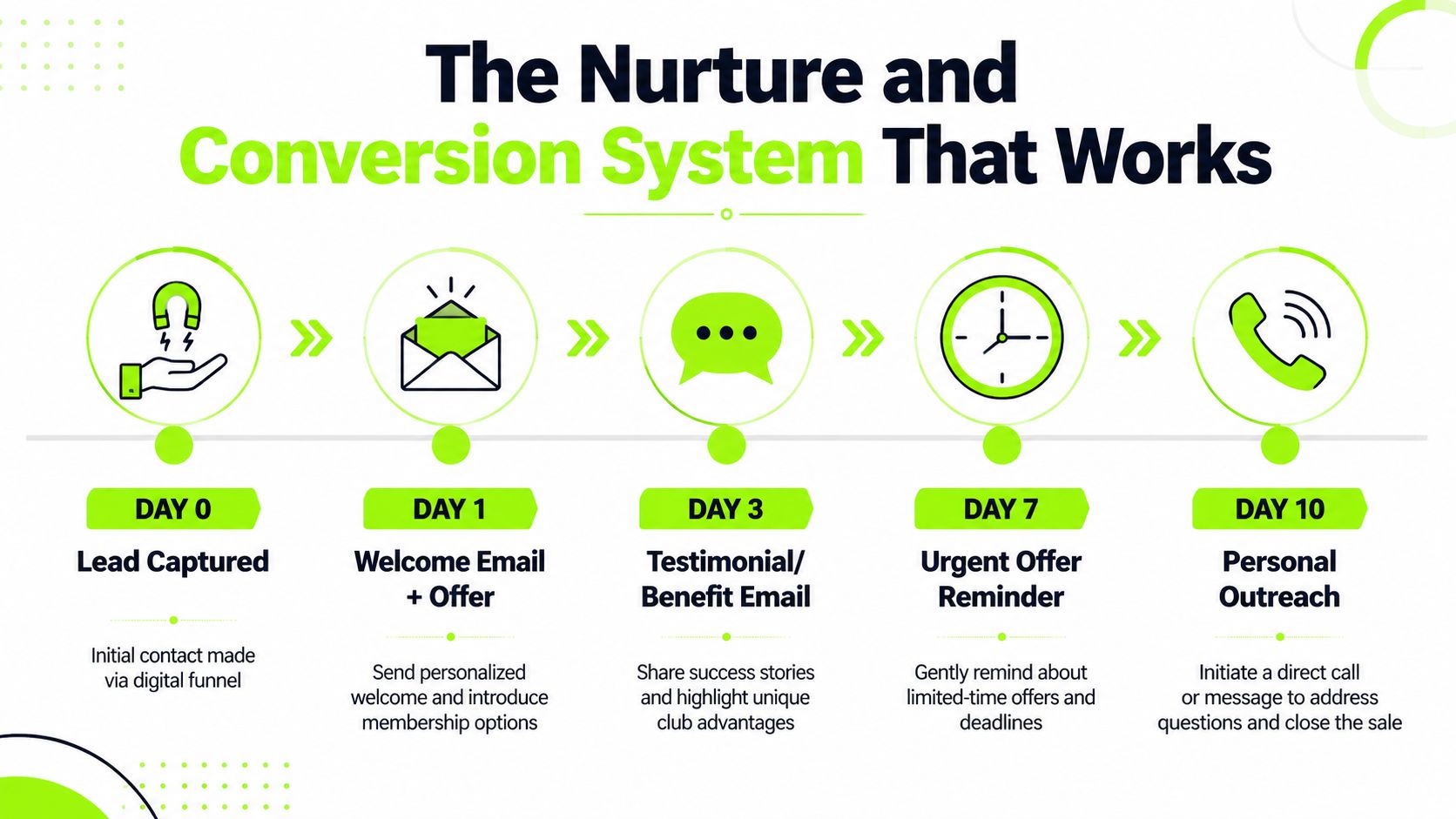
A club runs ads, enquiries come in over the weekend, and by Tuesday half the list has gone cold. That is the point where membership growth is usually won or lost. Lead generation got the conversation started. Conversion depends on what happens next, how fast the team responds, what gets sent automatically, who follows up, and how clearly each lead is moved toward a paid decision.
Automation should support the team, not replace it
The practical job of automation is consistency. Every enquiry should receive an immediate confirmation, the right follow-up sequence, and a prompt for staff to make personal contact while interest is still fresh. Staff should not have to remember who needs a message on day two or who attended a trial but never received the membership offer.
Human contact still does the closing work. A short call or text answers key questions faster than email usually can. Can beginners join? Is there a social group? Do they need a partner? What happens after the first session? Automation handles timing and coverage. Staff handle trust, objections, and commitment.
A workable sequence usually includes:
- Immediate confirmation: Confirm the enquiry, set expectations, and give the next step.
- Social proof: Show what a first visit looks like and who the club is a fit for.
- Objection handling: Answer common concerns around level, equipment, scheduling, and price.
- Timed follow-up: Keep the invitation active without letting it drift for days.
- Personal outreach: Call or text to move the lead from interest to action.
The trade-off is simple. Fully manual follow-up feels personal but breaks as volume rises. Fully automated follow-up keeps pace but misses context. Clubs that convert well use both.
The offer only works if the next step is defined
A trial package, beginner session, or referral incentive can fill the top of the funnel. It does not create members by itself. The club needs a planned handoff from enquiry to booking, from booking to attendance, and from attendance to a membership conversation.
That handoff should be visible in the CRM. Each stage needs a status, an owner, and a trigger for the next action. If a lead books but does not attend, they go into a recovery flow. If they attend and engage well, they should receive the right joining path within a day, not a generic price list sent a week later.
Here, clubs lose easy wins. A player enjoys the first session, says they had a great time, and then hears nothing useful afterwards. Interest drops because the process stopped.
What should happen after a trial
- After booking: Send confirmation, arrival details, what to bring, and what the session is for.
- After attendance: Trigger follow-up the same day or next morning while recall is strong.
- After positive engagement: Present the most relevant membership option based on how they came in, beginner group, social play, coaching, or family.
The point is progression. Each message should move the lead to one clear next action.
For clubs building that process, AI lead nurture for golf clubs is a useful reference because the same operational problems show up in every membership model. Slow response, inconsistent sequencing, and poor pipeline visibility all reduce conversion. GolfRep is one option clubs use to connect paid traffic, CRM capture, and automated follow-up into a single membership pipeline.
If the team wants a simple way to judge whether the system is working, UGC Copilot's conversion rate explained is a good refresher on the metric itself. The useful question is not how many enquiries arrived. It is how many moved from enquiry to trial, from trial to conversation, and from conversation to paid membership.
Measuring Optimising and Scaling Your Campaign
Once the campaign is live, the numbers should tell a story. Not just whether enquiries arrived, but where momentum is being gained or lost.
The most useful audit points come from the UK campaign model already discussed: CPL, lead-to-member conversion rate, cost per new member, and ROAS were identified by AceRally as the core performance metrics to review after launch. Those measures are useful because they link spend to sales outcome rather than vanity activity.
Read the problem in the right order
When results disappoint, clubs often blame the ads first. That's not always where the issue sits.
Use a simple diagnosis table:
| Symptom | Likely issue | First action |
|---|---|---|
| Lead cost feels too high | Targeting or offer mismatch | Review audience quality and opening proposition |
| Lots of leads, few memberships | Follow-up gap | Check response time, call attempts, and nurture completion |
| Landing page gets traffic but few forms | Friction on page | Reduce choices and clarify next step |
| Trial bookings happen but joins stall | Weak sales transition | Tighten post-visit follow-up and membership packaging |
A useful refresher on what conversion rate means can be found in UGC Copilot's conversion rate explained. The article is simple, but it helps keep teams focused on the core question: what percentage of the people taking one step move to the next?
Scale what is repeatable
A campaign becomes scalable when the club can answer three things with confidence:
- Which source produced the best leads
- How quickly those leads were contacted
- What sequence turned interest into a sale
If those answers live in people's heads, the campaign won't scale. If they live in a CRM with visible stages, they can be repeated, improved, and delegated.
That's when a launch campaign stops being a one-off effort and starts becoming an always-on pipeline.
Conclusion Building Your Predictable Growth Engine
A strong padel membership campaign isn't a clever ad and a temporary offer. It's a connected system.
That system starts with targeting the right segments rather than everybody. It uses an offer that lowers friction without damaging long-term value. It sends every enquiry into a central process. It follows up quickly. It nurtures consistently. It measures each stage so the club can improve what happens after interest appears.
The clubs that struggle usually don't have a demand problem. They have a conversion problem. Enquiries arrive, but nobody can see them clearly, respond in time, or move them through a structured path into paid membership. That's why the operational side matters more than the creative side once a campaign begins.
The final strategic choice most clubs avoid
There's also a deeper question behind campaign design. Should the offer lead directly into formal membership, or should it first build court-access loyalty and repeated usage?
Industry discussion reflected in this conversation on membership and accessibility in padel points to the need for a “happy medium” between exclusivity and accessibility, while also noting there is little UK data on which model converts best. That uncertainty is exactly why clubs need flexibility. A rigid pricing model or all-or-nothing membership proposition can work against the local market.
What good looks like in practice
A club is on firmer ground when it can say:
- We know who we want first
- We know what happens after each enquiry
- We can see which leads were contacted and when
- We can measure the path from click to joined member
- We can adjust the offer without breaking the system
That's what turns a campaign into a growth engine. Not more noise. Not more manual chasing. A proper operating model for member acquisition.
If you're launching padel or trying to make existing courts produce stronger membership outcomes, start by fixing the handover between interest and conversion. That's where significant gains usually sit.
If you want help building that kind of system, GolfRep works with clubs on the practical side of growth: lead generation, CRM capture, structured follow-up, and conversion tracking so enquiries don't get lost between marketing and membership sales.
Ready to tap into our proven growth system?