Golf Club AI Automation: A Practical Guide for UK Clubs

The loudest advice in golf marketing is usually wrong. Most clubs are told to chase more enquiries, more traffic, more top-of-funnel activity, but the leak is much earlier in the journey, when the enquiry lands and nobody handles it well enough to turn interest into a booking or a conversation. That's why golf club AI automation matters less as a lead-generation gimmick and more as a conversion system.
In practice, the bottleneck is operational. A UK club can have the attention, the web visits, and the phone activity, yet still lose business because the response is slow, the lead is invisible to the right person, or the follow-up depends on memory and spare time. GolfRep works in this space every day, and the pattern is consistent, clubs don't usually need more noise, they need a cleaner handover from enquiry to action.
Why Golf Club Enquiries Fall Through the Cracks
Most clubs blame low conversion on the market. In practice, the loss usually starts inside the club, because the enquiry process is fragmented, slow, and hard to manage across a busy office, a pro shop, and a committee structure. The problem is not only whether someone is interested, it is whether anyone sees that interest quickly enough to do something useful with it.
Fragmented handling is where enquiries slip away. A membership form may sit with one person, a phone call may be answered by another, and a society request may sit in an inbox until someone has spare time. Clubs that want to understand the scale of that leakage should read how golf clubs lose enquiries without realising, because the pattern is usually the same, leads do not disappear in one dramatic failure, they disappear across several small delays.
A useful UK benchmark shows why this matters. An AI-automation software review noted that only 30% of tee times are booked online, while golf shops can receive 120 calls per day, creating about 50 reservations representing 90 rounds. That same review said the software had already booked 250,000 tee-time reservations through 31 December 2025 and processed 180,000 calls, with the booking flow taking an average of 66 seconds per customer. Those figures point to the same operational truth, the workload sits in conversion, not just demand. The more friction there is between enquiry and booked round, the more revenue leaks away. Golf club booking and call handling review
Why response time beats volume
A club can generate a healthy stream of enquiries and still underperform if response is inconsistent. When someone fills in a membership form, asks about societies, or rings after work, the clock starts immediately. If the reply lands later, or only after a staff member finds time, the lead often cools before the club even knows it was hot.
Practical rule: if a club cannot see and route enquiries quickly, it does not really know how many opportunities it has.
That is why the usual advice to “do more marketing” often disappoints committee-led clubs. Marketing can create attention, but systems convert it. Without lead visibility, response discipline, and structured follow-up, the club is effectively paying to generate work it then struggles to handle.
The issue shows up in membership, lessons, society requests, buggy bookings, and tee-time enquiries alike. It is not that people are not interested. It is that the club's operating model is still built around manual handoffs, and manual handoffs break under pressure.
What Golf Club AI Automation Actually Means
AI automation in a golf club is not a robot replacing the secretary. It's a system that helps the club respond, sort, route, and follow up faster than a manual process can manage. In plain English, it takes the repetitive parts of enquiry handling and booking support and turns them into a reliable workflow.
A committee member doesn't need the technical detail to understand the value. If someone asks about membership, the system can send the right response, log the lead, and pass it to the right person. If a visitor wants a tee time, the same logic can help move them from interest to reservation without waiting for office hours. For clubs that want a practical starting point, this guide to AI lead qualification for golf clubs is a useful reference point for how routing and scoring work in day-to-day operations.

What it does and what it doesn't do
AI automation isn't a shortcut around bad offer design, weak pricing, or a course that doesn't match the market. It won't magically make a poor membership proposition work. What it does do is remove delay and uncertainty from the handoff between enquiry and human follow-up.
A basic autoresponder says, “Thanks, we got your message.” That's useful, but limited. A better automation flow can ask the right next question, identify urgency, route the enquiry to the correct team member, and trigger a follow-up task if nobody replies. That's the difference between an inbox notification and an operating system.
The booking side works the same way. Instead of forcing a prospect to wait for a callback, the system can present the next step immediately. Clubs that use this approach compress the booking journey from days to minutes, which is why AI automation is best understood as a conversion tool, not a vanity tech layer.
Four Automation Use Cases That Drive Membership Growth
The most effective clubs don't try to automate everything at once. They start with a few workflows that remove obvious friction, then build from there. That usually means lead qualification, booking support, member nurture, and renewal control.
Lead qualification and routing
A good lead enters with context, not just a name and email address. If the system can identify whether the enquiry is for membership, lessons, society golf, or general visitor play, it can route that lead to the right person immediately. That matters because a committee or small office team can't treat every enquiry the same way and still expect consistent conversion.
Booking support and tee-time handling
When clubs automate booking handling, they reduce the number of times a staff member has to pick up the phone, check availability, and manually confirm a slot. That's where the earlier booking-flow data becomes useful, because the value is in compressing the time from first question to confirmed round. In practice, even modest friction removal makes the experience feel smoother for the golfer and lighter for the office.
CRM-driven nurture
Not every enquiry converts on day one. Some people need a reminder, a follow-up offer, or a reason to come back after an initial website visit or call. Structured nurture sequences matter for this, and resources on automation for customer engagement are relevant because the principle is the same, consistent follow-up beats one-off outreach. For clubs, the goal is to keep the lead visible until the timing is right.
Membership renewal and retention
Retention automation is often overlooked because it sits in the background. Yet it's one of the most practical uses of AI in a club setting. If renewal risk is flagged early, the club can trigger a conversation, a reminder, or a customized offer before a member drifts away.
For clubs wanting a simple implementation reference, golf club automated follow-up is the right idea to focus on, because follow-up is where most manual systems fail.
The clubs that see the cleanest results usually don't talk about AI first. They talk about fewer missed leads, faster replies, and less chaos in the office.
Measuring Automation Success With Real KPIs
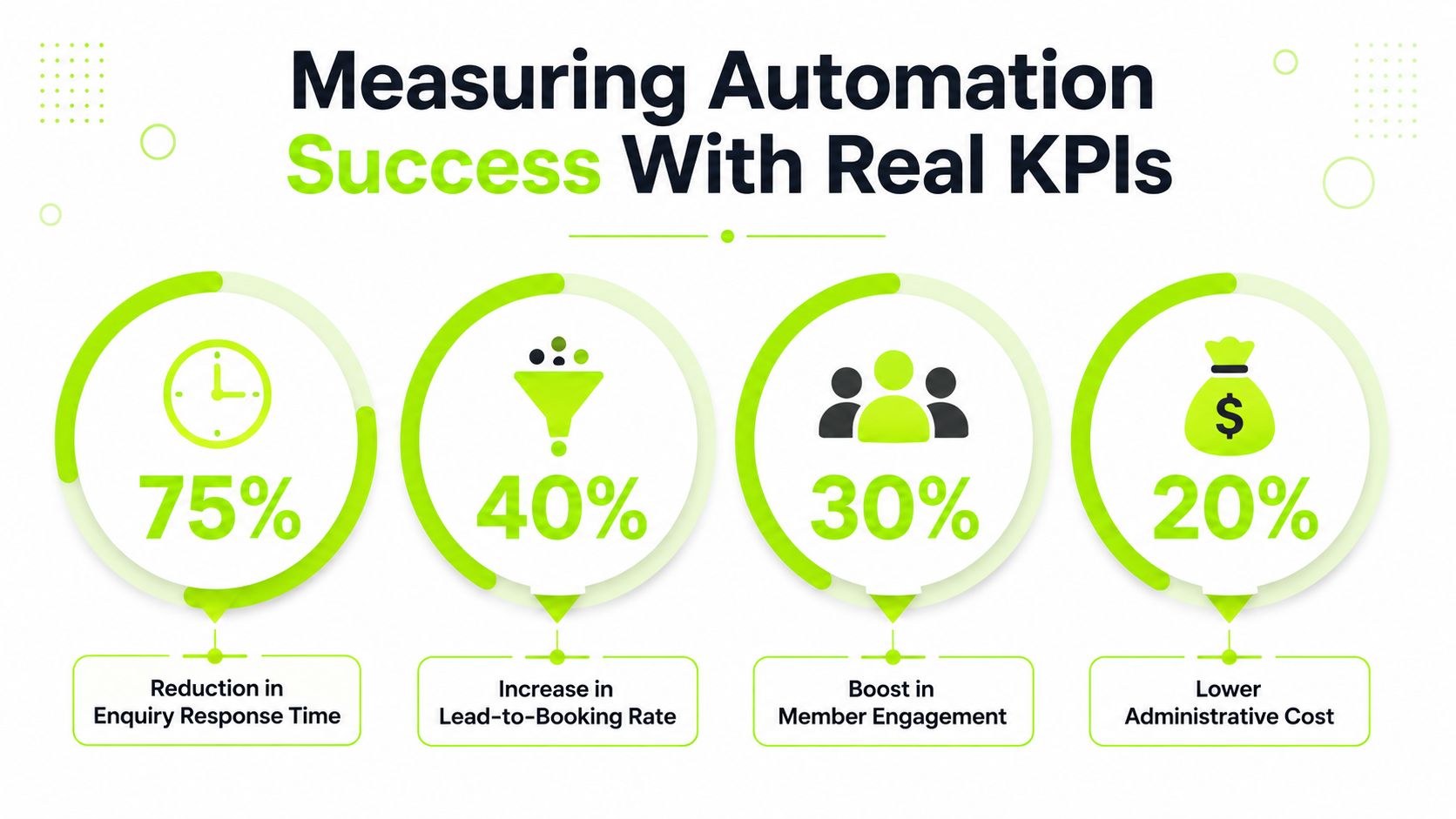
If a club can't measure response, routing, and conversion, it can't manage them. Vanity metrics like open rates are secondary. The numbers that matter are the ones that tell you whether the club is handling enquiries faster, converting more of them, and reducing the admin burden that sits on staff and volunteers.
The clearest benchmark for clubs comes from hospitality and golf-adjacent operator behaviour. The Business of Golf cites a Florida resort where enquiry response time fell from 4 hours to 4 minutes and conversion rates increased by 23%, while also noting that AI-powered chatbots can handle up to 87% of hospitality enquiries. That example isn't UK-specific, but it shows what faster handling can look like when manual follow-up is replaced by structured automation. Golf industry benchmark on AI response handling
What to track first
Start with the numbers that map directly to revenue and labour:
- Enquiry response time, because speed shapes whether the lead stays warm.
- Lead-to-booking conversion, because the key test is whether interest turns into action.
- After-hours booking revenue, because many golfers enquire outside office hours.
- Administrative workload, because automation should remove repetitive tasks, not add new ones.
- Renewal behaviour, because retention is usually cheaper to manage than replacement.
The GCMA has also framed AI as part of mainstream club operations, highlighting its role in saving time and growing profits. That context matters because the measurement framework should match the operational aim, not just the software dashboard. GCMA guidance on AI in golf club management
Use this test: if the workflow doesn't reduce waiting, increase visibility, or improve follow-up discipline, it isn't doing useful work.
Clubs often overcomplicate the reporting stage. A simple monthly review with the secretary, general manager, or membership lead is usually enough to spot whether the system is helping. The goal is to see fewer dropped leads, quicker replies, and a more reliable path from enquiry to visit.
Implementation Roadmap for UK Golf Clubs
The mistake many clubs make is buying software before deciding who owns it. That's why implementation needs to start with process, not product. If nobody is responsible for the workflow, the tool becomes another login that no one uses properly.
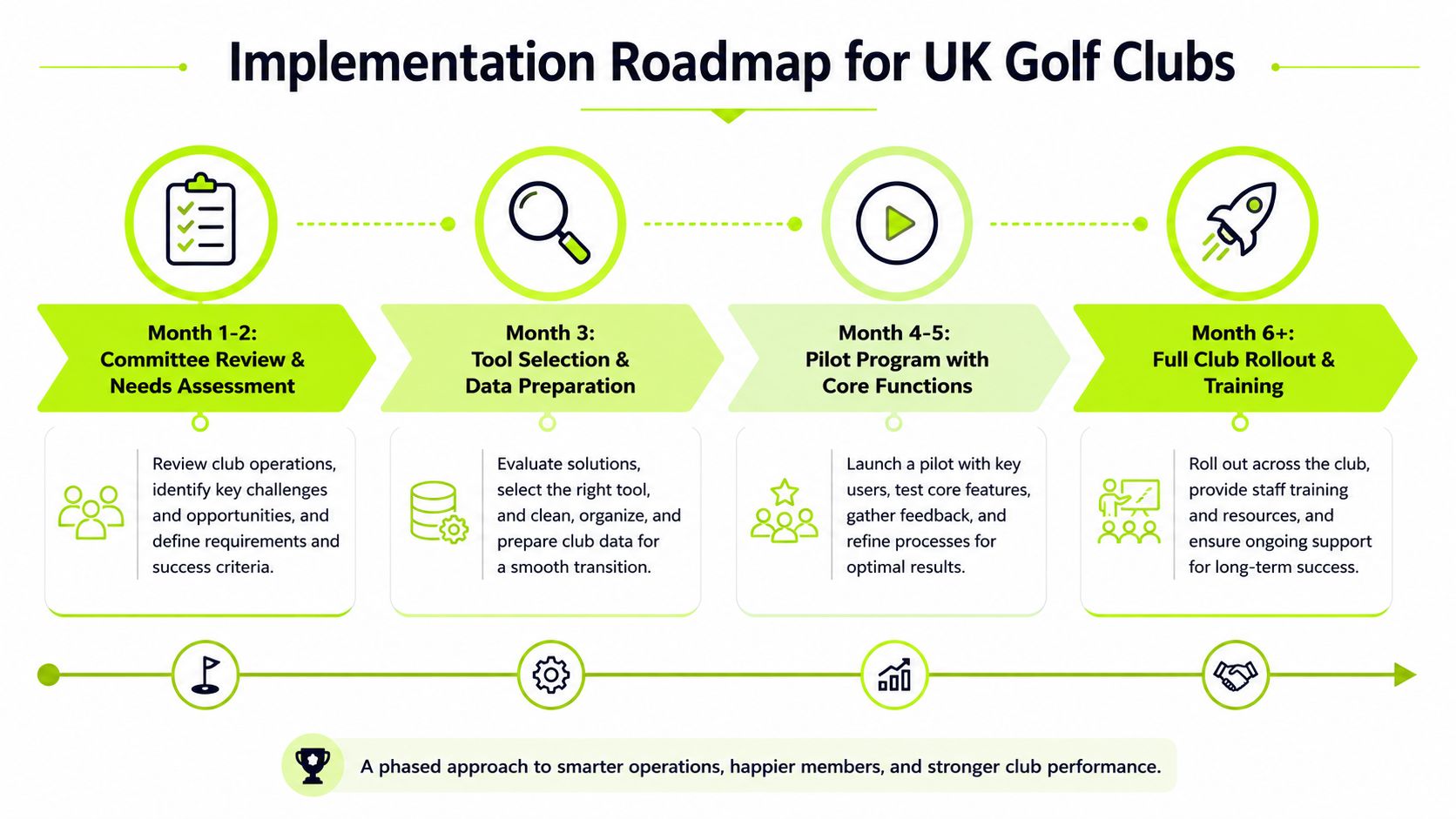
The most reliable rollout path is simple. First, map the enquiries the club receives and decide which ones need instant handling. Then clean the data fields the system depends on, such as enquiry type, contact details, and source. After that, test one or two high-value flows before opening the system across the whole club.
A phased approach that fits club structures
A committee-led club usually needs one clear owner, often the general manager, secretary, or membership lead, with a named backup for holiday cover. Multi-site operators need tighter central governance, because automation only works if the same logic is applied consistently across locations. That's where CRM integration becomes critical, since scattered systems produce scattered follow-up.
The practical rule is to automate the most repetitive, most visible tasks first. Enquiry routing, booking confirmations, reminder messages, and follow-up tasks usually produce the fastest operational relief. More complex workflows can wait until the team trusts the system.
For clubs that also want to connect payments and workflow control, a useful adjacent read is Vanta Sports payment automation, because payment handling often sits beside booking and member admin in the same bottleneck.
What good implementation looks like
- Clear ownership: one person is accountable for the setup and the outcome.
- Clean data: fields are standardised before automation goes live.
- Simple first use cases: start with enquiries and follow-up, not a full transformation project.
- Staff training: people need to know what the system does and what they still need to handle manually.
- Review cadence: the club checks the workflow regularly and adjusts it.
Golf-specific automation also needs to respect how clubs operate. A volunteer-run committee club, a resort, and a multi-site operator won't have the same governance, so they shouldn't be forced into the same deployment model. The technology can be similar. The operating approach can't.
Choosing the Right Automation Partner
The right partner should understand golf club operations, not just software. That means they need to ask how the club handles membership, tee times, enquiries, renewals, and staff ownership before they recommend any platform. If they start with features instead of process, they probably don't understand the environment well enough.
For private member clubs, the main questions are usually about fit, simplicity, and support. For multi-site groups, integration, reporting, and central control matter more. Both need data security, but they often need different operating models.
GolfRep sits in this category as one option for clubs that want AI-driven automation, structured follow-up, and CRM-enabled nurture tied to enquiry handling. It's not a generic marketing layer, it's a system for qualifying leads, routing responses, and keeping conversion visible across the full journey.
Questions worth asking before you sign
- Who owns the setup after launch? If the answer is vague, the rollout will drift.
- How does it connect to existing CRM or booking tools? Poor integration creates manual re-entry.
- What does it do when staff are unavailable? Good automation should still move the enquiry forward.
- How is member or prospect data protected? Clubs need confidence before they centralise information.
- What support is included? The software only matters if people use it correctly.
The GCMA's UK-focused coverage makes clear that AI is being treated as part of club operations, but the harder question remains who inside the club is responsible for adoption and process change. That's where many implementations stall. GCMA on AI's growing role in golf clubs
A vendor can promise efficiency, but the club still has to supply discipline. If the workflow is poorly defined, the best software in the world will just automate confusion. If the process is clear, the tool can support a much more predictable operating rhythm.
Building Predictable Growth Systems
The clubs that win with automation usually stop thinking in campaign terms and start thinking in system terms. They don't ask only how to get enquiries. They ask how to capture them, qualify them, follow them up, and track the path to booking or membership. That shift is what turns AI from a novelty into part of the club's commercial structure.
The biggest lesson is simple. golf club AI automation works best as a conversion tool, not a lead-generation shortcut. It helps clubs handle more of the interest they already earn, and it does that by improving response time, lead visibility, and follow-up discipline.
If you're reviewing your own club's enquiry handling, start with three questions. Who sees the lead first, how quickly do they respond, and what happens if nobody replies straight away? Once those answers are clear, automation becomes much easier to design, measure, and defend to a committee or board.
GolfRep helps UK clubs build structured pipelines with AI-driven follow-up, CRM-enabled nurture, and enquiry handling that's designed to convert, not just collect leads. If you want a practical view of where automation fits in your club, visit GolfRep and see how a better system can make enquiry handling more predictable.
Ready to tap into our proven growth system?