Padel Club Lead Generation: Playbook for Growth
Most advice on padel club lead generation starts in the wrong place. It starts with ads, social posts, or reach. That sounds sensible until you look at how clubs lose revenue.
A manager gets an enquiry on Friday evening. Someone fills in a contact form asking about beginner sessions, coaching, or membership. The email lands in a general inbox. By Monday, the lead has gone cold, booked elsewhere, or forgotten they enquired. The issue wasn't lead volume. It was the absence of a system.
That distinction matters more in padel than many operators realise. The UK market is still expanding, awareness is still catching up, and many clubs are dealing with first-time players rather than highly informed repeat buyers. In that environment, lead generation is not the act of collecting contact details. It's the start of a conversion process that needs speed, visibility, and follow-up.
The Hidden Problem with Padel Club Enquiries
The phrase "we need more leads" often hides a more basic problem. Most clubs don't have a reliable way to see every enquiry, respond quickly, qualify intent, and move that person towards a first booking or membership conversation.
That creates a false diagnosis. Managers assume demand is weak when the underlying issue is that demand is handled manually and inconsistently. One lead gets a fast reply because someone happened to be near the phone. Another waits until the next working day. A third gets no follow-up after the first message.
Why enquiry volume can mislead
A padel club can receive interest from very different types of people:
- A complete beginner who wants a low-pressure first session
- An existing racket-sport player comparing clubs and court access
- A parent looking for junior activity
- A company organiser exploring a social or corporate event
- A potential member who wants regular play, coaching, and community
If all of those enquiries are treated the same way, conversion drops. A generic reply doesn't answer the underlying question behind the enquiry.
Practical rule: If your team can't say where each enquiry came from, who followed it up, and what happened next, you don't have a lead generation problem. You have a lead handling problem.
The market conditions make that even more important. Sport England reported that around 400,000 adults in England had played padel in the previous 12 months in its Active Lives Adult Survey covering the year to November 2023, which highlights a growing but still relatively niche player base that clubs must actively convert rather than attract through awareness alone, as noted by Padel Unlimited's review of UK club growth.
What predictable growth actually looks like
Predictable growth doesn't come from occasional campaign spikes. It comes from a process that handles each enquiry properly every time.
In practice, that means a club needs:
- Clear capture points so enquiries don't disappear into inbox clutter
- Immediate acknowledgement so interest doesn't cool
- Structured follow-up instead of ad hoc replies
- Simple tracking so management can see what converts
- A path to repeat play and membership rather than one-off bookings only
Many clubs get stuck, as they think of lead generation as a front-end marketing task. In reality, it's an operational system that starts with the first click and only proves its value when that person becomes a regular player or member.
Laying the Foundation of Your Growth System
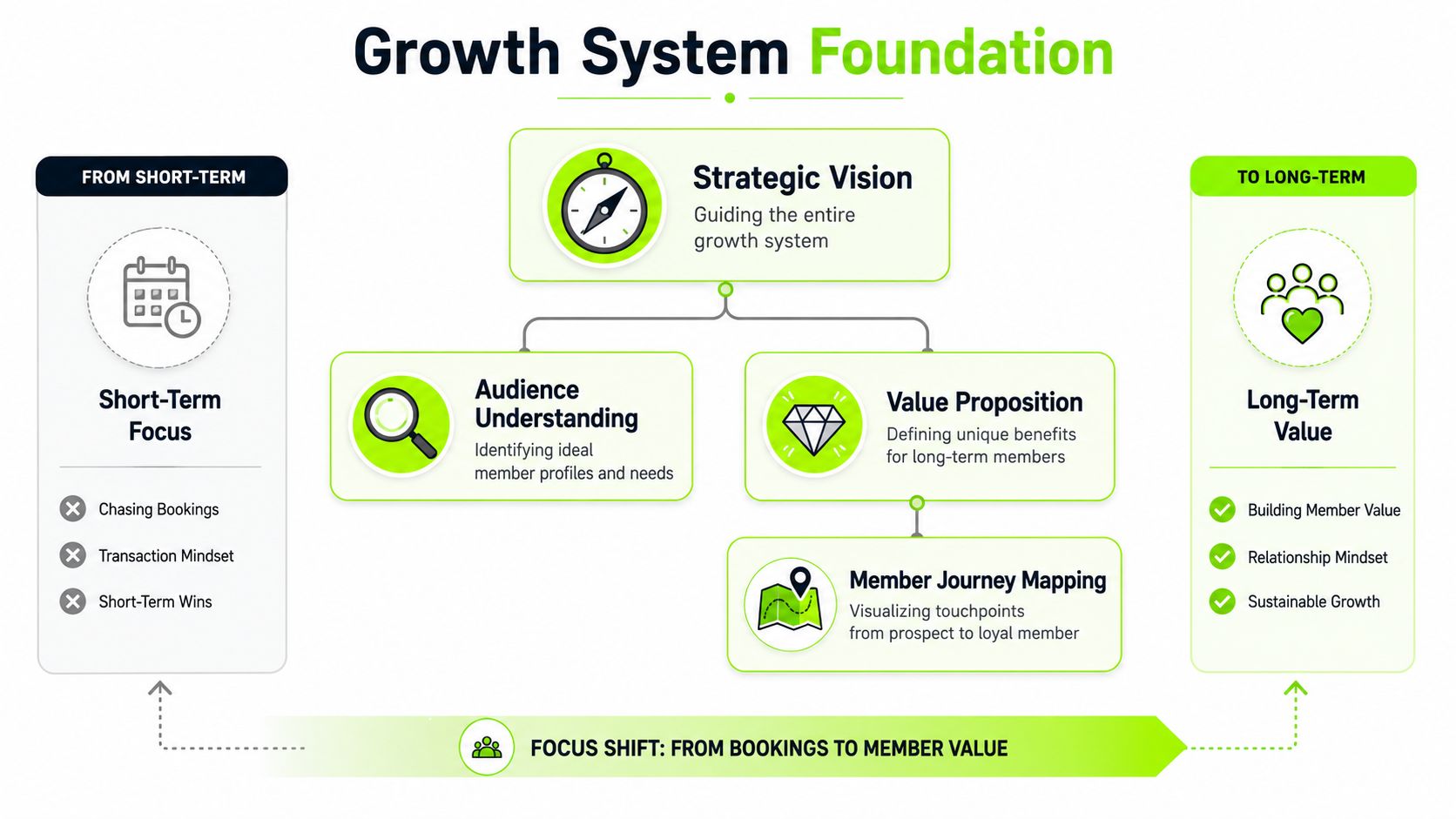
A growth system starts with a harder question than "how do we fill courts next week?" The better question is "which types of players create long-term value for this club, and what journey will move them there?"
That shift sounds subtle, but it changes almost every marketing decision.
A UK advisory article argues that clubs can be full yet still fail to generate value if they don't measure conversion into members, frequency of return, customer satisfaction, and referral behaviour. That's the blind spot many operators miss, as explained in this analysis of why some full padel clubs still don't generate value.
Start with segments, not slogans
Most clubs write one generic message and hope everyone responds. That usually produces weak enquiries because the offer is too broad.
A more useful approach is to separate your main audiences by intent.
| Audience type | What they usually want | What the club should offer first |
|---|---|---|
| Beginner | Confidence, simplicity, low pressure | Intro session, starter lesson, clear next step |
| Existing player | Court quality, availability, standard of play | Booking convenience, league or ladder, social proof |
| Parent | Safe structure, routine, coaching | Junior programme, timetable, easy sign-up |
| Corporate organiser | Simplicity, hosting, experience | Event package, named contact, quick proposal |
| Membership prospect | Regular play and belonging | Tour, trial experience, membership conversation |
This is basic segmentation, but it's where many conversion problems begin. A beginner doesn't want the same message as a frequent app user looking for competitive matches.
Build the journey before buying traffic
Managers often ask which campaign to run first. The better order is different.
Before spending on paid acquisition, get these pieces in place:
- A defined entry offer such as a beginner session, coached taster, social event, or club tour
- A response workflow so every enquiry gets a fast acknowledgement and a next step
- A central record of leads, even if it starts as a spreadsheet
- A follow-up sequence for people who don't book immediately
- A membership pathway for those who show repeat interest
A club doesn't need dozens of campaigns. It needs one reliable route from enquiry to repeat play, and then to membership where appropriate.
Clubs that invest in experience tend to understand this better. If your venue is visually strong, practical resources on generating leads from virtual tours can help you think about how digital presentation qualifies interest before a person ever visits. That matters because better-qualified leads are easier to convert and usually need less discounting.
A system beats a campaign
Campaigns are temporary. Systems compound.
A campaign may create a burst of enquiries. A system tells you which source brought them in, how quickly your team replied, who booked, who became a member, and who needs a win-back message after going quiet.
That's the difference between activity and control. A full diary can still hide poor economics if the club fills courts with casual, low-retention traffic and never converts those players into repeat users.
How to Attract the Right Kinds of Players
The best acquisition channels aren't the ones that produce the most clicks. They're the ones that send people into your system with clear intent.
That matters because padel is still expanding quickly in England. The Lawn Tennis Association reported that court numbers rose from 87 in 2022 to 202 by the end of 2023, with a target of 400 by the end of 2024, which creates fresh opportunities to capture first-time local demand, as covered in GolfRep's overview of padel club marketing.

Local paid social works when the offer is narrow
Many clubs waste paid social budget by promoting the club in broad terms. "Come and play padel" is not a strong offer. It's too vague, and it attracts curiosity more than intent.
A better approach is to match a message to a local audience:
- Beginners in nearby postcodes see a simple starter offer
- Parents see junior coaching or school-holiday sessions
- Office workers see after-work socials or corporate league messaging
- Existing racket-sport players see competitive play, ladders, or leagues
Creative should answer one question quickly: why should this person enquire now?
If you want a broader view of sustainable acquisition thinking, this piece on profitable growth strategies is useful because it reframes customer acquisition around quality and economics rather than surface-level activity.
Partnerships produce better-fit leads than many clubs expect
Local partnerships often bring in stronger leads than broad awareness campaigns because the trust transfer is built in.
Three that tend to make sense for padel clubs:
Local employers for social leagues, team sessions, and corporate events
These enquiries are usually organised, easier to follow up, and often lead to repeat bookings.Physios, fitness studios, and health businesses
They can introduce active adults who are open to a new sport but want a welcoming starting point.Other clubs and sporting venues
Tennis clubs, gyms, and golf venues can all be relevant if the proposition is clear and non-competing.
The mistake is treating partnership leads casually. They should enter the same lead pipeline as any paid enquiry, with tagged source data and a defined next step.
The strongest partnerships don't just send traffic. They send people with a reason to trust your club before the first conversation.
Events should qualify, not just entertain
Introductory events can work very well, but only when they are designed to move people forward.
A "Learn Padel in a Day" session, beginner social, or open evening can be effective if each attendee is guided towards one of three outcomes:
- a follow-up coached session
- a repeat social booking
- a membership conversation
Without that next step, events become one-off activity.
A practical format is simple. Keep registration short, collect the right details, segment attendees afterwards, and follow up based on what they did. Someone who attended with friends needs a different message from someone who asked about weekly play or coaching.
Winning the First Five Minutes After an Enquiry
Most conversion is won or lost at this stage.
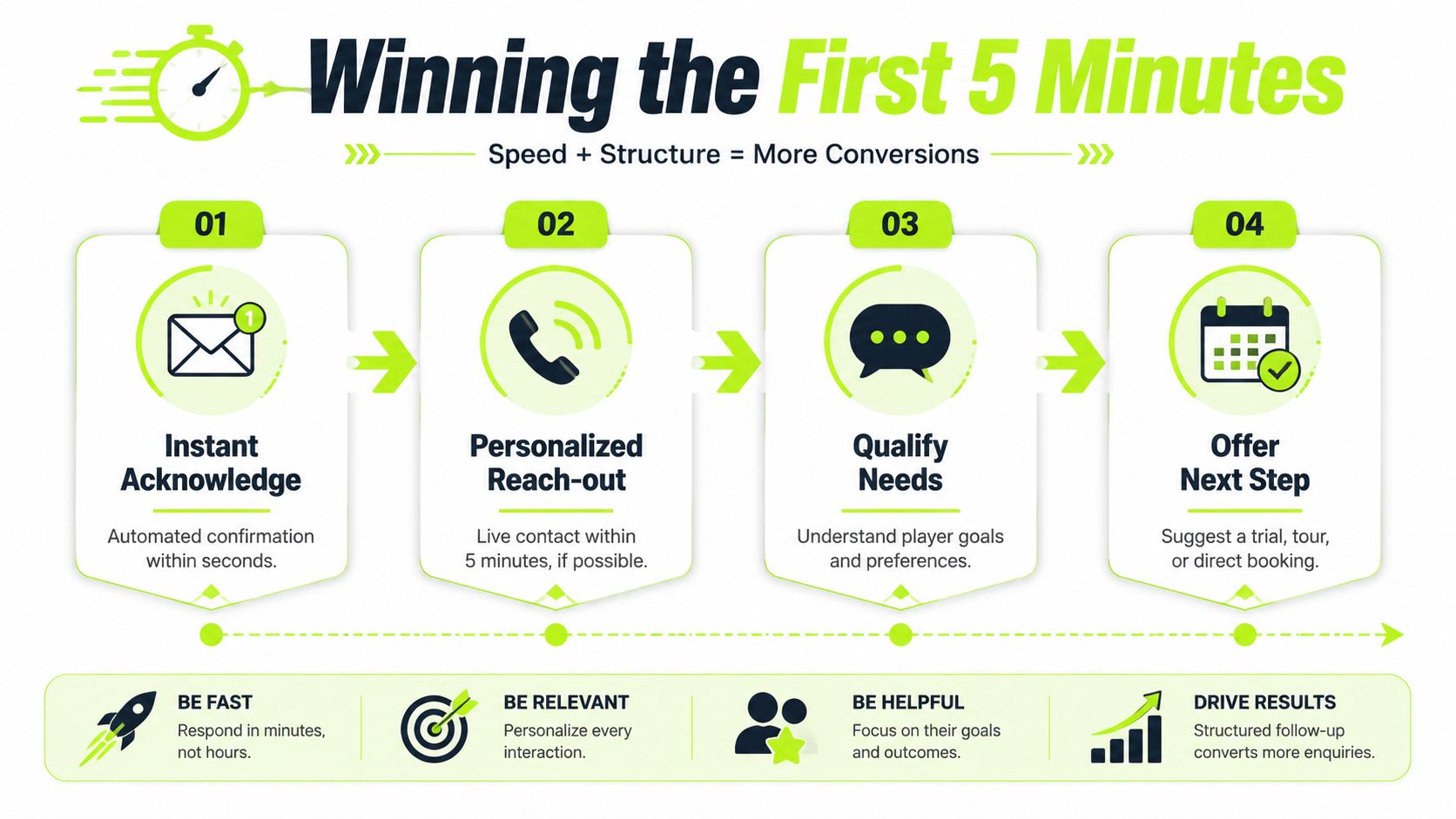
Industry guidance for UK padel clubs says lead-to-booking conversion rises sharply when automated follow-up is triggered immediately after an enquiry, and warns that static contact forms leave weekend and evening leads cold, as outlined in this guidance on marketing strategies for padel clubs.
What your landing page must do
A lead capture page doesn't need to be clever. It needs to remove doubt and make action easy.
The essentials are:
- One clear offer instead of multiple competing choices
- A short form that captures enough to follow up properly
- Visible trust signals such as reviews, photos, or community proof
- A clear next step so the user knows what happens after submitting
- Mobile-first layout because many enquiries happen on phones
What usually fails is the typical "contact us" page. It asks the visitor to make all the effort. They fill in a generic form and receive silence or a delayed manual reply.
The first message should move the lead forward
An automated response should do more than confirm receipt. It should reduce uncertainty and make booking feel easy.
A strong first response usually includes:
- Confirmation that the enquiry has been received
- Reassurance about who the club helps, especially for beginners
- A clear next option such as booking a taster, tour, or call
- A practical detail such as what to bring, how sessions work, or who it suits
- A direct contact route for questions
Here's a simple shape for that message:
Thanks for getting in touch about padel at [Club Name]. We've received your enquiry and one of the team will follow up shortly. If you're new to the sport, that's absolutely fine. We run beginner-friendly sessions and can recommend the best next step based on what you're looking for. If you'd like to move quickly, you can book your taster session here or reply with a preferred day and time.
That works because it removes friction. It acknowledges the lead, answers the most common anxiety, and offers a path forward.
Speed needs a system behind it
Fast response doesn't happen because staff try harder. It happens because the club has a workflow.
That workflow should assign ownership automatically. The person following up needs visibility into where the lead came from, what they asked for, and whether they've already received a message. This is the same principle discussed in GolfRep's look at speed to lead for golf clubs. The sport differs, but the operational problem is similar.
A practical sequence often looks like this:
| Time | Action |
|---|---|
| Immediate | Automated email or SMS confirmation |
| As soon as possible | Personal reply or call from staff |
| Same day | Offer relevant next step |
| If no response | Reminder with social proof or availability prompt |
| Later follow-up | Re-engagement message tied to an event or beginner offer |
The clubs that convert well don't rely on memory. They build the first five minutes into the process.
Turning First Contact into a Loyal Member
Not every enquiry is ready to join on day one. That's normal. What matters is whether the club has a way to keep the conversation alive without nagging or losing visibility.
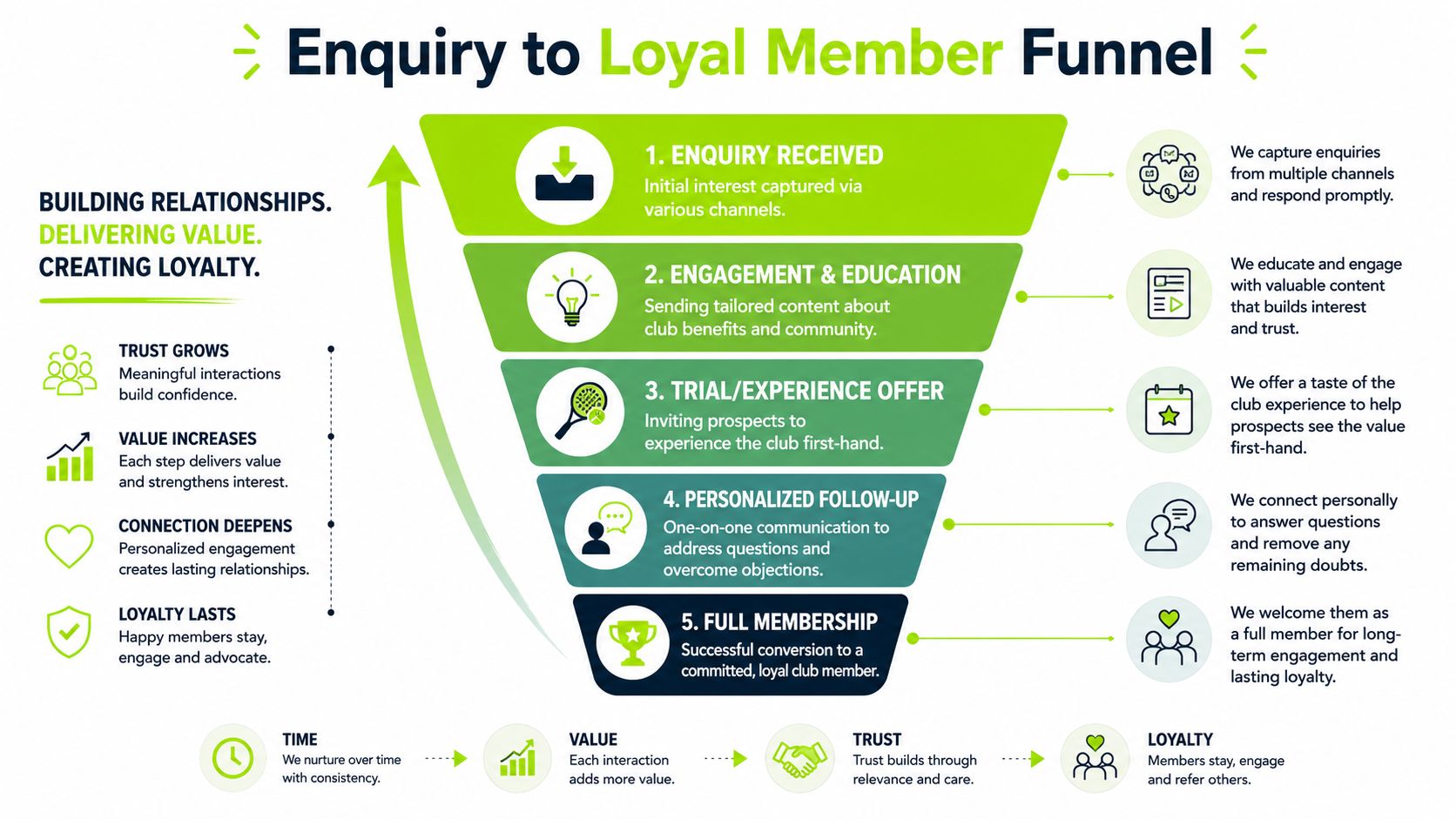
A simple nurture sequence earns its place. It gives staff a repeatable way to move an interested person from first contact to first experience, and from first experience to regular play.
A practical follow-up sequence
Most clubs don't need a complex CRM setup on day one. They need a clear sequence and somewhere central to track it.
A useful structure is 3 to 5 messages, depending on the enquiry type.
- Message one confirms the enquiry and offers the most relevant next step.
- Message two helps the person imagine their first visit. That might be a short explanation of how beginner sessions work, what standard to expect, or how social play is organised.
- Message three adds proof. Use reviews, event photos, or evidence of community.
- Message four creates a reason to act now, such as upcoming beginner availability, a new social session, or a suitable off-peak slot.
- Message five works as a gentle win-back if they've gone quiet.
The content matters, but the bigger point is consistency. If follow-up only happens when staff remember, the club is relying on luck.
Use a CRM, even if it starts simple
A CRM doesn't need to be complicated. At the beginning, it can be a disciplined spreadsheet or a basic contact pipeline. What matters is visibility.
You need to know:
- Where the lead came from
- What they asked about
- What stage they're at
- Who owns the next action
- Whether they booked, joined, or went quiet
That visibility is what turns lead generation from marketing activity into management information.
A lead that isn't tracked can't be improved. If you can't see the drop-off point, you can't fix it.
This is also where a tool-based setup can help. Some clubs use booking platforms and simple automations. Others use a structured pipeline managed by an external partner. GolfRep, for example, builds lead handling around capture, automated nurture, and CRM visibility, which is useful when a club wants one place to see the path from enquiry to revenue.
Membership and retention need human follow-through
Booking systems can identify inactive prospects and support offers, but they don't replace community building. UK padel industry commentary notes that rolling monthly or quarterly memberships can reduce churn by 15 to 25 per cent, and also warns against over-reliance on app visibility alone, highlighting the value of community mechanisms and structured follow-up in turning enquiries into recurring revenue, according to Padel Business Magazine's insight report.
That's a useful reminder. Retention improves when the player feels known, matched, and included.
For many clubs, the highest-value follow-up actions are still human:
- introducing a beginner to a suitable social group
- inviting a returning player into a ladder
- checking in after a first coached session
- offering a membership option only after there is evidence of fit
Those actions don't replace automation. They make it worthwhile.
Your Padel Club Growth Playbook in Action
A practical playbook is easier to follow when you can see how it fits different operating models.
UK analysis increasingly frames padel as a case study in experience-led growth, which means the better question is not how to get more leads, but how to attract higher-intent players and monetise the experience without discounting, as discussed in UHY's analysis of padel's rise and experience-led growth.
Scenario one: a new two-court urban venue
A new club in a competitive town centre location often assumes it needs aggressive promotion straight away. In practice, it usually needs message discipline first.
The right first move is a limited set of offers. One for beginners, one for social repeat play, and one for corporate or group bookings. Every enquiry should go into a single tracking view, and staff should know exactly what happens after the form is submitted.
If the club runs events, each attendee should be tagged by interest. Beginner, regular play, coaching, or group organiser. Without that, the club ends up with a list of names but no reliable route to revenue.
Scenario two: an established club adding padel
This is common in golf and racquet settings. The temptation is to bolt padel onto existing communications and assume members will figure it out.
That usually underperforms. Existing members, visitors, and local non-members all need different entry points. The club should explain where padel sits in the wider experience, who it is for, and what the first booking should be.
A membership campaign can work here, but only if it's joined to follow-up and onboarding. This is the same issue explored in GolfRep's guide to a padel membership campaign. Campaign activity creates interest. The operating system turns it into joined-up action.
Scenario three: a club with decent traffic but weak repeat play
This club often looks busy from the outside. Courts are occupied, enquiries are coming in, and social posts are active. Yet management still feels that revenue is fragile.
The problem is usually after the first booking. No structured follow-up. No segmentation between casual visitors and potential members. No process for bringing people back into leagues, socials, or coached pathways.
That club doesn't need more top-of-funnel volume first. It needs a better middle and bottom of funnel.
A simple sample budget
A club doesn't need a huge budget to start. It needs clarity.
Sample Monthly Padel Club Lead Generation Budget (£500)
| Expense Item | Description | Estimated Monthly Cost |
|---|---|---|
| Paid social ads | Local Facebook and Instagram campaigns promoting beginner sessions or events | £250 |
| Creative and landing page tools | Basic design, form software, booking page support | £100 |
| CRM or automation tools | Simple lead tracking and follow-up workflow | £100 |
| Partnership and event materials | Posters, flyers, guest welcome materials, small local promotion | £50 |
A follow-up call that doesn't sound salesy
When a lead is warm, the phone still matters. The tone should be helpful, not pushy.
A simple script is often enough:
Hi [Name], it's [Staff Name] from [Club Name]. I'm just following up on your padel enquiry. I wanted to check what you're looking for so we can point you to the right next step. Are you completely new to padel, or have you played before?
That opens a conversation instead of forcing a close. From there, staff can recommend a taster, social session, tour, or membership discussion based on fit.
The clubs that grow well don't treat padel club lead generation as an advertising problem alone. They treat it as a conversion system, built around response speed, lead visibility, and a better player experience from first enquiry onwards.
If your club wants a more structured approach to padel enquiries, GolfRep helps clubs build practical lead pipelines with follow-up, CRM visibility, and conversion tracking so interest doesn't get lost between the form submission and the first booking.
Ready to tap into our proven growth system?