Golf Course Lead Generation That Converts Enquiries

Most advice on golf course lead generation gets the problem backwards. Clubs are told to buy more traffic, post more content, run more ads, and chase more enquiries. That sounds productive. It often creates a bigger mess.
At GolfRep, we see the same pattern repeatedly. Enquiries come in through a website form, a Facebook message, a phone call to the office, a reply to a campaign, or a note passed to the pro shop. Then they disappear into inboxes, spreadsheets, and memory. The club assumes lead generation is weak, when the issue is that the club can't see, handle, or convert the demand it already has.
That matters because demand is not the issue in England. England's golf membership base reached 750,071 in 2025, up by nearly 20,000 year on year, or 2.66%, and reported as the highest total in at least 13 years. The same dataset also showed 1,919,316 regular adult golfers, 4,327,200 occasional adult golfers, and 1,735 golf clubs in England according to England Golf reporting covered by The Golf Business. The question isn't whether golfers exist. The question is whether your club has a system that turns interest into booked visits and memberships.
Why Most Golf Clubs Lose Leads Before They Convert
The biggest mistake clubs make is treating lead generation as a traffic problem. It usually isn't. It is a conversion system problem.
A club can spend money getting local golfers to enquire, then lose them because nobody replies quickly, nobody knows who owns the lead, and nobody tracks what happened after the first contact. Committees often focus on campaign spend because it's visible. Leakage happens after the click.
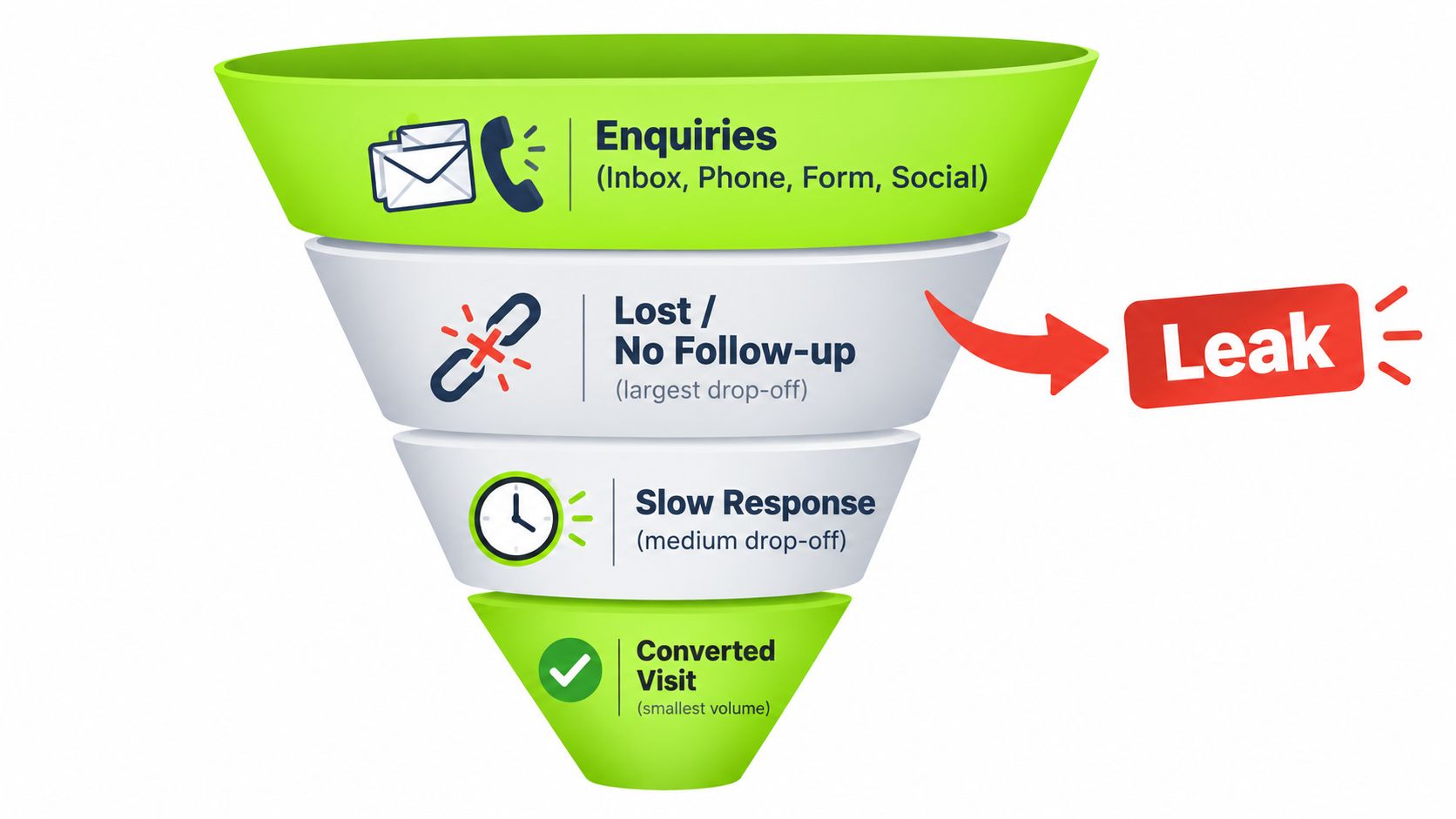
The leak is usually inside the club
Most golf clubs don't have one pipeline. They have fragments.
A prospect fills out a membership form. Another sends a social message. Someone else calls reception and asks about flexible membership. Another downloads a joining pack and hears nothing after. Staff may work hard, but the process is manual and inconsistent. That is where golf course lead generation falls apart.
Practical rule: If you can't see source, first response, follow-up status, booked visit, and join outcome in one place, you don't have a lead generation system. You have a collection of hopeful activities.
The evidence on response speed is blunt. UK businesses average 47-hour response times to enquiries, and only 7% achieve replies within 5 minutes according to the Made Smarter lead response report. The same report cites analysis saying 78% of customers buy from the first company to respond. Golf clubs are not exempt from that behaviour.
That means the first competitive advantage isn't a clever advert. It's organised enquiry handling.
More enquiries won't fix weak handling
The clubs that grow steadily don't just generate leads. They respond, qualify, route, and follow up with discipline.
Hillier Hopkins reported an average of 76 additional net members per club in 2023, up from 5 in 2022, in its 2023/24 golf clubs report. That doesn't point to a market suddenly discovering golf for the first time. It points to clubs converting interest better and moving prospects through the funnel with more consistency.
If you want a non-golf example of this thinking, this piece on how service businesses get home service leads that book is useful because it focuses on speed, qualification, and follow-up rather than lead volume alone. The principle is the same at a golf club.
A predictable pipeline looks like this:
- Lead source captured: You know whether the enquiry came from Google, Facebook, email, referral, phone, or an event.
- Response owned: One person, not three people, is responsible for the first reply.
- Visit conversion tracked: You measure whether the lead booked and attended a club visit or trial.
- Outcome recorded: Every lead ends in joined, lost, nurture, or no fit.
Clubs that want a sharper view of where enquiries disappear should also review how most golf clubs lose 30% of enquiries without realising. The point isn't the exact pathway. It's visibility.
Define Your Ideal Golfer and Irresistible Offer
Most clubs still market in broad terms. "Join our friendly club." "Flexible packages available." "Visitors welcome." That language doesn't help a golfer decide whether your club is for them or what they should do next.
Better golf course lead generation starts with a simple question. Which golfer are you trying to move now?
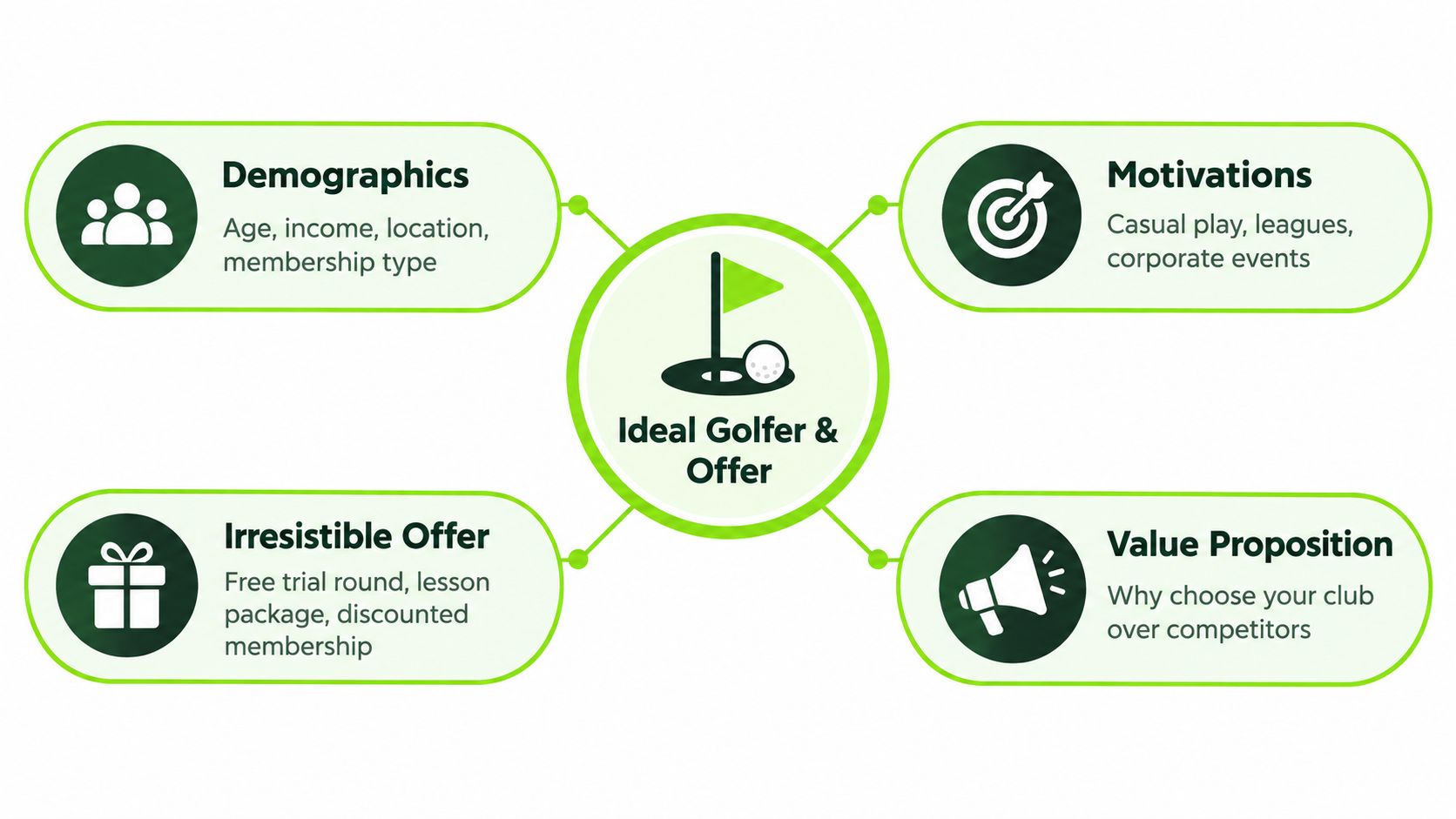
Build your offer around real club demand
The UK club market is not short of interest, but it is uneven in who joins and who gets nurtured properly. Hillier Hopkins found that 59% of members' clubs and 55% of proprietary clubs had more than 600 playing members in its 2024/25 survey, while clubs welcomed an average of 94 new members in 2023. The same report found 46% of clubs still had waiting lists, with an average of 51 people on them. Earlier survey data also showed 64% of members were aged 51 and over and only 16% were under 30, based on the Hillier Hopkins 2024/25 report.
That tells you two things. First, generic awareness isn't enough. Second, younger and flexible segments need a clearer path into the club.
Create a short list of target golfer types:
- Traditional full member: Wants regular competition golf, a handicap, and club community.
- Time-poor local golfer: Interested in flexible membership, weekday access, or a staged route in.
- Beginner or returning golfer: Needs a lower-pressure entry point, usually through lessons, academy offers, or trial access.
- Visitor with member potential: Already likes the course and needs a reason to come back as more than a green fee player.
Make the next step easy to say yes to
Most clubs ask for too much commitment too early. A golfer who's only just discovered you does not always want a membership sales call as the first step.
Offer a clear action that matches intent. That might be:
- Book a trial round for the golfer comparing local options.
- Request a membership guide for someone still evaluating categories and pricing.
- Join an open day or member experience event for prospects who want to see the culture first.
- Start with an academy pathway for newer golfers who aren't ready for full membership.
Clubs don't need louder offers. They need clearer ones.
Avoid defaulting to discounts. Discount-led acquisition attracts price shoppers and creates awkward conversations later. A stronger offer qualifies interest. It gives the prospect a reason to enquire and gives the club a reason to continue the conversation.
Use a simple persona and offer matrix
A practical matrix can sit in one page and guide your campaigns, website pages, and follow-up.
| Golfer Type | Likely Motivation | Best Offer | Best Next Step |
|---|---|---|---|
| Full member prospect | Belonging, competitions, regular play | Membership guide | Book a club visit |
| Flexible golfer | Value, convenience, less pressure | Flexible options summary | Speak to membership lead |
| Beginner | Confidence, coaching, low commitment | Academy trial or lesson package | Book introduction session |
| Visitor | Course quality, repeat play | Visitor to member pathway | Invite back for hosted round |
If your offer doesn't naturally lead to a visit, a call, or an application, it isn't helping your lead generation. It's just occupying website space.
High Value Traffic Channels That Fill Your Pipeline
A club doesn't need to be everywhere. It needs to be visible in the right places, for the right local golfers, with proper source tracking.
The strongest channel mix usually combines high-intent search, local social reach, partnership traffic, and events that accelerate decisions. What matters is not which channel sounds modern. What matters is whether the enquiry quality is visible after the lead arrives.
Start with channels that carry intent
Golf is growing, but broad awareness is not the constraint. Great Britain rounds played were up 14% in 2025 versus 2024, reaching the highest level since recording began, and 11.83 million WHS scores were submitted in 2025, a 16% increase on the previous year according to The Golf Business participation coverage. Clubs should read that correctly. The market is active. The operational question is how you capture and convert that activity.
Here is the channel mix we recommend most often.
| Channel | Best For | Intent Level | Key Watch Out |
|---|---|---|---|
| Google Business Profile and local search | Golfers already looking for a club nearby | High | Poor follow-up wastes the strongest enquiries |
| Paid social | Reaching local golfers who fit a target profile | Medium | Easy to generate volume without quality |
| Email to owned lists | Re-engaging past visitors, enquiries, and lapsed prospects | Medium to high | Weak segmentation creates generic messaging |
| Local partnerships and societies | Warm introductions and referral traffic | Medium to high | Hard to scale if nobody owns the relationship |
| Open days and hosted events | Converting fence-sitters into visits | High | Bad registration handling ruins attendance |
Don't let one channel dominate because it's familiar
Some clubs lean too heavily on Facebook because committee members can see activity there. Others rely on search because it feels more direct. That creates blind spots.
A better approach is balanced and boring. Keep a steady acquisition layer running, then add seasonal pushes around joining windows, trial events, or category-specific campaigns. Preserve source attribution from the start so you know which leads book visits and join.
Channel rule: Follow joined members back to their original source. Don't follow clicks.
That applies well beyond golf. In other sectors, teams trying to find high-quality real estate leads face the same issue. They don't just ask which channel produced leads. They ask which channel produced conversations and completed sales. Golf clubs need the same discipline.
Paid social works best when the message is narrow
Social is useful for local reach and creative testing, especially for flexible membership, beginner pathways, and event registration. But it should not send everyone to the same generic membership page.
Run separate campaigns for separate intent. A beginner should not land on a page written for an experienced club golfer. A visitor considering membership should not receive the same message as someone who has never played your course.
Clubs wanting a more practical view on campaign setup can review Facebook ads for golf clubs. The key is simple. Match the traffic source, message, and landing page, then track outcomes all the way to visit and join.
Turn Interest Into Booked Visits With Conversion Focused Pages
Most club websites are built to inform, not convert. That is fine for general browsing. It is poor for lead generation.
When a golfer clicks an advert, an email, or a Google listing with membership intent, don't send them into a full website navigation maze. Send them to a page with one job.
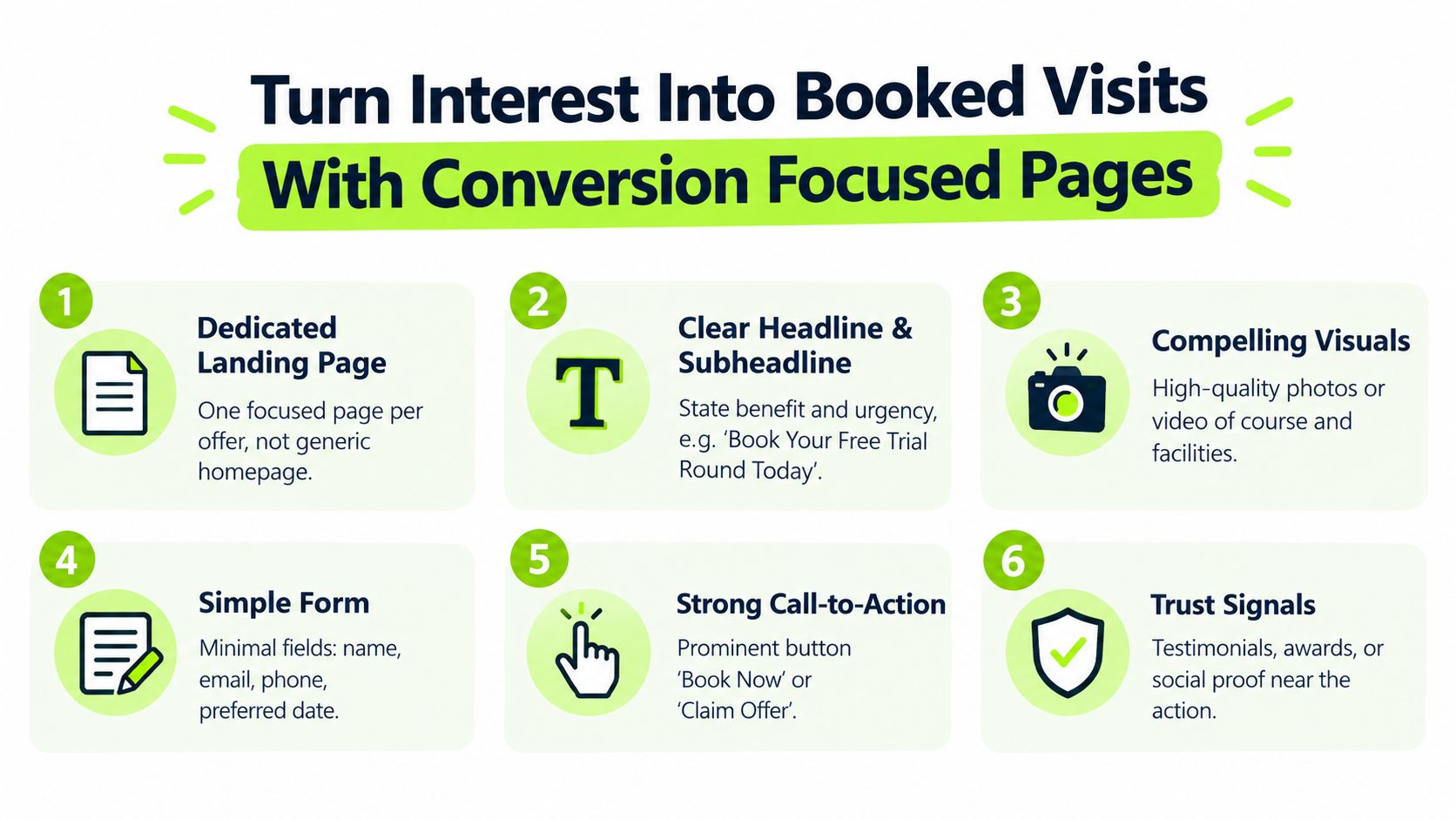
A conversion page needs one decision
The strongest pages for golf course lead generation are not complicated. They are focused.
Each page should align to one offer and one audience. If the page tries to explain the history of the club, the full fixture calendar, visitor rates, wedding packages, and membership categories all at once, it will do none of those jobs well.
A solid page usually includes:
- A clear headline: Tell the golfer what they get and who it is for.
- A direct next step: Book a visit, request a guide, or claim a trial.
- Relevant imagery: Show the course, clubhouse, practice areas, and member experience.
- Short proof points: Keep these qualitative if you don't have approved numbers. Use reputation, atmosphere, course condition, and convenience.
- A simple form: Only ask for what the club needs to act.
- A thank-you handoff: Tell the prospect what happens next and when.
Forms should qualify without creating friction
Many clubs either ask for too much or too little.
If you ask for every preference, category, handicap detail, and availability item on the first form, some golfers won't finish. If you ask for only a name and email, your team may struggle to route the enquiry properly. The answer is a short form plus immediate follow-up.
Use a few fields that help action the lead. For example:
| Form Field | Why It Helps |
|---|---|
| Name | Personal follow-up |
| Written confirmation and nurture | |
| Mobile number | Fast contact and reminders |
| Interest type | Membership, flexible, beginner, visitor to member |
| Preferred timing | Helps the club book the right next step |
A landing page should reduce uncertainty, not add admin.
The thank-you page matters too. Confirm that the enquiry has been received. Offer a clear next step such as booking a call or choosing a visit slot. If the process stops at "Thanks, we'll be in touch", the page has done half a job.
Test offers and language before rebuilding the whole site
You don't need a full website project to improve conversion. Start by creating dedicated pages for the offers that matter most right now.
For clubs working on better page structure and message clarity, guidance from outside golf can still help. This article on improving your landing page conversion rate is useful because it focuses on page intent, clarity, and friction removal rather than design fashion.
Useful tests include:
- Headline angle: Community-led, convenience-led, or improvement-led
- Call to action: Book a visit versus request details
- Offer type: Trial round, open event, guide, or academy route
- Page length: Short and direct versus slightly more detailed
If your club is paying for traffic, conversion-focused pages are not optional. They are where interest becomes a booked visit.
Qualify Instantly and Nurture Automatically With CRM
The fastest way to waste a good enquiry is to make the prospect wait while the club decides who should respond.
Manual follow-up breaks because clubs are busy. The office gets pulled into daily operations. The pro is on the lesson tee. Committee members only review things at set times. None of that matters to the golfer who has just raised a hand.
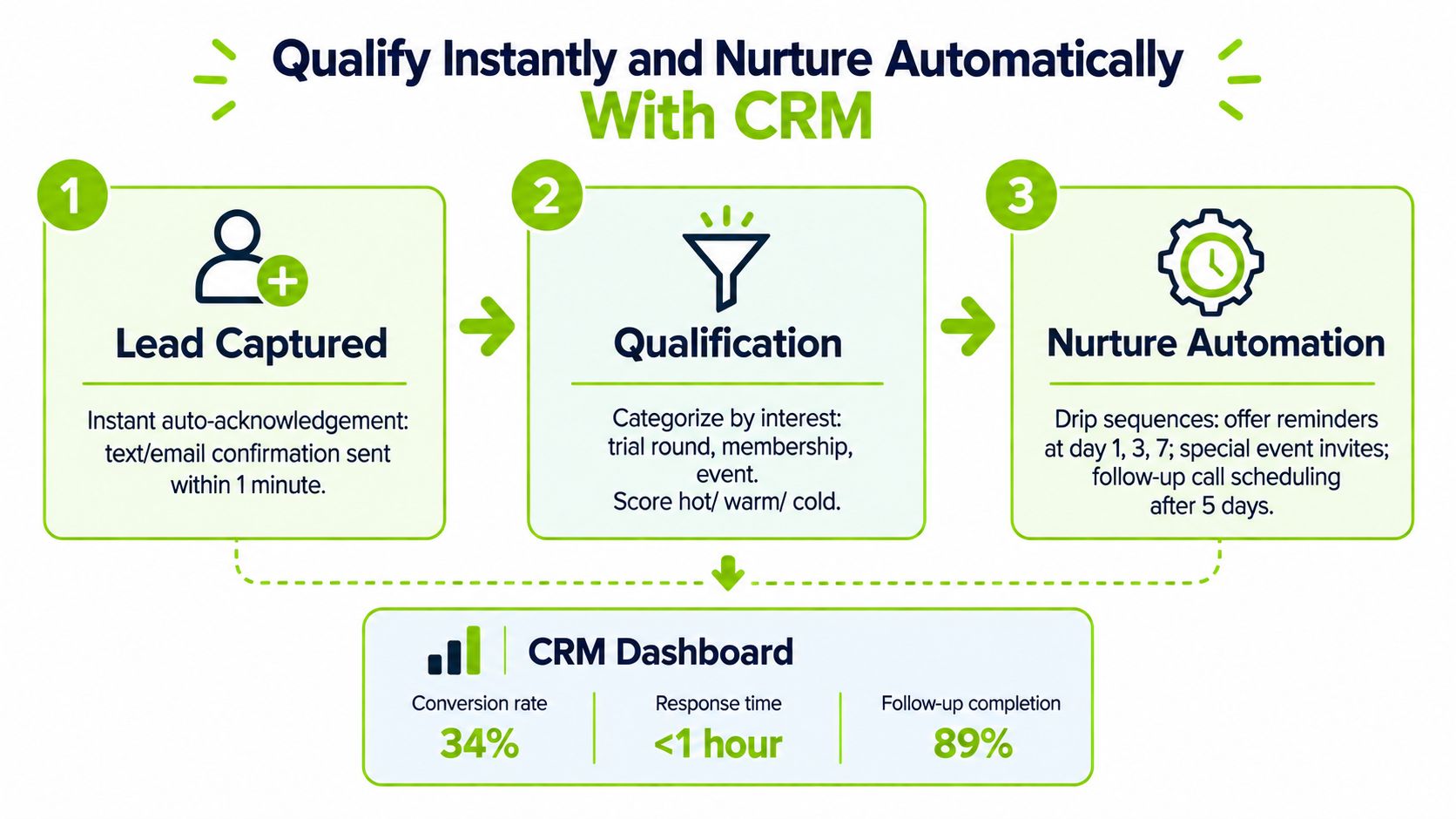
Speed changes outcomes
There is clear UK evidence that organised response processes outperform slow ones. Survey Booker found that nearly 10% of firms responded within 5 minutes and over 46% within an hour of receiving an enquiry, while the same study reported zero follow-up after the first response in the sample, according to the Survey Booker lead response study.
That last point matters. A one-off reply is not a follow-up system. It is a single touch.
Another UK benchmark is even harder to ignore. A 2026 article on service enquiries reported that replying within the same day, ideally within the first hour, produced a 41% conversion success rate versus 11% for replies taking longer than eight hours, based on Noticed's service enquiry conversion article. Clubs don't need to copy every service business habit, but they do need to accept that speed affects conversion.
CRM should handle the first part automatically
A proper CRM setup gives the club a single view of the lead from first source through to outcome. It should also remove the delay between enquiry and acknowledgement.
The core workflow is straightforward:
- Capture the lead instantly from form, social, phone note, or manual entry.
- Acknowledge immediately with an email or text confirming receipt.
- Qualify early by interest type, category, urgency, and preferred next step.
- Route correctly so the right staff member owns the conversation.
- Trigger nurture if the golfer isn't ready to book now.
A government service standard gives a useful operational benchmark here. The official target is 1 working day for 100% performance and 1.5 working days for 99% performance in the UK government general enquiries service standard dataset. Clubs trying to grow membership should aim much faster than that, but it shows what organised service delivery looks like when response time is taken seriously.
Nurture the leads that aren't ready yet
Not every prospect joins quickly. That doesn't make them a bad lead.
Some golfers need to wait for renewal timing, partner approval, seasonal budget, or confidence. Others are on a waiting list, or they visited once and then went quiet. These people need structured nurture, not random chasing.
Use short nurture flows with practical content:
- After first enquiry: Confirmation, next steps, and a clear contact point.
- If no booking happens: Reminder with a reason to visit, such as an open day or hosted round.
- If the lead is delayed: Category-specific updates and relevant invitations.
- If on a waiting list: Regular check-ins and priority rules when spaces open.
GolfRep is one option clubs use to connect lead capture, automated qualification, and CRM follow-up in one system, especially when the club wants visibility from source to join without relying on spreadsheets. The principle matters more than the platform. Use whatever system your team will maintain.
Clubs considering automated routing and qualification can explore lead qualification automation. If your staff still need to hunt through inboxes to see who enquired, the process is too fragile.
Measure What Matters and Roll Out Your 90 Day Plan
Most clubs report on activity because it is easy. Clicks, impressions, reach, post comments, website sessions. None of those tell a committee whether lead generation is producing members.
Track the movement from enquiry to join. That is where decisions get clearer and budgets get easier to defend.
Measure the pipeline, not just the campaign
A practical scorecard should include:
- Source quality: Which channels create the right kind of enquiries
- Response time: How quickly the club acknowledges and contacts the lead
- Qualification rate: How many enquiries fit the offer or category
- Booked visit rate: How many qualified leads commit to a next step
- Show rate: How many attend
- Join outcome: Which visits become applications and memberships
If a club can't see where a lead stalled, it can't fix the leak.
That view also changes conversations with committees. Instead of debating whether Facebook is "working" in abstract terms, you can show whether a campaign produced qualified leads, booked visits, and applications. That is a healthier discussion.
A workable 90 day rollout
The first 90 days should be operational, not theoretical.
Days 1 to 30
- Audit your current path: Review every enquiry route across forms, calls, email, and social.
- Define target offers: Pick the golfer segments that matter most right now.
- Set ownership: Assign one person to first response and one person to reporting.
Days 31 to 60
- Launch dedicated pages: Build focused pages for each active offer.
- Switch on tracking: Capture source, stage movement, and final outcomes.
- Create response templates: Use approved replies for key lead types.
Days 61 to 90
- Automate follow-up: Add acknowledgement, reminders, and nurture sequences.
- Review lead quality by source: Move spend away from weak channels.
- Report: Show managers and committees where leads came from and what happened next.
Keep the plan disciplined
Don't launch five offers at once. Don't let staff invent their own follow-up process. Don't send all traffic to the homepage and hope.
Golf course lead generation becomes predictable when the club treats it as a managed pipeline. Clear audience. Clear offer. Clear page. Fast response. Visible follow-up. Measured outcomes.
That is how you turn demand into growth without relying on discounts or guesswork.
GolfRep helps UK golf clubs build that system end to end, combining lead generation with CRM tracking, automated follow-up, and clear visibility from enquiry to joined member. If you want a more predictable pipeline and fewer lost opportunities, visit GolfRep and see how the process works in practice.
Ready to tap into our proven growth system?