Indoor Golf Gift Vouchers: What to Check Before You Buy

A customer wants to buy a simulator session as a present. Your team can take payment, but can they explain what happens if the recipient uses only part of the time, cancels late or tries to book just before expiry? Those answers need to be settled before the voucher goes on sale.
Treat an indoor golf gift voucher as a product with its own terms. The expiry date, partial-use rule, cancellation policy and VAT treatment affect whether the venue protects capacity, the recipient keeps the value and the sale is recorded correctly. A good voucher is easy to redeem and hard to misinterpret.
What an Indoor Golf Gift Voucher Covers
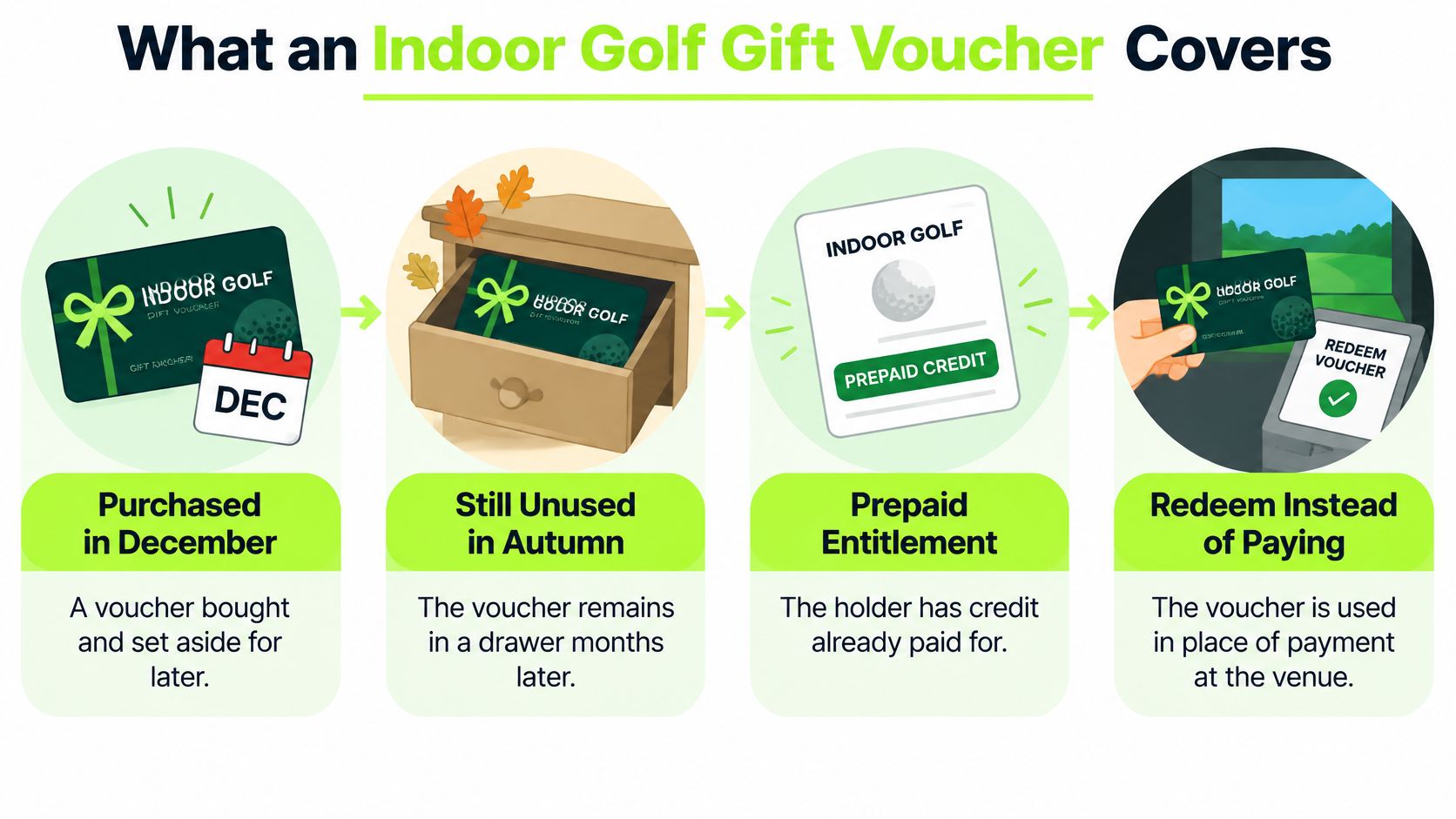
A voucher bought in December can still be sitting in a drawer the following autumn. When the recipient finally finds it, they need to know what they own: a particular experience, money to spend or simulator time held on account.
An indoor golf gift voucher is a prepaid entitlement the holder uses instead of paying for eligible services on the day. It can usually be passed on as a gift, subject to the venue's terms.
Choose the format before writing the terms
- Fixed experience: A named simulator session or lesson. Think of it as a ticket for a particular show, not permission to spend the equivalent value elsewhere.
- Monetary credit: A cash value redeemable against specified services, potentially including bay hire, coaching, food or merchandise. This works more like a shop gift card.
- Session credit: Simulator time stored on an account and deducted as the recipient makes eligible bookings.
These distinctions decide whether unused value survives, whether the recipient can switch activities and how the finance team should classify the sale. Session credit also needs a clear booking increment, so staff aren't improvising when someone wants to split their time.
Build the entitlement around your golf simulator bay pricing, including any peak-time restrictions or top-ups.
Product test: If the recipient can't use the entitlement for a different service, treat it as a fixed product and describe it that way.
Experiences Indoor Golf Vouchers Commonly Cover
Two published products provide useful reference points, not a market average. Benchmark your offer against your own rate card, staffing requirements and bay availability rather than copying another venue's headline price.
Common indoor golf voucher experiences and reference terms
| Experience | Typical format | Reference price | Validity |
|---|---|---|---|
| One-hour simulator session, 1 to 4 people | Fixed session, booked in advance | £40, The Cotswolds Club | 12 months from purchase |
| Two-hour simulator experience, 2 people | Fixed session using TrackMan technology | £60, WonderDays | 12 months, must be booked and taken before expiry |
| Monetary credit | Spend on any eligible service | Set by the venue | Venue's published credit expiry |
| Coaching or lesson | Fixed session with a coach | Set by the venue | Published lesson-voucher expiry |
| Pay-and-play bay hire | Fixed or credit-based session | Set by the venue | Published bay-voucher expiry |
| Food and beverage credit | Café or bar spend | Set by the venue | Published hospitality-credit expiry |
The Cotswolds Club reference terms are examined under cancellation rules below. For the other priced example, WonderDays lists its £60 experience for two, using TrackMan, as lasting over two hours, with 12 months' validity and a requirement to both book and take the experience before expiry.
Compare what the recipient actually gets
A session for a couple or close friends offers a different experience from a shared bay for a social group. More participants means each person takes fewer shots, so sell the social occasion rather than implying everyone receives uninterrupted practice.
For coaching, identify whether the voucher includes a PGA professional, simulator hire and any assessment or follow-up. For food and beverage credit, state which outlets accept it and whether it can cover the whole bill or only specified items. These details decide whether the recipient feels the gift was generous or restricted.
The unpriced rows reflect how widely venue rate cards differ, so compare each club's own published prices rather than borrowing unsupported benchmarks. Group buyers may also need a hosted package rather than individual vouchers, particularly for indoor golf corporate events.
Match the duration to what a first-time player can comfortably use in a visit. A longer session is not automatically a better present if the recipient needs instruction, regular breaks or a simpler introduction.
Who Indoor Golf Vouchers Suit as Gifts
Treating every simulator voucher as a present for an experienced golfer narrows the offer unnecessarily. Beginners, non-golfing partners and returning players can all be suitable recipients, provided the experience matches their confidence and support needs.
England recorded more than 5.75 million World Handicap System scores in the first half of 2025, up 29% year on year; its full-year total reached 11.83 million, with nine-hole submissions up 28%, according to the Golf Club Managers' Association. That supports offering shorter formats, although score submissions aren't evidence of simulator demand on their own.

Matching voucher formats to recipients
| Recipient | Best voucher format | Why it fits | Check before buying |
|---|---|---|---|
| Experienced golfer in winter | Two-hour simulator session | Practice without waiting for dry weather | Session length and booking lead time |
| Complete beginner | One-hour introductory session or coaching | Low commitment when equipment is provided | Equipment and supervision included |
| Non-golfing partner or friend | One-hour group session for two to four | Social play without needing a handicap, where permitted | Whether guests can join without a handicap |
| Child or teenager | Family or junior session | Short, active and supervised | Age limits and adult supervision rules |
| Lapsed golfer | Lesson or return session | Support with getting back into golf | Coach availability and expiry |
| Corporate or team reward | Monetary credit across several visits | Flexibility for mixed groups | Invoicing and VAT treatment |
Sell the support as well as the simulator
Ask how much golf the recipient plays, how long they'll want to stay and whether they'll need help. An experienced player might want practice data and course choice; a beginner needs someone to explain setup, safety and what to do first.
For example, a partner who's never played may be better served by a short group introduction with clubs supplied than a lengthy practice session aimed at regular golfers. A lapsed player may value coaching more than unrestricted bay time.
For children, confirm suitable clubs before buying equipment. If a family also wants an equipment gift, Fayrway's junior golf collection is a relevant browsing resource, but it doesn't replace checking the venue's requirements.
Check minimum ages, handicap requirements and supervision rules before payment. Don't assume a simulator venue accepts every age or provides beginner instruction with ordinary bay hire.
Validity, Booking and Expiry Terms to Check
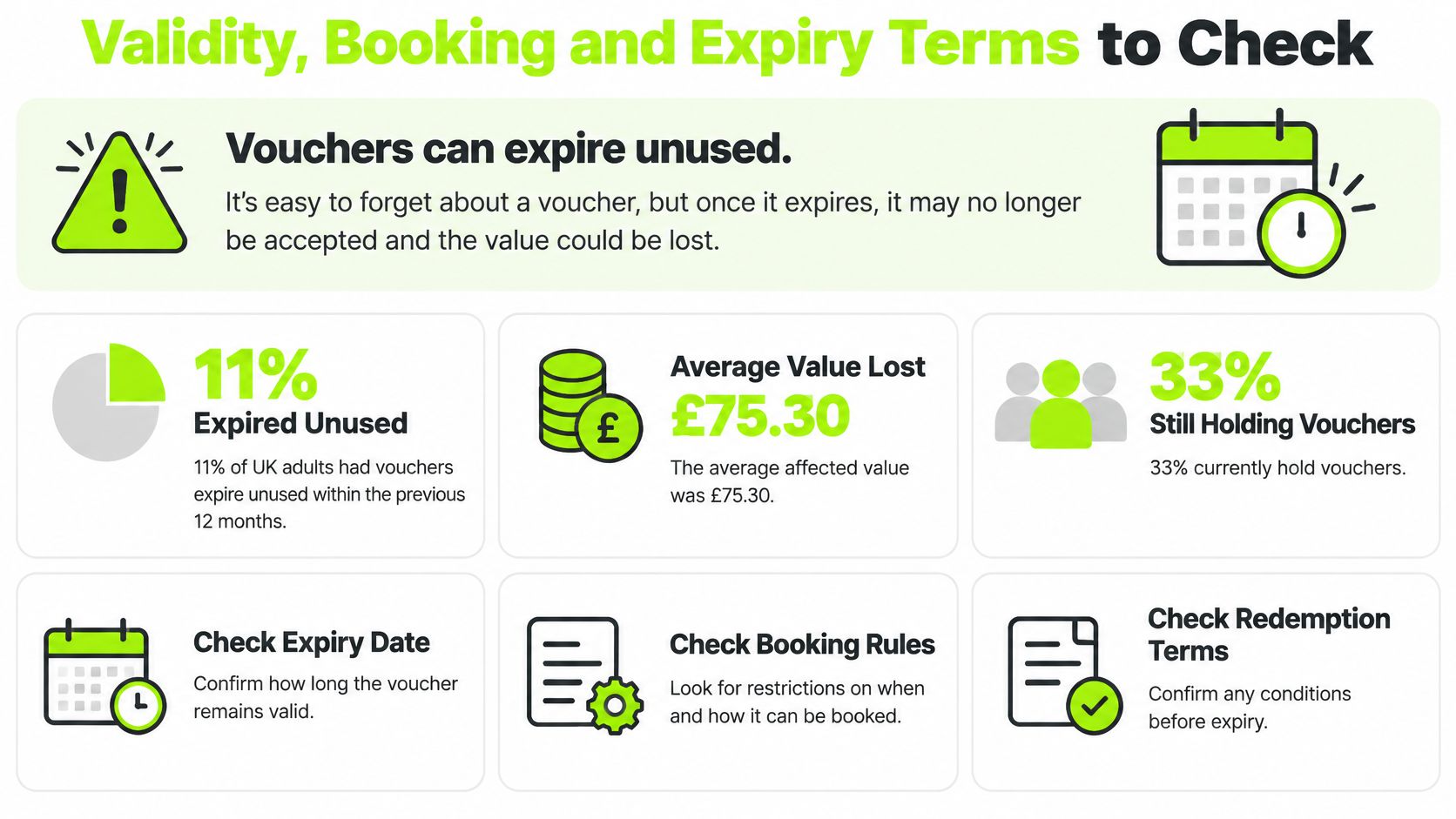
Unused vouchers represent a real recipient risk. Ipsos found that 11% of UK adults had vouchers expire unused within the previous 12 months, with an average affected value of £75.30, while 33% held vouchers due to expire within the next year.
Don't assume indoor golf venues use standard terms. The Indoor Golf Guide lists examples ranging from no expiry to six months, 12 months or one year, alongside restrictions on refunds, combining offers and the treatment of unused simulator hours.
Put the usable terms beside the purchase button
Voucher terms to state before sale
| Term | What to state | Why it matters |
|---|---|---|
| Expiry date | Exact period from purchase or issue, with the actual expiry shown on the voucher | Prevents the recipient guessing how long they have |
| Booking and attendance deadlines | Separate deadlines for reserving and completing the visit | Stops recipients booking in time but attending too late |
| Booking lead time | Minimum notice and whether advance booking is required | Prevents gifts becoming unusable because diaries are full |
| Partial balance | Whether unused monetary value or session time carries forward | Stops leftovers being silently lost |
| Extension of expired voucher | Whether extensions are available and on what terms | Explains whether a missed gift can be recovered |
| Transferability | Whether the recipient can pass the voucher on | Avoids problems when the attendee isn't the buyer |
| Refunds and exchanges | The refund and exchange policy, subject to applicable consumer rights | Sets expectations without overstating restrictions |
| Accessibility | Handicap requirements, minimum ages, format restrictions and physical access arrangements | Reduces unsuitable bookings |
Booking before expiry and attending before expiry aren't the same condition. If you require completion by the deadline, say so directly, as the WonderDays product does. Recipients shouldn't have to discover that distinction when they call to reserve a bay.
Make partial use explicit
Say a recipient books an eligible session costing less than their monetary credit. The terms must explain whether the remainder stays on the voucher, moves to their account or is forfeited under the product rules.
For time-based credit, describe how deductions work and whether leftover time can support another booking. Give staff a balance lookup and a consistent redemption process, rather than asking them to calculate adjustments from old emails.
A longer usable validity period can be worth more to the recipient than a discount. It gives them room to arrange a visit without reducing your selling price.
Use reminders to help recipients book while suitable slots remain. If redemption is restricted to quieter periods, make those restrictions prominent and align the offer with your golf simulator off-peak promotions, rather than revealing them after purchase.
GolfRep provides a system, strategy and partnership to help golf clubs grow membership, increase enquiries or stabilise retention. For vouchers, the practical discipline is to connect clear product terms with accurate customer records and useful reminders.
Buyers should test whether the recipient can realistically attend within the permitted window. Operators should run the same test before launch, identifying each product as monetary or session-based and checking that the booking team can honour it.
Cancellation, No-Show and Redemption Rules to Set
Voucher cancellation rules protect bookable capacity. A late cancellation can leave a bay empty after you've turned away another customer, so the consequences need to be clear before anyone reserves the slot.
The Cotswolds Club publishes a £40, one-hour experience for one to four people, valid for 12 months from purchase, with no redemption within 72 hours of purchase, advance booking required, availability restrictions and redemption only at Cotswolds Hotel & Spa. Its terms make the voucher void for cancellation with less than 72 hours' notice and state that it cannot be refunded or exchanged for cash.
Make each operational decision deliberately
Set the earliest redemption date. Decide whether recipients can book immediately after purchase or must wait. State whether the restriction applies to making the reservation or attending, because those are different actions.
Define cancellation notice and consequences. Choose a notice period that gives your team a realistic opportunity to resell the bay. Explain whether late cancellation forfeits the entire voucher or only the booked entitlement.
Give no-shows their own rule. Don't assume a cancellation policy automatically explains non-attendance. Decide whether staff can reissue the session in exceptional circumstances and who can authorise that decision.
Control combinations with other offers. Specify whether vouchers work alongside member rates, promotional prices or other credits. Otherwise reception staff may approve inconsistent discounts against the same bay capacity.
Name the eligible site or sites. A multi-site operator needs clear redemption permissions and a shared balance record. Don't sell apparent flexibility that another venue's team can't honour.
Set the refund and exchange policy. Explain the commercial policy without suggesting it overrides applicable statutory rights. Give staff an approved response and an escalation route for disputed cases.
Capacity rule: Customers should understand what they lose by cancelling late before they commit to the booking.
Put these conditions on the product page, in the confirmation and alongside the booking instructions. Small print alone isn't a substitute for an understandable offer.
How VAT Treatment Changes Your Voucher Accounting
Voucher design changes when VAT is accounted for, so involve your accountant before launch. Under HMRC's business promotions and VAT guidance, a voucher is a physical or electronic instrument accepted as consideration for specified goods or services that can be transferred by gift.
A single-purpose voucher has a known place of supply and VAT liability when issued. A specific simulator experience may qualify, with VAT accounted for at issue rather than again at redemption.
A multi-purpose voucher doesn't meet those conditions, so VAT is generally accounted for when the underlying supply occurs on redemption. Flexibility alone doesn't establish the classification: several eligible services can still share the same known VAT treatment.
Compare the ledger entries
Consider a hypothetical monetary credit usable across bay hire and the bar. If its eligible supplies make it multi-purpose, record the receipt and outstanding entitlement at issue, then account for VAT as redemption creates the taxable supply.
For a fixed simulator hour confirmed as single-purpose, account for VAT when issued and avoid charging it again when the recipient attends. VAT timing isn't, by itself, the complete answer to when accounting revenue should be recognised.
Store these fields consistently across checkout, CRM and the finance ledger:
- Voucher classification: Single-purpose or multi-purpose, with the approved VAT treatment.
- Issue record: Issue value, purchaser and identifying voucher code.
- Redemption record: Redemption date, services supplied and amount used.
- Outstanding entitlement: Remaining monetary balance or session time.
For an unused multi-purpose voucher, HMRC's position is that no VAT is due if no taxable supply has occurred. Don't apply that treatment indiscriminately to every expired voucher.
Get accountant confirmation for bundled services, separate issuers and multi-site arrangements. Cash received, VAT due and outstanding voucher obligations need distinct records.
GolfRep helps golf businesses improve customer acquisition, sales processes, CRM, retention and revenue growth. If you want to connect your voucher offer with reliable redemption records and a clear route to repeat visits, visit GolfRep to discuss the commercial process around your indoor golf products.
Ready to tap into our proven growth system?