Indoor Golf Corporate Events: Formats, Costs and Planning

A 40-person finance team has booked a simulator venue for a Thursday afternoon, with three clients due to join for the final hour. The organiser's first job isn't choosing the longest-drive prize. It's deciding how many people can take part at once, and what everyone else will be doing while they wait.
That's the practical question behind indoor golf corporate events. A well-run event is a hosted, time-boxed programme where golf sits alongside food, drinks, presentations and conversation. It should feel organised without making every guest complete a round.
What Indoor Golf Corporate Events Are For
A corporate event at a simulator venue differs from a society day or member competition. There's usually no handicap requirement and no full eighteen holes. The format might run for a few hours, with guests taking part in short challenges, watching colleagues, eating or networking. Some attendees may never have held a club.
Organisers typically have one or more of three aims: team building, client entertainment or staff recognition. The venue has its own commercial reasons to host, including catering, room hire and the chance of repeat bookings. Those aims can fit together, but they need a programme that gives both golfers and non-golfers a worthwhile role.
The potential audience extends well beyond regular course golfers. England Golf participation reporting found that 12.6 million adults in England played some form of golf during the previous 12 months. That included 5.3 million people using off-course formats such as driving ranges, adventure golf, golf simulators and Topgolf, while 7.3 million played on a 9- or 18-hole course, according to England Golf participation reporting discussed by GolfRep. Off-course golf is therefore a substantial complementary market, not a niche substitute. For an event organiser, the implication is straightforward: don't assume the guest list consists of keen golfers.
For branded gifts or practical event merchandise, Dirt Cheap Product's event merchandise guide can help organisers think through useful items and how they fit the event. For clubs considering the wider commercial role of corporate golf, GolfRep's perspective on golf for business provides related context.
Before comparing venues or formats, answer three questions: What is the event for? How many guests will attend? How many will realistically swing a club?
Five Event Formats and Where Each One Fits
| Format | Golf involvement | Best objective | Group size guidance | Main cost driver |
|---|---|---|---|---|
| Closest-to-the-pin and longest-drive contests | Low to medium | Mixed groups and quick competition | 6 to 100 guests at one Birmingham venue | Bay time and prizes |
| Team scramble or six-shot challenge | Medium | Team building and shared goals | Teams of four to six | Bay time and scoring set-up |
| Beginner coaching clinic | Medium to high | Employee development and first-timers | Limited by coach supervision | Coach fee per hour |
| Rotating networking programme | Low for most guests | Large groups and client networking | Scales with rotations | Food, drink and room hire |
| Exclusive whole-venue hire | Optional | Client entertainment and launches | Whole venue capacity | Fixed hire fee plus hospitality |
Closest-to-the-pin and longest-drive contests work well when the group has mixed experience and the organiser wants quick turns with a visible result. Guests don't need to play a full hole to understand the challenge, and a short contest can keep attention moving between bays. One Birmingham venue advertises corporate events for groups of 6 to 100 guests, with these types of challenges among its formats, in its corporate event offer.
A team scramble or six-shot challenge puts colleagues on a shared score rather than making the event a test of individual ability. Pre-assign teams of four to six and give them a fixed number of shots or a short target to complete. It's a useful choice when the point is collaboration, but it needs an agreed scoring method and someone responsible for keeping results accurate.
Beginner coaching clinics make sense when staff development or a first golf experience is central. The trade-off is supervision: a coach can only manage the group safely and usefully if the size and bay layout allow proper attention. Don't sell a large clinic as personal coaching if most participants will spend the session waiting.
A rotating networking programme gives each guest a brief playing slot while others eat, talk or attend a presentation. This usually suits bigger groups better than trying to keep everyone swinging at once. Exclusive venue hire suits launches and client entertainment where privacy and hospitality matter more than continuous golf, but the fixed hire fee makes it a larger commitment.
Decision rule: Choose the format that serves the commercial objective, then check that the amount of golf matches how many guests actually want to play. A short contest followed by a networking meal often combines the two needs.
Planning Bays, Rotations and Timings
A large corporate event is a rotation problem before it's a golf problem. A UK events-industry report describes an average corporate event of roughly 200 participants lasting four hours. That is a useful stress test, not a golf-specific average. The report also illustrates the capacity arithmetic: with four players sharing each bay, 20 bays can serve 80 active players in a round. The UK Events Report update emphasises throughput, turnover, scoring reliability and queues, not headcount alone.
If all 200 guests are meant to play on 20 bays, they need at least three rounds. With each round set at 30 minutes including turnover, active play takes about 90 minutes, leaving time in a four-hour programme for food, presentations and networking. The numbers won't work unless someone decides in advance who plays and when.
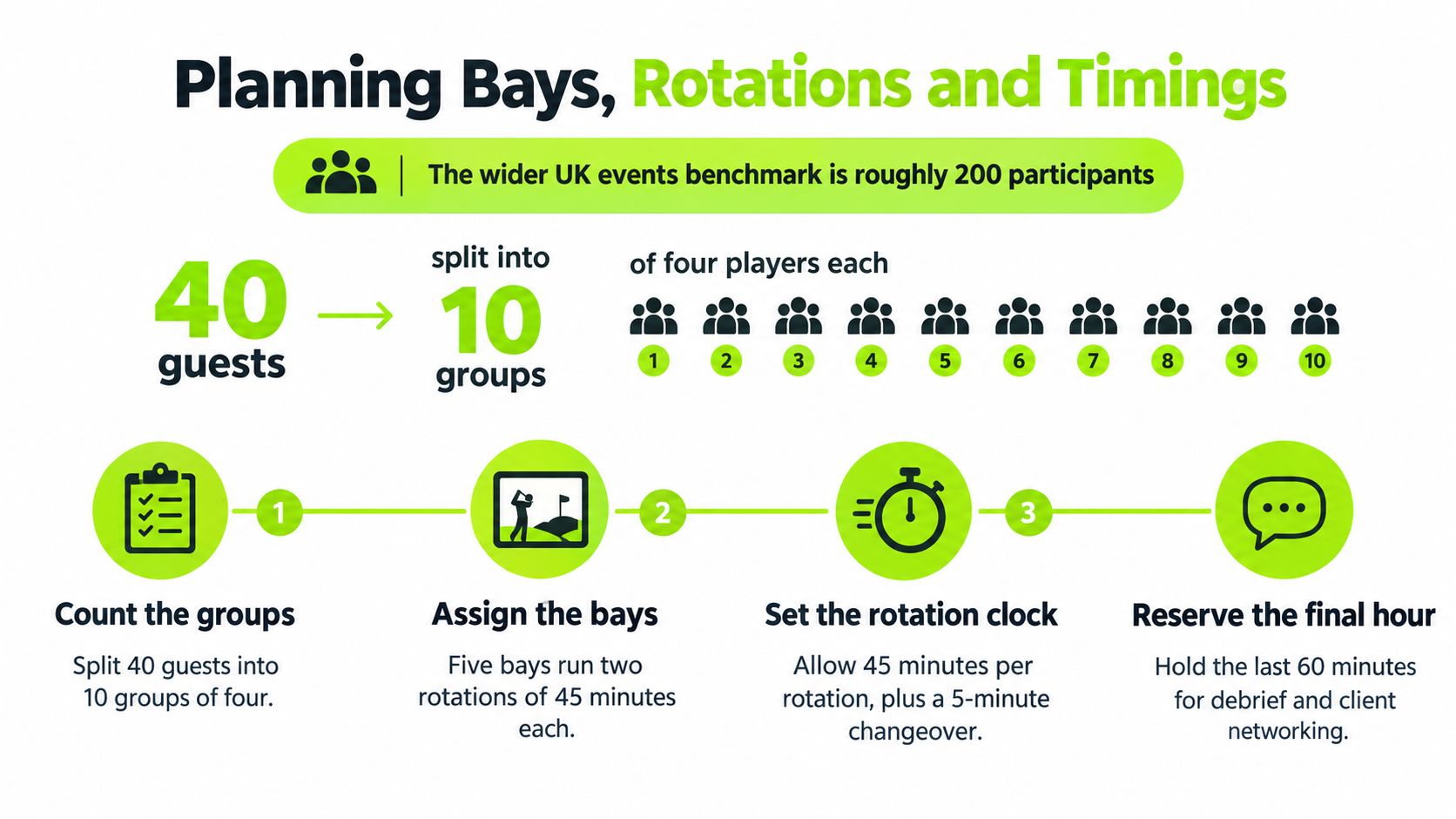
Use this sequence when building the schedule:
- Confirm headcount. Separate guests who are attending from those who are expected to play.
- Choose the playing share. A client event might prioritise conversation, while a team challenge could give more guests a turn.
- Calculate players per round. Multiply the number of bays by the players assigned to each bay.
- Round up to whole rounds. Divide the number of people who will play by that round capacity. Any remainder still needs a slot.
- Add changeover time. Allow time for groups to move, clubs to be handed over and scores to be entered.
- Check the programme length. Fit play around, rather than through, food, presentations and arrivals.
- Assign teams and publish the schedule. Give each guest a group, bay and start time before the event.
The table assumes four players per bay. Round figures are calculated by dividing guests playing by the number of active player places in each round, then rounding up.
| Guests playing | Bays | Players per bay | Rounds needed |
|---|---|---|---|
| 40 | 6 | 4 | 2 (24 active per round) |
| 100 | 12 | 4 | 3 (48 active per round) |
| 200 | 20 | 4 | 3 (80 active per round) |
| 200 | 10 | 4 | 5 (40 active per round) |
On the day, keep an eye on player-minutes per bay, turnover time and queue length. If the schedule needs more than three rounds, reduce the share of guests playing, add bays or divide the event into two sessions. Long queues aren't a minor inconvenience; they can make the golf feel like a waiting-room activity.
Designing for Colleagues Who Do Not Play
Indoor doesn't automatically mean accessible. A simulator bay may have a raised threshold, restricted swing space, loud audio, visually busy screens or equipment that's difficult to adapt. A venue's general statement that it welcomes groups won't tell an organiser whether a specific guest can arrive, move around and take part comfortably.
The Equality Act 2010 is relevant to reasonable adjustments. Raise access needs with the venue in writing well before booking, and record what the venue agrees to provide. One venue's information says step-free access may rely on a collapsible ramp and staff assistance requested at least four hours in advance, illustrating why you should confirm arrangements rather than assume they're ready, as shown on Pod Golf's White City venue information.
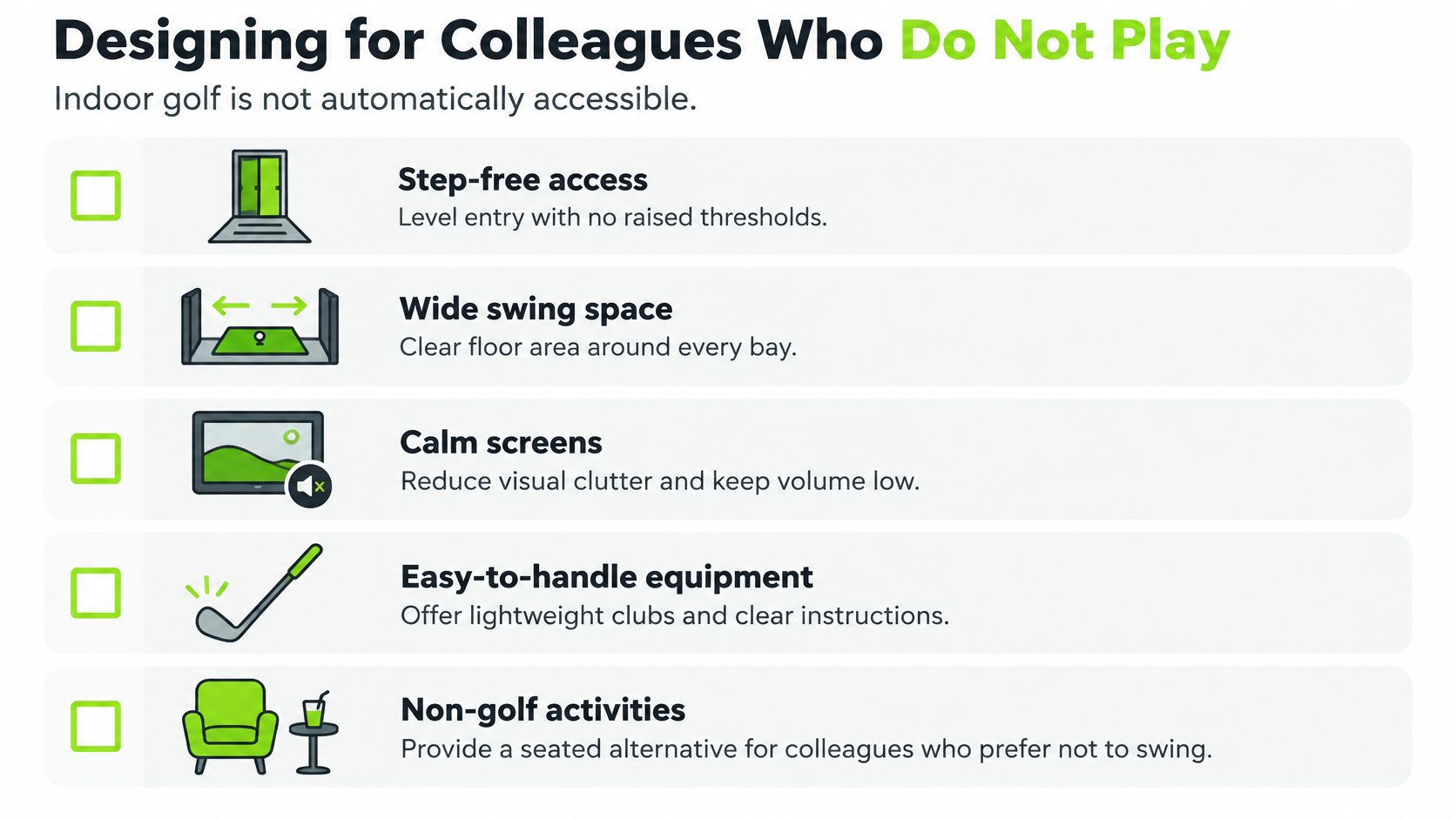
Before you confirm a venue, use this written audit:
- Arrival and route: Is there a step-free route from the entrance to the bays, including any lift access?
- Toilets: Are accessible toilets available on the same level as the event?
- Seating and breaks: Can guests sit close to the bays, and is there a quieter space for a break?
- Equipment and roles: Can the venue supply adapted or lighter clubs? If a guest can't use a standard club, what non-swinging role can they choose?
- Sensory needs: Can the venue adjust screen brightness, visual effects or sound levels?
- Assistance arrangements: What notice does the venue need, and who will provide help on arrival? Check any claim of Part M compliance in person rather than relying on a brochure.
Participation doesn't have to mean swinging a club. A guest can contribute through putting, team strategy, scoring, commentary, presenting or hospitality. For a 40-person event where half the group are new to golf, one option is a beginner clinic for those guests alongside a team contest for more confident players. Put agreed adjustments and alternative activities into the invitation so guests know what to expect.
Pricing, Quotes and Questions to Ask Venues
Published rates are starting points, not a market average. They aren't directly comparable unless the booking basis, duration, VAT and inclusions are clear.
| Operator | Pricing basis | Published price | What is included | Year noted |
|---|---|---|---|---|
| Birmingham indoor golf venue | Per person per hour | From £10.75 plus VAT | Simulator, clubs, games and event support, food extra | Not stated |
| Birmingham indoor golf venue | Exclusive ground-floor hire, up to 20 guests | £250 plus VAT per hour | Private ground-floor space | Not stated |
| Birmingham indoor golf venue | Exclusive whole-venue hire, up to 100 guests | £450 plus VAT per hour | Whole venue | Not stated |
| London indoor golf venue | Per 30 minutes, up to four players | £14.50 | Bay access for up to four players | Not stated |
| Inverness simulator venue | Per simulator room per hour | £40 for two players, £10 per extra player, four maximum | Simulator room access | Not stated |
| 4Events | Corporate golf simulator hire | From £995 | Simulator hire for corporate events | 2026 |
| Big Swingers | Corporate and charity Pro Event package | From £699 per event | Up to 5 hours of activity | 2025 |
The Birmingham venue lists its rates and inclusions in its corporate event offer. The London and Inverness examples, and the wider range of UK pricing, are discussed in Golf News' coverage of the changing simulator-club model. The Inverness venue publishes its room rate and player limit on iSight Golf's booking information. Corporate hire starting prices are listed by 4Events and Big Swingers.
At the Birmingham per-person rate, a three-hour booking for 30 guests works out as 30 × 3 × £10.75 = £967.50 plus VAT, before food. Exclusive ground-floor hire for 20 guests over three hours costs £750 plus VAT, or £37.50 per guest. These calculations compare the published hire charges only; they don't establish which option gives each guest more playing time.
Compare cost per guest and cost per active player, not just the hourly headline. A low bay rate can be poor value if guests spend most of the event waiting, while a venue buyout may cost more but include privacy and a suitable space for networking. For broader planning, GolfRep's guide to golf simulator bay pricing covers the commercial questions behind pricing decisions.
Before asking for a quote, give the venue the headcount, date, expected playing ability, equipment requirements and whether you want a hosted competition. Ask how many bays are available at the chosen time, whether adapted equipment is available and what minimum group size applies. Then check the written quote for:
- Full cost: VAT treatment, minimum hire period, deposit and cancellation terms.
- Inclusions: Food and drink, equipment, coaching, staffing and room hire.
- Practical arrangements: Transport, late arrivals and how long each group gets on a bay.
- Event economics: Expected active-player time and any costs that rise with guest numbers.
A nominally inexpensive booking can become costly once catering, private space, coaching, transport, VAT and minimum hire periods are added. Price the whole programme before you commit.
Hosting the Event in Your Own Club
A club with eight simulator bays and a quiet Thursday afternoon faces a different decision from an organiser choosing a venue. Hosting in-house keeps the event revenue at the club, but the club also carries the staffing, equipment and delivery risk.
Illustrative calculation: with four players per bay, eight bays can accommodate 32 active players in one round. If the club charges £10 per player per hour, a three-hour session for 32 guests produces £960 before food and drink. That's gross event revenue, not profit. Compare it with the pay-and-play income the same bays would otherwise generate on that afternoon, then deduct the direct cost of delivering the event.
Staffing is easy to underestimate. A workable plan might assign one host per four bays, plus a scorer and a bar lead. Set food and drink as a minimum spend per head, take a deposit when the booking is confirmed, and make the cancellation terms clear enough to protect the bay slot.
Commercial test: Host in-house when bays would otherwise sit idle, the kitchen can serve the group and the event can run without pulling staff away from the main floor. If those conditions aren't met, a venue partner may be the better option.
Build the bay schedule before agreeing the date, so you know what capacity the club can actually deliver. If you're considering branded gifts, Custom Mark's guide to budgeting golf giveaways for company events can help frame merchandise as part of the event budget rather than an unplanned extra.
GolfRep launches hyper-local campaigns to increase awareness, attract new members and drive secondary revenue through open days and events. We create campaigns around each club's brand, pricing and goals, and a call with our founder can be arranged to discuss the commercial options.
Measuring Whether the Event Paid Back
A full room can still be a weak event. Judge it on whether the right people got active time and whether the club can trace revenue afterwards. Start with cost per guest and, when golf is central to the programme, cost per active player.
For an illustrative event costing £2,000, with 40 guests and 24 active players, the cost is £50 per guest and about £83 per active player. If eight guests spent the afternoon watching from the sofa, the £50 headline hides a weaker rotation result than the £83 figure reveals.

Keep the measurement set small enough that someone will actually maintain it:
- Attendance and cost: Record who attended, total direct cost, cost per guest and cost per active player.
- Food and room use: Calculate food-and-beverage spend per head and record room utilisation.
- Enquiries: Log enquiries generated by the event and review what arrives within a week.
- Commercial outcomes: Track bookings and membership introductions within 90 days.
Set up the tracking before guests arrive. Give each guest a source tag, record marketing consent at sign-in in line with UK GDPR and PECR, and assign one named person to log every enquiry. A one-page event report should summarise attendance, cost, revenue, enquiries, bookings and the decision: repeat, adjust the format or drop it.
The wider market gives clubs a reason to treat corporate golf as more than bay hire. The latest UK Events Report cited in the NOEA summary puts meetings and conferences at approximately £16.3 billion in UK economic value and incentive travel at £2.4 billion. Those figures cover the broader UK business-events market, not indoor golf specifically, so the practical lesson is narrower: assess the event as a package of play, hospitality, room use and possible future business. GolfRep's guidance on golf club event revenue offers related commercial context.
General recommendation: Repeat an event only if it covers its direct costs and produces at least one booking or membership introduction within 90 days. If it falls short, change the format before changing the guest list: tighten rotations, shorten speeches, or raise the spend requirement only where demand supports it.
GolfRep partners only with golf clubs and builds campaigns around each club's brand, pricing and goals, including demand created by open days and events. If you want to assess where corporate events could sit in your revenue plan, visit GolfRep.
Ready to tap into our proven growth system?