Indoor Golf Facebook Ads: A Practical Setup Guide
A Tuesday afternoon in January, rain on the roof, and one simulator bay sitting dark while the others tick over. The commercial question is simple: can indoor golf Facebook ads put a bookable offer in front of people who will turn up, or will the spend only buy clicks from people browsing in the warm?
What Facebook Ads Can and Cannot Do for an Indoor Golf Venue
Say the empty bay is at a venue on the edge of a town. Facebook can put a winter practice offer, a coached session or a group booking in front of people inside a postcode radius you choose, then show which ad set produced each enquiry. That is the useful part of the platform for a local indoor centre.
DataReportal's Digital 2025 United Kingdom report, using figures from Meta's advertising tools, estimated that Facebook ads could reach approximately 55.2% of the UK's total population and 56.5% of the country's internet-user base in January 2025. The same report recorded a 1.2 million increase in potential Facebook ad reach on the year before, equivalent to growth of 3.2%. Those figures are potential advertising reach, not guaranteed impressions and not sales. A local venue only needs a small slice of that pool.
What the platform cannot do is answer the phone, explain a price, or rescue a vague offer. An unanswered line and a landing page that hides the bay rate will waste whatever the ads deliver. If in-house time is the constraint, it is reasonable to find a paid social agency that will run the account against bookings rather than vanity metrics.
Every step below judges success by booked and attended sessions, not clicks. Catchment, creative, consent and reporting only work if the previous step is already in place.
Build Campaigns Around Local Catchments and Segments
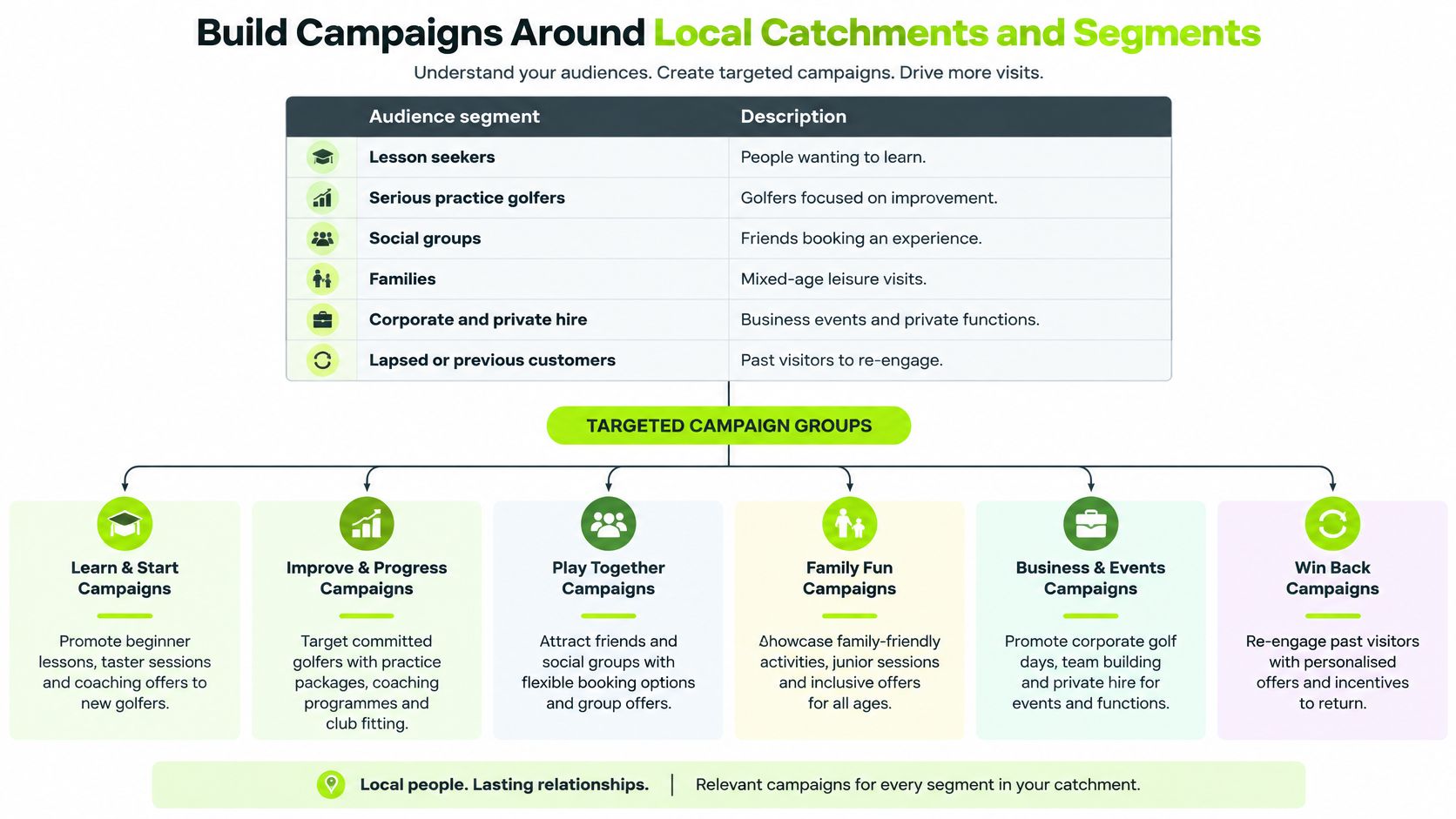
Treat indoor golf as several jobs people hire, not one “simulator” audience. The table below is the campaign map. Each row gets its own offer, its own ad set and its own budget.
| Segment | Job the customer hires indoor golf for | Offer to lead with | Targeting approach |
|---|---|---|---|
| Lesson seekers | Improve technique with data | Single session with launch monitor feedback | Local radius, age 18 and over, lesson-page visitors retargeted |
| Serious practice golfers | Measurable practice in winter | Off-peak bay block or practice package | Local radius, interest suggestions, past bay users as Custom Audience |
| Social groups | Weather-proof night out with friends | Group bay booking with food and drink | Local radius, age 21 to 45, lookalike of recent group bookings |
| Families | Something to do together in bad weather | Junior or family session slot | Local radius, age 25 to 54, family-session page visitors retargeted |
| Corporate and private hire | Team events and client hospitality | Private hire enquiry with room and package details | Business-owner audience within wider catchment, separate budget |
| Previous customers and lapsed visitors | Return visit | Returning visitor offer with a fixed expiry | Custom Audience from booking history, excluded from prospecting |
Build order
- Draw the catchment in drive time, then test two or three radii. Ten minutes in a city is not ten minutes in a rural area. A tight radius protects spend. A wider one only earns its place if bookings still come from people who will travel.
- Create one campaign per commercial goal. Keep prospecting separate from retargeting so a warm visitor does not inflate the cost of finding a new one.
- Create one ad set per segment, each with its own budget. Mixing lesson seekers and corporate bookers in one ad set hides which job is paying for the bay.
- Upload previous customers and members as Custom Audiences, and exclude existing members from prospecting. You already have their business. Paying to show them a new-customer offer is wasted money.
- Treat interest labels such as golf or simulator as suggestions only. Meta's own targeting changes removed sensitive categories in January 2022, removed detailed-targeting exclusions in January 2025, and merged or retired further options in June 2025. The controls that still hold for UK advertisers are location, minimum age, language and Custom Audiences. Meta may widen delivery past a golf interest, so do not treat that label as the audience.
- Review reach and frequency weekly. Cut budget where frequency climbs and bookings do not. Guides on how to target nearby customers with Facebook ads are useful background, but the catchment you draw around your own postcode matters more than a national interest stack.
Budget rule: Meta does not publish an official country-level CPC or CPM, and the traceable 2025 medians of $0.70 for traffic and $1.92 for lead generation are US or global figures, not UK indoor golf costs, as set out in Outra's cost review. Start each segment on a modest fixed daily budget and move money only towards segments that produce booked, attended sessions.
Idle weekday bays are a capacity problem as much as an ads problem. The same logic sits behind how to fill golf simulator bays when the tee sheet, or the bay sheet, has holes you can price.
Write Creative for the Reason People Book Indoor Golf
A headline that says “play golf indoors” asks the viewer to invent the reason. Most will scroll past. The ad has to name the job.
UK evidence supports splitting the message. BBC Sport's coverage of changing golf habits reported that 82% of traditional on-course golfers in Britain and Ireland have tried an alternative format, and that simulator use is weighted towards swing analysis, coaching and social play rather than a full simulated round. One indoor centre in that coverage mixes serious golfers, families, groups of friends and corporate bookings, with more than 300 weekly visitors. One generic film cannot speak to all of them.
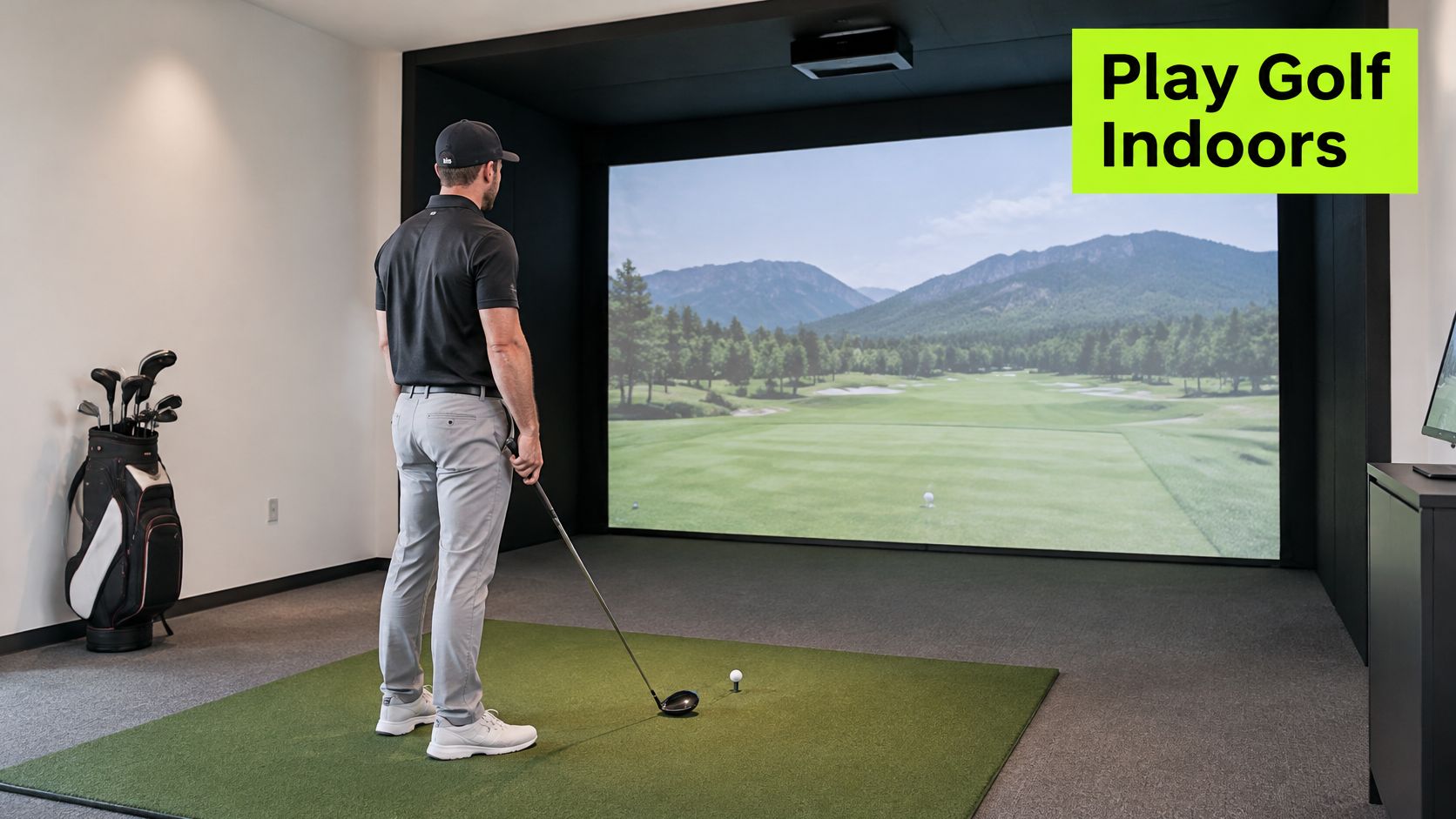
One ad, one job
Lesson seekers see a swing or a launch monitor number on screen, with a single coached session as the offer. The objection is usually “will I learn anything in an hour?”, so the first line should name the feedback, not the bay.
Serious practice golfers get winter language: keep the swing sharp through the off-season, at the off-peak bay rate. Show the screen, the numbers and the price. They are buying measurable practice, not a night out.
Social groups see friends around a bay in the evening. Lead with a group booking that includes food and drink. Weather-proof entertainment is the product. A swing-speed graphic will not book the table.
Families see children in a junior slot, with the session times written in the first line. Parents decide on logistics. If Thursday at 4pm is the slot you need to fill, say so.
Corporate and private hire leads with private hire, screens and hospitality. The person booking is often not the person playing. Room, headcount and what is included beat any swing video.
Creative checklist
- Photograph your own bays. Stock simulators look like every other venue.
- Show the price or a starting price. Hidden rates kill the click that would have booked.
- Run one offer per ad, and put that offer in the first line of copy.
- Test a short video against a still for the same segment before you judge the audience. A clear way to create Facebook video ads with Wideo is enough if you do not have an editor on site.
The landing page and the first follow-up must stay on the same job as the ad. A social click that lands on a membership tariff, or a lesson click that lands on party packages, throws the enquiry away. Lesson-led creative in particular needs a page built for coaching demand, which is the point of golf simulator lessons marketing.
Set Up Lead Capture and Consent Before You Spend
Decide the lead event before you turn spend on. A booked session, a trial request or a membership consultation is the event. An instant-form submission on its own is not.
In September 2025 the UK Information Commissioner's Office said Meta's previous approach of using personal information for personalised advertising as part of standard service terms was not aligned with UK law, and welcomed the move towards a consent-or-pay model. If you collect a name, mobile number or email through a Facebook lead form, state why you are collecting it. Do not treat every lead as permission for unrestricted marketing. Meta also prohibits ads that use deceptive or misleading practices, including tactics meant to obtain money or personal information fraudulently.
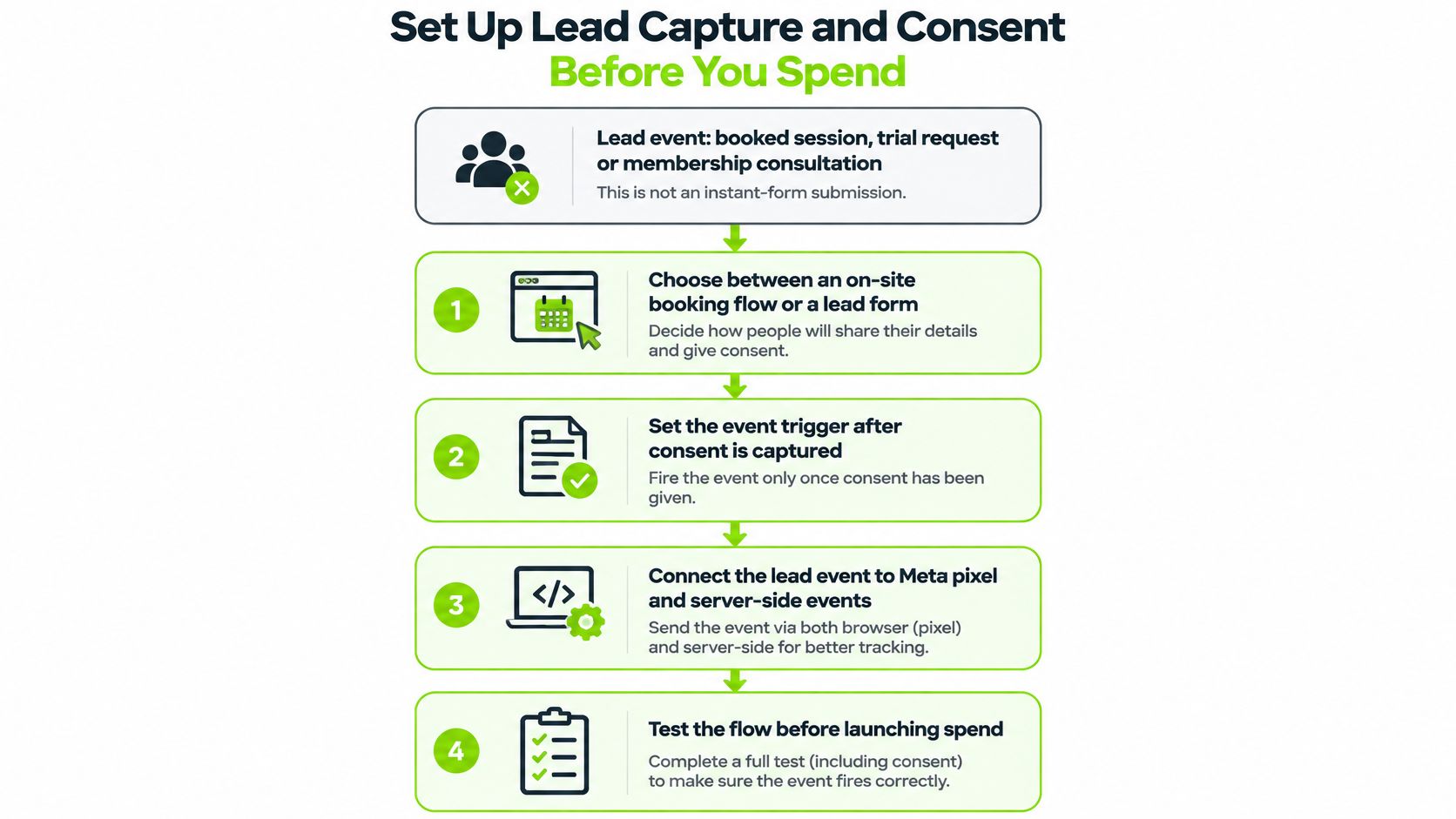
Setup steps
- Choose an instant form or a landing page. A landing page can show prices and which bays are free. An instant form suits a quick callback, such as a corporate enquiry where the package needs a conversation. Pick one primary path per segment.
- Keep fields to what you will use. First name, mobile number, email and preferred slot or date. Every extra field cuts completions from people who would have booked.
- Name the venue and the purpose. “We will use these details to confirm your bay booking” is clear. A vague privacy line is not.
- Add a separate, unticked box for marketing messages. Keep it apart from the booking confirmation. A person can book a bay without joining a newsletter.
- Set a response standard. A reply within two working hours during opening times is a fair club standard, with an automated acknowledgement the moment the form lands so the enquiry is not sitting unseen.
- Give a clear way to stop further messages in every follow-up, and only send the sequence the consent covers. Identify the business in the first line so the message is not anonymous.
- Check the offer matches the ad. A “from £15” line that is a members-only rate is a misleading practice, and it also produces complaints you then have to unwind.
Volume against quality
A short form produces fewer leads and more of them are bookable. A long instant form, or a form with no price, produces cheap names that never pick a slot. I would rather pay more per enquiry and see the booking in the diary than celebrate a low cost per lead that never walks through the door.
A lead is permission to arrange the session they asked for. It is not permission to market everything the venue sells.
Measure Bookings, Attendance and Revenue, Not Clicks
Build the measurement path before the first pound goes out. The lead event is a booked simulator session or a membership consultation. Install Meta's pixel and server-side events only after you have the consent required for advertising cookies or similar technologies, and pass the campaign identifier into the booking system or CRM so a booking can be traced to an ad set.
The ICO's direct marketing guidance states that online advertising using storage and access technologies, including tracking pixels, requires consent when used for ad selection, tracking, profiling or behavioural analysis. Structure the account by catchment, keep prospecting apart from retargeting, and optimise toward completed bookings rather than instant-form submissions.
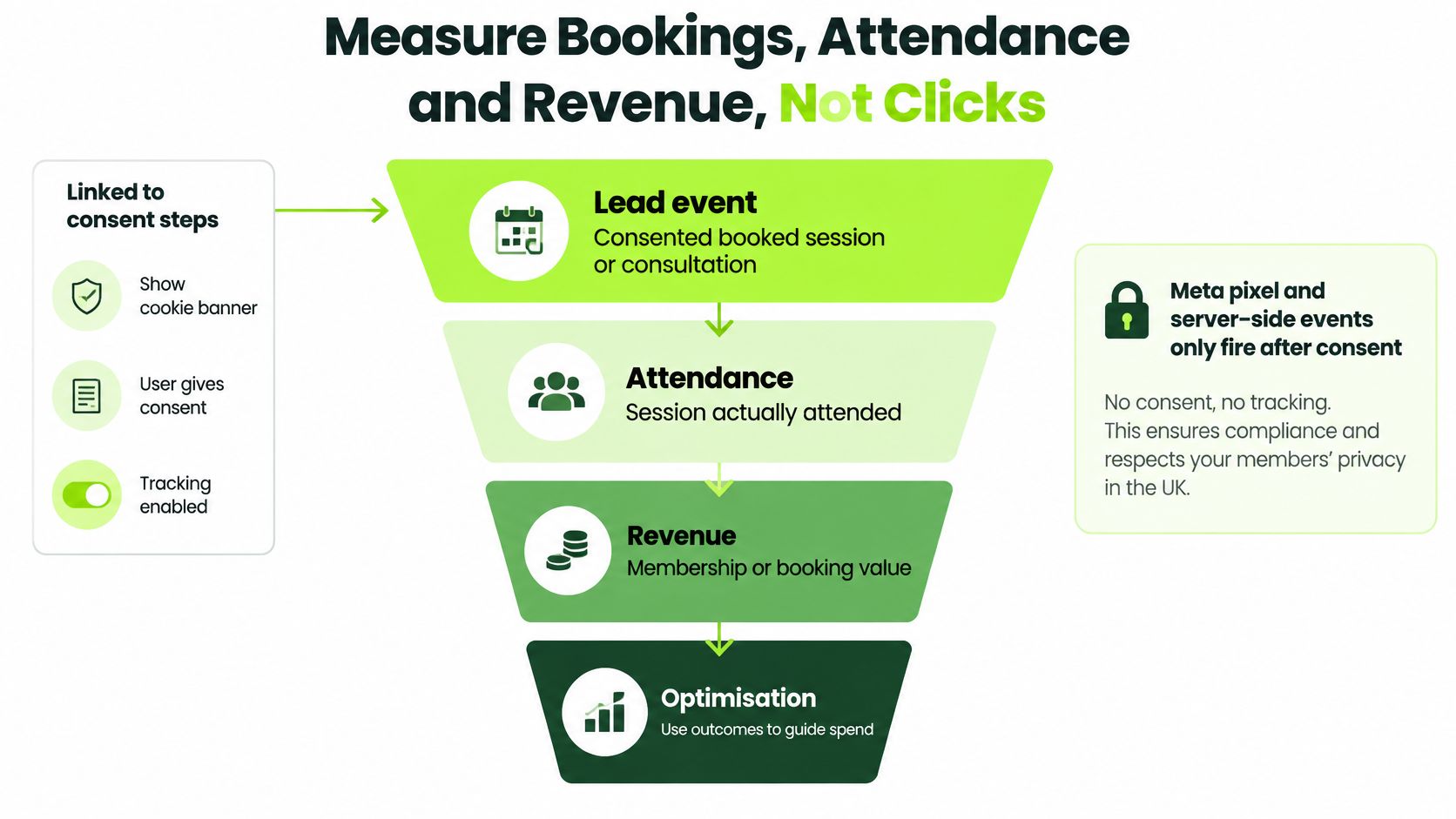
Record, for each segment, impressions, reach, frequency, landing-page views, qualified leads, bookings, attendance, membership applications and revenue. A cheap lead who never attends is a cost.
A worked week
Say one segment spends £600 and produces 40 qualified leads. Cost per qualified lead is £600 ÷ 40, which is £15. Sixteen of those leads book, so the booking rate is 16 ÷ 40, which is 40%. Twelve attend, so the show-up rate is 12 ÷ 16, which is 75%. Cost per booked session is £600 ÷ 16, which is £37.50. If four of those attended bookings become members, member acquisition cost on this illustrative spend is £600 ÷ 4, which is £150. Judge that £150 against expected tenure and package revenue, not against the click price.
| Metric | Formula | Illustrative example | What it tells you |
|---|---|---|---|
| Cost per qualified lead | Spend ÷ qualified leads | £600 ÷ 40 = £15 | Whether the creative and form attract real enquiries |
| Booking rate | Bookings ÷ qualified leads | 16 ÷ 40 = 40% | Whether follow-up turns enquiries into bookings |
| Show-up rate | Attended visits ÷ bookings | 12 ÷ 16 = 75% | Whether reminders and the offer hold commitment |
| Cost per booked session | Spend ÷ bookings | £600 ÷ 16 = £37.50 | The true cost of filling a bay or lesson slot |
| Member acquisition cost | Spend ÷ new members | £600 ÷ 4 = £150 | Whether membership campaigns pay back over expected tenure |
| Revenue per segment | Booking and package revenue by segment | Set per venue from the booking system | Which audience is worth more budget |
Which numbers you trust
Use a seven-day click and one-day view window only if the CRM can reconcile platform-reported leads with actual bookings. Otherwise first-party CRM records are the commercial source of truth. Phone and WhatsApp bookings never appear in a pixel-only report, so a venue that takes a lot of calls will under-count Facebook if it trusts Ads Manager alone.
A weekly line per segment should sit spend next to bookings, attendance, revenue and second visits. That is also the discipline behind a proper conversion tracking setup. Bays, lessons and memberships then get judged on their own economics, not on a blended cost per click.
Reading Results and Deciding What to Change Next
A campaign is a chain. The weakest link sets the result, and the pattern in the numbers usually names that link. Changing creative, audience and offer in the same week makes the next reading useless.
| Pattern in results | Likely bottleneck | First action | Review point |
|---|---|---|---|
| High clicks, few qualified leads | Offer or creative does not match the segment | Rewrite the first line and offer for one segment | After 14 days of spend |
| Qualified leads, few bookings | Slow reply or hard booking step | Set a reply standard and simplify the booking link | After 14 days of spend |
| Bookings, low attendance | No reminder or weak commitment | Add reminders and a deposit or pre-booking | After 30 bookings |
| Attendance, no second visit | First session did not meet the reason for booking | Send a follow-up offer tied to the same job | After 30 days of spend |
| Stable bookings, rising cost | Audience fatigue or overlap | Refresh creative and reduce overlap between ad sets | Weekly frequency check |
One change, then wait
Clicks without qualified leads means the offer does not fit the segment. Rewrite the first line for that one audience and leave the others alone. Review after 14 days of spend, not after a noisy weekend.
Leads without bookings usually means a slow reply or a booking step with too many choices. Set the reply standard and shorten the link to a single slot type. The ad is not the problem if people asked to be contacted and nobody rang.
Bookings without attendance means commitment is weak. A reminder the day before, plus a small deposit or a pre-paid booking, holds the slot. Judge it after 30 bookings so one rainy Saturday does not rewrite the policy.
Attendance without a second visit means the first session missed the job they hired you for. A practice golfer who got a party atmosphere, or a family who got a serious lesson, will not rebook. The follow-up offer has to match the original job. Review after 30 days.
Stable bookings with a rising cost points to fatigue or two ad sets talking to the same people. Refresh the creative and check frequency every week. Do not add budget to hide the overlap.
Change one variable at a time. Do not judge a segment on a handful of leads, and do not scale a segment whose cost per booked session is rising while the show-up rate is falling.
Winter is not summer
Compare January with January last year, and with a summer month, before you call a result poor. Indoor demand moves with weather and school holidays. A flat January against a busy July can still be a good commercial month if the bays you chose to fill are full at a price you can live with.
If a segment produces no bookings after a fair test, stop it. In this plan a fair test is the 14-day window in the next section, run at the fixed budget you wrote down before you spent. Leaving a silent ad set on “to see” is how small budgets disappear.
Confirm Your Two-Week Test Plan
Match one segment, one offer and one local catchment to the bay you need to fill. If weekday afternoons are quiet, test an off-peak block for serious practice golfers. If weekends are already busy but Friday evenings are slow, test a social group booking with food and drink. Keep the test focused: several audiences at once make it harder to see which one brings bookings.
Write the rule before you spend
- Fix the budget for 14 days and do not top it up mid-test because Tuesday looked quiet.
- Use one landing page or one form, with weekly reporting for bookings, attendance and revenue.
- Continue if the cost per booked session is within the venue's target and the show-up rate holds.
- Adjust creative only when the results match the diagnosis you identified, then change that one variable.
- Stop the segment if it produces no bookings after the 14 days.
Each indoor golf job needs its own test. Lessons, serious practice, social play, family visits and corporate hire are different reasons to book, so pair the chosen audience with an offer and creative that fit. Keep the question commercial: does this bay block or package fill a gap at a price the club can sustain? A visually strong ad that misses the target cost has not passed.
GolfRep creates campaigns centered on a club's brand, pricing, and goals, using data-led targeting, automated follow-ups, and nurture systems. The test can also reveal whether the sticking point is the offer, response time, or return visit rather than the ad. That provides the club with a clearer basis for its next decision.
GolfRep works with golf clubs and golf brands on acquisition, follow-up and retention, with campaigns shaped around your brand, pricing and the bays you need to fill. For help setting a two-week test against a clear booking target, rather than a pile of cheap leads, start with GolfRep.
Ready to tap into our proven growth system?