How to Increase Golf Club Revenue: A UK Playbook for 2026
Most advice on how to increase golf club revenue starts in the wrong place. It starts with more adverts, more enquiries, more offers, more “visibility”. That sounds sensible until you look at how most clubs operate day to day.
The manager is in meetings. The secretary is covering reception. The pro is on the lesson tee. A membership enquiry arrives on Friday evening and sits unanswered until Monday, or longer. By then, the golfer has already booked elsewhere, joined elsewhere, or cooled off.
That is the actual leak.
For many UK clubs, the problem isn't lack of demand. It's the absence of a reliable system for handling the demand already there. If you want to increase golf club revenue, the first move usually isn't to push harder on promotion. It's to stop losing value inside the enquiry and follow-up process.
The Hidden Opportunity in Your Existing Enquiries
The UK market gives clubs more room than many committees assume. UK golf participation data shows the number of people playing golf in the UK rose from 2.3 million in 2016 to 3.0 million in 2022, while rounds played increased from 63.0 million to 72.5 million over the same period. That matters because it points to a healthier base of active golfers, not a shrinking audience.
The common response to revenue pressure is still “we need more leads”. Sometimes that's true. More often, clubs already have interest coming in through the website, phone, social media, visitor bookings, society enquiries, and referrals from members. What they don't have is full visibility of what happens next.
Where revenue usually slips away
A typical club doesn't have one tidy pipeline. It has scattered contact points.
- Website forms go to a shared inbox no one fully owns.
- Phone enquiries depend on who answers and how much they remember to log.
- Visitor bookings sit in one system while membership conversations sit somewhere else.
- Committee-led follow-up becomes inconsistent because nobody wants to chase too hard.
That creates a false conclusion. The club assumes marketing isn't working, when the actual issue is that the enquiry never entered a process.
Practical rule: If a club can't see every enquiry, assign ownership, and track the outcome, it doesn't have a revenue system. It has hopeful admin.
This is why the biggest upside is often hidden in plain sight. A golfer who has already asked about membership, a flexible category, a trial round, or an academy package is far more valuable than a vague future prospect. They've shown intent. The club's job is to respond properly and move that interest forward.
Why system beats volume
Blanket discounting often looks like action, but it usually masks weak conversion. If your response times are slow, your follow-up is ad hoc, and your team can't see lead status in one place, adding more enquiries just increases the pile-up.
A better question is simple: how many live opportunities are already sitting in your club with no next step attached?
That's where predictable growth starts. Not with more noise, but with tighter handling. We've written before about how most golf clubs lose enquiries without realising it, and the pattern is usually the same: interest exists, but the club has no organised path from first contact to booked visit, membership conversation, or conversion.
When clubs fix that, revenue becomes less random. They stop relying on luck, staff memory, and whoever happens to be on shift.
Diagnose Your Revenue Engine Before You Accelerate
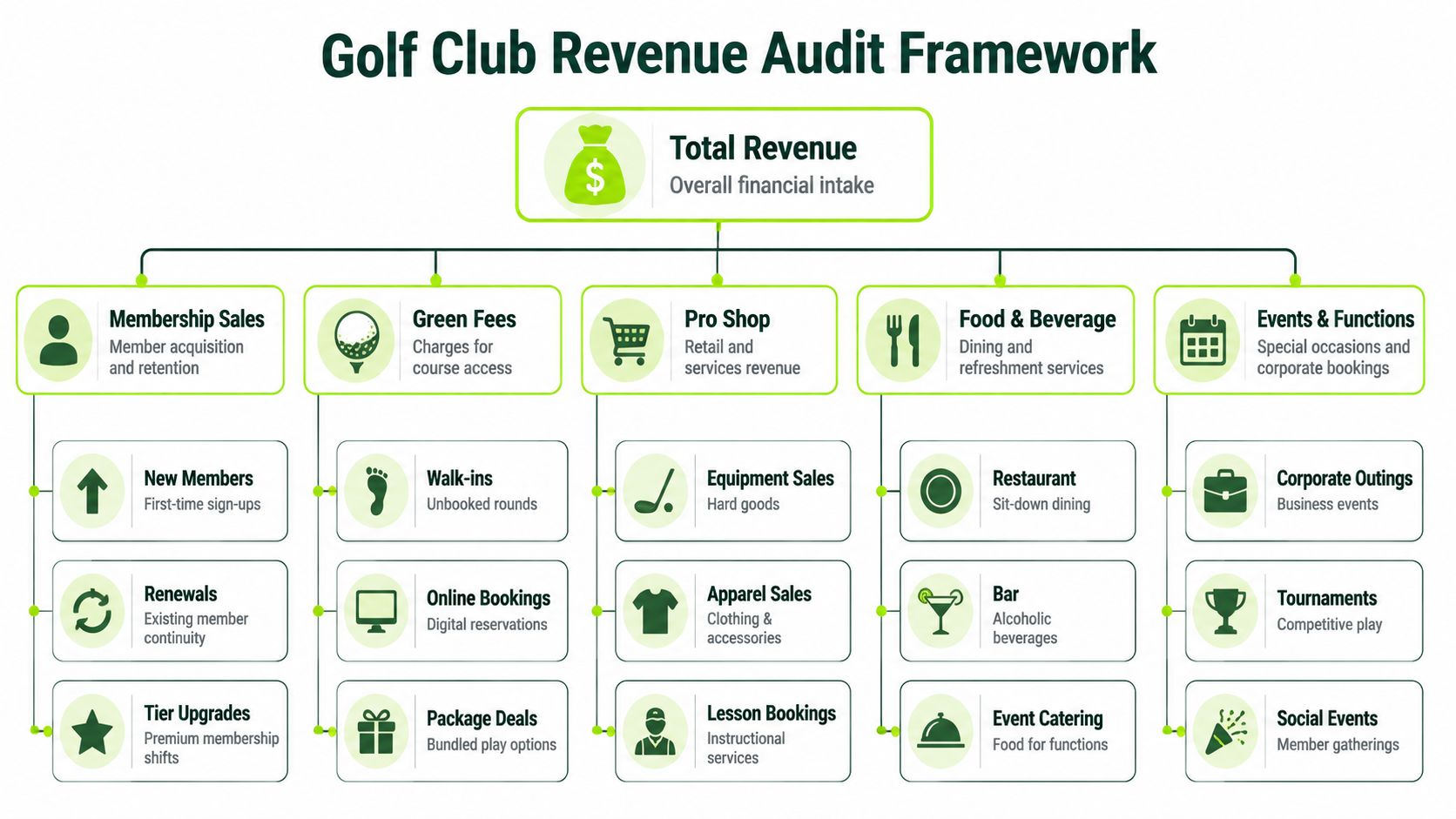
Clubs often talk about revenue as if it comes from one source. It doesn't. It comes from a mix of memberships, green fees, food and beverage, coaching, retail, events, and all the decisions that affect how those streams interact.
That's why the first practical step is a revenue audit. Not a finance exercise for the year-end file. A working diagnosis of where money comes from, where margin gets squeezed, and where operational friction is holding growth back.
The wider sector is large enough that small improvements matter. Industry research cited by the British Golf Industry Association reports that golf generates around £2.0 billion in direct spending at clubs in England and supports about 50,000 jobs. A club doesn't need dramatic change to improve its position inside a market of that size. It needs clarity.
Audit each stream on its own merits
Start with the obvious categories, but don't treat them equally. Each one behaves differently.
| Revenue stream | What to check first | Common mistake |
|---|---|---|
| Memberships | Renewal patterns, upgrade opportunities, enquiry handling | Looking only at joins, not retention |
| Green fees | Peak vs off-peak yield, booking source, no-shows | Chasing volume with flat discounts |
| Food and beverage | Spend by daypart, event crossover, member usage | Judging performance on busy days alone |
| Pro shop and coaching | Attachment to member activity, repeat booking behaviour | Treating retail and lessons as separate |
| Events and functions | Seasonality, local demand, repeat organisers | Relying on one-off bookings |
A good audit asks awkward questions. Which revenue line looks healthy but consumes too much staff time? Which line appears weak only because it isn't tracked properly? Which “busy” area is blocking higher-value activity?
Look for operational leaks, not just line items
Many clubs have a revenue issue that isn't visible in the accounts alone.
- Enquiries without ownership create silent loss. If nobody is responsible for moving an interested golfer to the next step, that lead goes cold.
- Seasonal dependence leaves the club exposed. A strong summer can hide a weak winter plan.
- Manual reporting slows decisions. By the time the team notices a problem, the month has already gone.
This is where broader marketing context matters. Consumer behaviour keeps shifting toward faster response, better digital journeys, and more personalised communication. A useful overview of that wider environment is SleekPost on 2026 marketing shifts, not as a golf-specific playbook, but as a reminder that clubs are competing with the service standards people now expect elsewhere.
A club doesn't need every new tactic. It needs a clearer view of where enquiries, bookings, and spend actually turn into revenue.
The questions worth putting in front of the board
Take this list into the next management or committee review:
- Which revenue streams are predictable: renewals, recurring subscriptions, regular societies, repeat coaching?
- Which depend on heroic effort: one person chasing, one staff member remembering, one busy month saving the quarter?
- Where does premium positioning break down: poor follow-up, dated booking flow, inconsistent quoting, vague membership process?
- What gets measured weekly: not annually, not when there's a problem, but every week?
If you can answer those cleanly, you can make sensible growth decisions. If you can't, more marketing spend won't solve the underlying issue.
Building Your High-Conversion Enquiry System
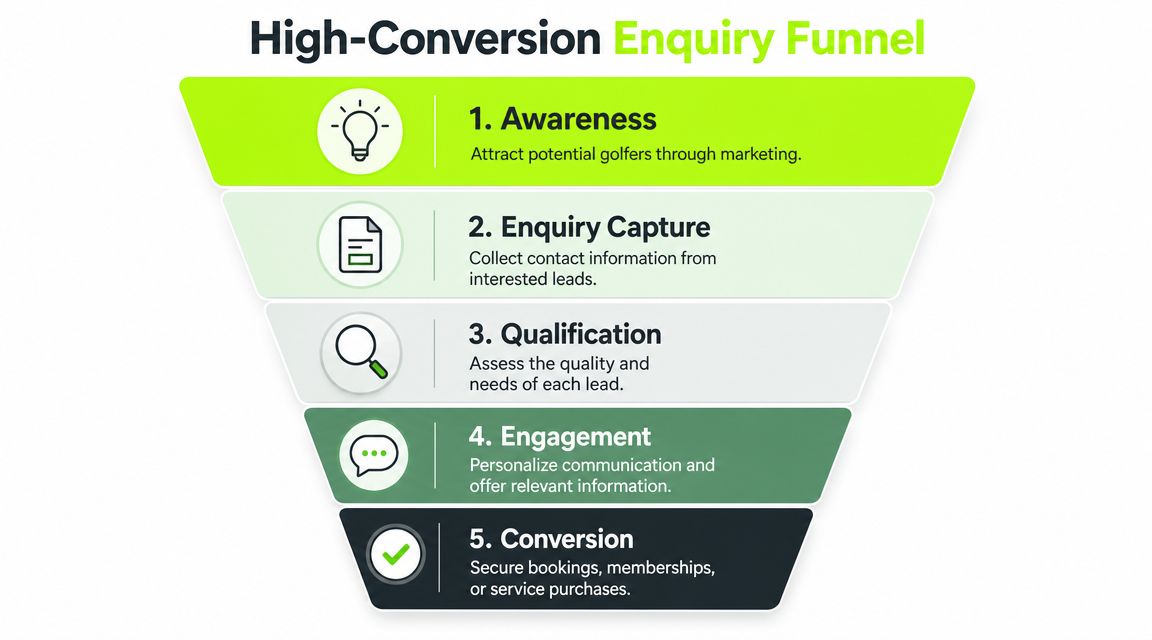
A high-conversion system is built around one idea. No enquiry should depend on memory.
That sounds basic, but it changes everything. The difference between clubs that grow steadily and clubs that lurch from campaign to campaign is usually process, not effort. Staff at both types of club work hard. One just has a structure that protects revenue.
The harder issue for private clubs is protecting yield while still growing. Industry commentary on UK clubs points to an underserved problem: how to raise revenue without relying on blanket discounting or constant new-member acquisition, especially where capacity constraints and premium positioning matter. That's exactly why the enquiry process matters. Poor follow-up pushes clubs toward price cuts they often don't need.
What happens when an enquiry arrives at 9 pm on a Friday
Take a common scenario. A golfer visits your website after work, reads the membership page, and submits a form asking about a five-day category or flexible option.
At many clubs, this is what happens next:
- The form lands in a shared inbox.
- Nobody sees it until Monday.
- The reply is manual and generic.
- No visit gets booked.
- No reminder is sent.
- The lead disappears.
Now compare that with a systemised approach:
- The enquiry is captured instantly.
- The golfer receives an immediate acknowledgement.
- The lead is logged in a CRM with source and interest type.
- A task is assigned for personal follow-up.
- If there's no reply, the system prompts the next action.
- Every stage is visible to the team.
The point isn't automation for its own sake. The point is that speed, visibility, and consistency protect intent while it's still warm.
The four parts of a proper conversion system
Capture every enquiry in one place
If leads arrive by website, phone, social ads, referral, or walk-in conversation, they still need one home. Otherwise the club cannot track pipeline or spot drop-off.
Many clubs experience a breakdown here. Marketing may generate interest, but operations can't see the whole picture.
Respond fast without sounding robotic
An immediate confirmation message isn't the final sales conversation. It's a holding move that reassures the prospect the club is organised and responsive. The personal contact still matters, but it shouldn't be the first sign of life.
Speed matters because the golfer is comparing clubs in real time, not waiting patiently for office hours.
Make follow-up structured
Most clubs say they follow up. Fewer can show the sequence.
A useful basic structure looks like this:
- Day one response: acknowledge the enquiry and answer the direct question.
- Next contact: offer a visit, call, or trial experience.
- Later follow-up: handle hesitation, timing, and objections.
- Final check-in: close the loop so no lead sits open indefinitely.
The exact timing can vary. What matters is that the sequence exists and someone owns it. A practical example of that structure is covered in this guide to a golf club follow-up system.
Give the team lead visibility
If the membership lead knows what the pro has discussed, and the front desk can see that a prospect is due for a visit, the club feels joined up. If each department works from fragments, the prospect feels the gaps.
Tools only help if the process is clear
A CRM, forms software, call logging, and automated email flows can all help. GolfRep is one option clubs use when they want lead generation connected to structured follow-up and CRM visibility rather than treated as separate tasks. But no platform fixes a club that hasn't agreed who responds, what happens next, and when a lead is considered lost.
That's the shift. Stop treating enquiries as admin. Treat them as pipeline.
Optimising Core Golf Revenue Streams
Once the enquiry process is under control, the next step is to get more value from the course and the categories you already sell. At this stage, many clubs either underprice demand or create operational problems by chasing volume in the wrong places.

The most useful discipline here is yield management, but applied sensibly. Sagacity Golf's revenue guidance recommends measuring Rounds Played / Available Inventory and green-fee revenue / available rounds, then testing price changes only in peak-demand windows. It also notes that shorter tee-time intervals can reduce revenue if they create congestion.
Don't confuse more slots with more income
This is a classic mistake. A club sees strong demand and assumes the answer is tighter intervals. On paper, that creates more inventory. On the ground, it can damage pace of play, push rounds later, frustrate visitors, and reduce repeat booking intent.
A better approach is to review the tee sheet by demand pattern.
- Peak periods: identify the windows that already fill strongly and test pricing there first.
- Underfilled periods: use targeted offers, not public discounting, to stimulate specific segments.
- Congested times: protect the playing experience before adding capacity.
Higher utilisation only helps if golfers still enjoy the round and book again.
Modernise membership categories without cheapening the brand
Many clubs still force prospects into an all-or-nothing choice. Full membership or nothing. That leaves money on the table from golfers who want commitment, just not the traditional model.
Better category design usually includes a mix of access levels and usage patterns, such as weekday-focused options, flexible structures, or entry points that help people move toward fuller commitment over time. The detail depends on the club's capacity, constitution, and member sentiment. The principle is consistent: categories should fit real golfer behaviour, not just legacy thinking.
Use a simple decision grid
When reviewing green fees and membership together, ask:
| Question | If yes | If no |
|---|---|---|
| Are premium slots filling without resistance? | Test price carefully in those windows | Keep price stable and improve demand capture |
| Are off-peak times underused? | Target specific segments with controlled offers | Protect price and review awareness |
| Are prospects asking for alternatives to full membership? | Build clearer entry categories | Improve the sales conversation before changing structure |
| Is pace of play suffering? | Review intervals and operational flow | Look at pricing and demand mix instead |
Clubs increase golf club revenue fastest when they stop treating every tee time and every member as the same commercial unit. Not every slot deserves the same price. Not every prospect needs the same package.
Driving Retention and Lifetime Value with CRM
Most clubs leave money on the table after the sale. The new member joins, gets a welcome email if they're lucky, and then disappears into the general mailing list. The visitor books once, plays, and never hears from the club again unless there's a generic promotion.
That isn't a retention strategy. It's a database.
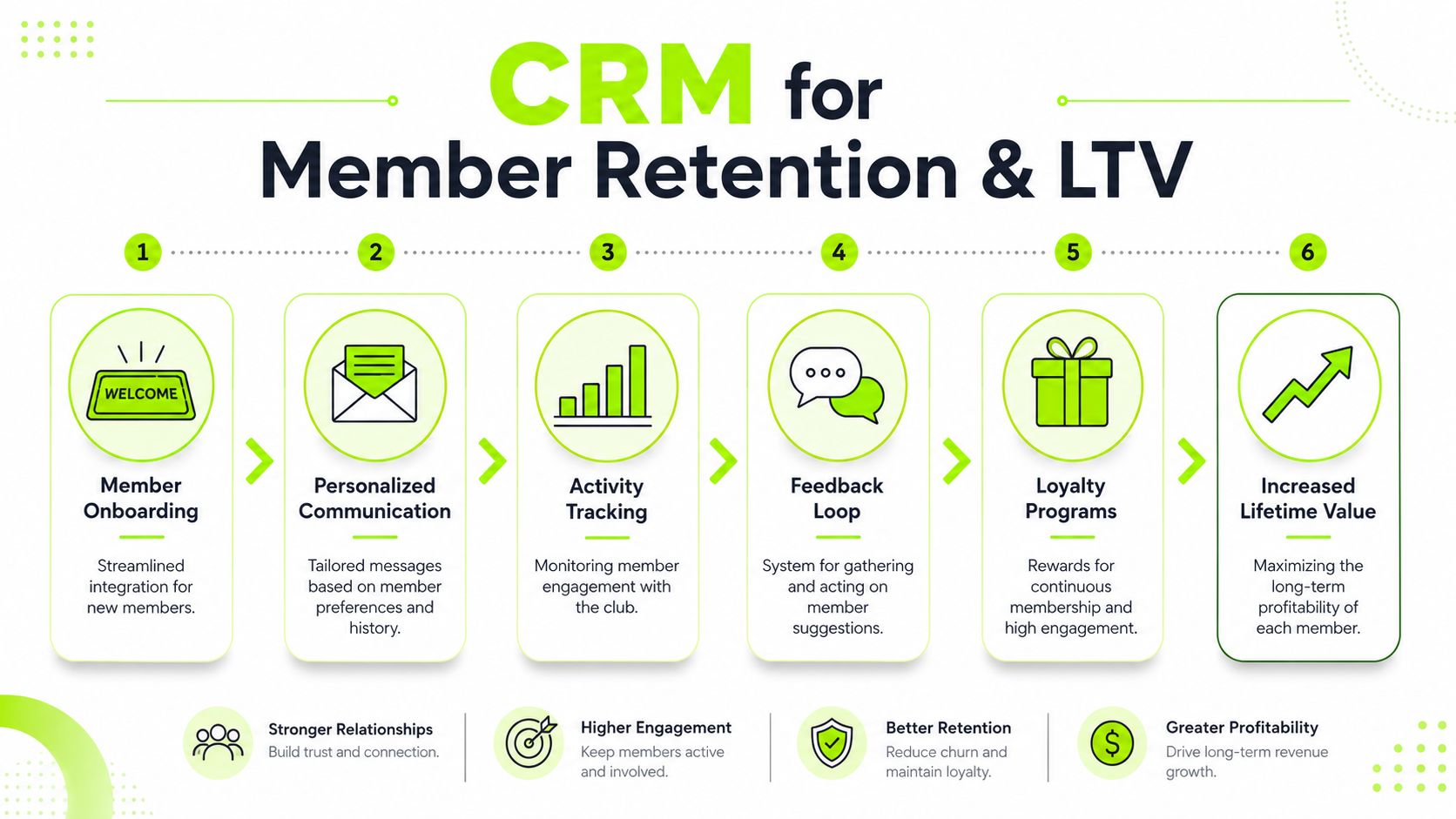
For UK clubs, the more practical benchmark is to track direct-booking share, average rate per round, and RevPAR together, then use CRM-triggered offers to move players from one-off visits into repeat play and ancillary spend, as outlined in this golf performance guidance. The strongest execution is to identify underfilled inventory and target only the relevant segment.
What a CRM should actually do
A CRM is useful when it changes behaviour, not when it's limited to storing contact details.
Here's what that looks like in practice:
- New member onboarding: send the right welcome sequence, explain how to book, introduce competitions or socials, and prompt early use of the club.
- Lapsed activity triggers: if someone hasn't played or booked for a while, prompt a relevant nudge.
- Ancillary offers by behaviour: coaching, retail, dining, guest rounds, or event invitations based on actual usage.
- Renewal risk signals: spot members who are disengaging before renewal becomes a problem.
The logic isn't complicated. People stay when they use the club, feel known, and receive relevant communication at the right time.
Borrow onboarding discipline from outside golf
Other sectors are often better at this than clubs. Good onboarding is structured, staged, and intentional. Superdocu's onboarding strategies are useful here because they show the wider principle clearly: early experience shapes long-term engagement.
That applies directly to golf clubs. If the first weeks feel organised, the member settles faster. If they feel unsure how to book, who to contact, or where they fit, retention becomes harder.
The sale is not the finish line. It's the start of the member experience that determines whether future revenue compounds or stalls.
A simple CRM sequence most clubs can use
For a new member
Send a warm welcome, introduce the next practical step, and prompt a first booking or visit. Then follow with helpful touchpoints, not noise.
For a one-off visitor
Thank them, invite them back, and tailor the next message around the time they played, the booking type, or the interest they showed.
For a quiet existing member
If they haven't been active, don't blast them with a generic newsletter. Send something specific and useful.
That's where clubs often need better systems. A proper golf club CRM software setup gives the team one place to see activity, schedule follow-up, and automate the obvious steps without losing the personal feel.
Retention is where predictability comes from
New enquiries matter, but predictable revenue comes from repeat behaviour. Members renew. Visitors come back. Event organisers rebook. Golfers book direct instead of through a third party. Those outcomes don't happen because the club is busy. They happen because someone built a system that makes repeat action more likely.
Your 90-Day Plan for Predictable Growth
Most clubs don't need a grand transformation project. They need a sensible sequence. Trying to fix pricing, memberships, CRM, events, and winter revenue all at once usually creates confusion and stalls progress.
A better route is to build in phases over ninety days. That's enough time to diagnose the leaks, put structure around enquiries, and start improving retention and utilisation without overwhelming the team.
Days 1 to 30: diagnose and stabilise
Start by getting honest about the current picture.
- Map every enquiry source: website forms, phone calls, walk-ins, referrals, visitor bookings, social media messages.
- Audit revenue by stream: memberships, green fees, food and beverage, retail, events, coaching.
- Assign ownership: every live enquiry needs a named person responsible for next action.
- Set a follow-up standard: who responds, how, and what happens if there is no reply.
This first phase is about visibility. You're not trying to perfect the system yet. You're making sure revenue opportunities stop disappearing into inboxes and notebooks.
Days 31 to 60: build the conversion engine
Once the club can see demand, put process around it.
Use this phase to create a repeatable enquiry journey. That includes acknowledgement messages, clear lead stages, visit or call booking prompts, and a follow-up sequence for prospects who don't respond straight away.
A simple working checklist helps:
| Area | Minimum standard by day 60 |
|---|---|
| Enquiry capture | All leads enter one trackable system |
| Response | Every enquiry gets an immediate acknowledgement |
| Follow-up | A defined sequence exists for non-responders |
| Visibility | Team can see lead status and ownership |
| Reporting | Management can review pipeline regularly |
This is usually the point where clubs realise their issue wasn't “not enough leads”. It was inconsistent handling.
Days 61 to 90: optimise revenue and smooth seasonality
Only once the basics are working should you move into optimisation.
Review tee sheet demand, protect premium slots, and test pricing carefully where demand is already strong. Build retention triggers for new members and quieter existing ones. Then look at year-round revenue options that suit the local market rather than defaulting to generic diversification ideas.
That matters because industry coverage on year-round golf revenue points to growing interest in indoor simulators and flexible memberships as ways to smooth seasonal swings for UK facilities. The right choice depends on local demand, available space, and operational appetite, but the principle is sound: clubs need revenue lines that aren't entirely dependent on perfect weather and peak-season golf.
Don't add winter products just because they sound modern. Add them if the club can run them well, market them clearly, and measure whether they generate repeat spend.
The discipline that makes the plan work
The clubs that make progress over ninety days usually stick to three habits:
- Weekly review: live enquiries, follow-up status, booked visits, and stalled opportunities.
- Tight accountability: one owner per task, not shared responsibility across everyone.
- Measured decisions: pricing, membership changes, and new offers based on usage and response, not hunches.
If you want to increase golf club revenue, that's the shift to make. Stop chasing isolated wins. Build a system that turns demand into tracked opportunities, opportunities into conversions, and conversions into repeat revenue.
If your club wants a clearer way to turn enquiries into memberships, bookings, and repeat spend, GolfRep helps UK golf clubs build structured pipelines with lead tracking, follow-up systems, and CRM-led nurture. The aim isn't more noise. It's a revenue process your team can run consistently.
Ready to tap into our proven growth system?