Playsport Golf Range: A Model for Modern Club Growth
In the first year after implementing Toptracer technology, Playsport Golf Range's revenue grew by 90%, from £320,000 to over £595,000, while balls hit increased by 52% to 6.8 million according to the Toptracer Playsport case study.
That's the number most club managers should pay attention to first. Not the bays. Not the screens. Not the novelty. The commercial result.
Playsport Golf Range is a useful case study because it shows what happens when a facility gives golfers a clear reason to visit, stay longer, and come back. But there's a second lesson that matters just as much. Once a club creates that level of interest, the next problem appears quickly. Can the business see, respond to, and convert the demand it generates?
That's where many clubs fall short. They invest in the front-end experience, then rely on manual follow-up, shared inboxes, patchy call handling, and staff memory to do the rest. That approach doesn't scale. It leaks revenue.
The Growth Story Inspired by Playsport
Playsport didn't grow because it looked modern. It grew because the offer became more compelling to the golfer, and the customer experience became easier to repeat.
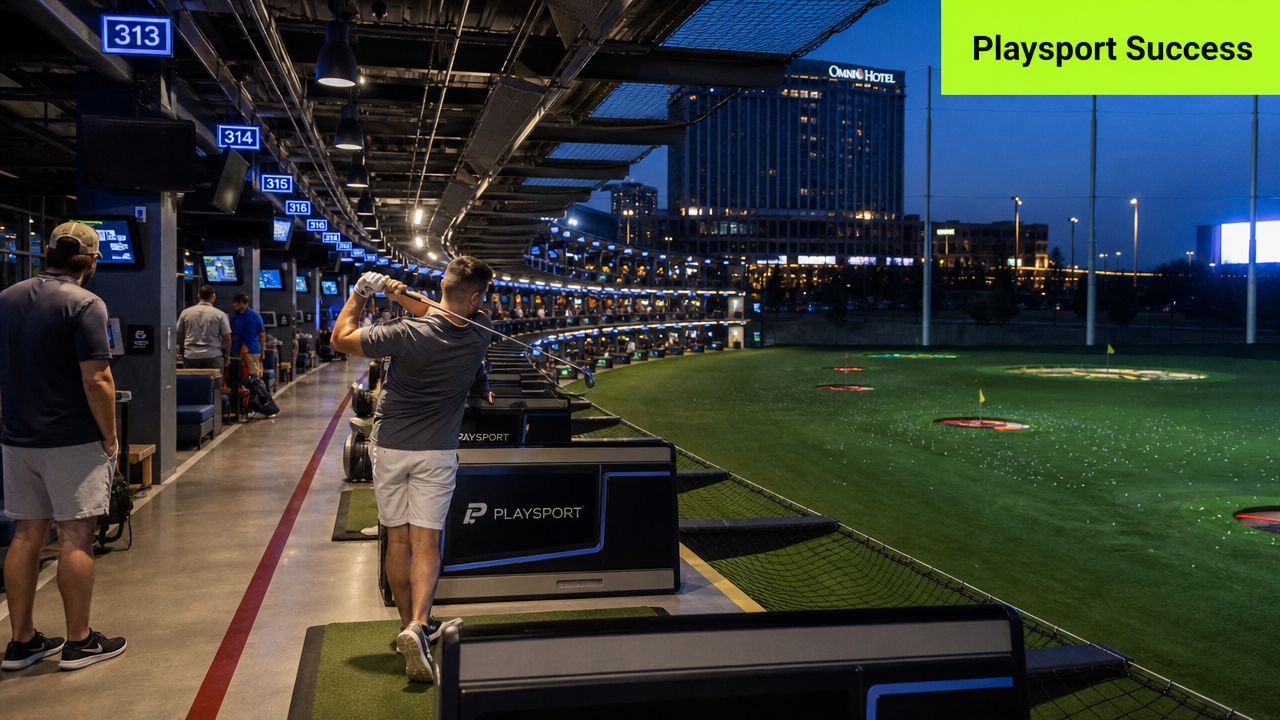
The headline figure matters because it ties usage directly to revenue. More golfers hit more balls, and the business produced more income. That sounds obvious, but plenty of golf clubs still treat range investment as a side project rather than a core growth channel. Playsport shows that a driving range can be a serious commercial asset when it's designed around engagement instead of basic ball dispensing.
Why this case matters to more than range operators
Most articles about Playsport Golf Range stop at description. They mention the facility, the scale, and the technology. Those things matter, but the more important takeaway is strategic. A modern range doesn't just create activity. It creates attention, repeat visits, and new opportunities to move casual users into coaching, club engagement, and longer-term value.
That shift changes the management challenge.
If your club upgrades its range, improves its website, sharpens its social presence, or launches a better membership campaign, you won't just need more leads. You'll need a better process for handling them. That's the operational lesson hidden inside the Playsport story.
Practical rule: Attraction without follow-up is expensive. Strong facilities create demand, but systems convert it.
For clubs looking at East Kilbride and asking what they can learn, the answer isn't “copy everything.” The answer is to study the model behind the momentum. A useful starting point is this closer look at Playsport East Kilbride golf, not as a consumer destination, but as a commercial example of what modern golf demand can look like.
The two-part formula clubs often miss
In practice, growth usually depends on two linked jobs:
- Create a reason to enquire: through facilities, coaching, technology, presentation, and relevance.
- Handle every enquiry properly: with speed, visibility, accountability, and follow-up.
- Track what happens next: so management knows what turned into visits, lessons, memberships, or nothing at all.
Playsport is a strong example of the first job done well. The wider industry still struggles with the second.
Inside the Playsport Model More Than a Driving Range
From a management perspective, Playsport works because it isn't a single-product venue. It combines practice, coaching, play, and retail into one golf destination.
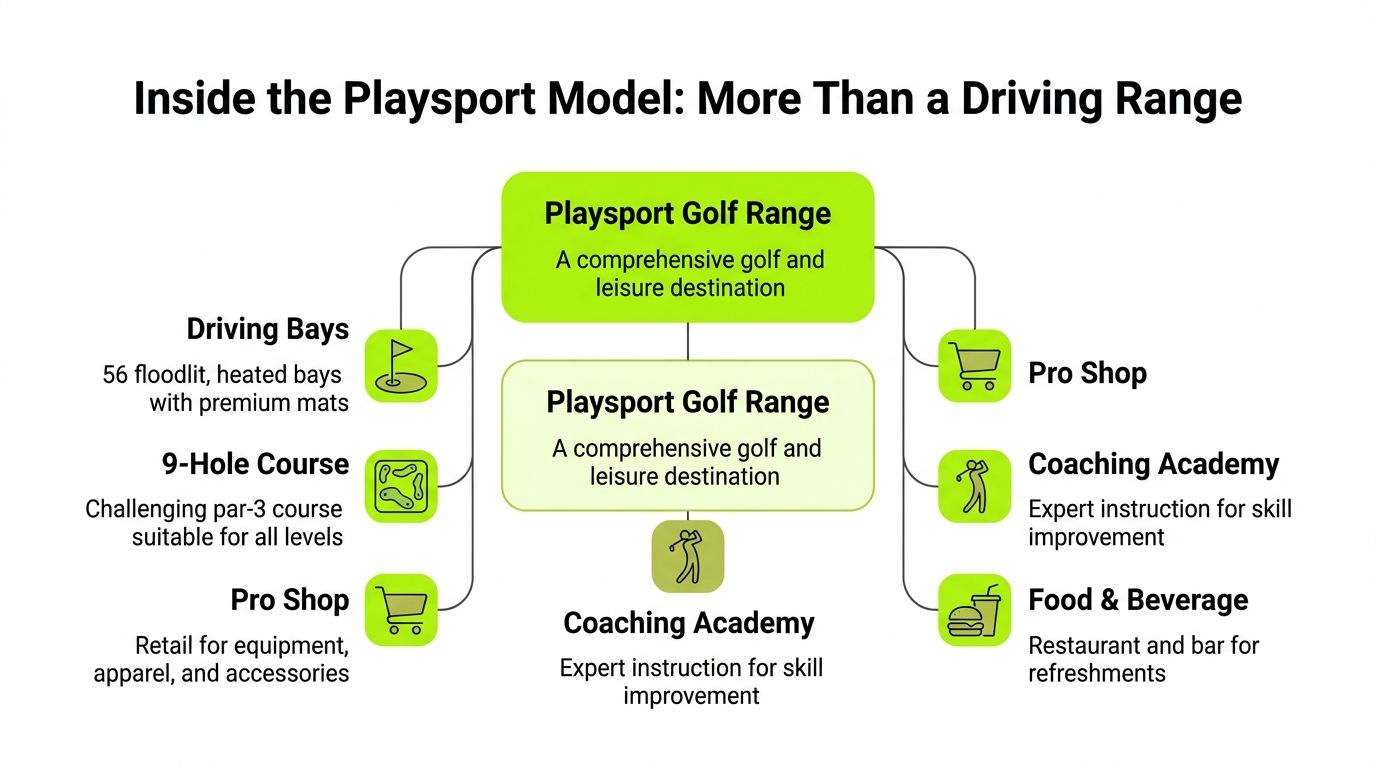
The facility includes a 56-bay driving range with Toptracer, a PGA coaching centre, and a 9-hole Heritage Links course, positioning it as one of the UK's largest and most extensive golf practice facilities, as described in this Playsport Golf listing.
That mix matters because it broadens the entry points into the business. One golfer arrives to hit balls. Another comes for tuition. Another wants a shorter on-course option. A parent may first see it as an accessible place for a beginner. An improving player may use it as a regular training base.
What a club manager should notice
When I assess a facility like Playsport Golf Range, I'm not asking whether every feature looks impressive on paper. I'm asking whether each part supports the next commercial step.
Here's what stands out.
| Asset | Why it matters operationally |
|---|---|
| 56 covered and floodlit bays | Extends usability across weather and daylight conditions, making demand more consistent |
| Toptracer-enabled range | Turns a basic practice session into a measurable experience |
| PGA coaching centre | Gives the club a natural upgrade path from casual use to paid instruction |
| 9-hole Heritage Links course | Creates a bridge between range users and on-course play |
A lot of clubs own pieces of this model, but they don't connect them well. The range runs separately. The pro runs coaching separately. Membership sits with the office. Enquiries arrive in different places and no one has a complete view of the customer.
That fragmentation is where good facilities underperform.
Integration beats isolated amenities
The lesson isn't that every club needs to build a complex destination. Most won't, and many shouldn't. The lesson is that each offer should feed the next.
Consider the difference:
- A golfer visits the range once, enjoys it, and leaves.
- A golfer visits the range, gets interested in their numbers, books a coaching session, returns for another session, then explores membership.
Same customer. Very different outcome.
A facility becomes more valuable when it creates a journey, not just a transaction.
That's why Playsport is more than a large range. It's a structured environment with multiple reasons to return. The bays bring traffic. The coaching centre adds progression. The short-format course lowers the barrier for players who want on-course experience without committing to a full round.
What doesn't work
Clubs often misread this and focus only on physical upgrades. They add mats, repaint bays, improve signage, or install one piece of technology, then assume the commercial model will take care of itself.
It usually doesn't.
The missing ingredient is operational design. Who follows up with the golfer who asks about lessons? Where is that enquiry stored? Can anyone see whether they came back? Does the club know which offer generates the best next step?
Without those answers, even a strong venue can't run at full value.
The Technology Engine Driving Unprecedented Engagement
Toptracer matters because it changes what the golfer experiences in the bay.
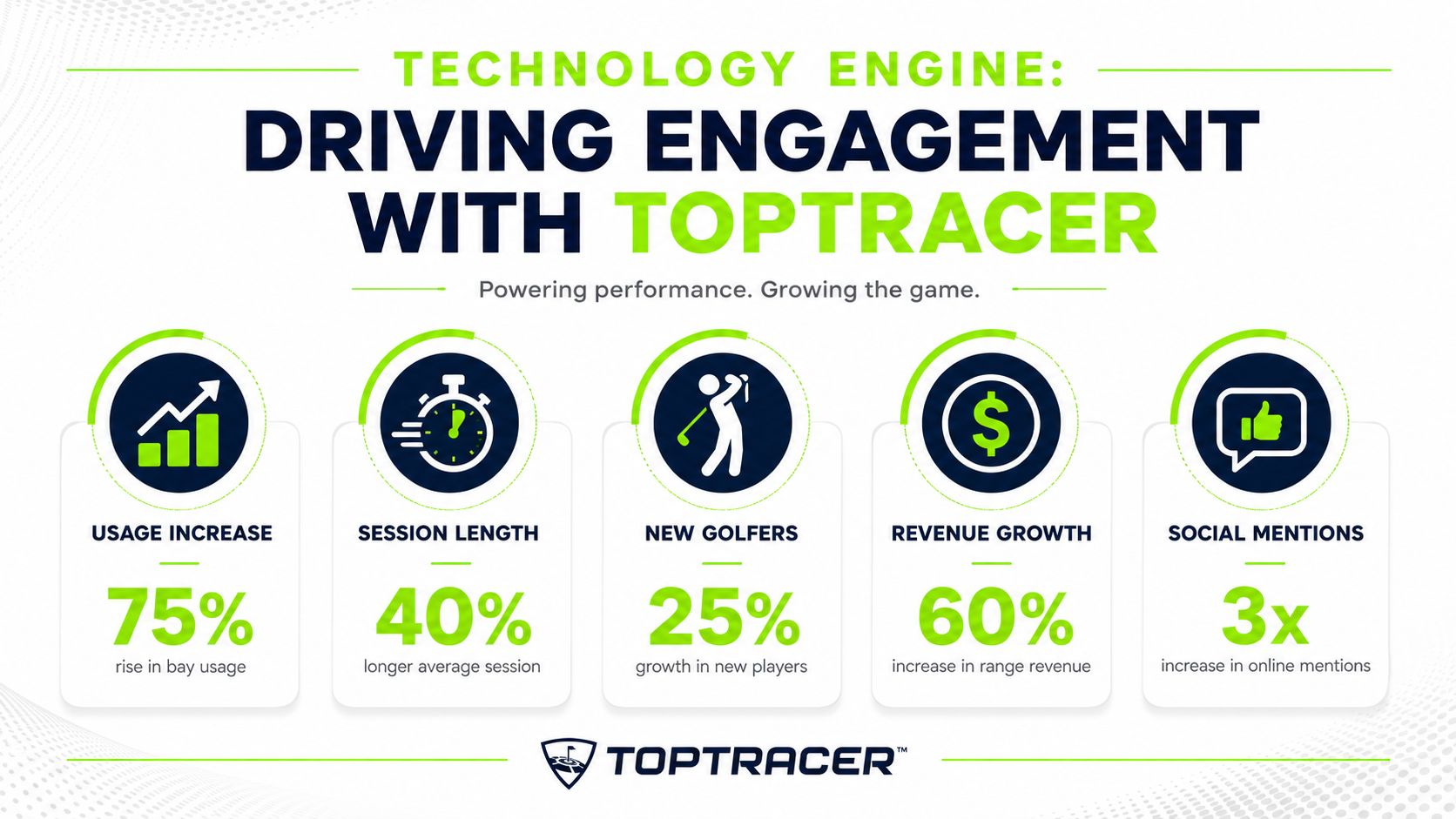
A traditional range gives the player balls, targets, and guesswork. A tracked range gives the player feedback. Distance, speed, and dispersion become visible. That creates a tighter link between effort and improvement, which is why the technology tends to produce stronger repeat behaviour.
At facilities like Playsport, that shift has clear commercial implications. According to the Playsport driving range page, technology-driven ranges see user retention increase by 35% compared to traditional ranges, and 68% of users who engage with shot tracking later book coaching or join the club.
What the technology actually changes
The true value isn't the screen itself. It's what the screen enables.
- Feedback becomes immediate: golfers can connect swing changes to outcomes in real time.
- Practice feels purposeful: players aren't just hitting balls into the dark and hoping they're improving.
- The session becomes more social: games and tracking make the range more appealing to groups and casual users.
- Coaching becomes easier to sell: the player already sees the value of data before speaking to a pro.
That final point is often underappreciated. Technology can reduce resistance to coaching because it gives the golfer a clearer picture of what needs work. The lesson is no longer abstract. It's visible.
Technology is only useful if the club operationalises it
Many clubs make a poor decision. They buy the engagement tool, then fail to build the process around it.
A golfer uses the range regularly. They enjoy the data. They ask a casual question about lessons or membership. Then the enquiry sits in an inbox, a staff member forgets to call back, or the only follow-up happens when someone has a spare moment.
That's not a technology problem. It's a systems problem.
On the ground: The best range technology creates intent. Clubs still need a process that captures that intent before it fades.
There's a wider operational lesson here too. If you're thinking about automation beyond the bay experience, this piece on how AI helps golf resort operations is worth reading because it looks at where automated handling can support service consistency when staff aren't available.
For clubs exploring the same question in a range-specific context, this guide to the digital driving range model is useful because it ties customer experience to commercial process rather than treating technology as décor.
What works and what doesn't
A few clear patterns show up repeatedly.
What works
- Technology tied to coaching pathways
- Staff who understand how to use data in conversations
- Clear prompts for booking the next step
- Simple follow-up after first use
What doesn't
- Installing technology with no conversion plan
- Treating tracked users the same as anonymous walk-ins
- Relying on memory instead of recorded lead status
- Assuming interest will still be there next week
The New Bottleneck Converting High Interest into Revenue
The industry spends a lot of time talking about lead generation. In many clubs, that isn't the main weakness.
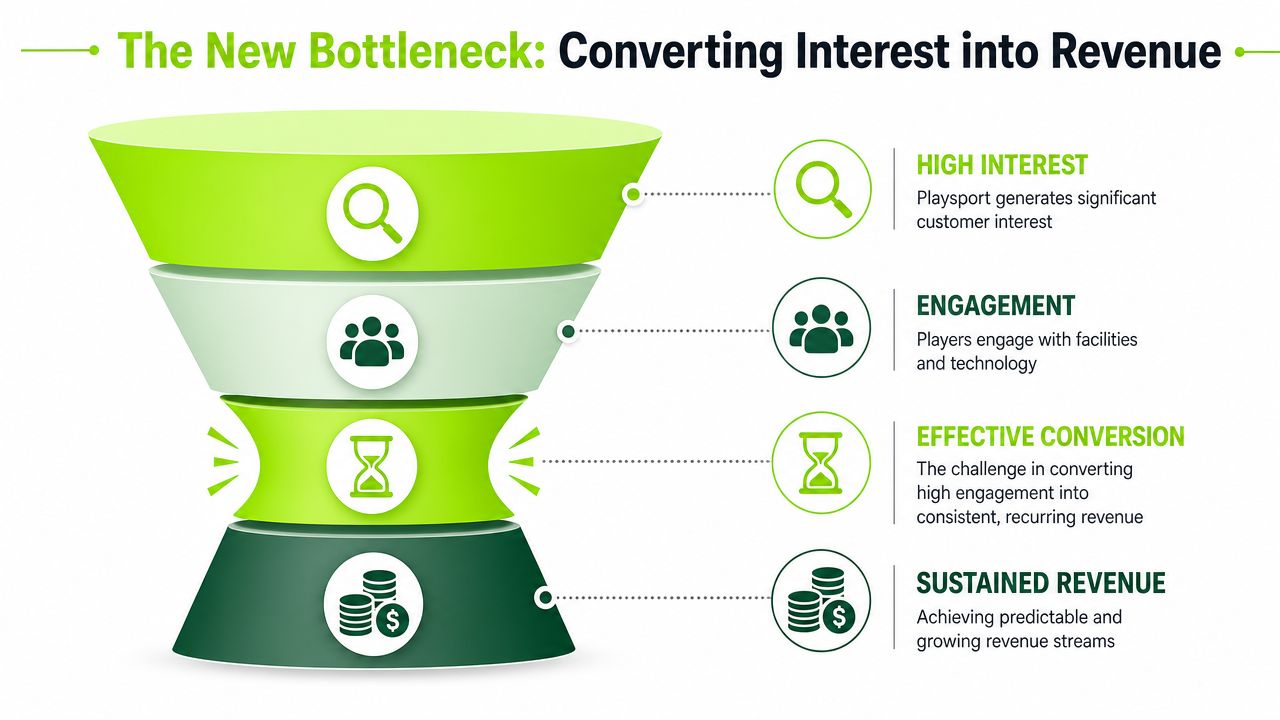
The bigger issue is what happens after someone shows interest. Across the UK golf sector, clubs lose approximately 30% of membership enquiries before a proper discussion even begins, largely because the handling is slow, inconsistent, or invisible, according to this analysis of how golf clubs lose 30% of enquiries.
That's the bottleneck. Not the advert. Not the website form. Not the social post. The handoff.
Interest is fragile
A place like Playsport Golf Range can generate curiosity quickly. Modern facilities, strong presentation, and a more engaging range experience naturally create more inbound questions. The same applies when a private members' club sharpens its offer and starts marketing properly.
But interest decays fast.
Someone enquires on a Sunday night after seeing your range, your coaching offer, or your membership page. By Monday afternoon they may have forgotten, chosen another club, or decided to do nothing. If no one can see the lead, assign the lead, and follow up properly, the enquiry was never really captured.
That's why manual handling breaks under growth. It depends too much on who is in the office, who remembered to reply, and whether anyone checks what happened next.
The signs a club has this problem
Most clubs don't describe it as lead leakage. They describe the symptoms:
- “We get enquiries, but they don't seem to go anywhere.”
- “I thought someone had already called them.”
- “The pro had that one, I think.”
- “We're busy, so replies sometimes slip.”
Those aren't small admin issues. They're revenue issues.
A useful external perspective on this comes from a resellable CRO framework that breaks conversion work into stages rather than treating it as a single act. That mindset applies well to golf because the problem is rarely one broken step. It's usually several small failures stacked together.
If a club can't see every enquiry, it can't manage growth. It can only hope staff catch up.
Why this matters more as facilities improve
Better facilities often expose weak operations. That sounds backwards, but it's true.
When demand is low, poor follow-up hides in the background. When demand rises, it becomes obvious. The club starts getting more range enquiries, more lesson interest, more visitor questions, more membership forms. Then the office gets stretched, the pro team gets interrupted, and no one has a reliable pipeline view.
That's why the Playsport example matters beyond the range itself. It shows the upside of creating strong interest. It also points to the next responsibility. Clubs need conversion infrastructure that matches the quality of the customer experience.
Systemising Success From Enquiry to Conversion
Speed changes outcomes. In golf club sales, that isn't theory. It's operational fact.
A lead contacted within one hour is five times more likely to convert than one contacted after 24 hours, yet the UK golf industry average response time is around 30 hours, according to this response time and conversion analysis.
That gap explains a lot.
Manual effort isn't the same as a system
Most clubs aren't careless. They're just relying on methods that stop working once enquiry volume becomes uneven or staff time gets tight.
Here's the usual setup:
| Manual handling | Systemised handling |
|---|---|
| Shared inbox monitored when someone remembers | All enquiries logged in one place |
| Staff rely on memory and sticky notes | Every lead has a visible status |
| Follow-up depends on office hours | Immediate acknowledgement happens automatically |
| Reporting is anecdotal | Conversion can be tracked stage by stage |
The difference isn't cosmetic. It affects whether leads get spoken to at all.
What a workable process looks like
A good club system doesn't need to feel complicated to the golfer. In fact, the best ones feel simple from the outside.
Internally, though, a few elements need to be in place:
Every enquiry lands in one visible pipeline
Website forms, phone calls, coaching requests, membership interest, and visitor questions shouldn't live in separate silos.The first response happens quickly
If staff are unavailable, the system should still acknowledge the enquiry and set expectation.Ownership is clear
One person must know who is responsible for the next action.Follow-up is scheduled, not improvised
Clubs lose leads when staff mean to chase and never quite get to it.Management can review outcomes
Without conversion tracking, clubs can't tell whether the issue is traffic, response, offer, or sales process.
Useful benchmark: If your club has to search inboxes, ask around the office, or check with the pro to find out what happened to a lead, your process is too fragile.
This is why systems beat heroic effort. Staff working harder isn't a growth strategy. It's a temporary patch.
The operational shift clubs need to make
The biggest mental change is this. Stop treating enquiry handling as administration. It's sales infrastructure.
A modern club may invest heavily in presentation, facility upgrades, and marketing campaigns. That's worthwhile. But if the lead journey from first contact to booked visit isn't structured, a good part of that investment gets wasted.
For clubs reviewing their current process, this guide on golf club enquiry conversion is a useful reference because it breaks the issue down into visible operational steps rather than vague advice.
The clubs that grow predictably don't rely on memory, goodwill, or whoever happens to be free. They build a repeatable process for responding, tracking, and following up.
Applying the Lessons A Blueprint for Your Club's Growth
The simplest lesson from Playsport Golf Range is that modern golf growth has two jobs. First, create an offer golfers want to engage with. Second, build a process that turns that engagement into revenue.
Most clubs focus almost entirely on the first. That's why they keep asking how to generate more enquiries while ignoring what happens to the ones they already get.
Start with a blunt internal audit
You don't need a large project to spot the gaps. Start by checking the basics.
- Measure your real response time: not what staff think it is, but what it is across email, web forms, and phone follow-up.
- Trace one enquiry from start to finish: who sees it first, who owns it, and whether anyone records the outcome.
- Review visibility: can management see how many leads are open, contacted, booked, lost, or ignored?
- Check handoffs: when a lead moves from office to pro or from range to membership, does the trail stay intact?
Most clubs find friction immediately. Not because the team lacks effort, but because the process was never designed properly.
Build for consistency, not best-case behaviour
A club doesn't need to look like Playsport to learn from it. It needs to think clearly about how attraction and conversion work together.
For some clubs, the next step is range modernisation. For others, it's tighter enquiry handling, better CRM discipline, or a more joined-up coaching-to-membership journey. In many cases, the fastest improvement comes from fixing the operational middle rather than chasing more top-of-funnel activity.
If you're reviewing the broader management side of club operations, tools that help Manage your sports club can be useful as part of that thinking, especially when visibility and process control are weak.
The clubs that grow steadily don't just create interest. They know what happens to every serious enquiry after it arrives.
That's the benchmark. Not whether the club feels busy. Not whether staff are trying hard. Whether the business can repeatedly turn interest into booked visits, coaching conversations, and member sign-ups.
If your club can do that, growth becomes more predictable. If it can't, even a strong facility will leave revenue on the table.
GolfRep helps golf clubs build predictable pipelines by combining lead generation with structured follow-up, CRM visibility, and automation that makes enquiry handling faster and more consistent. If you want a clearer view of where your club is losing leads and how to fix it, visit GolfRep.
Ready to tap into our proven growth system?